

ISO 20890-2:2020
(Main)Guidelines for in-service inspections for primary coolant circuit components of light water reactors — Part 2: Magnetic particle and penetrant testing
General Information
- Abstract
This document gives guidelines for pre-service inspections (PSI) and in-service inspections (ISI) of the surfaces using the magnetic particle testing and penetrant testing on components of the reactor coolant circuit of light water reactors. This document is also applicable to other components of nuclear installations. Test systems for the localisation of surface inhomogeneities and requirements for test personnel, test devices, test media, accessories as well as optical auxiliaries, the preparation and implementation of the test as well as the recording are defined. NOTE 1 Data concerning the test section, test extent, inspection period, inspection interval and evaluation of indications are defined in the applicable national nuclear safety standards. NOTE 2 In general, this document is in accordance with ISO 3452 and ISO 9934 series. This document provides details to be considered in the standard test procedure (see Annex A).
- Status
- Published
- Publication Date
- 11-Jun-2020
- Technical Committee
- ISO/TC 85/SC 6 - Reactor technology
- Current Stage
- 9093 - International Standard confirmed
- Start Date
- 16-Sep-2025
- Completion Date
- 29-Aug-2026
Buy Documents

ISO 20890-2:2020 - Guidelines for in-service inspections for primary coolant circuit components of light water reactors
ISO 20890-2:2020 - Guidelines for in-service inspections for primary coolant circuit components of light water reactors — Part 2: Magnetic particle and penetrant testing/12/2020
Overview
ISO 20890-2:2020 provides guidance for pre‑service inspections (PSI) and in‑service inspections (ISI) of surface defects on primary coolant circuit components of light water reactors using magnetic particle testing (MPT) and penetrant testing (PT). The standard sets out requirements for test personnel, test systems, test media, accessories and optical aids, as well as preparation, execution and recording of inspections. It is also applicable to other components of nuclear installations. Annex A contains a model standard test procedure.
Keywords: ISO 20890-2:2020, magnetic particle testing, penetrant testing, in‑service inspections, PSI, ISI, light water reactors, reactor coolant circuit
Key Topics and Requirements
- Scope and applicability: Surface localization of inhomogeneities on reactor coolant circuit components; aligns with ISO 3452 (penetrant) and ISO 9934 (magnetic particle) series.
- Test personnel: Minimum qualification for both test inspector and test supervisor is Level 2 certification (e.g., ISO 9712 or equivalent). Annual validation of visual acuity and colour/greyscale discrimination is required.
- Test media and equipment: Test media must be supplier‑certified and released by the licensee/operator. Equipment and media selection follow referenced ISO parts for MPT and PT.
- Surface preparation: Surfaces must be accessible, clean and free of interfering contaminants; thin non‑magnetic coatings up to 50 µm can be acceptable if adherent and continuous.
- Testing workflow: Defined phases include preparation, inspection performance, evaluation of indications, and final measures. Specific test procedures and recording requirements are provided; data storage must support identification, prevent accidental overwrite and ensure long‑term suitability.
- Limitations and national rules: Inspection extent, intervals and acceptance criteria are to follow applicable national nuclear safety regulations; this document provides method details rather than national interval/evaluation rules.
Applications and Users
ISO 20890-2 is intended for organizations and professionals involved in nuclear plant inspection and maintenance:
- NDT engineers and inspectors performing MPT and PT on reactor coolant circuit components
- Nuclear power plant operators and licensees responsible for PSI/ISI programs
- Inspection contractors, quality assurance teams and regulators
- Designers and maintenance planners specifying inspection procedures for welded joints, piping, valves and pressure boundary components
Practical value: helps harmonize inspection methods, ensure qualified personnel, document traceable test records, and support safe operation through consistent surface defect detection.
Related Standards
Relevant referenced standards include:
- ISO 3452 series (penetrant testing)
- ISO 9934 series (magnetic particle testing)
- ISO 9712 (NDT personnel qualification/certification)
- ISO 3059, ISO 12706, ISO 12707, ISO 8596, ISO 18490
For inspection intervals, acceptance criteria and regulatory compliance consult national nuclear safety standards and the licensing authority.
Buy Documents
ISO 20890-2:2020 - Guidelines for in-service inspections for primary coolant circuit components of light water reactors
ISO 20890-2:2020 - Guidelines for in-service inspections for primary coolant circuit components of light water reactors — Part 2: Magnetic particle and penetrant testing/12/2020
Get Certified
Connect with accredited certification bodies for this standard

DNV
DNV is an independent assurance and risk management provider.

Lloyd's Register
Lloyd's Register is a global professional services organisation specialising in engineering and technology.
DNV Energy Systems
Energy and renewable energy certification.
Sponsored listings
Frequently Asked Questions
ISO 20890-2:2020 is a standard published by the International Organization for Standardization (ISO). Its full title is "Guidelines for in-service inspections for primary coolant circuit components of light water reactors — Part 2: Magnetic particle and penetrant testing". This standard covers: This document gives guidelines for pre-service inspections (PSI) and in-service inspections (ISI) of the surfaces using the magnetic particle testing and penetrant testing on components of the reactor coolant circuit of light water reactors. This document is also applicable to other components of nuclear installations. Test systems for the localisation of surface inhomogeneities and requirements for test personnel, test devices, test media, accessories as well as optical auxiliaries, the preparation and implementation of the test as well as the recording are defined. NOTE 1 Data concerning the test section, test extent, inspection period, inspection interval and evaluation of indications are defined in the applicable national nuclear safety standards. NOTE 2 In general, this document is in accordance with ISO 3452 and ISO 9934 series. This document provides details to be considered in the standard test procedure (see Annex A).
This document gives guidelines for pre-service inspections (PSI) and in-service inspections (ISI) of the surfaces using the magnetic particle testing and penetrant testing on components of the reactor coolant circuit of light water reactors. This document is also applicable to other components of nuclear installations. Test systems for the localisation of surface inhomogeneities and requirements for test personnel, test devices, test media, accessories as well as optical auxiliaries, the preparation and implementation of the test as well as the recording are defined. NOTE 1 Data concerning the test section, test extent, inspection period, inspection interval and evaluation of indications are defined in the applicable national nuclear safety standards. NOTE 2 In general, this document is in accordance with ISO 3452 and ISO 9934 series. This document provides details to be considered in the standard test procedure (see Annex A).
ISO 20890-2:2020 is classified under the following ICS (International Classification for Standards) categories: 27.120.10 - Reactor engineering. The ICS classification helps identify the subject area and facilitates finding related standards.
ISO 20890-2:2020 is available in PDF format for immediate download after purchase. The document can be added to your cart and obtained through the secure checkout process. Digital delivery ensures instant access to the complete standard document.
Standards Content (Sample)
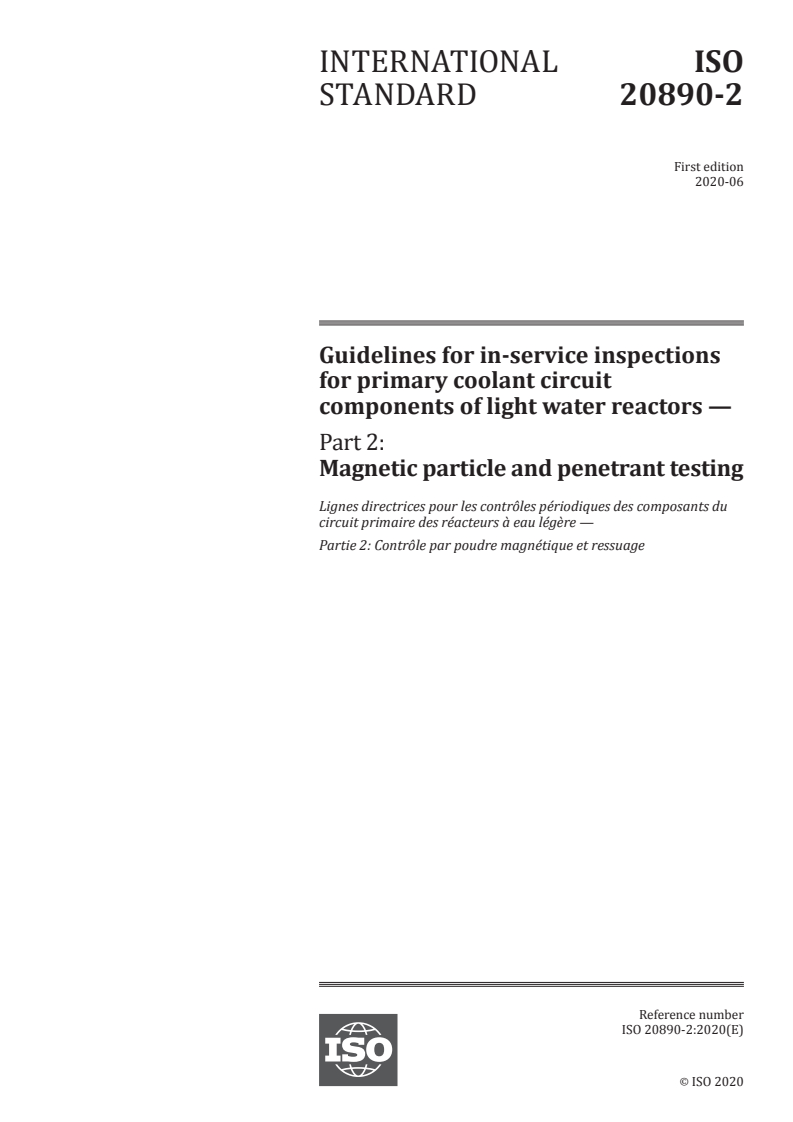
INTERNATIONAL ISO
STANDARD 20890-2
First edition
2020-06
Guidelines for in-service inspections
for primary coolant circuit
components of light water reactors —
Part 2:
Magnetic particle and penetrant testing
Lignes directrices pour les contrôles périodiques des composants du
circuit primaire des réacteurs à eau légère —
Partie 2: Contrôle par poudre magnétique et ressuage
Reference number
©
ISO 2020
© ISO 2020
All rights reserved. Unless otherwise specified, or required in the context of its implementation, no part of this publication may
be reproduced or utilized otherwise in any form or by any means, electronic or mechanical, including photocopying, or posting
on the internet or an intranet, without prior written permission. Permission can be requested from either ISO at the address
below or ISO’s member body in the country of the requester.
ISO copyright office
CP 401 • Ch. de Blandonnet 8
CH-1214 Vernier, Geneva
Phone: +41 22 749 01 11
Fax: +41 22 749 09 47
Email: copyright@iso.org
Website: www.iso.org
Published in Switzerland
ii © ISO 2020 – All rights reserved
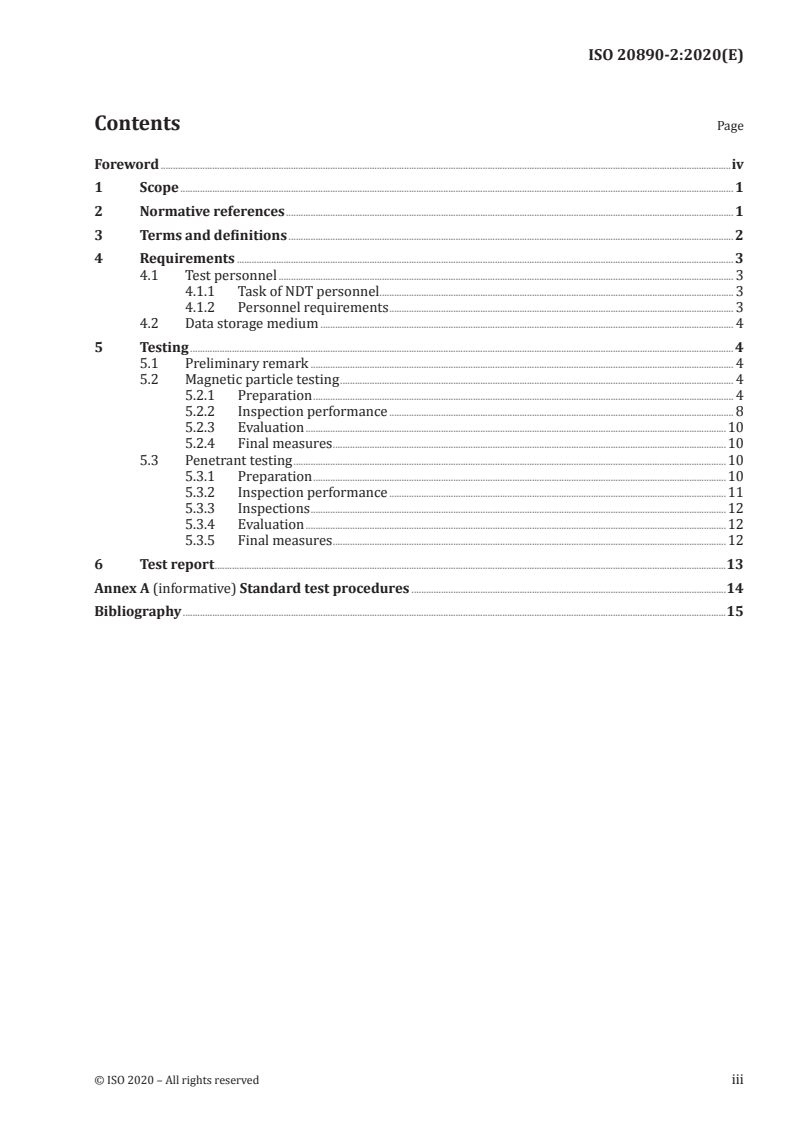
Contents Page
Foreword .iv
1 Scope . 1
2 Normative references . 1
3 Terms and definitions . 2
4 Requirements . 3
4.1 Test personnel . 3
4.1.1 Task of NDT personnel . . 3
4.1.2 Personnel requirements . 3
4.2 Data storage medium . 4
5 Testing . 4
5.1 Preliminary remark . 4
5.2 Magnetic particle testing . 4
5.2.1 Preparation . 4
5.2.2 Inspection performance . 8
5.2.3 Evaluation .10
5.2.4 Final measures .10
5.3 Penetrant testing .10
5.3.1 Preparation .10
5.3.2 Inspection performance .11
5.3.3 Inspections .12
5.3.4 Evaluation .12
5.3.5 Final measures .12
6 Test report .13
Annex A (informative) Standard test procedures .14
Bibliography .15
Foreword
ISO (the International Organization for Standardization) is a worldwide federation of national standards
bodies (ISO member bodies). The work of preparing International Standards is normally carried out
through ISO technical committees. Each member body interested in a subject for which a technical
committee has been established has the right to be represented on that committee. International
organizations, governmental and non-governmental, in liaison with ISO, also take part in the work.
ISO collaborates closely with the International Electrotechnical Commission (IEC) on all matters of
electrotechnical standardization.
The procedures used to develop this document and those intended for its further maintenance are
described in the ISO/IEC Directives, Part 1. In particular the different approval criteria needed for the
different types of ISO documents should be noted. This document was drafted in accordance with the
editorial rules of the ISO/IEC Directives, Part 2 (see www .iso .org/ directives).
Attention is drawn to the possibility that some of the elements of this document may be the subject of
patent rights. ISO shall not be held responsible for identifying any or all such patent rights. Details of
any patent rights identified during the development of the document will be in the Introduction and/or
on the ISO list of patent declarations received (see www .iso .org/ patents).
Any trade name used in this document is information given for the convenience of users and does not
constitute an endorsement.
For an explanation on the voluntary nature of standards, the meaning of ISO specific terms and
expressions related to conformity assessment, as well as information about ISO's adherence to the
World Trade Organization (WTO) principles in the Technical Barriers to Trade (TBT) see the following
URL: www .iso .org/ iso/ foreword .html.
This document was prepared by ISO/TC 85, Nuclear energy, nuclear technologies, and radiological
protection, Subcommittee SC 6, Reactor technology.
A list of all parts in the ISO 20890 series can be found on the ISO website.
Any feedback or questions on this document should be directed to the user’s national standards body. A
complete listing of these bodies can be found at www .iso .org/ members .html.
iv © ISO 2020 – All rights reserved
INTERNATIONAL STANDARD ISO 20890-2:2020(E)
Guidelines for in-service inspections for primary coolant
circuit components of light water reactors —
Part 2:
Magnetic particle and penetrant testing
1 Scope
This document gives guidelines for pre-service inspections (PSI) and in-service inspections (ISI) of
the surfaces using the magnetic particle testing and penetrant testing on components of the reactor
coolant circuit of light water reactors. This document is also applicable to other components of nuclear
installations.
Test systems for the localisation of surface inhomogeneities and requirements for test personnel, test
devices, test media, accessories as well as optical auxiliaries, the preparation and implementation of the
test as well as the recording are defined.
NOTE 1 Data concerning the test section, test extent, inspection period, inspection interval and evaluation of
indications are defined in the applicable national nuclear safety standards.
NOTE 2 In general, this document is in accordance with ISO 3452 and ISO 9934 series. This document provides
details to be considered in the standard test procedure (see Annex A).
2 Normative references
The following documents are referred to in the text in such a way that some or all of their content
constitutes requirements of this document. For dated references, only the edition cited applies. For
undated references, the latest edition of the referenced document (including any amendments) applies.
ISO 3059, Non-destructive testing — Penetrant testing and magnetic particle testing — Viewing conditions
ISO 3452-1, Non-destructive testing — Penetrant testing — Part 1: General principles
ISO 3452-2, Non-destructive testing — Penetrant testing — Part 2: Testing of penetrant materials
ISO 3452-3, Non-destructive testing — Penetrant testing — Part 3: Reference test blocks
ISO 3452-4, Non-destructive testing — Penetrant testing — Part 4: Equipment
ISO 3452-5, Non-destructive testing — Penetrant testing — Part 5: Penetrant testing at temperatures
higher than 50 °C
ISO 3452-6, Non-destructive testing — Penetrant testing — Part 6: Penetrant testing at temperatures
lower than 10 °C
ISO 8596, Ophthalmic optics — Visual acuity testing — Standard and clinical optotypes and their
presentation
ISO 9934-1, Non-destructive testing — Magnetic particle testing — Part 1: General principles
ISO 9934-2:2015, Non-destructive testing — Magnetic particle testing — Part 2: Detection media
ISO 9934-3, Non-destructive testing — Magnetic particle testing — Part 3: Equipment
ISO 9712:2012, Non-destructive testing — Qualification and certification of NDT personnel
ISO 12706, Non-destructive testing — Penetrant testing — Vocabulary
ISO 12707, Non-destructive testing — Magnetic particle testing — Vocabulary
ISO 18490, Non-destructive testing — Evaluation of vision acuity of NDT personnel
3 Terms and definitions
For the purposes of this document, the terms and definitions given in ISO 12706, ISO 12707 and the
following apply.
ISO and IEC maintain terminological databases for use in standardization at the following addresses:
— ISO Online browsing platform: available at https:// www .iso .org/ obp
— IEC Electropedia: available at http:// www .electropedia .org/
3.1
component
part of a system delimited according to structural or functional aspects, which can still implement
independent sub-functions
3.2
test section
part of the test area (3.4)
3.3
test supervisor
responsible for application of the test method and for the individual details of the test implementation
including monitoring of the activities for preparation and implementation of the test as well as analysis
of the test results
3.4
test area
defined area on the test object (3.6) over which the tests are to be conducted
[SOURCE: ISO 5577:2017, 6.2.2]
3.5
test surface
surface of the test object (3.6) to be tested
3.6
test object
part of a component (3.1) to be tested
3.7
test medium
magnetic particles suspended in liquid or in dry powder form, ready for use
[SOURCE: ISO 12707:2016, 2.17]
3.8
test medium
products consisting of cleaner, penetrants, removers and developers
[SOURCE: ISO 12706:2009, 2.19]
2 © ISO 2020 – All rights reserved
4 Requirements
4.1 Test personnel
4.1.1 Task of NDT personnel
[3]
NDT personnel have a great responsibility, not only with respect to their employers or contractors
but also under the rules of good workmanship. The NDT personnel shall be independent and free from
economic influences with regard to his test results, otherwise the results may be compromised. The
NDT personnel should be aware of the importance of his signature and the consequences of incorrect
test results for safety, health and environment. Under legal aspects, the falsification of certificates is an
offence and judged according to the national legal regulations. A tester may find himself in a conflicting
situation about his findings with his employer, the responsible authorities or legal requirements.
Finally, the NDT personnel is responsible for all interpretations of test results carrying his signature.
NDT personnel should never sign test reports beyond their certification (see Table 1).
NOTE For reasons of readability, the male form is used with personal names, however the female form is
also always intended.
4.1.2 Personnel requirements
The test personnel comprise test inspectors and the test supervisor.
Those personnel, using qualified non-destructive testing (NDT) procedures and equipment, shall be
qualified through one or any combination of the following:
— certification through a national NDT personnel certification scheme;
— theoretical and/or open trials.
Any personnel certification requirements invoking relevant national NDT personnel certification
schemes (e.g. ISO 9712) shall be validated according to Table 1. Any additional personnel training
requirements shall also be specified in the qualification dossier.
If no relevant scheme exists or if extra personnel qualification is needed, the qualification body shall
determine the additional practical and theoretical examinations needed beyond those in the national
certification scheme, include these in the qualification procedure and ensure that the NDT procedure also
includes the necessary requirements. The qualification procedure shall describe the proposed system.
The test supervisor is responsible for the application of the NDT qualified system and shall have
the knowledge required for his tasks as well as sufficient knowledge of the application options
and limitations of the test methods and have knowledge about the characteristic appearances of
operationally induced faults. Indications beyond the evaluation limit shall be evaluated by the test
supervisor, who has the requisite experience in respect to the test object, test assignment, test method
and device system.
The test inspectors shall have the skills to perform the work they are to carry out. In particular, they
shall have adequate experience in the implementation of magnetic particle testing, penetrant testing
and knowledge about the test object in respect to this.
Test personnel performing NDT and the evaluation of the results shall be qualified in accordance with
ISO 9712 or equivalent at an appropriate level in the relevant industrial sector.
Table 1 — Minimum requirements for the test personnel
Test personnel Qualification
Test inspector Certified with at least level 2 according to ISO 9712
Test supervisor Certified with at least level 2 according to ISO 9712
The test personnel shall fulfil the vision requirements of ISO 9712:2012, 7.4 or comparable.
The test personnel shall provide annual validation of their visual ability, which has been determined
by an ophthalmologist, optician or other medically recognised person. The vision requirements of
ISO 9712 shall be fulfilled. The following modifications can be used as substitutes to ISO 9712.
a) The visual acuity testing shall be conducted in accordance using standard symbols according to
ISO 8596 (Landolt rings) or ISO 18490 (E shaped character). Here a near vision acuity of 1,0 at a
test distance of 0,33 m with at least one eye, with or without optical aid shall be validated; or
b) The ability to distinguish between colours and between grey shadowing shall be validated with
colour sense test boards. The validation can typically be conducted with the help of Ishihara colour
boards as well as the "shades of grey test". In case of anomalies, the employer shall decide whether
the ability to see colours is sufficient for the test assignment.
If disorders in the adaptability are determined, these shall be considered.
4.2 Data storage medium
Data storage medium shall be designed in such way that
— they enable a labelling for identification,
— an unintentional overwrite is prevented, and
— the suitability of storage is ensured.
It shall be ensured that measuring data can be read and processed by the next in-service test.
NOTE The operating system or hardware modifications could render it necessary to transfer original data
to other data storage medium types.
5 Testing
5.1 Preliminary remark
Most of the technical requirements of this document are referencing to other ISO standards and are
accepted in applicable national nuclear safety standards. Whilst all mandatory parameter for PSI/
ISI specified in a general test procedure following to this document no system qualification has to be
performed. Otherwise application of the selected parameter shall be validated by special qualification.
[6]
NOTE The procedure for the qualification is described in ENIQ report no. 31 .
A general test procedure shall be prepared. Annex A contains the items of the standard test procedure.
The test media to be used shall be certified by supplier and monitored and released by the licensee/
operator.
5.2 Magnetic particle testing
5.2.1 Preparation
5.2.1.1 General
The specifications in accordance with ISO 9934-1, ISO 9934-2 and ISO 9934-3 shall apply in respect to
the general preparation for the magnetic particle testing.
4 © ISO 2020 – All rights reserved
5.2.1.2 Requirements for surfaces
The test surfaces shall be accessible, cleaned and free of interfering impurities (e.g. loose colour
residues, rust, dirt, grease, oil) and ground to be notch-free grinded where surface irregularities could
mask indications due to discontinuities or weld root leads to pseudo exposure.
NOTE Surfaces with a thin non-magnetic colour layer, e.g. paint, can also be tested, on condition that the
colour layer is firmly adhesive, not interrupted and the thickness of the layer does not exceed 50 µm.
The temperature of the test surface should be between 10 °C and 50 °C. The precise range of the surface
temperature in the test area is specified by the test medium to be used. The ambient temperature in the
immediate working range should not be greater
...
INTERNATIONAL ISO
STANDARD 20890-2
First edition
2020-06
Guidelines for in-service inspections
for primary coolant circuit
components of light water reactors —
Part 2:
Magnetic particle and penetrant testing
Lignes directrices pour les contrôles périodiques des composants du
circuit primaire des réacteurs à eau légère —
Partie 2: Contrôle par poudre magnétique et ressuage
Reference number
©
ISO 2020
© ISO 2020
All rights reserved. Unless otherwise specified, or required in the context of its implementation, no part of this publication may
be reproduced or utilized otherwise in any form or by any means, electronic or mechanical, including photocopying, or posting
on the internet or an intranet, without prior written permission. Permission can be requested from either ISO at the address
below or ISO’s member body in the country of the requester.
ISO copyright office
CP 401 • Ch. de Blandonnet 8
CH-1214 Vernier, Geneva
Phone: +41 22 749 01 11
Fax: +41 22 749 09 47
Email: copyright@iso.org
Website: www.iso.org
Published in Switzerland
ii © ISO 2020 – All rights reserved
Contents Page
Foreword .iv
1 Scope . 1
2 Normative references . 1
3 Terms and definitions . 2
4 Requirements . 3
4.1 Test personnel . 3
4.1.1 Task of NDT personnel . . 3
4.1.2 Personnel requirements . 3
4.2 Data storage medium . 4
5 Testing . 4
5.1 Preliminary remark . 4
5.2 Magnetic particle testing . 4
5.2.1 Preparation . 4
5.2.2 Inspection performance . 8
5.2.3 Evaluation .10
5.2.4 Final measures .10
5.3 Penetrant testing .10
5.3.1 Preparation .10
5.3.2 Inspection performance .11
5.3.3 Inspections .12
5.3.4 Evaluation .12
5.3.5 Final measures .12
6 Test report .13
Annex A (informative) Standard test procedures .14
Bibliography .15
Foreword
ISO (the International Organization for Standardization) is a worldwide federation of national standards
bodies (ISO member bodies). The work of preparing International Standards is normally carried out
through ISO technical committees. Each member body interested in a subject for which a technical
committee has been established has the right to be represented on that committee. International
organizations, governmental and non-governmental, in liaison with ISO, also take part in the work.
ISO collaborates closely with the International Electrotechnical Commission (IEC) on all matters of
electrotechnical standardization.
The procedures used to develop this document and those intended for its further maintenance are
described in the ISO/IEC Directives, Part 1. In particular the different approval criteria needed for the
different types of ISO documents should be noted. This document was drafted in accordance with the
editorial rules of the ISO/IEC Directives, Part 2 (see www .iso .org/ directives).
Attention is drawn to the possibility that some of the elements of this document may be the subject of
patent rights. ISO shall not be held responsible for identifying any or all such patent rights. Details of
any patent rights identified during the development of the document will be in the Introduction and/or
on the ISO list of patent declarations received (see www .iso .org/ patents).
Any trade name used in this document is information given for the convenience of users and does not
constitute an endorsement.
For an explanation on the voluntary nature of standards, the meaning of ISO specific terms and
expressions related to conformity assessment, as well as information about ISO's adherence to the
World Trade Organization (WTO) principles in the Technical Barriers to Trade (TBT) see the following
URL: www .iso .org/ iso/ foreword .html.
This document was prepared by ISO/TC 85, Nuclear energy, nuclear technologies, and radiological
protection, Subcommittee SC 6, Reactor technology.
A list of all parts in the ISO 20890 series can be found on the ISO website.
Any feedback or questions on this document should be directed to the user’s national standards body. A
complete listing of these bodies can be found at www .iso .org/ members .html.
iv © ISO 2020 – All rights reserved
INTERNATIONAL STANDARD ISO 20890-2:2020(E)
Guidelines for in-service inspections for primary coolant
circuit components of light water reactors —
Part 2:
Magnetic particle and penetrant testing
1 Scope
This document gives guidelines for pre-service inspections (PSI) and in-service inspections (ISI) of
the surfaces using the magnetic particle testing and penetrant testing on components of the reactor
coolant circuit of light water reactors. This document is also applicable to other components of nuclear
installations.
Test systems for the localisation of surface inhomogeneities and requirements for test personnel, test
devices, test media, accessories as well as optical auxiliaries, the preparation and implementation of the
test as well as the recording are defined.
NOTE 1 Data concerning the test section, test extent, inspection period, inspection interval and evaluation of
indications are defined in the applicable national nuclear safety standards.
NOTE 2 In general, this document is in accordance with ISO 3452 and ISO 9934 series. This document provides
details to be considered in the standard test procedure (see Annex A).
2 Normative references
The following documents are referred to in the text in such a way that some or all of their content
constitutes requirements of this document. For dated references, only the edition cited applies. For
undated references, the latest edition of the referenced document (including any amendments) applies.
ISO 3059, Non-destructive testing — Penetrant testing and magnetic particle testing — Viewing conditions
ISO 3452-1, Non-destructive testing — Penetrant testing — Part 1: General principles
ISO 3452-2, Non-destructive testing — Penetrant testing — Part 2: Testing of penetrant materials
ISO 3452-3, Non-destructive testing — Penetrant testing — Part 3: Reference test blocks
ISO 3452-4, Non-destructive testing — Penetrant testing — Part 4: Equipment
ISO 3452-5, Non-destructive testing — Penetrant testing — Part 5: Penetrant testing at temperatures
higher than 50 °C
ISO 3452-6, Non-destructive testing — Penetrant testing — Part 6: Penetrant testing at temperatures
lower than 10 °C
ISO 8596, Ophthalmic optics — Visual acuity testing — Standard and clinical optotypes and their
presentation
ISO 9934-1, Non-destructive testing — Magnetic particle testing — Part 1: General principles
ISO 9934-2:2015, Non-destructive testing — Magnetic particle testing — Part 2: Detection media
ISO 9934-3, Non-destructive testing — Magnetic particle testing — Part 3: Equipment
ISO 9712:2012, Non-destructive testing — Qualification and certification of NDT personnel
ISO 12706, Non-destructive testing — Penetrant testing — Vocabulary
ISO 12707, Non-destructive testing — Magnetic particle testing — Vocabulary
ISO 18490, Non-destructive testing — Evaluation of vision acuity of NDT personnel
3 Terms and definitions
For the purposes of this document, the terms and definitions given in ISO 12706, ISO 12707 and the
following apply.
ISO and IEC maintain terminological databases for use in standardization at the following addresses:
— ISO Online browsing platform: available at https:// www .iso .org/ obp
— IEC Electropedia: available at http:// www .electropedia .org/
3.1
component
part of a system delimited according to structural or functional aspects, which can still implement
independent sub-functions
3.2
test section
part of the test area (3.4)
3.3
test supervisor
responsible for application of the test method and for the individual details of the test implementation
including monitoring of the activities for preparation and implementation of the test as well as analysis
of the test results
3.4
test area
defined area on the test object (3.6) over which the tests are to be conducted
[SOURCE: ISO 5577:2017, 6.2.2]
3.5
test surface
surface of the test object (3.6) to be tested
3.6
test object
part of a component (3.1) to be tested
3.7
test medium
magnetic particles suspended in liquid or in dry powder form, ready for use
[SOURCE: ISO 12707:2016, 2.17]
3.8
test medium
products consisting of cleaner, penetrants, removers and developers
[SOURCE: ISO 12706:2009, 2.19]
2 © ISO 2020 – All rights reserved
4 Requirements
4.1 Test personnel
4.1.1 Task of NDT personnel
[3]
NDT personnel have a great responsibility, not only with respect to their employers or contractors
but also under the rules of good workmanship. The NDT personnel shall be independent and free from
economic influences with regard to his test results, otherwise the results may be compromised. The
NDT personnel should be aware of the importance of his signature and the consequences of incorrect
test results for safety, health and environment. Under legal aspects, the falsification of certificates is an
offence and judged according to the national legal regulations. A tester may find himself in a conflicting
situation about his findings with his employer, the responsible authorities or legal requirements.
Finally, the NDT personnel is responsible for all interpretations of test results carrying his signature.
NDT personnel should never sign test reports beyond their certification (see Table 1).
NOTE For reasons of readability, the male form is used with personal names, however the female form is
also always intended.
4.1.2 Personnel requirements
The test personnel comprise test inspectors and the test supervisor.
Those personnel, using qualified non-destructive testing (NDT) procedures and equipment, shall be
qualified through one or any combination of the following:
— certification through a national NDT personnel certification scheme;
— theoretical and/or open trials.
Any personnel certification requirements invoking relevant national NDT personnel certification
schemes (e.g. ISO 9712) shall be validated according to Table 1. Any additional personnel training
requirements shall also be specified in the qualification dossier.
If no relevant scheme exists or if extra personnel qualification is needed, the qualification body shall
determine the additional practical and theoretical examinations needed beyond those in the national
certification scheme, include these in the qualification procedure and ensure that the NDT procedure also
includes the necessary requirements. The qualification procedure shall describe the proposed system.
The test supervisor is responsible for the application of the NDT qualified system and shall have
the knowledge required for his tasks as well as sufficient knowledge of the application options
and limitations of the test methods and have knowledge about the characteristic appearances of
operationally induced faults. Indications beyond the evaluation limit shall be evaluated by the test
supervisor, who has the requisite experience in respect to the test object, test assignment, test method
and device system.
The test inspectors shall have the skills to perform the work they are to carry out. In particular, they
shall have adequate experience in the implementation of magnetic particle testing, penetrant testing
and knowledge about the test object in respect to this.
Test personnel performing NDT and the evaluation of the results shall be qualified in accordance with
ISO 9712 or equivalent at an appropriate level in the relevant industrial sector.
Table 1 — Minimum requirements for the test personnel
Test personnel Qualification
Test inspector Certified with at least level 2 according to ISO 9712
Test supervisor Certified with at least level 2 according to ISO 9712
The test personnel shall fulfil the vision requirements of ISO 9712:2012, 7.4 or comparable.
The test personnel shall provide annual validation of their visual ability, which has been determined
by an ophthalmologist, optician or other medically recognised person. The vision requirements of
ISO 9712 shall be fulfilled. The following modifications can be used as substitutes to ISO 9712.
a) The visual acuity testing shall be conducted in accordance using standard symbols according to
ISO 8596 (Landolt rings) or ISO 18490 (E shaped character). Here a near vision acuity of 1,0 at a
test distance of 0,33 m with at least one eye, with or without optical aid shall be validated; or
b) The ability to distinguish between colours and between grey shadowing shall be validated with
colour sense test boards. The validation can typically be conducted with the help of Ishihara colour
boards as well as the "shades of grey test". In case of anomalies, the employer shall decide whether
the ability to see colours is sufficient for the test assignment.
If disorders in the adaptability are determined, these shall be considered.
4.2 Data storage medium
Data storage medium shall be designed in such way that
— they enable a labelling for identification,
— an unintentional overwrite is prevented, and
— the suitability of storage is ensured.
It shall be ensured that measuring data can be read and processed by the next in-service test.
NOTE The operating system or hardware modifications could render it necessary to transfer original data
to other data storage medium types.
5 Testing
5.1 Preliminary remark
Most of the technical requirements of this document are referencing to other ISO standards and are
accepted in applicable national nuclear safety standards. Whilst all mandatory parameter for PSI/
ISI specified in a general test procedure following to this document no system qualification has to be
performed. Otherwise application of the selected parameter shall be validated by special qualification.
[6]
NOTE The procedure for the qualification is described in ENIQ report no. 31 .
A general test procedure shall be prepared. Annex A contains the items of the standard test procedure.
The test media to be used shall be certified by supplier and monitored and released by the licensee/
operator.
5.2 Magnetic particle testing
5.2.1 Preparation
5.2.1.1 General
The specifications in accordance with ISO 9934-1, ISO 9934-2 and ISO 9934-3 shall apply in respect to
the general preparation for the magnetic particle testing.
4 © ISO 2020 – All rights reserved
5.2.1.2 Requirements for surfaces
The test surfaces shall be accessible, cleaned and free of interfering impurities (e.g. loose colour
residues, rust, dirt, grease, oil) and ground to be notch-free grinded where surface irregularities could
mask indications due to discontinuities or weld root leads to pseudo exposure.
NOTE Surfaces with a thin non-magnetic colour layer, e.g. paint, can also be tested, on condition that the
colour layer is firmly adhesive, not interrupted and the thickness of the layer does not exceed 50 µm.
The temperature of the test surface should be between 10 °C and 50 °C. The precise range of the surface
temperature in the test area is specified by the test medium to be used. The ambient temperature in the
immediate working range should not be greater
...