


ISO 22904:2020
(Main)Additions for concrete
Additions for concrete
This document specifies requirements for the properties for silica fume, siliceous fly ash and ground granulated blastfurnace slag for use as a type II addition for production of concrete conforming to ISO 22965. Additions according to this document can also be used in mortars and grouts. This document applies to the silica fume which is a by-product of the smelting process used to produce silicon metal and ferro-silicon alloys. Fly ash produced with other types or higher percentages of co-combustion materials than those provided for in this document is outside the scope of this document. Ground granulated blastfurnace slag containing any added materials other than grinding aids and/or gypsum (calcium sulfate) is not within the scope of this document. It is not within the scope of this document to specify provisions for the practical application of additions in the production of concrete, mortar or grout, i.e. requirements concerning composition, mixing, placing, curing, etc. NOTE Some rules are given in ISO 22965‑2, e.g. provisions on general suitability and use of additions. Guidance on batching, control of additions content and the use of the k-value concept are also given in ISO 22965‑2.
Ajout pour béton
General Information
Overview
ISO 22904:2020 - Additions for concrete specifies requirements for three common Type II additions used in concrete production: silica fume, siliceous fly ash, and ground granulated blastfurnace slag (GGBFS). The standard sets out the properties, testing and conformity requirements these additions must meet when used in concrete that conforms to ISO 22965. Additions covered may also be used in mortars and grouts. ISO 22904:2020 clarifies what is in scope (by‑product silica fume from silicon/ferro‑silicon smelting, specific fly ashes, and GGBFS without added materials) and what is excluded (certain co‑combustion ashes, slag with added constituents, and practical application processes such as mixing or curing).
Key Topics and Technical Requirements
- Material definitions and classification: clear definitions for silica fume, fly ash and ground granulated blastfurnace slag including processing states (densified, slurry).
- Chemical requirements: compositional limits and test methods for relevant chemical constituents (references to standardized analysis methods such as ISO 29581 and ICP‑OES where applicable).
- Physical requirements: particle characteristics, fineness/surface area (e.g., BET method ISO 9277), bulk and particle density, moisture content (see normative Annex A for GGBFS moisture).
- Durability and safety: durability-related criteria, release of dangerous substances and radioactivity limits.
- Sampling, conformity and quality control: prescribed sampling procedures, conformity assessment and evaluation (informative guidance in Annex D).
- Normative test methods: several annexes provide methods (moisture content, water requirement for specific fly ash categories, soluble phosphate determination).
- Packaging, labelling and marking: requirements to ensure traceability and user information.
Note: ISO 22904 does not prescribe how to use these additions in concrete mixes (batching, placing, curing); users should consult ISO 22965‑2 for suitability, batching, k‑value concept and practical guidance.
Practical Applications and Who Uses This Standard
- Concrete producers and ready‑mix plants selecting and specifying Type II additions to achieve targeted fresh and hardened concrete performance.
- Material suppliers and processors ensuring silica fume, fly ash or GGBFS meet international quality and conformity requirements.
- Testing laboratories and QA/QC teams performing chemical and physical testing, sampling and conformity evaluation.
- Specifiers, engineers and consultants referencing ISO 22904 when writing material specifications for durable, sustainable concrete (including use in mortars and grouts).
Related Standards
- ISO 22965‑2 (concrete constituent specification and use)
- ISO 9277 (BET surface area), ISO 29581 (chemical analysis), ISO 11885 (ICP‑OES)
- Relevant EN standards cited in the document for cement and fly ash test methods
Keywords: ISO 22904:2020, additions for concrete, silica fume standard, fly ash specification, ground granulated blastfurnace slag, GGBFS, Type II addition, ISO 22965.
Standards Content (Sample)
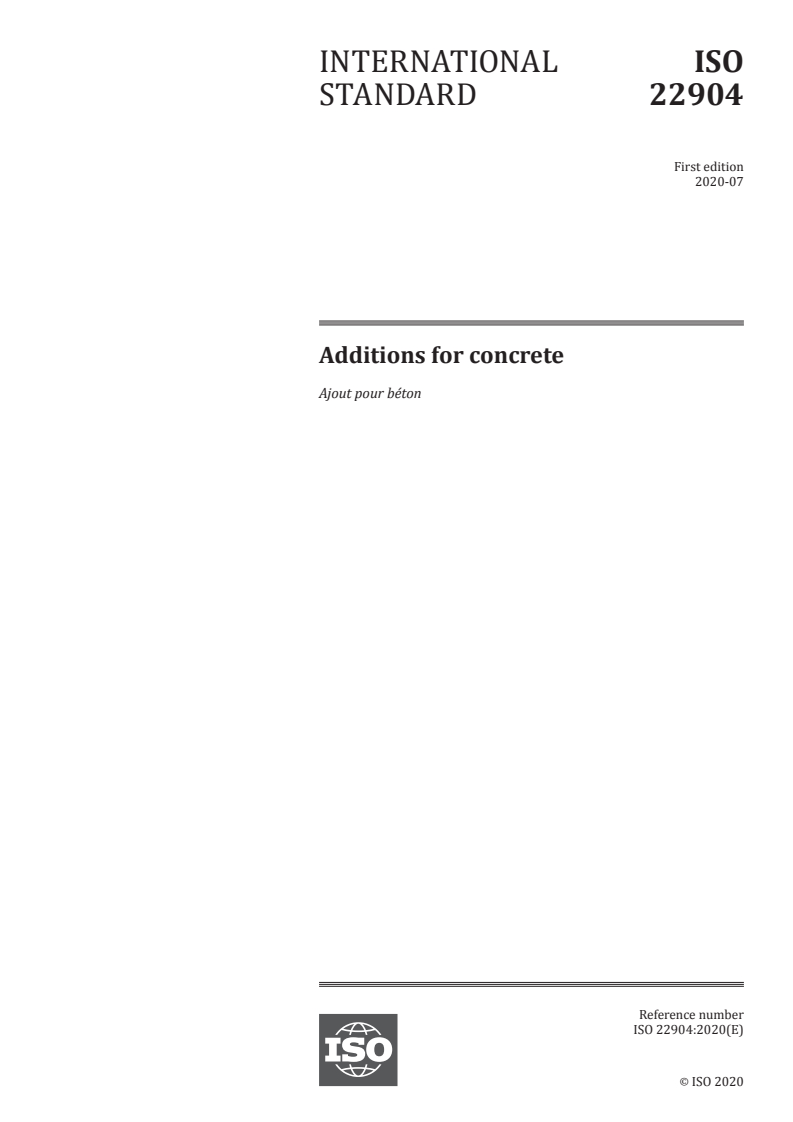
INTERNATIONAL ISO
STANDARD 22904
First edition
2020-07
Additions for concrete
Ajout pour béton
Reference number
©
ISO 2020
© ISO 2020
All rights reserved. Unless otherwise specified, or required in the context of its implementation, no part of this publication may
be reproduced or utilized otherwise in any form or by any means, electronic or mechanical, including photocopying, or posting
on the internet or an intranet, without prior written permission. Permission can be requested from either ISO at the address
below or ISO’s member body in the country of the requester.
ISO copyright office
CP 401 • Ch. de Blandonnet 8
CH-1214 Vernier, Geneva
Phone: +41 22 749 01 11
Email: copyright@iso.org
Website: www.iso.org
Published in Switzerland
ii © ISO 2020 – All rights reserved
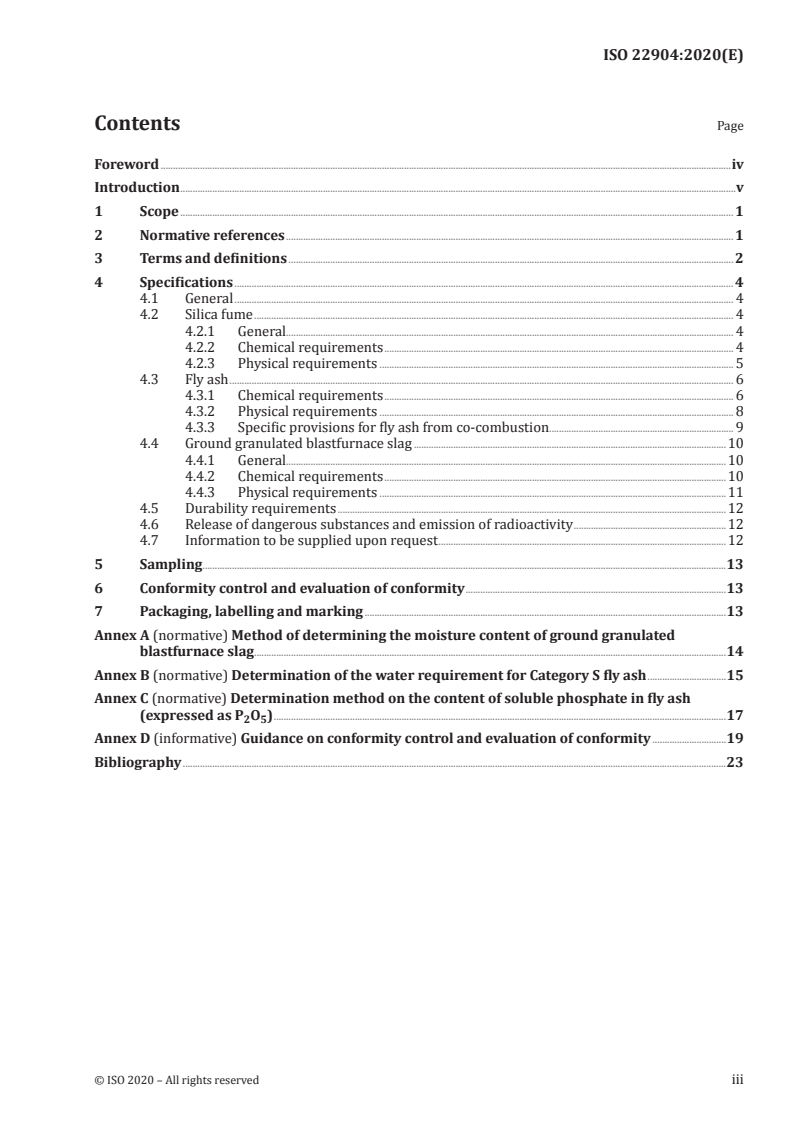
Contents Page
Foreword .iv
Introduction .v
1 Scope . 1
2 Normative references . 1
3 Terms and definitions . 2
4 Specifications . 4
4.1 General . 4
4.2 Silica fume . 4
4.2.1 General. 4
4.2.2 Chemical requirements . 4
4.2.3 Physical requirements . 5
4.3 Fly ash . 6
4.3.1 Chemical requirements . 6
4.3.2 Physical requirements . 8
4.3.3 Specific provisions for fly ash from co-combustion. 9
4.4 Ground granulated blastfurnace slag .10
4.4.1 General.10
4.4.2 Chemical requirements .10
4.4.3 Physical requirements .11
4.5 Durability requirements .12
4.6 Release of dangerous substances and emission of radioactivity .12
4.7 Information to be supplied upon request .12
5 Sampling .13
6 Conformity control and evaluation of conformity .13
7 Packaging, labelling and marking .13
Annex A (normative) Method of determining the moisture content of ground granulated
blastfurnace slag.14
Annex B (normative) Determination of the water requirement for Category S fly ash .15
Annex C (normative) Determination method on the content of soluble phosphate in fly ash
(expressed as P O ) .17
2 5
Annex D (informative) Guidance on conformity control and evaluation of conformity .19
Bibliography .23
Foreword
ISO (the International Organization for Standardization) is a worldwide federation of national standards
bodies (ISO member bodies). The work of preparing International Standards is normally carried out
through ISO technical committees. Each member body interested in a subject for which a technical
committee has been established has the right to be represented on that committee. International
organizations, governmental and non-governmental, in liaison with ISO, also take part in the work.
ISO collaborates closely with the International Electrotechnical Commission (IEC) on all matters of
electrotechnical standardization.
The procedures used to develop this document and those intended for its further maintenance are
described in the ISO/IEC Directives, Part 1. In particular, the different approval criteria needed for the
different types of ISO documents should be noted. This document was drafted in accordance with the
editorial rules of the ISO/IEC Directives, Part 2 (see www .iso .org/ directives).
Attention is drawn to the possibility that some of the elements of this document may be the subject of
patent rights. ISO shall not be held responsible for identifying any or all such patent rights. Details of
any patent rights identified during the development of the document will be in the Introduction and/or
on the ISO list of patent declarations received (see www .iso .org/ patents).
Any trade name used in this document is information given for the convenience of users and does not
constitute an endorsement.
For an explanation of the voluntary nature of standards, the meaning of ISO specific terms and
expressions related to conformity assessment, as well as information about ISO's adherence to the
World Trade Organization (WTO) principles in the Technical Barriers to Trade (TBT) see www .iso .org/
iso/ foreword .html.
This document was prepared by Technical Committee ISO/TC 71, Concrete, reinforced concrete and pre-
stressed concrete, Subcommittee SC 3, Concrete production and execution of concrete structures.
Any feedback or questions on this document should be directed to the user’s national standards body. A
complete listing of these bodies can be found at www .iso .org/ members .html.
iv © ISO 2020 – All rights reserved
Introduction
–6
Silica fume consists of mainly spherical particles of amorphous silicon dioxide smaller than 10 m
and is highly pozzolanic. It is collected by filters as a by-product of the smelting process to produce
silicon metal and ferro-silicon alloys. It can be supplied as collected from the filters (undensified),
after treatment to increase its bulk density (densified), or as a slurry. Silica fume from more than one
furnace, filter or intermediate storage silo will normally be blended in the production plant.
Many years of research and practical experience have demonstrated that silica fume which satisfies the
requirements in this document has highly pozzolanic properties and can be used to produce concrete
with improved properties in both the fresh and hardened states. Silica fume is normally used in
combination with a plasticizer and/or superplasticizer.
The use of coal for electricity production results in the generation of large quantities of fly ash. Different
types of coal and the type of boiler used in this process produce different fly ashes, such as siliceous,
silico-calcareous, or calcareous fly ashes with pozzolanic and/or latent hydraulic properties. All these
types of fly ash are used in concrete production in some countries, based on national experience and
tradition.
Before use, fly ash can be subject to processing, for example by classification, selection, sieving, drying,
blending, grinding or carbon reduction, to optimize its fineness, reduce its water demand or to improve
other properties. Such processed fly ashes can conform to this document to which reference is made in
such a case. If they are out of the scope of this document, their suitability for use as Type II additions in
concrete according to ISO 22965-2 can also be established from national standards or provisions valid
in the place of use of the concrete and which refer specifically to the use of the addition in concrete
conforming to ISO 22965-2.
When using fly ashes conforming to this document, it should be noted that, apart from the effect from
the pozzolanicity of the fly ash, certain properties of fresh and hardened concrete can be affected.
Where relevant, such effects need to be considered in concrete mix design (see ISO 22965-2).
Blast-furnace slag is classified into two types, air-cooled blast-furnace slag and granulated blast-
furnace slag, according to the cooling process after the molten slag of approximately 1 500 °C is
removed from the furnace. Granulated slag is made by rapidly chilling molten slag, such as by water jet,
into a granulated glassy material, which is used for ground granulated blast-furnace slag, a material for
slag cement. The amorphous glassy granulated slag has hydraulicity. When finely ground into ground
granulated blast-furnace slag, it also demonstrates hardening and strength-developing properties
(latent hydraulicity), as the slag itself undergoes hydration, similarly to cement, in the co-presence of
cement (an alkaline stimulant) and water.
INTERNATIONAL STANDARD ISO 22904:2020(E)
Additions for concrete
1 Scope
This document specifies requirements for the properties for silica fume, siliceous fly ash and ground
granulated blastfurnace slag for use as a type II addition for production of concrete conforming to
ISO 22965. Additions according to this document can also be used in mortars and grouts.
This document applies to the silica fume which is a by-product of the smelting process used to produce
silicon metal and ferro-silicon alloys.
Fly ash produced with other types or higher percentages of co-combustion materials than those
provided for in this document is outside the scope of this document.
Ground granulated blastfurnace slag containing any added materials other than grinding aids and/or
gypsum (calcium sulfate) is not within the scope of this document.
It is not within the scope of this document to specify provisions for the practical application of additions
in the production of concrete, mortar or grout, i.e. requirements concerning composition, mixing,
placing, curing, etc.
NOTE Some rules are given in ISO 22965-2, e.g. provisions on general suitability and use of additions.
Guidance on batching, control of additions content and the use of the k-value concept are also given in ISO 22965-2.
2 Normative references
The following documents are referred to in the text in such a way that some or all of their content
constitutes requirements of this document. For dated references, only the edition cited applies. For
undated references, the latest edition of the referenced document (including any amendments) applies.
ISO 679, Cement — Test methods — Determination of strength
ISO 9277, Determination of the specific surface area of solids by gas adsorption — BET method
ISO 9286, Abrasive grains and crude — Chemical analysis of silicon carbide
ISO 9597, Cement — Test methods — Determination of setting time and soundness
ISO 10694, Soil quality — Determination of organic and total carbon after dry combustion (elementary
analysis)
ISO 11885, Water quality — Determination of selected elements by inductively coupled plasma optical
emission spectrometry (ICP-OES)
ISO 16559, Solid biofuels — Terminology, definitions and descriptions
ISO 19596, Admixtures for concrete
ISO 20290-1, Aggregates for concrete — Test methods for mechanical and physical properties — Part 1:
Determination of bulk density, particle density, particle mass-per-volume and water absorption
ISO 22965-2, Concrete — Part 2: Specification of constituent materials, production of concrete and
compliance of concrete
ISO 29581-1, Cement — Test methods — Part 1: Analysis by wet chemistry
ISO 29581-2, Cement — Test methods — Part 2: Chemical analysis by X-ray fluorescence
EN 196-6, Methods of testing cement — Part 6: Determination of fineness
EN 196-7, Methods of testing cement — Part 7: Methods of taking and preparing samples of cement
EN 197-1, Cement — Part 1: Composition, specifications and conformity criteria for common cements
EN 413-2:2005, Masonry cement — Part 2: Test methods
EN 451-1, Method of testing fly ash — Part 1: Determination of free calcium oxide content
EN 451-2, Method of testing fly ash — Part 2: Determination of fineness by wet sieving
EN 933-10, Tests for geometrical properties of aggregates — Part 10: Assessment of fines — Grading of
filler aggregates (air jet sieving)
EN 1015-3:1999, Methods of test for mortar for masonry — Part 3: Determination of consistence of fresh
mortar (by flow table)
3 Terms and definitions
For the purposes of this document, the following terms and definitions apply.
ISO and IEC maintain terminological databases for use in standardization at the following addresses:
— ISO Online browsing platform: available at https:// www .iso .org/ obp
— IEC Electropedia: available at http:// www .electropedia .org/
3.1
activity index
ratio (in percent) of the compressive strength of a mortar where a specific percentage of the cement
is replaced with the addition, relative to the compressive strength of the reference mortar specimens
made from the test cement, tested at the same age
3.2
characteristic value
value having a prescribed probability of not being attained in a hypothetical unlimited test series
Note 1 to entry: Equivalent to "fractile" which is defined in ISO 3534-1:1993.
[SOURCE: ISO 8930:1987]
3.3
densified
state of silica fume that has been treated to increase the bulk density by particle agglomeration, the
bulk density typically being above 450 kg/m
3.4
fly ash
fine powder of mainly spherical, glassy particles, derived from burning of pulverised coal, with or
without co-combustion materials, which has pozzolanic properties and consists essentially of SiO and
Al O and which:
2 3
— is obtained by electrostatic or mechanical precipitation of dust-like particles from the flue gases of
the power stations;
— can be processed, for example by classification, selection, sieving, drying, blending, grinding or
carbon reduction, or by combination of these processes, in adequate production plants, in which
case it can consist of fly ashes from different sources, each conforming to the definition given in this
document
Note 1 to entry: Municipal and industrial waste incineration ashes do not conform to this definition.
2 © ISO 2020 – All rights reserved
3.5
granulated blastfurnace slag
vitrified material made by rapid cooling of a slag melt of suitable composition, obtained by smelting iron
ore in a blastfurnace, consisting of at least two thirds by mass of glassy slag and possessing hydraulic
properties when suitably activated
Note 1 to entry: Rapid cooling includes quenching in water (granulation) and projecting through water and air
(pelletization).
3.6
green wood
wood originating from trees, bushes and shrubs that is created when processing wood as cross-cut
ends, planings, saw dust and shavings used in the form of dust, chips and pellets
3.7
ground granulated blastfurnace slag
fine powder made by drying and grinding granulated blastfurnace slag where gypsum can be added
and sulphur trioxide (SO ) can be added up to 4,0 % of mass
3.8
particle density
average density of addition particles, including voids inside the particles
3.9
production plant
facility used by a manufacturer for the production and processing of addition
Note 1 to entry: Processing of addition includes selection, slurrifying, blending or densifying of addition.
3.10
silica fume
set of very fine particles of amorphous silicon dioxide collected as a by-product of the smelting process
used to produce silicon metal and ferro-silicon alloys
Note 1 to entry: Silica fume can be processed, for example by classification, selection, blending, densifying, or
slurrifying, or by a combination of these processes, in adequate production plants. Such processed silica fume
can consist of silica fumes from different sources, each conforming to the definition given in this document.
Note 2 to entry: Other names used for silica fume are condensed silica fume and microsilica.
3.11
silica fume slurry
slurry
homogeneous, pH-regulated liquid suspension of silica fume in water, typically with a dry content of
50 % by mass, corresponding to about 700 kg of silica fume per cubic metre of slurry
3.12
spot sample
sample taken within a short period of time and at a fixed point from within a larger quantity, relating to
the intended tests
Note 1 to entry: It can be obtained by combining one or more immediately consecutive increments.
3.13
test cement
Portland cement, conforming to ISO 22965, to be used for carrying out the tests needed to evaluate
conformity
Note 1 to entry: Test cement is selected by the manufacturer and is further characterized by its fineness and
contents of tricalcium aluminate and alkalis as follows:
— Fineness (Blaine): at least 300 m /kg when determined in accordance with EN 196-6 (or equivalent);
— Tricalcium aluminate: 6 % to 12 % when determined in accordance with EN 196-2 (or equivalent);
— Alkalis (Na O eqv): 0,4 % to 1,2 % when determined in accordance with ISO 29581-1 or ISO 29581-2 (or
equivalent);
— Cement 28-day strength: 42,5 or higher.
3.14
type II addition
finely divided inorganic, pozzolanic or latent hydraulic material that may be added to concrete in order
to improve certain properties or to achieve special properties
Note 1 to entry: See ISO 22965.
3.15
undensified
state of silica fume taken directly from the collection filter, the bulk density typically being in the range
3 3
150 kg/m to 350 kg/m
4 Specifications
4.1 General
The chemical and physical requirements are specified as characteristic values. Conformity to a
characteristic value is assessed by means of statistical control procedures (see Clause 6).
The test methods prescribed in this document are reference methods. In factory production control,
other methods may be used provided they give results equivalent to those obtained with the reference
method. In case of dispute, only the reference method shall be used.
4.2 Silica fume
4.2.1 General
The properties in 4.2.2.1 to 4.2.3.1 are specified as proportions by mass of dry silica fume. The
laboratory samples shall be dried in a ventilated oven at (105 ± 5) °C to constant mass and then cooled
in a dry atmosphere.
4.2.2 Chemical requirements
4.2.2.1 Silicon dioxide
The content of silicon dioxide, SiO , as determined by the method described as reference method in
ISO 29581-1 or ISO 29581-2 shall be not less than 85 % by mass.
4.2.2.2 Elemental silicon
The content of elemental silicon, Si, determined according to ISO 9286, shall not be greater than 0,4 %
by mass.
4.2.2.3 Free calcium oxide
The content of free calcium oxide, free CaO, as determined by the method described in EN 451-1 (or
equivalent), shall not be greater than 1,0 % by mass.
4 © ISO 2020 – All rights reserved
4.2.2.4 Sulfate
The sulfate content, as determined by the method described in ISO 29581-1 or ISO 29581-2 (or
equivalent) and expressed as total content of SO , shall not be greater than 3,0 % by mass.
4.2.2.5 Total content of alkalis
The total content of alkalis determined by the method described in ISO 29581-1 or ISO 29581-2 and
calculated as "Na O equivalent" shall be declared.
NOTE Different national provisions adopt different principles but, in general, only a small proportion of
alkalis in silica fume are considered to contribute to alkali silica reaction (see CEN Report CR 1901).
4.2.2.6 Chloride
The total content of chloride, calculated in accordance with the method described in ISO 29581-1 or
–
ISO 29581-2, shall not be greater than 0,3 % by mass. If the Cl content is above 0,10 % by mass, the
upper limit for its characteristic value shall be declared by the manufacturer.
4.2.2.7 Loss on ignition
The loss on ignition, as determined in accordance with the method described in ISO 29581-1 or
ISO 29581-2, but using an ignition time of 1 h, shall not be greater than 5,0 % by mass.
4.2.3 Physical requirements
4.2.3.1 Specific surface area
The specific surface area, as determined by nitrogen adsorption according to the method given in
2 2
ISO 9277, shall not be less than 15 000 m /kg, nor more than 35 000 m /kg.
4.2.3.2 Dry mass content in slurry
The dry mass content shall not deviate from the value declared by the supplier by more than ±2 %
by mass of the slurry when determined by drying a representative sample of at least 5 g of slurry in a
well ventilated oven at (105 ± 5) °C to constant mass. Constant mass is considered to be reached when
successive weightings at least 1 h apart during drying at (105 ± 5) °C do not differ by more than 0,2 %.
4.2.3.3 Activity index
The activity index is determined as the ratio (in percent) of the compressive strength of standard
mortar bars, prepared with 90 % test cement plus 10 % silica fume per mass of total binder, to the
compressive strength of standard mortar bars prepared with 100 % test cement, when tested at the
same age.
Preparation of standard mortar bars and determination of the compressive strength shall be carried
out in accordance with the method described in ISO 679. The mortar containing silica fume shall
be mixed with an amount of superplasticizer (conforming to ISO 19596) so that the mortar has a
consistency equivalent to the reference mortar when tested by the flow table method given in EN 413-2
(or equivalent).
The activity index shall be at least 100 % when tested at a mortar age of 28 days.
NOTE The result of the activity index tests gives no direct information on the strength contribution of silica
fume in concrete, nor is the use of silica fume limited to mixing ratio used in these tests.
4.3 Fly ash
4.3.1 Chemical requirements
4.3.1.1 General
The chemical composition shall be expressed as proportions by mass of dry fly ash.
In performing the test methods for major elements described in ISO 29581-1:2009, Clause 13, the
following modifications shall be observed:
a) When heating the sample-peroxide mixture (ISO 29581-1:2009, 13.2) a furnace temperature
of 550 °C shall be used and maintained for 60 min. Timing to start is when the temperature has
recovered to 540 °C;
b) When dispersing the sintered mass from the furnace (ISO 29581-1:2009, 13.2), proceed with the
test even though the melting may not be clear;
c) To decompose the evaporation residue (ISO 29581-1:2009, 13.7), add 2,0 g potassium bisulphate
instead of the sodium carbonate/sodium chloride mixture.
4.3.1.2 Loss on ignition
The loss on ignition shall be determined in accordance with the principles of the method described
in ISO 29581-1 or ISO 29581-2 but using an ignition time of 1 h, and shall fall within the limits of the
categories specified below:
— Category A: not greater than 5,0 % by mass;
— Category B: not greater than 7,0 % by mass;
— Category C: not greater than 9,0 % by mass.
The purpose of this requirement is to limit the residue of unburnt carbon in the fly ash. It is sufficient,
therefore, to show, through direct measurement of unburnt carbon residue, that the content of unburnt
carbon falls within the limits of the categories specified above. The content of unburnt carbon shall be
determined in accordance with ISO 10694.
NOTE As the magnitude of the loss on ignition can have an influence on the effect of air-entraining
admixtures used for the manufacture of concrete resistant to freezing and thawing, the three loss on ignition
categories defined in this document allow the user to take this into account by choosing the appropriate category
for each particular application and exposure class, thus following the standards and/or regulations for concrete
valid in the place of use.
4.3.1.3 Chloride
–
The content of chloride, expressed as total content of Cl , shall be determined in accordance with
ISO 29581-1 or ISO 29581-2 and shall not be greater than 0,10 % by mass.
4.3.1.4 Sulphate (SO ) content
The sulphate content, expressed as total content of SO , shall be determined in accordance with
ISO 29581-1 or ISO 29581-2 and shall not be greater than 3,0 % by mass.
4.3.1.5 Free calcium oxide
The content of free calcium oxide shall be determined by the method described in EN 451-1 (or
equivalent). If the content of free calcium oxide is greater than 1,5 % by mass, the fly ash shall be tested
for conformity to the requirements for soundness in 4.3.2.3.
6 © ISO 2020 – All rights reserved
4.3.1.6 Reactive calcium oxide
The content of reactive calcium oxide shall be calculated and shall not exceed 10,0 % by mass.
Reactive calcium oxide (CaO) is defined as fraction of the calcium oxide which, under normal hardening
conditions, can form calcium silicate hydrates or calcium aluminate hydrates. To calculate this fraction,
the total calcium oxide content (see ISO 22981-1) is reduced by the fraction corresponding to calcium
carbonate (CaCO ), based on the measured carbon dioxide (CO ) content (see ISO 22981-1), and the
3 2
fraction corresponding to calcium sulfate (CaSO ), based on the measured sulfate (SO ) content (see
4 3
ISO 22981-1) after subtraction of the SO taken up by alkalis.
If the total content of calcium oxide determined in accordance with 4.3.1.1 does not exceed 10,0 % by
mass, the requirement for reactive calcium oxide shall be deemed to be satisfied.
4.3.1.7 Reactive silicon dioxide
The amount of reactive silicon shall not be less than 25 % by mass. Fly ash obtained from combustion of
pulverised coal only shall be deemed to satisfy this requirement. In the initial type test for fly ash from
co-combustion (see 4.3.3.2) the amount of reactive silicon shall be determined and the result shall be
declared.
Reactive silicon dioxide (SiO) is defined as fraction of the silicon dioxide which is soluble after treatment
with hydrochloric acid (HCl) and with boiling potassium hydroxide (KOH) solution. The quantity
of reactive silicon dioxide is determined by subtracting from the total silicon dioxide content (see
ISO 29581-1 or ISO 29581-2) the fraction contained in the residue insoluble in hydrochloric acid and
potassium hydroxide (see ISO 29581-1 or ISO 29581-2), both on a dry basis.
4.3.1.8 Silicon dioxide (SiO ), aluminium oxide (Al O ) and iron oxide (Fe O )
2 2 3 2 3
The sum of the contents of silicon dioxide (SiO ), aluminium oxide (Al O ) and iron oxide (Fe O ) shall
2 2 3 2 3
be determined in accordance with ISO 29581-1 or ISO 29581-2, modified as indicated in 4.3.1.1, and
shall not be less than 70 % by mass. Fly ash obtained from combustion of pulverized coal only shall be
deemed to satisfy this requirement.
4.3.1.9 Total content of alkalis
The total content of alkalis shall be determined in accordance with ISO 29581-1 or ISO 29581-2
and calculated as Na O and shall not exceed 5,0 % by mass. Fly ash obtained from combustion of
2 eq
pulverized coal only shall be deemed to satisfy this requirement.
4.3.1.10 Magnesium oxide
In the initial type test for fly ash from co-combustion (see 4.3.3.2), the content of free magnesium oxide
(periclase) shall be determined and shall not be greater than 5,0 % by mass. Fly ash obtained from
combustion of pulverized coal only shall be deemed to satisfy this requirement.
4.3.1.11 Phosphate
The content of total phosphate (P O ) shall be determined in accordance with ISO 29581-2 and shall
2 5
not be greater than 5,0 % by mass. Fly ash obtained from combustion of pulverized coal only shall be
deemed to satisfy this requirement.
In the initial type test for fly ash from co-combustion (see 4.3.3.2), the content of soluble phosphate
(P O ) shall be determined in acco
...
Frequently Asked Questions
ISO 22904:2020 is a standard published by the International Organization for Standardization (ISO). Its full title is "Additions for concrete". This standard covers: This document specifies requirements for the properties for silica fume, siliceous fly ash and ground granulated blastfurnace slag for use as a type II addition for production of concrete conforming to ISO 22965. Additions according to this document can also be used in mortars and grouts. This document applies to the silica fume which is a by-product of the smelting process used to produce silicon metal and ferro-silicon alloys. Fly ash produced with other types or higher percentages of co-combustion materials than those provided for in this document is outside the scope of this document. Ground granulated blastfurnace slag containing any added materials other than grinding aids and/or gypsum (calcium sulfate) is not within the scope of this document. It is not within the scope of this document to specify provisions for the practical application of additions in the production of concrete, mortar or grout, i.e. requirements concerning composition, mixing, placing, curing, etc. NOTE Some rules are given in ISO 22965‑2, e.g. provisions on general suitability and use of additions. Guidance on batching, control of additions content and the use of the k-value concept are also given in ISO 22965‑2.
This document specifies requirements for the properties for silica fume, siliceous fly ash and ground granulated blastfurnace slag for use as a type II addition for production of concrete conforming to ISO 22965. Additions according to this document can also be used in mortars and grouts. This document applies to the silica fume which is a by-product of the smelting process used to produce silicon metal and ferro-silicon alloys. Fly ash produced with other types or higher percentages of co-combustion materials than those provided for in this document is outside the scope of this document. Ground granulated blastfurnace slag containing any added materials other than grinding aids and/or gypsum (calcium sulfate) is not within the scope of this document. It is not within the scope of this document to specify provisions for the practical application of additions in the production of concrete, mortar or grout, i.e. requirements concerning composition, mixing, placing, curing, etc. NOTE Some rules are given in ISO 22965‑2, e.g. provisions on general suitability and use of additions. Guidance on batching, control of additions content and the use of the k-value concept are also given in ISO 22965‑2.
ISO 22904:2020 is classified under the following ICS (International Classification for Standards) categories: 91.100.30 - Concrete and concrete products. The ICS classification helps identify the subject area and facilitates finding related standards.
You can purchase ISO 22904:2020 directly from iTeh Standards. The document is available in PDF format and is delivered instantly after payment. Add the standard to your cart and complete the secure checkout process. iTeh Standards is an authorized distributor of ISO standards.
記事タイトル:ISO 22904:2020 - コンクリートへの添加物 記事内容:この文書は、ISO 22965に準拠したコンクリートの製造に使用されるシリカフューム、珪藻土を含む火力発電所灰、および粉砕溶融スラグの特性要件を規定しています。本文書による添加物は、モルタルやグラウトにも使用することができます。この文書は、シリカフュームがシリコン金属およびフェロシリコン合金の製造プロセスで副産物として発生することを明記しています。本文書で指定されているものとは異なる共焼材料の種類または割合で生産された火力発電所灰は、本文書の対象外です。また、グラウンドグラニュレータ化溶融スラグには、グラインディングエイドおよび/または石膏(硫酸カルシウム)以外の添加物が含まれている場合も本文書の対象外です。この文書では、コンクリート、モルタル、またはグラウトの製造における添加物の実際の適用に関する規定、つまり組成、混合、配置、硬化などの要件を定めていません。ただし、ISO 22965-2では、一般的な適合性と添加物の使用に関する規定に加え、バッチング、添加物の内容物の制御、およびk-値の概念の使用に関する指針も提供されています。
ISO 22904:2020 is a document that outlines the requirements for the properties of silica fume, siliceous fly ash, and ground granulated blastfurnace slag when used as additions in the production of concrete. These additions can also be used in mortars and grouts. The document specifically applies to silica fume produced as a by-product of the smelting process used for silicon metal and ferro-silicon alloys. Fly ash produced with different co-combustion materials or higher percentages than specified in the document are not covered. Ground granulated blastfurnace slag that contains added materials other than grinding aids and gypsum is also outside the document's scope. The document does not provide provisions for the practical application of these additions, such as their composition, mixing, placing, and curing. However, some regulations related to the general suitability and use of additions are provided in ISO 22965-2, along with guidance on batching, controlling additions content, and the use of the k-value concept.
제목: ISO 22904:2020 - 콘크리트용 첨가제 내용: 이 문서는 ISO 22965에 준하는 콘크리트 생산을 위한 제2형 첨가제로 사용되는 규격화 된 실리카 휴즈, 굵은 원료 좌사석 분말, 그리고 지옥에서 땄던 대로 받침받는 끄라위에 대한 특성 요구 사항을 명시합니다. 본 문서에 따른 첨가제는 몰탈이나 상선에도 사용될 수 있습니다. 이 문서는 실리카 휴즈가 실리콘 금속 및 철 성 응금을 생산하는 과정에서 발생한 부산물임을 언급합니다. 본 문서에 명시되지 않은 다른 종류나 더 높은 함량의 동반 연소물질로 생산된 좌사석 분말은 본 문서의 적용 범위에서 제외됩니다. 그리고 씨멘트 첨가제인 그라운드 그라뉼레이티드 블라스트퍼네이스 슬래그에 그라인딩 에이드와/또는 석고(과학 및 공학에서 석고는 두 가지 주요한 응용 분야인 합성 및 천연 물질로서 활용되는 질소산 칼슘 응액이다. 물리적 또는 화학적 조건을 충족하지 않는 대체 재료를 함유하면 본 문서의 적용 범위에서 벗어납니다. 따라서 본 문서는 콘크리트, 몰탈 또는 상선의 생산에서 첨가제를 실제적으로 적용하는 데 대한 규정을 명시하지 않습니다. 단, ISO 22965-2에서 일부 규칙이 제공되며, 첨가제 내용의 배치, 제어 및 k-값 개념의 사용에 대한 지침도 제공됩니다.
ISO 22904:2020 is a document that outlines the requirements for silica fume, siliceous fly ash, and ground granulated blastfurnace slag as type II additions for producing concrete, mortars, and grouts that conform to ISO 22965. It specifically applies to silica fume produced as a by-product of the smelting process for silicon metal and ferro-silicon alloys. The scope of the document excludes fly ash with different types or higher percentages of co-combustion materials, as well as ground granulated blastfurnace slag with added materials other than grinding aids and calcium sulfate. However, the document does not provide provisions for the practical application of these additions in terms of composition, mixing, placing, and curing. Additional guidance on the general suitability and use of additions, as well as batching control and the k-value concept, can be found in ISO 22965‑2.
記事のタイトル:ISO 22904:2020 - コンクリートの追加要件 記事の内容:この文書は、ISO 22965に準拠したコンクリートの製造におけるシリカフューム、ケイ酸性フライアッシュ、グラウンドグラナレータブラストファーネススラグの特性の要件を規定しています。追加物は、この文書に基づいてモルタルやグラウトにも使用することができます。この文書は、シリカフュームに適用され、シリコン金属とフェロシリコン合金の製造プロセスの副産物であるものについて説明しています。この文書の適用範囲外となるのは、この文書で提供されるものよりも他のタイプや共焼協力物の割合が高いフライアッシュです。また、グラウンドグラナレータブラストファーネススラグには研削剤や石膏(硫酸カルシウム)以外の添加物が含まれている場合には、この文書の対象外となります。ただし、この文書にはコンクリート、モルタル、グラウトの製造における追加物の実用的な適用に関する規定、組成、混合、配置、硬化などの要件は含まれていません。注意事項として、ISO 22965-2には一般的な適合性と追加物の使用に関する規定や、投入量のコントロール、k-値の概念の使用についてのガイダンスが記載されています。
제목: ISO 22904:2020 - 콘크리트에 대한 추가사항 내용: 이 문서는 ISO 22965에 준하는 콘크리트 제조를 위해 실리카 퓨즈, 규산성 플라이 애쉬, 그라운드 그라뉼레이티드 블라스트퓨네스 슬래그의 특성에 대한 요구사항을 명시합니다. 이 문서에 따른 추가사항은 몰타르와 그라우트에도 사용할 수 있습니다. 이 문서는 실리카 퓨즈로, 실리콘 금속 및 페로실리콘 합금 생산에 사용되는 제련 공정의 부산물입니다. 이 문서의 범위를 벗어나는 다른 유형이나 공동소각 재료의 비율이 더 높은 플라이 애쉬는 이 문서의 적용 대상이 아닙니다. 그라운드 그라뉼레이티드 블라스트퓨네스 슬래그는 연마 보조제나 석고(칼슘 설파이트) 외에 추가된 물질이 있는 경우 이 문서의 범위에 포함되지 않습니다. 이 문서는 콘크리트, 몰타르 또는 그라우트 제조에 추가사항의 실용적인 적용에 대한 규정, 구성, 혼합, 배치, 경화 등의 요구사항을 명시하지 않습니다. 참고로 ISO 22965-2에는 몇 가지 규정이 제공되며, 추가 내용의 투입량 및 k-값 개념의 사용에 대한 지침도 제시됩니다.
Questions, Comments and Discussion
Ask us and Technical Secretary will try to provide an answer. You can facilitate discussion about the standard in here.
Loading comments...