


ISO 11457:2018
(Main)Leather — Grading of wet blue goat and sheep skins based on defects
Leather — Grading of wet blue goat and sheep skins based on defects
This document provides guidance for grading wet blue goat and sheep skins on the basis of their defects.
Cuir — Classement des peaux de chèvre et de mouton en bleu humide sur la base des défauts
General Information
- Status
- Published
- Publication Date
- 05-Nov-2018
- Technical Committee
- ISO/TC 120/SC 2 - Tanned leather
- Drafting Committee
- ISO/TC 120/SC 2 - Tanned leather
- Current Stage
- 9093 - International Standard confirmed
- Start Date
- 12-Feb-2025
- Completion Date
- 12-Feb-2026
Relations
- Consolidated By
ISO 10545-18:2022 - Ceramic tiles — Part 18: Determination of light reflectance value (LRV) - Effective Date
- 06-Jun-2022
Overview
ISO 11457:2018 specifies guidance for the grading of wet blue goat and sheep skins based on defects. It defines grading principles, terminology and visual criteria used to evaluate chrome‑tanned intermediate hides (wet blue) for quality, cutting value and suitability for different end uses. The standard targets grading by visible grain‑side defects and uses schematic skin areas (figures) to identify prime portions.
Key Topics
- Scope and terms
- Defines wet blue, and defect terms such as scabies and pocca (warble/warble marks).
- No normative references; prepared by ISO/TC 120 (Leather).
- Presentation
- Requires well‑trimmed wet blue goat and sheep skins (neck, fore/hind legs, tail).
- Grading criteria
- Grading is based on three main checks: cutting value, defect and grain texture.
- Grading uses schematic areas to identify where defects are acceptable or disqualifying.
- Goat skin grades (I–V)
- Grade I: defects ≤ 10% of total area; fine smooth grain; prime clear portions.
- Grade II: defects 10–20%; minor healed defects allowed in certain areas.
- Grade III: defects 20–40%; acceptable minor pocca, vein marks in non‑prime areas.
- Grade IV: defects up to 70%; scattered pocca, pinholes, open defects in multiple areas.
- Grade V: defects up to 85%; thin/empty skin, heavy drawn grain, open defects.
- Sheep skin grades (A–E)
- Grade A: defects ≤ 10%; no rib/blood vessel marks or drawn grain.
- Grade B: defects 10–20%; limited scattered defects and light flay cuts in non‑prime areas.
- Grade C: defects 20–40%; coarse grain, scabies, pinholes, light rib marks.
- Grade D: defects ≤ 60%; some open defects across non‑prime portions.
- Grade E: defects ≤ 80%; open defects across most of the skin except minimal cuttable area.
- Remarks
- Skin area and substance, and final selection, depend on buyer‑seller contract and intended end product (shoes, garments, gloves, leather goods).
- Grading focuses on grain‑side defects; suede or heel‑grip manufacturers may accept lower grades if flesh side is clean.
Applications
ISO 11457 is used by:
- Leather tanneries for sorting and pricing wet blue goat and sheep skins.
- Quality control teams to apply consistent defect‑based grading.
- Buyers, traders and spec writers for procurement contracts and commercial grading terms.
- Product developers selecting skins for shoes, garments, gloves, suedes and other leather goods where cutting yield and defect distribution matter.
Keywords: ISO 11457, leather grading, wet blue goat skins, wet blue sheep skins, defect grading, cutting value, grain texture.
Related Standards
- Relevant to other ISO leather standards and guidance produced by ISO/TC 120 (Leather). For purchaser or laboratory conformity details consult national standards bodies or the ISO catalogue.
Get Certified
Connect with accredited certification bodies for this standard

Control Union Certifications
Global certification for agriculture and sustainability.

Bureau Veritas Bangladesh
Bureau Veritas certification services in Bangladesh.

ECOCERT France
Leader in organic and sustainability certification worldwide.
Sponsored listings
Frequently Asked Questions
ISO 11457:2018 is a standard published by the International Organization for Standardization (ISO). Its full title is "Leather — Grading of wet blue goat and sheep skins based on defects". This standard covers: This document provides guidance for grading wet blue goat and sheep skins on the basis of their defects.
This document provides guidance for grading wet blue goat and sheep skins on the basis of their defects.
ISO 11457:2018 is classified under the following ICS (International Classification for Standards) categories: 59.140.30 - Leather and furs. The ICS classification helps identify the subject area and facilitates finding related standards.
ISO 11457:2018 has the following relationships with other standards: It is inter standard links to ISO 10545-18:2022. Understanding these relationships helps ensure you are using the most current and applicable version of the standard.
ISO 11457:2018 is available in PDF format for immediate download after purchase. The document can be added to your cart and obtained through the secure checkout process. Digital delivery ensures instant access to the complete standard document.
Standards Content (Sample)
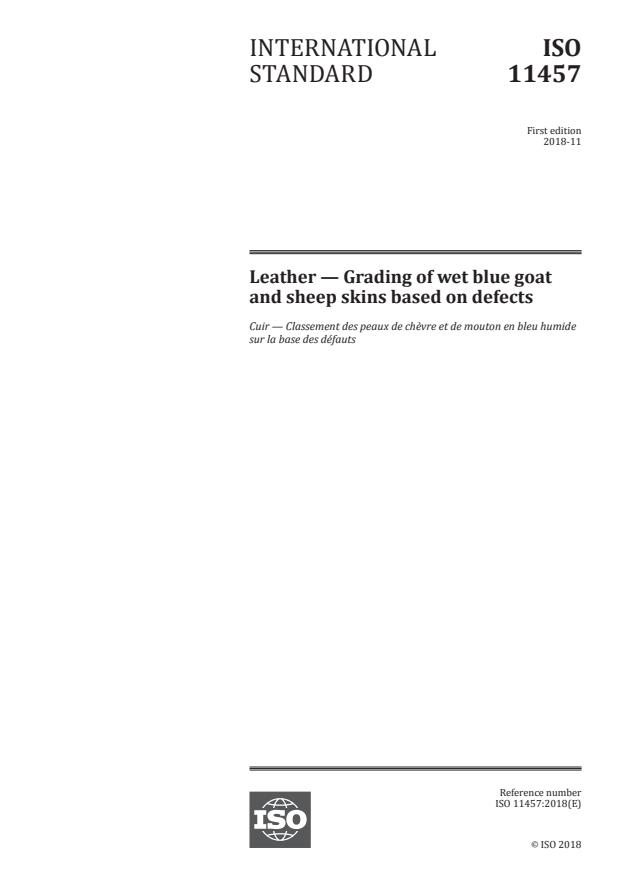
INTERNATIONAL ISO
STANDARD 11457
First edition
2018-11
Leather — Grading of wet blue goat
and sheep skins based on defects
Cuir — Classement des peaux de chèvre et de mouton en bleu humide
sur la base des défauts
Reference number
©
ISO 2018
© ISO 2018
All rights reserved. Unless otherwise specified, or required in the context of its implementation, no part of this publication may
be reproduced or utilized otherwise in any form or by any means, electronic or mechanical, including photocopying, or posting
on the internet or an intranet, without prior written permission. Permission can be requested from either ISO at the address
below or ISO’s member body in the country of the requester.
ISO copyright office
CP 401 • Ch. de Blandonnet 8
CH-1214 Vernier, Geneva
Phone: +41 22 749 01 11
Fax: +41 22 749 09 47
Email: copyright@iso.org
Website: www.iso.org
Published in Switzerland
ii © ISO 2018 – All rights reserved
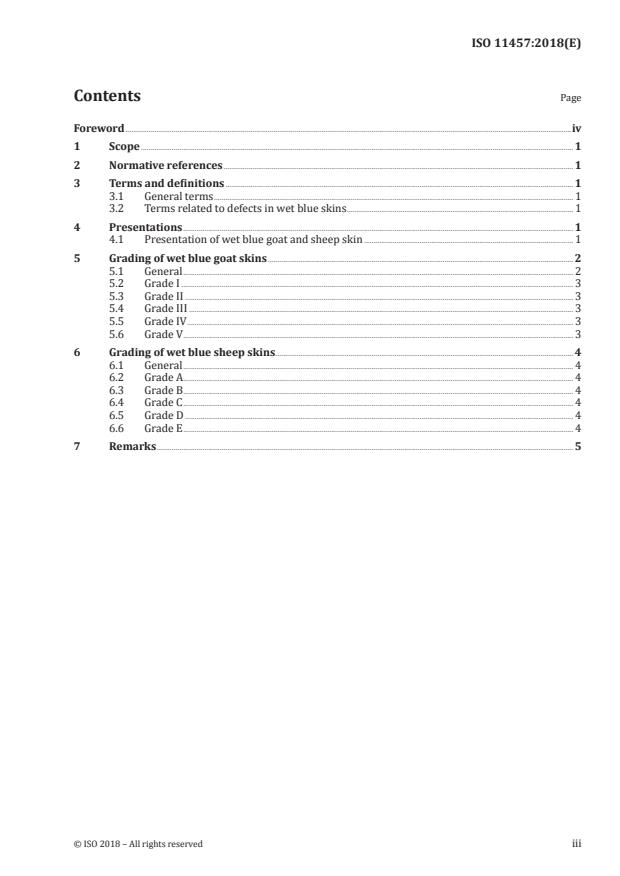
Contents Page
Foreword .iv
1 Scope . 1
2 Normative references . 1
3 Terms and definitions . 1
3.1 General terms . 1
3.2 Terms related to defects in wet blue skins . 1
4 Presentations . 1
4.1 Presentation of wet blue goat and sheep skin . 1
5 Grading of wet blue goat skins . 2
5.1 General . 2
5.2 Grade I . 3
5.3 Grade II . 3
5.4 Grade III . 3
5.5 Grade IV . 3
5.6 Grade V . 3
6 Grading of wet blue sheep skins . 4
6.1 General . 4
6.2 Grade A. 4
6.3 Grade B . 4
6.4 Grade C . 4
6.5 Grade D . 4
6.6 Grade E . 4
7 Remarks . 5
Foreword
ISO (the International Organization for Standardization) is a worldwide federation of national standards
bodies (ISO member bodies). The work of preparing International Standards is normally carried out
through ISO technical committees. Each member body interested in a subject for which a technical
committee has been established has the right to be represented on that committee. International
organizations, governmental and non-governmental, in liaison with ISO, also take part in the work.
ISO collaborates closely with the International Electrotechnical Commission (IEC) on all matters of
electrotechnical standardization.
The procedures used to develop this document and those intended for its further
...
Questions, Comments and Discussion
Ask us and Technical Secretary will try to provide an answer. You can facilitate discussion about the standard in here.
Loading comments...