

ISO 13061-14:2024
(Main)Physical and mechanical properties of wood — Test methods for small clear wood specimens — Part 14: Determination of volumetric shrinkage
General Information
- Abstract
This document specifies methods for the determination of volumetric shrinkage of wood.
- Status
- Published
- Publication Date
- 08-Feb-2024
- Technical Committee
- ISO/TC 218 - Timber
- Drafting Committee
- ISO/TC 218 - Timber
- Current Stage
- 6060 - International Standard published
- Start Date
- 09-Feb-2024
- Due Date
- 23-Nov-2024
- Completion Date
- 09-Feb-2024
Overview
ISO 13061-14:2024 specifies standardized test methods for determining volumetric shrinkage of wood using small clear specimens. The standard defines two accepted procedures - the stereometric method (linear dimension measurements) and the immersion method (water displacement) - to measure the change in specimen volume from a green or fully saturated state to an oven‑dry state. Results are reported as percentage volumetric shrinkage with prescribed calculation and reporting conventions.
Key topics and technical requirements
- Scope: Methods for determination of volumetric shrinkage of wood from green/fully saturated to oven‑dry condition.
- Two measurement methods:
- Stereometric method: Volume computed from measured radial, tangential (and optionally longitudinal) dimensions. Linear measuring instruments must read to 0.02 mm.
- Immersion method: Volume measured by mass of displaced distilled water; balance accuracy 0.001 g (1 mg), volume read to 0.01 cm³.
- Apparatus: Forced convection oven maintained at (103 ± 2) °C, desiccator, vessel with distilled water, balance (0.001 g), and dimension gauges (0.02 mm).
- Specimen preparation and size:
- Rectangular prisms for stereometric method: at least 20 mm in radial and tangential directions; at least 5 mm along grain if longitudinal shrinkage is neglected; minimum 100 mm length if longitudinal shrinkage is included.
- Immersion method specimens: any shape with a minimum volume of 4 cm³.
- Annual ring inclination to tangential faces shall not exceed 10°.
- Measurement points marked at the center of each surface.
- Moisture conditioning: Initial measurements must be taken at or above the fibre saturation point (FSP). If below FSP, specimens are soaked in distilled water at (20 ± 2) °C until dimensional/volume stability is achieved (checked every 3 days; stability criterion 0.01 mm or 0.01 cm³).
- Drying to constant mass: Oven dry at (103 ± 2) °C, check weight changes every 8 h until successive change ≤ 0.2% (or dimensional change ≤ 0.02 mm). Discard specimens that develop checks.
- Calculations and reporting: Formulas provided for volumetric shrinkage (with and without longitudinal shrinkage). Results expressed to the nearest 0.1%; report mean and standard deviation to 0.1%.
Applications and users
- Practical for wood scientists, material testing laboratories, timber product manufacturers, drying and kiln operators, product certification bodies, and researchers.
- Common uses:
- Characterizing dimensional stability of wood species and processed wood products.
- Informing drying schedules, product design tolerances, and quality control.
- Supporting comparative studies of species, treatments, composites, and engineered wood products.
Related standards
- ISO 3129 - Sampling methods and general requirements for small clear wood specimens.
- ISO 24294 - Timber vocabulary (terms and definitions used by this standard).
Keywords: ISO 13061-14, volumetric shrinkage, wood testing, stereometric method, immersion method, oven-dry, fibre saturation point, timber testing, physical properties of wood.
Relations
- Effective Date
- 26-Nov-2022
Get Certified
Connect with accredited certification bodies for this standard

Gozdarski inštitut Slovenije
Slovenian Forestry Institute. Forest management certification support, timber testing.
Sponsored listings
Frequently Asked Questions
ISO 13061-14:2024 is a standard published by the International Organization for Standardization (ISO). Its full title is "Physical and mechanical properties of wood — Test methods for small clear wood specimens — Part 14: Determination of volumetric shrinkage". This standard covers: This document specifies methods for the determination of volumetric shrinkage of wood.
This document specifies methods for the determination of volumetric shrinkage of wood.
ISO 13061-14:2024 is classified under the following ICS (International Classification for Standards) categories: 79.040 - Wood, sawlogs and sawn timber. The ICS classification helps identify the subject area and facilitates finding related standards.
ISO 13061-14:2024 has the following relationships with other standards: It is inter standard links to ISO 13061-14:2016. Understanding these relationships helps ensure you are using the most current and applicable version of the standard.
ISO 13061-14:2024 is available in PDF format for immediate download after purchase. The document can be added to your cart and obtained through the secure checkout process. Digital delivery ensures instant access to the complete standard document.
Standards Content (Sample)
International
Standard
ISO 13061-14
Second edition
Physical and mechanical properties
2024-02
of wood — Test methods for small
clear wood specimens —
Part 14:
Determination of volumetric
shrinkage
Propriétés physiques et mécaniques du bois — Méthodes d'essais
sur petites éprouvettes de bois sans défauts —
Partie 14: Détermination du retrait volumique
Reference number
© ISO 2024
All rights reserved. Unless otherwise specified, or required in the context of its implementation, no part of this publication may
be reproduced or utilized otherwise in any form or by any means, electronic or mechanical, including photocopying, or posting on
the internet or an intranet, without prior written permission. Permission can be requested from either ISO at the address below
or ISO’s member body in the country of the requester.
ISO copyright office
CP 401 • Ch. de Blandonnet 8
CH-1214 Vernier, Geneva
Phone: +41 22 749 01 11
Email: copyright@iso.org
Website: www.iso.org
Published in Switzerland
ii
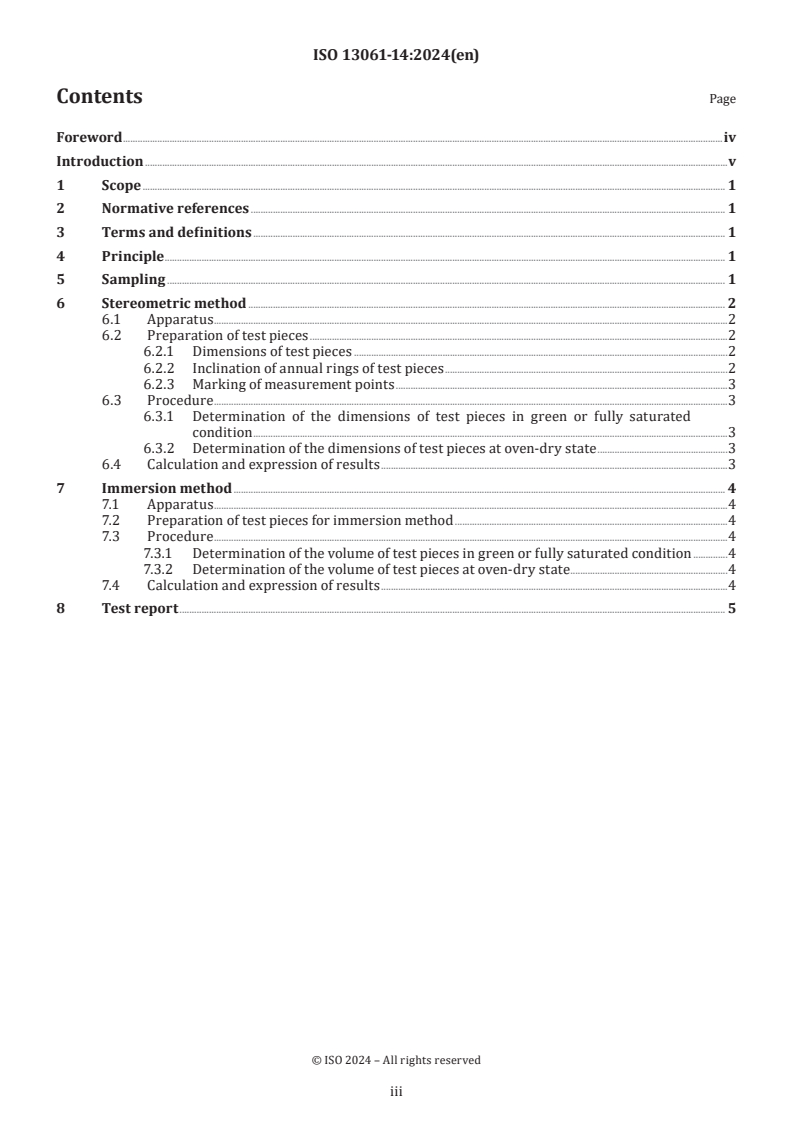
Contents Page
Foreword .iv
Introduction .v
1 Scope . 1
2 Normative references . 1
3 Terms and definitions . 1
4 Principle . 1
5 Sampling . 1
6 Stereometric method . 2
6.1 Apparatus .2
6.2 Preparation of test pieces .2
6.2.1 Dimensions of test pieces .2
6.2.2 Inclination of annual rings of test pieces .2
6.2.3 Marking of measurement points .3
6.3 Procedure .3
6.3.1 Determination of the dimensions of test pieces in green or fully saturated
condition .3
6.3.2 Determination of the dimensions of test pieces at oven-dry state .3
6.4 Calculation and expression of results .3
7 Immersion method . 4
7.1 Apparatus .4
7.2 Preparation of test pieces for immersion method .4
7.3 Procedure .4
7.3.1 Determination of the volume of test pieces in green or fully saturated condition .4
7.3.2 Determination of the volume of test pieces at oven-dry state .4
7.4 Calculation and expression of results .4
8 Test report . 5
iii
Foreword
ISO (the International Organization for Standardization) is a worldwide federation of national standards
bodies (ISO member bodies). The work of preparing International Standards is normally carried out through
ISO technical committees. Each member body interested in a subject for which a technical committee
has been established has the right to be represented on that committee. International organizations,
governmental and non-governmental, in liaison with ISO, also take part in the work. ISO collaborates closely
with the International Electrotechnical Commission (IEC) on all matters of electrotechnical standardization.
The procedures used to develop this document and those intended for its further maintenance are described
in the ISO/IEC Directives, Part 1. In particular, the different approval criteria needed for the different types
of ISO document should be noted. This document was drafted in accordance with the editorial rules of the
ISO/IEC Directives, Part 2 (see www.iso.org/directives).
ISO draws attention to the possibility that the implementation of this document may involve the use of (a)
patent(s). ISO takes no position concerning the evidence, validity or applicability of any claimed patent
rights in respect thereof. As of the date of publication of this document, ISO had not received notice of (a)
patent(s) which may be required to implement this document. However, implementers are cautioned that
this may not represent the latest information, which may be obtained from the patent database available at
www.iso.org/patents. ISO shall not be held responsible for identifying any or all such patent rights.
Any trade name used in this document is information given for the convenience of users and does not
constitute an endorsement.
For an explanation of the voluntary nature of standards, the meaning of ISO specific terms and expressions
related to conformity assessment, as well as information about ISO's adherence to the World Trade
Organization (WTO) principles in the Technical Barriers to Trade (TBT), see www.iso.org/iso/foreword.html.
This document was prepared by Technical Committee ISO/TC 218, Timber.
This second edition cancels and replaces the first edition (ISO 13061-14:2016), which has been technically
revised.
The main changes are as follows:
— changes in the sizes and measurements of test pieces and the calculation of test results.
A list of all parts in the ISO 13061 series can be found on the ISO website.
Any feedback or questions on this document should be directed to the user’s national standards body. A
complete listing of these bodies can be found at www.iso.org/members.html.
iv
Introduction
The main purpose of this document is to establish the common international point of member countries of
the International Organization for Standardization (ISO), concerning testing methods for small clear wood
specimens and general requirements for determining physical and mechanical properties of wood.
v
International Standard ISO 13061-14:2024(en)
Physical and mechanical properties of wood — Test methods
for small clear wood specimens —
Part 14:
Determination of volumetric shrinkage
1 Scope
This document specifies methods for the determination of volumetric shrinkage of wood.
2 Normative references
The following documents are referred to in the text in such a way that some or all of their content constitutes
requirements of this document. For dated references, only the edition cited applies. For undated references,
the latest edition of the referenced document (including any
...