

ISO 8810:2026
(Main)Plastics — Determination of residual peroxide — Gas chromatography method
- Abstract
This document specifies a method for the determination of di-tert-butyl peroxide (DTBP) and 2, 5-Dimethyl-2, 5-di (tert-butylperoxy) hexane (DBPH) in plastics by using gas chromatography. This document is applicable to the determination of the content of residual peroxides in plastics and their products, which use peroxides as a degradation agent or crosslinking agent during plastics processing, or as an additive during polymerization, thereby remaining in degraded polypropylene, crosslinked polyethylene, polystyrene and other plastics. NOTE The applicability of this method to other peroxides is possible when the method is validated for each case.
- Status
- Published
- Publication Date
- 21-May-2026
- Technical Committee
- ISO/TC 61/SC 5 - Physical-chemical properties
- Drafting Committee
- ISO/TC 61/SC 5 - Physical-chemical properties
- Current Stage
- 6060 - International Standard published
- Start Date
- 22-May-2026
- Due Date
- 30-Nov-2026
- Completion Date
- 22-May-2026
ISO 8810:2026 is an International Standard from ISO for determining residual peroxide in plastics by gas chromatography. It specifies a method for di-tert-butyl peroxide (DTBP) and 2,5-Dimethyl-2,5-di (tert-butylperoxy) hexane (DBPH) in plastics and plastic products, especially materials that have been degraded, crosslinked, or polymerized using peroxides. In practice, it gives laboratories a defined way to measure peroxide carryover in processed plastics.
What does ISO 8810:2026 specify?
ISO 8810:2026 specifies a gas chromatography method for measuring DTBP and DBPH in plastics. It is written for residual peroxide content in plastics and products made with peroxide-based degradation, crosslinking, or polymerization processes.
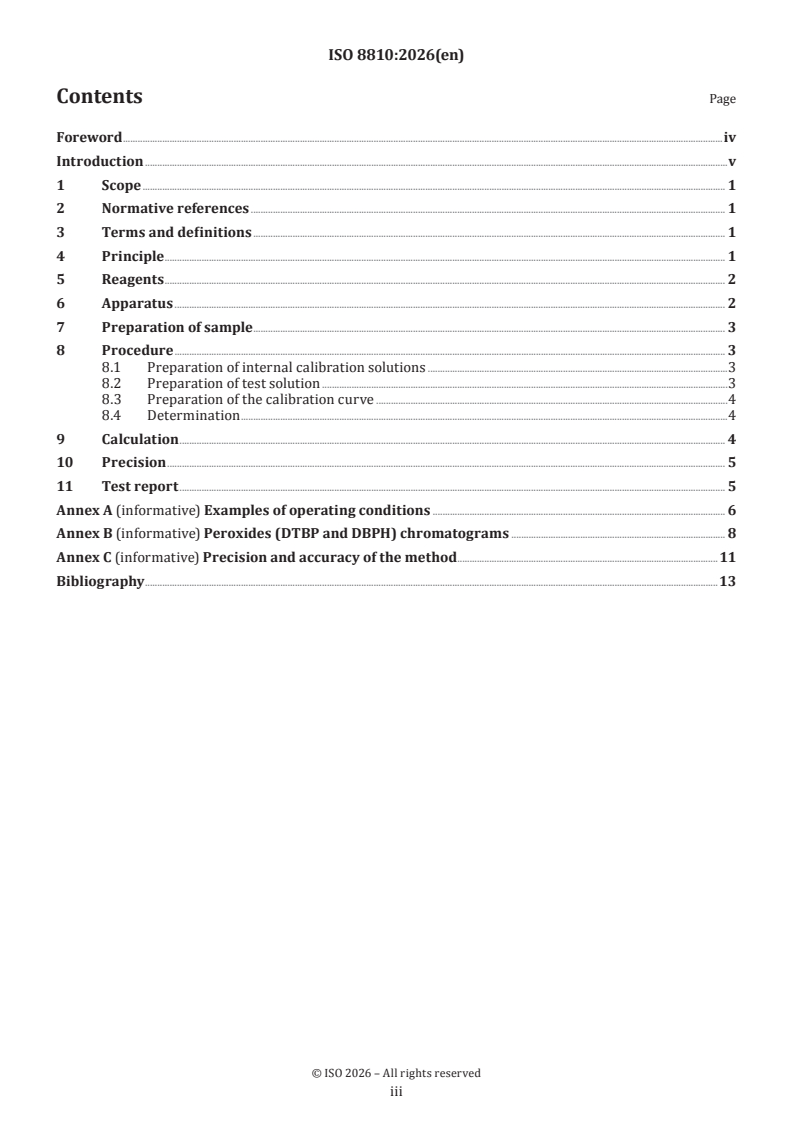
The document is organized into clauses covering scope, normative references, principle, reagents, apparatus, sample preparation, procedure, calculation, precision, and test report. It also includes three informative annexes.
| Annex | What it covers |
|---|---|
| Annex A | Examples of operating conditions |
| Annex B | DTBP and DBPH chromatograms |
| Annex C | Precision and accuracy of the method |
The scope also notes that the method can be applied to other peroxides when each case is validated. That matters because users may want to extend the procedure beyond the two named analytes, but they need evidence that the extension works for their material.
What are the key requirements of ISO 8810:2026?
ISO 8810:2026 combines solvent extraction, internal-standard calibration, and GC measurement. The practical focus is on getting a clean extract, a stable calibration, and a chromatographic separation that resolves the peroxide peaks from the internal standard and solvent.
Extraction and measurement
Clause 4 states that the test sample is extracted in an ultrasonic bath with tetrahydrofuran (THF) or another suitable solvent, then cooled, spiked with internal standard, shaken, filtered, and analyzed by gas chromatography (GC) with a suitable detector. This means the sample preparation step is part of the measurement quality: poor extraction or filtering will affect the result.
Clause 7 sets the sample preparation approach. Powder or granular resin may be sampled directly, while products are cut into particles or flakes smaller than 5 mm in any direction. That matters because the method depends on exposing enough surface area for the solvent to remove the residual peroxide.
Reagents and equipment
Clause 5 requires analytical-grade reagents and identifies DTBP, DBPH, and undecane as the internal reference substance. The solvent must dissolve the target peroxides and the internal reference, be inert, be compatible with the column, and separate from the analytes in retention time. In practice, that means the solvent choice affects both chemistry and chromatographic separation.
Clause 6 requires a GC system with suitable detection, a column that separates DTBP, DBPH, the internal standard, and solvent, plus standard lab items such as a balance, ultrasonic bath, storage at 4 °C, microsyringe, class A glassware, and a 0.45 μm organic phase membrane. The examples in Annex A show that the detector may be flame ionization detector (FID) or mass spectrometry (MS).
Calibration, calculation, and control
Clause 8.1 requires at least five calibration solutions and defines the concentration balance between peroxide and internal reference. The calibration solutions and stock solutions are stored at 4 °C. This is important because the method relies on a stable response factor over time.
Clause 8.3 uses the peak-area ratio and concentration ratio to build the calibration curve, and it calls for periodic verification of the response factor. If the average response factor changes by more than ±2 %, the apparatus needs full recalibration. That gives the user a practical system check, not just a one-time calibration.
Clause 9 converts the chromatographic result into peroxide concentration in the test solution and then into content in mg/kg in the sample. If the result falls outside the calibration range, the method allows using less sample or diluting the extract with THF.
What terms does ISO 8810:2026 use?
ISO 8810:2026 uses these key technical terms and abbreviations in the method:
- DTBP - di-tert-butyl peroxide, one of the two target residual peroxides measured by the method.
- DBPH - 2,5-Dimethyl-2,5-di (tert-butylperoxy) hexane, the second target peroxide.
- GC - gas chromatography, the separation and measurement technique used for the analysis.
- FID - flame ionization detector, one of the detector options shown in Annex A.
- MS - mass spectrometry, another detector option shown in Annex A.
- THF - tetrahydrofuran, the recommended extraction and dilution solvent.
- PP - polypropylene, one of the plastics named in the introduction as a typical application area.
- PE - polyethylene, another plastics group named in the introduction, including crosslinked PE.
Who uses ISO 8810:2026?
ISO 8810:2026 is used by laboratory analysts, plastics manufacturers, and quality control teams that need to measure residual peroxide in processed plastics. It is relevant for materials made from degraded polypropylene, crosslinked polyethylene, polystyrene, and similar plastics.
It is also useful for testing laboratories that perform routine product checks, method verification, or interlaboratory comparison work. Buyers and quality managers can use it to define how peroxide residues will be measured in incoming materials, finished goods, or process validation samples.
Which standards are used with ISO 8810:2026?
ISO 8810:2026 cites these standards in its normative references and supporting material:
- ISO 648 - specifies single-volume pipettes used for accurate liquid handling during preparation of solutions.
- ISO 1042 - specifies one-mark volumetric flasks used to make calibration and test solutions to a defined volume.
- ISO 5725-2 - used in Annex C for calculating the precision data from the collaborative trials, so readers can interpret the repeatability and reproducibility figures.
What does the ISO 8810:2026 document contain?
ISO 8810:2026 contains the measurement principle, reagent list, apparatus requirements, sampling guidance, preparation of internal calibration solutions, test solution preparation, calibration curve procedure, calculation formulas, precision statement, and test report contents. It also gives a sample report checklist in Clause 11.
Annex A provides two worked operating-condition examples, one for GC-FID and one for GC-MS, including column type, temperatures, gas, injection settings, and example calibration ranges. Annex B shows example chromatograms for DTBP, undecane, and DBPH under those conditions.
Annex C summarizes precision and accuracy from interlaboratory trials on PP samples, including repeatability and reproducibility data and recovery checks. For users, that annex is the main place to look when judging how the method performs in practice before adopting it for routine testing.
Get Certified
Connect with accredited certification bodies for this standard

DIN CERTCO
DIN Group product certification.

Smithers Quality Assessments
US management systems and product certification.
Sponsored listings
Frequently Asked Questions
ISO 8810:2026 is a standard published by the International Organization for Standardization (ISO). Its full title is "Plastics — Determination of residual peroxide — Gas chromatography method". This standard covers: This document specifies a method for the determination of di-tert-butyl peroxide (DTBP) and 2, 5-Dimethyl-2, 5-di (tert-butylperoxy) hexane (DBPH) in plastics by using gas chromatography. This document is applicable to the determination of the content of residual peroxides in plastics and their products, which use peroxides as a degradation agent or crosslinking agent during plastics processing, or as an additive during polymerization, thereby remaining in degraded polypropylene, crosslinked polyethylene, polystyrene and other plastics. NOTE The applicability of this method to other peroxides is possible when the method is validated for each case.
This document specifies a method for the determination of di-tert-butyl peroxide (DTBP) and 2, 5-Dimethyl-2, 5-di (tert-butylperoxy) hexane (DBPH) in plastics by using gas chromatography. This document is applicable to the determination of the content of residual peroxides in plastics and their products, which use peroxides as a degradation agent or crosslinking agent during plastics processing, or as an additive during polymerization, thereby remaining in degraded polypropylene, crosslinked polyethylene, polystyrene and other plastics. NOTE The applicability of this method to other peroxides is possible when the method is validated for each case.
ISO 8810:2026 is classified under the following ICS (International Classification for Standards) categories: 83.080.01 - Plastics in general. The ICS classification helps identify the subject area and facilitates finding related standards.
ISO 8810:2026 is available in PDF format for immediate download after purchase. The document can be added to your cart and obtained through the secure checkout process. Digital delivery ensures instant access to the complete standard document.
Standards Content (Sample)
International
Standard
ISO 8810
First edition
Plastics — Determination
2026-05
of residual peroxide — Gas
chromatography method
Plastiques — Détermination du peroxyde résiduel — Méthode
par chromatographie en phase gazeuse
Reference number
© ISO 2026
All rights reserved. Unless otherwise specified, or required in the context of its implementation, no part of this publication may
be reproduced or utilized otherwise in any form or by any means, electronic or mechanical, including photocopying, or posting on
the internet or an intranet, without prior written permission. Permission can be requested from either ISO at the address below
or ISO’s member body in the country of the requester.
ISO copyright office
CP 401 • Ch. de Blandonnet 8
CH-1214 Vernier, Geneva
Phone: +41 22 749 01 11
Email: copyright@iso.org
Website: www.iso.org
Published in Switzerland
ii
Contents Page
Foreword .iv
Introduction .v
1 Scope . 1
2 Normative references . 1
3 Terms and definitions . 1
4 Principle . 1
5 Reagents . 2
6 Apparatus . 2
7 Preparation of sample . 3
8 Procedure . 3
8.1 Preparation of internal calibration solutions .3
8.2 Preparation of test solution .3
8.3 Preparation of the calibration curve .4
8.4 Determination .4
9 Calculation . 4
10 Precision . 5
11 Test report . 5
Annex A (informative) Examples of operating conditions . 6
Annex B (informative) Peroxides (DTBP and DBPH) chromatograms . 8
Annex C (informative) Precision and accuracy of the method .11
Bibliography .13
iii
Foreword
ISO (the International Organization for Standardization) is a worldwide federation of national standards
bodies (ISO member bodies). The work of preparing International Standards is normally carried out through
ISO technical committees. Each member body interested in a subject for which a technical committee
has been established has the right to be represented on that committee. International organizations,
governmental and non-governmental, in liaison with ISO, also take part in the work. ISO collaborates closely
with the International Electrotechnical Commission (IEC) on all matters of electrotechnical standardization.
The procedures used to develop this document and those intended for its further maintenance are described
in the ISO/IEC Directives, Part 1. In particular, the different approval criteria needed for the different types
of ISO documents should be noted. This document was drafted in accordance with the editorial rules of the
ISO/IEC Directives, Part 2 (see www.iso.org/directives).
ISO draws attention to the possibility that the implementation of this document may involve the use of (a)
patent(s). ISO takes no position concerning the evidence, validity or applicability of any claimed patent
rights in respect thereof. As of the date of publication of this document, ISO had not received notice of (a)
patent(s) which may be required to implement this document. However, implementers are cautioned that
this may not represent the latest information, which may be obtained from the patent database available at
www.iso.org/patents. ISO shall not be held responsible for identifying any or all such patent rights.
Any trade name used in this document is information given for the convenience of users and does not
constitute an endorsement.
For an explanation of the voluntary nature of standards, the meaning of ISO specific terms and expressions
related to conformity assessment, as well as information about ISO's adherence to the World Trade
Organization (WTO) principles in the Technical Barriers to Trade (TBT), see www.iso.org/iso/foreword.html.
This document was prepared by Technical Committee ISO/TC 61, Plastics, Subcommittee SC 5, Physical-
chemical properties.
Any feedback or questions on this document should be directed to the user’s national standards body. A
complete listing of these bodies can be found at www.iso.org/members.html.
iv
Introduction
Peroxide has many applications in polymer preparation, such as: used as a degradation agent in the
degradation reaction of ultra-high fluidity polypropylene (PP) and a variety of polymers, as a crosslinking
agent in polyethylene’s (PE) crosslinking reaction, as initiator for free radical polymerization, as a
vulcanizing agent for rubber vulcanization, etc. For health reasons and stable product quality, the content of
residual peroxide in plastics, especially in peroxide-degraded polypropylene (PP) needs to be determined.
Chromatography is the main method for the determination of peroxide.
v
International Standard ISO 8810:2026(en)
Plastics — Determination of residual peroxide — Gas
chromatography method
WARNING — Persons using this document should be familiar with normal laboratory practice. This
document does not purport to address all of the safety problems, if any, associated with its use. It is
the responsibility of the user to establish appropriate safety and health practices and to determine
any applicable national regulatory conditions prior to use.
IMPORTANT — It is absolutely essential that tests conducted in accordance with this document be
carried out by suitably trained staff.
1 Scope
This document specifies a method for the determination of di-tert-butyl peroxide (DTBP) and 2, 5-Dimethyl-2,
5-di (tert-butylperoxy) hexane (DBPH) in plastics by using gas chromatography.
This document is applicable to the determination of the content of residual peroxides in plastics and their
products, which use peroxides as a degradation agent or crosslinking agent during plastics processing, or as
an additive during polymerization, thereby remaining in degraded polypropylene, crosslinked polyethylene,
polystyrene and other plastics.
NOTE The applicability of this method to other peroxides is possible when the method is validated for each case.
2 Normative references
The following documents are referred to in the text in such a way that some or all of their content constitutes
requirements of this document. For dated references, only the edition cited applies. For undated references,
the latest edition of the referenced document (including any amendments) applies.
ISO 648, Laboratory glassware — Single-volume pipettes
ISO 1042, Laboratory glassware — One-mark volumetric flasks
3 Terms and definitions
No terms and definitions are listed in this document.
ISO and IEC maintain terminology databases for use in standardization at the following addresses:
— ISO Online browsing platform: available at https:// www .iso .org/ obp
— IEC Electropedia: available at https:// www .electropedia .org/
4 Principle
The test sample is extracted by ultrasonic bath with tetrahydrofuran or other suitable solvent. After the
extract solution is cooled, the internal standard is added, and the solution is shaken and filtered. The residual
peroxides in the extract solution are determined by gas chromatography (GC) with suitable detection
technique.
5 Reagents
During the analysis, unless otherwise stated, use only reagents of recognized analytical grade and distilled
or demineralized water or water of equivalent purity.
®1)
5.1 Di-tert-butyl peroxide (DTBP), CAS RN . 110-05-4, minimum of 95 % purity.
®1)
5.2 2, 5-Dimethyl-2, 5-di (tert-butylperoxy) hexane (DBPH), CAS RN 78-63-7, minimum of 93 %
purity.
5.3 Solvent, any product which will completely dissolve the internal reference and the target peroxides
(DTBP and DBPH) to give a stable solution, and which meets the following requirements:
— is inert (does not react with the resin or the internal standard under the test conditions);
— is compatible with the constituents of the chromatographic column;
— has a retention time different from those of the peroxides and the internal reference.
Examples of solvents which meet the above-mentioned requirements are:
®1)
— tetrahydrofuran (THF), CAS RN 109-99-9 (recommended);
®1)
— toluene, CAS RN 108-88-3;
®1)
— trichloromethane, CAS RN 67-66-3.
WARNING — The reagents used in this method are toxic. Safety precautions are necessary.
®1)
5.4 Internal reference substance, Undecane, CAS RN 1120-21-4, analytical grade or higher.
The internal reference substance shall not be present in the test portion matrix. Other compounds may be
used as alternative internal reference substances.
5.5 Initial calibration solution, 100 mg/l of DTBP and DBPH, each in tetrahydrofuran or other suitable
solvent.
The initial calibration solution should be properly stored at 4 °C to prevent change of concentration. It is
recommended that the solution should be prepared at least every three months.
5.6 Internal reference solution, 100 mg/l of undecane or others, in tetrahydrofuran or other suitable
solvent.
The internal stock solution should be properly stored at 4 °C to prevent change of concentration. It is
recommended that the solution should be prepared at least every three months.
6 Apparatus
6.1 Gas chromatography (GC), any laboratory chromatograph fitted with a suitable detection.
Examples of the operating conditions are shown in Annex A. It is possible to use different procedures
providing it can be verified that they would give the same results.
1) CAS Registry Number® is a trademark of the American Chemical Society (ACS). This information is given for the
convenience of users of this document and does not constitute an endorsement by ISO of the product named. Equivalent
products may be used if they can be shown to lead to the same results.
...