


ISO 13739:2020
(Main)Petroleum products — Procedures for the transfer of bunkers to vessels
Petroleum products — Procedures for the transfer of bunkers to vessels
This document specifies procedures and requirements for the transfer of bunkers to vessels involving bunker tankers, road tankers and shore pipelines. It is applicable to pre-delivery, delivery and post-delivery checks and documentation.
Produits pétroliers — Procédures de transfert des soutes dans les navires
General Information
Relations
Overview - ISO 13739:2020 (Petroleum products - Procedures for the transfer of bunkers to vessels)
ISO 13739:2020 establishes standardized procedures and requirements for the safe, accurate and auditable transfer of marine fuels (bunkers) to vessels. The standard covers bunkering operations involving bunker tankers, road tankers and shore pipelines, and applies to pre-delivery, delivery and post-delivery checks, sampling, measurement and documentation. It was developed for the marine industry to promote consistent health, safety and environmental (HSE) practices and to support regulatory compliance (e.g., MARPOL requirements referenced in the standard).
Key topics and technical requirements
ISO 13739:2020 addresses the full bunkering lifecycle and includes normative and informative guidance on:
- Responsibilities and documentation - roles of supplier, ship’s chief engineer, bunker tanker operator, and required records such as the Bunker Delivery Note (BDN).
- Pre-delivery checks and safety - HSE requirements, pre-delivery safety checklists for bunker, shore and road tanker delivery (annexes provide example checklists).
- Bunker specifications and requisitioning - procedures for specifying required fuel and issuing bunker requisitions.
- Delivery procedures - operational requirements during transfer for bunker tanker, road tanker and shore pipeline deliveries.
- Sampling and sample handling - sampling procedures, equipment, sealing and labelling of samples to ensure quality traceability.
- Quantity measurements and tank gauging - manual tank gauging procedures, measurement/calculation forms, and secondary measurement recording.
- Post-delivery documentation and recordkeeping - sample labels, delivery time logs, stock movement logbooks, and example letters of protest.
- Annexes and practical forms - normative annexes for tank gauging, sampling equipment and procedures, and multiple informative annexes with example forms and diagrams.
Practical applications and who uses it
ISO 13739:2020 is useful for:
- Ship owners, ship operators and chief engineers - to ensure correct receipt, measurement and documentation of bunker deliveries.
- Bunker suppliers and bunker tanker operators - to implement consistent delivery and sampling practices.
- Port authorities, surveyors and independent inspectors - to audit and verify compliance with measurement, sampling and documentation.
- HSE managers and compliance officers - to align bunkering operations with safety and environmental requirements. Practical use cases include routine bunkering, dispute prevention (through standard sampling and documentation), regulatory compliance checks and internal audits.
Related standards and regulations
- ISO 8217 - Petroleum products - Specifications of marine fuels (relevant for fuel quality)
- ISO 4268 - Temperature measurements for petroleum products (manual methods)
- MARPOL Annex VI - International regulation referenced in the standard for air pollution and related bunkering obligations
Keywords: ISO 13739:2020, bunkering procedures, bunker transfer, bunker tanker, road tanker, shore pipeline, bunker delivery note, sampling, tank gauging, HSE, MARPOL.
Standards Content (Sample)
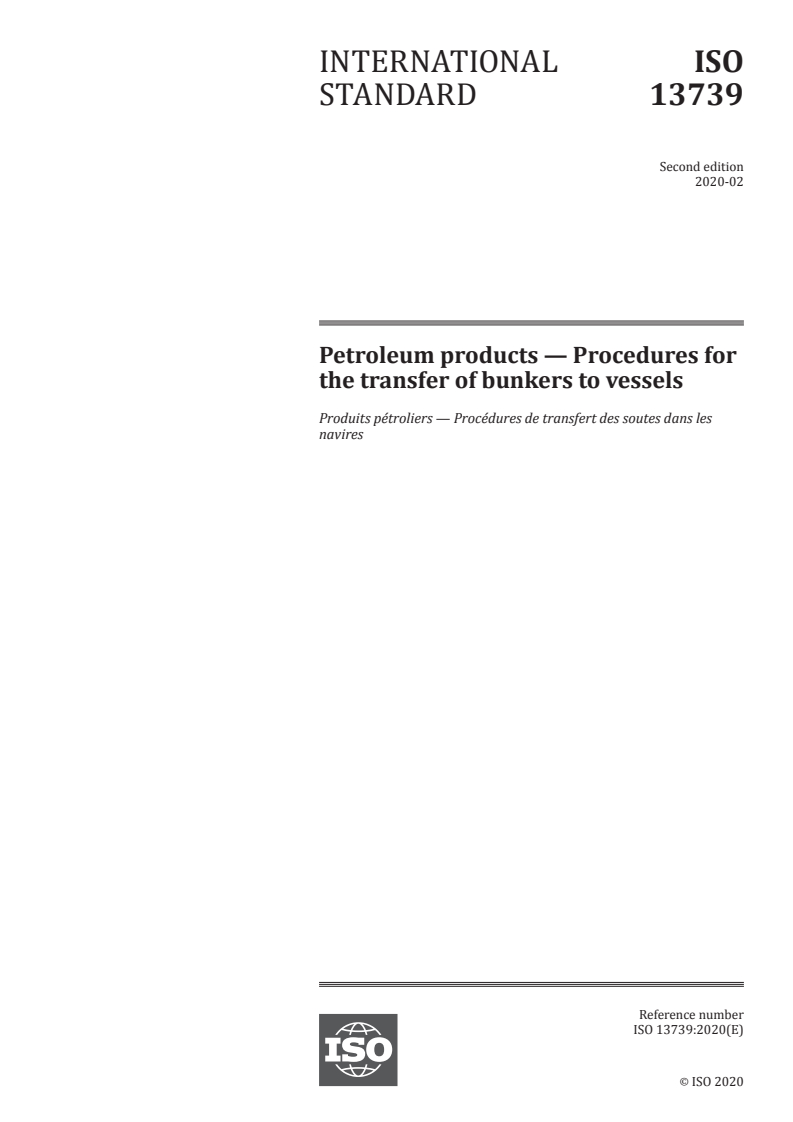
INTERNATIONAL ISO
STANDARD 13739
Second edition
2020-02
Petroleum products — Procedures for
the transfer of bunkers to vessels
Produits pétroliers — Procédures de transfert des soutes dans les
navires
Reference number
©
ISO 2020
© ISO 2020
All rights reserved. Unless otherwise specified, or required in the context of its implementation, no part of this publication may
be reproduced or utilized otherwise in any form or by any means, electronic or mechanical, including photocopying, or posting
on the internet or an intranet, without prior written permission. Permission can be requested from either ISO at the address
below or ISO’s member body in the country of the requester.
ISO copyright office
CP 401 • Ch. de Blandonnet 8
CH-1214 Vernier, Geneva
Phone: +41 22 749 01 11
Fax: +41 22 749 09 47
Email: copyright@iso.org
Website: www.iso.org
Published in Switzerland
ii © ISO 2020 – All rights reserved
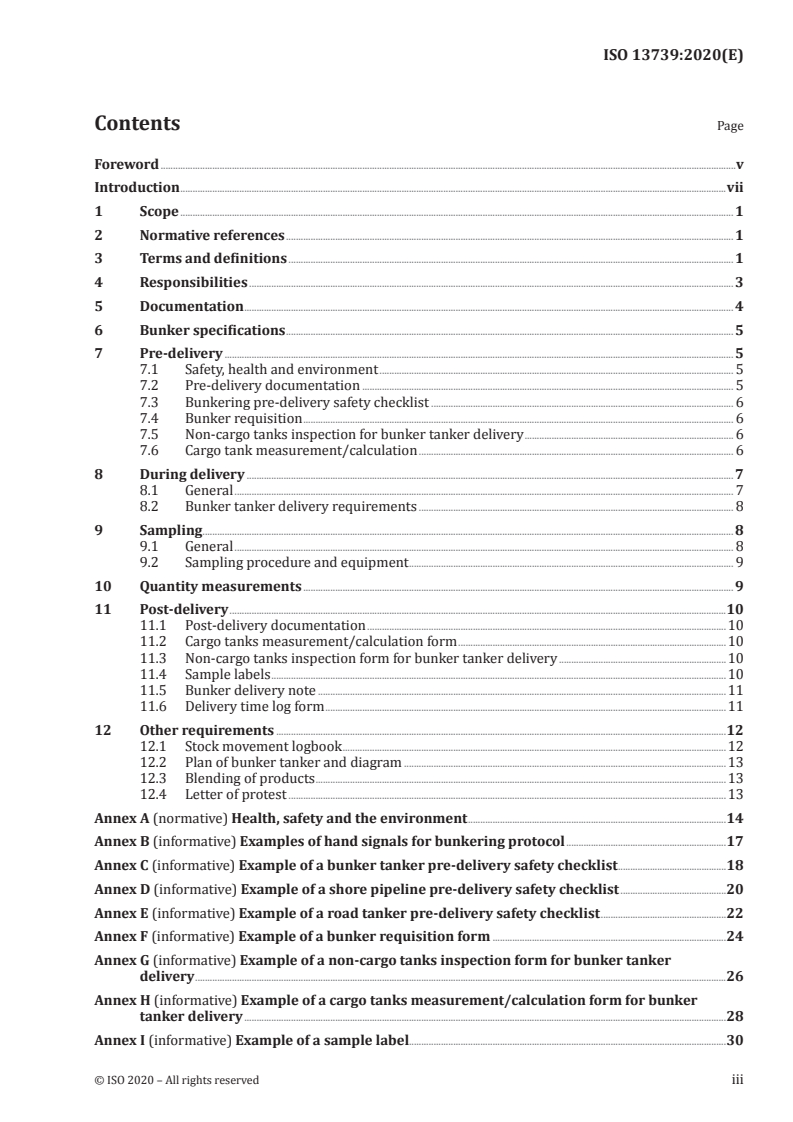
Contents Page
Foreword .v
Introduction .vii
1 Scope . 1
2 Normative references . 1
3 Terms and definitions . 1
4 Responsibilities . 3
5 Documentation . 4
6 Bunker specifications . 5
7 Pre-delivery . 5
7.1 Safety, health and environment . 5
7.2 Pre-delivery documentation . 5
7.3 Bunkering pre-delivery safety checklist . 6
7.4 Bunker requisition . 6
7.5 Non-cargo tanks inspection for bunker tanker delivery . 6
7.6 Cargo tank measurement/calculation . 6
8 During delivery . 7
8.1 General . 7
8.2 Bunker tanker delivery requirements . 8
9 Sampling . 8
9.1 General . 8
9.2 Sampling procedure and equipment . 9
10 Quantity measurements . 9
11 Post-delivery .10
11.1 Post-delivery documentation .10
11.2 Cargo tanks measurement/calculation form .10
11.3 Non-cargo tanks inspection form for bunker tanker delivery .10
11.4 Sample labels .10
11.5 Bunker delivery note .11
11.6 Delivery time log form .11
12 Other requirements .12
12.1 Stock movement logbook .12
12.2 Plan of bunker tanker and diagram .13
12.3 Blending of products .13
12.4 Letter of protest .13
Annex A (normative) Health, safety and the environment .14
Annex B (informative) Examples of hand signals for bunkering protocol .17
Annex C (informative) Example of a bunker tanker pre-delivery safety checklist .18
Annex D (informative) Example of a shore pipeline pre-delivery safety checklist .20
Annex E (informative) Example of a road tanker pre-delivery safety checklist .22
Annex F (informative) Example of a bunker requisition form .24
Annex G (informative) Example of a non-cargo tanks inspection form for bunker tanker
delivery .26
Annex H (informative) Example of a cargo tanks measurement/calculation form for bunker
tanker delivery .28
Annex I (informative) Example of a sample label.30
Annex J (normative) Manual tank gauging procedure for bunker tanker delivery .31
Annex K (normative) Sampling equipment .33
Annex L (normative) Sampling procedure .34
Annex M (informative) Diagrams of manual valve-setting continuous-drip sampler equipment .36
Annex N (informative) Example of a design of the sample bottle neck and cap .39
Annex O (informative) Example of a stock movement logbook for a bunker tanker .40
Annex P (informative) Example of a letter of protest .42
Annex Q (informative) Example of a delivery time log .43
Bibliography .44
iv © ISO 2020 – All rights reserved
Foreword
ISO (the International Organization for Standardization) is a worldwide federation of national standards
bodies (ISO member bodies). The work of preparing International Standards is normally carried out
through ISO technical committees. Each member body interested in a subject for which a technical
committee has been established has the right to be represented on that committee. International
organizations, governmental and non-governmental, in liaison with ISO, also take part in the work.
ISO collaborates closely with the International Electrotechnical Commission (IEC) on all matters of
electrotechnical standardization.
The procedures used to develop this document and those intended for its further maintenance are
described in the ISO/IEC Directives, Part 1. In particular, the different approval criteria needed for the
different types of ISO documents should be noted. This document was drafted in accordance with the
editorial rules of the ISO/IEC Directives, Part 2 (see www .iso .org/ directives).
Attention is drawn to the possibility that some of the elements of this document may be the subject of
patent rights. ISO shall not be held responsible for identifying any or all such patent rights. Details of
any patent rights identified during the development of the document will be in the Introduction and/or
on the ISO list of patent declarations received (see www .iso .org/ patents).
Any trade name used in this document is information given for the convenience of users and does not
constitute an endorsement.
For an explanation of the voluntary nature of standards, the meaning of ISO specific terms and
expressions related to conformity assessment, as well as information about ISO’s adherence to the
World Trade Organization (WTO) principles in the Technical Barriers to Trade (TBT) see www .iso .org/
iso/ foreword .html.
This document was prepared by Technical Committee ISO/TC 28, Petroleum and related products, fuels
and lubricants from natural or synthetic sources, Subcommittee SC 2, Measurement of petroleum and
related products.
This second edition cancels and replaces the first edition (ISO 13739:2010), which has been technically
revised. The main changes compared with the previous edition are as follows:
— definitions of the verbal forms “shall”, “should”, “may” and “can” have been included in the
Introduction;
— definitions of “list”, “list correction”, “supplier’s representative”, “trim” and “trim correction” have
been added in Clause 3;
— the following terms have been replaced throughout the document:
— “SHE” has been replaced by “HSE”;
— “cargo officer” has been replaced by “supplier’s representative”;
— “note of protest” has been replaced by “letter of protest”;
— 7.6 and Annex Q have been revised to include delivery by shore pipeline and road tankers;
— 11.5 has been updated to include a reference to MARPOL, Annex VI, Regulations 14.1, 14.4
[31]
and 18.3 ;
— a requirement to check for any leakages for filling lines has been included in A.5.4;
— units of measurements have been included in Annex H;
— a requirement to drain bunker tanker lines and hoses before opening and closing measurements
has been included in J.3;
— the recording of secondary measurement has been included and the requirement on gauging and
zero dip have been revised in J.4;
— a sample of a delivery time log has been included as a new Annex Q.
Any feedback or questions on this document should be directed to the user’s national standards body. A
complete listing of these bodies can be found at www .iso .org/ members .html.
vi © ISO 2020 – All rights reserved
Introduction
This document was developed for the benefit of the marine industry, including ship owners, operators,
charterers, bunker suppliers, bunker tanker operators and surveyors. It sets out a series of procedures
to promote the uniform and expeditious transfer of bunkers to vessels meeting the latest health, safety
and environmental (HSE) standards.
Local and international regulations, such as the International Maritime Organization (IMO) regulation
International Convention for the Prevention of Pollution from Ships, 1973, as modified by the Protocol of
[31]
1978 relating thereto (MARPOL), Annex VI: Prevention of Air Pollution from Ships , apply to all parties
involved in the transfer of bunkers.
In this document, the following verbal forms are used:
— “shall” indicates a requirement;
— “should” indicates a recommendation;
— “may” indicates a permission;
— “can” indicates a possibility or capability.
INTERNATIONAL STANDARD ISO 13739:2020(E)
Petroleum products — Procedures for the transfer of
bunkers to vessels
WARNING — The use of this document can involve hazardous materials, operations and
equipment. This document does not purport to address all the safety problems associated with
its use. It is the responsibility of the user of this document to establish appropriate safety and
health practices and to determine the applicability of regulatory limitations prior to use.
1 Scope
This document specifies procedures and requirements for the transfer of bunkers to vessels involving
bunker tankers, road tankers and shore pipelines. It is applicable to pre-delivery, delivery and post-
delivery checks and documentation.
2 Normative references
The following documents are referred to in the text in such a way that some or all of their content
constitutes requirements of this document. For dated references, only the edition cited applies. For
undated references, the latest edition of the referenced document (including any amendments) applies.
ISO 4268, Petroleum and liquid petroleum products — Temperature measurements — Manual methods
ISO 8217, Petroleum products — Fuels (class F) — Specifications of marine fuels
3 Terms and definitions
For the purposes of this document, the following terms and definitions apply.
ISO and IEC maintain terminological databases for use in standardization at the following addresses:
— ISO Online browsing platform: available at https:// www .iso .org/ obp
— IEC Electropedia: available at http:// www .electropedia .org/
3.1
bunker
marine fuels comprising distillate fuels and/or residual fuels for a vessel’s (3.23) consumption
3.2
bunker agreement
contractual terms applying to a bunker (3.1) transfer
3.3
bunker delivery note
BDN
official document from the supplier (3.19) providing information on the quantity of the bunker(s) (3.1)
delivered to the vessel (3.23) and limited information on the quality
3.4
bunker surveyor
person engaged to survey the bunker (3.1) operation
3.5
bunker tanker
bunker barge or tanker used for the supply of bunkers (3.1) to the vessel (3.23)
3.6
bunker tanker operator
company that operates the bunker tanker (3.5)
3.7
cargo tank
tank containing bunkers (3.1)
3.8
chief engineer
person authorized to receive bunkers (3.1) and sign the associated documentation
3.9
list
inclination of a vessel (3.23) expressed in degrees port or starboard away from the vertical
3.10
list correction
correction to the observed tank measurement or observed quantity when a vessel (3.23) is listing (3.9),
which can be applied provided that liquid is in contact with all bulkheads in the tank
Note 1 to entry: Correction for list may be made by reference to the vessel’s list correction tables for each tank or
by mathematical calculations.
3.11
nominated tank
tank from which bunkers (3.1) are delivered
3.12
non-cargo tank
tank not containing bunkers (3.1)
3.13
non-nominated tank
tank not nominated for current delivery
3.14
reference height
vertical distance that is noted on the tank capacity table, between the reference gauge point on the
gauge hatch and the datum strike point on the tank floor or the gauge datum plate
3.15
road tanker
truck used for the supply of bunkers (3.1) to the vessel (3.23)
3.16
sample
bunker (3.1) specimen defined by time, location and method of sampling
3.17
sample seal
tamper-evident device that uniquely identifies the origin of the sample (3.16) and prevents the
unauthorized loosening or removal of the sample container closure
3.18
shore pipeline
shore connection point for the supply of bunkers (3.1) to a vessel (3.23)
2 © ISO 2020 – All rights reserved
3.19
supplier
company whose name appears on the bunker delivery note (3.3)
Note 1 to entry: It is possible that the supplier is not the actual seller of the bunkers (3.1).
3.20
supplier’s representative
individual who is appointed by the supplier (3.19) to be responsible for the delivery of bunkers (3.1) to
the vessel (3.23) and for the completion of the documentation
3.21
trim
difference between the fore and aft draught of the vessel (3.23)
Note 1 to entry: When the aft draught is greater than the forward draught, the vessel is said to be trimmed by the
stern. When the aft draught is less than the forward draught, the vessel is said to be trimmed by the head.
3.22
trim correction
correction applied to the observed gauge or observed quantity when a vessel (3.23) is not on an even
keel, provided that the liquid is in contact with all bulkheads in the tank
Note 1 to entry: Correction for the trim (3.21) may be made by referencing trim tables for each tank or by
mathematical calculation.
3.23
vessel
ship receiving bunkers (3.1)
4 Responsibilities
4.1 The supplier’s representative shall:
a) provide an appropriate bunkering pre-delivery safety checklist depending on the mode of delivery
(see Annexes C, D or E);
b) prepare the bunker requisition form (see Annex F) and confirm with the chief engineer the actual
vessel requirements as stated on the requisition form;
c) prepare the non-cargo tank inspection form (see Annex G), as applicable;
d) prepare the cargo tanks measurement/calculation form (see Annex H), as applicable;
e) take samples in accordance with Annex L and prepare the sample labels (see Annex I);
f) prepare the BDN;
g) verify, sign and stamp the documents mentioned in a) to f).
4.2 The chief engineer shall:
a) prepare the vessel to receive bunkers;
b) confirm that the actual precautions and actions, as stated in the bunkering pre-delivery safety
checklist (see Annexes C, D and E), have been taken by the vessel;
c) inspect and verify the non-cargo tank inspection form (see Annex G), as applicable;
d) inspect the measuring and sampling equipment for good service condition;
e) witness the opening and closing of tank gauges or flow meter readings and confirm the cargo tanks
measurement/calculation form (see Annex H);
f) check the sample labels (see Annex I) upon completion of sampling (see Annex L);
g) check the BDN;
h) verify, sign and stamp the documents mentioned in b), c), e), f) and g).
4.3 The bunker surveyor(s), when engaged, shall:
a) identify themselves to the chief engineer and the master/supplier’s representative;
b) conform to this document and, where applicable, any additional procedures set out by the
authorities;
c) notify the supplier’s representative and the chief engineer of any nonconformity to this document
for immediate corrective action. Any nonconformity or irregularity found shall be reported to his/
her principal in writing.
4.4 The master of the bunker tanker shall allow the bunker surveyor to board the bunker tanker.
4.5 The supplier’s representative, the chief engineer and the bunker surveyor (when engaged) shall
work closely together to ensure the procedures are conformed to and carried out safely and diligently at
all times during the bunkering operation.
4.6 Bunker suppliers, bunker tanker operators, supplier’s representatives, chief engineers, bunker
surveyors and any other parties that have an interest in the bunker transaction shall not engage in any
unethical practices. Any inducement to participate in such activities should be immediately reported to
the appropriate authority and/or party.
5 Documentation
5.1 Documents supporting a transfer of bunkers to vessels involving bunker tankers, road tankers and
shore pipelines will vary according to the requirements of local authorities, the law, suppliers and the
vessel. Therefore, it is not practical to recommend standardized forms. However, for the accountability of
duties, the minimum documentation for a bunker delivery includes the following:
a) for the bunker tanker delivery:
1) safety checklist (see Annex C);
2) bunker requisition form (see Annex F);
3) non-cargo tank inspection form (see Annex G);
4) cargo tanks measurement/calculation form (see Annex H);
5) BDN (see 11.5);
6) delivery time log form (see 11.6 and Annex Q);
7) sample labels (see Annex I);
b) for the road tanker and/or shore pipeline delivery:
1) safety checklist (see Annex D and/or Annex E);
2) bunker requisition form (see Annex F);
4 © ISO 2020 – All rights reserved
3) bunker quantity measurement record;
4) BDN (see 11.5);
5) delivery time log form (see 11.6 and Annex Q);
6) sample labels (see Annex I).
5.2 Bunker suppliers shall have all these documents available. The documents shall bear the bunker
supplier’s name and, if applicable, a valid bunkering licence or registration number. Bunker suppliers
shall issue documents for a bunker delivery that are consistent with this document and applicable
international conventions. Bunker suppliers may have their own formats for these documents.
5.3 The completion of proper documentation is the joint responsibility of the supplier’s representative,
the chief engineer and the bunker surveyor (when engaged).
6 Bunker specifications
Unless otherwise agreed in the bunker agreement, the bunkers supplied shall be in accordance with
ISO 8217.
7 Pre-delivery
7.1 Safety, health and environment
7.1.1 For the safe transfer of bunkers, the health, safety and environment (HSE) requirements given
in Annex A shall be observed by all personnel involved in the delivery. Internationally accepted safety
standards should also be observed.
7.1.2 The person in charge of the respective area(s) of bunker delivery operation shall remain at all
times responsible for the safety of his/her crew, cargo and facilities, and should not allow safety to be
prejudiced by the actions of others.
7.1.3 Methods for effective communication, emergency shutdown requirements given in A.3.5 and
A.3.6, as well as hand signals shall be prearranged by the supplier’s representative, the chief engineer
and the bunker surveyor (when engaged) (see Annex B). A copy of the hand signal diagram shall be
given to the chief engineer and the bunker surveyor (when engaged) prior to the commencement of the
bunkering operation.
7.2 Pre-delivery documentation
The following pre-delivery documents, where applicable, shall be signed and stamped by the supplier’s
representative and the chief engineer when completed, except when otherwise stated by local
regulations. These pre-delivery documents include:
a) bunkering pre-delivery safety checklist;
b) bunker requisition form;
c) non-cargo tanks inspection form for bunker tanker delivery;
d) cargo tanks measurement/calculation form.
These pre-delivery documents are intended to:
— record an agreement on operational details of the transfer;
— ensure the safe transfer of the product.
7.3 Bunkering pre-delivery safety checklist
7.3.1 A pre-delivery conference shall be conducted between the supplier’s representative, the chief
engineer and the bunker surveyor (when engaged). Such a conference shall include HSE checks, a review
of the pre-delivery safety checklist and the establishment of communication links. A bunker pre-delivery
safety checklist (see Annexes C, D and E) shall be completed, signed and stamped by the supplier’s
representative and chief engineer, with their names clearly printed.
7.3.2 Any amendment to this checklist shall be signed by the supplier’s representative and the chief
engineer.
7.3.3 The original of the completed checklist shall be retained by the supplier’s representative and the
duplicate shall be given to the chief engineer.
7.4 Bunker requisition
7.4.1 The supplier’s representative shall inform the chief engineer of:
a) nominated quantity and grade(s) to be supplied;
b) delivery sequence and pumping rate;
c) sampling equipment to be used (see Annex K);
d) witnessing of the measurement procedure and sampling procedure (see Annex L);
e) line clearing requirements.
7.4.2 The requirements listed in 7.4.1 are given in the bunker requisition form (see Annex F). Any
amendment to this form shall be signed by the supplier’s representative and the chief engineer.
7.4.3 The original of the completed form(s) shall be retained by the supplier’s representative and the
duplicate(s) shall be given to the chief engineer.
7.5 Non-cargo tanks inspection for bunker tanker delivery
7.5.1 The supplier’s representative and the chief engineer shall witness the measurement of non-cargo
tanks and shall inspect the void spaces (see Annex G). If the chief engineer does not attend the inspection,
the supplier’s representative shall record this on the form. This shall be endorsed by the chief engineer.
7.5.2 Any amendment to this form shall be signed by the supplier’s representative and the chief
engineer.
7.5.3 The original of the completed form(s) shall be retained by the supplier’s representative and the
duplicate(s) shall be given to the chief engineer.
7.6 Cargo tank measurement/calculation
7.6.1 For bunker tanker delivery, the tank measurement/calculation form is used to record tank
gauging and/or meter readings, cargo temperature readings and quantity calculations. This form should
contain the information given in Annex H and shall be used by the supplier’s representative to record
6 © ISO 2020 – All rights reserved
the calculation of the quantity in the tanks. The relevant API/ASTM/IP/ISO methods for gauging and
measurement of petroleum and petroleum products should be used (see the Bibliography).
The supplier’s representative shall invite the chief engineer to witness the opening gauge (or meter
reading) and the taking of the cargo temperature of all cargo tanks. The chief engineer should witness
the (remote) tank gauging of all the cargo tanks before the commencement of the pumping operation.
If the chief engineer declines the invitation, the supplier’s representative shall record this on the form
and this shall be endorsed by the chief engineer.
The manual tank gauging procedure for bunker tanker deliveries shall be as given in Annex J.
If a flowmeter is used, it shall be calibrated, certified and sealed. The flow meter shall also be proven
or verified, and this should be done in accordance with applicable industry standards (examples are
included in Bibliography). A copy of the certificate shall be available for verification.
7.6.2 For shore pipeline delivery, the supplier’s representative shall invite the chief engineer to witness
the opening gauge (or meter reading) and the taking of the cargo temperature of all the cargo tanks. The
chief engineer should witness the (remote) tank gauging of all the cargo tanks before the commencement
of the pumping operation. If the chief engineer declines the invitation, the supplier’s representative shall
record this on the form. This shall be endorsed by the chief engineer.
7.6.3 For road tanker delivery, the supplier’s representative shall invite the chief engineer to witness
the opening gauge (or meter reading) or present the weighbridge ticket that shows the quantity that
is delivered. Where applicable, the supplier’s representative shall invite the chief engineer to witness
the breaking of all the seals on the road tanker related to the certificate of delivery. Upon completion
of the delivery, the supplier’s representative shall invite the chief engineer to perform the tank empty
inspection.
7.6.4 All documentation required by 7.6 shall be completed, signed and stamped by the supplier’s
representative and the chief engineer with their names, date and time of signing clearly printed (see
Annex H).
7.6.5 Any amendment to this form shall be signed by the supplier’s representative and the chief
engineer.
7.6.6 The original of the completed form(s) shall be retained by the supplier’s representative and the
duplicate(s) shall be given to the chief engineer.
8 During delivery
8.1 General
8.1.1 Once the pre-delivery requirements have been completed and the bunker hose(s) has/have been
properly connected, the bunkering operation shall commence after confirmation by the chief engineer.
8.1.2 The supplier’s representative and the chief engineer are responsible for the entire bunkering
operation, including the sampling process.
8.1.3 Communication between the supplier’s representative and the vessel shall be maintained
throughout the entire bunkering operation.
8.1.4 The supplier’s representative and the chief engineer shall agree on the pumping rate, but in no
case shall the agreed rate exceed the safe working pressure.
8.1.5 When an order to stop pumping is given by the vessel, the supplier’s representative shall stop the
pumping immediately.
8.1.6 All stoppages, shutdowns and suspensions, along with the reason for the action, shall be recorded
in the delivery time log form.
8.1.7 Details of any delays shall be recorded in a letter of protest or statement of fact.
8.2 Bunker tanker delivery requirements
8.2.1 During the entire bunkering process, no other bunker tanker shall be allowed to come alongside
the bunker tanker delivering the bunker(s) to the vessel, unless previously agreed by the supplier’s
representative and the chief engineer.
8.2.2 Onboard the bunker tanker, no inter-tank transfers except for stripping from the nominated
tanks shall be carried out during the bunkering operation.
8.2.3 If the chief engineer has disallowed the clearing of the bunker hose content into the vessel’s tank,
the content in the hose(s) shall be drained back into the bunker tanker after the pumping operation is
completed and before the final gauging is taken. This should be recorded in the statement of fact issued
by the supplier’s representative or the bunker surveyor (when engaged).
8.2.4 If the chief engineer has confirmed his/her acceptance of the line clearing process, the bunker
hose content shall be cleared (when possible) into the vessel’s tank, after the pumping operation is
completed. The following shall apply.
a) The supplier’s representative shall notify and confirm with the chief engineer, prior to the
commencement of operation, that the vessel has sufficient tank ullage for safe line clearing.
b) The supplier’s representative will close the discharge valve after the pump to build up the air
pressure in the pipeline within the safe operating limits, by using the bunker tanker’s pump.
c) Once the pressure is built up, the supplier’s representative will open the discharge valve for the
remaining bunkers in the bunker hose(s) to be cleared into the vessel’s tank.
d) The line clearing process shall only be carried out after the pumping operation is completed. It
shall not be repeated more than twice and shall not cause excessive air to be introduced into the
bunkers in the vessel’s tank(s).
e) Once the line clearing process is completed, the residue contents in the hose(s) shall be drained
back into the bunker tanker before the final gauging is taken.
f) Compressed air shall not be used by the bunker tanker for the line clearing process.
8.2.5 Post-delivery checks and documentation shall commence after the line clearing process and/or
the drain back process.
9 Sampling
9.1 General
9.1.1 The objective is to obtain a single representative sample of the delivered bunker.
9.1.2 The taking of the sample shall be witnessed by the supplier’s representative, the chief engineer
and the bunker surveyor (when engaged). The location of the sampler and method of sampling shall
8 © ISO 2020 – All rights reserved
be recorded on the bunker requisition form and signed by the supplier’s representative and the chief
engineer.
9.1.3 If a delivery is made from more than one bunker tanker, separate samples shall be drawn for
each delivery.
9.2 Sampling procedure and equipment
9.2.1 The sampling procedure is given in Annex L.
9.2.2 A single sample should be jointly drawn continuously throughout the delivery, using a sampling
[31]
device at the receiving vessel’s inlet bunker manifold, see Annex VI of MARPOL , unless otherwise
specified by the authorities having jurisdiction. Samples may also be taken from the bunker tanker outlet
manifold in the event that there is an agreement between all parties concerned. Automatic samplers and
continuous drip sampling devices are described in Annex M. It is recommended that the commercial
samples and the MARPOL sample be derived from this single sample.
9.2.3 All bunker deliveries shall conform to the sampling equipment requirements given in Annex K,
except for delivery from a road tanker, which is specified in 9.2.5.
9.2.4 If the sampling equipment provided by the bunker tanker or shore supply location differs from
those given in Annex K, the chief engineer shall make comments in the remarks section of the bunker
requisition form.
9.2.5 For road tanker delivery, truck loading samples are common industry practice and may be
designated as the representative samples for the delivery. The source of the sample shall be recorded in
the bunker requisition form and signed by the supplier’s representative and the chief engineer.
10 Quantity measurements
10.1 All equipment relating to measurement as well as to the tank calibration tables should be subject to
the requirements of applicable international standards and their accuracy should be verified according
to a regular maintenance programme.
10.2 For delivery by bunker tanker, the measurements of quantity shall be determined by tank gauging
or flowmeter onboard the bunker tanker. The manual tank gauging procedure is given in Annex J.
10.3 For shore pipeline delivery, the measurements of quantity shall be determined by automatic or
manual gauging or flowmeter on shore.
10.4 For delivery by road tanker, proficient means shall be provided to determine the quantity delivered
to the receiving vessel (e.g. certified weighbridge, flowmeter).
NOTE Flowmeters can be situated in pipelines from a tank farm or can be fitted on road tankers.
10.5 The supplier’s representative shall use the latest tank calibration tables, including trim and list
corrections, certified by a recognized, competent third-party for the calculations of quantity.
10.6 The delivered quantity shall be based on the out-turn quantity of the delivering facility and
measurements/readings and calculations witnessed by the supplier’s representative and the chief
engineer. The chief engineer shall verify the quantity stated on the BDN to be in accordance with the
calculations.
10.7 In the event of a quantity dispute, the party making the claim shall issue a letter of protest, which
shall be signed for receipt by the other party (see Annex P).
11 Post-delivery
11.1 Post-delivery documentation
The following post-delivery documents, where applicable, shall be signed by the supplier’s
representative and the chief engineer, when completed to their satisfaction:
a) cargo tanks measurement/calculation form (see Annex H);
b) non-cargo tanks inspection form for bunker tanker delivery (see Annex G);
c) sample labels (see Annex I);
d) BDN (see 11.5).
11.2 Cargo tanks measurement/calculation form
The procedure specified in 7.6 shall be carried out to determine the delivered quantity. The tank
gauging procedure shall be as given in Annex J.
11.3 Non-cargo tanks inspection form for bunker tanker delivery
In case of a dispute, the supplier’s representative, the chief engineer and the bunker surveyor (when
engaged) shall inspect and verify the contents and measurements of the non-cargo tanks. The
appropriate post-delivery section of the non-cargo tanks inspection form (see Annex G, Part II) shall be
completed and signed off by both parties.
11.4 Sample labels
Upon completion of the bunkering and sampling operations, sample labels (see Annex I) shall be
completed and pasted immediately on the respective sample bottles, in the presence of the chief
engineer and bunker surveyor (when engaged). The supplier’s representative and the chief engineer
shall sign and stamp the sample labels. No sample labels shall be presented to the chief engineer for
signature prior to the completion of the bunkering and sampling operations.
The sample labels shall be prepared by the supplier’s representative and shall contain at least the
following information:
a) name of vessel and IMO number;
b) date of sampling;
c) port/location;
d) supplier;
e) supply source (name of bunker tanker/shore terminal or road tanker number);
f) sampling point;
g) sampling method;
h) quantity and grade of the product;
i) names and signatures of the supplier’s representative, the chief engineer and the bunker surveyor
(when engaged);
10 © ISO 2020 – All rights reserved
j) supplier’s seal number and counter seal number (if applicable).
11.5 Bunker delivery note
A BDN shall be used for each individual bunker delivery. For multiple deliveries by bunker tanker,
a separate BDN will be issued for each bunker tanker delivery, whereas for multiple road tanker
deliveries, only one BDN needs to be issued.
While every supplier will have their own format for the BDN, it shall be prepared by the supplier’s
representative and shall contain at least the following information:
a) name of receiving vessel;
b) IMO number of the receiving vessel;
c) date and time of the commencement and completion of the delivery;
d) name, address and telephone number of the bunker supplier;
e) bunker specification (grade name);
f) quantity in tonnes (to indicate in air or in vacuum);
g) density at 15 °C, as supplied;
h) viscosity at 40 °C or 50 °C, as supplied;
i) sulfur content, as supplied;
j) a declaration signed and certified by the bunker supplier’s representative that “The bunker(s)
supplied is/are in compliance with Regulation 14.1 or 14.4 and Regulation 18.3 of MARPOL
Annex VI”;
k) a record of the supplier’s sample seal numbers and any counter seal numbers on the sample;
l) delivery port;
m) bunker tanker name, road tanker identification number or name of supplying terminal;
n) next port of call;
o) receiving vessel’s stamp and signature of the master/chief engineer;
p) signature and, where applicable, stamp from the supplier’s representative;
q) section for comments.
[31]
Regulations for the prevention of air pollution from ships in Annex VI of MARPOL require the BDN to
be stored onboard the vessel for a minimum of three years.
At least two copies of the completed BDN shall be signed by the supplier’s representative and the chief
engineer, with their names clearly printed and stamped with the bunker tanker/terminal/road tanker’s
stamp and vessel’s stamp.
Any cancellation or amendment on the BDN shall be endorsed and stamped by the supplier’s
representative and the chief engineer.
11.6 Delivery time log form
The delivery time log form (see Annex Q) shall be prepared by the supplier’s representative and shall
contain at least the following information, where applicable:
a) location of the delivery;
b) name of the supplier;
c) grade of the bunker;
d) name of the bunker tanker and IMO number;
e) road tanker number/name of shore terminal;
f) name of the receiving vessel and IMO number;
g) date and time of:
1) coming alongside of the bunker tanker or road tanker;
2) arrival and departure of the bunker surveyor (when engaged);
3) connection of the hose;
4) opening and closing measurements;
5) commencement of pumping;
6) any stoppages, shutdowns and suspensions;
7) completion of pumping;
8) disconnection of hose;
9) departure of the bunker tanker or road tanker.
h) signature and stamp of the master/chief engineer of the receiving vessel;
i) signature and stamp of the supplier’s representative;
j) signature and stamp of the bunker surveyor (when engaged).
12 Other requirements
12.1 Stock movement logbook
12.1.1 For bunker tanker delivery, the bunker tanker shall keep and maintain a stock movement
logbook. Every page of the logbook shall be serially numbered, and each page shall be for a day’s entries.
Any cancelled pages shall be crossed out and retained in the logbook. The logbook shall be properly
bound to prevent the removal of any page.
12.1.2 The daily entries
...
Frequently Asked Questions
ISO 13739:2020 is a standard published by the International Organization for Standardization (ISO). Its full title is "Petroleum products — Procedures for the transfer of bunkers to vessels". This standard covers: This document specifies procedures and requirements for the transfer of bunkers to vessels involving bunker tankers, road tankers and shore pipelines. It is applicable to pre-delivery, delivery and post-delivery checks and documentation.
This document specifies procedures and requirements for the transfer of bunkers to vessels involving bunker tankers, road tankers and shore pipelines. It is applicable to pre-delivery, delivery and post-delivery checks and documentation.
ISO 13739:2020 is classified under the following ICS (International Classification for Standards) categories: 75.180.30 - Volumetric equipment and measurements. The ICS classification helps identify the subject area and facilitates finding related standards.
ISO 13739:2020 has the following relationships with other standards: It is inter standard links to ISO 13739:2010. Understanding these relationships helps ensure you are using the most current and applicable version of the standard.
You can purchase ISO 13739:2020 directly from iTeh Standards. The document is available in PDF format and is delivered instantly after payment. Add the standard to your cart and complete the secure checkout process. iTeh Standards is an authorized distributor of ISO standards.
Questions, Comments and Discussion
Ask us and Technical Secretary will try to provide an answer. You can facilitate discussion about the standard in here.
Loading comments...