

ISO 12312-3:2022
(Main)Eye and face protection — Sunglasses and related eyewear — Part 3: Sunglasses for running, cycling and similar active lifestyles
General Information
- Abstract
This document is applicable to all nominally afocal (plano power) sunglasses for protection against environmental elements, such as solar radiation, wind, dust and rain when running, cycling and following similar active lifestyle recreational activities but not intended for competitive sporting activities where enhanced impact resistance is required. The document specifies additional material, design, performance and marking requirements. The other applicable requirements are given in ISO 12312‑1. This type of sunglass is designed to reduce secondary hazards to the wearer in an accident rather than to provide high amounts of impact protection which may be difficult in a spectacle format. This document is not applicable to: a) eyewear for protection against radiation from artificial light sources, such as those used in solaria; b) eye protectors intended for specific sports, e.g. ski goggles or other types – see ISO18527 (all parts); c) eye protectors for sports that include the use of a ball, stick, bat, racquet or other implement; d) sunglasses that have been medically prescribed for attenuating solar radiation; e) products intended for direct observation of the sun, such as for viewing a partial or annular solar eclipse, for which ISO12312-2 applies; f) products intended for occupational eye protection – for example, see ISO16321 (all parts).
- Status
- Published
- Publication Date
- 11-May-2022
- Technical Committee
- ISO/TC 94/SC 6 - Eye and face protection
- Drafting Committee
- ISO/TC 94/SC 6/WG 3 - Sunglasses and related eyewear
- Current Stage
- 6060 - International Standard published
- Start Date
- 12-May-2022
- Due Date
- 09-Jul-2022
- Completion Date
- 12-May-2022
Overview
ISO 12312-3:2022 - “Eye and face protection - Sunglasses and related eyewear - Part 3” defines material, design, performance and marking requirements for sunglasses for running, cycling and similar active lifestyles. It applies to nominally afocal (plano power) sunglasses intended to protect wearers from environmental elements (solar radiation, wind, dust, rain) during recreational active use - but excludes competitive sports requiring enhanced impact protection, occupational eye protection, medically prescribed filters, and products for direct solar observation.
Keywords: ISO 12312-3, sunglasses for running, cycling eyewear, active lifestyle sunglasses, sunglass standards.
Key topics
- Scope & exclusions: Recreational active-use sunglasses only; not for occupational, medical, competitive-impact sports or solar observation (see ISO 12312‑2).
- Reference requirements: Incorporates general requirements from ISO 12312‑1:2022 (construction, transmittance, refractive power, solar radiation resistance, ignition resistance).
- Robustness & mechanical strength:
- Frame deformation, filter retention and resistance to perspiration are mandatory.
- Increased endurance and strength level 2 robustness are required (tests per ISO 18526‑3).
- Strength level 3 (impact resistance of the filter) is optional; if claimed, tested per ISO 18526‑3.
- Optical and protective requirements:
- Transmittance and refractive power as per ISO 12312‑1.
- Field-of-view and coverage ellipses defined for adult and children headforms (specific dimensions provided).
- Optional features:
- Abrasion resistance and fog-resistance (fog test: filter alone must not fog in less than 30 s under ISO 18526‑3 conditions).
- Marking and user information:
- Mandatory labelling (model ID, manufacturer, reference to ISO 12312‑3:2022, filter type/category, symbols).
- Special marks: letter “A” for active lifestyle; letter “N” for fog resistance; driving suitability warnings and required wording/symbol sizes.
- Test sampling & conditioning: Random sampling, conditioning 4 h at 23 °C ±5 °C; minimum sample counts specified (e.g., at least 4, or 6 for nickel release testing).
Applications
- Guidance for sunglass manufacturers designing durable lenses and frames for running, cycling and outdoor recreation.
- Reference for testing laboratories performing mechanical, optical and environmental tests.
- Use by retailers, product certifiers, specifiers and regulators to verify labeling, warnings and suitability for active lifestyle consumers.
- Helpful to product designers seeking to balance comfort, coverage and secondary-hazard reduction (rather than full high-impact protection).
Related standards
- ISO 12312‑1:2022 - Sunglasses for general use
- ISO 12312‑2 - Filters for direct solar observation
- ISO 18526‑3:2020 - Test methods (physical/mechanical)
- ISO 18527 (all parts) - Sport-specific eyewear (e.g., ski goggles)
- ISO 16321 (all parts) - Occupational eye protection
- ISO 4007 - Eye and face protection vocabulary
ISO 12312‑3:2022 is essential for stakeholders producing or assessing active lifestyle sunglasses to ensure safety, durability and correct consumer information.
Get Certified
Connect with accredited certification bodies for this standard

CIS Institut d.o.o.
Personal Protective Equipment (PPE) certification body. Notified Body NB-2890 for EU Regulation 2016/425 PPE.

Kiwa BDA Testing
Building and construction product certification.
Kmetijski inštitut Slovenije
Agricultural Institute of Slovenia. Soil testing, plant health, agricultural product analysis.
Sponsored listings
Frequently Asked Questions
ISO 12312-3:2022 is a standard published by the International Organization for Standardization (ISO). Its full title is "Eye and face protection — Sunglasses and related eyewear — Part 3: Sunglasses for running, cycling and similar active lifestyles". This standard covers: This document is applicable to all nominally afocal (plano power) sunglasses for protection against environmental elements, such as solar radiation, wind, dust and rain when running, cycling and following similar active lifestyle recreational activities but not intended for competitive sporting activities where enhanced impact resistance is required. The document specifies additional material, design, performance and marking requirements. The other applicable requirements are given in ISO 12312‑1. This type of sunglass is designed to reduce secondary hazards to the wearer in an accident rather than to provide high amounts of impact protection which may be difficult in a spectacle format. This document is not applicable to: a) eyewear for protection against radiation from artificial light sources, such as those used in solaria; b) eye protectors intended for specific sports, e.g. ski goggles or other types – see ISO18527 (all parts); c) eye protectors for sports that include the use of a ball, stick, bat, racquet or other implement; d) sunglasses that have been medically prescribed for attenuating solar radiation; e) products intended for direct observation of the sun, such as for viewing a partial or annular solar eclipse, for which ISO12312-2 applies; f) products intended for occupational eye protection – for example, see ISO16321 (all parts).
This document is applicable to all nominally afocal (plano power) sunglasses for protection against environmental elements, such as solar radiation, wind, dust and rain when running, cycling and following similar active lifestyle recreational activities but not intended for competitive sporting activities where enhanced impact resistance is required. The document specifies additional material, design, performance and marking requirements. The other applicable requirements are given in ISO 12312‑1. This type of sunglass is designed to reduce secondary hazards to the wearer in an accident rather than to provide high amounts of impact protection which may be difficult in a spectacle format. This document is not applicable to: a) eyewear for protection against radiation from artificial light sources, such as those used in solaria; b) eye protectors intended for specific sports, e.g. ski goggles or other types – see ISO18527 (all parts); c) eye protectors for sports that include the use of a ball, stick, bat, racquet or other implement; d) sunglasses that have been medically prescribed for attenuating solar radiation; e) products intended for direct observation of the sun, such as for viewing a partial or annular solar eclipse, for which ISO12312-2 applies; f) products intended for occupational eye protection – for example, see ISO16321 (all parts).
ISO 12312-3:2022 is classified under the following ICS (International Classification for Standards) categories: 13.340.20 - Head protective equipment. The ICS classification helps identify the subject area and facilitates finding related standards.
ISO 12312-3:2022 is available in PDF format for immediate download after purchase. The document can be added to your cart and obtained through the secure checkout process. Digital delivery ensures instant access to the complete standard document.
Standards Content (Sample)
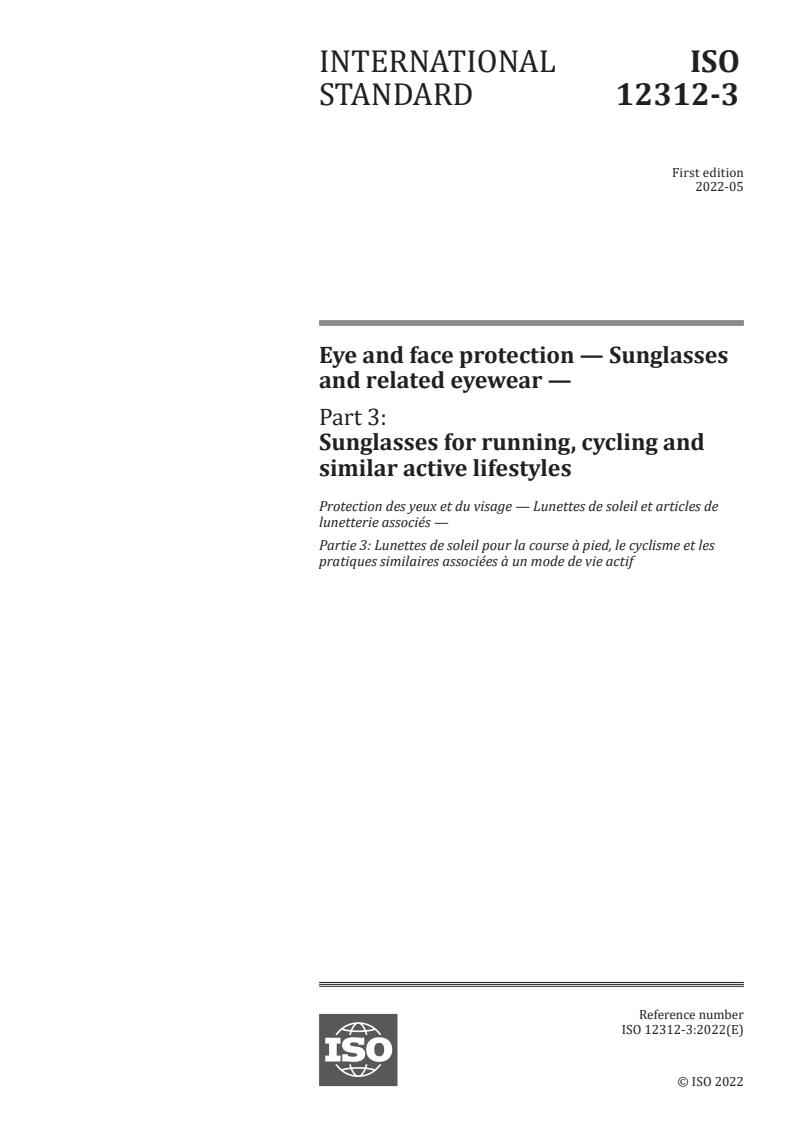
INTERNATIONAL ISO
STANDARD 12312-3
First edition
2022-05
Eye and face protection — Sunglasses
and related eyewear —
Part 3:
Sunglasses for running, cycling and
similar active lifestyles
Protection des yeux et du visage — Lunettes de soleil et articles de
lunetterie associés —
Partie 3: Lunettes de soleil pour la course à pied, le cyclisme et les
pratiques similaires associées à un mode de vie actif
Reference number
© ISO 2022
All rights reserved. Unless otherwise specified, or required in the context of its implementation, no part of this publication may
be reproduced or utilized otherwise in any form or by any means, electronic or mechanical, including photocopying, or posting on
the internet or an intranet, without prior written permission. Permission can be requested from either ISO at the address below
or ISO’s member body in the country of the requester.
ISO copyright office
CP 401 • Ch. de Blandonnet 8
CH-1214 Vernier, Geneva
Phone: +41 22 749 01 11
Email: copyright@iso.org
Website: www.iso.org
Published in Switzerland
ii
Contents Page
Foreword .iv
1 Scope . 1
2 Normative references . 1
3 Terms and definitions . 1
4 Construction and materials .2
5 Transmittance . 2
6 Refractive power . 2
7 Robustness . 2
7.1 Frame deformation and retention of filters. 2
7.2 Increased endurance of sunglasses . 2
7.3 Resistance to perspiration . 2
7.4 Increased robustness of the sunglass, strength level 2 . 2
7.5 Impact resistance of the filter, strength level 3 (optional requirement) . 2
8 Resistance to solar radiation . 2
9 Resistance to ignition . 3
10 Resistance to abrasion (optional requirement) . 3
11 Resistance to fogging (optional requirement) . 3
12 Protective requirements . 3
12.1 Field of view and coverage area . 3
12.2 Temporal protective requirements . 3
13 Information and labelling .3
13.1 Information to be provided with each pair of sunglasses . 3
13.2 Additional information. 5
14 Selection of test samples . 5
14.1 General . 5
14.2 Preparation and conditioning of test samples . 5
Bibliography . 7
iii
Foreword
ISO (the International Organization for Standardization) is a worldwide federation of national standards
bodies (ISO member bodies). The work of preparing International Standards is normally carried out
through ISO technical committees. Each member body interested in a subject for which a technical
committee has been established has the right to be represented on that committee. International
organizations, governmental and non-governmental, in liaison with ISO, also take part in the work.
ISO collaborates closely with the International Electrotechnical Commission (IEC) on all matters of
electrotechnical standardization.
The procedures used to develop this document and those intended for its further maintenance are
described in the ISO/IEC Directives, Part 1. In particular the different approval criteria needed for the
different types of ISO documents should be noted. This document was drafted in accordance with the
editorial rules of the ISO/IEC Directives, Part 2 (see www.iso.org/directives).
Attention is drawn to the possibility that some of the elements of this document may be the subject of
patent rights. ISO shall not be held responsible for identifying any or all such patent rights. Details of
any patent rights identified during the development of the document will be in the Introduction and/or
on the ISO list of patent declarations received (see www.iso.org/patents).
Any trade name used in this document is information given for the convenience of users and does not
constitute an endorsement.
For an explanation on the voluntary nature of standards, the meaning of ISO specific terms and
expressions related to conformity assessment, as well as information about ISO's adherence to the
World Trade Organization (WTO) principles in the Technical Barriers to Trade (TBT) see the following
URL: www.iso.org/iso/foreword.html.
This document was prepared by Technical Committee ISO/TC 94, Personal safety – Personal protective
equipment, Subcommittee SC 6, Eye and face protection.
This document differs from ISO 12312-1 in that the requirements for mechanical strength given in 7.2,
7.3 and 7.4 are mandatory (see 3.1), whereas they are optional in ISO 12312-1.
A list of all parts in the ISO 12312 series can be found on the ISO website.
iv
INTERNATIONAL STANDARD ISO 12312-3:2022(E)
Eye and face protection — Sunglasses and related
eyewear —
Part 3:
Sunglasses for running, cycling and similar active lifestyles
1 Scope
This document is applicable to all nominally afocal (plano power) sunglasses for protection against
environmental elements, such as solar radiation, wind, dust and rain when running, cycling and
following similar active lifestyle recreational activities but not intended for competitive sporting
activities where enhanced impact resistance is required.
The document specifies additional material, design, performance and marking requirements. The other
applicable requirements are given in ISO 12312-1.
This type of sunglass is designed to reduce secondary hazards to the wearer in an accident rather than
to provide high amounts of impact protection which may be difficult in a spectacle format.
This document is not applicable to:
a) eyewear for protection against radiation from artificial light sources, such as those used in solaria;
b) eye protectors intended for specific sports, e.g. ski goggles or other types – see ISO 18527 (all parts);
c) eye protectors for sports that include the use of a ball, stick, bat, racquet or other implement;
d) sunglasses that have been medically prescribed for attenuating solar radiation;
e) products intended for direct observation of the sun, such as for viewing a partial or annular solar
eclipse, for which ISO 12312-2 applies;
f) products intended for occupational eye protection – for example, see ISO 16321 (all parts).
2 Normative references
The following documents are referred to in the text in such a way that some or all of their content
constitutes requirements of this document. For dated references, only the edition cited applies. For
undated references, the latest edition of the referenced document (including any amendments) applies.
ISO 12312-1:2022, Eye and face protection — Sunglasses and related eyewear — Part 1: Sunglasses for
general use
ISO 4007, Personal protective equipment — Eye and face protection — Vocabulary
ISO 18526-3:2020, Eye and face protection — Test methods — Part 3: Physical and mechanical properties
3 Terms and definitions
For the purposes of this document, the terms and definitions given in ISO 4007, ISO 12312-1 and the
following apply.
...