


ISO 10161-1:1993
(Main)Information and documentation — Open Systems Interconnection — Interlibrary Loan Application Protocol Specification — Part 1: Protocol specification
Information and documentation — Open Systems Interconnection — Interlibrary Loan Application Protocol Specification — Part 1: Protocol specification
Information et documentation — Interconnexion de systèmes ouverts (OSI) — Spécification du protocole d'application pour les prêts entre bibliothèques — Partie 1: Spécification du protocole
General Information
- Status
- Withdrawn
- Publication Date
- 10-Feb-1993
- Withdrawal Date
- 10-Feb-1993
- Technical Committee
- ISO/TC 46/SC 4 - Technical interoperability
- Drafting Committee
- ISO/TC 46/SC 4 - Technical interoperability
- Current Stage
- 9599 - Withdrawal of International Standard
- Start Date
- 12-Jun-1997
- Completion Date
- 12-Feb-2026
Relations
- Effective Date
- 15-Apr-2008
Get Certified
Connect with accredited certification bodies for this standard

BSI Group
BSI (British Standards Institution) is the business standards company that helps organizations make excellence a habit.

NYCE
Mexican standards and certification body.
Sponsored listings
Frequently Asked Questions
ISO 10161-1:1993 is a standard published by the International Organization for Standardization (ISO). Its full title is "Information and documentation — Open Systems Interconnection — Interlibrary Loan Application Protocol Specification — Part 1: Protocol specification". This standard covers: Information and documentation — Open Systems Interconnection — Interlibrary Loan Application Protocol Specification — Part 1: Protocol specification
Information and documentation — Open Systems Interconnection — Interlibrary Loan Application Protocol Specification — Part 1: Protocol specification
ISO 10161-1:1993 is classified under the following ICS (International Classification for Standards) categories: 35.240.30 - IT applications in information, documentation and publishing. The ICS classification helps identify the subject area and facilitates finding related standards.
ISO 10161-1:1993 has the following relationships with other standards: It is inter standard links to ISO 10161-1:1997. Understanding these relationships helps ensure you are using the most current and applicable version of the standard.
ISO 10161-1:1993 is available in PDF format for immediate download after purchase. The document can be added to your cart and obtained through the secure checkout process. Digital delivery ensures instant access to the complete standard document.
Standards Content (Sample)
I N TE RN AT I O NA L
IS0
STANDARD
10161-1
First edition
1993-02-1 5
Information and documentation - Open
Systems Interconnection - Interlibrary
Loan Application Protocol Specification -
Part 1:
Protocol specification
Information et documentation - Interconnexion de systèmes ouverts
(OS) - Spécification du protocole d'application pour les prêts entre
bibliothèques -
Partie 1: Specification du protocole
Reference number
IS0 1 O1 61 -1 : 1993(E)
,' __._I
IS0 10161-1 :1993(E)
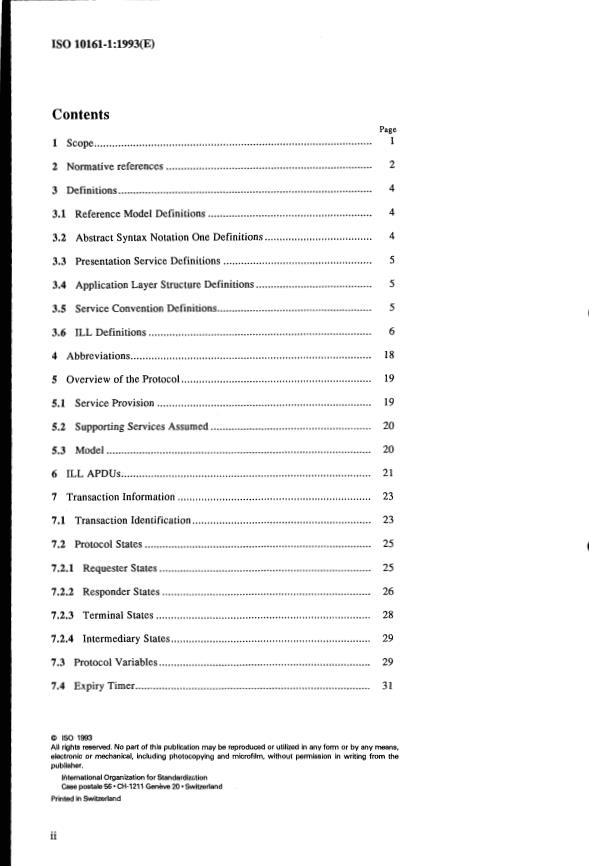
Contents
Page
1 Scope . 1
.....................................................................
2 Normative references 2
..................................................................................... 4
3 Definitions
3.1 Reference Model Definitions . 4
3.2 Abstract Syntax Notation One Definitions .
3.3 Presentation Service Definitions . 5
Application Layer Structure Definitions .
3.4
3.5 Service Convention Definitions . 5
3.6 ILL Definitions . 6
.................................................................................
4 Abbreviations 18
5 Overview of the Protocol . 19
5.1 Service Provision . 19
5.2 Supporting Services Assumed . 20
5.3 Model . 20
6 ILL APDUs . 21
7 Transaction Information . 23
7.1 Transaction Identification . 23
7.2 Protocol States . 25
7.2.1 Requester States . 25
7.2.2 Responder States . 26
7.2.3 Terminal States . 28
7.2.4 Intermediary States . 29
7.3 Protocol Variables . 29
7.4 Expiry Timer . 31
Q3 IS0 1993
All rights reserved . No part of this publication may be reproduced or utilized in any form or by any means.
electronic or mechanical. including photocopying and microfilm. without permission in writing from the
publisher .
Ifiternational Organization for Standardizûtion
Case postale 56 . CH-1211 Genève 20 *Switzerland
Printed in Switzerland
ii
IS0 10161-1:1993(E)
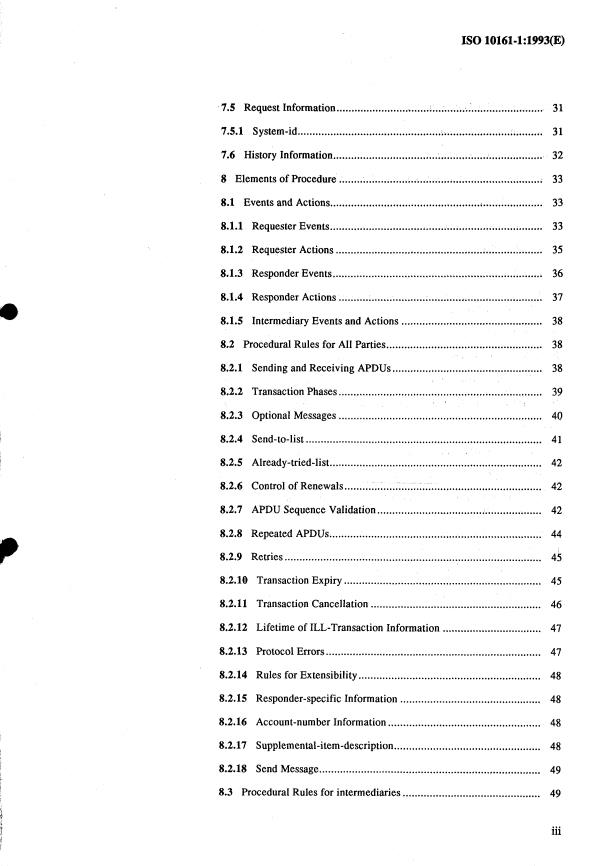
7.5 Request Information . 31
7.5.1 System-id . 31
7.6 History Information . 32
8 Elements of Procedure . 33
8.1 Events and Actions . 33
8.1.1 Requester Events . 33
8.1.2 Requester Actions . 35
8J.3 Responder Events . 36
8.1.4 Responder Actions . 37
8.1.5 Intermediary Events and Actions . 38
8.2 Procedural Rules for All Parties .
Sending and Receiving APDUs . 38
8.2.1
8.2.2 Transaction Phases . 39
8.2.3 Optional Messages . 40
8.2.4 Send-to-list . 41
8.2.5 Already-tried-list . 42
8.2.6 Control of Renewals .
8.2.7 APDU Sequence Validation . 42
8.2.8 Repeated APDUs . 44
8.2.9 Retries . 45
8.2.10 Transaction Expiry . 45
8.2.11 Transaction Cancellation . 46
8.2.12 Lifetime of ILL-Transaction Information . 47
8.2.13 Protocol Errors . 47
8.2.14 Rules for Extensibility . 48
8.2.15 Responder-specific Information . 48
8.2.16 Account-number Information . 48
8.2.17 Supplemental-item-description . 48
!
8.2.18 Send Message . 49
8.3 Procedural Rules for intermediaries . 49
iii
IS0 10161-1:1993(E)
.
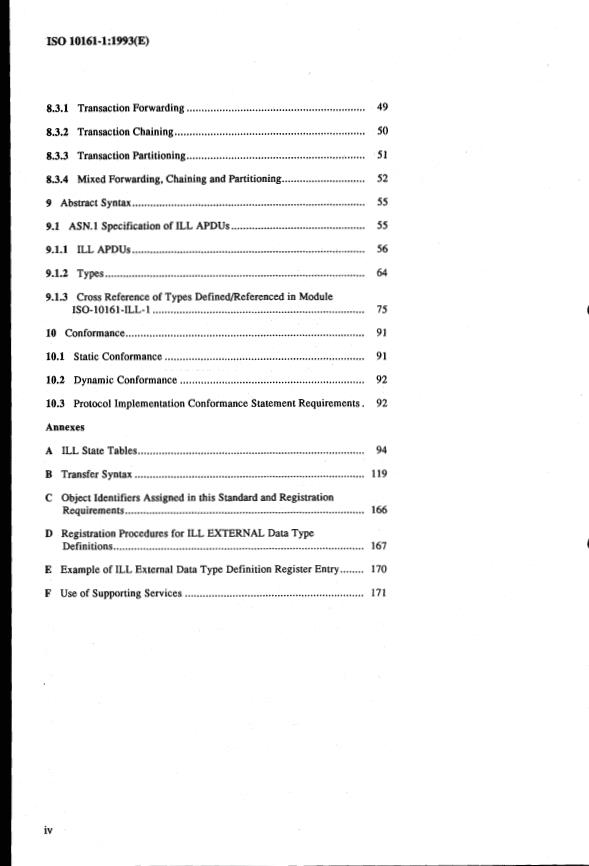
8.3.1 Transaction Forwarding . 49
8.3.2 Transaction Chaining . 50
8.3.3 Transaction Partitioning . 51
8.3.4 Mixed Forwarding. Chaining and Partitioning . 52
9 Abstract Syntax . 55
9.1 ASN . 1 Specification of ILL ApDUs . 55
9.1.1 ILL APDUs . 56
9.1.2 Types . 64
9.1.3 Cross Reference of Types Definedmeferenced in Module
ISO-10161-ILL-1 . 75
10 Conformance . 91
10.1 Static Conformance . 91
10.2 Dynamic Conformance . 92
10.3 Protocol Implementation Conformance Statement Requirements . 92
Annexes
A ILL State Tables . 94
B Transfer Syntax . 119
C Object Identifiers Assigned in this Standard and Registration
Requirements . 166
D Registration Procedures for ILL EXTERNAL Data Type
Definitions . 167
E Example of ILL External Data Type Definition Register Entry . 170
F Use of Supporting Services . 171
iv
IS0 10161-1:1993(E)
Foreword
IS0 (the International Organization for Standardization) is a world-
wide federation of national standards bodies (IS0 member bodies).
The work of preparing International Standards is normally carried out
through IS0 technical committees. Each member body interested in a
subject for which a technical committee has been established has the
right to be represented on that committee. International organizations,
governmental and non-governmental, in liaison with ISO, also take
part in the work. IS0 collaborates closely with the International Elec-
trotechnical Commission (IEC) on all matters of electrotechnical stan-
dardization.
Draft International Standards adopted by the technical committees are
circulated to the member bodies for voting. Publication as an Inter-
national Standard requires approval by at least 75 % of the member
bodies casting a vote.
International Standard IS0 1016 1 was prepared by Technical Com-
mittee ISO/TC 46, Information and documentation.
Annexes A to D form an integral part of this International Standard.
Annexes E and F are for information only.
IS0 10161 consists of the following parts, under the general title
Information and documentation - Open Systems Interconnection -
Interlibrary Loan Application Protocol Specification:
- Part I: Protocol specification
- Part 2: Protocol implementation conformance statement pro-
forma
Introduction
This standard is one of a set of Intemational Standards produced to facilitate the intercon-
nection of computer systems. It is related to other international standards in the set as
defined by the Reference Model for Open Systems Interconnection (IS0 7498). The Ref-
erence Model subdivides the area of standardization for interconnection into a series of
layers of specification, each of manageable size.
The aim of Open Systems Interconnection is to allow, with a minimum of technical agree-
ment outside the interconnection standards, the interconnection of computer systems:
a. from different manufacturers,
b. under different managements,
of different levels of complexity,
c.
d. of different ages.
This International Standard provides a protocol specification for Interlibrary Loan (ILL)
communication. The ILL protocol operates in the Application Layer and allows the par-
ties involved in an ILL-transaction to progress through the ILL-transaction in an orderly
and defined way.
10160, the
The ILL protocol has been designed to support the ILL services defined in IS0
ILL Application Service Definition.
This International Standard is one of a number of related standards supporting the inter-
connection of library systems. These standards can be used by themselves or in a coopera-
tive manner to support library applications requiring a mixture of communications ser-
vices. For example, IS0 10163, which supports remote access to bibliographic databases,
could be used in conjunction with the ILL protocol to obtain item identification informa-
tion. The control and management of interactions among such bibliographic applications
are local matters that are outside the scope of this International Standard.
Security and accounting issues as they relate to ILL operations are for further study.
The specification technique used in this International Standard is consistent with tech-
niques used in defining other OS1 protocols. Within most of this document, the technique
is self-explanatory. The Abstract Syntax of the ILL Application Protocol Data Units
(APDUs) is defined by means of the ASN.l specification technique specified in IS0 8824.
This International Standard contains six annexes. Annexes A to D are normative. Annex A
specifies the state tables for the ILL protocol. Annex B specifies the encoding rules for
generating a transfer syntax compatible with EDIFACT as defined in IS0 9735. Annex C
specifies the object identifiers assigned in this standard and registration requirements.
vi
IS0 10161-1:1993(E)
Annex D defines the registration procedures for ILL EXTERNAL data type definitions.
Annex E is an example of an ILL EXTERNAL data type definition registry entry and
annex F describes the possible mappings of this protocol onto supporting services.
Vii
~
INTERNATIONAL STANDARD IS0 10161-1:1993(E)
Information and documentation - Open Systems
Interconnection - Interlibrary Loan Application
Protocol Specification - Part II: Protocol specification
1 Scope
This International Standard defines the protocol for an ILL application-service-element
(ASE). It specifies the behaviour which must be exhibited by a system in order to take
part in the provision of the IS0 interlibrary loan service.
It provides a formai statement of the rules of behaviour of each of the two or more entities
b
participating in an ILL transaction. It specifies:
a. the actions to be taken on receiving request service primitives issued by an ILL ser-=
vice-user;
b. the actions to be taken on receiving application-protocol-data-units (APDUs);
c. the actions to be taken as a result of events within the local system.
It provides a specification (in clause 9) of the abstract syntax required to convey ,the ILL
protocol APDUs.
It states the conformance requirements to be met by implementors of this protocol (in
clause 10).
The scope of the ILL protocol is restricted to the interconnection of systems; it does not
specify or restrict the possible implementation of interfaces within a computer system.
Computer systems may range from stand-alone workstations to mainframes.
This International Standard is intended for use by libraries, information utilities such as
union catalogue centres, and any other system which processes bibliographic information.
These systems may participate in an interlibrary loan transaction in the role of requester
(i.e. an initiator of ILL requests), responder (i.e. a provider of bibliographic material or
information) and/or intermediary (i.e. an agent that acts on behalf of a requester to find
suitable responders).
Various intenvorking topologies are supported, ranging from shnple two-party hterac-
tions, to multi-party interactions.
IS0 10161-1:1993(E)
2 Normative references
The following standards contain provisions which, through reference in this text, constitute
provisions of this International Standard. At the time of publication, the editions indicated were
valid. All standards are subject to revision, and parties to agreements based on this Inter-
national Standard are encouraged to investigate the possibility of applying the most recent
editions of the standards indicated below. Members of IEC and IS0 maintain registers of
currently valid International Standards.
IS0 646:1983, information processing systems - IS0 7-bit coded character set for infor-
mation interchange.
IS0 2108: 1978, Documentation - international standard book numbering (ISBN).
IS0 2709: 198 1, Documentation - Format for bibliographic information interchange on
magnetic tape.
IS0 3297: 1986, Documentation - International standard serial numbering (iSSN).
IS0 4217: 1990, Codes for the representation of currencies and funds.
IS0 7498: 1984, Information processing systems - Open Systems interconnection - Basic
Reference Model.
IS0 8459-1:1988, Documentation - Bibliographic data element directory - Part I: Inter-
loan applications.
ISO/TR 8509: 1987, Information processing systems - Open Systems interconnection -
Service conventions.
IS0 8601 : 1988, Data elvents and interchange formats - Information interchange - Rep-
,
resentatïqn of dates aydtimes.
--.
-\
\,
IS0 8649: 1989, Information processing systems - Open Systems Interconnection - Service
definition for the Association Control Service Element.
IS0 8650: 1988, information processing systems - Open Systems interconnection - Protocol
specification for the Association Control Service Element.
IS0 8822: 1988, Information processing systems - Open Systems Interconnection - Connec-
tion oriented presentation service definition.
ISO/IEC 8824: 1990, Information technology - Open Systems Interconnection - Specifi-
cation of Abstract Syntax Notation One (ASN.1).
ISO/IEC 8825: 1990, information technology - Open Systems Interconnection - Specifi-
cation of Basic Encoding Rules for Abstract Syntax Notation One (ASN.1).
ISO/IEC 9545: 1989, Information technology - Open Systems Interconnection - Application
Layer structure.
IS0 10161-1:1993(E)
IS0 9735: 1988, Electronic data interchange for administration, commerce and transport
(EDIFACT) -Application level syntax rules.
IS0 9834- 1 :-l), Information technology - Open Systems Interconnection - Procedures for
the operation of OSI Registration Authorities - Part 1: General procedures.
ISO/IEC 10021 -4: 1990, Information technology - Text communication - Message-Oriented
Text Interchange Systems (MOTIS) - Part 4: Message Transfer System: Abstract Service
Definition and Procedures.
IS0 10160: 1993, Information and documentation - Open Systems Interconnection - Inter-
library Loan Application Service Definition.
IS0 10163-1: 1993, Information and documentation - Open Systems Interconnection - Search
and Retrieve Application Protocol Specification - Part 1 : Protocol specif cation.
1) To be published.
IS0 10161-1:1993(E)
3 Definitions
For the purposes of this International Standard, the following definitions apply.
3.1 Reference Model Definitions
This International Standard is based on the concepts developed in IS0 7498:1984 and
makes use of the following terms found in it. These terms are replicated here as a conve-
nience to the reader.
3.1.1 Application Layer: The seventh and highest layer in the Reference Model
for Open Systems Interconnection (OSI); it serves as the window between
correspondent application-processes which are using the OS1 to exchange
meaningful information.
3.1.2 application-entity: The aspects of an application-process pertinent to OSI.
3.1.3 application-process: An element within a real open system which performs
the infomation processing for a particular application.
3.1.4 application-protocol-data-unit: A unit of data specified in an application-
protocol and consisting of application-protocol-information and possibly
application-user-data.
3.1.5 application-service-element: That part of an application-entity which pro-
vides an OS1 environment capability, using underlying services when appro-
priate.
3.1.6 (N)-service: A capability of the (N)-layer and the layers beneath it, which is
provided to (N+l)-entities at the boundary between the (N)-layer and the
(N+1 )-layer.
\
NOTE - Ànxapplication-service does not provide a capability to higher layer
entities, but rather to application-processes.
3.1.7 presentation-service: A capability of the Presentation Layer and the layers
beneath it, which is provided to application-entities at the boundary between
the Presentation and the Application Layer.
3.1.8 transfer syntax: The concrete syntax used in the transfer of data between
open systems.
3.2 Abstract Syntax Notation One Definitions
This International Standard makes use of the following terms defined in IS0 8824: 1990.
3.2.1 data type; type: A named set of values.
3.2.2 simple type: A type defined by directly specifying the set of its values.
IS0 10161-1:1993(E)
3.2.3 structured type: A type defined by reference to one or more other types.
3.2.4 component type: One of the types referenced when defining a structured
type.
3.2.5 value: A distinguished member of a set of values.
3.3 Presentation Service Definitions
This International Standard makes use of the following term defined in IS0 8822:1988.
3.3.1 abstract syntax: Those aspects of the rules used in the formal specification of
data which are independent of the encoding technique to represent the data.
3.4 Application Layer Structure Definitions
This International Standard makes use of the following terms defined in IS0 9545: 1989.
3.4.1 application-association: A cooperative relationship between two applica-
tion-entity-invocations for the purpose of cornmunication of information and
coordination of their joint operation. This relationship is formed by the
exchange of application-protocol-control-information using the Presentation
Service.
3.4.2 application-context: A set of rules shared in common by two application-
entity-invocations governing their behavior in order to enable their coopera-
tive operation.
NOTE - an application-context is a shared conceptual schema for the uni-
verse of discourse for communication.
3.4.3 application-context-definition: The description of an application-context.
application-entity-invocation: A specific utilization of part or all of the
3.4.4
capabilities of a given application-entity in support of the communications
requirements of an application-process-invocation.
3.4.5 application-process-invocation: A specific utilization of part or all of the
capabilities of a given application-process in support of a specific occasion of
information processing.
3.5 Service Convention Definitions
This International Standard makes use of the following terms defined in IS0 TR
8509: 1987.
3.5.1 indication primitive: A representation of an interaction in which a service-
provider either:
IS0 10161-1:1993(E)
indicates that it has, on its own initiative, invoked some procedure; or
a.
indicates that a procedure has been invoked by the service-user at the
b.
peer service-access-point.
3.5.2 non-confirmed service: A distinct part of the total (N)-service which does
not result in an explicit confirmation from the service-provider to the initiating
service-user.
3.5.3 provider-initiated service: A distinct part of the total (N)-service which is
initiated by the service-provider rather than the service-user.
3.5.4 request primitive: A representation of an interaction in which a service-user
invokes some procedure.
3.5.5 service primitive: An abstract, implementation-independent representation of
an interaction between service-user and the service-provider.
3.5.6 service-provider: An abstract of the totality of those entities which provide a
service to peer service-users.
3.5.7 service-user: An entity in a single open system that makes use of a service.
3.6 ILL Definitions
For the purpose of this International Standard, the following definitions apply to the
ASN.l value reference names and values which are associated with simple data types, as
specified in clause 9. Of these definitions, the following are repetitions of those found in
IS0 8459- 1 1988:
author
call number
client identifier
client-status
country
edition
place-of-publication
post-office-box
postal-code
publisher
sponsoring body
street -and-number
title
transport at ion-rnode
IS0 10161-1:1993(E)
volume-issue
NOTE - volume-issue are defined together here, but separately in IS0 $459-1: 1988.
account-number: The nuniber of an account to which a credit or debit is
3.6.1
made. A requester typically has been assigned a separate account for each
responder. (Variation of IS0 8459-1)
3.6.2 additional-no-letters: (additional-numbers-letters) A number or code identi-
fying an item.
3.6.3 already-forwarded: Responder indication that an ILL request has already
been forwarded.
3.6.4 already-tried-list: Lkt of institutions which have been approached but were
unable to supply requested item.
3.6.5 answer: A code representing a yes or no response.
3.6.6 at bindery: Title is owned but the requested item is at the bindery.
3.6.7 author: Name of the person or corporate body responsible for the intellectual
or artistic content of an item, including composers, creators or originators of
an item.
3.6.8 author-of-article: Author of an item which is a component part of another
item.
3.6.9 badly-structured-APDU: The structure of a received APDU does not con-
form to the standard notation and encoding defined in 1SO 8824 and 8825, or
to the EDIFACT encoding defined in IS0 9735 and Annex B of this Interna-
tional Standard. For example, a received APDU does not match its stated
length.
3.6.10 being-processed-for-supply : Item is being retrieved, copied, and/or pack-
aged for delivery.
3.6.11 call-number: Notation assigned to an item indicating its physical location in
the owner institution.
3.6.12 can-send-CHECKED-IN: An indication by the responder that it is capable
of supplying the CHECKED-IN APDU.
3.6.13 can-send-RECEIVED: An indication by the requester that it is capable of
supplying the RECEIVED APDU.
3.6.14 can-send-RETURNED: An indication by the requester that it is capable of
supplying the RETURNED APDU.
3.6.15 can-send-SHIPPED: An indication by the responder that it is capable of sup-
plying the SHIPPED APDU.
IS0 10161-1:1993(E)
3.6.16 cannot-send-onward: An intermediary is unable to send on a request due to
communication problems.
3.6.17 chargeable-units: The number of units supplied for which there is a charge.
3.6.18 charges: The responder’s charges for the provision of the requested service.
3.6.19 city: A phrase used to identify a city, town or village. (Variation of IS0
8459-1)
3.6.20 client-identifier : Number or code used to identify the client uniquely.
3.6.21 client-name: Name of the person or institution for which the item lias been
requested. (Variation of IS0 8459-1)
3.6.22 client-signature-required: Responder’s stipulation that the client must sign
the signature sheet enclosed with the item.
3.6.23 client-status: Professional level or position of the client.
3.6.24 conditions: A code used to indicate the conditions under which an item may
be borrowed.
3.6.25 copyright-compliance: Requester notation indicating the applicable copy-
right regulations or laws to which the requester is adhering.
3.6.26 correlation-information: Information that is used to correlate an error report
with the service request to which the report relates.
3.6.27
cost: The amount asked, taken or billed by the responder for the service sup-
plied.
3.6.28 cost-estimate: Estimate of the cost to provide the service requested.
3.6.29 cost-exceeds-limit: Responder indication that the minimum cost to supply the
request is greater than the amount authorized.
3.6.30 country: A phrase used to identify a country.
3.6.31
currency-code: A code identifying the currency of an amount, according to
IS0 4217-1981.
3.6.32 current-state: A code identifying the state of the ILL-transaction.
3.6.33 date-checked-in: The date on which a loaned item is received back by the
responder.
3.6.34
date-due: The date by which the loaned item should be returned to the
responder. Note that this should reflect the latest date-due.
3.6.35 date-for-reply: The date by which a reply should be returned to the
responder.
IS0 10161-1:1993(E)
date-of-last-transition: The date on which the last state transition occurred.
3.6.36
3.6.37 date-of-most-recent-service: The date when the most recent service event
occurred at the system providing the status report. This is either a service
invoked by the system providing the status report or a service reflected in a
received APDU.
3.6.38 date-of-service: The date on which a service concerning an ILL-transaction
is invoked.
date-received: The date when the item is received by the requester.
3.6.39
3.6.40 date-requested: The date the ILL request was initiated by the requester.
3.6.41 date-returned: The date when the item was returned to the responder.
3.6.42 date-shipped: The date when the item was shipped to the requester.
3.6.43 delivery-service: A name or code for the delivery service or method to be
used in transporting the item.
3.6.44 desired-due-date: The proposed due date for the renewed loan.
duplicate-transaction-id: The transaction-id value of an ILL-REQUEST
3.6.45
APDU is an illegal duplicate, i.e. the value is identical to one for an existing
ILL-REQUEST received from the same requester.
3.6.46 edition: Al1 the copies of an item produced from one master copy or substan-
tially the same type image, having the same contents, and, in the case of non-
book materials, issued by a particular publishing agency or group of such
agencies.
3.6.47 estimated-date-available: Date when an item placed on hold is expected to
become available.
3.6.48 expiry date: The date on which an ILL-transaction expires automatically.
3.6.49 expiry flag: An indication of whether an expiry date has been set for an ILL-
transaction, and if so, whether that date is the "need-before-date", or some
other date.
3.6.50 extended-postal-delivery-address: Additional information in the postal
address necessary to identify the exact point of delivery, e.g. room and floor
number in a large building.
3.6.51 final-responder: Institution which supplies a requested item. This term is
used when it is necessary to distinguish between the responder of an ILL-
an ILL-sub-transaction.
transaction and the responder of
3.6.52 forward flag: An indication whether a received ILL-REQUEST has been for-
warded from an intermediary.
IS0 10161-1:1993(E)
3.6.53 forward note: Note added to the ILL-REQUEST by the responder when it is
forwarded to a new responder.
general-problem: Code indicating a general problem with a received APDU
3.6.54
detected by the ILL service-provider that is not related to either the transac-
tion-id or permissible state transitions.
3.6.55 ILL-APDU-type: Code identifying the type of APDU received.
ILL-service-type: A code for the type of ILL service requested. These can be
3.6.56
listed in a preferred order.
3.6.57 ILL-transaction: A single complete instance of the whole ILL cycle, includ-
ing all of the actions, service primitives, and messages involved from the ini-
tial ILL-Request until the cycle is concluded, as with the return of the
requested material.
3.6.58 in-process: Item has been received but is not yet ready for use.
3.6.59 in-use/on-loan: Item is owned but is currently being used by a client or is on
loan to another institution.
3.6.60 initial-requester: Person or institution which initiates an ILL- transaction;
this term is used when it is necessary to distinguish between the requester of an
ILL-transaction and the requester of an ILL sub-transaction.
3.6.61 initial-requester-address: Information identifying the telecommunications
service and address by which the initial-requester can be reached.
3.6.62 initiator-of-most-recent service: Identification information of the requester
or responder who initiated the most recent service.
3.6.63 institution-symbol: Number(s), letter(s) or a code serving to identify unam-
biguously and in an abbreviated format a library, institution or corporation that
is participating in an ILL-transaction, e.g. institution’s national union cata-
logue symbol.
3.6.64 insured-for: Notation of the amount of insurance purchased against loss or
damage of items.
3.6.65 intermediary-id: Identification information of an ILL-transaction intermedi-
ary.
3.6.66 intermediary-problem: Code indicating that the intermediary has a problem
in processing the request.
3.6.67 invalid-transaction-id: The transaction-id value of an ILL-REQUEST is
invalid, e.g. the value violates the assignment rules of this International Stan-
dard, or an unknown person-or-institution symbol or person-or-institution-
name is encountered.
IS0 10161-1:1993(E)
3.6.68 ISBN: The International Standard Book Number assigned to a monograph as
prescribed by IS0 3297-1986.
3.6.69 ISSN: The International Standard Serial Number assigned to a serial title as
prescribed by IS0 2108-1978.
3.6.70 item-type: A code identifying the bibliographic form in which the item has
been produced.
3.6.71 lacking: The title is owned but not the component part or pages requested.
3.6.72 lacks-copyright-compliance: Compliance with applicable copyright regula-
tions or laws must be indicated before copying can be done.
3.6.73 level-of-service: A code that indicates the level of search detail required or
the duration of time within which a response is required. Note that this code
reflects regional or national conventions.
3.6.74 library-use-only : Responder indication that the item may not be removed
froin the requesting institution.
3.6.75 location-address: Information identifying the telecommunication service and
address or the postal address by which the instituition that owns the item can
be reached.
3.6.76 location-id: The symbol or name of the institution that owns the requested
item.
3.6.77 location-note: Additional information that supplements or corrects the biblio-
graphic data provided in the ILL-REQUEST or that clarifies the location pro-
vided.
3.6.78 locations-not-found: No potential responder has been identified.
3.6.79 lost: Item declared missing and/or withdrawn from the collection.
3.6.80 mandatory-messaging-not-supported: The responder does not provide the
SHIPPED and/or CHECKED-IN niessage(s).
3.6.81 maximum-cost: Maximum amount that will be paid to obtain an ILL service.
(Variation of IS0 8459-1).
medium-characteristics: Technical specifications of the physical form in
3.6.82
which the requested item is to be supplied.
3.6.83 medium-type: A code identifying the medium in which the item has been
produced. (Variation of IS0 8459-1)
3.6.84 mistyped-APDU: The structure of the APDU does not conform to the struc-
ture defined in this International Standard. For example, it contains a data type
not defined for that version of the protocol.
IS0 10161-1:1993(E)
3.6.85 monetary-value: The value of an amount.
most-recent-service: A code identifying the last service event occurring at
3.6.86
the system providing the status report. This is either a service invoked by the
system providing the status report or a service reflected in a received APDU.
A status report sent in response to a status query will not indicate STATUS-
QUERY as the most-recent-service because this would not be hiformative.
niost-recent-service-note: The contents of the NOTE parameter from the
3.6.87
most recent service primitive.
3.6.88 name-of-institution: A word, phrase or abbreviation which identifies a
library, institution or corporation. (Variation of IS0 8459-1)
name-of-person: A word or combination of words and/or initials by which
3.6.89
an individual is regularly known or designated and which identifies the person
participating in the ILL-transaction.
3.6.90 national-bibliography-no: Information identifying the national bibliography
and the corresponding record number for the desired item, e.g. Library of
Congress Card Number (LCCN).
3.6.91 need-before-date: The date by which the item or a reply is needed.
3.6.92 no-of-units-per-medium: The number of physical pieces shipped per sup-
plied medium.
no-reproduction: Item may not be photocopied or mechanically reproduced
3.6.93
in whole or in part.
3.6.94 non-circulating: Item is held but is not available for loan.
not-available: Due to some technical problem the service-user is temporarily
3.6.95
unable to process the service request.
3.6.96 not-found-as-cited: The item identification information is believed by the
responder to be either incomplete or incorrect.
3.6.97 not-on-shelf Item is awned by the institution but is not charged out and is
not on shelf.
3.6.98 not-owned: Title is not owned by the responder.
note: Additional information which is not covered by any other data ele-
3.6.99
ments.
3.6.100 notification note: Note added to the FORWARD-NOTIFICATION by the
responder.
3.6.101 on-hold: Item has been requested by another institution or person and will be
supplied to that institution or person as soon as it becomes available.
IS0 10161-1:1993(E)
3.6.102 on-order: Item has been ordered but has not been received by the responder.
3.6.103 on-reserve: Item is owned but set aside for restricted use.
3.6.104 pagination: The numbering of the pages of an item or a component part of an
item. (Variation of IS0 8459-1)
3.6.105 payment-provided: Requester statement that payment of responder charges
has been authorized, is being sent, or will be enclosed with the returned mate-
rial.
3.6.106 permission-to-chain: An indication granting permission to the responder to
initiate a chained sub-transaction with another responder.
permission-to-change-send-to-list : An indication granting permission to
3.6.107
the responder to alter the contents of the send-to-list. The nature of the permit-
ted changes depends on the value of the type "preference".
3.6.108 permission-to-partition: An indication granting permission to the responder
to initiate a partitioned sub-transaction with another responder.
3.6.109 permission-to-forward: An indication granting permission to the responder
to forward the request to another responder.
3.6.110 person-symbol: Number(s), ietter(s) or code serving to identify unambigu-
ously and in an abbreviated format a person who is participating in an ILL-
transaction.
3.6.111 physical-medium: See medium-type.
3.6.112 place-of-publication: Geographical location of the publisher, or failing this,
of the printer, distributor or manufacturer.
3.6.113 place-on-hold: A request that a hold be placed on the item which is to be sup-
plied as soon as it becomes available.
3.6.114 policy-problem: Responder indication that there is no policy in place to per-
mit the completion of the request.
3.6.115 poor-condition: Item is owned but its physical condition prohibits lending or
reproduction.
3.6.116 post-office-box: A box number assigned by the post office.
3.6.117 postal-code: A code which identifies a given area within a city or other geo-
graphical area.
3.6.118 preference: An indication of whether the institutions listed in the send-to-list
are to be approached in the orcler of the list or in any order.
prepayment-required: Responder indication that prepayment is required
3.6.119
prior to the processing of the ILL-transaction.
ES0 10161-1:1993(E)
protocol-version-not-sepported: An APDU has been received with a proto-
3.6.120
col-version-number component identifying an unsupported version of the pro-
tocol.
protocol-version-num: A number identifying the protocol version in use.
3.6.121
3.6.122 publication-date: The date of issue of a work as designated by the publisher
of the work.
publication-date-of-components: The publication date assigned by the pub-
3.6.123
lisher to identify the unique bibliographic components of a work.
3.6.124 publisher: Person(s) or organization(s) responsible for the publication of an
item.
reason-locs-provided: A code used to indicate the reason why locations are
3.6.125
provided in response to an ILL request.
3.6.126 reason-no-report: A code used to indicate the reason why no report can be
provided in response to a STATUS-QUERY.
reason-not-available: A code used to indicate the reason for item unavaila-
3.6.127
bility.
3.6.128 reason-unfilled: A code used to indicate the reason for not filling an ILL
request.
3.6.129 reciprocal agreement: Requester indication of a prior agreement regarding
what may be supplied and under what conditions.
3.6.130 region: A phrase used to identify a province, state, region or locale.
3.6.131 renewable: An indication of whether the supplied item is renewable or not.
3.6.132 report-source: Code indicating whether the initiating source of the error
report is the service-user or the service-provider.
3.6.133 report-type: An indication of whether a report is available and if so, whether
it is a status report, error report or both.
3.6.134 requester-id: Identification information of the ILL-transaction requester.
3.6.135
requester-note: Note provided by the ILL-transaction requester.
3.6.136 requester-optional-messages: An indication of whether the requester is cap-
able of supplying the RECEIVED and RETURNED optional messages and
whether the SHIPPED and/or CHECKED-IN optional messages are required
or desired from the responder.
3.6.137 requester-CHECKED-IN: An indication by the requester as to whether or
not it requires or desires to receive the CHECKED-IN APDU.
IS0 10161-1:1993(E)
3.6.138 requester-SHIPPED: An indication by the requester as to whether or not it
requires or desires the SHIPPED APDU.
3.6.139 resource-limitation: The service;user is unable to perform the requested ser-
vice due to resource limitations.
3.6.140 responder-address: Information identifying the telecommunications service
and address by which the responder can be reached.
3.6.141
responder-id: Identification information of the ILL-transaction responder.
3.6.142
responder-note: Note provided by the ILL-transaction responder.
3.6.143 responder-optional-messages: Indication of whether the responder is cap-
able of sending the SHIPPED and/or CHECKED optional messages (for diag-
nostic purposes) and whether the RECEIVED and/or RETURNED messages
are required or desired from the requester.
O 3.6.144 responder-RECEIVED: An indication by the responder as to whether or not
it requires or desires to receive the RECEIVED APDU.
3.6.145 responder-RETURNED: An indication by the responder as to whether or
not it requires or desires to receive the RETURNED APDU.
3.6.146 responder-specific-result: A reason provided in response to an ILL request
which is specific to the responder, i.e. not specified in this standard.
3.6.147 responder-specific-service: A service provided by a responder which is spe-
cific to the responder, i.e. not specified in this standard.
3.6.148 retry-date: The date after which a request may be retried.
3.6.149 retry-flag: Requester indication that the ILL-transaction is or is not a retry
of a previous one.
3.6.150 return-insurance-required: Amount of insurance against loss or damage
required by the responder for the return of a loaned item.
3.6.151 returned-via: Requester’s inethod of shipment used to return the item.
3.6.152 security-problem: An indication that the recipient has encountered a security
problem that prevents it from processing the service request. The possible rea-
sons are outside the scope of this International Standard.
3.6.153 series-title-number: Name given to a number of separate publications related
to one another by the fact that each bears a collective title applying to the
group or subgroup as a whole as well as its own title, and its number within
that group. (Variation of IS0 8459-1)
3.6.154
send-to-list: List of potential responders for forwarded, chained or parti-
tioned ILL-trans actions.
IS0 10161-1:1993(E)
3.6.155 shipped-conditions: Conditions under which an item may be used.
3.6.156 shipped-service-type: A code for the type of ILL service provided.
3.6.157 shipped-via: Lender’s method of shipment used to send the item.
3.6.158 special-collections-supervision-required: Indication by the responder that
the item must be used within the special collections department or archives of
the requester.
3.6.159 sponsoring-body: The corporate body or organization that issued the item or
that is associated with its authorship.
3.6.160 street-and-number: A number and/or phrase used to identify the location of
a building within a city or a rural area.
3.6.161 supplemental-item-description: Additional item description information
that may be represented in a machine-readable format, e.g. MARC record.
3.6.162
...
Questions, Comments and Discussion
Ask us and Technical Secretary will try to provide an answer. You can facilitate discussion about the standard in here.
Loading comments...