

ISO 2821:1974
(Main)Leather — Raw hides of cattle and horses — Preservation by stack salting
General Information
- Abstract
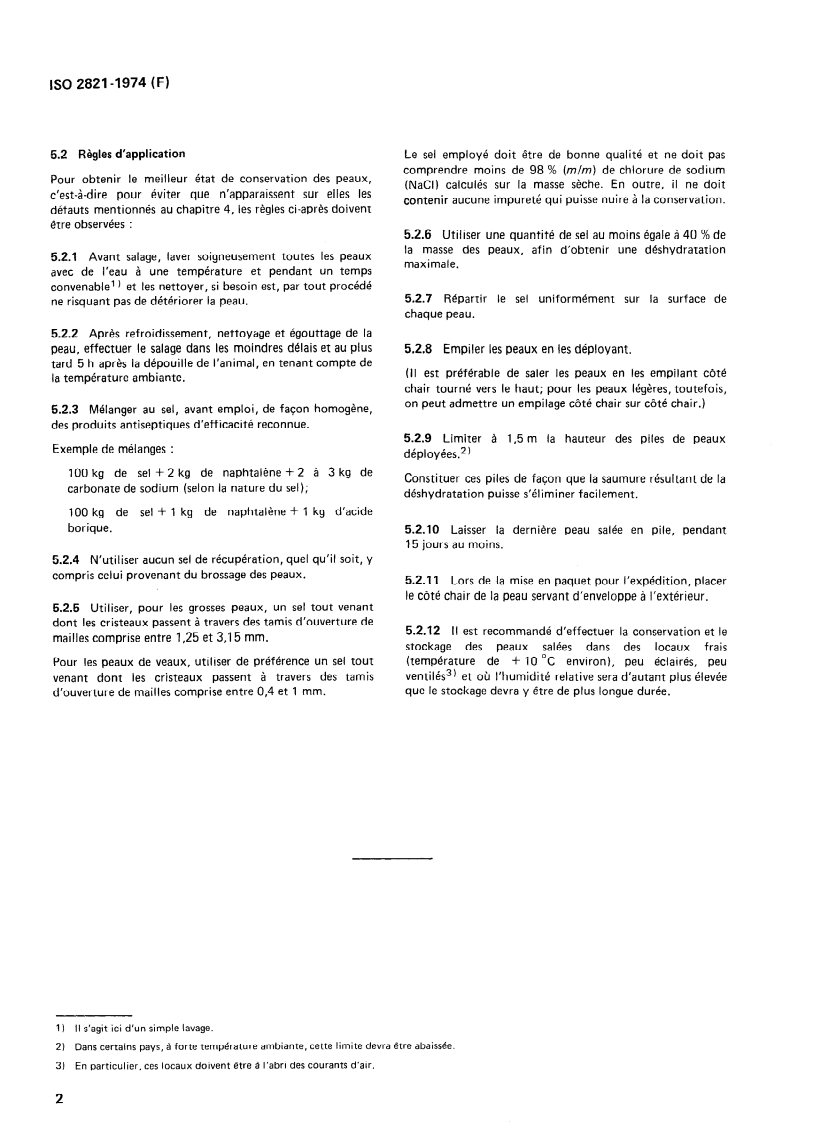
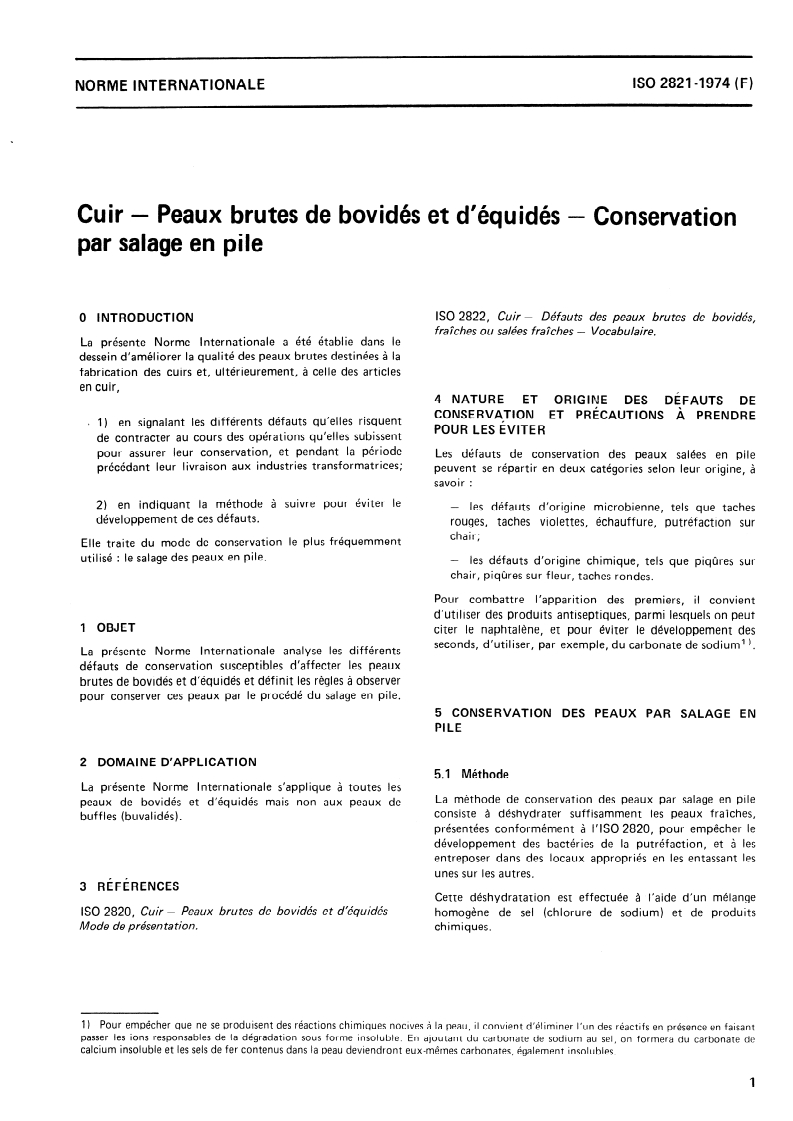
Applies to all raw and skins of cattle and horses but not to buffalo hides. Short description of nature and origin of preserving process defects. Gives rules of application for dehydration by means of a homogenous mixture of salt and chemical products.
- Status
- Published
- Publication Date
- 30-Sep-1974
- Technical Committee
- ISO/TC 120/SC 1 - Raw hides and skins, including pickled pelts
- Drafting Committee
- ISO/TC 120/SC 1 - Raw hides and skins, including pickled pelts
- Current Stage
- 9093 - International Standard confirmed
- Start Date
- 11-May-2023
- Completion Date
- 29-Aug-2026
Buy Documents

ISO 2821:1974 - Leather -- Raw hides of cattle and horses -- Preservation by stack salting
ISO 2821:1974 - Leather — Raw hides of cattle and horses — Preservation by stack salting/1/1974

ISO 2821:1974 - Cuir -- Peaux brutes de bovidés et d'équidés -- Conservation par salage en pile
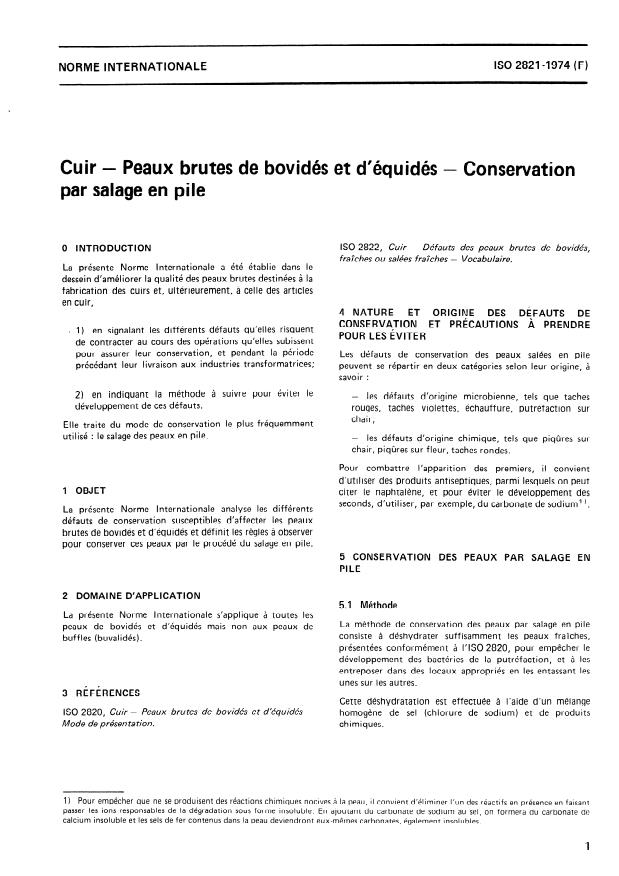

ISO 2821:1974 - Cuir -- Peaux brutes de bovidés et d'équidés -- Conservation par salage en pile
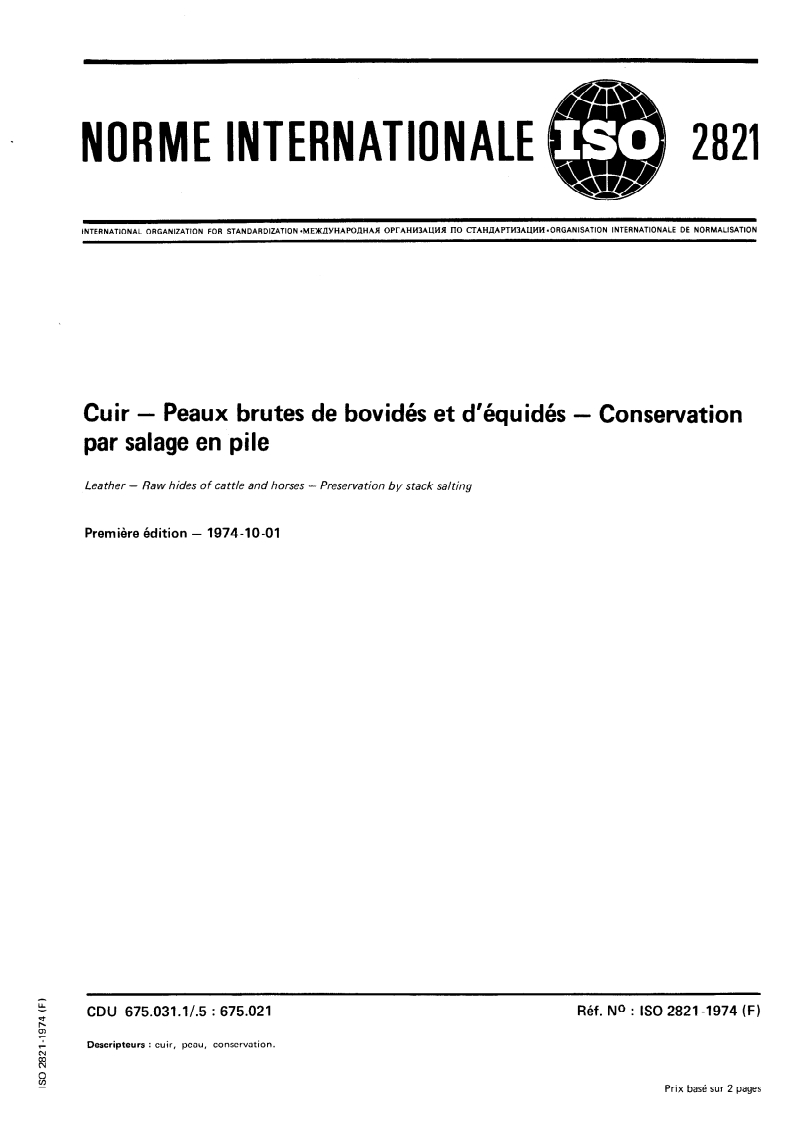
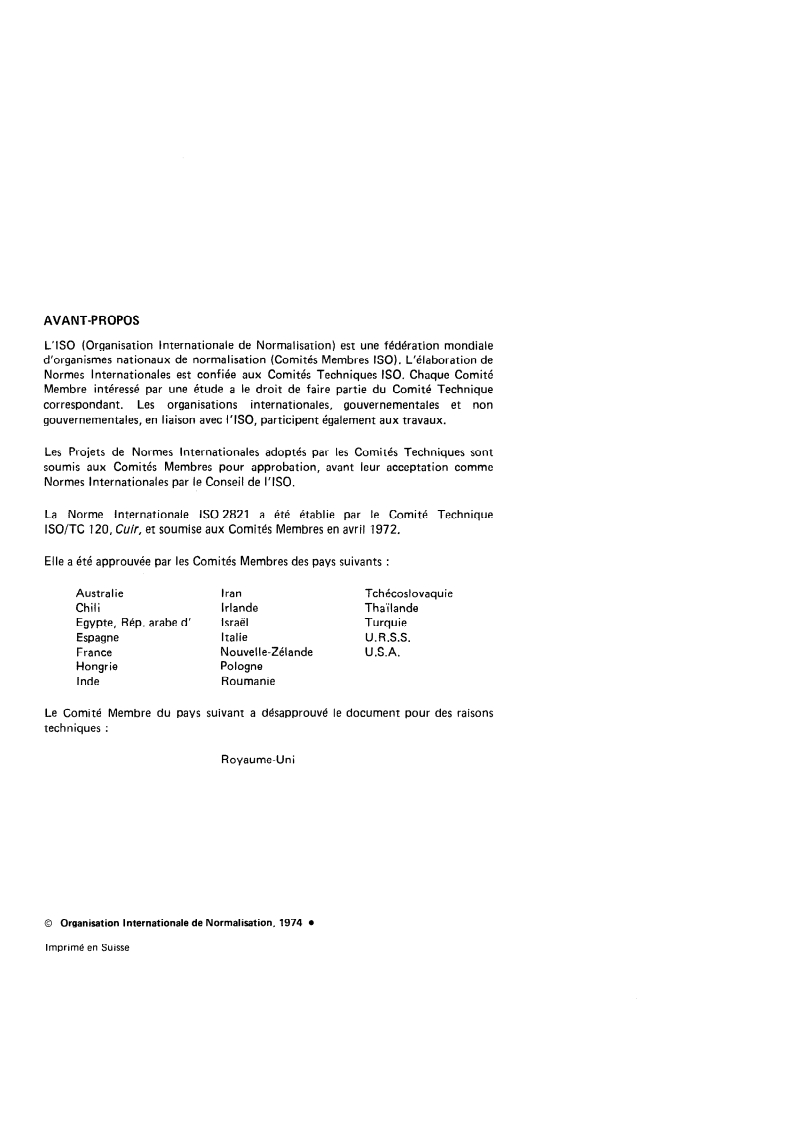
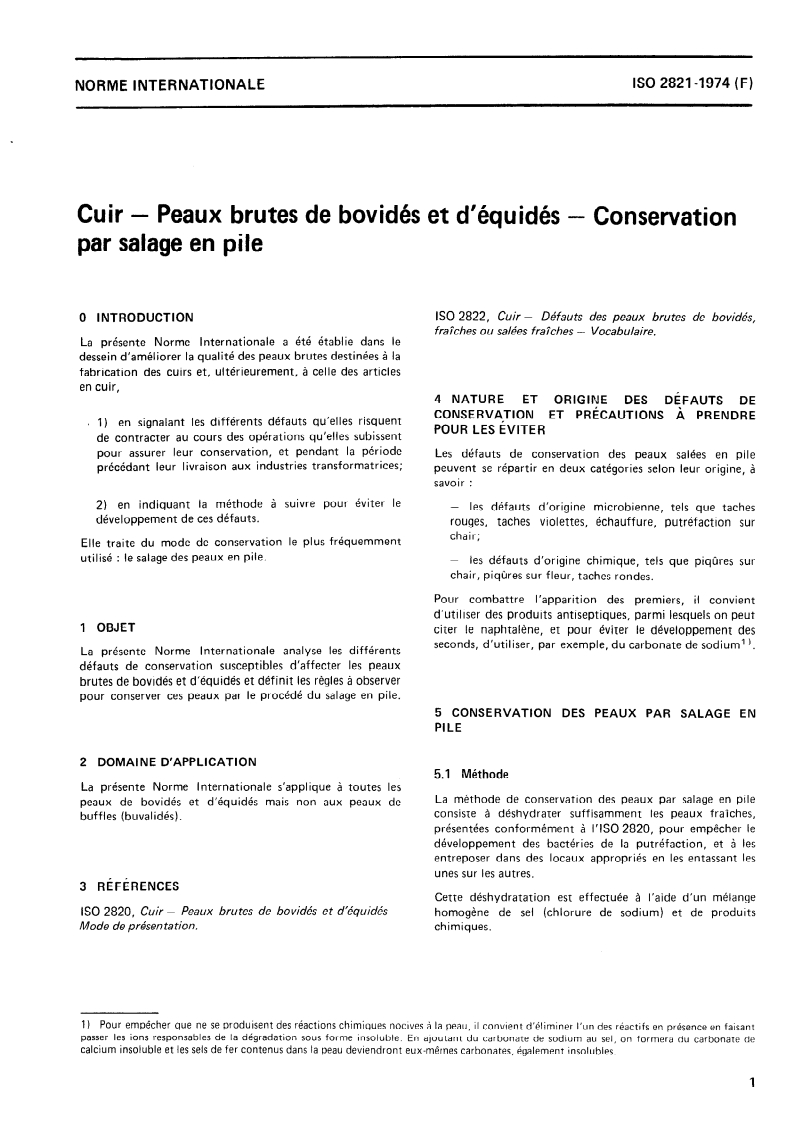
ISO 2821:1974 - Cuir — Peaux brutes de bovidés et d'équidés — Conservation par salage en pile/1/1974
ISO 2821:1974 - Cuir — Peaux brutes de bovidés et d'équidés — Conservation par salage en pile/1/1974
Overview
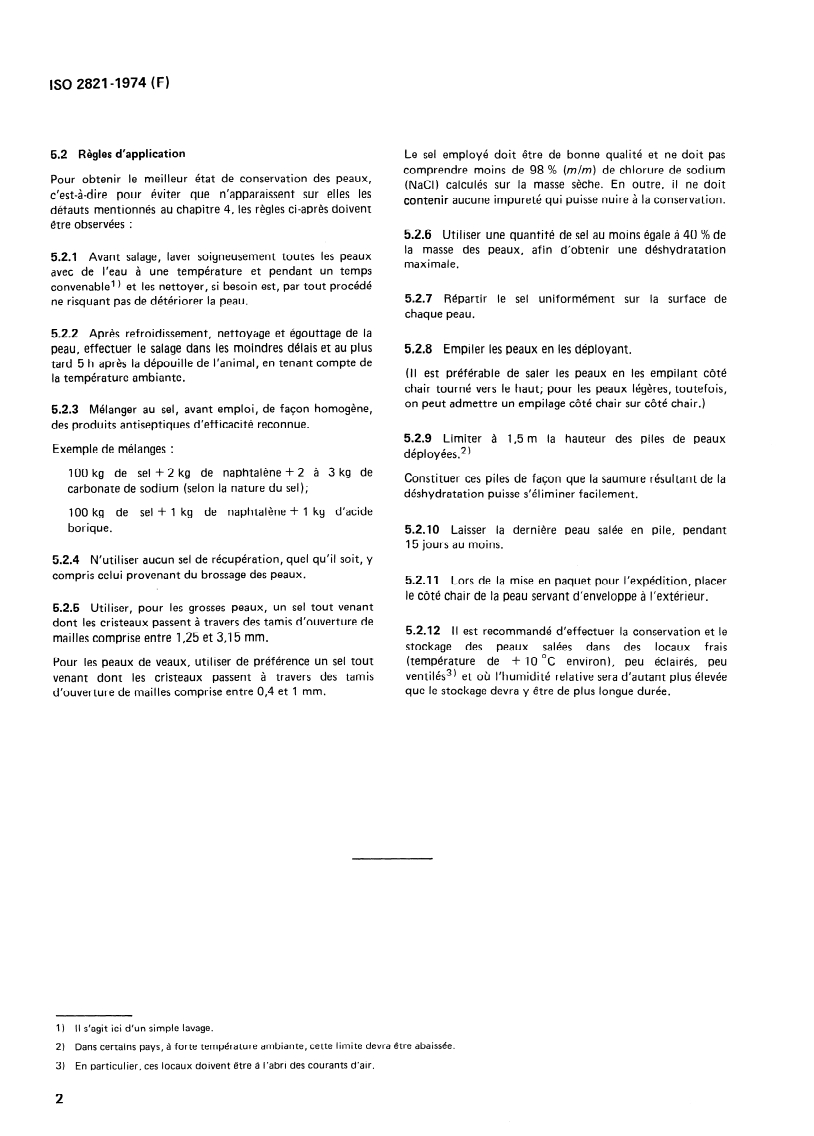
ISO 2821:1974 - Leather - Raw hides of cattle and horses - Preservation by stack salting describes an internationally agreed method for preserving raw cattle and horse hides by stack salting. The standard excludes buffalo hides (buvalids) and explains the nature and origin of common preservation defects (microbial and chemical). It gives practical rules for preparing, salting, stacking and storing hides using a homogeneous mixture of salt (sodium chloride) and approved chemical products.
Key Topics and Requirements
- Scope: Applies to raw hides of cattle and horses; excludes buffalo hides.
- Defect types: Distinguishes microbial defects (red/violet stains, heating, putrefaction) from chemical defects (pitting on flesh or grain, round stains) and recommends measures to avoid each.
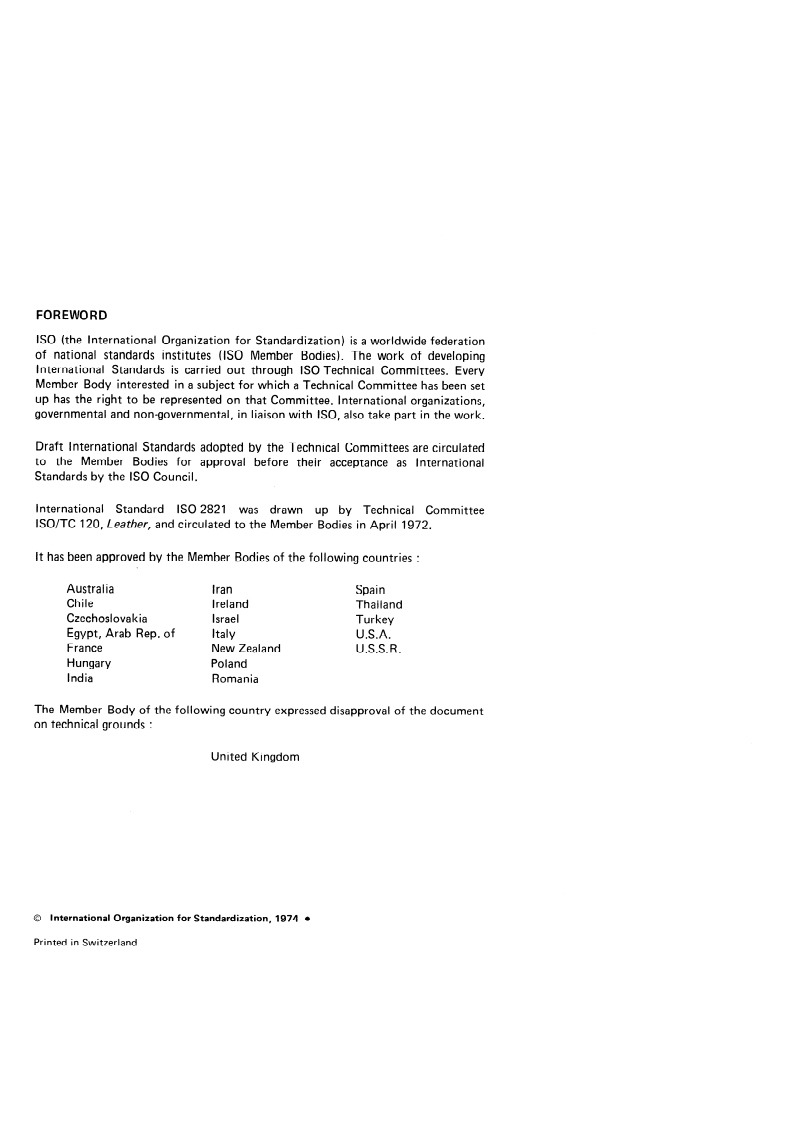
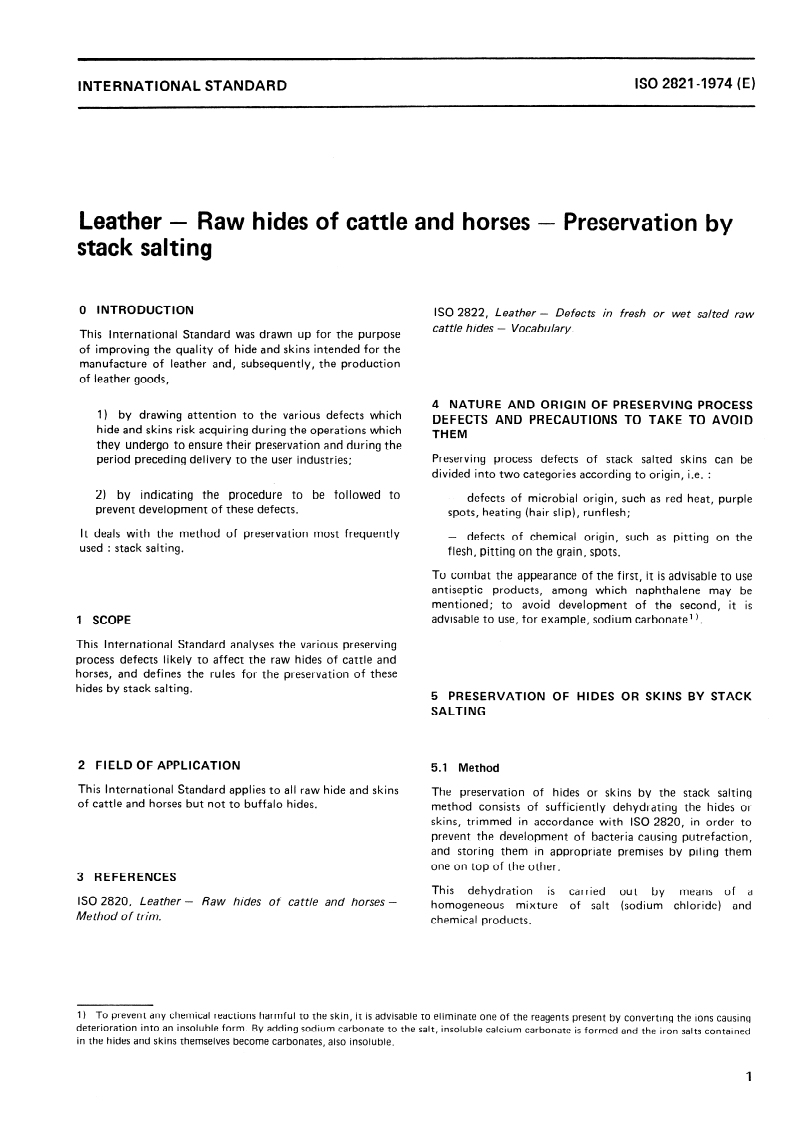
- Salt quality: Salt must be of good quality with ≥ 98% NaCl (dry basis) and free of harmful impurities.
- Additives: Use recognised antiseptics (example: naphthalene) and alkaline reagents (example: sodium carbonate) to prevent microbial growth and neutralise reactive ions that cause chemical damage. The standard explains that adding sodium carbonate converts reactive ions to insoluble carbonates, reducing harmful chemical reactions.
- Mixing and dosage: Salt must be mixed homogeneously with chemical products before use. Recommended minimum salt quantity is 40% of the mass of the hides to achieve adequate dehydration. Example mixtures given in the standard (for guidance) include:
- 100 kg salt + 2 kg naphthalene + 2–3 kg sodium carbonate
- 100 kg salt + 1 kg naphthalene + 1 kg boric acid
- Handling and timing: Wash hides appropriately, then salt within 5 hours of flaying (depending on ambient temperature). Prefer stacking with flesh side up (light hides may be flesh-to-flesh).
- Stacking and storage: Limit stack height to 1.5 m; keep the last salted hide in the stack for at least 15 days. Store in cool (~+10 °C), dim, low-ventilation premises with higher relative humidity for longer storage. Do not use recovered salt.
Applications and Users
Practical for tanneries, hide collectors, leather processors, logistics/quality managers, chemical suppliers and auditors. Use ISO 2821:1974 to:
- Prevent microbial spoilage and chemical staining during hide preservation and transit
- Standardise salting practices across collection and processing sites
- Guide procurement of preservation salt and additives
- Improve hide quality for downstream leather manufacture
Related Standards
- ISO 2820 - Leather - Raw hide presentation (referenced for presentation requirements)
- ISO 2822 - Leather - Vocabulary and defects of raw bovine and equine hides (related terminology and defect descriptions)
Keywords: ISO 2821:1974, leather preservation, raw hides, stack salting, sodium chloride, naphthalene, sodium carbonate, hide storage, tannery quality.
Relations
- Effective Date
- 06-Jun-2022
- Effective Date
- 15-Apr-2008
Buy Documents
ISO 2821:1974 - Leather -- Raw hides of cattle and horses -- Preservation by stack salting
ISO 2821:1974 - Leather — Raw hides of cattle and horses — Preservation by stack salting/1/1974
ISO 2821:1974 - Cuir -- Peaux brutes de bovidés et d'équidés -- Conservation par salage en pile
ISO 2821:1974 - Cuir -- Peaux brutes de bovidés et d'équidés -- Conservation par salage en pile
ISO 2821:1974 - Cuir — Peaux brutes de bovidés et d'équidés — Conservation par salage en pile/1/1974
ISO 2821:1974 - Cuir — Peaux brutes de bovidés et d'équidés — Conservation par salage en pile/1/1974
Get Certified
Connect with accredited certification bodies for this standard

Control Union Certifications
Global certification for agriculture and sustainability.

Hohenstein Institut
Textile testing and certification.

Bureau Veritas Bangladesh
Bureau Veritas certification services in Bangladesh.
Sponsored listings
Frequently Asked Questions
ISO 2821:1974 is a standard published by the International Organization for Standardization (ISO). Its full title is "Leather — Raw hides of cattle and horses — Preservation by stack salting". This standard covers: Applies to all raw and skins of cattle and horses but not to buffalo hides. Short description of nature and origin of preserving process defects. Gives rules of application for dehydration by means of a homogenous mixture of salt and chemical products.
Applies to all raw and skins of cattle and horses but not to buffalo hides. Short description of nature and origin of preserving process defects. Gives rules of application for dehydration by means of a homogenous mixture of salt and chemical products.
ISO 2821:1974 is classified under the following ICS (International Classification for Standards) categories: 59.140.20 - Raw skins, hides and pelts. The ICS classification helps identify the subject area and facilitates finding related standards.
ISO 2821:1974 has the following relationships with other standards: It is inter standard links to ISO 2821:1974/Amd 1:1996; is excused to ISO 2821:1974/Amd 1:1996. Understanding these relationships helps ensure you are using the most current and applicable version of the standard.
ISO 2821:1974 is available in PDF format for immediate download after purchase. The document can be added to your cart and obtained through the secure checkout process. Digital delivery ensures instant access to the complete standard document.
Standards Content (Sample)
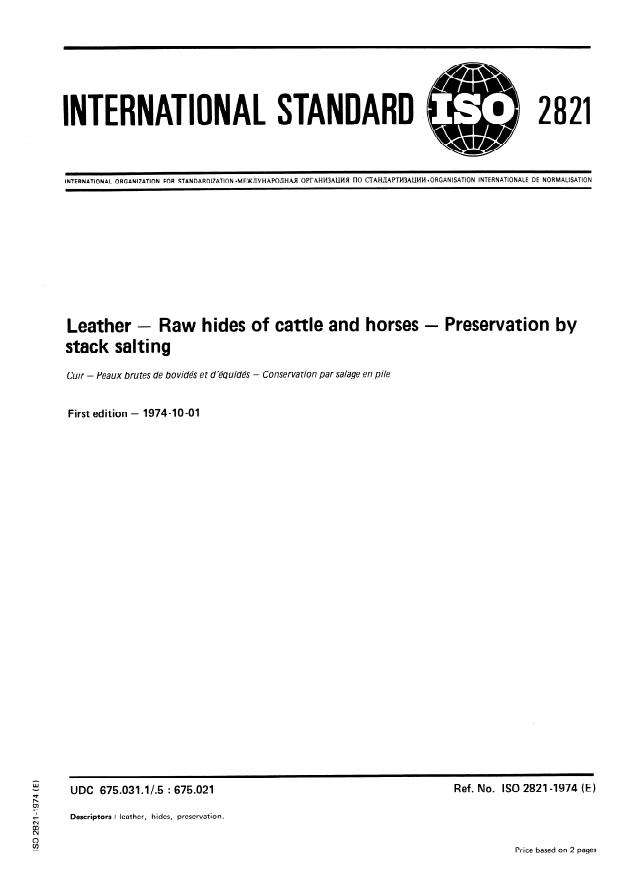
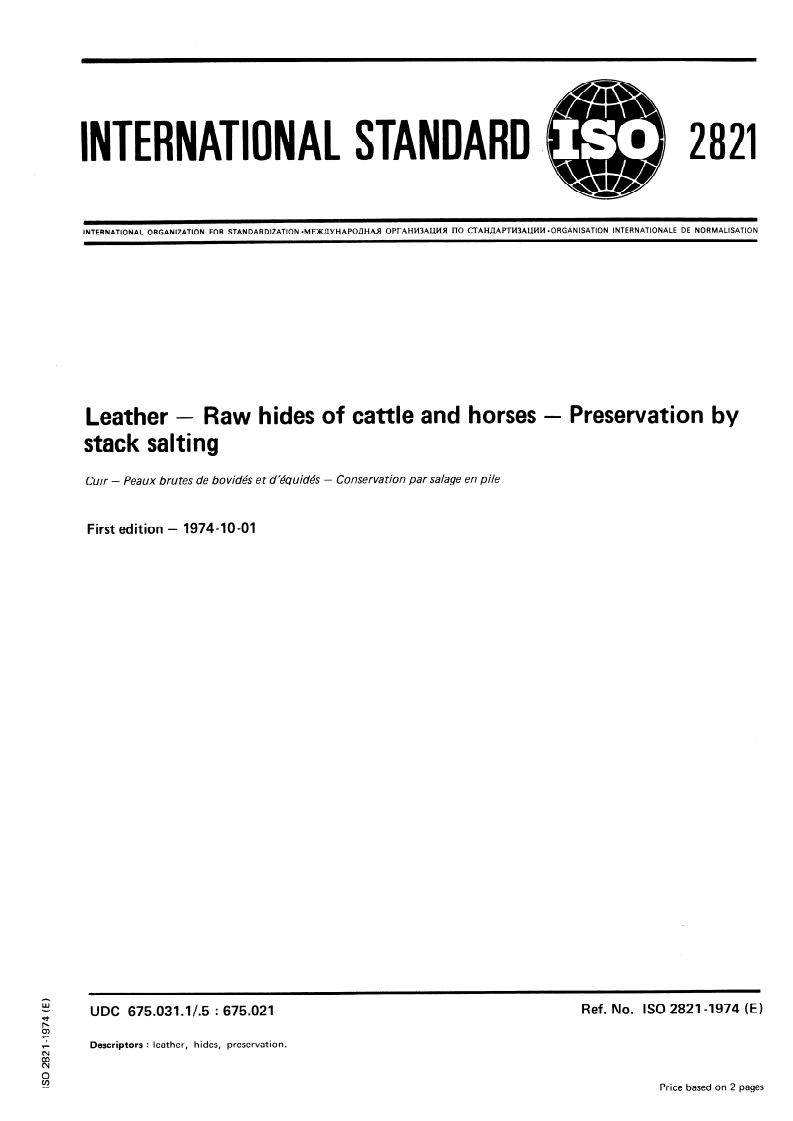
INTERNATIONAL STANDARD.
INTERNATIONAL ORGANKATION FOR STANDARDIZATION l MEXAYHAPOAHU OPl-AHM3AUMII l-IO ~AHAAPTMSALJMM .ORGANISATION INTERNATIONALE DE NORMALISATION
Raw hides of cattle and horses - Preservation by
Leather -
Stack salting
Conservation par salage en pile
Cuir - Peaux brutes de bovidks et dXquid6s -
First edition - 1974-10-01
Ref. No. ISO 2821-1974 (E)
UDC 675.031.1/.5 : 675.021
leather, hides, preservation.
Descriptors :
Price based on 2 pages
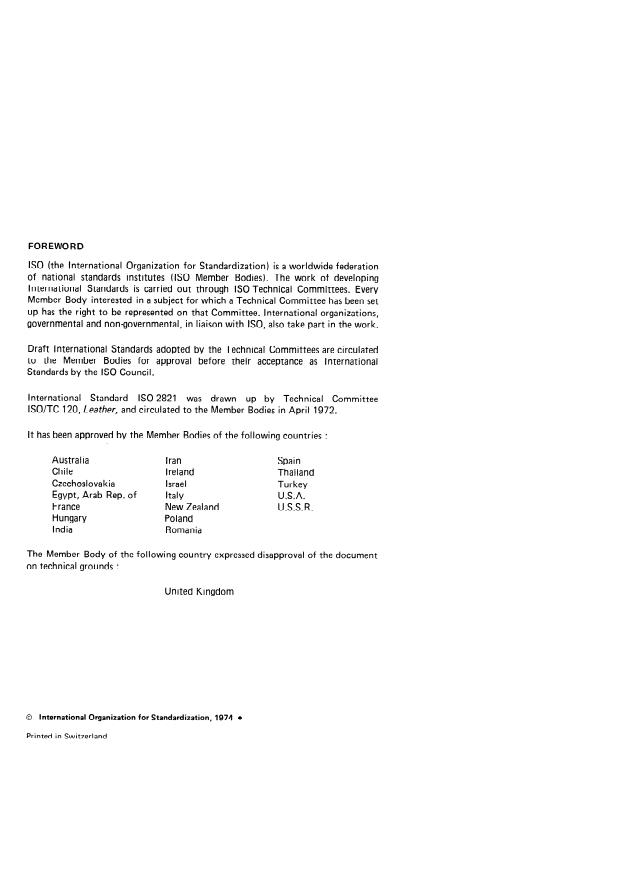
FOREWORD
ISO (the International Organization for Standardization) is a worldwide federation
of national Standards institutes (ISO Member Bodies). The work of developing
International Standards is carried out through ISO Technical Committees. Every
Member Body interested in a subject for which a Technical Committee has been set
up has the right to be represented on that Committee. International organizations,
governmental and non-governmental, in liaison with ISO, also take part in the work.
Draft International Standards adopted by the Technical Committees are circulated
to the Member Bodies for approval before their acceptance as International
Standards by the ISO Council.
International Standard ISO 2821 was drawn up by Technical Committee
ISO/TC 120, Leather, and circulated to the Member Bodies in April 1972.
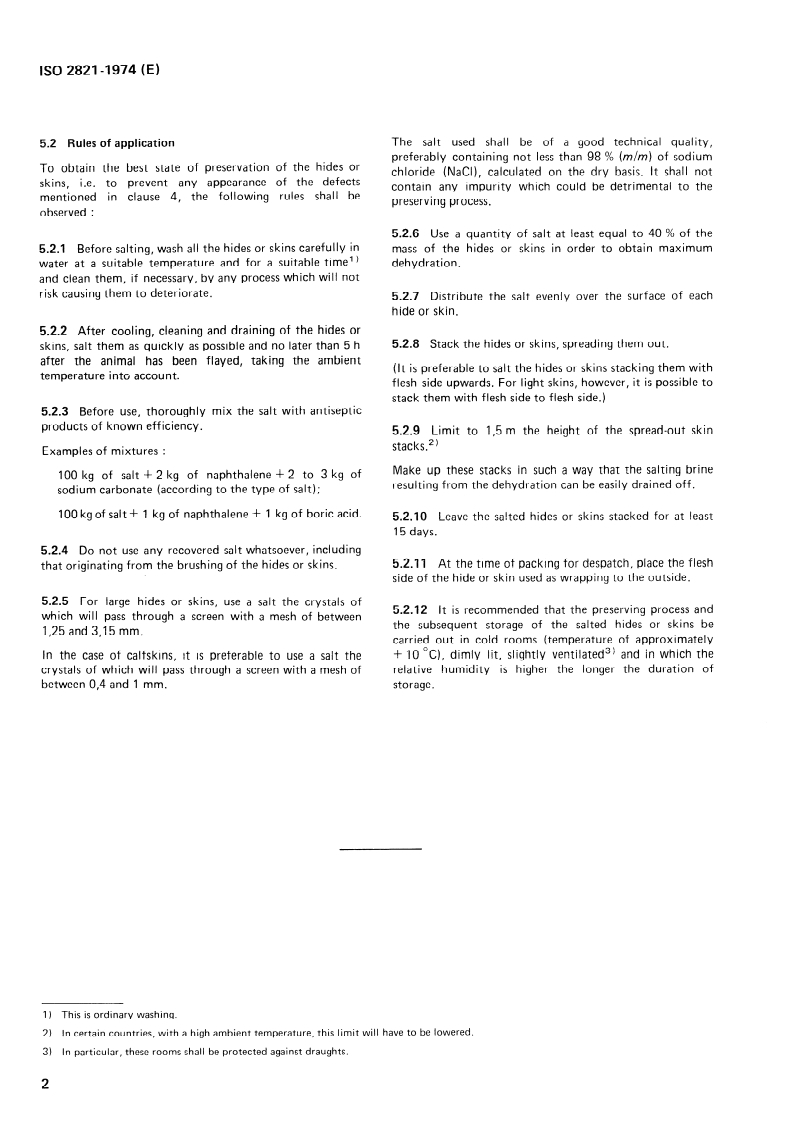
lt has been approved by the Member Bodies of the following countries :
Austral ia Iran Spain
Chile Ireland Thailand
Israel Turkey
Czechoslovakia
U.S.A.
Egypt, Arab Rep. of Italy
France New Zealand U.S.S.R.
Hungary Poland
India Romania
disapproval of the document
The Member Body of the following country expr
on technical grounds :
United Kingdom
0 International Organkation for Standardkation, 1974 l
Printed in Switzerland
ISO 2821-1974 (E)
INTERNATIONAL STANDARD
Leather - Raw hides of cattle and horses - Preservation by
Stack salting
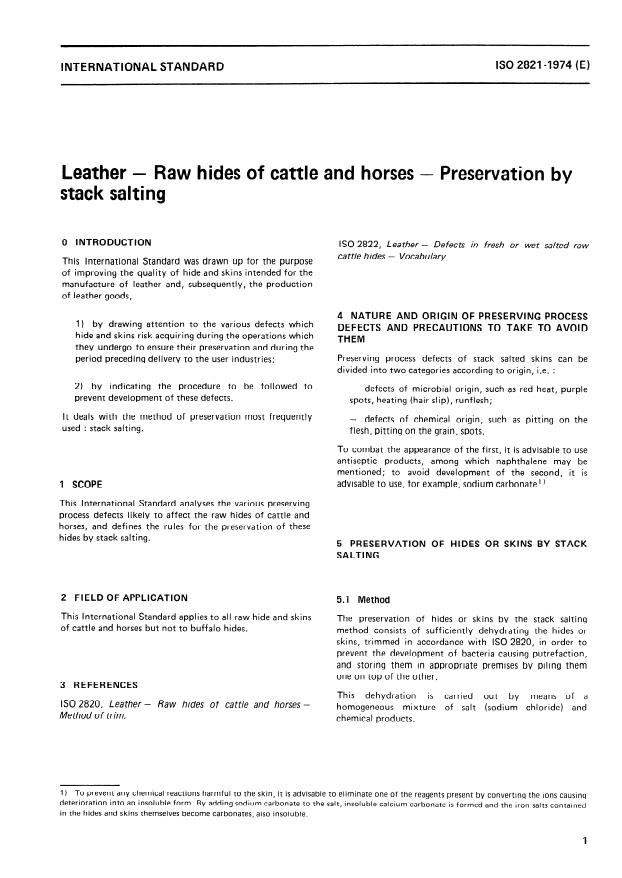
0 INTRODUCTION
ISO 2822, Leather - Defects in fresh or wet salted raw
cattle hides - Vocabulary.
This International Standard was drawn up for the purpose
of improving the quality of hide and skins intended for the
manufacture of leather and, subsequently, the production
of leather goods,
4 NATURE AND ORIGIN OF PRESERVING PROCESS
1) by drawing attention to the various defects which
DEFECTS AND PRECAUTIONS TO TAKE TO AVOID
hide and skins risk acquiring during the operations which
THEM
they undergo to ensure their preservation and during the
Preserving process defects of Stack salted skins tan be
period preceding delivery to the user industries;
divided into two categories according to origin, i.e. :
2) by indicating the procedure to be fall owed to
- defects of microbial origin, such as red heat, purple
prevent development of these defects.
spots, heating (hair Slip), runflesh;
lt deals with the method of preservation most f *equently
- defects of Chemical origin, such as pitting on the
used : Stack salting.
flesh, pitting on the grain, spots.
To combat the appearance of the first, it is advisable to use
antiseptic products, among which naphthalene may be
mentioned; to avoid development of the second, it is
advisable to use, for example, sodium carbonate’ ).
1 SCOPE
This International Standard analyses the various preserving
process defects Iikely to affect the raw hides of cattle and
horses, and defines the rules for the preservation of these
hides by Stack salting.
5 PRESERVATION OF HIDES OR SKINS BY STACK
SALTING
2 FIELD OF APPLICATION
5.1 Method
This International Standard applies to all raw hide and skins
The preservation of hides or skins by the Stack salting
of cattle and horses but not to buffalo hides.
method consists of sufficiently deh
...
INTERNATIONAL STANDARD.
INTERNATIONAL ORGANKATION FOR STANDARDIZATION l MEXAYHAPOAHU OPl-AHM3AUMII l-IO ~AHAAPTMSALJMM .ORGANISATION INTERNATIONALE DE NORMALISATION
Raw hides of cattle and horses - Preservation by
Leather -
Stack salting
Conservation par salage en pile
Cuir - Peaux brutes de bovidks et dXquid6s -
First edition - 1974-10-01
Ref. No. ISO 2821-1974 (E)
UDC 675.031.1/.5 : 675.021
leather, hides, preservation.
Descriptors :
Price based on 2 pages
FOREWORD
ISO (the International Organization for Standardization) is a worldwide federation
of national Standards institutes (ISO Member Bodies). The work of developing
International Standards is carried out through ISO Technical Committees. Every
Member Body interested in a subject for which a Technical Committee has been set
up has the right to be represented on that Committee. International organizations,
governmental and non-governmental, in liaison with ISO, also take part in the work.
Draft International Standards adopted by the Technical Committees are circulated
to the Member Bodies for approval before their acceptance as International
Standards by the ISO Council.
International Standard ISO 2821 was drawn up by Technical Committee
ISO/TC 120, Leather, and circulated to the Member Bodies in April 1972.
lt has been approved by the Member Bodies of the following countries :
Austral ia Iran Spain
Chile Ireland Thailand
Israel Turkey
Czechoslovakia
U.S.A.
Egypt, Arab Rep. of Italy
France New Zealand U.S.S.R.
Hungary Poland
India Romania
disapproval of the document
The Member Body of the following country expr
on technical grounds :
United Kingdom
0 International Organkation for Standardkation, 1974 l
Printed in Switzerland
ISO 2821-1974 (E)
INTERNATIONAL STANDARD
Leather - Raw hides of cattle and horses - Preservation by
Stack salting
0 INTRODUCTION
ISO 2822, Leather - Defects in fresh or wet salted raw
cattle hides - Vocabulary.
This International Standard was drawn up for the purpose
of improving the quality of hide and skins intended for the
manufacture of leather and, subsequently, the production
of leather goods,
4 NATURE AND ORIGIN OF PRESERVING PROCESS
1) by drawing attention to the various defects which
DEFECTS AND PRECAUTIONS TO TAKE TO AVOID
hide and skins risk acquiring during the operations which
THEM
they undergo to ensure their preservation and during the
Preserving process defects of Stack salted skins tan be
period preceding delivery to the user industries;
divided into two categories according to origin, i.e. :
2) by indicating the procedure to be fall owed to
- defects of microbial origin, such as red heat, purple
prevent development of these defects.
spots, heating (hair Slip), runflesh;
lt deals with the method of preservation most f *equently
- defects of Chemical origin, such as pitting on the
used : Stack salting.
flesh, pitting on the grain, spots.
To combat the appearance of the first, it is advisable to use
antiseptic products, among which naphthalene may be
mentioned; to avoid development of the second, it is
advisable to use, for example, sodium carbonate’ ).
1 SCOPE
This International Standard analyses the various preserving
process defects Iikely to affect the raw hides of cattle and
horses, and defines the rules for the preservation of these
hides by Stack salting.
5 PRESERVATION OF HIDES OR SKINS BY STACK
SALTING
2 FIELD OF APPLICATION
5.1 Method
This International Standard applies to all raw hide and skins
The preservation of hides or skins by the Stack salting
of cattle and horses but not to buffalo hides.
method consists of sufficiently deh
...
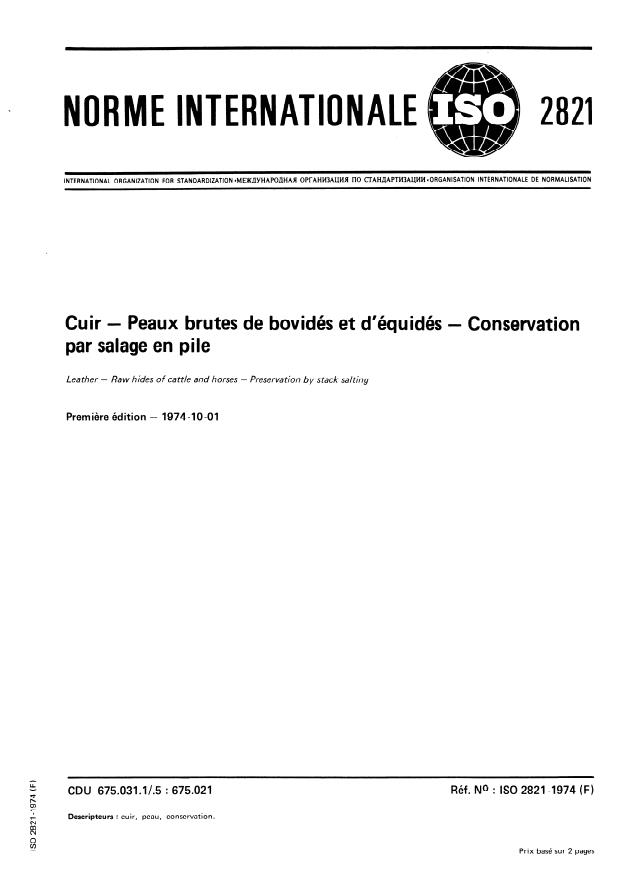
NORME INTERNATIONALE
INTERNATIONAL ORGANIZATION FOR STANDARDIZATION 44EXAYHAPOAHAII OPTAHM3AWII n0 CTAH~APTM3ALVWi~ORGANISATION INTERNATIONALE DE NORMALISATION
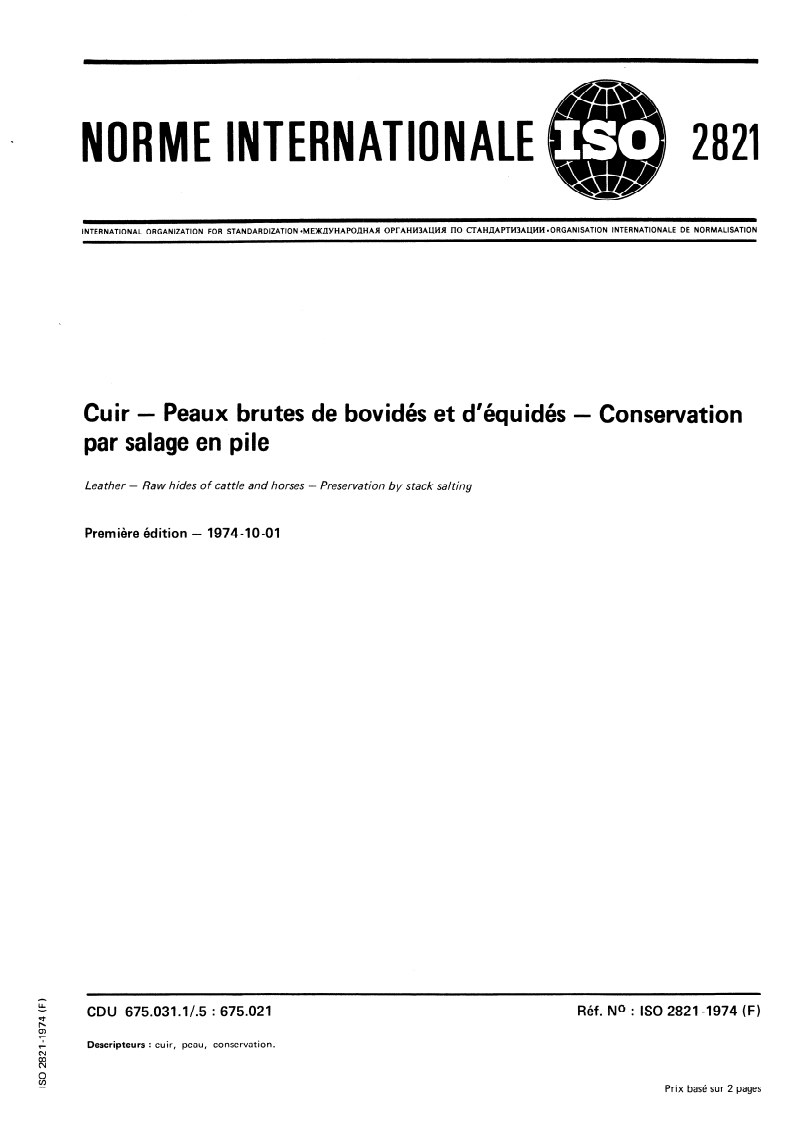
Cuir - Peaux brutes de bovidés et d’équidés - Conservation
par salage en pile
Leather - Raw hides of cattle and horses - Preservation by stack salting
Première édition - 1974-10-01
iî
-
Réf. No : ISO 2821-1974 (F)
CDU 675.031.1/.5 : 675.021
Descripteurs : cuir, peau, conservation.
Prix basé sur 2 pages
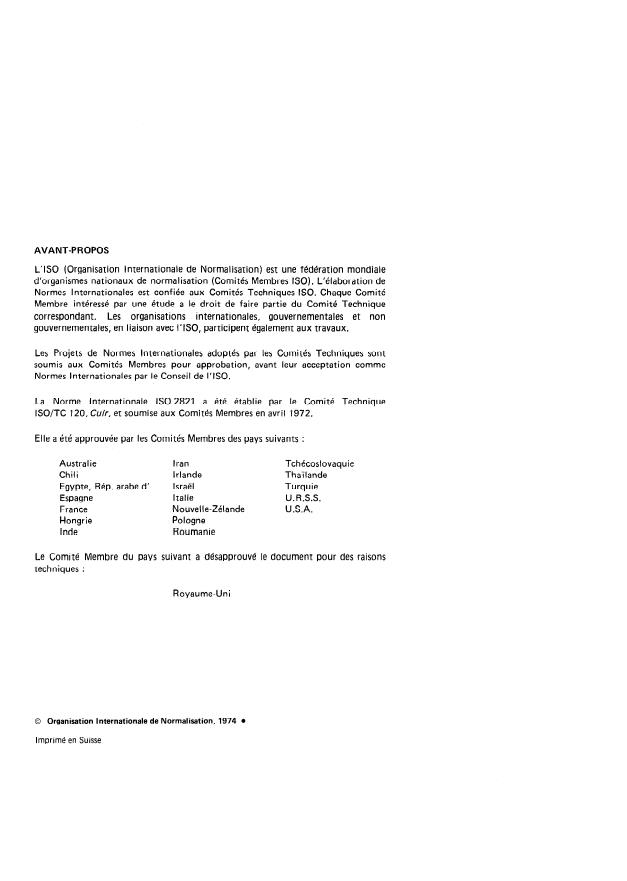
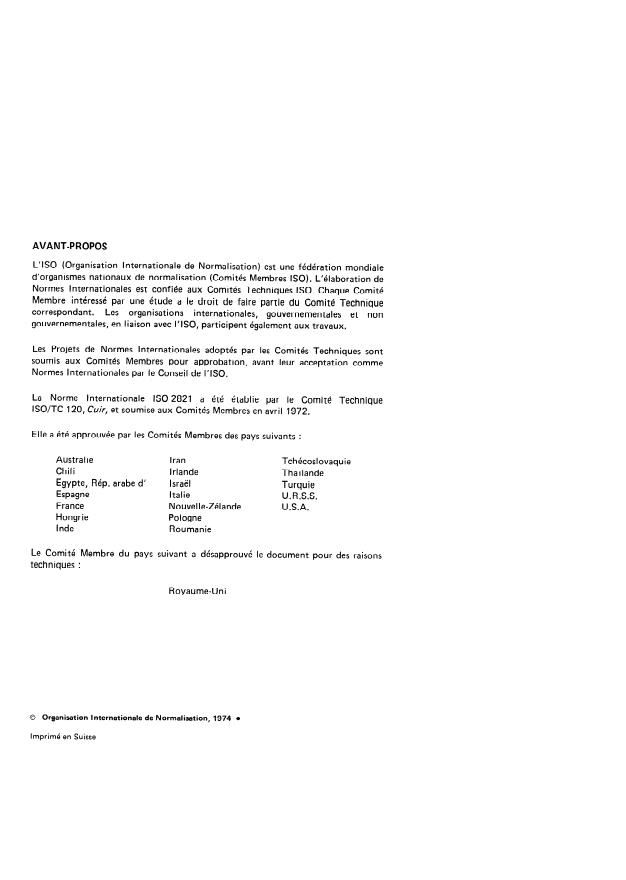
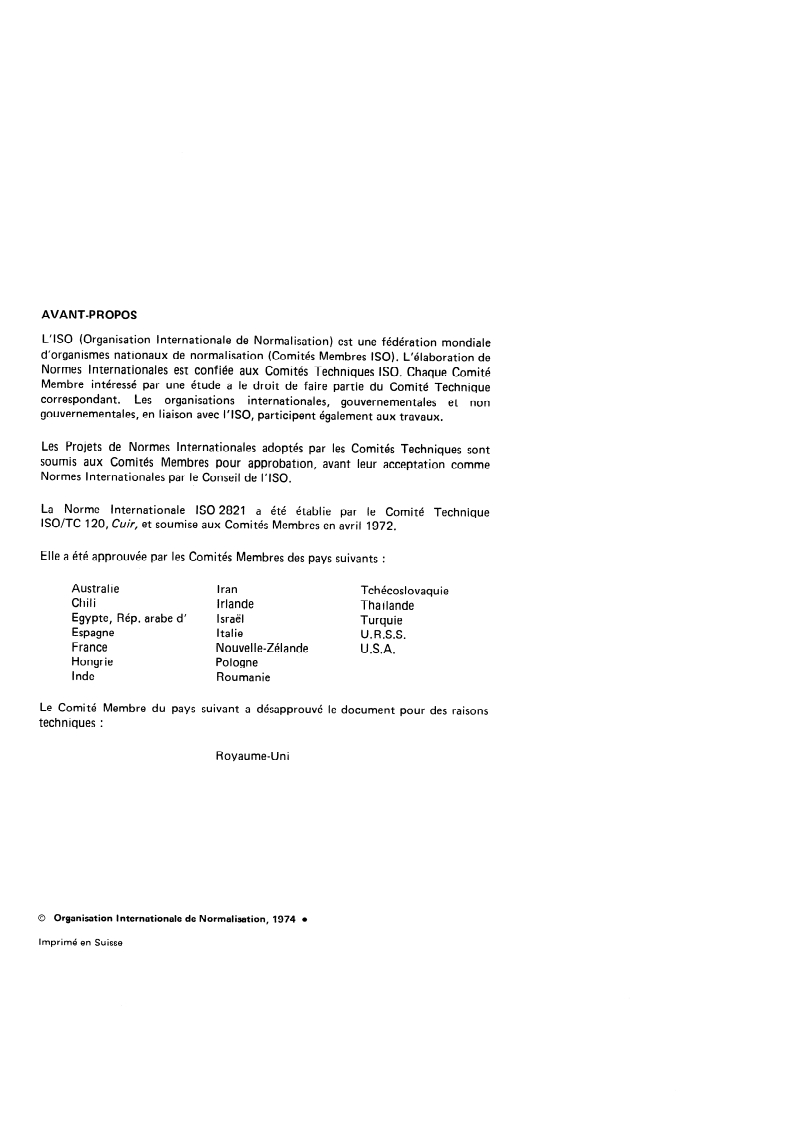
AVANT-PROPOS
L’ISO (Organisation Internationale de Normalisation) est une fédération mondiale
d’organismes nationaux de normalisation (Comités Membres ISO). L’élaboration de
Normes Internationales est confiée aux Comités Techniques ISO. Chaque Comité
Membre intéressé par une étude a le droit de faire partie du Comité Technique
correspondant. Les organisations internationales, gouvernementales et non
gouvernementales, en liaison avec I’ISO, participent également aux travaux.
Les Projets de Normes Internationales adoptés par les Comités Techniques sont
soumis aux Comités Membres pour approbation, avant leur acceptation comme
Normes Internationales par le Conseil de 1’60.
La Norme Internationale ISO 2821 a été établie par le Comité Technique
ISO/TC 120, Cuir, et soumise aux Comités Membres en avril 1972.
Elle a été approuvée par les Comités Membres des pays suivants :
Australie Iran Tchécoslovaquie
Chili Irlande Tha’ilande
Egypte, Rép. arabe d’ Israël Turquie
Espagne Italie U.R.S.S.
France Nouvelle-Zélande U.S.A.
Hongrie Pologne
Inde Roumanie
Le Comité Membre du pays suivant a désapprouvé le document pour des raisons
techniques :
Royaume-Uni
0 Organisation Internationale de Normalisation, 1974 l
Imprimé en Suisse
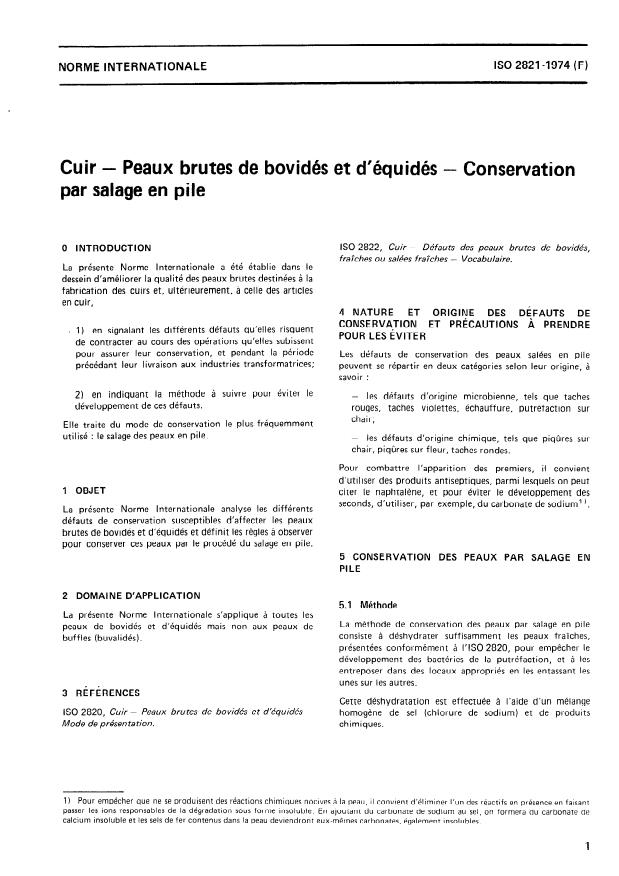
ISO 2821-1974 (F)
NORME INTERNATIONALE
Cuir - Peaux brutes de bovidés et d’équidés - Conservation
par salage en pile
ISO 2822, Cuir -
Défauts des peaux brutes de bovidés,
0 INTRODUCTION
fraîches ou salées fraîches - Vocabulaire.
La présente Norme Internationale a été établie dans le
dessein d’améliorer la qualité des peaux brutes destinées à la
fabrication des cuirs et, ultérieurement, à celle des articles
en cuir,
4 NATURE
ET ORIGINE DES DÉFAUTS DE
CONSERVATION ET PRÉCAUTIONS À PRENDRE
. 1) en signalant les différents défauts qu’elles risquent
POUR LES ÉWER
de contracter au cours des opérations qu’elles subissent
pour assurer leur conservation, et pendant la période
Les défauts de conservation des peaux salées en pile
précédant leur livraison aux industries transformatrices;
peuvent se répartir en deux catégories selon leur origine, à
savoir :
2) en indiquant la méthode à suivre pour éviter le
- les défauts d’origine microbienne, tels que taches
développement de ces défauts.
rouges, taches violettes, échauffure, putréfaction sur
chair;
Elle traite du mode de conservation le plus fréquemment
utilisé : le salage des peaux en pile.
- les défauts d’origine chimique, tels que piqûres sur
chair, piqûres sur fleur, taches rondes.
Pour combattre l’apparition des premiers, il convient
d’utiliser des produits antiseptiques, parmi lesquels on peut
1 OBJET
citer le naphtalène, et pour éviter le développement des
seconds, d’utiliser, par exemple, du carbonate de sodium’ ).
La présente Norme Internationale analyse les différents
défauts de conservation susceptibles d’affecter les peaux
brutes de bovidés et d’équidés et définit les règles à observer
pour conserver ces peaux par le procédé du salage en pile.
5 CONSERVATION DES PEAUX PAR SALAGE EN
PILE
2 DOMAINE D’APPLICATION
5.1 Méthode
La présente Norme Internationale s’applique à toutes les
La méthode de conservation des peaux par salage en pile
pea
...
NORME INTERNATIONALE
INTERNATIONAL ORGANIZATION FOR STANDARDIZATION 44EXAYHAPOAHAII OPTAHM3AWII n0 CTAH~APTM3ALVWi~ORGANISATION INTERNATIONALE DE NORMALISATION
Cuir - Peaux brutes de bovidés et d’équidés - Conservation
par salage en pile
Leather - Raw hides of cattle and horses - Preservation by stack salting
Première édition - 1974-10-01
Réf. No : ISO 2821-1974 (F)
CDU 675.031.1/.5 : 675.021
Descripteurs : cuir, peau, conservation.
Prix basé sur 2 pages
AVANT-PROPOS
L’ISO (Organisation Internationale de Normalisation) est une fédération mondiale
d’organismes nationaux de normalisation (Comités Membres ISO). L’élaboration de
Normes Internationales est confiée aux Comités Techniques ISO. Chaque Comité
Membre intéressé par une étude a le droit de faire partie du Comité Technique
correspondant. Les organisations internationales, gouvernementales et non
gouvernementales, en liaison avec I’ISO, participent également aux travaux.
Les Projets de Normes Internationales adoptés par les Comités Techniques sont
soumis aux Comités Membres pour approbation, avant leur acceptation comme
Normes Internationales par le Conseil de I’ISO.
La Norme Internationale ISO 2821 a été établie par le Comité Technique
ISO/TC 120, Cuir, et soumise aux Comités Membres en avril 1972.
Elle a été approuvée par les Comités Membres des pays suivants :
Australie Iran Tchécoslovaquie
Chili Irlande Tha’ilande
Egypte, Rép. arabe d’ Israël Turquie
Espagne Italie U.R.S.S.
France Nouvelle-Zélande U.S.A.
Hongrie Pologne
Inde Roumanie
Le Comité Membre du pays suivant a désapprouvé le document pour des raisons
techniques :
Royaume-Uni
0 Organisation Internationale de Normalisation, 1974 l
Imprimé en Suisse
ISO 2821-1974 (F)
NORME INTERNATIONALE
Cuir - Peaux brutes de bovidés et d’équidés - Conservation
par salage en pile
ISO 2822, Cuir -
Défauts des peaux brutes de bovidés,
0 INTRODUCTION
fraîches ou salées fraîches - Vocabulaire.
La présente Norme Internationale a été établie dans le
dessein d’améliorer la qualité des peaux brutes destinées à la
fabrication des cuirs et, ultérieurement, à celle des articles
en cuir,
4 NATURE
ET ORIGINE DES DÉFAUTS DE
CONSERVATION ET PRÉCAUTIONS À PRENDRE
. 1) en signalant les différents défauts qu’elles risquent
PouR LES ÉVITER
de contracter au cours des opérations qu’elles subissent
pour assurer leur conservation, et pendant la période
Les défauts de conservation des peaux salées en pile
précédant leur livraison aux industries transformatrices; peuvent se répartir en deux catégories selon leur origine, à
savoir :
2) en indiquant la méthode à suivre pour éviter le
- les défauts d’origine microbienne, tels que taches
développement de ces défauts.
rouges, taches violettes, échauffure, putréfaction sur
chair;
Elle traite du mode de conservation le plus fréquemment
utilisé : le salage des peaux en pile.
- les défauts d’origine chimique, tels que piqûres sur
chair, piqûres sur fleur, taches rondes.
Pour combattre l’apparition des premiers, il convient
d’utiliser des produits antiseptiques, parmi lesquels on peut
1 OBJET
citer le naphtalène, et pour éviter le développement des
seconds, d’utiliser, par exemple, du carbonate de sodium’ ).
La présente Norme Internationale analyse les différents
défauts de conservation susceptibles d’affecter les peaux
brutes de bovidés et d’équidés et définit les règles à observer
pour conserver ces peaux par le procédé du salage en pile.
5 CONSERVATION DES PEAUX PAR SALAGE EN
PILE
2 DOMAINE D’APPLICATION
5.1 Méthode
La présente Norme Internationale s’applique à toutes les
La méthode de conservation des peaux par salage en pile
peaux de bovidés et d’équidés mais non aux peaux de
consiste à déshydrater suffisam
...
NORME INTERNATIONALE
INTERNATIONAL ORGANIZATION FOR STANDARDIZATION 44EXAYHAPOAHAII OPTAHM3AWII n0 CTAH~APTM3ALVWi~ORGANISATION INTERNATIONALE DE NORMALISATION
Cuir - Peaux brutes de bovidés et d’équidés - Conservation
par salage en pile
Leather - Raw hides of cattle and horses - Preservation by stack salting
Première édition - 1974-10-01
iî
-
Réf. No : ISO 2821-1974 (F)
CDU 675.031.1/.5 : 675.021
Descripteurs : cuir, peau, conservation.
Prix basé sur 2 pages
AVANT-PROPOS
L’ISO (Organisation Internationale de Normalisation) est une fédération mondiale
d’organismes nationaux de normalisation (Comités Membres ISO). L’élaboration de
Normes Internationales est confiée aux Comités Techniques ISO. Chaque Comité
Membre intéressé par une étude a le droit de faire partie du Comité Technique
correspondant. Les organisations internationales, gouvernementales et non
gouvernementales, en liaison avec I’ISO, participent également aux travaux.
Les Projets de Normes Internationales adoptés par les Comités Techniques sont
soumis aux Comités Membres pour approbation, avant leur acceptation comme
Normes Internationales par le Conseil de 1’60.
La Norme Internationale ISO 2821 a été établie par le Comité Technique
ISO/TC 120, Cuir, et soumise aux Comités Membres en avril 1972.
Elle a été approuvée par les Comités Membres des pays suivants :
Australie Iran Tchécoslovaquie
Chili Irlande Tha’ilande
Egypte, Rép. arabe d’ Israël Turquie
Espagne Italie U.R.S.S.
France Nouvelle-Zélande U.S.A.
Hongrie Pologne
Inde Roumanie
Le Comité Membre du pays suivant a désapprouvé le document pour des raisons
techniques :
Royaume-Uni
0 Organisation Internationale de Normalisation, 1974 l
Imprimé en Suisse
ISO 2821-1974 (F)
NORME INTERNATIONALE
Cuir - Peaux brutes de bovidés et d’équidés - Conservation
par salage en pile
ISO 2822, Cuir -
Défauts des peaux brutes de bovidés,
0 INTRODUCTION
fraîches ou salées fraîches - Vocabulaire.
La présente Norme Internationale a été établie dans le
dessein d’améliorer la qualité des peaux brutes destinées à la
fabrication des cuirs et, ultérieurement, à celle des articles
en cuir,
4 NATURE
ET ORIGINE DES DÉFAUTS DE
CONSERVATION ET PRÉCAUTIONS À PRENDRE
. 1) en signalant les différents défauts qu’elles risquent
POUR LES ÉWER
de contracter au cours des opérations qu’elles subissent
pour assurer leur conservation, et pendant la période
Les défauts de conservation des peaux salées en pile
précédant leur livraison aux industries transformatrices;
peuvent se répartir en deux catégories selon leur origine, à
savoir :
2) en indiquant la méthode à suivre pour éviter le
- les défauts d’origine microbienne, tels que taches
développement de ces défauts.
rouges, taches violettes, échauffure, putréfaction sur
chair;
Elle traite du mode de conservation le plus fréquemment
utilisé : le salage des peaux en pile.
- les défauts d’origine chimique, tels que piqûres sur
chair, piqûres sur fleur, taches rondes.
Pour combattre l’apparition des premiers, il convient
d’utiliser des produits antiseptiques, parmi lesquels on peut
1 OBJET
citer le naphtalène, et pour éviter le développement des
seconds, d’utiliser, par exemple, du carbonate de sodium’ ).
La présente Norme Internationale analyse les différents
défauts de conservation susceptibles d’affecter les peaux
brutes de bovidés et d’équidés et définit les règles à observer
pour conserver ces peaux par le procédé du salage en pile.
5 CONSERVATION DES PEAUX PAR SALAGE EN
PILE
2 DOMAINE D’APPLICATION
5.1 Méthode
La présente Norme Internationale s’applique à toutes les
La méthode de conservation des peaux par salage en pile
pea
...
NORME INTERNATIONALE
INTERNATIONAL ORGANIZATION FOR STANDARDIZATION 44EXAYHAPOAHAII OPTAHM3AWII n0 CTAH~APTM3ALVWi~ORGANISATION INTERNATIONALE DE NORMALISATION
Cuir - Peaux brutes de bovidés et d’équidés - Conservation
par salage en pile
Leather - Raw hides of cattle and horses - Preservation by stack salting
Première édition - 1974-10-01
Réf. No : ISO 2821-1974 (F)
CDU 675.031.1/.5 : 675.021
Descripteurs : cuir, peau, conservation.
Prix basé sur 2 pages
AVANT-PROPOS
L’ISO (Organisation Internationale de Normalisation) est une fédération mondiale
d’organismes nationaux de normalisation (Comités Membres ISO). L’élaboration de
Normes Internationales est confiée aux Comités Techniques ISO. Chaque Comité
Membre intéressé par une étude a le droit de faire partie du Comité Technique
correspondant. Les organisations internationales, gouvernementales et non
gouvernementales, en liaison avec I’ISO, participent également aux travaux.
Les Projets de Normes Internationales adoptés par les Comités Techniques sont
soumis aux Comités Membres pour approbation, avant leur acceptation comme
Normes Internationales par le Conseil de I’ISO.
La Norme Internationale ISO 2821 a été établie par le Comité Technique
ISO/TC 120, Cuir, et soumise aux Comités Membres en avril 1972.
Elle a été approuvée par les Comités Membres des pays suivants :
Australie Iran Tchécoslovaquie
Chili Irlande Tha’ilande
Egypte, Rép. arabe d’ Israël Turquie
Espagne Italie U.R.S.S.
France Nouvelle-Zélande U.S.A.
Hongrie Pologne
Inde Roumanie
Le Comité Membre du pays suivant a désapprouvé le document pour des raisons
techniques :
Royaume-Uni
0 Organisation Internationale de Normalisation, 1974 l
Imprimé en Suisse
ISO 2821-1974 (F)
NORME INTERNATIONALE
Cuir - Peaux brutes de bovidés et d’équidés - Conservation
par salage en pile
ISO 2822, Cuir -
Défauts des peaux brutes de bovidés,
0 INTRODUCTION
fraîches ou salées fraîches - Vocabulaire.
La présente Norme Internationale a été établie dans le
dessein d’améliorer la qualité des peaux brutes destinées à la
fabrication des cuirs et, ultérieurement, à celle des articles
en cuir,
4 NATURE
ET ORIGINE DES DÉFAUTS DE
CONSERVATION ET PRÉCAUTIONS À PRENDRE
. 1) en signalant les différents défauts qu’elles risquent
PouR LES ÉVITER
de contracter au cours des opérations qu’elles subissent
pour assurer leur conservation, et pendant la période
Les défauts de conservation des peaux salées en pile
précédant leur livraison aux industries transformatrices; peuvent se répartir en deux catégories selon leur origine, à
savoir :
2) en indiquant la méthode à suivre pour éviter le
- les défauts d’origine microbienne, tels que taches
développement de ces défauts.
rouges, taches violettes, échauffure, putréfaction sur
chair;
Elle traite du mode de conservation le plus fréquemment
utilisé : le salage des peaux en pile.
- les défauts d’origine chimique, tels que piqûres sur
chair, piqûres sur fleur, taches rondes.
Pour combattre l’apparition des premiers, il convient
d’utiliser des produits antiseptiques, parmi lesquels on peut
1 OBJET
citer le naphtalène, et pour éviter le développement des
seconds, d’utiliser, par exemple, du carbonate de sodium’ ).
La présente Norme Internationale analyse les différents
défauts de conservation susceptibles d’affecter les peaux
brutes de bovidés et d’équidés et définit les règles à observer
pour conserver ces peaux par le procédé du salage en pile.
5 CONSERVATION DES PEAUX PAR SALAGE EN
PILE
2 DOMAINE D’APPLICATION
5.1 Méthode
La présente Norme Internationale s’applique à toutes les
La méthode de conservation des peaux par salage en pile
peaux de bovidés et d’équidés mais non aux peaux de
consiste à déshydrater suffisam
...