


ISO/FDIS 19178-1
(Main)Geographic information — Training data markup language for artificial intelligence — Part 1: Conceptual model
Geographic information — Training data markup language for artificial intelligence — Part 1: Conceptual model
Information géographique — Langage de balisage des données d'entraînement pour l'intelligence artificielle — Partie 1: Modèle conceptuel
General Information
Buy Standard
Standards Content (Sample)
FINAL DRAFT
International
Standard
ISO/TC 211
Geographic information — Training
Secretariat: SIS
data markup language for artificial
Voting begins on:
intelligence —
2025-03-07
Part 1:
Voting terminates on:
2025-05-02
Conceptual model
Information géographique — Langage de balisage des données
d'entraînement pour l'intelligence artificielle —
Partie 1: Modèle conceptuel
RECIPIENTS OF THIS DRAFT ARE INVITED TO SUBMIT,
WITH THEIR COMMENTS, NOTIFICATION OF ANY
RELEVANT PATENT RIGHTS OF WHICH THEY ARE AWARE
AND TO PROVIDE SUPPOR TING DOCUMENTATION.
IN ADDITION TO THEIR EVALUATION AS
BEING ACCEPTABLE FOR INDUSTRIAL, TECHNO-
ISO/CEN PARALLEL PROCESSING LOGICAL, COMMERCIAL AND USER PURPOSES, DRAFT
INTERNATIONAL STANDARDS MAY ON OCCASION HAVE
TO BE CONSIDERED IN THE LIGHT OF THEIR POTENTIAL
TO BECOME STAN DARDS TO WHICH REFERENCE MAY BE
MADE IN NATIONAL REGULATIONS.
Reference number
FINAL DRAFT
International
Standard
ISO/TC 211
Geographic information — Training
Secretariat: SIS
data markup language for artificial
Voting begins on:
intelligence —
Part 1:
Voting terminates on:
Conceptual model
Information géographique — Langage de balisage des données
d'entraînement pour l'intelligence artificielle —
Partie 1: Modèle conceptuel
RECIPIENTS OF THIS DRAFT ARE INVITED TO SUBMIT,
WITH THEIR COMMENTS, NOTIFICATION OF ANY
RELEVANT PATENT RIGHTS OF WHICH THEY ARE AWARE
AND TO PROVIDE SUPPOR TING DOCUMENTATION.
© ISO 2025
IN ADDITION TO THEIR EVALUATION AS
All rights reserved. Unless otherwise specified, or required in the context of its implementation, no part of this publication may
BEING ACCEPTABLE FOR INDUSTRIAL, TECHNO-
ISO/CEN PARALLEL PROCESSING
LOGICAL, COMMERCIAL AND USER PURPOSES, DRAFT
be reproduced or utilized otherwise in any form or by any means, electronic or mechanical, including photocopying, or posting on
INTERNATIONAL STANDARDS MAY ON OCCASION HAVE
the internet or an intranet, without prior written permission. Permission can be requested from either ISO at the address below
TO BE CONSIDERED IN THE LIGHT OF THEIR POTENTIAL
or ISO’s member body in the country of the requester.
TO BECOME STAN DARDS TO WHICH REFERENCE MAY BE
MADE IN NATIONAL REGULATIONS.
ISO copyright office
CP 401 • Ch. de Blandonnet 8
CH-1214 Vernier, Geneva
Phone: +41 22 749 01 11
Email: copyright@iso.org
Website: www.iso.org
Published in Switzerland Reference number
ii
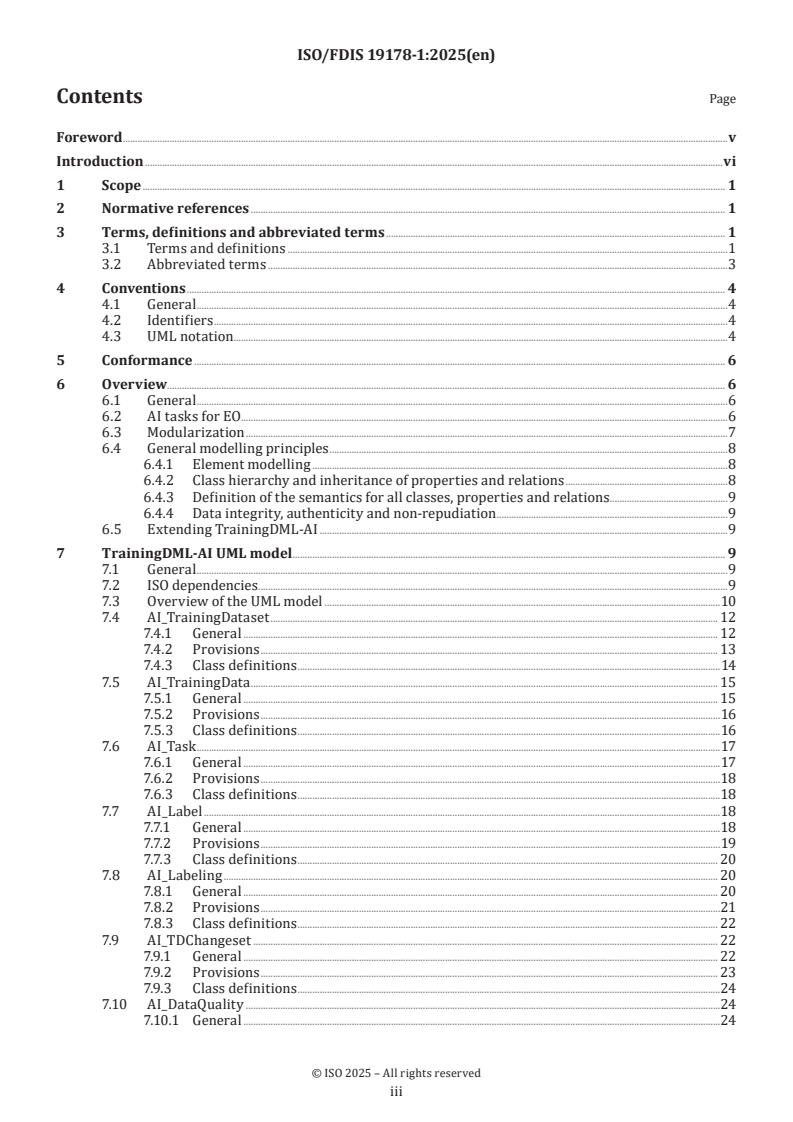
Contents Page
Foreword .v
Introduction .vi
1 Scope . 1
2 Normative references . 1
3 Terms, definitions and abbreviated terms . 1
3.1 Terms and definitions .1
3.2 Abbreviated terms .3
4 Conventions . 4
4.1 General .4
4.2 Identifiers .4
4.3 UML notation.4
5 Conformance . 6
6 Overview . 6
6.1 General .6
6.2 AI tasks for EO.6
6.3 Modularization .7
6.4 General modelling principles .8
6.4.1 Element modelling .8
6.4.2 Class hierarchy and inheritance of properties and relations .8
6.4.3 Definition of the semantics for all classes, properties and relations . .9
6.4.4 Data integrity, authenticity and non-repudiation .9
6.5 Extending TrainingDML-AI .9
7 TrainingDML-AI UML model . 9
7.1 General .9
7.2 ISO dependencies .9
7.3 Overview of the UML model .10
7.4 AI_TrainingDataset . 12
7.4.1 General . 12
7.4.2 Provisions . 13
7.4.3 Class definitions .14
7.5 AI_TrainingData . 15
7.5.1 General . 15
7.5.2 Provisions .16
7.5.3 Class definitions .16
7.6 AI_Task .17
7.6.1 General .17
7.6.2 Provisions .18
7.6.3 Class definitions .18
7.7 AI_Label .18
7.7.1 General .18
7.7.2 Provisions .19
7.7.3 Class definitions . 20
7.8 AI_Labeling . 20
7.8.1 General . 20
7.8.2 Provisions .21
7.8.3 Class definitions . 22
7.9 AI_TDChangeset . 22
7.9.1 General . 22
7.9.2 Provisions . 23
7.9.3 Class definitions .24
7.10 AI_DataQuality .24
7.10.1 General .24
iii
7.10.2 Provisions . 25
7.10.3 Class definitions . 26
8 TrainingDML-AI Data Dictionary .26
8.1 General . 26
8.2 ISO Classes . 26
8.2.1 Feature (from ISO 19101-1) .
...
2024-12-16
ISO/TC 211/WG 4
Secretariat: SIS
Date: 2025-02-20
Geographic information — Training data markup language for
artificial intelligence —
—
Part 1:
Conceptual model
Information géographique — Langage de balisage des données d'entraînement pour l'intelligence artificielle —
Partie 1: Modèle conceptuel
FDIS stage
ISO #####-#:####(X/FDIS 19178-1:2025(en)
All rights reserved. Unless otherwise specified, or required in the context of its implementation, no part of this publication
may be reproduced or utilized otherwise in any form or by any means, electronic or mechanical, including photocopying,
or posting on the internet or an intranet, without prior written permission. Permission can be requested from either ISO
at the address below or ISO’s member body in the country of the requester.
ISO copyright office
CP 401 • Ch. de Blandonnet 8
CH-1214 Vernier, Geneva
Phone: + 41 22 749 01 11
EmailE-mail: copyright@iso.org
Website: www.iso.orgwww.iso.org
Published in Switzerland
ii © ISO #### 2025 – All rights reserved
ii
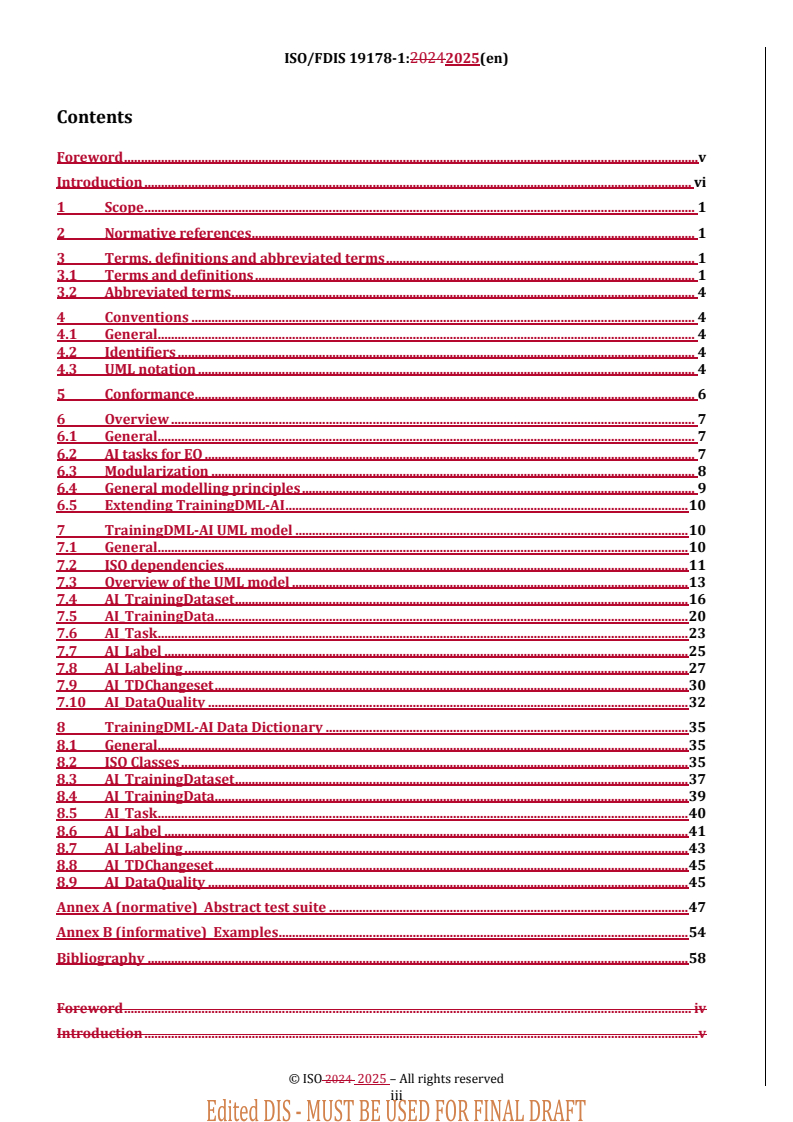
Contents
Foreword . v
Introduction . vi
1 Scope . 1
2 Normative references . 1
3 Terms, definitions and abbreviated terms . 1
3.1 Terms and definitions . 1
3.2 Abbreviated terms . 4
4 Conventions . 4
4.1 General. 4
4.2 Identifiers . 4
4.3 UML notation . 4
5 Conformance . 6
6 Overview . 7
6.1 General. 7
6.2 AI tasks for EO . 7
6.3 Modularization . 8
6.4 General modelling principles . 9
6.5 Extending TrainingDML-AI . 10
7 TrainingDML-AI UML model . 10
7.1 General. 10
7.2 ISO dependencies . 11
7.3 Overview of the UML model . 13
7.4 AI_TrainingDataset . 16
7.5 AI_TrainingData . 20
7.6 AI_Task . 23
7.7 AI_Label . 25
7.8 AI_Labeling . 27
7.9 AI_TDChangeset . 30
7.10 AI_DataQuality . 32
8 TrainingDML-AI Data Dictionary . 35
8.1 General. 35
8.2 ISO Classes . 35
8.3 AI_TrainingDataset . 37
8.4 AI_TrainingData . 39
8.5 AI_Task . 40
8.6 AI_Label . 41
8.7 AI_Labeling . 43
8.8 AI_TDChangeset . 45
8.9 AI_DataQuality . 45
Annex A (normative) Abstract test suite . 47
Annex B (informative) Examples . 54
Bibliography . 58
Foreword . iv
Introduction . v
iii
ISO #####-#:####(X/FDIS 19178-1:2025(en)
1 Scope . 1
2 Normative references . 1
3 Terms and definitions . 1
4 Conventions . 4
4.1 General. 4
4.2 Identifiers . 4
4.3 UML notation . 5
5 Conformance . 6
6 Overview . 6
6.1 General. 6
6.2 AI Tasks for EO . 6
6.3 Modularization . 7
6.4 General modelling principles . 8
6.5 Extending TrainingDML-AI . 9
7 TrainingDML-AI UML Model . 9
7.1 General. 9
7.2 ISO dependencies . 9
7.3 Overview of the UML Model . 11
7.4 AI_TrainingDataset . 12
7.5 AI_TrainingData . 16
7.6 AI_Task . 18
7.7 AI_Label . 20
7.8 AI_Labeling . 22
7.9 AI_TDChangeset . 24
7.10 AI_DataQuality . 26
8 TrainingDML-AI Data Dictionary . 28
8.1 General. 28
8.2 ISO Classes . 28
8.3 AI_TrainingDataset . 30
8.4 AI_TrainingData . 33
8.5 AI_Task . 34
8.6 AI_Label . 35
8.7 AI_Labeling . 37
8.8 AI_TDChangeset . 39
8.9 AI_DataQuality . 39
Annex A (normative) Abstract test suite . 41
Annex B (informative) Examples . 48
Bibliography .
...
PROJET FINAL
Norme
internationale
ISO/TC 211
Information géographique —
Secrétariat: SIS
Langage de balisage des données
Début de vote:
d'entraînement pour l'intelligence
2025-03-07
artificielle —
Vote clos le:
2025-05-02
Partie 1:
Modèle conceptuel
Geographic information — Training data markup language for
artificial intelligence —
Part 1: Conceptual model
LES DESTINATAIRES DU PRÉSENT PROJET SONT
INVITÉS À PRÉSENTER, AVEC LEURS OBSERVATIONS,
NOTIFICATION DES DROITS DE PROPRIÉTÉ DONT ILS
AURAIENT ÉVENTUELLEMENT CONNAISSANCE ET À
FOURNIR UNE DOCUMENTATION EXPLICATIVE.
OUTRE LE FAIT D’ÊTRE EXAMINÉS POUR
ÉTABLIR S’ILS SONT ACCEPTABLES À DES FINS
INDUSTRIELLES, TECHNOLOGIQUES ET COM-MERCIALES,
AINSI QUE DU POINT DE VUE DES UTILISATEURS, LES
PROJETS DE NORMES
TRAITEMENT PARALLÈLE ISO/CEN
INTERNATIONALES DOIVENT PARFOIS ÊTRE CONSIDÉRÉS
DU POINT DE VUE DE LEUR POSSI BILITÉ DE DEVENIR DES
NORMES POUVANT
SERVIR DE RÉFÉRENCE DANS LA RÉGLEMENTATION
NATIONALE.
Numéro de référence
PROJET FINAL
Norme
internationale
ISO/TC 211
Information géographique —
Secrétariat: SIS
Langage de balisage des données
Début de vote:
d'entraînement pour l'intelligence
2025-03-07
artificielle —
Vote clos le:
2025-05-02
Partie 1:
Modèle conceptuel
Geographic information — Training data markup language for
artificial intelligence —
Part 1: Conceptual model
LES DESTINATAIRES DU PRÉSENT PROJET SONT
INVITÉS À PRÉSENTER, AVEC LEURS OBSERVATIONS,
NOTIFICATION DES DROITS DE PROPRIÉTÉ DONT ILS
AURAIENT ÉVENTUELLEMENT CONNAISSANCE ET À
FOURNIR UNE DOCUMENTATION EXPLICATIVE.
DOCUMENT PROTÉGÉ PAR COPYRIGHT
OUTRE LE FAIT D’ÊTRE EXAMINÉS POUR
ÉTABLIR S’ILS SONT ACCEPTABLES À DES FINS
© ISO 2025 INDUSTRIELLES, TECHNOLOGIQUES ET COM-MERCIALES,
AINSI QUE DU POINT DE VUE DES UTILISATEURS, LES
Tous droits réservés. Sauf prescription différente ou nécessité dans le contexte de sa mise en œuvre, aucune partie de cette
PROJETS DE NORMES
TRAITEMENT PARALLÈLE ISO/CEN
INTERNATIONALES DOIVENT PARFOIS ÊTRE CONSIDÉRÉS
publication ne peut être reproduite ni utilisée sous quelque forme que ce soit et par aucun procédé, électronique ou mécanique,
DU POINT DE VUE DE LEUR POSSI BILITÉ DE DEVENIR DES
y compris la photocopie, ou la diffusion sur l’internet ou sur un intranet, sans autorisation écrite préalable. Une autorisation peut
NORMES POUVANT
être demandée à l’ISO à l’adresse ci-après ou au comité membre de l’ISO dans le pays du demandeur.
SERVIR DE RÉFÉRENCE DANS LA RÉGLEMENTATION
NATIONALE.
ISO copyright office
Case postale 401 • Ch. de Blandonnet 8
CH-1214 Vernier, Genève
Tél.: +41 22 749 01 11
E-mail: copyright@iso.org
Web: www.iso.org
Publié en Suisse Numéro de référence
ii
Sommaire Page
Avant-propos .v
Introduction .vi
1 Domaine d'application . 1
2 Références normatives . 1
3 Termes, définitions et abréviations . 1
3.1 Termes et définitions .1
3.2 Abréviations.4
4 Conventions . 4
4.1 Généralités .4
4.2 Identifiants . .4
4.3 Notation UML .5
5 Conformité . 6
6 Vue d'ensemble . 6
6.1 Généralités .6
6.2 Tâches d'IA pour l'EO .6
6.3 Modularisation .7
6.4 Principes généraux de modélisation .8
6.4.1 Modélisation des éléments .8
6.4.2 Hiérarchie des classes et héritage des propriétés et des relations.9
6.4.3 Définition de la sémantique pour toutes les classes, propriétés et relations .9
6.4.4 Intégrité, authenticité et non-répudiation des données .9
6.5 Extension du modèle TrainingDML-AI .9
7 Modèle UML TrainingDML-AI . 9
7.1 Généralités .9
7.2 Dépendances ISO .9
7.3 Vue d'ensemble du modèle UML .11
7.4 AI_TrainingDataset . 12
7.4.1 Généralités . 12
7.4.2 Dispositions . 13
7.4.3 Définitions de classes .14
7.5 AI_TrainingData . 15
7.5.1 Généralités . 15
7.5.2 Dispositions .16
7.5.3 Définitions de classes .16
7.6 AI_Task .17
7.6.1 Généralités .17
7.6.2 Dispositions .18
7.6.3 Définitions de classes .19
7.7 AI_Label .19
7.7.1 Généralités .19
7.7.2 Dispositions . 20
7.7.3 Définitions de classes .21
7.8 AI_Labeling .21
7.8.1 Généralités .21
7.8.2 Dispositions . 22
7.8.3 Définitions de classes . 23
7.9 AI_TDChangeset . 23
7.9.1 Généralités . 23
7.9.2 Dispositions .24
7.9.3 Définitions de classes .24
7.10 AI_DataQuality . 25
7.10.1 Généralités . 25
iii
7.10.2 Dispositions . 26
7.10.3 Définitions de classes .27
8 Dictionnaire de données TrainingDML-AI .27
8.1 Généralités .27
8.2 Classes ISO .27
8.2.1 Feature (entité, d’après l’ISO 19101-1) .
...
Questions, Comments and Discussion
Ask us and Technical Secretary will try to provide an answer. You can facilitate discussion about the standard in here.