

ISO 7625:2012
(Main)Sintered metal materials, excluding hardmetals — Preparation of samples for chemical analysis for determination of carbon content
General Information
- Abstract
ISO 7265:2012 specifies methods for preparing a sample from one or more sintered parts to be analysed for free or total carbon content. Combined carbon is determined as the difference between total and free carbon. This standard covers the preparation of samples for the determination of carbon by a chemical method, i.e. combustion in oxygen and measurement of the carbon dioxide produced, in accordance with ISO 437. It does not cover the preparation of samples for carbon determination by physical methods, such as metallography or spectroscopy.
- Status
- Published
- Publication Date
- 12-Nov-2012
- Current Stage
- 9093 - International Standard confirmed
- Start Date
- 30-Jan-2026
- Completion Date
- 29-Aug-2026
Buy Documents
ISO 7625:2012 - Sintered metal materials, excluding hardmetals -- Preparation of samples for chemical analysis for determination of carbon content
ISO 7625:2012 - Sintered metal materials, excluding hardmetals — Preparation of samples for chemical analysis for determination of carbon content/13/2012
ISO 7625:2012 - Matériaux métalliques frittés, a l'exclusion des métaux-durs -- Préparation des échantillons pour analyse chimique en vue du dosage du carbone
ISO 7625:2012 - Matériaux métalliques frittés, à l'exclusion des métaux-durs — Préparation des échantillons pour analyse chimique en vue du dosage du carbone/13/2012
Overview
ISO 7625:2012 specifies how to prepare samples from sintered metal materials (excluding hardmetals) for chemical analysis of carbon content. It covers preparation methods for determining free carbon and total carbon by combustion in oxygen with CO2 measurement (chemical method in accordance with ISO 437). Combined carbon is calculated as the difference between total and free carbon. This standard does not apply to physical carbon-determination methods (e.g., metallography or spectroscopy) or to materials with non-uniform carbon distribution unless sampling is agreed between supplier and purchaser.
Key topics and requirements
- Scope: Applies to sintered parts (excluding hardmetals) where carbon is uniformly distributed and present in forms listed by the standard.
- Chemical analysis method: Preparation is intended for combustion/CO2-based carbon measurement per ISO 437.
- Removal of interfering carbonaceous substances:
- Degreasing by Soxhlet extraction using an appropriate solvent (record the solvent used) in line with ISO 2738 when organic liquids/waxes are present in pores or on surfaces.
- Mechanical removal of surface carbon deposits (e.g., from sintering or heat treatment).
- Sample preparation techniques:
- Crushing in a non-contaminating mortar, or
- Dry machining (drilling, milling, turning) using ceramic or hardmetal tools; avoid overheating, oxidation, and contamination.
- For drilling, holes should be distributed uniformly and, if necessary for thick parts, drilled from both faces.
- Handling fine particles: Take care not to lose fine constituents (e.g., graphite) during manipulation.
- Storage: Keep prepared fragments in airtight containers to prevent contamination.
- Validity limits: Results may be questionable if repeatability exceeds 5% or reproducibility exceeds 10% at 95% confidence after degreasing per ISO 2738.
Applications and users
ISO 7625:2012 is relevant for:
- Metallurgists and materials engineers in the powder metallurgy industry
- Quality control and materials testing laboratories performing carbon analysis on sintered parts
- Suppliers and purchasers agreeing on sampling when carbon distribution is non-uniform (e.g., cemented or decarburized surfaces)
- R&D teams characterizing sintered components for performance or failure analysis
Practical benefits include improved accuracy of free/total carbon measurements, standardized sample handling to avoid contamination, and consistent procedures for contract testing and certification.
Related standards
- ISO 437 - Carbon determination by combustion (CO2 measurement)
- ISO 2738 - Sintered permeable materials - determination of density, oil content and open porosity (referenced for Soxhlet degreasing)
Keywords: ISO 7625:2012, sintered metal materials, sample preparation for chemical analysis, carbon content determination, combustion analysis, Soxhlet degreasing, powder metallurgy testing.
Relations
- Effective Date
- 09-Feb-2026
- Effective Date
- 12-Feb-2026
- Effective Date
- 02-Oct-2010
Buy Documents
ISO 7625:2012 - Sintered metal materials, excluding hardmetals -- Preparation of samples for chemical analysis for determination of carbon content
ISO 7625:2012 - Sintered metal materials, excluding hardmetals — Preparation of samples for chemical analysis for determination of carbon content/13/2012
ISO 7625:2012 - Matériaux métalliques frittés, a l'exclusion des métaux-durs -- Préparation des échantillons pour analyse chimique en vue du dosage du carbone
ISO 7625:2012 - Matériaux métalliques frittés, à l'exclusion des métaux-durs — Préparation des échantillons pour analyse chimique en vue du dosage du carbone/13/2012
Get Certified
Connect with accredited certification bodies for this standard

Element Materials Technology
Materials testing and product certification.

Inštitut za kovinske materiale in tehnologije
Institute of Metals and Technology. Materials testing, metallurgical analysis, NDT.
Sponsored listings
Frequently Asked Questions
ISO 7625:2012 is a standard published by the International Organization for Standardization (ISO). Its full title is "Sintered metal materials, excluding hardmetals — Preparation of samples for chemical analysis for determination of carbon content". This standard covers: ISO 7265:2012 specifies methods for preparing a sample from one or more sintered parts to be analysed for free or total carbon content. Combined carbon is determined as the difference between total and free carbon. This standard covers the preparation of samples for the determination of carbon by a chemical method, i.e. combustion in oxygen and measurement of the carbon dioxide produced, in accordance with ISO 437. It does not cover the preparation of samples for carbon determination by physical methods, such as metallography or spectroscopy.
ISO 7265:2012 specifies methods for preparing a sample from one or more sintered parts to be analysed for free or total carbon content. Combined carbon is determined as the difference between total and free carbon. This standard covers the preparation of samples for the determination of carbon by a chemical method, i.e. combustion in oxygen and measurement of the carbon dioxide produced, in accordance with ISO 437. It does not cover the preparation of samples for carbon determination by physical methods, such as metallography or spectroscopy.
ISO 7625:2012 is classified under the following ICS (International Classification for Standards) categories: 77.160 - Powder metallurgy. The ICS classification helps identify the subject area and facilitates finding related standards.
ISO 7625:2012 has the following relationships with other standards: It is inter standard links to EN ISO 5755:2022, EN ISO 7625:2012, ISO 7625:2006. Understanding these relationships helps ensure you are using the most current and applicable version of the standard.
ISO 7625:2012 is available in PDF format for immediate download after purchase. The document can be added to your cart and obtained through the secure checkout process. Digital delivery ensures instant access to the complete standard document.
Standards Content (Sample)
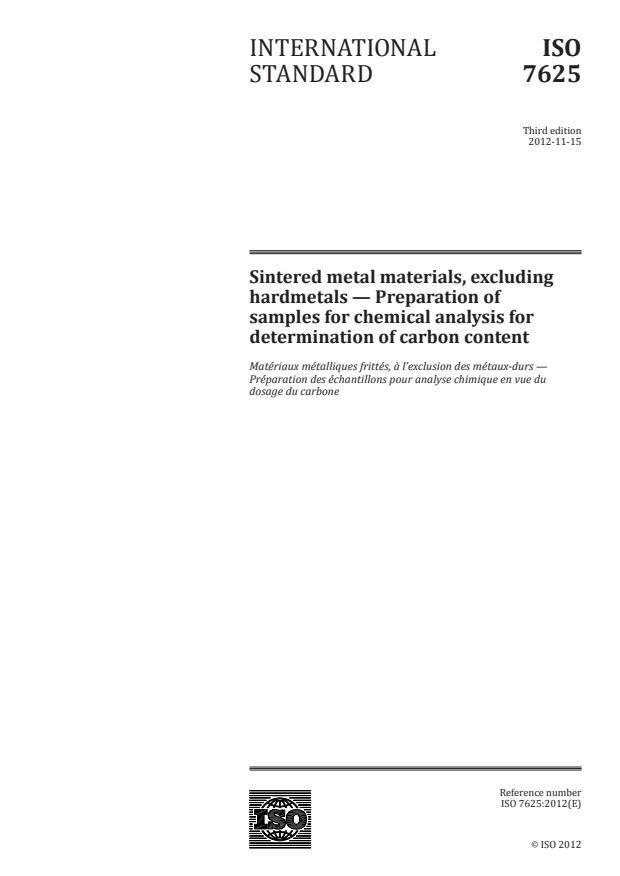
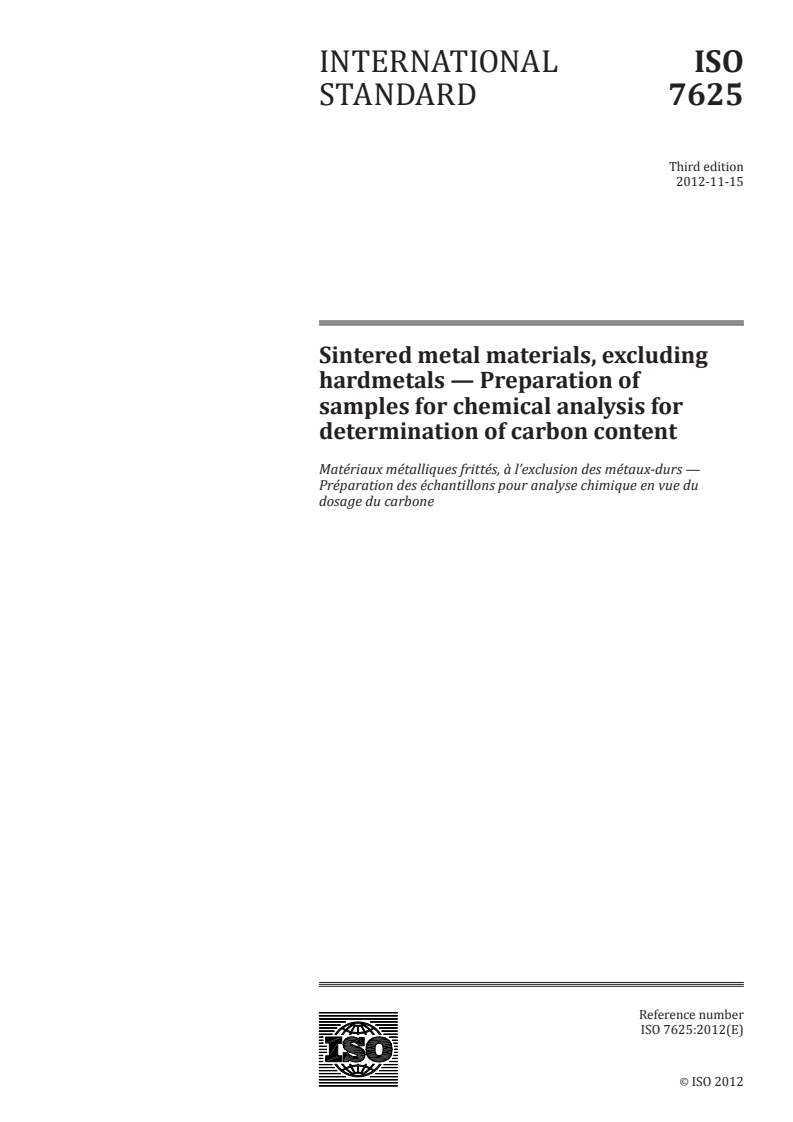
INTERNATIONAL ISO
STANDARD 7625
Third edition
2012-11-15
Sintered metal materials, excluding
hardmetals — Preparation of
samples for chemical analysis for
determination of carbon content
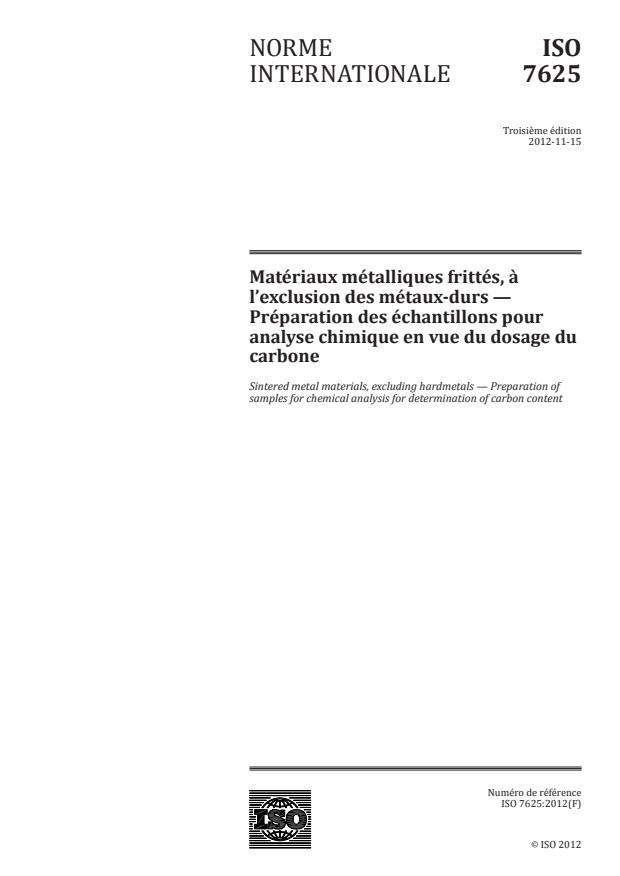
Matériaux métalliques frittés, à l’exclusion des métaux-durs —
Préparation des échantillons pour analyse chimique en vue du
dosage du carbone
Reference number
©
ISO 2012
© ISO 2012
All rights reserved. Unless otherwise specified, no part of this publication may be reproduced or utilized in any form or by any
means, electronic or mechanical, including photocopying and microfilm, without permission in writing from either ISO at the
address below or ISO’s member body in the country of the requester.
ISO copyright office
Case postale 56 • CH-1211 Geneva 20
Tel. + 41 22 749 01 11
Fax + 41 22 749 09 47
E-mail copyright@iso.org
Web www.iso.org
Published in Switzerland
ii © ISO 2012 – All rights reserved
Foreword
ISO (the International Organization for Standardization) is a worldwide federation of national standards
bodies (ISO member bodies). The work of preparing International Standards is normally carried out
through ISO technical committees. Each member body interested in a subject for which a technical
committee has been established has the right to be represented on that committee. International
organizations, governmental and non-governmental, in liaison with ISO, also take part in the work.
ISO collaborates closely with the International Electrotechnical Commission (IEC) on all matters of
electrotechnical standardization.
International Standards are drafted in accordance with the rules given in the ISO/IEC Directives, Part 2.
The main task of technical committees is to prepare International Standards. Draft International
Standards adopted by the technical committees are circulated to the member bodies for voting.
Publication as an International Standard requires approval by at least 75 % of the member bodies
casting a vote.
Attention is drawn to the possibility that some of the elements of this document may be the subject of
patent rights. ISO shall not be held responsible for identifying any or all such patent rights.
ISO 7625 was prepared by Technical Committee ISO/TC 119, Powder metallurgy, Subcommittee SC 3,
Sampling and testing methods for sintered metal materials (excluding hardmetals).
This third edition of ISO 7625 cancels and replaces the second edition (ISO 7625; 2006), which has been
technically revised in Clause 6.
Introduction
The chemical analysis of sintered metal materials, excluding hardmetals, is carried out as it would be
for solid metals, by using existing standard methods. However, as these sintered materials very often
contain carbonaceous constituents, the correct determination of carbon content (free or total) requires
that certain precautions be taken when preparing the sample for analysis from components.
Samples prepared in accordance with this International Standard may also be suitable for chemical
analysis for other elements.
iv © ISO 2012 – All rights reserved
INTERNATIONAL STANDARD ISO 7625:2012(E)
Sintered metal materials, excluding hardmetals —
Preparation of samples for chemical analysis for
determination of carbon content
1 Scope
This International Standard specifies methods for preparing a sample from one or more sintered parts to
be analysed for free or total carbon content. Combined carbon is determined as the difference between
total and free carbon. This standard covers the preparation of samples for the determination of carbon
by a chemical method, i.e. combustion in oxygen and measurement of the carbon dioxide produced,
in accordance with ISO 437. It does not cover the preparation of samples for carbon determination by
physical methods, such as metallography or spectroscopy.
2 Normative references
The following referenced documents are indispensable for the application of this document. For dated
references, only the edition cited applies. For undated references, the latest edition of the referenced
document (including any amendments) applies.
ISO 437, Steel and cast iron — Determination of total carbon content — Combustion gravimetric method
ISO 2738, Sintered metal materials, excluding hardmetals — Permeable sintered metal materials —
Determination of density, oil content, and open porosity
3 Principle
Eliminate any impregnated or surface carbon using the procedures in Clause 5. Prepare samples for
analysis by fragmentation or machining, taking care not to lose any free carbon.
4 Materials
This International Standard applies to parts
...
INTERNATIONAL ISO
STANDARD 7625
Third edition
2012-11-15
Sintered metal materials, excluding
hardmetals — Preparation of
samples for chemical analysis for
determination of carbon content
Matériaux métalliques frittés, à l’exclusion des métaux-durs —
Préparation des échantillons pour analyse chimique en vue du
dosage du carbone
Reference number
©
ISO 2012
© ISO 2012
All rights reserved. Unless otherwise specified, no part of this publication may be reproduced or utilized in any form or by any
means, electronic or mechanical, including photocopying and microfilm, without permission in writing from either ISO at the
address below or ISO’s member body in the country of the requester.
ISO copyright office
Case postale 56 • CH-1211 Geneva 20
Tel. + 41 22 749 01 11
Fax + 41 22 749 09 47
E-mail copyright@iso.org
Web www.iso.org
Published in Switzerland
ii © ISO 2012 – All rights reserved
Foreword
ISO (the International Organization for Standardization) is a worldwide federation of national standards
bodies (ISO member bodies). The work of preparing International Standards is normally carried out
through ISO technical committees. Each member body interested in a subject for which a technical
committee has been established has the right to be represented on that committee. International
organizations, governmental and non-governmental, in liaison with ISO, also take part in the work.
ISO collaborates closely with the International Electrotechnical Commission (IEC) on all matters of
electrotechnical standardization.
International Standards are drafted in accordance with the rules given in the ISO/IEC Directives, Part 2.
The main task of technical committees is to prepare International Standards. Draft International
Standards adopted by the technical committees are circulated to the member bodies for voting.
Publication as an International Standard requires approval by at least 75 % of the member bodies
casting a vote.
Attention is drawn to the possibility that some of the elements of this document may be the subject of
patent rights. ISO shall not be held responsible for identifying any or all such patent rights.
ISO 7625 was prepared by Technical Committee ISO/TC 119, Powder metallurgy, Subcommittee SC 3,
Sampling and testing methods for sintered metal materials (excluding hardmetals).
This third edition of ISO 7625 cancels and replaces the second edition (ISO 7625; 2006), which has been
technically revised in Clause 6.
Introduction
The chemical analysis of sintered metal materials, excluding hardmetals, is carried out as it would be
for solid metals, by using existing standard methods. However, as these sintered materials very often
contain carbonaceous constituents, the correct determination of carbon content (free or total) requires
that certain precautions be taken when preparing the sample for analysis from components.
Samples prepared in accordance with this International Standard may also be suitable for chemical
analysis for other elements.
iv © ISO 2012 – All rights reserved
INTERNATIONAL STANDARD ISO 7625:2012(E)
Sintered metal materials, excluding hardmetals —
Preparation of samples for chemical analysis for
determination of carbon content
1 Scope
This International Standard specifies methods for preparing a sample from one or more sintered parts to
be analysed for free or total carbon content. Combined carbon is determined as the difference between
total and free carbon. This standard covers the preparation of samples for the determination of carbon
by a chemical method, i.e. combustion in oxygen and measurement of the carbon dioxide produced,
in accordance with ISO 437. It does not cover the preparation of samples for carbon determination by
physical methods, such as metallography or spectroscopy.
2 Normative references
The following referenced documents are indispensable for the application of this document. For dated
references, only the edition cited applies. For undated references, the latest edition of the referenced
document (including any amendments) applies.
ISO 437, Steel and cast iron — Determination of total carbon content — Combustion gravimetric method
ISO 2738, Sintered metal materials, excluding hardmetals — Permeable sintered metal materials —
Determination of density, oil content, and open porosity
3 Principle
Eliminate any impregnated or surface carbon using the procedures in Clause 5. Prepare samples for
analysis by fragmentation or machining, taking care not to lose any free carbon.
4 Materials
This International Standard applies to parts
...
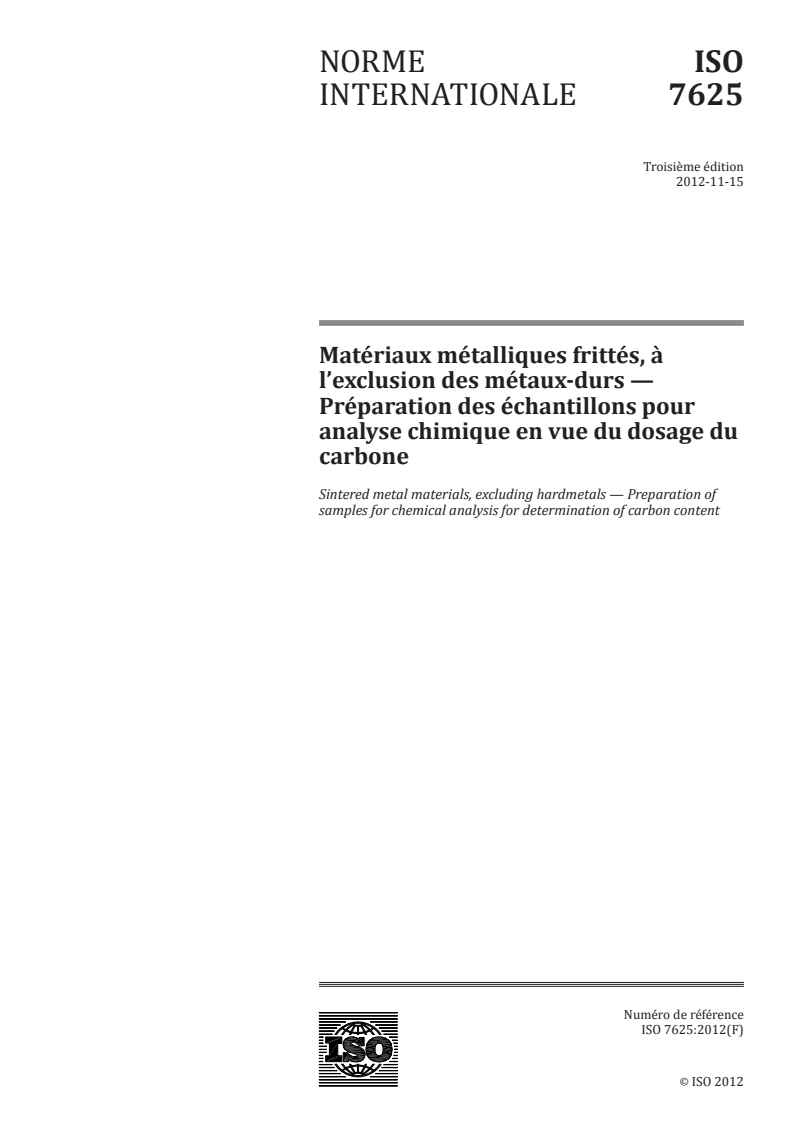
NORME ISO
INTERNATIONALE 7625
Troisième édition
2012-11-15
Matériaux métalliques frittés, à
l’exclusion des métaux-durs —
Préparation des échantillons pour
analyse chimique en vue du dosage du
carbone
Sintered metal materials, excluding hardmetals — Preparation of
samples for chemical analysis for determination of carbon content
Numéro de référence
©
ISO 2012
DOCUMENT PROTÉGÉ PAR COPYRIGHT
© ISO 2012
Droits de reproduction réservés. Sauf prescription différente, aucune partie de cette publication ne peut être reproduite ni utilisée
sous quelque forme que ce soit et par aucun procédé, électronique ou mécanique, y compris la photocopie et les microfilms, sans
l’accord écrit de l’ISO à l’adresse ci-après ou du comité membre de l’ISO dans le pays du demandeur.
ISO copyright office
Case postale 56 • CH-1211 Geneva 20
Tel. + 41 22 749 01 11
Fax + 41 22 749 09 47
E-mail copyright@iso.org
Web www.iso.org
Publié en Suisse
ii © ISO 2012 – Tous droits réservés
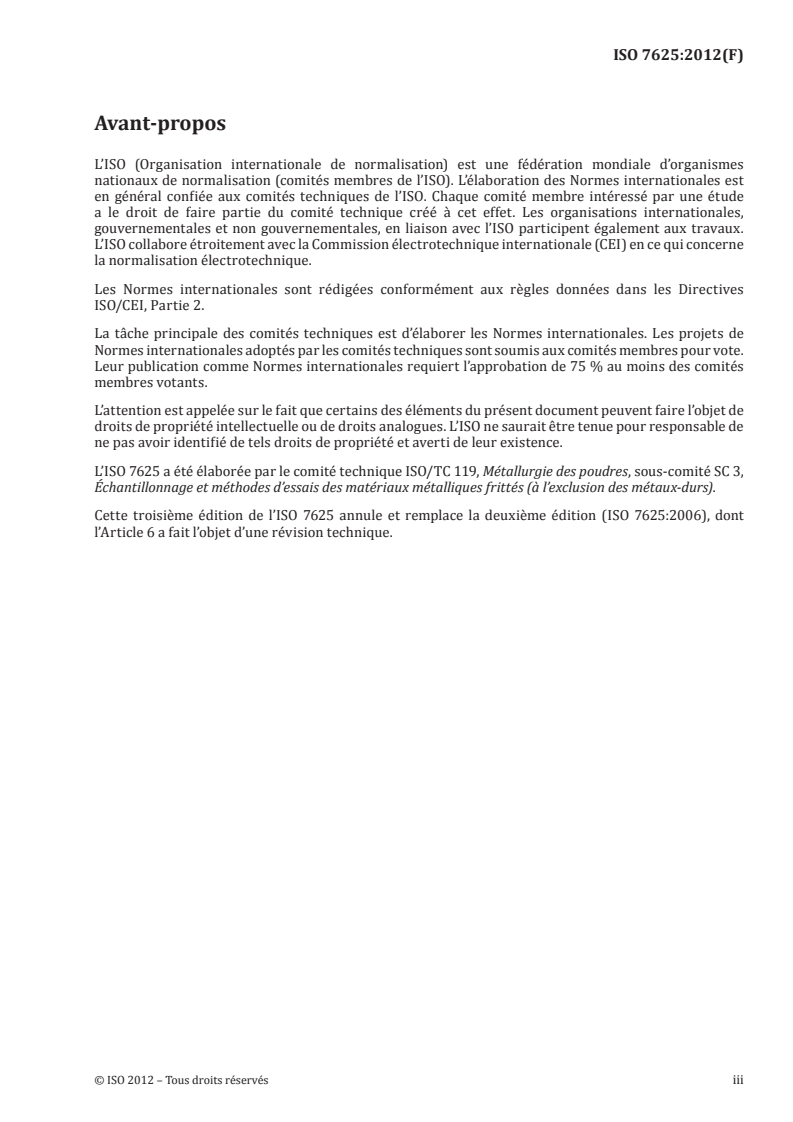
Avant-propos
L’ISO (Organisation internationale de normalisation) est une fédération mondiale d’organismes
nationaux de normalisation (comités membres de l’ISO). L’élaboration des Normes internationales est
en général confiée aux comités techniques de l’ISO. Chaque comité membre intéressé par une étude
a le droit de faire partie du comité technique créé à cet effet. Les organisations internationales,
gouvernementales et non gouvernementales, en liaison avec l’ISO participent également aux travaux.
L’ISO collabore étroitement avec la Commission électrotechnique internationale (CEI) en ce qui concerne
la normalisation électrotechnique.
Les Normes internationales sont rédigées conformément aux règles données dans les Directives
ISO/CEI, Partie 2.
La tâche principale des comités techniques est d’élaborer les Normes internationales. Les projets de
Normes internationales adoptés par les comités techniques sont soumis aux comités membres pour vote.
Leur publication comme Normes internationales requiert l’approbation de 75 % au moins des comités
membres votants.
L’attention est appelée sur le fait que certains des éléments du présent document peuvent faire l’objet de
droits de propriété intellectuelle ou de droits analogues. L’ISO ne saurait être tenue pour responsable de
ne pas avoir identifié de tels droits de propriété et averti de leur existence.
L’ISO 7625 a été élaborée par le comité technique ISO/TC 119, Métallurgie des poudres, sous-comité SC 3,
Échantillonnage et méthodes d’essais des matériaux métalliques frittés (à l’exclusion des métaux-durs).
Cette troisième édition de l’ISO 7625 annule et remplace la deuxième édition (ISO 7625:2006), dont
l’Article 6 a fait l’objet d’une révision technique.
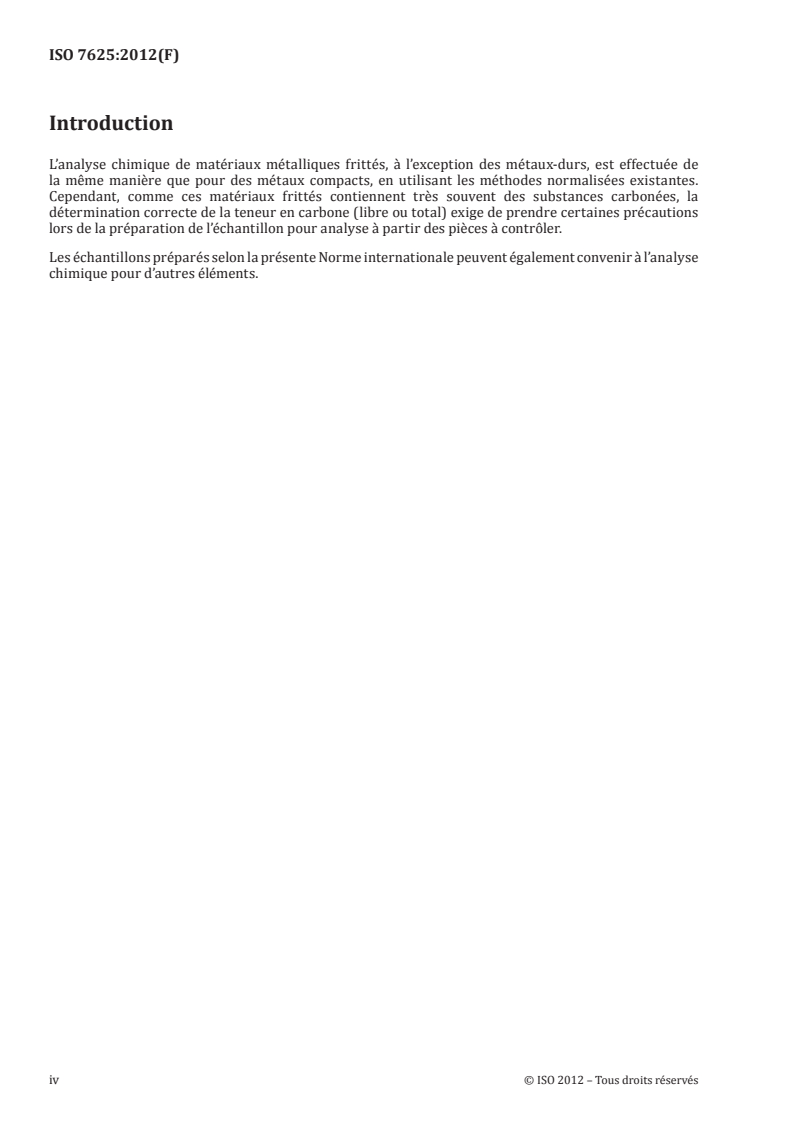
Introduction
L’analyse chimique de matériaux métalliques frittés, à l’exception des métaux-durs, est effectuée de
la même manière que pour des métaux compacts, en utilisant les méthodes normalisées existantes.
Cependant, comme ces matériaux frittés contiennent très souvent des substances carbonées, la
détermination correcte de la teneur en carbone (libre ou total) exige de prendre certaines précautions
lors de la préparation de l’échantillon pour analyse à partir des pièces à contrôler.
Les échantillons préparés selon la présente Norme internationale peuvent également convenir à l’analyse
chimique pour d’autres éléments.
iv © ISO 2012 – Tous droits réservés
NORME INTERNATIONALE ISO 7625:2012(F)
Matériaux métalliques frittés, à l’exclusion des métaux-
durs — Préparation des échantillons pour analyse
chimique en vue du dosage du carbone
1 Domaine d’application
La présente Norme internationale spécifie une méthode de préparation d’un échantillon à partir d’un
ou de plusieurs fragments frittés de matériaux à analyser en vue de la détermination de leur teneur en
carbone libre ou total. Le carbone combiné est déterminé par différence entre la teneur en carbone total
et celle en carbone libre. La présente Norme internationale concerne la préparation des échantillons
pour le dosage du carbone au moyen d’une méthode chimique, à savoir par combustion dans l’oxygène
et mesurage de la quantité de dioxyde de carbone formé, conformément à l’ISO 437. Elle ne concerne pas
la préparation d’échantillons en vue du dosage du carbone par des méthodes physiques, telles que la
métallographie ou la spectroscopie.
2 Références normatives
Les documents de référence suivants sont indispensables pour l’application du présent document. Pour
les références datées, seule l’édition citée s’applique. Pour les références non datées, la dernière édition
du document de référence s’applique (y compris les éventuels amendements).
ISO 437, Aciers et fontes — Dosage du carbone total — Méthode gravimétrique après combustion
ISO 2738, Matériaux métalliques frittés, à l’exclusion des matériaux-durs — Matériaux métalliques frittés
perméables — Détermination de la masse volumique, de la teneur en huile et de la porosité ouverte
3 Principe
Le carbone imprégné ou en surface est éliminé en utilisant le mode opératoire décrit dans l’Article 5.
Les échantillons pour analyse sont préparés par fragmentation ou usinage, en veillant à ne pas perdre
de carbone libre.
4 Matériaux
La présente Norme internationale est applicable aux fr
...
NORME ISO
INTERNATIONALE 7625
Troisième édition
2012-11-15
Matériaux métalliques frittés, à
l’exclusion des métaux-durs —
Préparation des échantillons pour
analyse chimique en vue du dosage du
carbone
Sintered metal materials, excluding hardmetals — Preparation of
samples for chemical analysis for determination of carbon content
Numéro de référence
©
ISO 2012
DOCUMENT PROTÉGÉ PAR COPYRIGHT
© ISO 2012
Droits de reproduction réservés. Sauf prescription différente, aucune partie de cette publication ne peut être reproduite ni utilisée
sous quelque forme que ce soit et par aucun procédé, électronique ou mécanique, y compris la photocopie et les microfilms, sans
l’accord écrit de l’ISO à l’adresse ci-après ou du comité membre de l’ISO dans le pays du demandeur.
ISO copyright office
Case postale 56 • CH-1211 Geneva 20
Tel. + 41 22 749 01 11
Fax + 41 22 749 09 47
E-mail copyright@iso.org
Web www.iso.org
Publié en Suisse
ii © ISO 2012 – Tous droits réservés
Avant-propos
L’ISO (Organisation internationale de normalisation) est une fédération mondiale d’organismes
nationaux de normalisation (comités membres de l’ISO). L’élaboration des Normes internationales est
en général confiée aux comités techniques de l’ISO. Chaque comité membre intéressé par une étude
a le droit de faire partie du comité technique créé à cet effet. Les organisations internationales,
gouvernementales et non gouvernementales, en liaison avec l’ISO participent également aux travaux.
L’ISO collabore étroitement avec la Commission électrotechnique internationale (CEI) en ce qui concerne
la normalisation électrotechnique.
Les Normes internationales sont rédigées conformément aux règles données dans les Directives
ISO/CEI, Partie 2.
La tâche principale des comités techniques est d’élaborer les Normes internationales. Les projets de
Normes internationales adoptés par les comités techniques sont soumis aux comités membres pour vote.
Leur publication comme Normes internationales requiert l’approbation de 75 % au moins des comités
membres votants.
L’attention est appelée sur le fait que certains des éléments du présent document peuvent faire l’objet de
droits de propriété intellectuelle ou de droits analogues. L’ISO ne saurait être tenue pour responsable de
ne pas avoir identifié de tels droits de propriété et averti de leur existence.
L’ISO 7625 a été élaborée par le comité technique ISO/TC 119, Métallurgie des poudres, sous-comité SC 3,
Échantillonnage et méthodes d’essais des matériaux métalliques frittés (à l’exclusion des métaux-durs).
Cette troisième édition de l’ISO 7625 annule et remplace la deuxième édition (ISO 7625:2006), dont
l’Article 6 a fait l’objet d’une révision technique.
Introduction
L’analyse chimique de matériaux métalliques frittés, à l’exception des métaux-durs, est effectuée de
la même manière que pour des métaux compacts, en utilisant les méthodes normalisées existantes.
Cependant, comme ces matériaux frittés contiennent très souvent des substances carbonées, la
détermination correcte de la teneur en carbone (libre ou total) exige de prendre certaines précautions
lors de la préparation de l’échantillon pour analyse à partir des pièces à contrôler.
Les échantillons préparés selon la présente Norme internationale peuvent également convenir à l’analyse
chimique pour d’autres éléments.
iv © ISO 2012 – Tous droits réservés
NORME INTERNATIONALE ISO 7625:2012(F)
Matériaux métalliques frittés, à l’exclusion des métaux-
durs — Préparation des échantillons pour analyse
chimique en vue du dosage du carbone
1 Domaine d’application
La présente Norme internationale spécifie une méthode de préparation d’un échantillon à partir d’un
ou de plusieurs fragments frittés de matériaux à analyser en vue de la détermination de leur teneur en
carbone libre ou total. Le carbone combiné est déterminé par différence entre la teneur en carbone total
et celle en carbone libre. La présente Norme internationale concerne la préparation des échantillons
pour le dosage du carbone au moyen d’une méthode chimique, à savoir par combustion dans l’oxygène
et mesurage de la quantité de dioxyde de carbone formé, conformément à l’ISO 437. Elle ne concerne pas
la préparation d’échantillons en vue du dosage du carbone par des méthodes physiques, telles que la
métallographie ou la spectroscopie.
2 Références normatives
Les documents de référence suivants sont indispensables pour l’application du présent document. Pour
les références datées, seule l’édition citée s’applique. Pour les références non datées, la dernière édition
du document de référence s’applique (y compris les éventuels amendements).
ISO 437, Aciers et fontes — Dosage du carbone total — Méthode gravimétrique après combustion
ISO 2738, Matériaux métalliques frittés, à l’exclusion des matériaux-durs — Matériaux métalliques frittés
perméables — Détermination de la masse volumique, de la teneur en huile et de la porosité ouverte
3 Principe
Le carbone imprégné ou en surface est éliminé en utilisant le mode opératoire décrit dans l’Article 5.
Les échantillons pour analyse sont préparés par fragmentation ou usinage, en veillant à ne pas perdre
de carbone libre.
4 Matériaux
La présente Norme internationale est applicable aux fr
...