

ISO 11897:1999
(Main)Packaging — Sacks made from thermoplastic flexible film — Tear propagation on edge folds
General Information
- Abstract
- Status
- Published
- Publication Date
- 10-Mar-1999
- Technical Committee
- ISO/TC 122 - Packaging
- Drafting Committee
- ISO/TC 122 - Packaging
- Current Stage
- 9060 - Close of review
- Completion Date
- 04-Jun-2031
Buy Documents
ISO 11897:1999 - Packaging — Sacks made from thermoplastic flexible film — Tear propagation on edge folds Released:3/11/1999
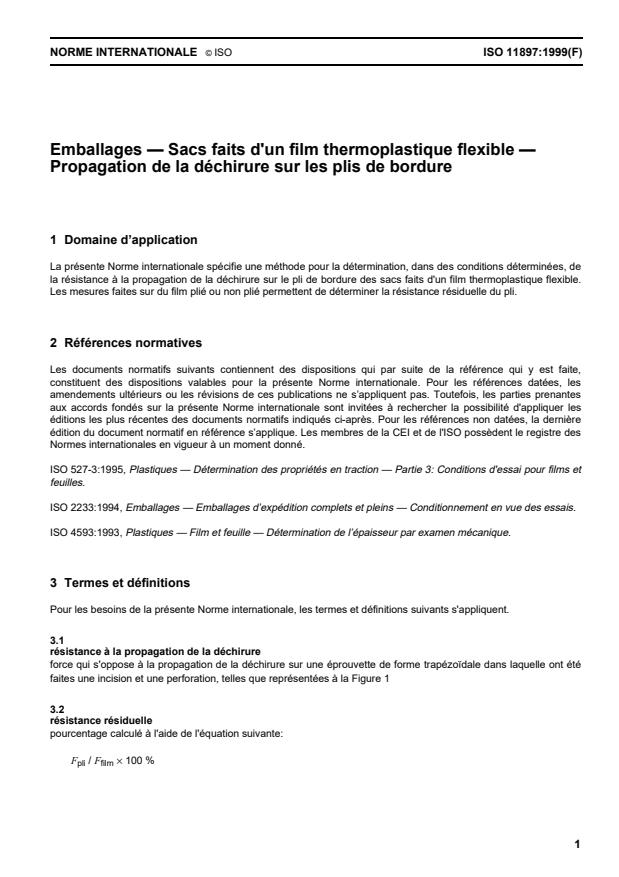
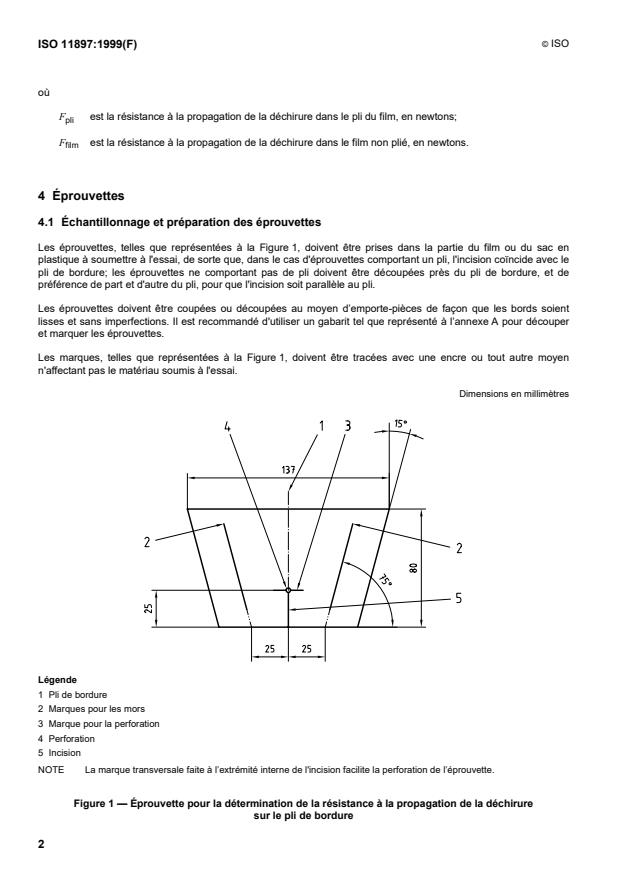
ISO 11897:1999 - Emballages — Sacs faits d'un film thermoplastique flexible — Propagation de la déchirure sur les plis de bordure Released:3/11/1999
Overview
ISO 11897:1999 specifies a standardized laboratory method to measure tear propagation on edge folds of sacks made from thermoplastic flexible film. The test quantifies how much an edge fold reduces tear resistance by comparing tear propagation force on folded and unfolded specimens and reporting the residual resistance as a percentage. This packaging standard supports quality control, material selection and performance benchmarking for flexible-film sacks.
Key Topics and Requirements
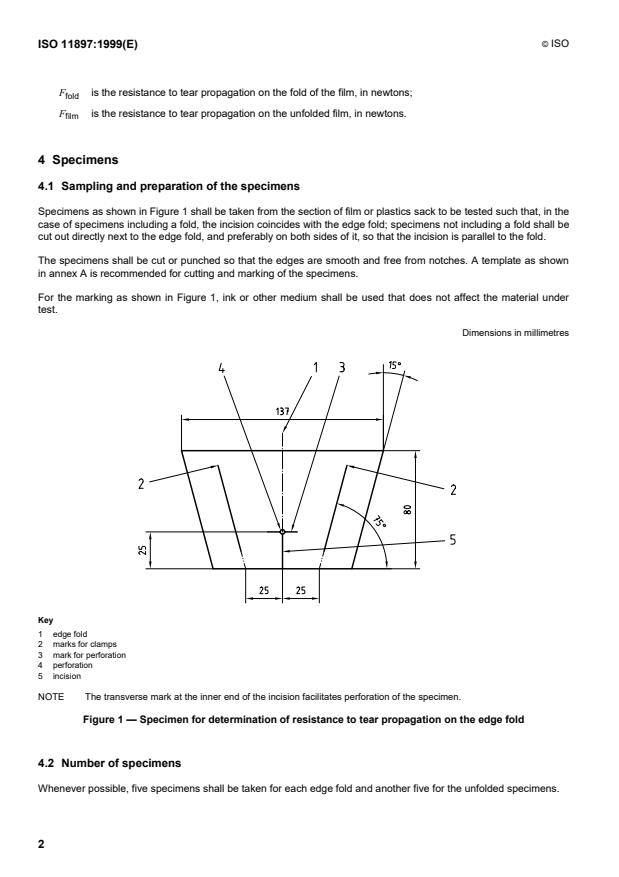
- Specimen preparation: Trapezoidal specimens with an incision and perforation are cut so the incision coincides with the edge fold; unfolded specimens are cut adjacent to the fold. A template (informative Annex A) is recommended to ensure smooth, notch-free edges.
- Number of tests: Whenever possible, take five specimens from the folded edge and five corresponding unfolded specimens.
- Conditioning and atmosphere: Condition specimens 24 h in standard laboratory atmosphere G (temperature and humidity as specified by the standard) prior to testing.
- Thickness measurement: Measure specimen thickness close to the base of the incision on both sides of the fold using ISO 4593 methods.
- Test apparatus and method:
- Use a tensile-testing machine appropriate for films (clamps to hold specimen marks; clamps span 100 mm).
- Carry out the tensile test at the test speed stated in the standard and record the maximum force attained.
- Evaluation and calculation:
- Compute the arithmetic mean of maximum forces for folded and unfolded specimens separately.
- Calculate residual resistance = (F_fold / F_film) × 100 %.
- Test report: Include reference to ISO 11897, material identification, production dates, specimen count, conditioning, thickness, F_fold, F_film, residual resistance, any unusual tear behavior, deviations from the standard, and test date.
Applications and Users
- Manufacturers of sacks and tubular thermoplastic film who need to validate edge-fold performance and durability.
- Packaging engineers and material scientists assessing film formulations, sealing and folding methods.
- Quality control and independent test laboratories performing acceptance testing or failure analysis.
- Suppliers and converters evaluating the impact of edge folds on tear resistance for transport packaging design.
Related Standards
- ISO 527-3 - Plastics: tensile test conditions for films and sheets (for tensile-testing machine requirements).
- ISO 2233 - Packaging: conditioning of complete filled transport packages (laboratory atmosphere guidance).
- ISO 4593 - Plastics: film thickness measurement (method for specimen thickness).
Keywords: ISO 11897, tear propagation, edge fold, thermoplastic flexible film, packaging standard, residual resistance, sack testing, tensile test.
Buy Documents
ISO 11897:1999 - Packaging — Sacks made from thermoplastic flexible film — Tear propagation on edge folds Released:3/11/1999
ISO 11897:1999 - Emballages — Sacs faits d'un film thermoplastique flexible — Propagation de la déchirure sur les plis de bordure Released:3/11/1999
Get Certified
Connect with accredited certification bodies for this standard

BRCGS (Brand Reputation Compliance Global Standards)
Global food safety and quality standards owner.
Sponsored listings
Frequently Asked Questions
ISO 11897:1999 is a standard published by the International Organization for Standardization (ISO). Its full title is "Packaging — Sacks made from thermoplastic flexible film — Tear propagation on edge folds". This standard covers: La présente Norme internationale spécifie une méthode pour la détermination, dans des conditions déterminées, de la résistance à la propagation de la déchirure sur le pli de bordure des sacs faits d'un film thermoplastique flexible. Les mesures faites sur du film plié ou non plié permettent de déterminer la résistance résiduelle du pli.
La présente Norme internationale spécifie une méthode pour la détermination, dans des conditions déterminées, de la résistance à la propagation de la déchirure sur le pli de bordure des sacs faits d'un film thermoplastique flexible. Les mesures faites sur du film plié ou non plié permettent de déterminer la résistance résiduelle du pli.
ISO 11897:1999 is classified under the following ICS (International Classification for Standards) categories: 55.080 - Sacks. Bags. The ICS classification helps identify the subject area and facilitates finding related standards.
ISO 11897:1999 is available in PDF format for immediate download after purchase. The document can be added to your cart and obtained through the secure checkout process. Digital delivery ensures instant access to the complete standard document.
Standards Content (Sample)
INTERNATIONAL ISO
STANDARD 11897
First edition
1999-03-01
Packaging — Sacks made from
thermoplastic flexible film — Tear
propagation on edge folds
Emballages — Sacs faits d'un film thermoplastique flexible — Propagation
de la déchirure sur les plis de bordure
A
Reference number
Foreword
ISO (the International Organization for Standardization) is a worldwide federation of national standards bodies (ISO
member bodies). The work of preparing International Standards is normally carried out through ISO technical
committees. Each member body interested in a subject for which a technical committee has been established has
the right to be represented on that committee. International organizations, governmental and non-governmental, in
liaison with ISO, also take part in the work. ISO collaborates closely with the International Electrotechnical
Commission (IEC) on all matters of electrotechnical standardization.
International Standards are drafted in accordance with the rules given in the ISO/IEC Directives, Part 3.
Draft International Standards adopted by the technical committees are circulated to the member bodies for voting.
Publication as an International Standard requires approval by at least 75 % of the member bodies casting a vote.
International Standard ISO 11897 was prepared by Technical Committee ISO/TC 122, Packaging, Subcommittee
SC 2, Sacks.
Annex A is for information only.
© ISO 1999
All rights reserved. Unless otherwise specified, no part of this publication may be reproduced or utilized in any form or by any means, electronic
or mechanical, including photocopying and microfilm, without permission in writing from the publisher.
International Organization for Standardization
Case postale 56 • CH-1211 Genève 20 • Switzerland
Internet iso@iso.ch
Printed in Switzerland
ii
INTERNATIONAL STANDARD © ISO ISO 11897:1999(E)
Packaging — Sacks made from thermoplastic flexible film — Tear
propagation on edge folds
1 Scope
This International Standard specifies a method for the determination, under given conditions, of the resistance to
tear propagation on an edge fold of sacks made from thermoplastic flexible film. Measurements on folded and
unfolded film permit the determination of the residual resistance in the fold.
2 Normative references
The following normative documents contain provisions which, through reference in this text, constitute provisions of
this International Standard. For dated references, subsequent amendments to, or revisions of, any of these
publications do not apply. However, parties to agreements based on this International Standard are encouraged to
investigate the possibility of applying the most recent editions of the normative documents indicated below. For
undated references, the latest edition of the normative document referred to applies. Members of ISO and IEC
maintain registers of currently valid International Standards.
ISO 527-3:1995, Plastics — Determination of tensile properties — Part 3: Test conditions for films and sheets.
ISO 2233:1994, Packaging — Complete filled transport packages — Conditioning for testing.
ISO 4593:1993, Plastics — Films and sheeting — Determination of thickness by mechanical scanning.
3 Terms and definitions
For the purposes of this International Standard, the following terms and definitions apply.
3.1
resistance to tear propagation
force that opposes tear propagation in a trapezoidal specimen with an incision and a perforation as shown in
Figure 1
3.2
residual resistance
percentage calculated by the equation
F / F · 100 %
fold film
where
© ISO
F is the resistance to tear propagation on the fold of the film, in newtons;
fold
F is the resistance to tear propagation on the unfolded film, in n
...
NORME ISO
INTERNATIONALE 11897
Première édition
1999-03-01
Emballages — Sacs faits d'un film
thermoplastique flexible — Propagation
de la déchirure sur les plis de bordure
Packaging — Sacks made from thermoplastic flexible film — Tear
propagation on edge folds
A
Numéro de référence
Avant-propos
L'ISO (Organisation internationale de normalisation) est une fédération mondiale d'organismes nationaux de
normalisation (comités membres de l'ISO). L'élaboration des Normes internationales est en général confiée aux
comités techniques de l'ISO. Chaque comité membre intéressé par une étude a le droit de faire partie du comité
technique créé à cet effet. Les organisations internationales, gouvernementales et non gouvernementales, en
liaison avec l'ISO participent également aux travaux. L'ISO collabore étroitement avec la Commission
électrotechnique internationale (CEI) en ce qui concerne la normalisation électrotechnique.
Les Normes internationales sont rédigées conformément aux règles données dans les Directives ISO/CEI, Partie 3.
Les projets de Normes internationales adoptés par les comités techniques sont soumis aux comités membres pour
vote. Leur publication comme Normes internationales requiert l'approbation de 75 % au moins des comités
membres votants.
La Norme internationale ISO 11897 a été élaborée par le comité technique ISO/TC 122, Emballages, sous-comité
SC 2, Sacs.
L’annexe A est donnée uniquement à titre d’information.
© ISO 1999
Droits de reproduction réservés. Sauf prescription différente, aucune partie de cette publication ne peut être reproduite ni utilisée sous quelque
forme que ce soit et par aucun procédé, électronique ou mécanique, y compris la photocopie et les microfilms, sans l'accord écrit de l'éditeur.
Organisation internationale de normalisation
Case postale 56 • CH-1211 Genève 20 • Suisse
Internet iso@iso.ch
Imprimé en Suisse
ii
NORME INTERNATIONALE © ISO ISO 11897:1999(F)
Emballages — Sacs faits d'un film thermoplastique flexible —
Propagation de la déchirure sur les plis de bordure
1 Domaine d’application
La présente Norme internationale spécifie une méthode pour la détermination, dans des conditions déterminées, de
la résistance à la propagation de la déchirure sur le pli de bordure des sacs faits d'un film thermoplastique flexible.
Les mesures faites sur du film plié ou non plié permettent de déterminer la résistance résiduelle du pli.
2 Références normatives
Les documents normatifs suivants contiennent des dispositions qui par suite de la référence qui y est faite,
constituent des dispositions valables pour la présente Norme internationale. Pour les références datées, les
amendements ultérieurs ou les révisions de ces publications ne s’appliquent pas. Toutefois, les parties prenantes
aux accords fondés sur la présente Norme internationale sont invitées à rechercher la possibilité d'appliquer les
éditions les plus récentes des documents normatifs indiqués ci-après. Pour les références non datées, la dernière
édition du document normatif en référence s’applique. Les membres de la CEI et de l'ISO possèdent le registre des
Normes internationales en vigueur à un moment donné.
ISO 527-3:1995, Plastiques — Détermination des propriétés en traction — Partie 3: Conditions d'essai pour films et
feuilles.
ISO 2233:1994, Emballages — Emballages d’expédition complets et pleins — Conditionnement en vue des essais.
ISO 4593:1993, Plastiques — Film et feuille — Détermination de l’épaisseur par examen mécanique.
3 Termes et définitions
Pour les besoins de la présente Norme internationale, les termes et définitions suivants s'appliquent.
3.1
résistance à la propagation de la déchirure
force qui s'oppose à la propagation de la déchirure sur une éprouvette de forme trapézoïdale dans laquelle ont été
faites une incision et une perforation, telles que représentées à la Figure 1
3.2
résistance résiduelle
pourcentage calculé à l'aide de l'équation suivante:
F / F · 100 %
pli film
© ISO
où
F est la résistance à la propagation de la déchirure dans le pli du film, en newtons;
pli
F est la résistance à la propagation de la déchirure dans le film non plié, en newtons.
film
4 Éprouvettes
4.1 Échantillonnage et préparation des éprouvettes
...