

ISO 7023:1983
(Main)Packaging — Sacks — Method of sampling empty sacks for testing
General Information
- Abstract
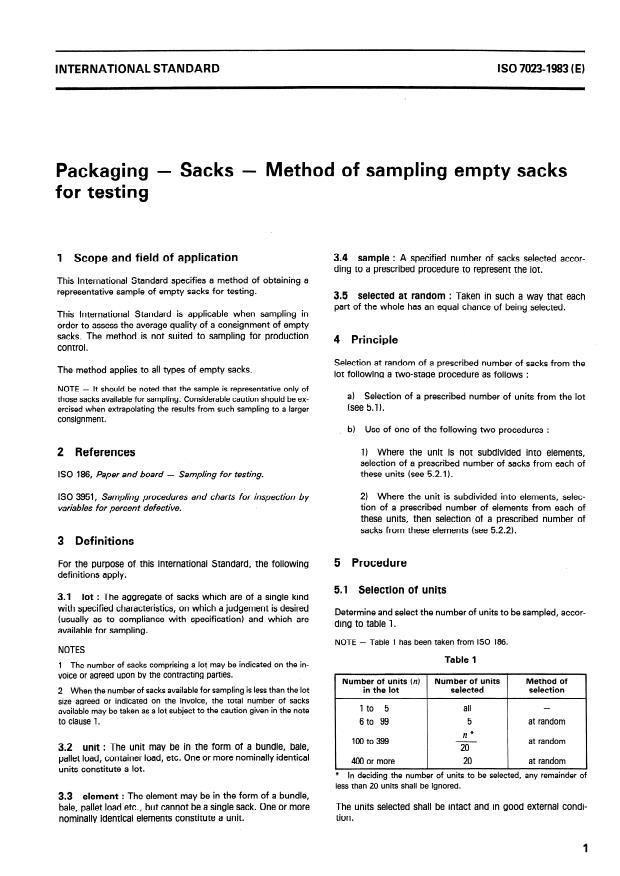
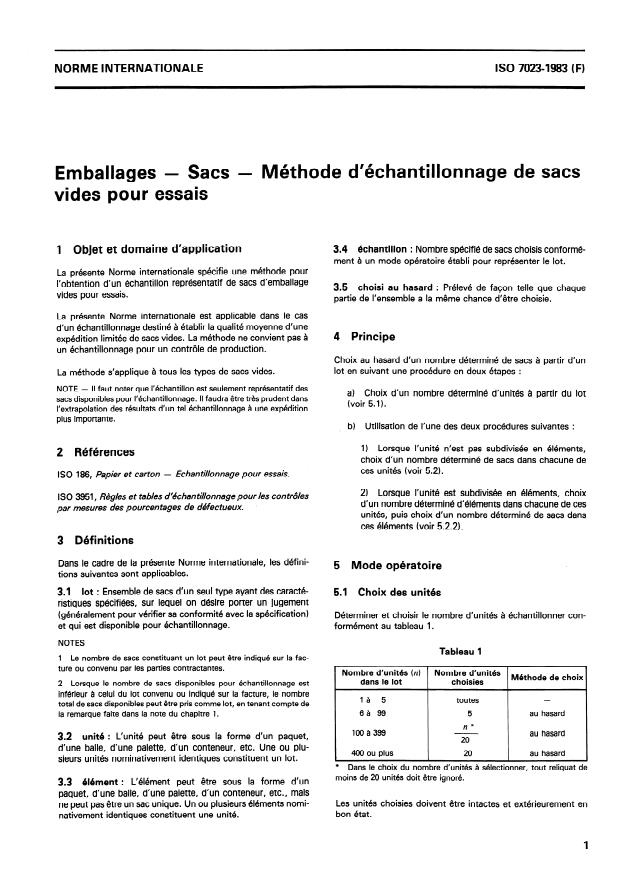
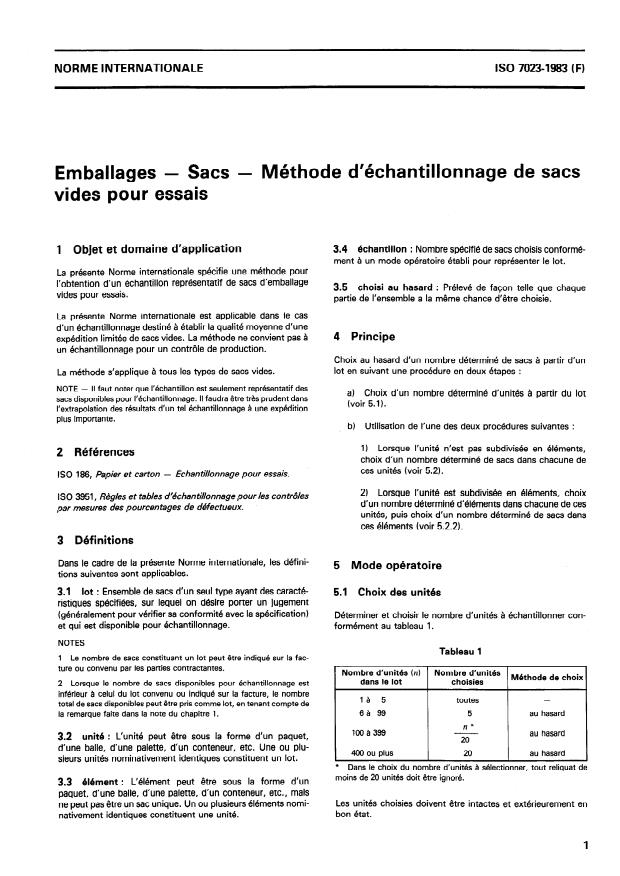
The principle consists in selection at random of a prescribes number of sacks from the lot following a two-stage procedure. Tables are given to determine the number of selected units and sacks. The method applies to all types of empty sacks
- Status
- Published
- Publication Date
- 31-Jan-1983
- Technical Committee
- ISO/TC 122 - Packaging
- Drafting Committee
- ISO/TC 122 - Packaging
- Current Stage
- 9093 - International Standard confirmed
- Start Date
- 10-Jun-2026
- Completion Date
- 29-Aug-2026
Buy Documents


ISO 7023:1983 - Packaging — Sacks — Method of sampling empty sacks for testing Released:2/1/1983

ISO 7023:1983 - Emballages — Sacs — Méthode d'échantillonnage de sacs vides pour essais Released:2/1/1983

ISO 7023:1983 - Emballages — Sacs — Méthode d'échantillonnage de sacs vides pour essais Released:2/1/1983
Overview
ISO 7023:1983, "Packaging - Sacks - Method of sampling empty sacks for testing", defines a standardized, two-stage method to obtain representative samples of empty sacks for laboratory testing and quality assessment. The procedure is applicable to all types of empty sacks and is intended to assess the average quality of a consignment (not for production process control). The standard describes random selection rules, unit and element definitions, use of sampling tables, handling precautions, re-sampling procedures and required test-report information.
Key topics and requirements
- Scope and applicability: Sampling to assess average lot quality; not intended for production control. The sample represents only the sacks available for sampling.
- Two-stage sampling principle:
- Stage 1 - selection of a prescribed number of units from the lot (examples of units: bundles, bales, pallet loads, container loads).
- Stage 2 - selection of sacks either directly from each selected unit or, where units are subdivided, selection of elements (elements cannot be individual sacks) and then sacks from those elements.
- Random selection: Each part of the whole must have an equal chance of being selected.
- Sampling tables: The standard provides tables (referenced from ISO 186 and ISO 3951) to determine the number of units, elements and sacks to select based on lot size.
- Definitions: Clear definitions for lot, unit and element to ensure consistent sampling.
- Precautions and handling: Selected sacks must be kept and handled to avoid permanent changes before testing.
- Marking and traceability: Each selected sack must carry identification marks proving origin.
- Re-sampling rules: Procedures for re-sampling after accidental loss/damage or other reasons; re-sampling should follow the same specification as closely as possible.
- Test report content: The report must include a reference to ISO 7023, purchaser/vendor names and addresses, date/place of sampling, lot description, numbers of units/elements/sacks (in lot and selected), identification references, circumstances affecting results, sampler signature and any deviations from the standard.
Applications and users
- Quality assurance and compliance testing for manufacturers, converters and traders of sacks (paper, woven, plastic, multiwall).
- Purchase inspection by buyers, inspection bodies and testing laboratories to verify consignment conformity.
- Contractual and dispute-resolution sampling where standardized, reproducible methods are required.
- Logistics and packaging engineers needing consistent sampling protocols for lot-based quality assessment.
Related standards
- ISO 186 (sampling guidance referenced for unit selection)
- ISO 3951 (sampling procedures and charts for inspection by variables)
- ISO/TC 122 (Packaging - technical committee developing packaging standards)
Keywords: ISO 7023:1983, empty sacks sampling, packaging standard, sacks sampling method, quality control sampling, sampling for testing.
Relations
- Effective Date
- 25-Aug-2026
- Effective Date
- 25-Aug-2026
- Effective Date
- 25-Aug-2026
- Effective Date
- 08-Jul-2026
Buy Documents
ISO 7023:1983 - Packaging — Sacks — Method of sampling empty sacks for testing Released:2/1/1983
ISO 7023:1983 - Emballages — Sacs — Méthode d'échantillonnage de sacs vides pour essais Released:2/1/1983
ISO 7023:1983 - Emballages — Sacs — Méthode d'échantillonnage de sacs vides pour essais Released:2/1/1983
Get Certified
Connect with accredited certification bodies for this standard

BRCGS (Brand Reputation Compliance Global Standards)
Global food safety and quality standards owner.
Sponsored listings
Frequently Asked Questions
ISO 7023:1983 is a standard published by the International Organization for Standardization (ISO). Its full title is "Packaging — Sacks — Method of sampling empty sacks for testing". This standard covers: The principle consists in selection at random of a prescribes number of sacks from the lot following a two-stage procedure. Tables are given to determine the number of selected units and sacks. The method applies to all types of empty sacks
The principle consists in selection at random of a prescribes number of sacks from the lot following a two-stage procedure. Tables are given to determine the number of selected units and sacks. The method applies to all types of empty sacks
ISO 7023:1983 is classified under the following ICS (International Classification for Standards) categories: 55.080 - Sacks. Bags. The ICS classification helps identify the subject area and facilitates finding related standards.
ISO 7023:1983 has the following relationships with other standards: It is inter standard links to EN ISO 8367-1:2026, EN ISO 15119:2004, EN ISO 7965-1:2024, EN ISO 6591-1:2026. Understanding these relationships helps ensure you are using the most current and applicable version of the standard.
ISO 7023:1983 is available in PDF format for immediate download after purchase. The document can be added to your cart and obtained through the secure checkout process. Digital delivery ensures instant access to the complete standard document.
Standards Content (Sample)
International Standard
INTERNATIONAL ORGANIZATION FOR STANDARDIZATIONWE)I(C\YHAPOAHAR OPTAHM3AUMR fl0 CTAHAAPTH3AWlM~RGANISATION INTERNATIONALE DE NORMALISATION
Method of sampling empty Sacks
Packaging - Sacks -
for testing
NIethode d ’khantilfonnage de sacs vides pour essais
Embaflages - Sacs -
First edition - 1983-02-15
Ref. No. ISO 70234983 (E)
UDC 621.798.15 : 676.821 : 620.11
w
-
Descrigtors : packages, bags, sampling.
Price based on 2 pages
Foreword
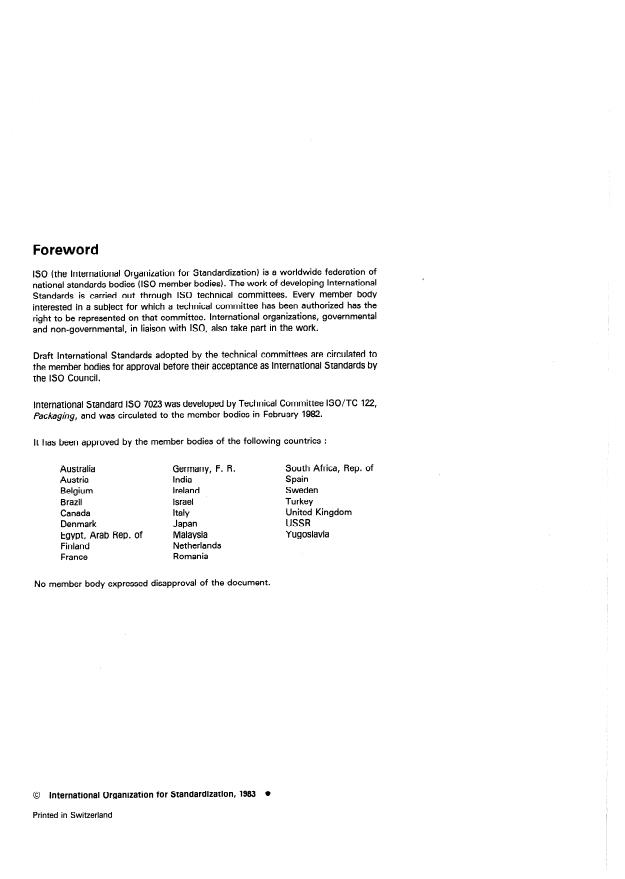
ISO (the International Organization for Standardization) is a worldwide federation of
national Standards bodies (ISO member bodies). The work of developing International
Standards is carried out through ISO technical committees. Every member body
interested in a subject for which a technical committee has been authorized has the
right to be represented on that committee. International organizations, governmental
and non-governmental, in liaison with ISO, also take part in the work.
Draft International Standards adopted by the technical committees are circulated to
the member bodies for approval before their acceptance as International Standards by
the ISO Council.
International Standard ISO 7023 was developed by Technical Committee ISO/TC 122,
Packaging, and was circulated to the member bodies in February 1982.
lt has been approved by the member bodies of the following countries :
Australia
Germany, F. R. South Africa, Rep. of
Austria India
Spain
Belgium
I reland Sweden
Brazil Israel Turkey
Canada Italy United Kingdom
Denmark
Japan USSR
Egypt, Arab Rep. of Malaysia Y ugoslavia
Finland
Netherlands
France Romania
No member body expressed disapproval of the document.
0 International Organkation for Standardkation, 1983
Printed in Switzerland
ISO 7023-1983 (E)
INTERNATIONAL STANDARD
Method of sampling empty Sacks
Packaging - Sacks -
for testing
3.4 Sample : A specified number of Sacks selected accor-
1 Scope and field of application
ding to a prescribed procedure to represent the lot.
This International Standard specifies a method of obtaining a
representative Sample of empty Sacks for testing.
3.5 selected at random : Taken in such a way that each
part of the whole has an equal Chance of being selected.
This International Standard is applicable when sampling in
Order to assess the average quality of a consignment of empty
Sacks. The method is not suited to sampling for production
4 Principle
control.
Selection at random of a prescribed number of Sacks from the
The method applies to all types of empty Sacks.
lot following a two-Stage procedure as follows :
NOTE - It should be noted that the Sample is representative only of
a) Selection of a prescribed number of units from the lot
those Sacks available for sampling. Considerable caution should be ex-
(sec 5.1).
ercised when extrapolating the results from such sampling to a larger
consignment.
b) Use of one of the following two procedures :
1) Where the unit is not subdivided into elements,
2 References
selection of a prescribed number of Sacks from each of
these units (sec 52.1).
ISO 106, Paper and board - Sampling for testing.
ISO 3951, Sampling procedures and Charts for inspection by 2) Where the unit is subdivided into elements, selec-
tion of a prescribed number of elements from each of
variables for percen t defective.
these units, then selection of a prescribed number of
Sacks from these elements (sec 5.2.2).
3 Definitions
5 Procedure
For the purpose of this International Standard, the following
definitions apply.
5.1 Selection of units
3.1 lot : The aggregate of Sacks which are of a Single kind
with specified characteristics, on which a judgement is desired
Determine and select the number of units to be sampled, accor-
(usually as to compliance with
...
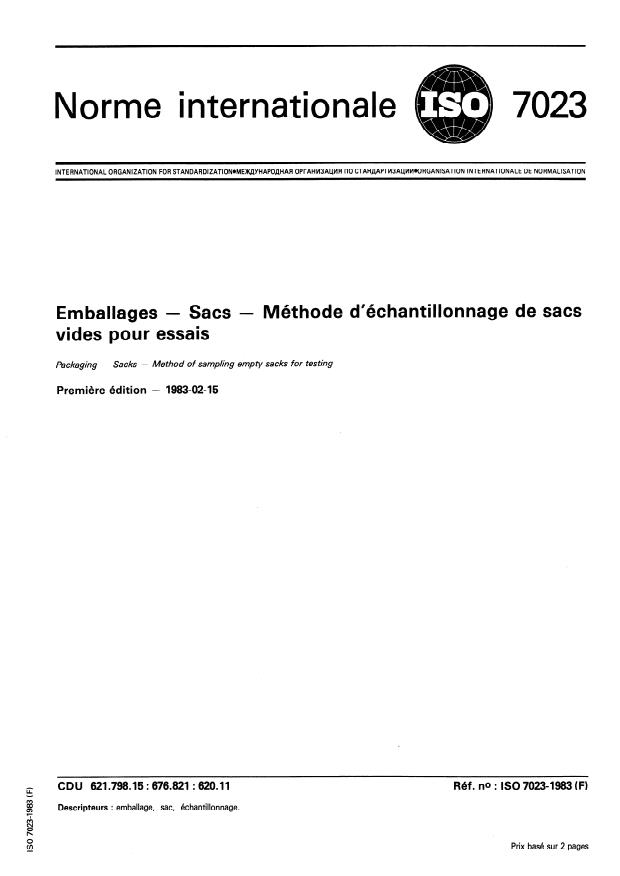
Norme internationale
INTERNATIONAL ORGANIZATION FOR STANDARDIZATIONWlE~YHAPO~HAR OPl-AHM3ALWlR fl0 CTAH~APTbl3ALWl~RGANISATION INTERNATIONALE DE NORMALISATION
Emballages - Sacs - Méthode d’échantillonnage de sacs
vides pour essais
Method of sampfing empty sacks for testing
Packaging - Sacks -
Première édition - 1983-02-15
CDU 621.798.15 : 676.821 : 620.11
Réf. no : ISO 70234983 (F)
îî
Y
Descripteurs : emballage, sac, échantillonnage.
Prix basé sur 2 pages
Avant-propos
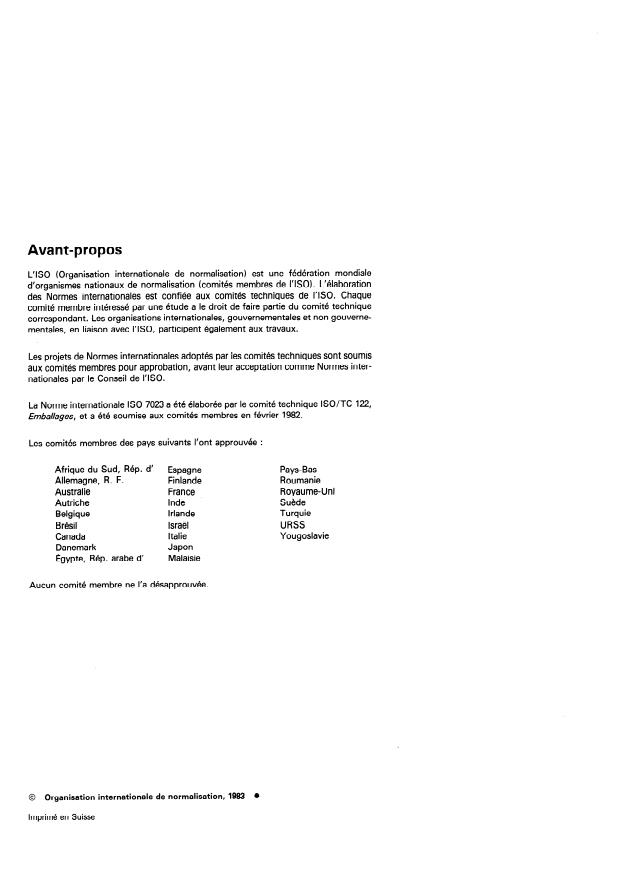
L’ISO (Organisation internationale de normalisation) est une fédération mondiale
d’organismes nationaux de normalisation (comités membres de I’ISO). L’élaboration
des Normes internationales est confiée aux comités techniques de I’ISO. Chaque
comité membre intéressé par une étude a le droit de faire partie du comité technique
correspondant. Les organisations internationales, gouvernementales et non gouverne-
mentales, en liaison avec I’ISO, participent également aux travaux.
Les projets de Normes internationales adoptés par les comités techniques sont soumis
aux comités membres pour approbation, avant leur acceptation comme Normes inter-
nationales par le Conseil de I’ISO.
La Norme internationale ISO 7023 a été élaborée par le comité technique ISO/TC 122,
Emballages, et a été soumise aux comités membres en février 1982.
Les comités membres des pays suivants l’ont approuvée :
Afrique du Sud, Rép. d’ Pays- Bas
Espagne
Allemagne, R. F. Finlande Roumanie
Australie
France Royaume-Uni
Autriche Inde Suède
Turquie
Belgique Irlande
Brésil Israël URSS
Canada Italie Yougoslavie
Danemark Japon
Égypte, Rép. arabe d’ Malaisie
Aucun comité membre ne l’a désapprouvée.
0 Organisation internationale de normalisation, 1983
Imprimé en Suisse
--
NORME INTERNATIONALE ISO 7023-1983 (F)
Méthode d’échantillonnage de sacs
Emballages - Sacs -
vides pour essais
3.4 khantillon : Nombre spécifié de sacs choisis conformé-
1 Objet et domaine d’application
ment à un mode opératoire établi pour représenter le lot.
La présente Norme internationale spécifie une méthode pour
l’obtention d’un échantillon représentatif de sacs d’emballage
3.5 choisi au hasard : Prélevé de facon telle que chaque
vides pour essais.
partie de l’ensemble a la même chance d’être choisie.
La présente Norme internationale est applicable dans le cas
d’un échantillonnage destiné à établir la qualité moyenne d’une
4 Principe
expédition limitée de sacs vides. La méthode ne convient pas à
un échantillonnage pour un contrôle de production.
Choix au hasard d’un nombre déterminé de sacs à partir d’un
La méthode s’applique à tous les types de sacs vides. lot en suivant une procédure en deux étapes :
II faut noter que l’échantillon est seulement représentatif des
NOTE -
a) Choix d’un nombre déterminé d’unités à partir du lot
sacs disponibles pour l’échantillonnage. II faudra être trés prudent dans
(voir 5.1).
l’extrapolation des résultats d’un tel échantillonnage à une expédition
plus importante.
b) Utilisation de l’une des deux procédures suivantes :
1) Lorsque l’unité n’est pas subdivisée en éléments,
2 Références
choix d’un nombre déterminé de sacs dans chacune de
ces unités (voir 5.2).
ISO 186, Pa,oier et carton - Échantillonnage ,oour essais.
2) Lorsque l’unité est subdivisée en éléments, choix
ISO 3951, Réglfes et tables d’échantillonnage ,oour les contrôles
d’un nombre déterminé d’éléments dans chacune de ces
,oar mesures des ,oourcentages de dhfectueux.
unités, puis choix d’un nombre déterminé de sacs dans
ces éléments (voir 5.2.2).
3 Définitions
Dans le cadre de la présente Norme internationale, les défini-
5 Mode opératoire
tions suivantes sont applicables.
3.1 lot : Ensemble de sacs d’un seul type ayant des caracté-
5.1 Choix des unités
ristiques spécifiées, sur lequel on désire porter un jugement
(généralement pour vérifier sa conformite avec la spécification)
Déterminer et choisir le nombre d’unités à échantillonner con-
et qui est di
...
Norme internationale
INTERNATIONAL ORGANIZATION FOR STANDARDIZATIONWlE~YHAPO~HAR OPl-AHM3ALWlR fl0 CTAH~APTbl3ALWl~RGANISATION INTERNATIONALE DE NORMALISATION
Emballages - Sacs - Méthode d’échantillonnage de sacs
vides pour essais
Method of sampfing empty sacks for testing
Packaging - Sacks -
Première édition - 1983-02-15
CDU 621.798.15 : 676.821 : 620.11
Réf. no : ISO 70234983 (F)
îî
Y
Descripteurs : emballage, sac, échantillonnage.
Prix basé sur 2 pages
Avant-propos
L’ISO (Organisation internationale de normalisation) est une fédération mondiale
d’organismes nationaux de normalisation (comités membres de I’ISO). L’élaboration
des Normes internationales est confiée aux comités techniques de I’ISO. Chaque
comité membre intéressé par une étude a le droit de faire partie du comité technique
correspondant. Les organisations internationales, gouvernementales et non gouverne-
mentales, en liaison avec I’ISO, participent également aux travaux.
Les projets de Normes internationales adoptés par les comités techniques sont soumis
aux comités membres pour approbation, avant leur acceptation comme Normes inter-
nationales par le Conseil de I’ISO.
La Norme internationale ISO 7023 a été élaborée par le comité technique ISO/TC 122,
Emballages, et a été soumise aux comités membres en février 1982.
Les comités membres des pays suivants l’ont approuvée :
Afrique du Sud, Rép. d’ Pays- Bas
Espagne
Allemagne, R. F. Finlande Roumanie
Australie
France Royaume-Uni
Autriche Inde Suède
Turquie
Belgique Irlande
Brésil Israël URSS
Canada Italie Yougoslavie
Danemark Japon
Égypte, Rép. arabe d’ Malaisie
Aucun comité membre ne l’a désapprouvée.
0 Organisation internationale de normalisation, 1983
Imprimé en Suisse
--
NORME INTERNATIONALE ISO 7023-1983 (F)
Méthode d’échantillonnage de sacs
Emballages - Sacs -
vides pour essais
3.4 khantillon : Nombre spécifié de sacs choisis conformé-
1 Objet et domaine d’application
ment à un mode opératoire établi pour représenter le lot.
La présente Norme internationale spécifie une méthode pour
l’obtention d’un échantillon représentatif de sacs d’emballage
3.5 choisi au hasard : Prélevé de facon telle que chaque
vides pour essais.
partie de l’ensemble a la même chance d’être choisie.
La présente Norme internationale est applicable dans le cas
d’un échantillonnage destiné à établir la qualité moyenne d’une
4 Principe
expédition limitée de sacs vides. La méthode ne convient pas à
un échantillonnage pour un contrôle de production.
Choix au hasard d’un nombre déterminé de sacs à partir d’un
La méthode s’applique à tous les types de sacs vides. lot en suivant une procédure en deux étapes :
II faut noter que l’échantillon est seulement représentatif des
NOTE -
a) Choix d’un nombre déterminé d’unités à partir du lot
sacs disponibles pour l’échantillonnage. II faudra être trés prudent dans
(voir 5.1).
l’extrapolation des résultats d’un tel échantillonnage à une expédition
plus importante.
b) Utilisation de l’une des deux procédures suivantes :
1) Lorsque l’unité n’est pas subdivisée en éléments,
2 Références
choix d’un nombre déterminé de sacs dans chacune de
ces unités (voir 5.2).
ISO 186, Pa,oier et carton - Échantillonnage ,oour essais.
2) Lorsque l’unité est subdivisée en éléments, choix
ISO 3951, Réglfes et tables d’échantillonnage ,oour les contrôles
d’un nombre déterminé d’éléments dans chacune de ces
,oar mesures des ,oourcentages de dhfectueux.
unités, puis choix d’un nombre déterminé de sacs dans
ces éléments (voir 5.2.2).
3 Définitions
Dans le cadre de la présente Norme internationale, les défini-
5 Mode opératoire
tions suivantes sont applicables.
3.1 lot : Ensemble de sacs d’un seul type ayant des caracté-
5.1 Choix des unités
ristiques spécifiées, sur lequel on désire porter un jugement
(généralement pour vérifier sa conformite avec la spécification)
Déterminer et choisir le nombre d’unités à échantillonner con-
et qui est di
...