

ISO 11093-2:2025
(Main)Paper and board — Testing of cores — Part 2: Conditioning of test samples
General Information
- Abstract
This document specifies the conditioning atmospheres to be used for conditioning and testing cores based on ISO 187.
- Status
- Published
- Publication Date
- 26-Oct-2025
- Technical Committee
- ISO/TC 6 - Paper, board and pulps
- Drafting Committee
- ISO/TC 6/WG 7 - Cores for reels of paper
- Current Stage
- 6060 - International Standard published
- Start Date
- 27-Oct-2025
- Due Date
- 22-Apr-2026
- Completion Date
- 27-Oct-2025
Overview
ISO 11093-2:2025 - Paper and board - Testing of cores - Part 2: Conditioning of test samples specifies the conditioning atmospheres and practical steps for preparing paper and board cores prior to testing. Aligned with ISO 187, this standard defines the temperature and relative humidity regimes, apparatus requirements and the conditioning procedure needed to establish a stable moisture equilibrium in test pieces. It replaces the earlier 1994 edition and updates terminology (e.g., “conditioning rooms” in place of “climatic chambers”).
Key topics and requirements
- Conditioning atmospheres (Table 1):
- 23/50: 23 ± 1 °C and 50 ± 2 % RH - preferred (default unless agreed otherwise)
- 27/65: 27 ± 1 °C and 65 ± 2 % RH - for tropical countries
- Apparatus: conditioning room with automatic control of temperature and relative humidity, and air circulation ensuring uniform conditions; atmospheric verification in accordance with ISO 187:2022 (Annex A).
- Pre-drying: predry test pieces for 48 h at 40 °C ± 2 °C and 20–35 % RH to ensure adsorption-based moisture adjustment before conditioning.
- Conditioning procedure:
- Position samples for free air access (no stacking; avoid overcrowding).
- Consider moisture equilibrium reached when two consecutive weighings (minimum 48 h apart) differ by ≤ 0.1 % of mass.
- Ensure pre-conditioning air moisture content is lower than the conditioning atmosphere.
- Conditioning report: include reference to ISO 11093-2:2025, specimen type, place/date, number of specimens, conditioning atmosphere and duration, and any deviations or relevant circumstances.
Applications and users
ISO 11093-2:2025 is intended for laboratories, manufacturers and quality assurance teams involved with:
- Paper and board core manufacturing and testing
- Converter or rewind operations using paper cores for reels and rolls
- Independent testing laboratories performing mechanical or dimensional tests where moisture state affects results
- R&D and process engineering groups validating material performance under standard atmospheres Using ISO 11093-2 ensures reproducible, comparable test conditions and reliable test data for contract testing, quality control, acceptance testing and regulatory compliance.
Related standards
- ISO 187:2022 - Standard atmosphere for conditioning and testing; procedure for monitoring atmosphere and conditioning of samples (normative reference)
- ISO 554:1976 - Standard atmospheres for conditioning and/or testing - specifications (referenced for tolerance values)
- Other parts of the ISO 11093 series for additional core testing methods
Keywords: ISO 11093-2:2025, conditioning of test samples, conditioning atmosphere, paper and board cores, ISO 187, pre-drying, moisture equilibrium, conditioning room.
Relations
- Effective Date
- 27-Apr-2024
Get Certified
Connect with accredited certification bodies for this standard

Control Union Certifications
Global certification for agriculture and sustainability.

Gozdarski inštitut Slovenije
Slovenian Forestry Institute. Forest management certification support, timber testing.
Sponsored listings
Frequently Asked Questions
ISO 11093-2:2025 is a standard published by the International Organization for Standardization (ISO). Its full title is "Paper and board — Testing of cores — Part 2: Conditioning of test samples". This standard covers: This document specifies the conditioning atmospheres to be used for conditioning and testing cores based on ISO 187.
This document specifies the conditioning atmospheres to be used for conditioning and testing cores based on ISO 187.
ISO 11093-2:2025 is classified under the following ICS (International Classification for Standards) categories: 85.060 - Paper and board. The ICS classification helps identify the subject area and facilitates finding related standards.
ISO 11093-2:2025 has the following relationships with other standards: It is inter standard links to ISO 11093-2:1994. Understanding these relationships helps ensure you are using the most current and applicable version of the standard.
ISO 11093-2:2025 is available in PDF format for immediate download after purchase. The document can be added to your cart and obtained through the secure checkout process. Digital delivery ensures instant access to the complete standard document.
Standards Content (Sample)
International
Standard
ISO 11093-2
Second edition
Paper and board — Testing of cores —
2025-10
Part 2:
Conditioning of test samples
Papier et carton — Essais des mandrins —
Partie 2: Conditionnement des échantillons pour essai
Reference number
© ISO 2025
All rights reserved. Unless otherwise specified, or required in the context of its implementation, no part of this publication may
be reproduced or utilized otherwise in any form or by any means, electronic or mechanical, including photocopying, or posting on
the internet or an intranet, without prior written permission. Permission can be requested from either ISO at the address below
or ISO’s member body in the country of the requester.
ISO copyright office
CP 401 • Ch. de Blandonnet 8
CH-1214 Vernier, Geneva
Phone: +41 22 749 01 11
Email: copyright@iso.org
Website: www.iso.org
Published in Switzerland
ii
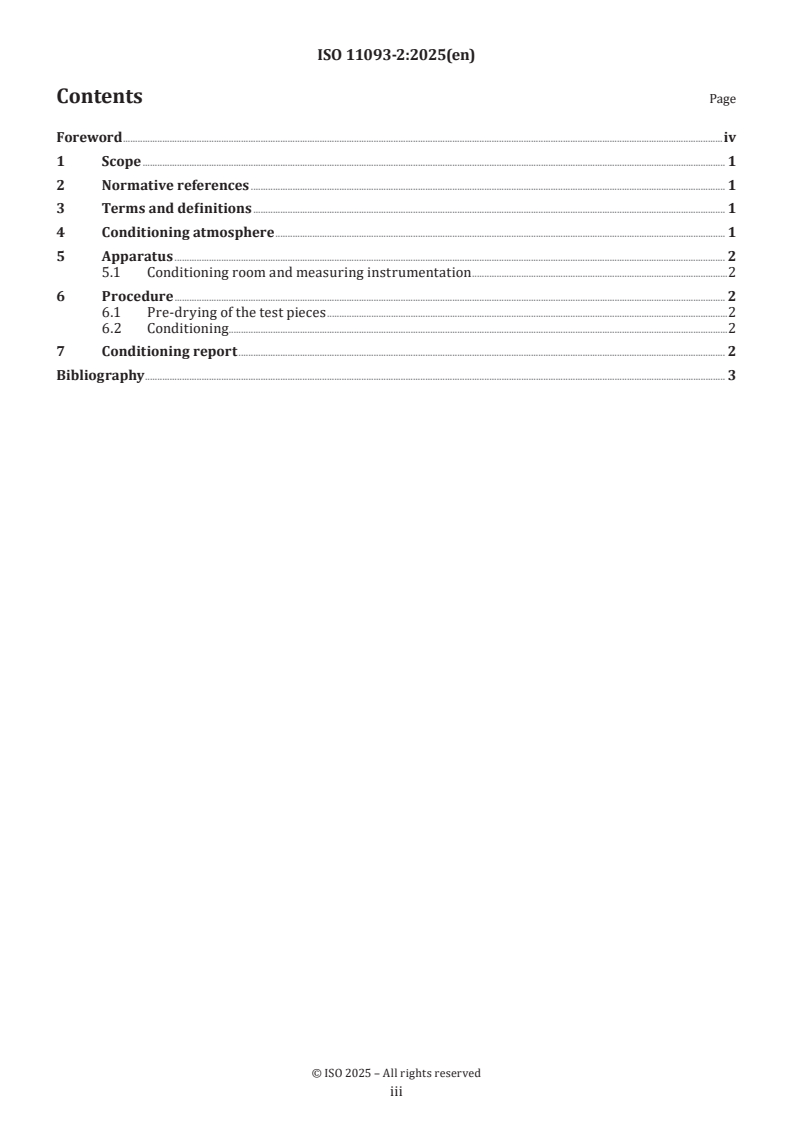
Contents Page
Foreword .iv
1 Scope . 1
2 Normative references . 1
3 Terms and definitions . 1
4 Conditioning atmosphere . 1
5 Apparatus . 2
5.1 Conditioning room and measuring instrumentation .2
6 Procedure . 2
6.1 Pre-drying of the test pieces .2
6.2 Conditioning.2
7 Conditioning report . 2
Bibliography . 3
iii
Foreword
ISO (the International Organization for Standardization) is a worldwide federation of national standards
bodies (ISO member bodies). The work of preparing International Standards is normally carried out through
ISO technical committees. Each member body interested in a subject for which a technical committee
has been established has the right to be represented on that committee. International organizations,
governmental and non-governmental, in liaison with ISO, also take part in the work. ISO collaborates closely
with the International Electrotechnical Commission (IEC) on all matters of electrotechnical standardization.
The procedures used to develop this document and those intended for its further maintenance are described
in the ISO/IEC Directives, Part 1. In particular, the different approval criteria needed for the different types
of ISO document should be noted. This document was drafted in accordance with the editorial rules of the
ISO/IEC Directives, Part 2 (see www.iso.org/directives).
ISO draws attention to the possibility that the implementation of this document may involve the use of (a)
patent(s). ISO takes no position concerning the evidence, validity or applicability of any claimed patent
rights in respect thereof. As of the date of publication of this document, ISO had not received notice of (a)
patent(s) which may be required to implement this document. However, implementers are cautioned that
this may not represent the latest information, which may be obtained from the patent database available at
www.iso.org/patents. ISO shall not be held responsible for identifying any or all such patent rights.
Any trade name used in this document is informati
...