

ISO 14300-2:2023
(Main)Space systems — Programme management — Part 2: Product assurance
General Information
- Abstract
This document defines the product assurance (PA) policy, objectives, principles, and requirements for the establishment and implementation of PA programmes for space programmes covering mission definition, design, development, production and operations of space products, including disposal. The PA discipline covers: PA management, quality assurance, safety assurance, dependability (reliability, availability and maintainability), assurance of software and hardware products, as well as parts (including electrical, electromechanical and electronic components, and mechanical parts), materials and processes assurance. This document defines their respective objectives, policies, and principles to achieve the stated overall PA objectives throughout the complete life cycle of the products. This document applies to space products.
- Status
- Published
- Publication Date
- 31-Oct-2023
- Technical Committee
- ISO/TC 20/SC 14 - Space systems and operations
- Drafting Committee
- ISO/TC 20/SC 14 - Space systems and operations
- Current Stage
- 6060 - International Standard published
- Start Date
- 01-Nov-2023
- Due Date
- 15-Feb-2025
- Completion Date
- 01-Nov-2023

Overview
ISO 14300-2:2023 - Space systems - Programme management - Part 2: Product assurance defines the policy, objectives, principles and requirements for establishing and implementing Product Assurance (PA) programmes across space programmes. Applicable from mission definition through design, development, production, operations and disposal, this standard addresses PA as a lifecycle discipline to ensure space products are safe, available, reliable and conformant.
Key SEO keywords: ISO 14300-2:2023, product assurance, space systems, programme management, quality assurance, safety assurance.
Key topics and requirements
- Product Assurance policy and objectives: Sets the prime PA goal - ensure space products meet mission objectives while protecting people, assets and environment.
- PA disciplines covered: Product assurance management, quality assurance, safety assurance, dependability (reliability, availability, maintainability), assurance of software and hardware, and parts, materials and processes assurance.
- Lifecycle scope: Requirements apply throughout the complete product lifecycle, including disposal.
- Management requirements: Roles, responsibilities, authority, resources, PA programme management and contractual aspects to ensure autonomy and integration with programme structures.
- Risk assessment and control: Integrated PA participation in programme risk management to identify, appraise, prevent and control technical and programmatic risks.
- Verification and certification: Emphasis on preventive approaches, early problem identification, verification activities consistent with programme objectives and supplier certification of end products for acceptance.
- Tailoring and integration: Standards and methods are to be tailored to programme needs and integrated with programme engineering and management activities.
- Software assurance alignment: Software product assurance requirements referenced to ISO 22893.
Applications and users
Who benefits from ISO 14300-2:2023:
- Space programme and project managers establishing PA governance
- Product assurance and quality managers creating PA programmes
- Systems, safety and reliability engineers implementing dependability and safety assurance
- Suppliers, contractors and subcontractors required to meet programme PA requirements
- Contracting authorities and regulators defining acceptance, verification and certification criteria
Practical applications:
- Developing PA plans and organizational structures
- Integrating PA into risk management, verification and supplier control
- Tailoring PA requirements for missions, subsystems and critical components
- Guiding software and parts assurance activities across development and operations
Related standards
This part of the ISO 14300 series references and aligns with standards such as ISO 9000, ISO 22893 (software product assurance), ISO 23460 (dependability assurance), and other ISO documents on EEE parts, materials and processes. Users should consult the normative references for detailed technical guidance.
Relations
- Effective Date
- 18-Feb-2023
Get Certified
Connect with accredited certification bodies for this standard

BUREAU VERITAS Certification Germany
Bureau Veritas certification in Germany.

Element Materials Technology
Materials testing and product certification.

AQMS Ltd.
AQMS provides ISO certification to SMEs across the UK.
Sponsored listings
Frequently Asked Questions
ISO 14300-2:2023 is a standard published by the International Organization for Standardization (ISO). Its full title is "Space systems — Programme management — Part 2: Product assurance". This standard covers: This document defines the product assurance (PA) policy, objectives, principles, and requirements for the establishment and implementation of PA programmes for space programmes covering mission definition, design, development, production and operations of space products, including disposal. The PA discipline covers: PA management, quality assurance, safety assurance, dependability (reliability, availability and maintainability), assurance of software and hardware products, as well as parts (including electrical, electromechanical and electronic components, and mechanical parts), materials and processes assurance. This document defines their respective objectives, policies, and principles to achieve the stated overall PA objectives throughout the complete life cycle of the products. This document applies to space products.
This document defines the product assurance (PA) policy, objectives, principles, and requirements for the establishment and implementation of PA programmes for space programmes covering mission definition, design, development, production and operations of space products, including disposal. The PA discipline covers: PA management, quality assurance, safety assurance, dependability (reliability, availability and maintainability), assurance of software and hardware products, as well as parts (including electrical, electromechanical and electronic components, and mechanical parts), materials and processes assurance. This document defines their respective objectives, policies, and principles to achieve the stated overall PA objectives throughout the complete life cycle of the products. This document applies to space products.
ISO 14300-2:2023 is classified under the following ICS (International Classification for Standards) categories: 49.140 - Space systems and operations. The ICS classification helps identify the subject area and facilitates finding related standards.
ISO 14300-2:2023 has the following relationships with other standards: It is inter standard links to ISO 14300-2:2011. Understanding these relationships helps ensure you are using the most current and applicable version of the standard.
ISO 14300-2:2023 is available in PDF format for immediate download after purchase. The document can be added to your cart and obtained through the secure checkout process. Digital delivery ensures instant access to the complete standard document.
Standards Content (Sample)
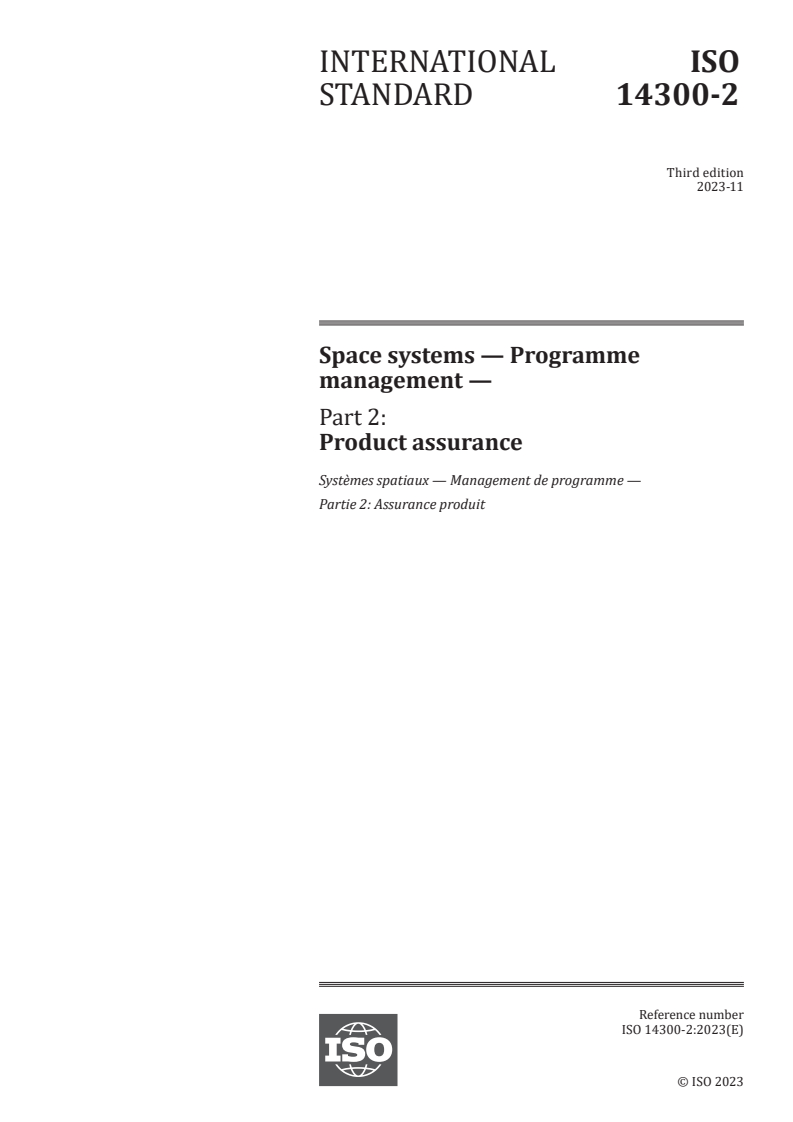
INTERNATIONAL ISO
STANDARD 14300-2
Third edition
2023-11
Space systems — Programme
management —
Part 2:
Product assurance
Systèmes spatiaux — Management de programme —
Partie 2: Assurance produit
Reference number
© ISO 2023
All rights reserved. Unless otherwise specified, or required in the context of its implementation, no part of this publication may
be reproduced or utilized otherwise in any form or by any means, electronic or mechanical, including photocopying, or posting on
the internet or an intranet, without prior written permission. Permission can be requested from either ISO at the address below
or ISO’s member body in the country of the requester.
ISO copyright office
CP 401 • Ch. de Blandonnet 8
CH-1214 Vernier, Geneva
Phone: +41 22 749 01 11
Email: copyright@iso.org
Website: www.iso.org
Published in Switzerland
ii
Contents Page
Foreword .iv
Introduction .v
1 Scope . 1
2 Normative references . 1
3 Terms, definitions and abbreviated terms . 2
3.1 Terms and definitions . 2
3.2 Abbreviated terms . 2
4 Objectives, policy and principles — General . 2
4.1 Objectives . 2
4.2 Policy and principles . 2
5 Product assurance management .3
5.1 Objective. 3
5.2 Policy and principles . 3
5.3 Requirements . 4
5.3.1 Responsibility and authority . 4
5.3.2 Resources . 4
5.3.3 Product assurance programme management . 4
5.3.4 Contractual aspects . 4
5.3.5 Risk assessment and control . 5
6 Quality assurance . 6
6.1 Objective. 6
6.2 Policy and principles . 6
7 Safety assurance. 7
7.1 Objective. 7
7.2 Policy and principles . 7
7.2.1 Policy . 7
7.2.2 Implementation principles . 7
7.2.3 Safety programme . 8
8 Dependability assurance .8
8.1 Objective. 8
8.2 Policy and principles . 8
8.2.1 General . 8
8.2.2 Dependability programme . 8
9 Parts, materials and processes . 9
9.1 Objective. 9
9.2 Policy and programme . 9
9.2.1 Policy . 9
9.2.2 Programme. 9
Bibliography .10
iii
Foreword
ISO (the International Organization for Standardization) is a worldwide federation of national standards
bodies (ISO member bodies). The work of preparing International Standards is normally carried out
through ISO technical committees. Each member body interested in a subject for which a technical
committee has been established has the right to be represented on that committee. International
organizations, governmental and non-governmental, in liaison with ISO, also take part in the work.
ISO collaborates closely with the International Electrotechnical Commission (IEC) on all matters of
electrotechnical standardization.
The procedures used to develop this document and those intended for its further maintenance are
described in the ISO/IEC Directives, Part 1. In particular, the different approval criteria needed for the
different types of ISO document should be noted. This document was drafted in accordance with the
editorial rules of the ISO/IEC Directives, Part 2 (see www.iso.org/directives).
ISO draws attention to the possibility that the implementation of this document may involve the use
of (a) patent(s). ISO takes no position concerning the evidence, validity or applicability of any claimed
patent rights in respect thereof. As of the date of publication of this document, ISO had not received
notice of (a) patent(s) which may be required to implement this document. However, implementers are
cautioned that this may not represent the latest information, which may be obtained from the patent
database available at www.iso.org/patents. ISO shall not be held responsible for identifying any or all
such patent rights.
Any trade name used in this document is information given for the convenience of users and does not
constitute an endorsement.
For an explanation of the voluntary nature of standards, the meaning of ISO specific terms and
expressions related to conformity assessment, as well as information about ISO's adherence to
the World Trade Organization (WTO) principles in the Technical Barriers to Trade (TBT), see
www.iso.org/iso/foreword.html.
This document was prepared by Technical Committee ISO/TC 20, Aircraft and space vehicles,
Subcommittee SC 14, Space systems and operations.
This third edition cancels and replaces the second edition (ISO 14300-2:2011), which has been
technically revised.
The main changes are as follows:
— update of normative references, related references in the text and related terms and definitions;
— update of the Bibliography;
A list of all parts in the ISO 14300 series can be found on the ISO website.
Any feedback or questions on this document should be directed to the user’s national standards body. A
complete listing of these bodies can be found at www.iso.org/members.html
iv
Introduction
This document is intended to be applied for the product assurance in space programmes/projects and
applications.
Requirements in this document are defined in terms of what is intended to be accomplished, rather
than in terms of how to organize and perform the necessary work. This allows existing organizational
structures and methods to be applied where they are effective, and for the structures and methods to
evolve as necessary without rewriting the standards.
The formulation of this document considers the existing ISO 9000 family of standards and the content
of ISO 14300-1.
NOTE The term "programme" is understood as a group of several projects. Both “programme” and “project”
can be used in the same context throughout this document. They are defined in ISO 14300-1.
v
INTERNATIONAL STANDARD ISO 14300-2:2023(E)
Space systems — Programme management —
Part 2:
Product assurance
1 Scope
This document defines the product assurance (PA) policy, objectives, principles, and requirements for
the establishment and implementation of PA programmes for space programmes covering mission
definition, design, development, production and operations of space products, including disposal.
The PA discipline covers: PA management, quality assurance, safety assurance, dependability
(reliability, availability and maintainability), assurance of software and hardware products, as well
as parts (including electrical, electromechanical and electronic components, and mechanical parts),
materials and processes assurance.
This document defines their respective objectives, policies, and principles to achieve the stated overall
PA objectives throughout the complete life cycle of the products.
This document applies to space products.
2 Normative references
The following documents are referred to in the text in such a way that some or all of their content
constitutes requirements of this document. For dated references, only the edition cited applies. For
undated references, the latest edition of the referenced document (including any amendments) applies.
ISO 9000, Quality management systems — Fundamentals and vocabulary
ISO 10794, Space systems — Programme management — Material, mechanical parts and processes
ISO 10795, Space systems — Programme management and quality — Vocabulary
ISO 14300-1, Space systems — Programme management — Part 1: Structuring of a project
ISO 14620-1, Space systems — Safety requirements — Part 1: System safety
ISO 14620-2, Space systems — Safety requirements — Part 2: Launch site operations
ISO 14620-3, Space systems — Safety requirements — Part 3: Flight safety systems
ISO 14621-1, Space systems — Electrical, electronic and electromechanical (EEE) parts — Part 1: Parts
management
ISO 14621-2, Space systems — Electrical, electronic and electromechanical (EEE) parts — Part 2: Control
programme requirements
ISO 17666, Space systems — Risk management
ISO 18238, Space systems — Closed loop problem solving management
ISO 22893, Space systems — Software product assurance requirements
ISO 23460, Space projects — Programme management — Dependability assurance requirements
ISO 23461, Space systems — Programme management — Non-conformance control system
ISO 27025, Space systems — Programme management — Quality assurance requirements
3 Terms, definitions and abbreviated terms
3.1 Terms and definitions
For the purposes of this document, the terms and definitions given in ISO 9000, ISO 10795, ISO 14300-1
and the following apply.
ISO and IEC maintain terminology databases for use in standardization at the following addresses:
— ISO Online browsing platform: available at https:// www .iso .org/ obp
— IEC Electropedia: available at https:// www .electropedia .org/
3.1.1
product assurance
discipline devoted to the study, planning and implementation of activities intended to ensure that the
design, controls, methods and techniques in a programme result in a satisfactory level of quality in a
product
3.2 Abbreviated terms
EEE electrical, electronic, electromechanical
PA product assurance
4 Objectives, policy and principles — General
4.1 Objectives
The prime objective of PA is to ensure that the space products accomplish their defined mission
objectives and, more specifically, that they are safe, available and reliable.
An additional objective is to achieve more cost-effective space programmes by coordinating the
development and implementation of appropriate PA methods and standards.
In support of programme risk management, PA ensures an adequate identification, appraisal, prevention
and control of technical and programmatic risks within programme constraints.
4.2 Policy and principles
In order to meet these objectives, a PA policy is defined in this document, which requires a PA
programme derived from a system based on preventive approach and includes:
a) protection of human life, space products, investment and environment;
b) definition and maintenance of a programme PA function, with appropriate autonomy with respect
to other lines and programme level organizations;
c) integrated application of the PA disciplines and coordination with the associated functions of
programme management and programme engineering;
d) tailoring of the PA requirements to the specific programme needs;
e) assignment of PA requirements and their control commensurate with the function criticality within
the system;
f) integrated PA participation to the overall risk management process;
g) PA contribution to proper control of the technical risks and ensuring awareness by the appropriate
levels of management until the end of the disposal phase;
h) implementation of a preventive approach, i.e. early identification of
...