

ISO 18997:2025
(Main)Water reuse in urban areas — Guidelines for urban reclaimed water for landscaping uses
General Information
- Abstract
This document provides a guideline for good design and practice for urban reclaimed water that recharges into landscape water, including urban stream flow (e.g. rivers and lakes), aesthetic impoundments and wetlands replenishment, to ensure the proper support of the aquatic ecosystem. This document covers urban stream flow and leisure with possible incidental body contact. It does not cover urban irrigation, such as the irrigation of elements of the natural environment, urban public areas, or residential areas. It does not cover the cultivation of aquatic plants or animals for food purposes, including their sale. This document provides recommendations for reclaimed water for landscaping uses, including those for planning, design, management, and maintenance.
- Status
- Published
- Publication Date
- 31-Jul-2025
- Technical Committee
- ISO/TC 282/SC 2 - Water reuse in urban areas
- Drafting Committee
- ISO/TC 282/SC 2 - Water reuse in urban areas
- Current Stage
- 6060 - International Standard published
- Start Date
- 01-Aug-2025
- Due Date
- 09-Jan-2026
- Completion Date
- 01-Aug-2025

Overview
ISO 18997:2025 - Water reuse in urban areas: Guidelines for urban reclaimed water for landscaping uses - provides internationally harmonized guidance for the safe, sustainable use of reclaimed water in urban landscapes. The standard covers use cases where reclaimed water replenishes landscape water bodies (for example, urban stream flow, rivers, lakes, aesthetic impoundments and wetlands replenishment) to support aquatic ecosystems and enhance urban amenity. It addresses planning, design, management and maintenance while explicitly excluding irrigation of public or residential green spaces and any cultivation of aquatic plants/animals for food.
Key topics and technical requirements
ISO 18997 focuses on practical design and operation considerations rather than prescriptive numeric limits. Key technical topics include:
- General recommendations - safety, ecological rationale, public acceptability and aesthetic considerations for reclaimed water in landscape settings.
- Hydraulic design - assessment of reclaimed water quantity, hydraulic retention time (HRT), flow patterns and optimal input points to support ecosystem health and aesthetic goals.
- Water quality considerations - routine and specific monitoring parameters (microbial/pathogen risks, nutrients, suspended solids, organic load) to manage risk for incidental body contact and aquatic life.
- Supplemental treatment options - guidance on decolourisation, disinfection (UV, etc.), odour and turbidity removal, nutrient reduction and other treatments suitable for landscape reuse.
- Management and monitoring - operational controls, signage for public safety, and recommended monitoring frequency and parameters (see Annex A and B for examples).
- Emergency response planning - procedures to respond to quality or quantity failures.
- Cross-cutting topics include GHG emissions, photoreactivation risks, and interactions with local regulations.
Practical applications
ISO 18997 is intended to support projects that use reclaimed water to:
- Augment urban streams and lakes to maintain ecological flows and prevent drought impacts
- Replenish constructed or restored aesthetic wetlands and impoundments
- Improve urban aquatic habitat, visual amenity and recreational landscapes where incidental body contact may occur
Practical benefits include improved water resource resilience, ecosystem restoration, and more sustainable urban water cycles.
Who should use this standard
- Urban planners and landscape architects specifying reclaimed water systems
- Water utilities and wastewater reuse engineers designing supply points and treatment trains
- Environmental regulators and public health authorities assessing risk and permits
- Consultants and asset managers responsible for operation, monitoring and emergency response
Related standards
- ISO 20670 - Water reuse - Vocabulary (referenced)
- ISO 20469 - (referenced for water quality grading and body contact guidance)
Keywords: ISO 18997, water reuse, urban reclaimed water, landscaping uses, hydraulic retention time, reclaimed water quality, urban stream flow, aesthetic impoundments, wetlands replenishment.
Get Certified
Connect with accredited certification bodies for this standard

CIS Institut d.o.o.
Personal Protective Equipment (PPE) certification body. Notified Body NB-2890 for EU Regulation 2016/425 PPE.

Kiwa BDA Testing
Building and construction product certification.
Kmetijski inštitut Slovenije
Agricultural Institute of Slovenia. Soil testing, plant health, agricultural product analysis.
Sponsored listings
Frequently Asked Questions
ISO 18997:2025 is a standard published by the International Organization for Standardization (ISO). Its full title is "Water reuse in urban areas — Guidelines for urban reclaimed water for landscaping uses". This standard covers: This document provides a guideline for good design and practice for urban reclaimed water that recharges into landscape water, including urban stream flow (e.g. rivers and lakes), aesthetic impoundments and wetlands replenishment, to ensure the proper support of the aquatic ecosystem. This document covers urban stream flow and leisure with possible incidental body contact. It does not cover urban irrigation, such as the irrigation of elements of the natural environment, urban public areas, or residential areas. It does not cover the cultivation of aquatic plants or animals for food purposes, including their sale. This document provides recommendations for reclaimed water for landscaping uses, including those for planning, design, management, and maintenance.
This document provides a guideline for good design and practice for urban reclaimed water that recharges into landscape water, including urban stream flow (e.g. rivers and lakes), aesthetic impoundments and wetlands replenishment, to ensure the proper support of the aquatic ecosystem. This document covers urban stream flow and leisure with possible incidental body contact. It does not cover urban irrigation, such as the irrigation of elements of the natural environment, urban public areas, or residential areas. It does not cover the cultivation of aquatic plants or animals for food purposes, including their sale. This document provides recommendations for reclaimed water for landscaping uses, including those for planning, design, management, and maintenance.
ISO 18997:2025 is classified under the following ICS (International Classification for Standards) categories: 13.060.01 - Water quality in general. The ICS classification helps identify the subject area and facilitates finding related standards.
ISO 18997:2025 is available in PDF format for immediate download after purchase. The document can be added to your cart and obtained through the secure checkout process. Digital delivery ensures instant access to the complete standard document.
Standards Content (Sample)
International
Standard
ISO 18997
First edition
Water reuse in urban areas —
2025-08
Guidelines for urban reclaimed
water for landscaping uses
Recyclage des eaux dans les zones urbaines — Lignes directrices
relatives à l'eau réutiisée urbaine pour l'aménagement paysager
Reference number
© ISO 2025
All rights reserved. Unless otherwise specified, or required in the context of its implementation, no part of this publication may
be reproduced or utilized otherwise in any form or by any means, electronic or mechanical, including photocopying, or posting on
the internet or an intranet, without prior written permission. Permission can be requested from either ISO at the address below
or ISO’s member body in the country of the requester.
ISO copyright office
CP 401 • Ch. de Blandonnet 8
CH-1214 Vernier, Geneva
Phone: +41 22 749 01 11
Email: copyright@iso.org
Website: www.iso.org
Published in Switzerland
ii
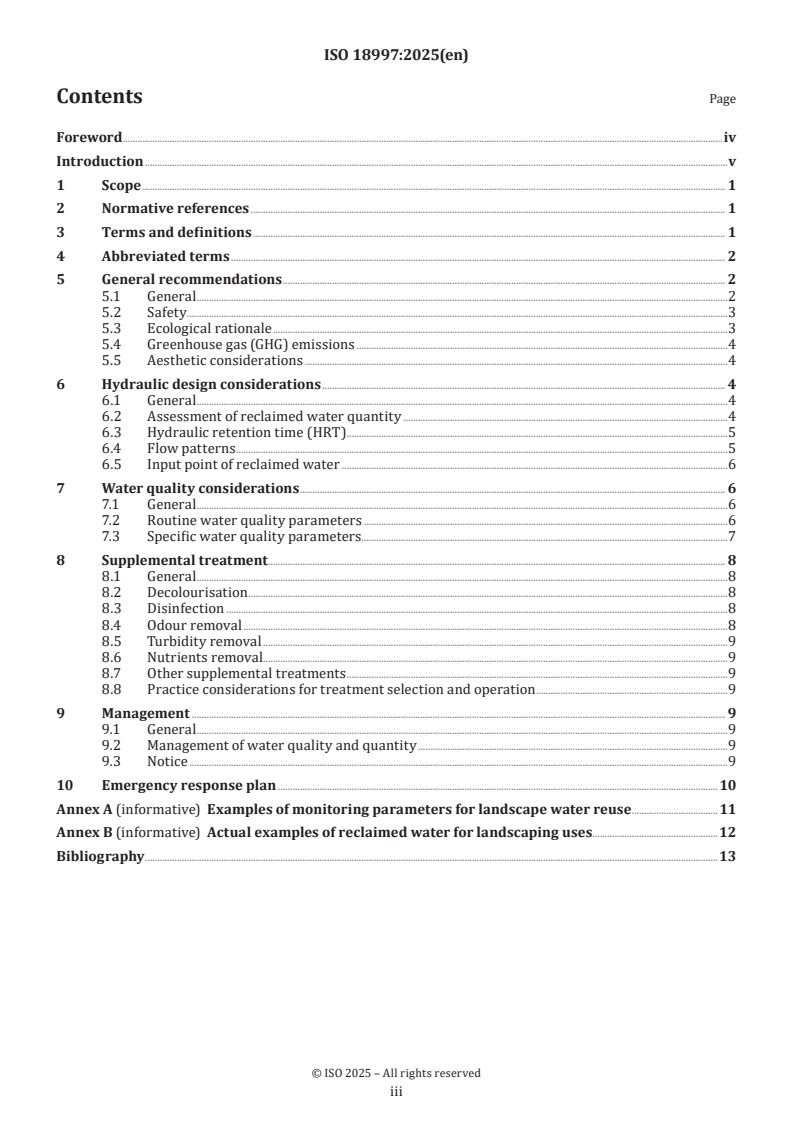
Contents Page
Foreword .iv
Introduction .v
1 Scope . 1
2 Normative references . 1
3 Terms and definitions . 1
4 Abbreviated terms . 2
5 General recommendations . 2
5.1 General .2
5.2 Safety.3
5.3 Ecological rationale .3
5.4 Greenhouse gas (GHG) emissions .4
5.5 Aesthetic considerations .4
6 Hydraulic design considerations . 4
6.1 General .4
6.2 Assessment of reclaimed water quantity .4
6.3 Hydraulic retention time (HRT) .5
6.4 Flow patterns . .5
6.5 Input point of reclaimed water .6
7 Water quality considerations . 6
7.1 General .6
7.2 Routine water quality parameters .6
7.3 Specific water quality parameters.7
8 Supplemental treatment . . 8
8.1 General .8
8.2 Decolourisation .8
8.3 Disinfection .8
8.4 Odour removal .8
8.5 Turbidity removal .9
8.6 Nutrients removal.9
8.7 Other supplemental treatments .9
8.8 Practice considerations for treatment selection and operation .9
9 Management . 9
9.1 General .9
9.2 Management of water quality and quantity .9
9.3 Notice .9
10 Emergency response plan . 10
Annex A (informative) Examples of monitoring parameters for landscape water reuse .11
Annex B (informative) Actual examples of reclaimed water for landscaping uses .12
Bibliography .13
iii
Foreword
ISO (the International Organization for Standardization) is a worldwide federation of national standards
bodies (ISO member bodies). The work of preparing International Standards is normally carried out through
ISO technical committees. Each member body interested in a subject for which a technical committee
has been established has the right to be represented on that committee. International organizations,
governmental and non-governmental, in liaison with ISO, also take part in the work. ISO collaborates closely
with the International Electrotechnical Commission (IEC) on all matters of electrotechnical standardization.
The procedures used to develop this document and those intended for its further maintenance are described
in the ISO/IEC Directives, Part 1. In particular, the different approval criteria needed for the different types
of ISO documents should be noted. This document was drafted in accordance with the editorial rules of the
ISO/IEC Directives, Part 2 (see www.iso.org/directives).
ISO draws attention to the possibility that the implementation of this document may involve the use of (a)
patent(s). ISO takes no position concerning the evidence, validity or applicability of any claimed patent
rights in respect thereof. As of the date of publication of this document, ISO had not received notice of (a)
patent(s) which may be required to implement this document. However, implementers are cautioned that
this may not represent the latest information, which may be obtained from the patent database available at
www.iso.org/patents. ISO shall not be held responsible for identifying any or all such patent rights.
Any trade name used in this document is information given for the convenience of users and does not
constitute an endorsement.
For an explanation of the voluntary nature of standards, the meaning of ISO specific terms and expressions
related to conformity assessment, as well as information about ISO’s adherence to the World Trade
Organization (WTO) principles in the Technical Barriers to Trade (TBT), see www.iso.org/iso/foreword.html.
This document was prepared by Technical Committee ISO/TC 282, Water reuse, Subcommittee SC 2, Water
reuse in urban areas.
Any feedback or questions on this document should be directed to the user’s national standards body. A
complete listing of these bodies can be found at www.iso.org/members.html.
iv
Introduction
As population increases and urbanization, industrialization, and climate change are intensifying water
scarcity, water reuse presents an effective solution to the pressing issue of severe water shortages. In many
regions, reclaimed water has emerged as an important alternative water resource for sustainable socio-
economic development. Landscaping use is one of the major applications of water reuse in many regions,
because it not only alleviates water shortages, but it can also maintain ecological flow and improve the local
aquatic environment and ecosystem.
The landscaping use of reclaimed water includes urban stream flow augmentation (e.g. rivers and lakes),
aesthetic impoundments and wetlands replenishment. The benefits include ensuring ecological flow to
help protect urban rivers and lakes from drought, recovering natural assets, expanding the size of aquatic
habitat, and improving urban aquatic spaces and scenery.
Despite the advantages of landscaping with reclaimed water, challenges can arise if the design, construction,
and management of reuse projects are inappropriate. Compared with traditional water sources, reclaimed
water can have variations in composition depending on the season, and to some extent it can contain
pharmaceutical and personal care products which can pose potential risks to human health and the aquatic
environment. Therefore, the risk associated with reclaimed water should be controlled in terms of water
quality and quantity. Guidelines for water quality and quantity should be developed to ensure the safe,
stable, and efficient use of reclaimed water.
This guideline is developed for the landscaping use of reclaimed water. It provides professional guidance
to ensure the safe, stable, and efficient application of reclaimed water for landscaping, addressing water
quantity, quality recommendations, supplemental treatments, and management practices. Utilizing
reclaimed water for non-potable use, such as landscaping, is a win-win situation.
v
International Standard ISO 18997:2025(en)
Water reuse in urban areas — Guidelines for urban reclaimed
water for landscaping uses
1 Scope
This document provides a guideline for good design and practice for urban reclaimed water that recharges
into landscape water, including urban stream flow (e.g. rivers and lakes), aesthetic impoundments and
wetlands replenishment, to ensure the proper support of the aquatic ecosystem. This document covers
urban stream flow and leisure with possible incidental body contact. It does not cover urban irrigation, such
as the irrigation of elements of the natural environment, urban public areas, or residential areas. It does not
cover the cultivation of aquatic plants or animals for food purposes, including their sale.
This document provides recommendations for reclaimed water for landscaping uses, including those for
planning, design, management, and maintenance.
2 Normative references
The following documents are referred to in the text in such a way that some or all of their content constitutes
requirements of this document. For dated references, only the edition cited applies. For undated references,
the latest edition of the referenced document (including any amendments) applies.
ISO 20670, Water reuse — Vocabulary
3 Terms and definitions
For the purposes of this document, the terms and definitions given in ISO 20670 and the following apply.
ISO and IEC maintain terminology databases for use in standardization at the following addresses:
— ISO Online browsing platform: available at https:// www .iso .org/ obp
— IEC Electropedia: available at https:// www .electropedia .org/
3.1
landscaping use of reclaimed water
practice of using reclaimed water for landscaping purposes, including urban stream flow (3.7) augmentation
(e.g. rivers and lakes), aesthetic impoundments (3.2) and wetlands replenishment (3.4)
3.2
aesthetic impoundment
landscape water area with facilities where recreation is the primary use and people do not have direct body
contact (3.6) with water
EXAMPLE Landscape areas in streams, rivers, lakes, and artificial aquatic areas.
3.3
aesthetic wetland
wetland that has been constructed or restored to enhance urban landscapes, and does not include wetlands
that treat wastewater from sewage or wastewater treatment plants
3.4
wetlands replenishment
replenishment of aquatic areas to provide landscape use or to provide support for ecosystem life, or both
3.5
photoreactivation
phenomenon by which UV-inactivated organisms regain their activity via photo repair of UV-induced lesions
in the DNA by utilizing the energy of visible light and the enzyme photolyase
3.6
body contact
exposure of human body to reclaimed water via oral digestion, dermal contact, or inhalation
Note 1 to entry: According to the water quality grade for non-potable reuse application, direct body contact usually
includes recreational activities, equipment and vehicle washing, dust suppression, etc. Incidental body contact
includes landscape water features, landscape impoundments, industrial water applications, etc. (see ISO 20469).
3.7
urban stream flow
designed and engineered rivers, lakes and ponds that receive urban reclaimed water as the primary or
supplementary water source
3.8
hydraulic retention time
HRT
average time the reclaimed water spends passing through a specific water area
Note 1 to entry: Adapted from Reference [12].
3.9
supply point
location where the reclaimed water enters the receiving water
4 Abbreviated terms
BOD five-day biochemical oxygen demand
COD chemical oxygen demand
DO dissolved oxygen
GHG greenhouse gas
PAC polyaluminum chloride
TN total nitrogen
TOC total organic carbon
TP total phosphorus
TSS total suspended solid
SS suspended solids
UV ultraviolet
5 General recommendations
5.1 General
Reclaimed water intended for environmental use and potential human exposure should be safe, stable,
ecologically friendly, and publicly acceptable. These characteristics are defined by local guidelines or
regulations. In landscaping reuse projects, the environmental benefits of reclaimed water should be
considered and potential risks to human health and the environment should be evaluated and managed.
Urban stream flows can enhance the visual and sensory qualities of natural or human-made environments
that are appreciated for their beauty and appeal. However, direct human contact with reclaimed water
should be avoided.
Wetlands, which are either permanently or seasonally saturated with water, support diverse plant and
animal species. Aesthetic wetlands are designed to enhance landscapes, provide wildlife habitats, improve
water quality, and reduce nutrients. Aesthetic wetlands are characterized by their visual appeal and human-
made features, such as boardwalks, observation decks, and interpretive signage.
Incidental body contact of humans and pets with reclaimed water used for landscaping is considered in this
document. Signs should be set up to warn people to take care of pets and prevent them from going into
the water. Monitoring should be conducted in situations where direct harm to humans can be caused, for
example upon contact with pathogenic bacteria.
5.2 Safety
The landscaping uses of reclaimed water should be safe for both the ecological environment and humans,
particularly in the case of incidental body contact. Risks to human health via incidental body contact
primarily arise from harmful pollutants, pathogens, or parasites in reclaimed water. The possible pollutants
in reclaimed water include heavy metals and recalcitrant organics, to which humans can be exposed via
environmental contamination such as groundwater contamination. Pathogens in reclaimed water can cause
symptoms like diarrhea, vomiting, headaches. Risks to ecological environments include harm to aquatic
biota, eutrophication, and landscape degradation.
Water quantity is also a critical safety factor. Insufficient water flow cannot support the functioning of the
ecosystem, while excessive flow can destabilize habitat for submerged plants and zoobenthos (organisms
that live on or in the bottom of water sediments).
To ensure safety, the quality and quantity of reclaimed water for landscaping uses should be carefully
monitored and controlled.
Key considerations include:
— The source of reclaimed water should be domestic wastewater or municipal wastewater without
industrial wastewater.
— The quantity should be managed and the quality should be ensured by proper treatment before reclaimed
water is recharged into landscapes.
— Regular monitoring of water quality and quantity should be carried out.
— Aesthetic wetlands replenishment should prevent people from contacting reclaimed water. Fences or
barriers should be built surrounding deep water. Warning signs indicating reclaimed water use should
be installed (see ISO 20469).
— Exposure to reclaimed water should be minimized to prevent humans from potential indirect contact.
5.3 Ecological rationale
Reclaimed water serves as a complementary water source, addressing water shortages and promoting
ecological restoration and conservation. However, the ecological impact of reclaimed water recharge should
be considered before and after landscape construction.
a) Reclaimed water for landscaping uses should be designed to maintain ecological flow, restore natural
assets, and expand ecological habitats.
b) Impact of reclaimed water recharge on aquatic ecosystems, including changes in species composition
and populations, should be predicted and evaluated. In particular, the influence on sensitive and
endangered species should be minimized.
c) Groundwater and soil pollutants should be regularly monitored and timely action should be taken to
prevent pollution.
5.4 Greenhouse gas (GHG) emissions
Landscaping with reclaimed water can contribute to GHG emissions through energy-intensive processes
and microbiological activities. Carbon dioxide, methane, and nitrous oxide are the main GHGs involved.
Energy efficiency and GHG mitigation during reclaimed water distribution, treatment, replenishment, and
management should be considered for landscaping uses (see ISO 20469).
5.5 Aesthetic considerations
The aesthetic value of reclaimed water for landscaping uses relates to public acceptance. One of the purposes
of landscaping uses is to provide space for human relaxation. The design of the landscaping projects should
meet citizens’ aesthetic expectations. Key considerations include:
— controlling the colour and odour of reclaimed water;
— regularly maintaining plants and landscapes to ensure visually appealing environments;
— installing signs for environmental maintenance as necessary;
— installing adequate number of waste collection bins and signage to prevent littering;
— designing facilities to prevent human or pet contact with reclaimed water.
6 Hydraulic design considerations
6.1 General
Reclaimed water improves the aesthetics, habitats, and assets of landscapes when recharged in appropriate
quantities. Considerations for reclaimed water quantity include hydraulic retention time (HRT),
[10]
hydrodynamic force, flow pattern, recharge point, and others. With regard to the quantity of reclaimed
water, the soil characteristics should be considered, including soil type, permeability, and the Atterberg
limits (critical water contents of fine-grained soil).
6.2 Assessment of reclaimed water quantity
To maintain an aesthetic environment and ecology in urban streams and wetlands, the water flow, which
includes the original base flow and recharged reclaimed water, should be within an appropriate range.
The water flow can decrease due to evaporation, absorption, loss through infiltration, or other factors,
[11]
deteriorating the landscapes and ecosystems. An insufficient amount of water can lead to adverse
consequences, for example:
— plants and wildlife can disappear, resulting in aquatic habitat fragmentation;
— water quality can deteriorate, leading to algae growth and odour.
The water flow can increase due to rainfall, natural recharge, infiltration from surrounding water areas,
oversupply from reclaimed water treatment facilities, or other factors. Excessive flow can have negative
impact on the environment and the ecosystem, such as soil erosion and ecosystem instability due to rapid
water flush.
Therefore, the water quantity should be estimated considering the characteristics of the ecosystem, and
the replenishment of reclaimed water should be adjusted accordingly. The following factors should be
considered to perform accurate calculations:
— geographical factors (terrain and hydrological characteristics);
— climate and climate change (precipitation, evaporation, and temperature);
— chemical factors (water properties, types, and concentration of pollutants);
— users (number and purpose of users in the receiving area).
6.3 Hydraulic retention time (HRT)
HRT can impact the quality and composition of water, so maintaining a proper HRT can minimize the
[13]
harmful effects that can occur in the environment. A general criterion of the HRT of reclaimed water
is the HRT of the original base flow. On the one hand, the HRT of reclaimed water should be similar to that
of the original base flow to minimize potential influence on the base flow of the river or lake. On the other
hand, the HRT of reclaimed water should minimize the side influence on the water quality and ecology at
short or long durations. Wetlands can be a solution to adjust the HRT of receiving water.
In case of short HRT, negative impacts can be caused by the huge quantities of reclaimed water moving
through the water area. A short HRT can:
— disrupt the water flow pattern, increase suspended solids, and decrease the transparency of water;
— disturb bank-inhabiting and aquatic plants and animals, destroying the ecosystem balance.
An extended HRT can:
— promote the growth of algae and create breeding habitats for mosquitoes, leading to undesirable odours
and discolouration of the water;
— deplete DO l
...