


ISO 16532-1:2008
(Main)Paper and board — Determination of grease resistance — Part 1: Permeability test
Paper and board — Determination of grease resistance — Part 1: Permeability test
ISO 16532-1:2008 specifies a method for the determination of the grease resistance of paper and board. The paper or board can be tested creased or uncreased. The test is primarily intended to establish a level of grease resistance by determining the time taken for a simulated “fat material” (palm kernel oil) to penetrate (break-through) the sheet for papers such as food board, and greaseproof and vegetable parchment. It is also applicable to paper and board which have been internally or surface sized with organophobic materials, or made grease resistant by a plastic extrusion coating.
Papier et carton — Détermination de l'imperméabilité aux graisses — Partie 1: Essai de perméabilité
L'ISO 16532-1:2008 spécifie une méthode de détermination de l'imperméabilité aux graisses des papiers et des cartons. Les papiers ou cartons peuvent être soumis à essai pliés ou non pliés. L'essai vise tout d'abord à établir un niveau d'imperméabilité aux graisses en déterminant le temps qu'il faut à une «matière grasse» simulée (huile de palme) pour pénétrer (transpercement) une feuille de papier ou carton tel que carton pour produits alimentaires, papier ingraissable et papier sulfurisé. Il peut aussi être appliqué aux papiers et aux cartons collés en masse ou en surface avec des matières organophobiques, ou à ceux qui sont rendus ingraissables grâce à un couchage plastique par extrusion.
General Information
- Status
- Published
- Publication Date
- 23-Nov-2008
- Technical Committee
- ISO/TC 6/SC 2 - Test methods and quality specifications for paper and board
- Current Stage
- 9093 - International Standard confirmed
- Start Date
- 29-Jun-2023
- Completion Date
- 12-Feb-2026
Overview
ISO 16532-1:2008 - "Paper and board - Determination of grease resistance - Part 1: Permeability test" - specifies a laboratory method to measure the grease resistance (grease permeability) of paper and board. The test establishes the break-through time (actual penetration) and, optionally, show-through time (visual spotting) by applying a dyed simulated fat (standard palm kernel oil) to test pieces and timing penetration through the sheet. The method applies to food board, greaseproof and vegetable parchment, sized or coated papers, and materials made grease resistant by extrusion coatings. Tests may be performed on creased or uncreased samples.
Key Topics and Requirements
- Test principle: Apply a controlled volume of dyed palm kernel oil through a template onto the sample with a defined weight; observe underside staining (break-through) or surface spotting (show-through).
- Standard grease: Palm kernel oil specified by liquefaction temperature (27–29 °C), dynamic viscosity at 35 °C (33.5–35.0 mPa·s), refractive index at 40 °C (1.44–1.45) and dyed with 0.25% Sudan red (or equivalent fat‑soluble dye).
- Apparatus: glass plate with mirror, cellulose wadding, metal template (≈30 mm hole), weights (50–55 g), metal rings, stopwatch, creasing apparatus (Annex A).
- Sampling & conditioning: Samples selected per ISO 186; condition tests at 23 °C ±1 °C and 50 % ±2 % RH (per ISO 187). Minimum of 10 determinations per side (20 if both sides tested).
- Observation intervals: Frequent checks (every 1 min for first 10 min, then progressively longer intervals up to a final 24 h inspection) are prescribed.
- Results reporting: Express mean and range for break-through / show-through times using defined rounding intervals; include full test conditions and reference to ISO 16532-1.
- Precision: No definitive interlaboratory precision statement available due to subjective observation challenges.
Applications
- Quality control and specification of food packaging papers, greaseproof board, and coated substrates where prevention of oil/grease permeation and spotting is critical.
- Verification of internal sizing, surface treatments or extrusion coatings intended to impart grease resistance.
- Comparative testing during material development, supplier qualification, and production acceptance testing.
Who Uses This Standard
- Paper and board manufacturers and converters
- Packaging designers and food-packaging engineers
- Independent testing and materials laboratories
- Regulatory and compliance teams concerned with food-contact packaging performance
Related Standards
- ISO 16532-2 (Surface repellency test)
- ISO 16532-3 (Turpentine test - under preparation)
- ISO 186 (Sampling)
- ISO 187 (Conditioning and testing atmosphere)
- ISO 4046-4 (Vocabulary: paper and board grades)
Keywords: ISO 16532-1:2008, grease resistance, paper and board, permeability test, break-through time, show-through time, palm kernel oil, food packaging, greaseproof paper.
Get Certified
Connect with accredited certification bodies for this standard

Control Union Certifications
Global certification for agriculture and sustainability.

Gozdarski inštitut Slovenije
Slovenian Forestry Institute. Forest management certification support, timber testing.
Sponsored listings
Frequently Asked Questions
ISO 16532-1:2008 is a standard published by the International Organization for Standardization (ISO). Its full title is "Paper and board — Determination of grease resistance — Part 1: Permeability test". This standard covers: ISO 16532-1:2008 specifies a method for the determination of the grease resistance of paper and board. The paper or board can be tested creased or uncreased. The test is primarily intended to establish a level of grease resistance by determining the time taken for a simulated “fat material” (palm kernel oil) to penetrate (break-through) the sheet for papers such as food board, and greaseproof and vegetable parchment. It is also applicable to paper and board which have been internally or surface sized with organophobic materials, or made grease resistant by a plastic extrusion coating.
ISO 16532-1:2008 specifies a method for the determination of the grease resistance of paper and board. The paper or board can be tested creased or uncreased. The test is primarily intended to establish a level of grease resistance by determining the time taken for a simulated “fat material” (palm kernel oil) to penetrate (break-through) the sheet for papers such as food board, and greaseproof and vegetable parchment. It is also applicable to paper and board which have been internally or surface sized with organophobic materials, or made grease resistant by a plastic extrusion coating.
ISO 16532-1:2008 is classified under the following ICS (International Classification for Standards) categories: 85.060 - Paper and board. The ICS classification helps identify the subject area and facilitates finding related standards.
ISO 16532-1:2008 is available in PDF format for immediate download after purchase. The document can be added to your cart and obtained through the secure checkout process. Digital delivery ensures instant access to the complete standard document.
Standards Content (Sample)
INTERNATIONAL ISO
STANDARD 16532-1
First edition
2008-12-01
Paper and board — Determination of
grease resistance —
Part 1:
Permeability test
Papier et carton — Détermination de l'imperméabilité aux graisses —
Partie 1: Essai de perméabilité
Reference number
©
ISO 2008
PDF disclaimer
This PDF file may contain embedded typefaces. In accordance with Adobe's licensing policy, this file may be printed or viewed but
shall not be edited unless the typefaces which are embedded are licensed to and installed on the computer performing the editing. In
downloading this file, parties accept therein the responsibility of not infringing Adobe's licensing policy. The ISO Central Secretariat
accepts no liability in this area.
Adobe is a trademark of Adobe Systems Incorporated.
Details of the software products used to create this PDF file can be found in the General Info relative to the file; the PDF-creation
parameters were optimized for printing. Every care has been taken to ensure that the file is suitable for use by ISO member bodies. In
the unlikely event that a problem relating to it is found, please inform the Central Secretariat at the address given below.
© ISO 2008
All rights reserved. Unless otherwise specified, no part of this publication may be reproduced or utilized in any form or by any means,
electronic or mechanical, including photocopying and microfilm, without permission in writing from either ISO at the address below or
ISO's member body in the country of the requester.
ISO copyright office
Case postale 56 • CH-1211 Geneva 20
Tel. + 41 22 749 01 11
Fax + 41 22 749 09 47
E-mail copyright@iso.org
Web www.iso.org
Published in Switzerland
ii © ISO 2008 – All rights reserved
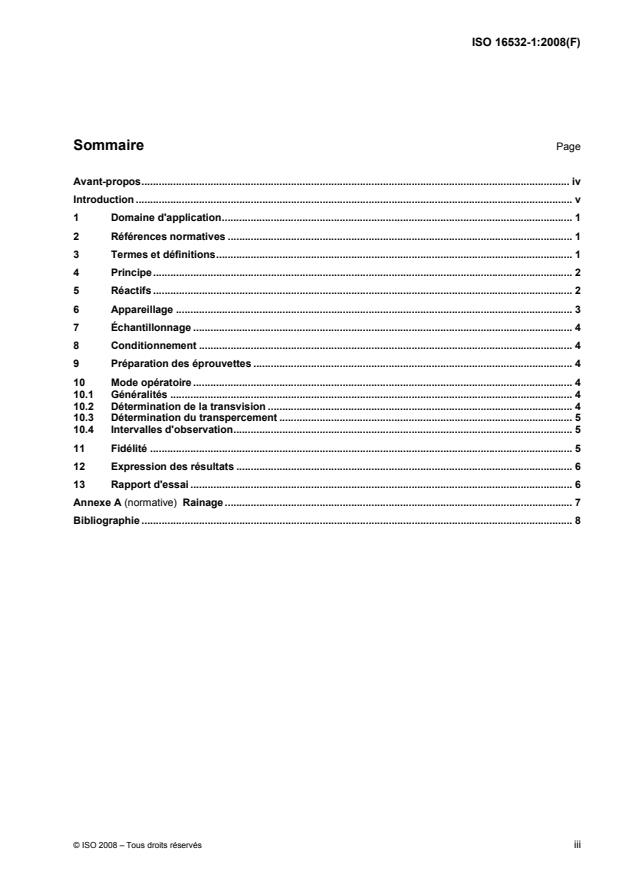
Contents Page
Foreword. iv
Introduction . v
1 Scope . 1
2 Normative references . 1
3 Terms and definitions. 1
4 Principle. 2
5 Reagents. 2
6 Apparatus . 2
7 Sampling. 4
8 Conditioning. 4
9 Preparation of test pieces. 4
10 Procedure . 4
10.1 General. 4
10.2 Determination of show-through . 4
10.3 Determination of break-through. 5
10.4 Observation intervals . 5
11 Precision. 5
12 Expression of results . 5
13 Test report . 6
Annex A (normative) Creasing. 7
Bibliography . 8
Foreword
ISO (the International Organization for Standardization) is a worldwide federation of national standards bodies
(ISO member bodies). The work of preparing International Standards is normally carried out through ISO
technical committees. Each member body interested in a subject for which a technical committee has been
established has the right to be represented on that committee. International organizations, governmental and
non-governmental, in liaison with ISO, also take part in the work. ISO collaborates closely with the
International Electrotechnical Commission (IEC) on all matters of electrotechnical standardization.
International Standards are drafted in accordance with the rules given in the ISO/IEC Directives, Part 2.
The main task of technical committees is to prepare International Standards. Draft International Standards
adopted by the technical committees are circulated to the member bodies for voting. Publication as an
International Standard requires approval by at least 75 % of the member bodies casting a vote.
Attention is drawn to the possibility that some of the elements of this document may be the subject of patent
rights. ISO shall not be held responsible for identifying any or all such patent rights.
ISO 16532-1 was prepared by Technical Committee ISO/TC 6, Paper, board and pulps, Subcommittee SC 2,
Test methods and quality specifications for paper and board.
ISO 16532 consists of the following parts, under the general title Paper and board — Determination of grease
resistance:
⎯ Part 1: Permeability test
⎯ Part 2: Surface repellency test
The following part is under preparation:
⎯ Part 3: Turpentine test for voids in glassine and greaseproof papers
iv © ISO 2008 – All rights reserved
Introduction
The resistance of paper and board to penetration by fats, greases and oils is of particular importance for
certain packaging purposes, for example the packaging of food. The packaging should not only provide an
effective grease barrier, but should also deter the formation of aesthetically unacceptable grease spots on the
packaging surfaces.
INTERNATIONAL STANDARD ISO 16532-1:2008(E)
Paper and board — Determination of grease resistance —
Part 1:
Permeability test
1 Scope
This part of ISO 16532 specifies a method for the determination of the grease resistance of paper and board.
The paper or board can be tested creased or uncreased. The test is primarily intended to establish a level of
grease resistance by determining the time taken for a simulated “fat material” (palm kernel oil) to penetrate
(break-through) the sheet for papers such as food board, and greaseproof and vegetable parchment. It is also
applicable to paper and board which have been internally or surface sized with organophobic materials, or
made grease resistant by a plastic extrusion coating.
2 Normative references
The following referenced documents are indispensable for the application of this document. For dated
references, only the edition cited applies. For undated references, the latest edition of the referenced
document (including any amendments) applies.
ISO 186, Paper and board — Sampling to determine average quality
ISO 187, Paper, board and pulps — Standard atmosphere for conditioning and testing and procedure for
monitoring the atmosphere and conditioning of samples
ISO 4046-4, Paper, board, pulps and related terms — Vocabulary — Part 4: Paper and board grades and
converted products
3 Terms and definitions
For the purposes of this document, the following terms and definitions apply.
3.1
grease resistance
ability of paper or board to resist the formation of surface spots or stains or the permeation of grease through
the sheet
3.2
grease permeability
ability of the paper or board to resist penetration of the grease through the sheet
NOTE Grease permeability is described by two characteristics: “break-through time” (actual penetration time) and
“show-through time” (visual penetration time).
3.3
break-through time
time elapsed between the application of the test grease, together with a weight, to one side of the test piece
and the penetration of grease through to the other side of the test piece
3.4
show-through time
time elapsed between the application of the test grease, together with a weight, to one side of the test piece
and the first visual detection of grease stains (or a partial penetration of the grease through the sheet)
NOTE 1 The determination of break-through time is the primary purpose of this part of ISO 16532. However,
show-through time may be of interest in special cases, for example, in the study of papers and boards internally or surface
sized with organophobic materials, or of papers and boards which have been made grease resistant by plastic extrusion
coating. The two tests may be combined, in which case show-through time is determined before break-through time.
NOTE 2 For many grades of paper and board, show-through times and break-through times are nearly identical.
4 Principle
The test pieces are placed on a glass plate, with or without a layer of cellulose wadding, and dyed palm kernel
oil is applied, together with a weight, to the upper side of the test pieces. The time elapsed until an indication
of partial or actual penetration of the grease through each test piece is noted, as described in the following
paragraphs.
For determination of actual penetration (break-through) of grease through the test pieces, the end point is
indicat
...
NORME ISO
INTERNATIONALE 16532-1
Première édition
2008-12-01
Papier et carton — Détermination de
l'imperméabilité aux graisses —
Partie 1:
Essai de perméabilité
Paper and board — Determination of grease resistance —
Part 1: Permeability test
Numéro de référence
©
ISO 2008
PDF – Exonération de responsabilité
Le présent fichier PDF peut contenir des polices de caractères intégrées. Conformément aux conditions de licence d'Adobe, ce fichier
peut être imprimé ou visualisé, mais ne doit pas être modifié à moins que l'ordinateur employé à cet effet ne bénéficie d'une licence
autorisant l'utilisation de ces polices et que celles-ci y soient installées. Lors du téléchargement de ce fichier, les parties concernées
acceptent de fait la responsabilité de ne pas enfreindre les conditions de licence d'Adobe. Le Secrétariat central de l'ISO décline toute
responsabilité en la matière.
Adobe est une marque déposée d'Adobe Systems Incorporated.
Les détails relatifs aux produits logiciels utilisés pour la création du présent fichier PDF sont disponibles dans la rubrique General Info
du fichier; les paramètres de création PDF ont été optimisés pour l'impression. Toutes les mesures ont été prises pour garantir
l'exploitation de ce fichier par les comités membres de l'ISO. Dans le cas peu probable où surviendrait un problème d'utilisation,
veuillez en informer le Secrétariat central à l'adresse donnée ci-dessous.
DOCUMENT PROTÉGÉ PAR COPYRIGHT
© ISO 2008
Droits de reproduction réservés. Sauf prescription différente, aucune partie de cette publication ne peut être reproduite ni utilisée sous
quelque forme que ce soit et par aucun procédé, électronique ou mécanique, y compris la photocopie et les microfilms, sans l'accord écrit
de l'ISO à l'adresse ci-après ou du comité membre de l'ISO dans le pays du demandeur.
ISO copyright office
Case postale 56 • CH-1211 Geneva 20
Tel. + 41 22 749 01 11
Fax + 41 22 749 09 47
E-mail copyright@iso.org
Web www.iso.org
Publié en Suisse
ii © ISO 2008 – Tous droits réservés
Sommaire Page
Avant-propos. iv
Introduction . v
1 Domaine d'application. 1
2 Références normatives . 1
3 Termes et définitions. 1
4 Principe. 2
5 Réactifs . 2
6 Appareillage . 3
7 Échantillonnage . 4
8 Conditionnement . 4
9 Préparation des éprouvettes . 4
10 Mode opératoire . 4
10.1 Généralités . 4
10.2 Détermination de la transvision . 4
10.3 Détermination du transpercement . 5
10.4 Intervalles d'observation. 5
11 Fidélité . 5
12 Expression des résultats . 6
13 Rapport d'essai . 6
Annexe A (normative) Rainage . 7
Bibliographie . 8
Avant-propos
L'ISO (Organisation internationale de normalisation) est une fédération mondiale d'organismes nationaux de
normalisation (comités membres de l'ISO). L'élaboration des Normes internationales est en général confiée
aux comités techniques de l'ISO. Chaque comité membre intéressé par une étude a le droit de faire partie du
comité technique créé à cet effet. Les organisations internationales, gouvernementales et non
gouvernementales, en liaison avec l'ISO participent également aux travaux. L'ISO collabore étroitement avec
la Commission électrotechnique internationale (CEI) en ce qui concerne la normalisation électrotechnique.
Les Normes internationales sont rédigées conformément aux règles données dans les Directives ISO/CEI,
Partie 2.
La tâche principale des comités techniques est d'élaborer les Normes internationales. Les projets de Normes
internationales adoptés par les comités techniques sont soumis aux comités membres pour vote. Leur
publication comme Normes internationales requiert l'approbation de 75 % au moins des comités membres
votants.
L'attention est appelée sur le fait que certains des éléments du présent document peuvent faire l'objet de
droits de propriété intellectuelle ou de droits analogues. L'ISO ne saurait être tenue pour responsable de ne
pas avoir identifié de tels droits de propriété et averti de leur existence.
L'ISO 16532-1 a été élaborée par le comité technique ISO/TC 6, Papiers, cartons et pâtes, sous-comité SC 2,
Méthodes d'essais et spécifications de qualité des papiers et cartons.
L'ISO 16532 comprend les parties suivantes, présentées sous le titre général Papier et carton —
Détermination de l'imperméabilité aux graisses:
⎯ Partie 1: Essai de perméabilité
⎯ Partie 2: Essai de résistance au mouillage de surface
La partie suivante est en cours de préparation:
⎯ Partie 3: Essai à la térébenthine pour papiers cristal et papiers ingraissables
iv © ISO 2008 – Tous droits réservés
Introduction
La résistance à la pénétration des matières grasses, des graisses et des huiles qui caractérise le papier et le
carton est d'une importance particulière au regard de certaines applications d'emballage telles que les
emballages alimentaires. Il convient que l'emballage fasse non seulement efficacement barrage aux graisses,
mais qu'il prévienne également la formation de taches de graisse inacceptables du point de vue esthétique
sur la surface des emballages.
NORME INTERNATIONALE ISO 16532-1:2008(F)
Papier et carton — Détermination de l'imperméabilité aux
graisses —
Partie 1:
Essai de perméabilité
1 Domaine d'application
La présente partie de l'ISO 16532 spécifie une méthode de détermination de l'imperméabilité aux graisses
des papiers et des cartons. Les papiers ou cartons peuvent être soumis à essai pliés ou non pliés. L'essai
vise tout d'abord à établir un niveau d'imperméabilité aux graisses en déterminant le temps qu'il faut à une
«matière grasse» simulée (huile de palme) pour pénétrer (transpercement) une feuille de papier ou carton tel
que carton pour produits alimentaires, papier ingraissable et papier sulfurisé. Il peut aussi être appliqué aux
papiers et aux cartons collés en masse ou en surface avec des matières organophobiques, ou à ceux qui sont
rendus ingraissables grâce à un couchage plastique par extrusion.
2 Références normatives
Les documents de référence suivants sont indispensables pour l'application du présent document. Pour les
références datées, seule l'édition citée s'applique. Pour les références non datées, la dernière édition du
document de référence (y compris les éventuels amendements) s'applique.
ISO 186, Papier et carton — Échantillonnage pour déterminer la qualité moyenne
ISO 187, Papier, carton et pâtes — Atmosphère normale de conditionnement et d'essai et méthode de
surveillance de l'atmosphère et de conditionnement des échantillons
ISO 4046-4, Papier, carton, pâtes et termes connexes — Vocabulaire — Partie 4: Catégories et produits
transformés de papier et de carton
3 Termes et définitions
Pour les besoins du présent document, les termes et définitions suivants s'appliquent.
3.1
imperméabilité aux graisses
aptitude d'un papier ou d'un carton à résister à la formation de taches superficielles ou de traces engendrées
par la matière grasse ou à sa perméation à travers la feuille
3.2
perméabilité aux graisses
aptitude d'un papier ou d'un carton à résister à la pénétration de la graisse à travers la feuille
NOTE La perméabilité à la graisse est décrite par deux caractéristiques: le «temps de transpercement» (temps de
pénétration réel) et le «temps de transvision» (temps de pénétration visuel).
3.3
temps de transpercement
temps s'écoulant entre l'application de la graisse pour essai, à l'aide d'un poids, d'un côté de l'éprouvette, et la
pénétration de cette graisse jusqu'à l'autre face de l'éprouvette
3.4
temps de transvision
temps s'écoulant entre l'application de la graisse pour essai, à l'aide d'un poids, d'un côté de l'éprouvette, et la
première détection visuelle de traces (ou d'une pénétration partielle de la graisse dans la feuille)
NOTE 1 La détermination du temps de transpercement est l'objectif principal de la présente partie de l'ISO 16532.
Cependant, le temps de transvision peut présenter un intérêt dans des cas précis, par exemple dans l'étude des papiers
et des cartons collés en masse ou en surface avec des matières organophobiques, ou des papiers et des cartons rendus
imperméables aux graisses grâce à un couchage plastique par extrusion. Les deux essais peuvent être combinés auquel
cas le temps de transvision est déterminé avant le temps de transpercement.
NOTE 2 Les temps de transpercement et les temps de transvision sont presque identiques pour de nombreuses
qualités de papier et carton.
4 Principe
Les éprouvettes sont placées sur une plaque de verre, protégée ou non par une couche de ouate de cellulose,
et de l'huile de palme colorée est appliquée à l'aide d'un poids sur la face supérieure des éprouvettes. Le
temps s'écoulant jusqu'à l'indication de la pénétration partielle ou réelle de la graisse dans chaque éprouvette
est noté, de la manière décrite dans les paragraphes suivants.
Le point final de détermination de la pénétration réelle (transpercement) de la graisse dans les éprouvettes
est indiqué par l'observation visuelle de traces de décolorati
...
Questions, Comments and Discussion
Ask us and Technical Secretary will try to provide an answer. You can facilitate discussion about the standard in here.
Loading comments...