

ISO/FDIS 25243
(Main)Textiles — Smart textiles systems — Test method for repeated underwater pressurization
- Abstract
Environmental test method of repeated pressurization underwater for smart textiles systems.
- Status
- Not Published
- Technical Committee
- ISO/TC 38 - Textiles
- Drafting Committee
- ISO/TC 38/WG 32 - Smart textiles
- Current Stage
- 5020 - FDIS ballot initiated: 2 months. Proof sent to secretariat
- Start Date
- 21-Aug-2026
- Completion Date
- 21-Aug-2026
Buy Documents
ISO/FDIS 25243 - Textiles — Smart textiles systems — Test method for repeated underwater pressurization
REDLINE ISO/FDIS 25243 - Textiles — Smart textiles systems — Test method for repeated underwater pressurization
ISO/FDIS 25243 is an ISO test method for smart textile systems. It specifies how to evaluate whether a smart textile system can withstand repeated underwater pressurization, and it includes run-time measurements before and after the test so users can see whether performance changes after exposure.
What does ISO/FDIS 25243 specify?
ISO/FDIS 25243 specifies an environmental test method for repeated pressurization underwater for smart textile systems. It is organized into Scope, Normative references, Terms and definitions, Apparatus, General requirements, Test procedure, and Test report.
The document is aimed at checking high-pressure underwater use, so the test is not just about water exposure. It also compares system operation before and after the pressure cycles, which matters when the textile carries electronics or powered functions.
What are the key requirements of ISO/FDIS 25243?
Test set-up and equipment
ISO/FDIS 25243 requires an immersion tank in accordance with EN 14225-1. The tank shall be able to deliver at least 6 bar and be large enough for the smart textile system under test.
In practice, this means the lab needs equipment that can reproduce the underwater pressure condition and physically accommodate the full product, not just a small component.
Specimens and initial condition
ISO/FDIS 25243 requires three test specimens per sample. The specimen shall be in an unpacked, switched-off, ready-for-use state, or in whatever state the operating conditions specify.
The document also requires the operating instructions and all parts needed for connection to be available for testing. In practice, the test setup should match real use as closely as possible so the result reflects the product as supplied.
Conditioning and initial run-time
ISO/FDIS 25243 requires the initial run-time to be measured under standard atmosphere conditions of 20,0 ± 2,0 °C and 65,0 ± 4,0 % RH, in accordance with ISO 139. The specimen is connected to the power source, operated at maximum performance, and the initial run-time is measured for each of the three specimens, then averaged.
This gives a baseline before the underwater pressure exposure. It matters because the later result is only meaningful if the starting condition is measured in a controlled and repeatable way.
Repeated underwater pressurization
ISO/FDIS 25243 requires the specimen to be disconnected from the power source and fully submerged in water. It is then subjected to ten continuous pressure cycles in a pressure chamber at 6 ± 0,18 bar absolute and 20 ± 2 °C water temperature.
Each cycle has three stages:
- pressure increase over 3 min ± 10 s
- hold at 6 bar for 10 min ± 10 s
- pressure release over 5 min ± 10 s
This is the core durability exposure. In practice, it checks whether repeated pressure loading under water affects the smart textile system.
Drying, finished run-time, and result calculation
ISO/FDIS 25243 requires drying on a horizontal screen drying rack to ISO 6330 flat drip dry, followed by at least 24 h in standard atmosphere conditions per ISO 139. Finished run-time is then measured for the three specimens and averaged.
If one or more specimens do not work normally, the document requires that the situation be recorded and that finished run-time not be calculated. The rate of change is then calculated from initial and finished run-time; if finished run-time is not obtained, the rate of change is not calculated.
What terms does ISO/FDIS 25243 define?
- Smart textile system - A fabric that gives an intended and usable response to changes in its surroundings or to an external signal.
- Initial run-time (t_initial) - The time from start-up using the fully charged auxiliary battery until the system stops because the battery is discharged, before the durability test.
- Finished run-time (t_final) - The same run-time measurement taken after the test has been completed.
- Immersion tank - The test equipment used to carry out repeated pressurization in water.
- Rate of change - The percentage comparison between initial run-time and finished run-time, used to show performance change after testing.
Who uses ISO/FDIS 25243?
ISO/FDIS 25243 is used by manufacturers, test laboratories, quality managers, and buyers working with smart textile systems intended for underwater or high-pressure environments. It helps them qualify products, compare test results, and document how a system behaves before and after pressure exposure.
It is especially relevant when the product includes powered functions, because the method measures both environmental resistance and run-time change.
Which standards are used with ISO/FDIS 25243?
- ISO 139 - Provides the standard atmospheres used for conditioning and testing, and is also used for the 24 h post-test conditioning.
- ISO 6330 - Provides the flat drip dry procedure used after the pressure cycles.
- EN 14225-1 - Provides the diving suit requirements and test methods that the immersion tank and underwater pressure setup shall follow.
- ISO/TR 23383:2020 - Supplies the source definition for “smart textile system”.
What does the ISO/FDIS 25243 document contain?
ISO/FDIS 25243 contains the apparatus requirement for the immersion tank, the specimen preparation steps, the initial and finished run-time measurements, the repeated underwater pressurization cycle, and the calculation of the run-time change rate. It also includes the reporting items that a test record shall include, such as product identification, test conditions, runtime results, appearance changes, deviations, unusual features, and the test date.
The document is structured as a practical laboratory method. Its content is meant to support testing, comparison, and reporting for smart textile systems exposed to repeated underwater pressure.
Buy Documents
ISO/FDIS 25243 - Textiles — Smart textiles systems — Test method for repeated underwater pressurization
REDLINE ISO/FDIS 25243 - Textiles — Smart textiles systems — Test method for repeated underwater pressurization
Get Certified
Connect with accredited certification bodies for this standard

Control Union Certifications
Global certification for agriculture and sustainability.

Hohenstein Institut
Textile testing and certification.

Bureau Veritas Bangladesh
Bureau Veritas certification services in Bangladesh.
Sponsored listings
Frequently Asked Questions
ISO/FDIS 25243 is a draft published by the International Organization for Standardization (ISO). Its full title is "Textiles — Smart textiles systems — Test method for repeated underwater pressurization". This standard covers: Environmental test method of repeated pressurization underwater for smart textiles systems.
Environmental test method of repeated pressurization underwater for smart textiles systems.
ISO/FDIS 25243 is classified under the following ICS (International Classification for Standards) categories: 59.080.80 - Smart textiles. The ICS classification helps identify the subject area and facilitates finding related standards.
ISO/FDIS 25243 is available in PDF format for immediate download after purchase. The document can be added to your cart and obtained through the secure checkout process. Digital delivery ensures instant access to the complete standard document.
Standards Content (Sample)
FINAL DRAFT
International
Standard
ISO/TC 38
Textiles — Smart textiles systems
Secretariat: SAC
— Test method for repeated
Voting begins on:
underwater pressurization
2026-08-21
Textiles — Systèmes de textiles intelligents — Méthode d'essai de
Voting terminates on:
pressurisation répétée en immersion
2026-10-16
RECIPIENTS OF THIS DRAFT ARE INVITED TO SUBMIT,
WITH THEIR COMMENTS, NOTIFICATION OF ANY
RELEVANT PATENT RIGHTS OF WHICH THEY ARE AWARE
AND TO PROVIDE SUPPOR TING DOCUMENTATION.
IN ADDITION TO THEIR EVALUATION AS
BEING ACCEPTABLE FOR INDUSTRIAL, TECHNO
LOGICAL, COMMERCIAL AND USER PURPOSES, DRAFT
INTERNATIONAL STANDARDS MAY ON OCCASION HAVE
TO BE CONSIDERED IN THE LIGHT OF THEIR POTENTIAL
TO BECOME STAN DARDS TO WHICH REFERENCE MAY BE
MADE IN NATIONAL REGULATIONS.
Reference number
FINAL DRAFT
International
Standard
ISO/TC 38
Textiles — Smart textiles systems
Secretariat: SAC
— Test method for repeated
Voting begins on:
underwater pressurization
Textiles — Systèmes de textiles intelligents — Méthode d'essai de
Voting terminates on:
pressurisation répétée en immersion
RECIPIENTS OF THIS DRAFT ARE INVITED TO SUBMIT,
WITH THEIR COMMENTS, NOTIFICATION OF ANY
RELEVANT PATENT RIGHTS OF WHICH THEY ARE AWARE
AND TO PROVIDE SUPPOR TING DOCUMENTATION.
© ISO 2026
IN ADDITION TO THEIR EVALUATION AS
All rights reserved. Unless otherwise specified, or required in the context of its implementation, no part of this publication may
BEING ACCEPTABLE FOR INDUSTRIAL, TECHNO
LOGICAL, COMMERCIAL AND USER PURPOSES, DRAFT
be reproduced or utilized otherwise in any form or by any means, electronic or mechanical, including photocopying, or posting on
INTERNATIONAL STANDARDS MAY ON OCCASION HAVE
the internet or an intranet, without prior written permission. Permission can be requested from either ISO at the address below
TO BE CONSIDERED IN THE LIGHT OF THEIR POTENTIAL
or ISO’s member body in the country of the requester.
TO BECOME STAN DARDS TO WHICH REFERENCE MAY BE
MADE IN NATIONAL REGULATIONS.
ISO copyright office
CP 401 • Ch. de Blandonnet 8
CH-1214 Vernier, Geneva
Phone: +41 22 749 01 11
Email: copyright@iso.org
Website: www.iso.org
Published in Switzerland Reference number
ii
Contents Page
Foreword .iv
Introduction .v
1 Scope . 1
2 Normative references . 1
3 Terms and definitions . 1
4 Apparatus . 2
4.1 Immersion tank.2
5 General requirements . 2
6 Test procedure . 2
6.1 Sampling and preparation of test specimen .2
6.2 Initial run-time measurement .2
6.3 Durability test .2
6.4 Finished run-time measurement.3
6.4.1 Drying procedure .3
6.4.2 Finished run-time measurement .3
6.5 Rate of change .3
7 Test report . 3
Bibliography . 4
iii
Foreword
ISO (the International Organization for Standardization) is a worldwide federation of national standards
bodies (ISO member bodies). The work of preparing International Standards is normally carried out through
ISO technical committees. Each member body interested in a subject for which a technical committee
has been established has the right to be represented on that committee. International organizations,
governmental and non-governmental, in liaison with ISO, also take part in the work. ISO collaborates closely
with the International Electrotechnical Commission (IEC) on all matters of electrotechnical standardization.
The procedures used to develop this document and those intended for its further maintenance are described
in the ISO/IEC Directives, Part 1. In particular, the different approval criteria needed for the different types
of ISO documents should be noted. This document was drafted in accordance with the editorial rules of the
ISO/IEC Directives, Part 2 (see www.iso.org/directives).
ISO draws attention to the possibility that the implementation of this document may involve the use of (a)
patent(s). ISO takes no position concerning the evidence, validity or applicability of any claimed pa
...
ISO/DISFDIS 25243:2026(en)
ISO/TC 38
Secretariat: SAC
Date: 2026-08-07-20
Textiles — Smart textiles systems — Test method for repeated
underwater pressurization
Textiles — Systèmes de textiles intelligents — Méthode d'essai de pressurisation répétée en immersion
FDIS stage
All rights reserved. Unless otherwise specified, or required in the context of its implementation, no part of this publication
may be reproduced or utilized otherwise in any form or by any means, electronic or mechanical, including photocopying,
or posting on the internet or an intranet, without prior written permission. Permission can be requested from either ISO
at the address below or ISO’s member body in the country of the requester.
ISO copyright office
CP 401 • Ch. de Blandonnet 8
CH-1214 Vernier, Geneva
Phone: + 41 22 749 01 11
EmailE-mail: copyright@iso.org
Website: www.iso.org
Published in Switzerland
ii
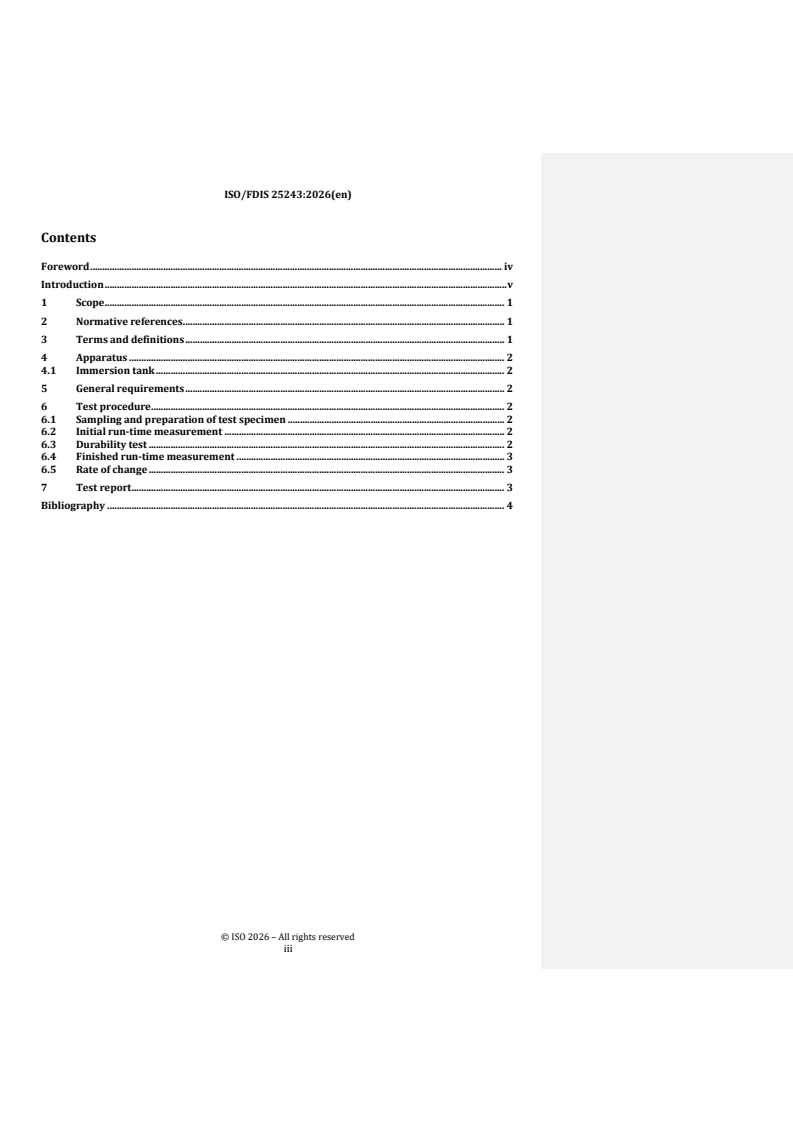
Contents
Foreword . iv
Introduction . v
1 Scope . 1
2 Normative references . 1
3 Terms and definitions . 1
4 Apparatus . 2
4.1 Immersion tank . 2
5 General requirements . 2
6 Test procedure . 2
6.1 Sampling and preparation of test specimen . 2
6.2 Initial run-time measurement . 2
6.3 Durability test . 2
6.4 Finished run-time measurement . 3
6.5 Rate of change . 3
7 Test report . 3
Bibliography . 4
iii
Foreword
ISO (the International Organization for Standardization) is a worldwide federation of national standards
bodies (ISO member bodies). The work of preparing International Standards is normally carried out through
ISO technical committees. Each member body interested in a subject for which a technical committee has been
established has the right to be represented on that committee. International organizations, governmental and
non-governmental, in liaison with ISO, also take part in the work. ISO collaborates closely with the
International Electrotechnical Commission (IEC) on all matters of electrotechnical standardization.
The procedures used to develop this document and those intended for its further maintenance are described
in the ISO/IEC Directives, Part 1. In particular, the different approval criteria needed for the different types of
ISO documents should be noted. This document was drafted in accordance with the editorial rules of the
ISO/IEC Directives, Part 2 (see www.iso.org/directives).
Field Code Changed
ISO draws attention to the possibility that the implementation of this document may involve the use of (a)
patent(s). ISO takes no position concerning the evidence, validity or applicability of any claimed patent rights
in respect thereof. As of the date of publication of this document, ISO had not received notice of (a) patent(s)
which may be required to implement this document. However, implementers are cautioned that this may not
represent the latest information, which may be obtained from the patent database available at
www.iso.org/patents. ISO shall not be held responsible for identifying any or all such patent rights.
Any trade name used in this document is information given for the convenience of users and does not
constitute an endorsement.
For an explanation of the voluntary nature of standards, the meaning of ISO specific terms and expressions
related to conformity assessment, as well as information about ISO's adherence to the World Trade
Organization (WTO) principles in the Technical Barriers to Trade (TBT), see www.iso.org/iso/foreword.html.
Field Code Changed
This document was prepared by Technical Committee ISO/TC 38, Textiles.
Any feedback or questions on this document should be directed to the user’s national standards body. A
complete listing of these bodies can be found at www.iso.org/members.html.
iv
Introduction
E-textiles (smart textiles) are increasingly being used in applications involvi
...