

ISO 12619
(Main)Road vehicles — Natural gas and hydrogen blends fuel system components
- Status
- Not Published
- Technical Committee
- ISO/TC 22/SC 41 - Specific aspects for gaseous fuels
- Current Stage
- 6000 - International Standard under publication - 60 Publication
- Start Date
- 12-Nov-2026
Buy Documents


ISO/FDIS 12619 - Road vehicles — Natural gas and hydrogen blends fuel system components
REDLINE ISO/FDIS 12619 - Road vehicles — Natural gas and hydrogen blends fuel system components
ISO 12619 is an ISO standard for road vehicle fuel system components used with compressed natural gas (CNG) blended with hydrogen. It specifies general requirements for the components themselves, plus the instructions, marking, and test methods needed for safe use in vehicles defined in ISO 3833.
What does ISO 12619 specify?
ISO 12619 specifies general requirements for fuel system components intended for compressed natural gas blended with hydrogen, and it is written for the motor vehicle types defined in ISO 3833. The document also covers the information that manufacturers must provide to installers and the marks that must appear on components.
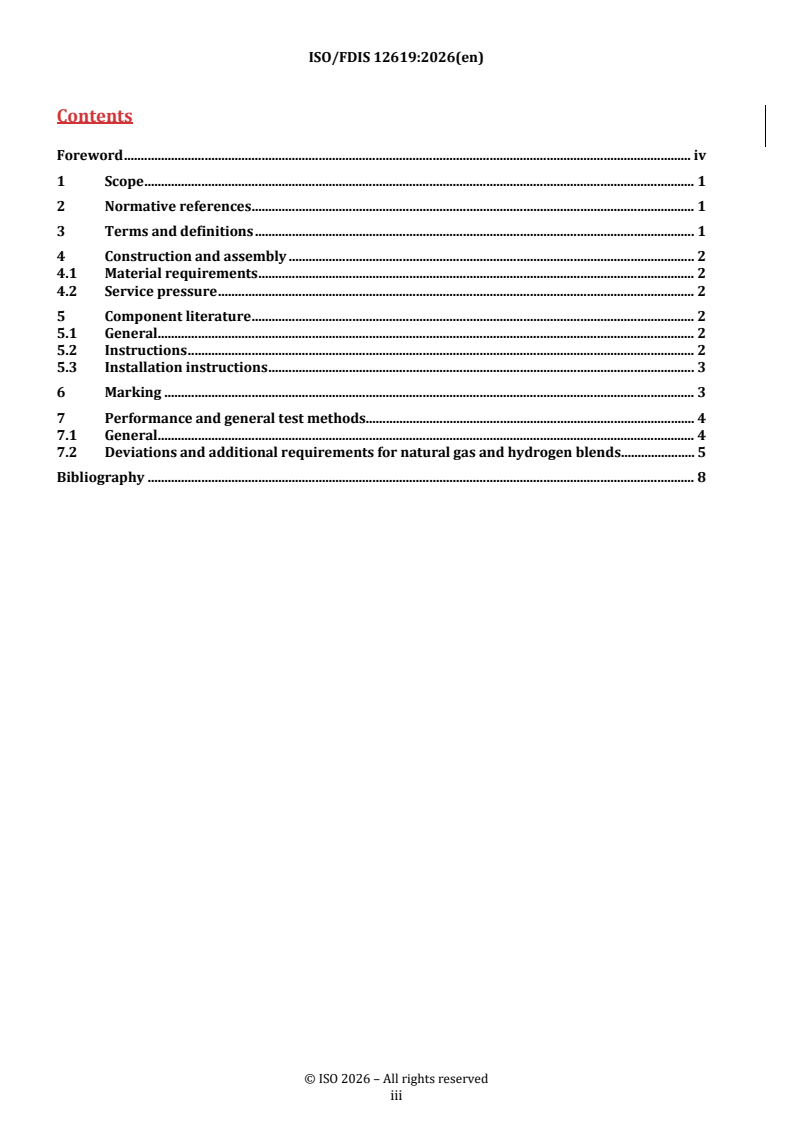
ISO 12619 is organized into clauses on scope, normative references, terms and definitions, construction and assembly, component literature, marking, and performance and general test methods, followed by a bibliography.
In practice, the standard focuses on components that sit in the vehicle fuel system, not on every hydrogen-related vehicle part.
- It excludes CNG-only components, gaseous hydrogen fuel system components, LNG and LH2 components, fuel containers, stationary gas engines, container mounting hardware, electronic fuel management, refuelling receptacles, and fuel cell vehicles.
- It also notes that references to natural gas in the ISO 15500 series are to be read as natural gas and hydrogen blends unless stated otherwise.
What are the key requirements of ISO 12619?
ISO 12619 sets out the main design, information, marking, and testing requirements for components used with natural gas and hydrogen blends. The most important practical point is that component suitability must be proven for hydrogen-containing fuel, not assumed from CNG use alone.
Materials and construction
Clause 4.1 requires materials in contact with the blend to be acceptable for the intended fuel in service, with attention to hydrogen embrittlement and hydrogen accelerated fatigue. This matters because hydrogen can change how metals and polymers behave over time, so the design must avoid harmful corrosion, deformation, or deterioration.
The same clause also calls out chloride stress corrosion cracking for stainless steel and sustained load cracking for aluminum. For buyers and engineers, that means material selection and evidence of compatibility are part of the conformity case.
Pressure levels
Clause 4.2 ties high-pressure components upstream of the first stage of pressure reduction to the service pressures in Table 2. The table pairs 20 MPa, 25 MPa, and 35 MPa service pressure with 25 MPa, 31.25 MPa, and 43.75 MPa working pressure. This tells designers and test labs which pressure class a component must withstand.
Literature and installation information
Clause 5 requires manufacturers to provide component literature in printed or electronic form, and to pass warnings and instructions through intermediate assemblers to the final installer. The instructions must state working pressure, temperature range, installation torques where relevant, orientation, venting, fuel type and maximum hydrogen percentage, flow ratings when safety depends on them, warning labels, and mounting limits.
Clause 5.3 adds that critical information shall be written in the imperative. In practice, that makes installation instructions direct and unambiguous.
Marking
Clause 6 requires each different component to be marked according to the applicable ISO 15500 part, but with a reference to ISO 12619 instead of ISO 15500. It also requires the maximum hydrogen percentage to be marked in the format HCNGXX. That gives users a quick way to identify the blend limit on the component itself.
Performance and tests
Clause 7 says components are tested using the relevant ISO 15500 part, with extra requirements for hydrogen-blend service. The added checks cover leakage, material compatibility, continued operation, non-metallic material immersion, and hydrogen gas exposure.
The leakage test may use the blend, hydrogen, helium, or another gas mixture that can detect leakage, and the leakage rate limit is tied to the declared blend. For non-metallic materials, the hydrogen gas exposure test checks swelling, shrinkage, and weight loss after exposure at pressure. These tests matter because they verify that seals, polymers, and similar materials still work with a hydrogen-containing fuel.
What terms does ISO 12619 define?
- Natural gas and hydrogen blend - a mixture of natural gas with more than 2% by volume of hydrogen.
- CNG (compressed natural gas) - the natural-gas fuel family that the document uses as its baseline reference.
- CGH2 (compressed gaseous hydrogen) - the hydrogen fuel form named in ISO 21266-1 and related references.
- Working pressure - the pressure level a component is expected to handle in service and during relevant tests.
- Service pressure - the pressure level used to classify high-pressure components upstream of pressure reduction.
- PRV (pressure relief valve) - a component type covered by the related ISO 15500-based test regime.
- PRD (pressure relief device) - another safety-related component type covered by the performance requirements.
Who uses ISO 12619?
ISO 12619 is used by component manufacturers, vehicle system integrators, installers, intermediate assemblers, test laboratories, and purchasers or quality teams working on natural gas and hydrogen blend vehicle systems.
Manufacturers use it to design and document compatible components. Installers and intermediate assemblers use it to get the correct installation, warning, and marking information. Test labs use it to run the required leakage, material compatibility, and exposure tests. Buyers and quality managers use it to check whether a component is meant for this fuel blend and for the required pressure range.
Which standards are used with ISO 12619?
| Standard | What it contributes |
|---|---|
| ISO 15500 (all parts) | Baseline requirements for CNG fuel system components, used as the main reference framework for component requirements and testing. |
| ISO 16380 | Refuelling connector requirements for blended fuels, and the pressure context used for service pressure in Clause 4.2. |
| ISO 21266-1 | Safety requirements for compressed gaseous hydrogen and hydrogen/natural gas blend fuel systems, used as the installation reference in Clause 5. |
| ISO 3833 | Defines the motor vehicle types that fall within the scope of ISO 12619. |
What does the ISO 12619 document contain?
ISO 12619 contains the scope, normative references, terms and definitions, construction and assembly requirements, component literature requirements, marking rules, and performance and general test methods. The document includes a pressure table for component service and working pressure, and test procedures that adapt ISO 15500 methods for hydrogen-containing blends.
It also describes the types of information manufacturers must provide to installers, including fuel identification and hydrogen percentage. The performance section sets out how to check leakage and how to assess metallic and non-metallic material suitability for blend service.
Buy Documents
ISO/FDIS 12619 - Road vehicles — Natural gas and hydrogen blends fuel system components
REDLINE ISO/FDIS 12619 - Road vehicles — Natural gas and hydrogen blends fuel system components
Get Certified
Connect with accredited certification bodies for this standard

TÜV Rheinland
TÜV Rheinland is a leading international provider of technical services.

TÜV SÜD
TÜV SÜD is a trusted partner of choice for safety, security and sustainability solutions.

DEKRA Certification Inc.
DEKRA US certification services.
Sponsored listings
Frequently Asked Questions
ISO 12619 is a draft published by the International Organization for Standardization (ISO). Its full title is "Road vehicles — Natural gas and hydrogen blends fuel system components". This standard covers: Road vehicles — Natural gas and hydrogen blends fuel system components
Road vehicles — Natural gas and hydrogen blends fuel system components
ISO 12619 is classified under the following ICS (International Classification for Standards) categories: 43.060.40 - Fuel systems. The ICS classification helps identify the subject area and facilitates finding related standards.
ISO 12619 is available in PDF format for immediate download after purchase. The document can be added to your cart and obtained through the secure checkout process. Digital delivery ensures instant access to the complete standard document.
Standards Content (Sample)
FINAL DRAFT
International
Standard
ISO/FDIS 12619
ISO/TC 22/SC 41
Road vehicles — Natural gas and
Secretariat: UNI
hydrogen blends fuel system
Voting begins on:
components
2026-09-16
Voting terminates on:
2026-11-11
RECIPIENTS OF THIS DRAFT ARE INVITED TO SUBMIT,
WITH THEIR COMMENTS, NOTIFICATION OF ANY
RELEVANT PATENT RIGHTS OF WHICH THEY ARE AWARE
AND TO PROVIDE SUPPOR TING DOCUMENTATION.
IN ADDITION TO THEIR EVALUATION AS
BEING ACCEPTABLE FOR INDUSTRIAL, TECHNO
LOGICAL, COMMERCIAL AND USER PURPOSES, DRAFT
INTERNATIONAL STANDARDS MAY ON OCCASION HAVE
TO BE CONSIDERED IN THE LIGHT OF THEIR POTENTIAL
TO BECOME STAN DARDS TO WHICH REFERENCE MAY BE
MADE IN NATIONAL REGULATIONS.
Reference number
ISO/FDIS 12619:2026(en) © ISO 2026
FINAL DRAFT
ISO/FDIS 12619:2026(en)
International
Standard
ISO/FDIS 12619
ISO/TC 22/SC 41
Road vehicles — Natural gas and
Secretariat: UNI
hydrogen blends fuel system
Voting begins on:
components
Voting terminates on:
RECIPIENTS OF THIS DRAFT ARE INVITED TO SUBMIT,
WITH THEIR COMMENTS, NOTIFICATION OF ANY
RELEVANT PATENT RIGHTS OF WHICH THEY ARE AWARE
AND TO PROVIDE SUPPOR TING DOCUMENTATION.
© ISO 2026
IN ADDITION TO THEIR EVALUATION AS
All rights reserved. Unless otherwise specified, or required in the context of its implementation, no part of this publication may
BEING ACCEPTABLE FOR INDUSTRIAL, TECHNO
LOGICAL, COMMERCIAL AND USER PURPOSES, DRAFT
be reproduced or utilized otherwise in any form or by any means, electronic or mechanical, including photocopying, or posting on
INTERNATIONAL STANDARDS MAY ON OCCASION HAVE
the internet or an intranet, without prior written permission. Permission can be requested from either ISO at the address below
TO BE CONSIDERED IN THE LIGHT OF THEIR POTENTIAL
or ISO’s member body in the country of the requester.
TO BECOME STAN DARDS TO WHICH REFERENCE MAY BE
MADE IN NATIONAL REGULATIONS.
ISO copyright office
CP 401 • Ch. de Blandonnet 8
CH-1214 Vernier, Geneva
Phone: +41 22 749 01 11
Email: copyright@iso.org
Website: www.iso.org
Published in Switzerland Reference number
ISO/FDIS 12619:2026(en) © ISO 2026
ii
ISO/FDIS 12619:2026(en)
Contents Page
Foreword .iv
1 Scope . 1
2 Normative references . 1
3 Terms and definitions . 1
4 Construction and assembly . 2
4.1 Material requirements.2
4.2 Service pressure . .2
5 Component literature . 2
5.1 General .2
5.2 Instructions .2
5.3 Installation instructions .3
6 Marking . . 3
7 Performance and general test methods . 3
7.1 General .3
7.2 Deviations and additional requirements for natural gas and hydrogen blends .4
7.2.1 General .4
7.2.2 Leakage test .4
7.2.3 Material compatibility tests .5
7.2.4 Continued operation test .6
7.2.5 Non-metallic material immersion .6
7.2.6 Hydrogen gas exposure .6
Bibliography . 8
iii
ISO/FDIS 12619:2026(en)
Foreword
ISO (the International Organization for Standardization) is a worldwide federation of national standards
bodies (ISO member bodies). The work of preparing International Standards is normally carried out through
ISO technical committees. Each member body interested in a subject for which a technical committee
has been established has the right to be represented on that committee. International organizations,
governmental and non-governmental, in liaison with ISO, also take part in the work. ISO collaborates closely
with the International Electrotechnical Commission (IEC) on all matters of electrotechnical standardization.
The procedures used to develop this document and those intended for its further maintenance are described
in the ISO/IEC Directives, Part 1. In particular, the different approval criteria needed for the different types
of ISO document should be noted. This document was drafted in accordance with the editorial rules of the
ISO/IEC Directives, Part 2 (see www.iso.org/directives).
ISO draws attention to the possibility that the implementation of this document may involve the use of (a)
patent(s). ISO takes no position concerning the evidence, validity or applicability of any claimed patent
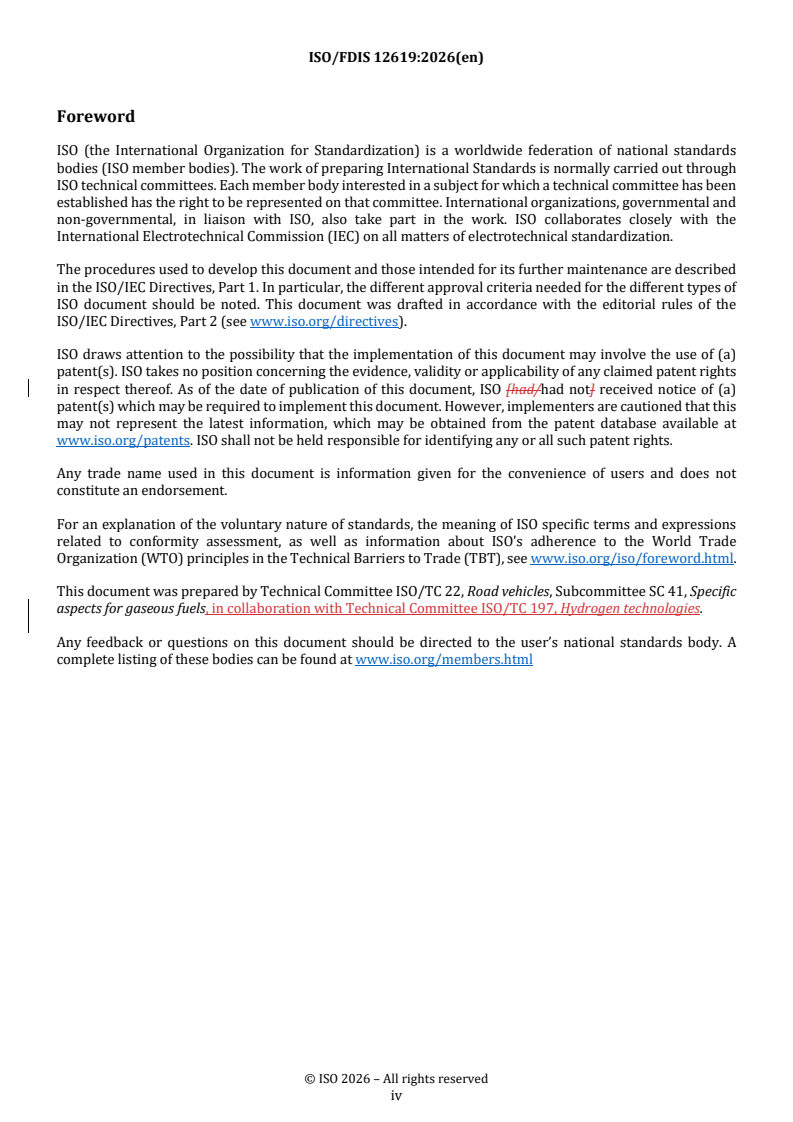
rights in respect thereof. As of the date of publication of this document, ISO had not received notice of (a)
patent(s) which may be required to implement this document. However, implementers are cautioned that
this may not represent the latest information, which may be obtained from the patent database available at
www.iso.org/patents. ISO shall not be held responsible for identifying any or all such patent rights.
Any trade name used in this document is information given for the convenience of users and does not
constitute an endorsement.
For an explanation of the voluntary nature of standards, the meaning of ISO specific terms and expressions
related to conformity assessment, as well as information about ISO's adherence to the World Trade
Organization (WTO) principles in the Technical Barriers to Trade (TBT), see www.iso.org/iso/foreword.html.
This document was prepared by Technical Committee ISO/TC 22, Road vehicles, Subcommittee SC 41, Specific
aspects for gaseous fuels, in collaboration with Technical Committee ISO/TC 197, Hydrogen technologies.
Any feedback or questions on this document should be directed to the user’s national standards body. A
complete listing of these bodies can be found at www.iso.org/members.html
iv
FINAL DRAFT International Standard ISO/FDIS 12619:2026(en)
Road vehicles — Natural gas and hydrogen blends fuel system
components
1 Scope
This document specifies general requirements for fuel system components for use with gaseous compressed
natural gas (CNG) blended with hydrogen, intended for use on the types of motor vehicles defined in ISO 3833.
It also provides general design principles and specifies requirements for instructions and markings.
This document does not apply to the following:
— CNG fuel system components (see the ISO 15500 series);
— gaseous hydrogen fuel systems components (see ISO 19887-1);
— liquefied natural gas (LNG) or liquefied hydrogen (LH2) fuel system components;
— fuel containers;
— stationary gas engines;
— container mounting hardware;
— electronic fuel management;
— refuelling receptacles;
— fuel cell vehicles.
NOTE For the purpose of this document, all references to natural gas in the ISO 15500 series are to natural gas
and hydrogen blends, unless otherwise specified.
2 Normative references
The following documents are referred to in the text in such a way that some or all of their content constitutes
requirements of this document. For dated references, only the edition cited applies. For undated references,
the latest edition of the referenced document (including any amendments) applies.
ISO 15500 (all parts), Road vehicles — Compressed natural gas (CNG) fuel system components
ISO 16380, Road vehicles — Blended fuels refuelling connector
3 Terms and definitions
For the purposes of this document, the terms and definitions given in the ISO 15500 series and the following
apply.
ISO and IEC maintain terminology databases for use in standardization at the following addresses:
— ISO Online browsing platform: available at https:// www .iso .org/ obp
— IEC Electropedia: available at https:// www .electropedia .org/
ISO/FDIS 12619:2026(en)
3.1
natural gas and hydrogen blend
mixture of natural gas and more than 2 % by volume of hydrogen
4 Construction and assembly
4.1 Material requirements
Materials normally in contact with natural gas and hydrogen blends shall be determined to be acceptable
with the intended fuel in service, with particular attention to hydrogen embrittlement and hydrogen
accelerated fatigue. Materials and design shall be such that there will be no significant change in the
functioning of the device, deformation or mechanical change in the device, and no harmful corrosion,
deformation, or deterioration of the materials.
Resistance to chloride stress corrosion cracking shall be taken under consideration if selecting stainless
steel materials. Resistance to sustained load cracking shall be taken under consideration if selecting
aluminum materials.
NOTE 1 Material performance data in hydrogen environments can be found in the Sandia National Laboratory
Technical Reference for Hydrogen Compatibility of Materials or the ANSI/AIAA G-095 Guide to Safety of Hydrogen and
Hydrogen Systems.
NOTE 2 Guidance to account for the degradation effects of hydrogen on the mechanical performance of a material
can be found in ISO/TS 15916, ANSI/CSA CHMC 1, CSA/ANSI CHMC 2, ASME B31.12 and SAE J2579_202301 Appendix B.
4.2 Service pressure
High pressure components upstream of the first stage of pressure reduction shall be suitable for service
in accordance with the service pressures, as specified for the refuelling connectors in ISO 16380, listed in
Table 2.
Table 2 — Natural gas and hydrogen blends fuel system components
Service pressure Working pressure
20 MPa 25 MPa
25 MPa 31,25 MPa
...
ISO/DISFDIS 12619:2025(en)
ISO/TC 22/SC 41
Secretariat: UNI
Date: 2025-11-072026-09-01
Road vehicles — Natural gas and hydrogen blends fuel system
components
FDIS stage
ISO/FDIS 12619:2026(en)
All rights reserved. Unless otherwise specified, or required in the context of its implementation, no part of this publication
may be reproduced or utilized otherwise in any form or by any means, electronic or mechanical, including photocopying,
or posting on the internet or an intranet, without prior written permission. Permission can be requested from either ISO
at the address below or ISO’s member body in the country of the requester.
ISO copyright office
CP 401 • Ch. de Blandonnet 8
CH-1214 Vernier, Geneva
Phone: + 41 22 749 01 11
EmailE-mail: copyright@iso.org
Website: www.iso.org
Published in Switzerland
ii
ISO/FDIS 12619:2026(en)
Contents
Foreword . iv
1 Scope . 1
2 Normative references . 1
3 Terms and definitions . 1
4 Construction and assembly . 2
4.1 Material requirements . 2
4.2 Service pressure . 2
5 Component literature . 2
5.1 General. 2
5.2 Instructions . 2
5.3 Installation instructions . 3
6 Marking . 3
7 Performance and general test methods. 4
7.1 General. 4
7.2 Deviations and additional requirements for natural gas and hydrogen blends. 5
Bibliography . 8
iii
ISO/FDIS 12619:2026(en)
Foreword
ISO (the International Organization for Standardization) is a worldwide federation of national standards
bodies (ISO member bodies). The work of preparing International Standards is normally carried out through
ISO technical committees. Each member body interested in a subject for which a technical committee has been
established has the right to be represented on that committee. International organizations, governmental and
non-governmental, in liaison with ISO, also take part in the work. ISO collaborates closely with the
International Electrotechnical Commission (IEC) on all matters of electrotechnical standardization.
The procedures used to develop this document and those intended for its further maintenance are described
in the ISO/IEC Directives, Part 1. In particular, the different approval criteria needed for the different types of
ISO document should be noted. This document was drafted in accordance with the editorial rules of the
ISO/IEC Directives, Part 2 (see www.iso.org/directives).
ISO draws attention to the possibility that the implementation of this document may involve the use of (a)
patent(s). ISO takes no position concerning the evidence, validity or applicability of any claimed patent rights
in respect thereof. As of the date of publication of this document, ISO [had/had not] received notice of (a)
patent(s) which may be required to implement this document. However, implementers are cautioned that this
may not represent the latest information, which may be obtained from the patent database available at
www.iso.org/patents. ISO shall not be held responsible for identifying any or all such patent rights.
Any trade name used in this document is information given for the convenience of users and does not
constitute an endorsement.
For an explanation of the voluntary nature of standards, the meaning of ISO specific terms and expressions
related to conformity assessment, as well as information about ISO's adherence to the World Trade
Organization (WTO) principles in the Technical Barriers to Trade (TBT), see www.iso.org/iso/foreword.html.
This document was prepared by Technical Committee ISO/TC 22, Road vehicles, Subcommittee SC 41, Specific
aspects for gaseous fuels, in collaboration with Technical Committee ISO/TC 197, Hydrogen technologies.
Any feedback or questions on this document should be directed to the user’s national standards body. A
complete listing of these bodies can be found at www.iso.org/members.html
iv
ISO/FDIS 12619:2026(en)
Road vehicles — Natural gas and hydrogen blends fuel system
components
1 Scope
This document specifies general requirements for fuel system components for use with gaseous compressed
natural gas (CNG) blended with hydrogen, intended for use on the types of motor vehicles defined in ISO 3833.
It also provides general design principles and specifies requirements for instructions and markings.
This document does not apply to the following:
— — CNG fuel system components (see the ISO 15500 series);
— — gaseous hydrogen fuel systems components (see ISO 19887-1);
— — liquefied natural gas (LNG) or liquefied hydrogen (LH2) fuel system components;
— — fuel containers;
— — stationary gas engines;
— — container mounting hardware;
— — electronic fuel management;
— — refuelling receptacles;
— — fuel cell vehicles.
NOTE : For the purpose of this document, all references to natural gas in the ISO 15500 series are to natural gas and
hydrogen blends, unless otherwise specified.
2 Normative references
The following documents are referred to in the text in such a way that some or all of their content constitutes
requirements of this document. For dated references, only the edition cited applies. For undated references,
the latest edition of the referenced document (including any amendments) applies.
ISO 15500 (all parts), Road vehicles — Compressed natural gas (CNG) fuel system components
ISO 16380, Road vehicles — Blended fuels refuelling connector
ISO 21266-1, Road vehicles — Compressed gaseous hydrogen (CGH2) and hydrogen/natural gas blends fuel
systems — Part 1: Safety requirements
3 Terms and definitions
For the purposes of this document, the terms and definitions given in the ISO 15500 series and the following
apply.
ISO and IEC maintain terminology databases for use in standardization at the following addresses:
— — ISO Online browsing platform: available at https://www.iso.org/obp
ISO/FDIS 12619:2026(en)
— — IEC Electropedia: available at https://www.electropedia.org/
3.1 3.1
natural gas and hydrogen blend
mixture of natural gas and more than 2 % by volume of hydrogen
4 Construction and assembly
4.1 Material requirements
Materials normally in contact with natural gas and hydrogen blends shall be determined to be acceptable with
the intended fuel in service, with particular attention to hydrogen embrittlement and hydrogen accelerated
fatigue. Materials and design shall be such that there will be no significant change in the functioning of the
device, deformation or mechanical change in the device, and no harmful corrosion, deformation, or
deterioration of the materials.
Resistance to chloride stress corrosion cracking shall be taken under consideration if selecting stainless steel
materials. Resistance to sustained load cracking shall be taken under consideration if selecting aluminum
materials.
NOTE 1 Material performance data in hydrogen environments can be found in the Sandia National Laboratory
Technical Reference for Hydrogen Compatibility of Materials or the ANSI/AIAA G-095 Guide to Safety of Hydrogen and
Hydrogen Systems.
NOTE 2 Guidance to account for the degradation effects of hydrogen on the mechanical performance of a material can
be found in ISO/TS 15916, ANSI/CSA CHMC 1, CSA/ANSI CHMC 2, ASME B31.12 and SAE J2579_202301 Appendix B.
4.2 Service pressure
High pressure components upstream of the first stage of pressure reduction shall be suitable for service in
accordance with the service pressures (, as specified for the refuelling connectors in ISO 16380), listed in
Table 2table 2.
Table 2 — Natural gas and hydrogen blends fuel system components
Service pressure Working pressure
20 MPa 25 MPa
25 MPa 31,25 MPa
35 MPa 43,75 MPa
5 Component literature
5.1 General
Manufacturers of components for natural gas and hydrogen blends powered vehicles shall provide literature
for their components. Literature may be provided in printed or electronic format. This literature shall provide
information to guide the installer in making a proper installation. The literature shall also require that
intermediate assemblers transmit the component warnings and literature to the installer. The manufacturer
shall provide duplicate literature in response to requests, including service parts.
5.2 Instructions
Instructions shall include the following as a minimum:
ISO/FDIS 12619:2026(en)
— — working pressure (MPa);
— — temperature range;
— — installation torques, if applicable;
— — orientation requirements, if applicable;
— — venting requirements with consideration for water ingress, if applicable;
— — type of fuel (“natural gas and hydrogen blend” including the maximum percentage of hydrogen
allowed);
— — flow ratings of connections if required for safety, such as flow requirements into and out of relief
valves;
— — requirements for warning labels that might be required as part of the installation;
— mounting limitations with regards to corrosion resistance, including whether the component is suitable
for underbody, exterior, or interior locations.
Instructions shall also include, as appropriate:
— — service procedures;
— — recommendations for service access;
— — components that require periodic replacement shall be identified;
— — manuf
...