

ISO 15501-1:2025
(Main)Road vehicles — Compressed natural gas (CNG) fuel systems — Part 1: Safety requirements
General Information
- Abstract
This document specifies the minimum safety requirements applicable for the functionality of compressed natural gas (CNG) on-board fuel systems intended for use on the types of motor vehicles defined in ISO 3833. This document is applicable to vehicles using compressed natural gas in accordance with ISO 15403-1, including mono-fuel, bi-fuel or dual-fuel applications, original-production and converted vehicles. All matters relating to the skills of installers and converters have been excluded from this document.
- Status
- Published
- Publication Date
- 30-Nov-2025
- Technical Committee
- ISO/TC 22/SC 41 - Specific aspects for gaseous fuels
- Drafting Committee
- ISO/TC 22/SC 41 - Specific aspects for gaseous fuels
- Current Stage
- 6060 - International Standard published
- Start Date
- 01-Dec-2025
- Due Date
- 16-Feb-2026
- Completion Date
- 01-Dec-2025

Overview
ISO 15501-1:2025 provides the minimum safety requirements for compressed natural gas (CNG) fuel systems used in road vehicles. Developed by the International Organization for Standardization (ISO), this standard is an integral guideline for manufacturers, vehicle integrators, and regulatory bodies to ensure safe functionality of CNG on-board fuel systems. The scope covers CNG systems in road vehicles as defined in ISO 3833, including mono-fuel, bi-fuel, and dual-fuel configurations for both original production and converted vehicles. The standard specifically addresses safety aspects of system functionality, excluding the competencies of installers and converters.
Key Topics
- Component Compliance: Requirements for cylinders, valves, pressure regulators, and safety devices according to referenced ISO standards.
- System Design and Protection:
- Positioning and mounting rules to reduce the risk of damage from vibration, heat, or collisions.
- Measures to minimize corrosion and system deterioration.
- Specifications for heat protection and electrical safety.
- Refuelling Connections:
- Recommendations for receptacle location, mounting strength, and protective requirements.
- Leakage Control:
- Criteria for gas-tight connections and testing for leaks.
- Provisions for proper venting of leaking or vented gas.
- Cylinder Mounting:
- Detailed requirements for the secure installation of gas cylinders to withstand collision forces.
- Use of isolation materials and anti-corrosion measures.
- Venting Systems:
- Guidelines for designing vent lines for PRDs (Pressure Relief Devices) and PRVs (Pressure Relief Valves) to direct gas safely away from occupied compartments.
- Minimizing Risk of Gas Ignition:
- Electrical component requirements to reduce ignition hazards.
- Non-sparking designs in areas where gas leakage is possible.
- Marking and Identification:
- Requirements for marking system components and refuelling receptacles with necessary safety and inspection information.
Applications
ISO 15501-1:2025 is crucial for stakeholders involved in the design, manufacture, integration, and regulation of CNG vehicles. Its primary applications include:
- Vehicle Manufacturing: Ensuring that CNG safety features are integrated into new vehicles during production to minimize risks.
- Vehicle Conversion: Supporting safe retrofitting of vehicles for CNG use by specifying component and protection requirements.
- Component Development: Guiding manufacturers of CNG system components to meet globally accepted safety standards.
- Regulatory Compliance: Assisting certification bodies and regulators in assessing CNG vehicles for conformity with international safety standards.
- Fleet Safety Management: A valuable reference for fleet operators and maintenance teams working to ensure safe operation of CNG-powered vehicles.
These practical applications make ISO 15501-1:2025 essential for the global adoption of CNG as a cleaner alternative fuel, providing assurance of performance and public safety.
Related Standards
Compliance with ISO 15501-1:2025 is supported by a network of referenced standards, including:
- ISO 15403-1 - Natural gas fuel quality standard for vehicles.
- ISO 11439 - Gas cylinders for on-board CNG storage.
- ISO 14469 - CNG refuelling connector.
- ISO 15500 series - CNG fuel system components.
- ISO/IEC 20653 - Degrees of protection (IP code) for electrical equipment.
- ISO 7637 & ISO 11451/52 series - Electromagnetic compatibility standards for road vehicles.
- ISO 15501-2 - Test methods for CNG fuel systems.
By adhering to these interlinked standards, vehicle and component producers achieve a consistent, high level of safety for CNG-powered road vehicles.
Keywords: ISO 15501-1:2025, CNG fuel systems, compressed natural gas, road vehicles, safety requirements, vehicle standards, CNG component safety, fuel system protection, automotive safety standards, CNG system compliance.
Relations
- Effective Date
- 18-Feb-2023
- Effective Date
- 18-Feb-2023
Get Certified
Connect with accredited certification bodies for this standard

TÜV Rheinland
TÜV Rheinland is a leading international provider of technical services.

TÜV SÜD
TÜV SÜD is a trusted partner of choice for safety, security and sustainability solutions.

DEKRA Certification Inc.
DEKRA US certification services.
Sponsored listings
Frequently Asked Questions
ISO 15501-1:2025 is a standard published by the International Organization for Standardization (ISO). Its full title is "Road vehicles — Compressed natural gas (CNG) fuel systems — Part 1: Safety requirements". This standard covers: This document specifies the minimum safety requirements applicable for the functionality of compressed natural gas (CNG) on-board fuel systems intended for use on the types of motor vehicles defined in ISO 3833. This document is applicable to vehicles using compressed natural gas in accordance with ISO 15403-1, including mono-fuel, bi-fuel or dual-fuel applications, original-production and converted vehicles. All matters relating to the skills of installers and converters have been excluded from this document.
This document specifies the minimum safety requirements applicable for the functionality of compressed natural gas (CNG) on-board fuel systems intended for use on the types of motor vehicles defined in ISO 3833. This document is applicable to vehicles using compressed natural gas in accordance with ISO 15403-1, including mono-fuel, bi-fuel or dual-fuel applications, original-production and converted vehicles. All matters relating to the skills of installers and converters have been excluded from this document.
ISO 15501-1:2025 is classified under the following ICS (International Classification for Standards) categories: 43.060.40 - Fuel systems. The ICS classification helps identify the subject area and facilitates finding related standards.
ISO 15501-1:2025 has the following relationships with other standards: It is inter standard links to ISO 15501-1:2016/Amd 1:2021, ISO 15501-1:2016. Understanding these relationships helps ensure you are using the most current and applicable version of the standard.
ISO 15501-1:2025 is available in PDF format for immediate download after purchase. The document can be added to your cart and obtained through the secure checkout process. Digital delivery ensures instant access to the complete standard document.
Standards Content (Sample)
International
Standard
ISO 15501-1
Fourth edition
Road vehicles — Compressed
2025-12
natural gas (CNG) fuel systems —
Part 1:
Safety requirements
Véhicules routiers — Systèmes d'alimentation en gaz naturel
comprimé (GNC) —
Partie 1: Exigences de sécurité
Reference number
© ISO 2025
All rights reserved. Unless otherwise specified, or required in the context of its implementation, no part of this publication may
be reproduced or utilized otherwise in any form or by any means, electronic or mechanical, including photocopying, or posting on
the internet or an intranet, without prior written permission. Permission can be requested from either ISO at the address below
or ISO’s member body in the country of the requester.
ISO copyright office
CP 401 • Ch. de Blandonnet 8
CH-1214 Vernier, Geneva
Phone: +41 22 749 01 11
Email: copyright@iso.org
Website: www.iso.org
Published in Switzerland
ii
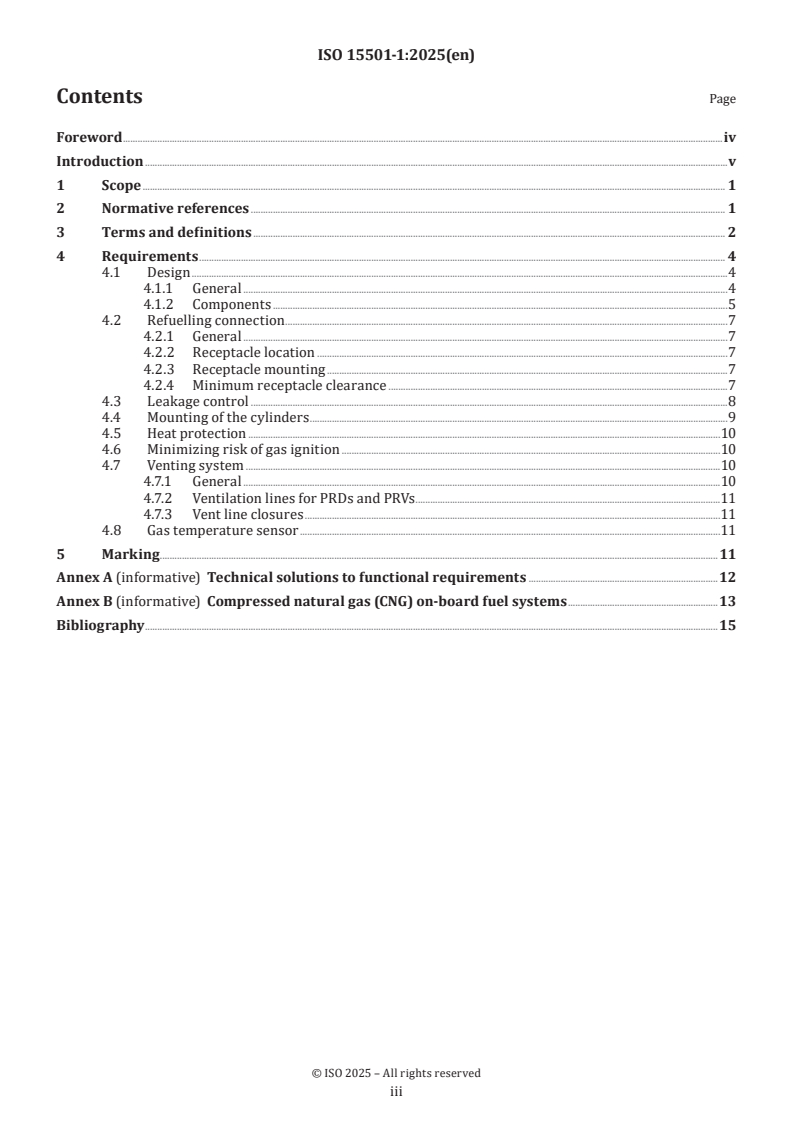
Contents Page
Foreword .iv
Introduction .v
1 Scope . 1
2 Normative references . 1
3 Terms and definitions . 2
4 Requirements . 4
4.1 Design .4
4.1.1 General .4
4.1.2 Components .5
4.2 Refuelling connection .7
4.2.1 General .7
4.2.2 Receptacle location .7
4.2.3 Receptacle mounting .7
4.2.4 Minimum receptacle clearance .7
4.3 Leakage control .8
4.4 Mounting of the cylinders .9
4.5 Heat protection .10
4.6 Minimizing risk of gas ignition .10
4.7 Venting system .10
4.7.1 General .10
4.7.2 Ventilation lines for PRDs and PRVs .11
4.7.3 Vent line closures .11
4.8 Gas temperature sensor .11
5 Marking . .11
Annex A (informative) Technical solutions to functional requirements .12
Annex B (informative) Compressed natural gas (CNG) on-board fuel systems .13
Bibliography .15
iii
Foreword
ISO (the International Organization for Standardization) is a worldwide federation of national standards
bodies (ISO member bodies). The work of preparing International Standards is normally carried out through
ISO technical committees. Each member body interested in a subject for which a technical committee
has been established has the right to be represented on that committee. International organizations,
governmental and non-governmental, in liaison with ISO, also take part in the work. ISO collaborates closely
with the International Electrotechnical Commission (IEC) on all matters of electrotechnical standardization.
The procedures used to develop this document and those intended for its further maintenance are described
in the ISO/IEC Directives, Part 1. In particular, the different approval criteria needed for the different types
of ISO document should be noted. This document was drafted in accordance with the editorial rules of the
ISO/IEC Directives, Part 2 (see www.iso.org/directives).
ISO draws attention to the possibility that the implementation of this document may involve the use of (a)
patent(s). ISO takes no position concerning the evidence, validity or applicability of any claimed patent
rights in respect thereof. As of the date of publication of this document, ISO had not received notice of (a)
patent(s) which may be required to implement this document. However, implementers are cautioned that
this may not represent the latest information, which may be obtained from the patent database available at
www.iso.org/patents. ISO shall not be held responsible for identifying any or all such patent rights.
Any trade name used in this document is information given for the convenience of users and does not
constitute an endorsement.
For an explanation of the voluntary nature of standards, the meaning of ISO specific terms and expressions
related to conformity assessment, as well as information about ISO's adherence to the World Trade
Organization (WTO) principles in the Technical Barriers to Trade (TBT), see www.iso.org/iso/foreword.html.
This document was prepared by Technical Committee ISO/TC 22, Road vehicles, Subcommittee SC 41, Specific
aspects for gaseous fuels.
This fourth edition cancels and replaces the third edition (ISO 15501-1:2016), which has been technically
revised. It also incorporates the Amendment ISO 15501-1:2016/Amd. 1:2021.
The main changes are as follows:
— normative references have been updated;
— terminological entries have been updated;
— the reference to the series PRD has been removed;
— an electronic control unit requirement has been added;
— an electrical connections requirement has been added;
— the minimum receptacle clearance has been updated;
— vent line closures requirements have been added;
— gas temperature sensor requirements have been added.
A list of all parts in the ISO 15501 series can be found on the ISO website.
Any feedback or questions on this document should be directed to the user’s national standards body. A
complete listing of these bodies can be found at www.iso.org/members.html.
iv
Introduction
For the purposes of this document, all fuel system components in contact with natural gas have been
considered suitable for natural gas as defined in ISO 15403-1.
When applying this document, it is to be understood that a safety device to prevent overfilling the vehicle's
fuel system is part of the refuelling station. The pressure gauge has not been considered as a safety
component.
When necessary, technical solutions regarding functional requirements are given in Annex A.
This document refers to a service pressure of 20 MPa (200 bar).
5 2
NOTE 1 1 bar = 0,1 MPa = 10 Pa. 1 MPa = 1 N/mm .
NOTE 2 This document is based upon a service pressure for natural gas as fuel of 20 MPa (200 bar) settled at 15 °C.
Other service pressures can be accommodated by adjusting the pressure by the appropriate factor (ratio). For example,
a 25 MPa (250 bar) service pressure system will require pressures to be multiplied by 1,25.
v
International Standard ISO 15501-1:2025(en)
Road vehicles — Compressed natural gas (CNG) fuel
systems —
Part 1:
Safety requirements
1 Scope
This document specifies the minimum safety requirements applicable for the functionality of compressed
natural gas (CNG) on-board fuel systems intended for use on the types of motor vehicles defined in ISO 3833.
This document is applicable to vehicles using compressed natural gas in accordance with ISO 15403-1,
including mono-fuel, bi-fuel or dual-fuel applications, original-production and converted vehicles.
All matters relating to the skills of installers and converters have been excluded from this document.
2 Normative references
The following documents are referred to in the text in such a way that some or all of their content constitutes
requirements of this document. For dated references, only the edition cited applies. For undated references,
the latest edition of the referenced document (including any amendments) applies.
ISO 1176, Road vehicles — Masses — Vocabulary and codes
ISO 7637-1, Road vehicles — Electrical disturbances from conduction and coupling — Part 1: Vocabulary and
general considerations
ISO 7637-2, Road vehicles — Electrical disturbances from conduction and coupling — Part 2: Electrical transient
conduction along supply lines only
ISO 11439, Gas cylinders — High pressure cylinders for the on-board storage of natural gas as a fuel for
automotive vehicles
ISO 11451-1, Road vehicles — Vehicle test methods for electrical disturbances from narrowband radiated
electromagnetic energy — Part 1: General principles and terminology
ISO 11451-2, Road vehicles — Vehicle test methods for electrical disturbances from narrowband radiated
electromagnetic energy — Part 2: Off-vehicle radiation sources
ISO 11451-4, Road vehicles — Vehicle test methods for electrical disturbances from narrowband radiated
electromagnetic energy — Part 4: Harness excitation methods
ISO 11452-1, Road vehicles — Component test methods for electrical disturbances from narrowband radiated
electromagnetic energy — Part 1: General principles and terminology
ISO 11452-2, Road vehicles — Component test methods for electrical disturbances from narrowband radiated
electromagnetic energy — Part 2: Absorber-lined shielded enclosure
ISO 11452-3, Road vehicles — Component test methods for electrical disturbances from narrowband radiated
electromagnetic energy — Part 3: Transverse electromagnetic (TEM) cell
ISO 11452-4, Road vehicles — Component test methods for electrical disturbances from narrowband radiated
electromagnetic energy — Part 4: Harness excitation methods
ISO 11452-5, Road vehicles — Component test methods for electrical disturbances from narrowband radiated
electromagnetic energy — Part 5: Stripline
ISO 14469, Road vehicles — Compressed natural gas (CNG) refuelling connector
ISO 15500 (all parts), Road vehicles — Compressed natural gas (CNG) fuel system components
ISO 15501-2, Road vehicles — Compressed natural gas (CNG) fuel systems — Part 2: Test methods
ISO 20653, Road vehicles — Degrees of protection (IP code) — Protection of electrical equipment against foreign
objects, water and access
3 Terms and definitions
For the purposes of this document, the terms and definitions given in ISO 1176, ISO 15500-6, ISO 15500-7,
ISO 15500-9, ISO 15500-12, ISO 15500-13, ISO 15500-14 and the following apply.
ISO and IEC maintain terminology databases for use in standardization at the following addresses:
— ISO Online browsing platform: available at https:// www .iso .org/ obp
— IEC Electropedia: available at https:// www .electropedia .org/
3.1
service pressure
settled pressure at a uniform gas temperature of 15 °C
Note 1 to entry: The ISO 15501 series is based on a service pressure for natural gas used as fuel of 20 MPa (200 bar),
settled at 15 °C. Other service pressures can be accommodated by adjusting the pressure by the appropriate factor
(ratio). For example, a 25 MPa (250 bar) service pressure system will require pressures to be multiplied by 1,25.
3.2
CNG on-board fuel system
compressed natural gas fuel system comprising cylinder, or cylinders according to ISO 11439, mounting, one
or more refuelling receptacles according to ISO 14469, and the components described in the ISO 15500 series
3.3
main shut-off valve
automatic valve designed to isolate a high-pressure source
3.4
vehicle mass
3.4.1
maximum authorized mass
vehicle mass determined as a maximum by the administrative authority for operating conditions laid down
by that authority
Note 1 to entry: For vehicles coupled with a trailer or a semi-trailer which exerts a significant vertical load on the
coupling device or the fifth wheel, this load, divided by standard acceleration of gravity, is included in the maximum
design total mass or maximum authorized total mass.
Note 2 to entry: For semi-trailers, the maximum authorized total mass including the vertical load on the fifth wheel is
determined by the administrative authority taking into account the characteristics of the towing vehicle.
[SOURCE: ISO 1176:1990, 4.8, modified — The original term was "maximum authorized total mass".]
3.5
vehicle categories
3.5.1
category M
power-driven vehicles having at least four wheels and used for the carriage of passengers
3.5.1.1
category M1
vehicles used for the carriage of passengers and comprising no more than eight seats in addition to the
driver's seat
3.5.1.2
category M2
vehicles used for the carriage of passengers and comprising more than eight seats in addition to the driver's
seat and having a maximum authorized mass (3.4.1) not exceeding 5 000 kg
3.5.1.3
category M3
vehicles used for the carriage of passengers and comprising more than eight seats in addition to the driver's
seat and having a maximum authorized mass (3.4.1) exceeding 5 000 kg
3.5.2
category N
power-driven vehicles having at least four wheels and used for the carriage of goods
3.5.2.1
category N1
vehicles used for the carriage of goods and having a maximum authorized mass (3.4.1) not exceeding 3 500 kg
3.5.2.2
category N2
vehicles used for the carriage of goods and having a maximum authorized mass (3.4.1) exceeding 3 500 kg,
but not exceeding 12 000 kg
3.5.2.3
category N3
vehicles used for the carriage of goods and having a maximum authorized mass (3.4.1) exceeding 12 000 kg
3.6
electronic control unit
ECU
device which controls the compressed natural gas demand of the engine and establishes the cut-off of the
automatic valve in case of a broken fuel supply pipe or in case of stalling of the engine, or during a crash
3.7
pressure relief device
PRD
one-time-use device triggered by excessive temperature or temperature and pressure acting in series or in
parallel which vents gas to protect the cylinder from rupture
3.8
pressure relief valve
PRV
discharge valve
self-closing device which opens to prevent a pre-determined pressure being exceeded
4 Requirements
4.1 Design
4.1.1 General
The compressed natural gas (CNG) on-board fuel system components shall comply with ISO 11439, ISO 14469
and the ISO 15500 series, as applicable.
For bi-fuel vehicles, provisions shall be made to avoid accelerated deterioration of the non-CNG fuel system
as a result of sustained operation on natural gas. Such measures shall be as recommended by the original
vehicle manufacturer (e.g. fuel hoses).
All fuel system components shall fulfill the following conditions.
a) They shall withstand the environmental temperatures and other environmental conditions safely
during their operational life.
b) They shall be located with full regard for anticipated damage while the vehicle is being used safely. Such
damage may be caused by the vehicle itself, by extraneous factors such as heat, road debris, automotive
fluids (e.g. brake liquid, oil, petrol, cooling liquid), or by rust, etc.
c) They shall be fitted so that they are not the outermost, highest or lowest parts of the vehicles; otherwise
they shall be protected.
d) They shall be fitted so as not to affect ground clearance, approach angle, ramp (break-over) angle or
departure angles as defined by the vehicle manufacturer.
e) They shall be located so that they will not suffer corrosion damage by accumulation of water or cargo
chemicals.
f) They shall ensure the proper electrical conductivity throughout the fuel system in order to avoid the
electrostatic charges. This provision does not apply to gas-tight housing and ventilation hose.
g) All connections shall be made in locations where access is possible for inspection.
The CNG system shall be installed in such a way that it has suitable protection against damage, such as
damage due to moving vehicle components, collision, grit or due to the loading or unloading of the vehicle or
the shifting of those loads.
The CNG system shall include automatic valves designed to close when the engine is not running on CNG, and
shall be able to be manually opened or closed in case of failure of the automatism (see Annex B).
The CNG on-board fuel system shall include the following:
— an automatic valve to be installed directly on every CNG cylinder with a manual valve rigidly fixed to the
CNG cylinder, which may be integrated into the automatic valve. The manual valve shall be able to isolate
the cylinder content from the automatic valve;
— a pressure relief device (PRD) installed on each cylinder, functionally independent from any other
component;
— one or more additional PRD as applicable to the approval of the cylinder according to ISO 11439; and
— an excess flow valve inside every cylinder or a functionally equivalent system to control the gas leakage
in the event of an abnormal flow (see Annex A).
The automatic valve shall be closed when:
— the vehicle is not operating on CNG, and
— the engine is not running.
The valve may remain open when the engine stops during the stop phase in start-stop systems where the
valve shall remain open by design.
Only automatic valves that are no
...