

ISO 5149-1
(Main)Refrigerating systems and heat pumps — Safety and environmental requirements — Part 1: Vocabulary
- Abstract
ISO 5149-1:2014 specifies the requirements for the safety of persons and property, provides guidance for the protection of the environment, and establishes procedures for the operation, maintenance, and repair of refrigerating systems and the recovery of refrigerants. ISO 5149-1:2014 specifies the classification and selection criteria applicable to the refrigerating systems and heat pumps. These classification and selection criteria are used in ISO 5149‑2, ISO 5149‑3, and ISO 5149‑4. ISO 5149-1:2014 applies to: a) refrigerating systems, stationary or mobile, of all sizes including heat pumps; b) secondary cooling or heating systems; c) the location of the refrigerating systems; and d) replaced parts and added components after adoption of this part of ISO 5149 if they are not identical in function and in the capacity. ISO 5149-1:2014 applies to fixed or mobile systems, except to vehicle air conditioning systems covered by a specific product standard, e.g. ISO 13043 and SAE J 639. ISO 5149-1:2014 is applicable to new refrigerating systems, extensions or modifications of already existing systems, and for used systems, being transferred to and operated on another site. ISO 5149-1:2014 also applies in the case of the conversion of a system to another refrigerant. Systems containing refrigerants which are not listed in ISO 817 are not covered in ISO 5149-1:2014.
- Status
- Not Published
- Current Stage
- 6000 - International Standard under publication
- Start Date
- 22-Sep-2026
- Completion Date
- 10-Oct-2026
Buy Documents
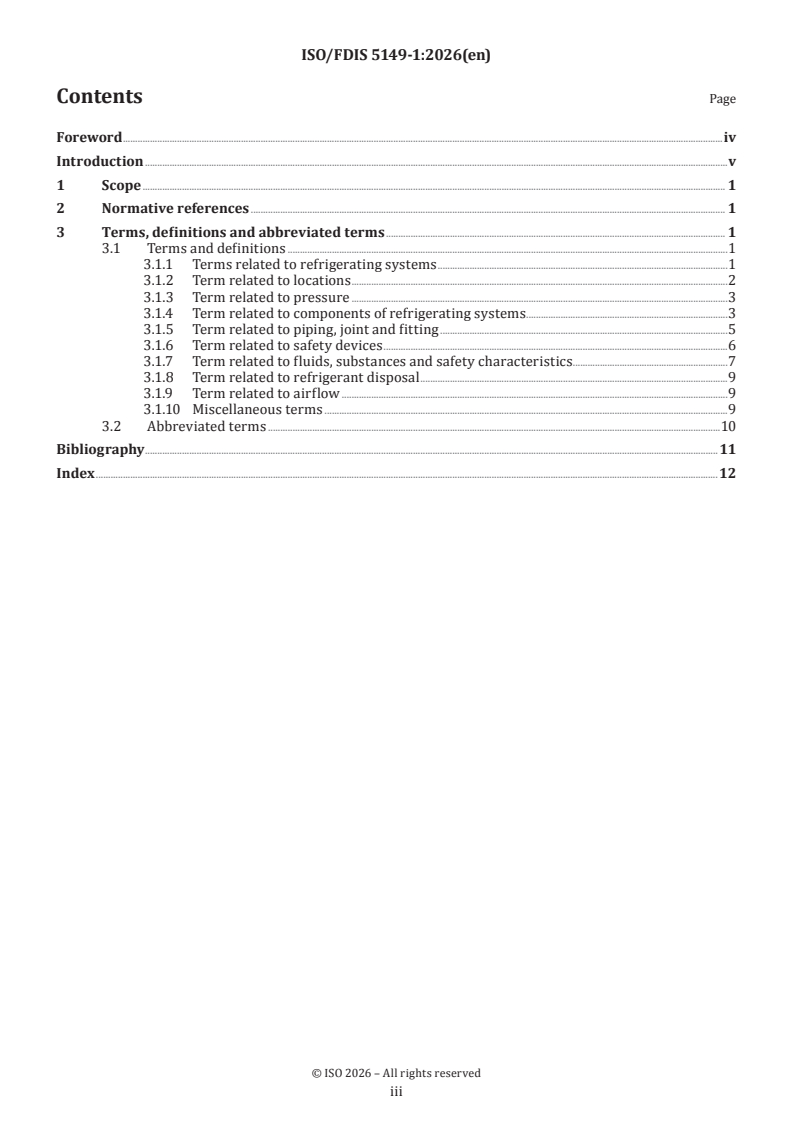
ISO/FDIS 5149-1 - Refrigerating systems and heat pumps — Safety and environmental requirements — Part 1: Vocabulary
REDLINE ISO/FDIS 5149-1 - Refrigerating systems and heat pumps — Safety and environmental requirements — Part 1: Vocabulary
ISO 5149-1 is the ISO vocabulary part of the ISO 5149 series for refrigerating systems and heat pumps. It defines the terms used across the series so that designers, manufacturers, installers, operators and repair personnel use the same language for safety and environmental work. In this edition, the document is focused on vocabulary rather than technical requirements.
What does ISO 5149-1 specify?
ISO 5149-1 defines the terms used in the specification, design, manufacture, construction, installation, commissioning, maintenance and decommissioning of refrigerating systems with regard to safety and environmental requirements. It also gives the abbreviated terms used in the series.
The document is organized into:
- Clause 1, Scope
- Clause 2, Normative references
- Clause 3, Terms and definitions
- Clause 4, Additional abbreviated terms
- Bibliography
- Index
Clause 3 is structured by topic: refrigerating systems, location, pressure, components, piping, joints and fittings, safety devices, fluids and safety characteristics, refrigerant disposal, airflow, and miscellaneous terms. That structure matters in practice because users can find the definition they need without guessing which part of the series uses it.
The introduction links this vocabulary to the wider ISO 5149 series, which covers safety and environmental requirements and the procedures for design, construction, testing, marking and documentation, installation, operation, maintenance, repair and disposal. The term refrigerating systems includes heat pumps and air conditioners.
What are the key requirements of ISO 5149-1?
ISO 5149-1 does not set performance limits or test methods. Its key function is to standardize the language that the rest of the ISO 5149 series relies on, so that classification, safety decisions and documentation are interpreted consistently.
System and application terms
Clause 3.1.1 defines the main system types, including sorption system, cascade system, indirect system, limit-charged system, self-contained system, hermetically sealed system, unit system, split system and multi-split system. In practice, these definitions tell you how a system is built and how parts are connected, which affects design choices, installation work and the way safety rules are applied.
Clause 3.1.2 defines location terms such as machinery room, separate refrigeration machinery room, occupied space, open air, hallway, crawl space and class IV ventilated enclosure. These terms matter because the physical location of equipment changes the ventilation, access and containment approach used in a project.
Pressure and mechanical terms
Clause 3.1.3 defines design pressure, maximum allowable pressure (PS) and strength test pressure. These are the pressure words engineers and buyers need when checking component ratings, sizing equipment and writing inspection or test plans.
Clauses 3.1.4 and 3.1.5 define components and connections such as compressor, condenser, evaporator, pressure vessel, liquid receiver, piping, joint, welded joint, brazed joint, flanged joint and compression joint. This section helps users describe what is part of the refrigerating system and what kind of connection is being specified or inspected.
Safety devices and control terms
Clause 3.1.6 defines safety-related devices, including bursting disc, pressure relief valve, pressure relief device, pressure limiter, pressure cutout, safety pressure cutout, refrigerant detector, temperature limiting device and changeover valve. In practice, these definitions support safety design, maintenance checks and fault-response planning because they distinguish automatic limiting devices from devices that need manual or tool-based reset.
Fluids, charges and environmental terms
Clause 3.1.7 defines lubricant, halocarbon, hydrocarbon, heat-transfer fluid, refrigerant type, toxicity, practical limit, maximum refrigerant charge, charge limit, refrigerant quantity, refrigerant quantity limit, refrigerant charge, releasable charge and hot surface ignition temperature (HSIT). These terms are important when calculating how much refrigerant may be present, how much may be released into a space and what hazard characteristics drive the safety concept.
End-of-life and handling terms
Clause 3.1.8 defines disposal, reclaim, recover, recycle and reuse. These terms are the basis for specifying what happens to refrigerant during maintenance, recovery work and system end-of-life activities, especially when a project needs to distinguish between captured, cleaned and reprocessed refrigerant.
Abbreviated terms
Clause 4 and Table 1 standardize abbreviations such as ATEL, CLAM, GWP, HSIT, LFL, ODL, ODP, ppm, RV, SDS and TF. This helps keep technical documentation, calculations and safety records consistent across teams and suppliers.
What terms does ISO 5149-1 define?
- Refrigerating system - a closed circuit of interconnected refrigerant-containing parts that circulates refrigerant to extract and reject heat; the document notes that this includes heat pumps and air conditioners.
- Machinery room - an enclosed, mechanically ventilated room or space, sealed from public areas, intended to contain refrigerating system components.
- Pressure vessel - a refrigerant-containing part of a refrigerating system that is treated as a pressure vessel unless it falls within the listed exclusions in the definition.
- Charge limit - the maximum amount of refrigerant considered safe to contain, based on toxicity or flammability.
- Refrigerant charge - the amount of refrigerant contained in the refrigerating system.
- Recover - to remove refrigerant in any condition from a system and store it in an external container.
- PS - the maximum allowable pressure specified by the manufacturer.
Who uses ISO 5149-1?
ISO 5149-1 is used by people who write, review or apply the technical language of refrigerating systems and heat pumps. That includes system designers, manufacturers, installers, commissioning teams, maintenance and repair personnel, safety engineers, quality managers and technical buyers.
It is especially useful in refrigeration, HVAC, heat pump and air-conditioning work where teams must describe equipment, locations, pressures, refrigerants and safety devices in the same way. It also supports service and recovery work where terms such as recover, reclaim, recycle and reuse have to be used carefully in records and procedures.
What changed in ISO 5149-1 from the previous edition?
ISO 5149-1:2026 is the second edition and it cancels and replaces ISO 5149-1:2014. The foreword states that it also incorporates ISO 5149-1:2014/Amd 1:2015 and ISO 5149-1:2014/Amd 2:2021.
The main change is that the entire technical part was moved to ISO 5149-3, leaving this part as the vocabulary document.
Which standards are used with ISO 5149-1?
| Standard | What it contributes |
|---|---|
| ISO 817 | Refrigerant designation and safety classification; ISO 5149-1 uses this for the refrigerant type terminology. |
| ISO 5149-2 | A related part of the ISO 5149 series that uses the classification and selection criteria defined here. |
| ISO 5149-3 | The part that receives the technical content referenced by the foreword as having been moved from this document. |
| ISO 5149-4 | Another related part of the ISO 5149 series that uses the classification and selection criteria defined here. |
| ISO 14903 | Qualification of tightness of components and joints; cited in the definition of hermetically sealed system. |
| ISO 13043 | A specific product standard for mobile air conditioning systems, cited as an exception to the general scope. |
| SAE J 639 | A specific product standard for motor vehicle refrigerant vapor compression systems, cited as an exception to the general scope. |
What does the ISO 5149-1 document contain?
ISO 5149-1 contains a structured vocabulary for refrigerating systems and heat pumps, grouped by system type, location, pressure, components, piping, safety devices, fluids, refrigerant disposal, airflow and miscellaneous terms. It also contains a table of additional abbreviated terms, which supports consistent use of short forms in calculations, records and specifications.
The bibliography points readers to related standards and the index provides fast term lookup. In practice, the document is used when writing specifications, checking design documents, preparing safety files, training staff and keeping maintenance or recovery records consistent.
Relations
- Effective Date
- 19-Nov-2022
- Effective Date
- 19-Nov-2022
- Effective Date
- 19-Nov-2022
Buy Documents
ISO/FDIS 5149-1 - Refrigerating systems and heat pumps — Safety and environmental requirements — Part 1: Vocabulary
REDLINE ISO/FDIS 5149-1 - Refrigerating systems and heat pumps — Safety and environmental requirements — Part 1: Vocabulary
Get Certified
Connect with accredited certification bodies for this standard

DNV
DNV is an independent assurance and risk management provider.

Lloyd's Register
Lloyd's Register is a global professional services organisation specialising in engineering and technology.
DNV Energy Systems
Energy and renewable energy certification.
Sponsored listings
Frequently Asked Questions
ISO 5149-1 is a draft published by the International Organization for Standardization (ISO). Its full title is "Refrigerating systems and heat pumps — Safety and environmental requirements — Part 1: Vocabulary". This standard covers: ISO 5149-1:2014 specifies the requirements for the safety of persons and property, provides guidance for the protection of the environment, and establishes procedures for the operation, maintenance, and repair of refrigerating systems and the recovery of refrigerants. ISO 5149-1:2014 specifies the classification and selection criteria applicable to the refrigerating systems and heat pumps. These classification and selection criteria are used in ISO 5149‑2, ISO 5149‑3, and ISO 5149‑4. ISO 5149-1:2014 applies to: a) refrigerating systems, stationary or mobile, of all sizes including heat pumps; b) secondary cooling or heating systems; c) the location of the refrigerating systems; and d) replaced parts and added components after adoption of this part of ISO 5149 if they are not identical in function and in the capacity. ISO 5149-1:2014 applies to fixed or mobile systems, except to vehicle air conditioning systems covered by a specific product standard, e.g. ISO 13043 and SAE J 639. ISO 5149-1:2014 is applicable to new refrigerating systems, extensions or modifications of already existing systems, and for used systems, being transferred to and operated on another site. ISO 5149-1:2014 also applies in the case of the conversion of a system to another refrigerant. Systems containing refrigerants which are not listed in ISO 817 are not covered in ISO 5149-1:2014.
ISO 5149-1:2014 specifies the requirements for the safety of persons and property, provides guidance for the protection of the environment, and establishes procedures for the operation, maintenance, and repair of refrigerating systems and the recovery of refrigerants. ISO 5149-1:2014 specifies the classification and selection criteria applicable to the refrigerating systems and heat pumps. These classification and selection criteria are used in ISO 5149‑2, ISO 5149‑3, and ISO 5149‑4. ISO 5149-1:2014 applies to: a) refrigerating systems, stationary or mobile, of all sizes including heat pumps; b) secondary cooling or heating systems; c) the location of the refrigerating systems; and d) replaced parts and added components after adoption of this part of ISO 5149 if they are not identical in function and in the capacity. ISO 5149-1:2014 applies to fixed or mobile systems, except to vehicle air conditioning systems covered by a specific product standard, e.g. ISO 13043 and SAE J 639. ISO 5149-1:2014 is applicable to new refrigerating systems, extensions or modifications of already existing systems, and for used systems, being transferred to and operated on another site. ISO 5149-1:2014 also applies in the case of the conversion of a system to another refrigerant. Systems containing refrigerants which are not listed in ISO 817 are not covered in ISO 5149-1:2014.
ISO 5149-1 is classified under the following ICS (International Classification for Standards) categories: 27.080 - Heat pumps; 27.200 - Refrigerating technology. The ICS classification helps identify the subject area and facilitates finding related standards.
ISO 5149-1 has the following relationships with other standards: It is inter standard links to ISO 5149-1:2014, ISO 5149-1:2014/Amd 1:2015, ISO 5149-1:2014/Amd 2:2021. Understanding these relationships helps ensure you are using the most current and applicable version of the standard.
ISO 5149-1 is available in PDF format for immediate download after purchase. The document can be added to your cart and obtained through the secure checkout process. Digital delivery ensures instant access to the complete standard document.
Standards Content (Sample)
FINAL DRAFT
International
Standard
ISO/FDIS 5149-1
ISO/TC 86/SC 1
Refrigerating systems and heat
Secretariat: ANSI
pumps — Safety and environmental
Voting begins on:
requirements —
2026-07-27
Part 1:
Voting terminates on:
2026-09-21
Vocabulary
Systèmes frigorifiques et pompes à chaleur — Exigences de
sécurité et d'environnement —
Partie 1: Vocabulaire
RECIPIENTS OF THIS DRAFT ARE INVITED TO SUBMIT,
WITH THEIR COMMENTS, NOTIFICATION OF ANY
RELEVANT PATENT RIGHTS OF WHICH THEY ARE AWARE
AND TO PROVIDE SUPPOR TING DOCUMENTATION.
IN ADDITION TO THEIR EVALUATION AS
BEING ACCEPTABLE FOR INDUSTRIAL, TECHNO-
LOGICAL, COMMERCIAL AND USER PURPOSES, DRAFT
INTERNATIONAL STANDARDS MAY ON OCCASION HAVE
TO BE CONSIDERED IN THE LIGHT OF THEIR POTENTIAL
TO BECOME STAN DARDS TO WHICH REFERENCE MAY BE
MADE IN NATIONAL REGULATIONS.
Reference number
ISO/FDIS 5149-1:2026(en) © ISO 2026
FINAL DRAFT
ISO/FDIS 5149-1:2026(en)
International
Standard
ISO/FDIS 5149-1
ISO/TC 86/SC 1
Refrigerating systems and heat
Secretariat: ANSI
pumps — Safety and environmental
Voting begins on:
requirements —
Part 1:
Voting terminates on:
Vocabulary
Systèmes frigorifiques et pompes à chaleur — Exigences de
sécurité et d'environnement —
Partie 1: Vocabulaire
RECIPIENTS OF THIS DRAFT ARE INVITED TO SUBMIT,
WITH THEIR COMMENTS, NOTIFICATION OF ANY
RELEVANT PATENT RIGHTS OF WHICH THEY ARE AWARE
AND TO PROVIDE SUPPOR TING DOCUMENTATION.
© ISO 2026
IN ADDITION TO THEIR EVALUATION AS
All rights reserved. Unless otherwise specified, or required in the context of its implementation, no part of this publication may
BEING ACCEPTABLE FOR INDUSTRIAL, TECHNO-
LOGICAL, COMMERCIAL AND USER PURPOSES, DRAFT
be reproduced or utilized otherwise in any form or by any means, electronic or mechanical, including photocopying, or posting on
INTERNATIONAL STANDARDS MAY ON OCCASION HAVE
the internet or an intranet, without prior written permission. Permission can be requested from either ISO at the address below
TO BE CONSIDERED IN THE LIGHT OF THEIR POTENTIAL
or ISO’s member body in the country of the requester.
TO BECOME STAN DARDS TO WHICH REFERENCE MAY BE
MADE IN NATIONAL REGULATIONS.
ISO copyright office
CP 401 • Ch. de Blandonnet 8
CH-1214 Vernier, Geneva
Phone: +41 22 749 01 11
Email: copyright@iso.org
Website: www.iso.org
Published in Switzerland Reference number
ISO/FDIS 5149-1:2026(en) © ISO 2026
ii
ISO/FDIS 5149-1:2026(en)
Contents Page
Foreword .iv
Introduction .v
1 Scope . 1
2 Normative references . 1
3 Terms, definitions and abbreviated terms . 1
3.1 Terms and definitions .1
3.1.1 Terms related to refrigerating systems .1
3.1.2 Term related to locations .2
3.1.3 Term related to pressure .3
3.1.4 Term related to components of refrigerating systems .3
3.1.5 Term related to piping, joint and fitting .5
3.1.6 Term related to safety devices .6
3.1.7 Term related to fluids, substances and safety characteristics .7
3.1.8 Term related to refrigerant disposal .9
3.1.9 Term related to airflow .9
3.1.10 Miscellaneous terms .9
3.2 Abbreviated terms .10
Bibliography .11
Index .12
iii
ISO/FDIS 5149-1:2026(en)
Foreword
ISO (the International Organization for Standardization) is a worldwide federation of national standards
bodies (ISO member bodies). The work of preparing International Standards is normally carried out through
ISO technical committees. Each member body interested in a subject for which a technical committee
has been established has the right to be represented on that committee. International organizations,
governmental and non-governmental, in liaison with ISO, also take part in the work. ISO collaborates closely
with the International Electrotechnical Commission (IEC) on all matters of electrotechnical standardization.
The procedures used to develop this document and those intended for its further maintenance are described
in the ISO/IEC Directives, Part 1. In particular, the different approval criteria needed for the different types
of ISO document should be noted. This document was drafted in accordance with the editorial rules of the
ISO/IEC Directives, Part 2 (see www.iso.org/directives).
ISO draws attention to the possibility that the implementation of this document may involve the use of (a)
patent(s). ISO takes no position concerning the evidence, validity or applicability of any claimed patent
rights in respect thereof. As of the date of publication of this document, ISO had not received notice of (a)
patent(s) which may be required to implement this document. However, implementers are cautioned that
this may not represent the latest information, which may be obtained from the patent database available at
www.iso.org/patents. ISO shall not be held responsible for identifying any or all such patent rights.
Any trade name used in this document is information given for the convenience of users and does not
constitute an endorsement.
For an explanation of the voluntary nature of standards, the meaning of ISO specific terms and expressions
related to conformity assessment, as well as information about ISO's adherence to the World Trade
Organization (WTO) principles in the Technical Barriers to Trade (TBT), see www.iso.org/iso/foreword.html.
This document was prepared by Technical Committee ISO/TC 86, Refrigeration and air-conditioning,
Subcommittee SC 1, Safety and environmental requirements for refrigerating systems.
This second edition cancels and replaces the first edition (ISO 5149-1:2014), which has been technically
revised. It also incorporates the Amendments ISO 5149-1:2014/Amd 1:2015 and ISO 5149-1:2014/Amd
2:2021.
The main changes are as follows:
— the entire technical content has been moved to ISO 5149-3, keeping only the vocabulary in this document.
A list of all parts in the ISO 5149 series can be found on the ISO website.
Any feedback or questions on this document should be directed to the user’s national standards body. A
complete listing of these bodies can be found at www.iso.org/members.html.
iv
ISO/FDIS 5149-1:2026(en)
Introduction
This document defines terms for the ISO 5149 series, the purpose of which is to specify requirements for
the safety of persons and property involved with refrigerating systems, heat pumps and the recovery of
refrigerants. The ISO 5149 series also provides guidance for the protection of the environment. The series
establishes procedures for the following items as regards refrigerating systems, heat pumps and the
recovery of refrigerants:
— design;
— construction;
— testing;
— marking and documentation;
— installation;
— operation;
— maintenance;
— repair;
— refrigerating system disposal.
The ISO 5149 series is applicable to:
a) refrigerating systems, stationary or mobile, of all sizes, except vehicle air conditioning systems covered
by a specific product standard, e.g. ISO 13043 and SAE J 639;
b) secondary cooling or heating systems;
c) the location of the refrigerating systems;
d) parts replaced and components added if they are not identical in function and capacity.
v
FINAL DRAFT International Standard ISO/FDIS 5149-1:2026(en)
Refrigerating systems and heat pumps — Safety and
environmental requirements —
Part 1:
Vocabulary
1 Scope
This document defines terms used in the specification, design, manufacture, construction, installation,
commissioning, maintenance and decommissioning of refrigerating systems with regard to safety and
environmental requirements.
The term "refrigerating systems" includes heat pumps and air conditioners.
2 Normative references
There are no normative references in this document.
3 Terms, definitions and abbreviated terms
ISO and IEC maintain terminology databases for use in standardization at the following addresses:
— ISO Online browsing platform: available at https:// www .iso .org/ obp
— IEC Electropedia: available at https:// www .electropedia .org/
3.1 Terms and definitions
3.1.1 Terms related to refrigerating systems
3.1.1.1
sorption system
refrigerating system in which refrigeration is achieved by evaporation of a refrigerant, the vapour then being
absorbed or adsorbed by an absorbent or adsorbent medium respectively, from which it is subsequently
expelled at a higher partial vapour pressure by heating and then liquefied by cooling
Note 1 to entry: Absorption systems and adsorption systems are covered in this definition.
3.1.1.2
cascade system
two or more independent refrigerant circuits where the condenser of one system rejects heat directly to the
evaporator of another
3.1.1.3
indirect system
system with more than one degree of separation from the occupied space
3.1.1.4
limit-charged system
refrigerating system in which the internal volume and total refrigerant charge are such that, with the system
idle, the allowable pressure will not be exceeded if complete evaporation of the refrigerant charge occurs
ISO/FDIS 5149-1:2026(en)
3.1.1.5
high-pressure side
part of a refrigerating system operating approximately at the condenser pressure
3.1.1.6
low-pressure side
part of a refrigerating system operating approximately at the evaporator pressure
3.1.1.7
refrigerating system
combination of interconnected refrigerant-containing parts constituting one closed circuit in which the
refrigerant is circulated for the purpose of extracting and rejecting heat (i.e. cooling and heating)
Note 1 to entry: "Refrigerating system" includes heat pumps and air conditioners.
3.1.1.8
self-contained system
complete factory-made refrigerating system in a suitable frame or enclosure, which is fabricated and
transported as a complete unit system, or in two or more sections and in which no refrigerant-containing
parts are connected on site other than by isolation valves, such as companion (block) valves
3.1.1.9
hermetically sealed system
refrigerating system in which all refrigerant containing parts are made tight by welding, brazing or a similar
permanent connection, which may include capped valves and capped service ports that allow proper repair
or disposal and which have a tested leakage rate of less than 3 g per year under a pressure of at least a
quarter of the maximum allowable pressure
Note 1 to entry: Permanent mechanical joints meeting the requirements of hermetically sealed joints in ISO 14903 are
considered to be similar permanent connections.
3.1.1.10
unit system
self-contained system that is assembled, filled, ready for use and tested prior to its installation and is
installed without the need for connecting any refrigerant-containing parts
3.1.1.11
split system
refrigerating system, comprising one or more factory-made indoor units in a space and one or more factory-
made units which are located outside the space and which are connected on site by refrigerant piping to
form a single functional system
3.1.1.12
multi-split system
split system with at least two indoor units
3.1.2 Term related to locations
3.1.2.1
crawl space
space that is generally accessed for maintenance only and where it is not possible to walk or access by
walking
Note 1 to entry: The height of crawl spaces is usually less than 1 m.
3.1.2.2
exit passageway
passageway in the immediate vicinity of the exit through which people may leave the building
ISO/FDIS 5149-1:2026(en)
3.1.2.3
hallway
corridor for the passage of people
3.1.2.4
machinery room
enclosed room or space, with mechanical ventilation, sealed from public areas and not accessible to the
public, which is intended to contain components of the refrigerating system
Note 1 to entry: A machinery room can contain other equipment provided that the design and its installation
requirements are compatible with the requirements for the safety of the refrigerating system.
3.1.2.5
occupied space
space in a building which is bounded by walls, floors and ceilings and which is used and intended for human
occupation or human activities or both
3.1.2.6
open air
unenclosed space, possibly but not necessarily roofed
3.1.2.7
separate refrigeration machinery room
machinery room intended to contain only components of the refrigerating system, accessible only to
competent personnel for the purposes of inspection, maintenance and repair
Note 1 to entry: The term "machinery room" includes separate refrigeration machinery rooms.
3.1.2.8
class IV ventilated enclosure
enclosure containing the refrigerating system that does not enable air to flow from the enclosure to the
surrounding space and has a ventilation system that produces airflow from the enclosure to the open air or
to a suitable indoor space through a ventilation duct
3.1.3 Term related to pressure
3.1.3.1
design pressure
pressure chosen for the strength calculation of each component
Note 1 to entry: The design pressure is used for determining the necessary materials, thickness and construction for
components with regard to their ability to withstand pressure.
3.1.3.2
maximum allowable pressure
PS
P
S
maximum pressure for which a system or component is designed, as specified by the manufacturer
3.1.3.3
stren
...
Formatted
...
Style Definition
...
Style Definition
...
Style Definition
...
Style Definition
...
Style Definition
ISO/FDIS 5149-1:2026(en) .
Style Definition
...
ISO/TC 86/SC 1
Style Definition
...
Style Definition
...
Secretariat: ANSI
Style Definition
...
Date: 2026-04-0107-13
Style Definition
...
Style Definition
...
Style Definition
...
Style Definition
...
Style Definition
...
Style Definition
...
Style Definition
...
Refrigerating systems and heat pumps — Safety and environmental
Style Definition
...
requirements — —
Style Definition
...
Style Definition
...
Style Definition
...
Style Definition
...
Style Definition
...
Style Definition
...
Part 1:
Style Definition
...
Vocabulary
Style Definition
...
Style Definition
...
Systèmes frigorifiques et pompes à chaleur — Exigences de sécurité et d'environnement — —
Style Definition
...
Style Definition
...
Partie 1: Vocabulaire
Style Definition
...
Style Definition
...
Style Definition
...
Style Definition
...
Style Definition
...
Style Definition
...
Style Definition
...
Style Definition
...
Style Definition
...
FDIS stage
Style Definition
...
Style Definition
...
Style Definition
...
Style Definition
...
Style Definition
...
Style Definition
...
Style Definition
...
Style Definition
...
Style Definition
...
Style Definition
...
Style Definition
...
Style Definition
...
Style Definition
...
Style Definition
...
Style Definition
...
Style Definition
...
Style Definition
...
Style Definition
...
Style Definition
...
Style Definition
...
Style Definition
...
Style Definition
...
Style Definition
...
Style Definition
...
Style Definition
...
Style Definition
...
Formatted
ISO/FDIS 5149-1:2026(en) Formatted: Font: Bold
HeaderCentered
Formatted:
Formatted: French (Switzerland)
Formatted: Default Paragraph Font, French
All rights reserved. Unless otherwise specified, or required in the context of its implementation, no part of this publication
(Switzerland)
may be reproduced or utilized otherwise in any form or by any means, electronic or mechanical, including photocopying,
Formatted: French (Switzerland)
or posting on the internet or an intranet, without prior written permission. Permission can be requested from either ISO
Formatted: Default Paragraph Font, French
at the address below or ISO'sISO’s member body in the country of the requester.
(Switzerland)
French (Switzerland)
ISO Copyright Officecopyright office Formatted:
CP 401 • Ch. de Blandonnet 8
Adjust space between Latin and Asian
Formatted:
CH-1214 Vernier, Geneva text, Adjust space between Asian text and numbers,
Phone: + 41 22 749 01 11 Border: Top: (No border), Bottom: (No border)
Formatted: Right: 1.5 cm, Gutter: 0 cm, Header
distance from edge: 1.27 cm, Footer distance from
Email: copyright@iso.org
edge: 0.5 cm
E-mail: copyright@iso.org
Formatted: French (Switzerland)
Website: www.iso.orgwww.iso.org
Formatted: zzCopyright address, Adjust space
between Latin and Asian text, Adjust space between
Published in Switzerland.
Asian text and numbers, Border: Top: (No border),
Bottom: (No border)
Formatted: FooterPageRomanNumber
ii
ISO/FDIS 5149-1:2026(en) Formatted: Font: 11 pt
Font: Bold
Formatted:
Formatted: HeaderCentered, Left
Contents Page
Formatted: Adjust space between Latin and Asian
text, Adjust space between Asian text and numbers,
Tab stops: Not at 14.5 cm + 15.25 cm + 16 cm
Foreword . iv
Introduction . v
1 Scope . 1
2 Normative references . 1
3 Terms, definitions and abbreviated terms . 1
3.1 Terms and definitions . 1
3.2 Abbreviated terms . 12
Bibliography . 13
Index 14
Foreword . iv
Introduction . v
1 Scope . 1
2 Normative references . 1
3 Terms and definitions . 1
3.1 Refrigerating system . 1
3.2 Location . 3
3.3 Pressure . 4
3.4 Components of refrigerating system . 4
3.5 Piping, joint and fitting . 6
3.6 Safety device . 7
3.7 Fluids, substances and safety characteristics . 8
3.8 Refrigerant disposal . 10
3.9 Airflow . 11
3.10 Miscellaneous . 11
4 Additional abbreviated terms . 11
Bibliography . 13
Formatted: Font: 10 pt
Formatted: Font: 10 pt
Font: 10 pt
Formatted:
Formatted: FooterCentered, Left, Space Before: 0 pt,
Tab stops: Not at 17.2 cm
Formatted: Font: 11 pt, Not Bold
Formatted: Font: Not Bold
FooterPageRomanNumber, Left, Space
Formatted:
After: 0 pt, Tab stops: Not at 17.2 cm
© ISO 2026 – All rights reserved
iii
ISO/FDIS 5149-1:2026(en) Formatted: Font: Bold
HeaderCentered
Formatted:
Adjust space between Latin and Asian
Formatted:
Foreword
text, Adjust space between Asian text and numbers
ISO (the International Organization for Standardization) is a worldwide federation of national standards
bodies (ISO member bodies). The work of preparing International Standards is normally carried out through
ISO technical committees. Each member body interested in a subject for which a technical committee has been
established has the right to be represented on that committee. International organizations, governmental and
non-governmental, in liaison with ISO, also take part in the work. ISO collaborates closely with the
International Electrotechnical Commission (IEC) on all matters of electrotechnical standardization.
The procedures used to develop this document and those intended for its further maintenance are described
in the ISO/IEC Directives, Part 1. In particular, the different approval criteria needed for the different types of
ISO document should be noted. This document was drafted in accordance with the editorial rules of the
ISO/IEC Directives, Part 2 (see www.iso.org/directives). English (United Kingdom)
Formatted:
ISO draws attention to the possibility that the implementation of this document may involve the use of (a)
patent(s). ISO takes no position concerning the evidence, validity or applicability of any claimed patent rights
in respect thereof. As of the date of publication of this document, ISO had not received notice of (a) patent(s)
which may be required to implement this document. However, implementers are cautioned that this may not
represent the latest information, which may be obtained from the patent database available at
www.iso.org/patents.www.iso.org/patents. ISO shall not be held responsible for identifying any or all such
patent rights.
Any trade name used in this document is information given for the convenience of users and does not
constitute an endorsement.
For an explanation of the voluntary nature of standards, the meaning of ISO specific terms and expressions
related to conformity assessment, as well as information about ISO's adherence to the World Trade
Organization (WTO) principles in the Technical Barriers to Trade (TBT), see
www.iso.org/iso/foreword.htmlwww.iso.org/iso/foreword.html.
This document was prepared by Technical Committee ISO/TC 86, Refrigeration and air-conditioning,
Subcommittee SC 1, Safety and environmental requirements for refrigerating systems.
This second edition cancels and replaces the first edition (ISO 5149-1:2014), which has been technically Formatted: Default Paragraph Font
revised. It also incorporates the Amendments ISO 5149-1:2014/Amd 1:2015 and ISO 5149-1:2014/Amd
Formatted: Default Paragraph Font
2:2021.
Default Paragraph Font
Formatted:
Default Paragraph Font
Formatted:
The main changes are as follows:
— — transfer of the entire technical partcontent has been moved to ISO 5149-3, keeping only the Formatted: Default Paragraph Font
vocabulary partin this document.
Formatted: Default Paragraph Font
Formatted: Default Paragraph Font
A list of all parts in the ISO 5149 series can be found on the ISO website.
Adjust space between Latin and Asian
Formatted:
text, Adjust space between Asian text and numbers,
Any feedback or questions on this document should be directed to the user’s national standards body. A
Tab stops: Not at 0.7 cm + 1.4 cm + 2.1 cm + 2.8 cm
complete listing of these bodies can be found at www.iso.org/members.htmlwww.iso.org/members.html.
+ 3.5 cm + 4.2 cm + 4.9 cm + 5.6 cm + 6.3 cm + 7
Default Paragraph Font
Formatted:
Formatted: Default Paragraph Font
Formatted: Default Paragraph Font
Formatted: Adjust space between Latin and Asian
text, Adjust space between Asian text and numbers
Formatted: FooterPageRomanNumber
iv
ISO/FDIS 5149-1:2026(en) Formatted: Font: 11 pt
Font: Bold
Formatted:
Formatted: HeaderCentered, Left
Introduction
This document defines terms for the ISO 5149 series, the purpose of which is to specify requirements for the Formatted: Default Paragraph Font
safety of persons and property involved with refrigerating systems, heat pumps and the recovery of
Formatted: Default Paragraph Font
refrigerants. ThisThe ISO 5149 series also provides guidance for the protection of the environment. ThisThe
Formatted: Default Paragraph Font
series establishes procedures for the following items as regards refrigerating systems, heat pumps and the
recovery of refrigerants:
— — design; Formatted: Adjust space between Latin and Asian
text, Adjust space between Asian text and numbers,
Tab stops: Not at 0.7 cm + 1.4 cm + 2.1 cm + 2.8 cm
— — construction;
+ 3.5 cm + 4.2 cm + 4.9 cm + 5.6 cm + 6.3 cm + 7
— — testing;
— — marking and documentation;
— — installation;
— — operation;
— — maintenance;
— — repair;
— — refrigerating system disposal.
The ISO 5149 series is applicable to: Formatted: Default Paragraph Font
Formatted: Default Paragraph Font
a) a) refrigerating systems, stationary or mobile, of all sizes, except vehicle air conditioning systems
Default Paragraph Font
Formatted:
covered by a specific product standard, e.g. ISO 13043 and SAE J 639;
Formatted: Adjust space between Latin and Asian
text, Adjust space between Asian text and numbers
b) b) secondary cooling or heating systems;
Formatted: Numbered + Level: 1 + Numbering Style:
a, b, c, … + Start at: 1 + Alignment: Left + Aligned at: 0
c) c) the location of the refrigerating systems;
cm + Indent at: 0 cm, Adjust space between Latin and
Asian text, Adjust space between Asian text and
d) d) parts replaced and components added if they are not identical in function and capacity.
numbers, Tab stops: Not at 0.7 cm + 1.4 cm + 2.1 cm
+ 2.8 cm + 3.5 cm + 4.2 cm + 4.9 cm + 5.6 cm +
6.3 cm + 7 cm
Formatted: Default Paragraph Font
Formatted: Default Paragraph Font
Default Paragraph Font
Formatted:
Formatted: Default Paragraph Font
Formatted: Font: 10 pt
Formatted: Font: 10 pt
Font: 10 pt
Formatted:
Formatted: FooterCentered, Left, Space Before: 0 pt,
Tab stops: Not at 17.2 cm
Formatted: Font: 11 pt, Not Bold
Formatted: Font: Not Bold
FooterPageRomanNumber, Left, Space
Formatted:
After: 0 pt, Tab stops: Not at 17.2 cm
© ISO 2026 – All rights reserved
v
FINAL DRAFT International Standard ISO/FDIS 5149-1:2026(en)
Formatted: Left
Refrigerating systems and heat pumps — Safety and environmental
requirements — —
Formatted: Main Title 2, Adjust space between Latin
Part 1:
and Asian text, Adjust space between Asian text and
numbers
Vocabulary
Formatted: Right: 1.5 cm, Gutter: 0 cm, Header
distance from edge: 1.27 cm, Footer distance from
1 Scope
edge: 0.5 cm
This document defines terms used in the specification, design, manufacture, construction, installation,
commissioning, maintenance and decommissioning of refrigerating systems with regard to safety and
environmental requirements.
The term "refrigerating systems" includes heat pumps and air conditioners.
NOTE See the introduction for more information on the relationship between this document and other parts of
ISO 5149 series, as well as the scope of the ISO 5149 series.
Adjust space between Latin and Asian
2 Normative references Formatted:
text, Adjust space between Asian text and numbers
There are no normative references in this document.
3 Terms and, definitions and abbreviated terms
ISO and IEC maintain terminology databases for use in standardization at the following addresses:
— — ISO Online browsing platform: available at https://www.iso.org/obphttps://www.iso.org/obp Formatted: Adjust space between Latin and Asian
text, Adjust space between Asian text and numbers,
Tab stops: Not at 0.7 cm + 1.4 cm + 2.1 cm + 2.8 cm
— — IEC Electropedia: available at https://www.electropedia.org/https://www.electropedia.org/
+ 3.5 cm + 4.2 cm + 4.9 cm + 5.6 cm + 6.3 cm + 7
3.1 Refrigerating system
3.1 3.1.1Terms and definitions
3.1.1 Terms related to refrigerating systems
3.1.1.1
Formatted: TermNum4, Adjust space between Latin
and Asian text, Adjust space between Asian text and
sorption system
numbers
refrigerating system in which refrigeration is achieved by evaporation of a refrigerant, the vapour then being
absorbed or adsorbed by an absorbent or adsorbent medium respectively, from which it is subsequently
expelled at a higher partial vapour pressure by heating and then liquefied by cooling
Formatted: Adjust space between Latin and Asian
Note 1 to entry: Absorption systemsystems and adsorption systemsystems are covered in this definition.
text, Adjust space between Asian text and numbers,
Tab stops: Not at 0.7 cm + 1.4 cm + 2.1 cm + 2.8 cm
3.1.1.2 3.1.2 + 3.5 cm + 4.2 cm + 4.9 cm + 5.6 cm + 6.3 cm + 7
cascade system
Formatted: TermNum4, Adjust space between Latin
two or more independent refrigerant circuits where the condenser of one system rejects heat directly to the and Asian text, Adjust space between Asian text and
numbers
evaporator of another
Font: Not Bold
Formatted:
Footer, Left, Space After: 0 pt, Tab stops:
Formatted:
Not at 17.2 cm
ISO/FDIS 5149-1:2026(en) Formatted: Font: Bold
HeaderCentered
Formatted:
3.1.1.3 3.1.3
indirect system
system with more than one degree of separation from the occupied space
3.1.1.4 3.1.4
limit-charged system
refrigerating system in which the internal volume and total refrigerant charge are such that, with the system
idle, the allowable pressure will not be exceeded if complete evaporation of the refrigerant charge occurs
3.1.1.5 3.1.5
high-pressure side
part of a refrigerating system operating approximately at the condenser pressure
3.1.1.6 3.1.6
low-pressure side
part of a refrigerating system operating approximately at the evaporator pressure
3.1.1.7 3.1.7
refrigerating system
combination of interconnected refrigerant-containing parts constituting one closed circuit in which the
refrigerant is circulated for the purpose of extracting and rejecting heat (i.e. cooling and heating)
Note 1 to entry: "Refrigerating system" includes heat pumps and air conditioners. Formatted: Adjust space between Latin and Asian
text, Adjust space between Asian text and numbers,
Tab stops: Not at 0.7 cm + 1.4 cm + 2.1 cm + 2.8 cm
3.1.1.8 3.1.8
+ 3.5 cm + 4.2 cm + 4.9 cm + 5.6 cm + 6.3 cm + 7
self-contained system
Formatted: TermNum4, Adjust space between Latin
complete factory-made refrigerating system in a suitable frame or enclosure, which is fabricated and
and Asian text, Adjust space between Asian text and
transported as a complete unit system, or in two or more sections and in which no refrigerant-containing parts
numbers
are connected on site other than by isolation valves, such as companion (block) valves
3.1.1.9 3.1.9
hermetically sealed system
refrigerating system in which all refrigerant containing parts are made tight by welding, brazing or a similar
permanent connection, which may include capped valves and capped service ports that allow proper repair
or disposal and which have a tested leakage rate of less than 3 g per year under a pressure of at least a quarter
of the maximum allowable pressure
Note 1 to entry: Permanent mechanical joints meeting the requirements of hermetically sealed joints in ISO 14903 are
Formatted: Default Paragraph Font
considered to be similar permanent connections.
Formatted: Default Paragraph Font
Adjust space between Latin and Asian
Formatted:
3.1.1.10 3.1.10
text, Adjust space between Asian text and numbers,
unit system
Tab stops: Not at 0.7 cm + 1.4 cm + 2.1 cm + 2.8 cm
self-contained system that is assembled, filled, ready for use, and tested prior to its installation and is installed
+ 3.5 cm + 4.2 cm + 4.9 cm + 5.6 cm + 6.3 cm + 7
without the need for connecting any refrigerant-containing parts
TermNum4, Adjust space between Latin
Formatted:
and Asian text, Adjust space between Asian text and
3.1.1.11 3.1.11
numbers
split system
refrigerating system, comprising one or more factory-made indoor units in a space and one or more factory-
made units which are located outside the space and which are connected on site by refrigerant piping to form
a single functional system
3.1.1.12 3.1.12
multi-split system
split system with at least two indoor units
Formatted: FooterPageNumber
ISO/FDIS 5149-1:2026(en) Formatted: Font: 11 pt
Font: Bold
Formatted:
Formatted: HeaderCentered, Left
3.2 Location
3.1.2 3.2.1Term related to locations
3.1.2.1
Formatted: TermNum4, Adjust space between Latin
and Asian text, Adjust space between Asian text and
crawl space
numbers
space that is generally accessed for maintenance only and where it is not possible to walk or access by walking
Note 1 to entry: Usually, the The height of crawl spaces is usually less than 1 m.
Formatted: Adjust space between Latin and Asian
text, Adjust space between Asian text and numbers,
Tab stops: Not at 0.7 cm + 1.4 cm + 2.1 cm + 2.8 cm
3.1.2.2 3.2.2
+ 3.5 cm + 4.2 cm + 4.9 cm + 5.6 cm + 6.3 cm + 7
exit passageway
Formatted: TermNum4, Adjust space between Latin
passageway in the immediate vicinity of the exit through which people may leave the building
and Asian text, Adjust space between Asian text and
numbers
3.1.2.3 3.2.3
hallway
corridor for the passage of people
3.1.2.4 3.2.4
machinery room
enclosed room or space, with mechanical ventilation, sealed from public areas and not accessible to the public,
which is intended to contain components of the refrigerating system
Note 1 to entry: A machinery room can contain other equipment provided that the design and its installation
Formatted: Adjust space between Latin and Asian
requirements are compatible with the requirements for the safety of the refrigerating system. text, Adjust space between Asian text and numbers,
Tab stops: Not at 0.7 cm + 1.4 cm + 2.1 cm + 2.8 cm
+ 3.5 cm + 4.2 cm + 4.9 cm + 5.6 cm + 6.3 cm + 7
3.1.2.5 3.2.5
Formatted: TermNum4, Adjust space between Latin
occupied space
and Asian text, Adjust space between Asian text and
space in a building which is bounded by walls, floors and ceilings and which is used and intended for human
numbers
occupation or human activities or both
3.1.2.6 3.2.6
Formatted: Don't keep with next, Adjust space
open air
between Latin and Asian text, Adjust space between
unenclosed space, possibly but not necessarily roofed
Asian text and numbers
Formatted: TermNum4, Adjust space between Latin
3.1.2.7 3.2.7
and Asian text, Adjust space between Asian text and
separate refrigeration machinery room
numbers
machinery room intended to contain only components of the refrigerating system, accessible only to
Formatted: Adjust space between Latin and Asian
competent personnel for the purposes of inspection, maintenance and repair text, Adjust space between Asian text and numbers,
Tab stops: Not at 0.7 cm + 1.4 cm + 2.1 cm + 2.8 cm
+ 3.5 cm + 4.2 cm + 4.9 cm + 5.6 cm + 6.3 cm + 7
Note 1 to entry: The term "machinery room" includes separate refrigeration machinery rooms.
Formatted: TermNum4, Adjust space between Latin
and Asian text, Adjust space between Asian text and
3.1.2.8 3.2.8
numbers
class IV ventilated enclosure
Formatted: Don't keep with next, Adjust space
enclosure containing the refrigerating system that does not enable air to flow from the enclosure to the
between Latin and Asian text, Adjust space between
surrounding space and has a ventilation system that produces airflow from the enclosure to the open air or to
Asian text and numbers
a suitable indoor space through a ventilation duct
Formatted: Adjust space between Latin and Asian
text, Adjust space between Asian text and numbers
3.3 Pressure
Formatted: Font: 10 pt
Font: 10 pt
Formatted:
3.3.1
3.1.3 Term related to pressure Formatted: Font: 10 pt
Formatted: FooterCentered, Left, Space Before: 0 pt,
3.1.3.1 Tab stops: Not at 17.2 cm
design pressure
Formatted: Font: 11 pt
pressure chosen for the strength calculation of each component
FooterPageNumber, Left, Space After: 0
Formatted:
pt, Tab stops: Not at 17.2 cm
© ISO 2026 – All rights reserved
ISO/FDIS 5149-1:2026(en) Formatted: Font: Bold
HeaderCentered
Formatted:
Note 1 to entry: The design pressure is used for determining the necessary materials, thickness and construction for Adjust space between Latin and Asian
Formatted:
components with regard to their ability to withstand pressure. text, Adjust space between Asian text and numbers,
Tab stops: Not at 0.7 cm + 1.4 cm + 2.1 cm + 2.8 cm
+ 3.5 cm + 4.2 cm + 4.9 cm + 5.6 cm + 6.3 cm + 7
3.1.3.2 3.3.2
TermNum4, Adjust space between Latin
Formatted:
maximum allowable pressure
and Asian text, Adjust space between Asian text and
PS
numbers
P
S
Formatted: Regular Italic, Font: Bold, Not Italic
maximum pressure for which a system or component is designed, as specified by the manufacturer
Regular Sub, Font: Bold, Not Superscript/
Formatted:
Subscript
3.1.3.3 3.3.3
strength test pressure
pressure that is applied to test the strength of a refrigerating system or any part of it
3.43.1.4 ComponentsTerm related to components of refrigerating systemsystems Heading 3, Adjust space between Latin
Formatted:
and Asian text, Adjust space between Asian text and
numbers, Tab stops: Not at 0.71 cm
3.1.4.1 3.4.1
coil Formatted: TermNum4, Adjust space between Latin
and Asian text, Adjust space between Asian text and
part of the refrigerating system constructed from pipes or tubes suitably connected and serving as a heat
numbers
exchanger (evaporator or condenser)
Note 1 to entry: A header connecting the tubes of the heat exchanger is part of the coil.
Formatted: Adjust space between Latin and Asian
text, Adjust space between Asian text and numbers,
Tab stops: Not at 0.7 cm + 1.4 cm + 2.1 cm + 2.8 cm
3.1.4.2 3.4.2
+ 3.5 cm + 4.2 cm + 4.9 cm + 5.6 cm + 6.3 cm + 7
compressor
Formatted: TermNum4, Adjust space between Latin
device for mechanically increasing the pressure of a refrigerant vapour
and Asian text, Adjust space between Asian text and
numbers
3.1.4.2.1 3.4.2.1
compressor unit
combination of one or more compressors and the regularly furnished accessories
3.1.4.2.2 3.4.2.2
positive displacement compressor
compressor in which compression is obtained by changing the internal volume of the compression chamber
3.1.4.2.3 3.4.2.3
non-positive displacement compressor
compressor in which compression is obtained without changing the internal volume of the compression
chamber
3.1.4.2.4 3.4.2.4
open compressor
compressor having a drive shaft penetrating the housing Don't keep with next, Adjust space
Formatted:
between Latin and Asian text, Adjust space between
Asian text and numbers
3.1.4.3 3.4.3
Formatted: TermNum4, Adjust space between Latin
heat exchanger
and Asian text, Adjust space between Asian text and
device designed to transfer heat between two physically separated fluids
numbers
3.1.4.4 3.4.4
condenser
heat exchanger in which refrigerant vapour is liquefied by removal of heat
3.1.4.5 3.4.5
condensing unit
combination of one or more compressors, condensers and liquid receivers (when required) and the regularly Formatted: Don't keep with next, Adjust space
between Latin and Asian text, Adjust space between
furnished accessories
Asian text and numbers
Formatted: FooterPageNumber
ISO/FDIS 5149-1:2026(en) Formatted: Font: 11 pt
Font: Bold
Formatted:
Formatted: HeaderCentered, Left
3.1.4.6 3.4.6
Formatted: TermNum4, Adjust space between Latin
evaporator
and Asian text, Adjust space between Asian text and
heat exchanger in which liquid refrigerant is vaporized by absorbing heat from the substance to be cooled numbers
3.1.4.7 3.4.7
pressure vessel
any refrigerant-containing part of a refrigerating system other than:
— — compressors; Formatted: Adjust space between Latin and Asian
text, Adjust space between Asian text and numbers,
Tab stops: Not at 0.7 cm + 1.4 cm + 2.1 cm + 2.8 cm
— — pumps;
+ 3.5 cm + 4.2 cm + 4.9 cm + 5.6 cm + 6.3 cm + 7
— — component parts of sealed absorption systems;
— — evaporators, each separate section of which does not exceed 15 l of refrigerant-containing volume;
— — coils;
— — piping and its valves, joints and fittings;
— — control devices;
— — pressure-containing components (including headers) having an internal diameter or largest
cross--sectional dimension not greater than 152 mm
Note 1 to entry: Equipment comprising casings or envelope where the dimensioning, choice of material and
manufacturing rules are based primarily on requirements for sufficient strength, rigidity and stability to meet the static
and dynamic operational effects or other operational characteristics and for which pressure is not a significant design
factor are not pressure vessels. Such equipment can include pumps and compressors.
3.1.4.8 3.4.8
Formatted: TermNum4, Adjust space between Latin
fade-out vessel and Asian text, Adjust space between Asian text and
numbers
vapour receiver connected to the low temperature stage of a limit-charged system which is of sufficient size
to limit the rise in pressure during system standstill
Note 1 to entry: The receiver provides sufficient volume to accommodate the total refrigerant charge of the circuit as
Formatted: Adjust space between Latin and Asian
vapour at ambient temperature without exceeding the allowable pressure of the system. text, Adjust space between Asian text and numbers,
Tab stops: Not at 0.7 cm + 1.4 cm + 2.1 cm + 2.8 cm
+ 3.5 cm + 4.2 cm + 4.9 cm + 5.6 cm + 6.3 cm + 7
3.1.4.9 3.4.9
Formatted: TermNum4, Adjust space between Latin
liquid receiver
and Asian text, Adjust space between Asian text and
vessel permanently connected to a system by inlet and outlet pipes for accumulation of liquid refrigerant
numbers
3.1.4.10 3.4.10
internal net volume
volume calculated from the internal dimensions of a vessel, after the subtraction of the volume of the parts
within the internal dimensions
3.1.4.11 3.4.11
refrigerating equipment
Formatted: Font: 10 pt
components forming a part of the refrigerating system, e.g. compressor, condenser, generator, absorber,
Font: 10 pt
Formatted:
adsorber, liquid receiver, evaporator and surge drum
Formatted: Font: 10 pt
3.1.4.12 3.4.12
Formatted: FooterCentered, Left, Space Before: 0 pt,
surge drum Tab stops: Not at 17.2 cm
vessel containing refrigerant at low pressure and temperature and connected by liquid feed and vapour return
Formatted: Font: 11 pt
pipes to one or more evaporator(s)
FooterPageNumber, Left, Space After: 0
Formatted:
pt, Tab stops: Not at 17.2 cm
© ISO 2026 – All rights reserved
ISO/FDIS 5149-1:2026(en) Formatted: Font: Bold
HeaderCentered
Formatted:
3.53.1.5 PipingTerm related to piping, joint and fitting Heading 3, Adjust space between Latin
Formatted:
and Asian text, Adjust space between Asian text and
numbers, Tab stops: Not at 0.71 cm
3.1.5.1 3.5.1
companion (block) valve Formatted: TermNum4, Adjust space between Latin
and Asian text, Adjust space between Asian text and
pair of mating stop valves that isolate sections of systems and are arranged so that these sections can be joined
numbers
before opening these valves or separated after closing them
3.1.5.2 3.5.2
compression joint
pipe joint in whic
...