

ISO 1952:2025
(Main)Coal — Determination of extractable metals in dilute hydrochloric acid
General Information
- Abstract
This document describes the extraction from coal by dilute hydrochloric acid and determination of extractable sodium, potassium, calcium, iron and magnesium.
- Status
- Published
- Publication Date
- 03-Jul-2025
- Technical Committee
- ISO/TC 27/SC 5 - Methods of analysis
- Drafting Committee
- ISO/TC 27/SC 5 - Methods of analysis
- Current Stage
- 6060 - International Standard published
- Start Date
- 04-Jul-2025
- Due Date
- 20-May-2026
- Completion Date
- 04-Jul-2025
Overview
ISO 1952:2025 - Coal - Determination of extractable metals in dilute hydrochloric acid describes a standardized laboratory method to extract and quantify sodium, potassium, calcium, iron and magnesium that are extractable from coal using dilute hydrochloric acid. The method is intended for coal quality assessment and research into coal-utilization problems (e.g., fouling and slagging). Extraction is followed by instrumental determination primarily by atomic absorption spectrometry (AAS), with ICP‑OES permitted when suitably validated.
Key topics and technical requirements
- Scope: Extraction from coal by dilute HCl and measurement of extractable Na, K, Ca, Fe, Mg.
- Principle: Wet the coal with ethanol, extract with hot dilute HCl, filter, and measure element concentrations in the filtrate by AAS (or validated ICP‑OES).
- Representative sample & test portion: General test sample prepared per ISO 13909‑4 or ISO 18283; typical test portion ~1.5 g (determined to nearest 2 mg).
- Extraction procedure:
- Add 4 ml ethanol to wet the sample, add 50 ml water and 8 ml dilute HCl (1:1 with water).
- Heat at just below boiling for 15 min, then continue 45 min (maintain ~50 ml volume).
- Cool, decant and filter into a 250 ml volumetric flask, rinse with hot HCl solution, add 10 ml lanthanum solution, make to volume.
- Reagents & calibration:
- Use high‑purity water (ISO 3696), analytical‑grade reagents; lanthanum solution used as ionization suppressant for Ca (other suppressants like cesium may be used).
- Calibration solutions typically prepared in the 1–5 mg/l range with lanthanum and dilute HCl; include a reagent blank.
- Instrumentation & settings:
- AAS recommended wavelengths (air‑C2H2 fuel): K 766.5 nm, Na 589.6 nm, Mg 285.2 nm, Ca 422.7 nm, Fe 372.2 / 248.3 nm.
- Aspirate water between readings; periodically recalibrate.
- Quality & reporting: Clauses cover precision (repeatability/reproducibility), test report contents and required apparatus and glassware.
Applications and users
ISO 1952:2025 is used by:
- Coal testing laboratories and quality control units
- Power utilities and boiler operators evaluating fouling/slagging risk
- Coal producers and traders assessing product quality
- Environmental and combustion researchers monitoring ash chemistry
- Instrumentation labs implementing standardized AAS/ICP‑OES methods
Practical benefits include consistent, comparable data on the acid‑extractable fraction of alkali and alkaline‑earth metals-information more closely linked to fouling/slagging behavior than total metal content.
Related standards
- ISO 1042 - Laboratory glassware (volumetric flasks)
- ISO 3696 - Water for analytical laboratory use
- ISO 5068‑2, ISO 11722 - Moisture determination methods
- ISO 13909‑4, ISO 18283 - Sampling and preparation of coal samples
Keywords: ISO 1952:2025, coal analysis, extractable metals, dilute hydrochloric acid, atomic absorption spectrometry, ICP‑OES, sodium, potassium, calcium, iron, magnesium.
Relations
- Effective Date
- 27-May-2023
Get Certified
Connect with accredited certification bodies for this standard

Element Materials Technology
Materials testing and product certification.

ABS Group Brazil
ABS Group certification services in Brazil.

ABS Quality Evaluations Inc.
American Bureau of Shipping quality certification.
Sponsored listings
Frequently Asked Questions
ISO 1952:2025 is a standard published by the International Organization for Standardization (ISO). Its full title is "Coal — Determination of extractable metals in dilute hydrochloric acid". This standard covers: This document describes the extraction from coal by dilute hydrochloric acid and determination of extractable sodium, potassium, calcium, iron and magnesium.
This document describes the extraction from coal by dilute hydrochloric acid and determination of extractable sodium, potassium, calcium, iron and magnesium.
ISO 1952:2025 is classified under the following ICS (International Classification for Standards) categories: 73.040 - Coals; 75.160.10 - Solid fuels. The ICS classification helps identify the subject area and facilitates finding related standards.
ISO 1952:2025 has the following relationships with other standards: It is inter standard links to ISO 1952:2008. Understanding these relationships helps ensure you are using the most current and applicable version of the standard.
ISO 1952:2025 is available in PDF format for immediate download after purchase. The document can be added to your cart and obtained through the secure checkout process. Digital delivery ensures instant access to the complete standard document.
Standards Content (Sample)
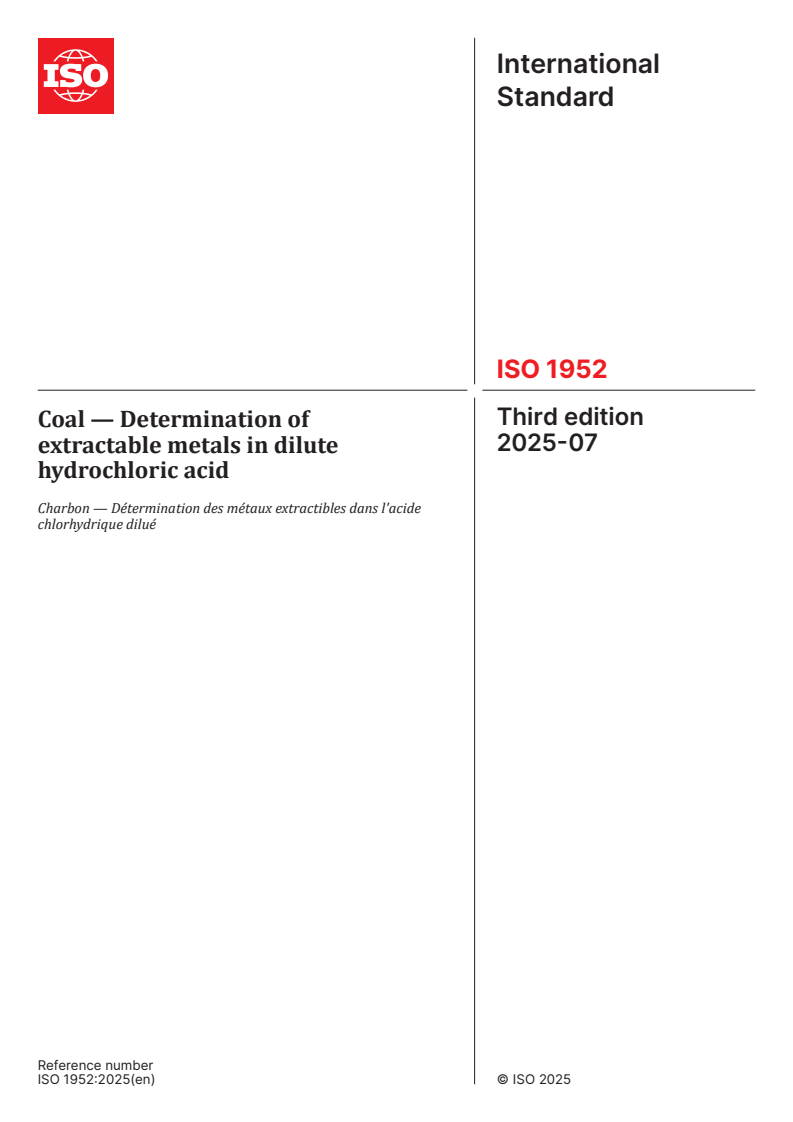
International
Standard
ISO 1952
Third edition
Coal — Determination of
2025-07
extractable metals in dilute
hydrochloric acid
Charbon — Détermination des métaux extractibles dans l'acide
chlorhydrique dilué
Reference number
© ISO 2025
All rights reserved. Unless otherwise specified, or required in the context of its implementation, no part of this publication may
be reproduced or utilized otherwise in any form or by any means, electronic or mechanical, including photocopying, or posting on
the internet or an intranet, without prior written permission. Permission can be requested from either ISO at the address below
or ISO’s member body in the country of the requester.
ISO copyright office
CP 401 • Ch. de Blandonnet 8
CH-1214 Vernier, Geneva
Phone: +41 22 749 01 11
Email: copyright@iso.org
Website: www.iso.org
Published in Switzerland
ii
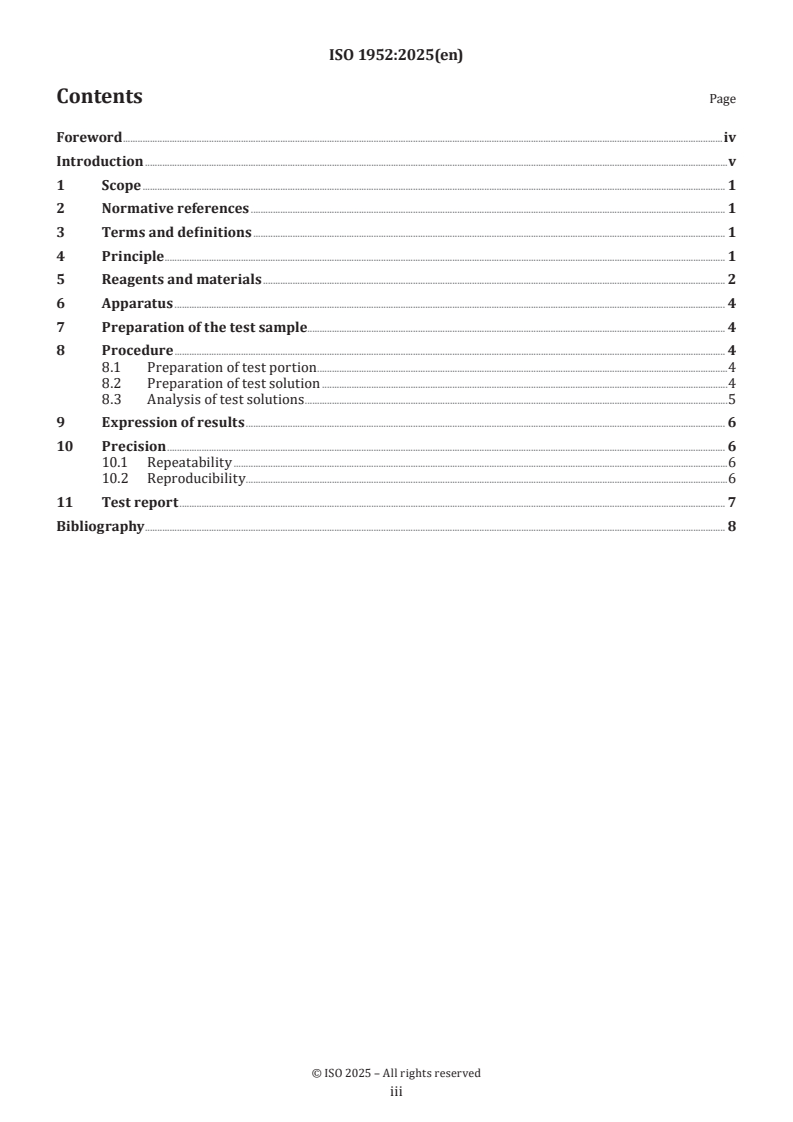
Contents Page
Foreword .iv
Introduction .v
1 Scope . 1
2 Normative references . 1
3 Terms and definitions . 1
4 Principle . 1
5 Reagents and materials . 2
6 Apparatus . 4
7 Preparation of the test sample. 4
8 Procedure . 4
8.1 Preparation of test portion .4
8.2 Preparation of test solution .4
8.3 Analysis of test solutions .5
9 Expression of results . 6
10 Precision . 6
10.1 Repeatability .6
10.2 Reproducibility .6
11 Test report . 7
Bibliography . 8
iii
Foreword
ISO (the International Organization for Standardization) is a worldwide federation of national standards
bodies (ISO member bodies). The work of preparing International Standards is normally carried out through
ISO technical committees. Each member body interested in a subject for which a technical committee
has been established has the right to be represented on that committee. International organizations,
governmental and non-governmental, in liaison with ISO, also take part in the work. ISO collaborates closely
with the International Electrotechnical Commission (IEC) on all matters of electrotechnical standardization.
The procedures used to develop this document and those intended for its further maintenance are described
in the ISO/IEC Directives, Part 1. In particular, the different approval criteria needed for the different types
of ISO document should be noted. This document was drafted in accordance with the editorial rules of the
ISO/IEC Directives, Part 2 (see www.iso.org/directives).
ISO draws attention to the possibility that the implementation of this document may involve the use of (a)
patent(s). ISO takes no position concerning the evidence, validity or applicability of any claimed patent
rights in respect thereof. As of the date of publication of this document, ISO had not received notice of (a)
patent(s) which may be required to implement this document. However, implementers are cautioned that
this may not represent the latest information, which may be obtained from the patent database available at
www.iso.org/patents. ISO shall not be held responsible for identifying any or all such patent rights.
Any trade name used in this document is information given for the convenience of users and does not
constitute an endorsement.
For an explanation of the voluntary nature of standards, the meaning of ISO specific terms and expressions
related to conformity assessment, as well as information about ISO's adherence to the World Trade
Organization (WTO) principles in the Technical Barriers to Trade (TBT), see www.iso.org/iso/foreword.html.
This document was prepared by Technical Committee ISO/TC 27, Coal and coke, Subcommittee SC 5, Methods
of analysis.
This third edition cancels and replaces the second edition (ISO 1952:2008), which has been technically
revised.
The main changes are as follows:
— the title and scope has been modified to specifically refer to coal;
— the normative references have been updated;
— the mandatory terms and definitions clause (Clause 3) has been added; subsequent clauses have been
renumbered;
— Formula (1) has been modified;
— the test report has been modified.
Any feedback or questions on this document should be directed to the user’s national standards body. A
complete listing of these bodies can be found at www.iso.org/members.html.
iv
Introduction
Sodium, potassium, calcium, iron and magnesium are commonly present in coal. They can contribute
significantly to coal-utilization problems, such as boiler-tube fouling and ash disposal; they also affect
product quality and gaseous emissions from combustion processes.
Research indicates that the amounts of alkaline and earth-alkaline metals extractable with dilute
hydrochloric acid are more closely related to the fouling/slagging properties of coal than are the total
amounts of the metals.
v
International Standard ISO 1952:2025(en)
Coal — Determination of extractable metals in dilute
hydrochloric acid
1 Scope
This document describes the extraction from coal by dilute hydrochloric acid and determination of
extractable sodium, potassium, calcium, iron and magnesium.
2 Normative references
The following documents are referred to in the text in such a way that some or all of their content constitutes
requirements of this document. For dated references, only the edition cited applies. For undated references,
the latest edition of the referenced document (including any amendments) applies.
ISO 1042, Laboratory glassware — One-mark volumetric flasks
ISO 3696, Water for analytical laboratory use — Specification and test methods
ISO 5068-2, Brown coals and lignites — Determination of moisture — Part 2: Indirect gravimetric method for
moisture in the analysis sample
ISO 11722, Solid mineral fuels — Hard coal — Determination of moisture in the general analysis test sample by
drying in nitrogen
ISO 13909-4, Coal and coke — Mechanical sampling — Part 4: Preparation of test samples of coal
ISO 18283, Coal and coke — Manual sampling
3 Terms and definitions
No terms and definitions are listed in this document.
ISO and IEC maintain terminology databases for use in standardization at the following addresses:
— ISO Online browsing platform: available at https:// www .iso .org/ obp
— IEC Electropedia: available at https:// www .electropedia .org/
4 Principle
A portion of the sample is extracted with hot, dilute hydrochloric acid after wetting of the coal with alcohol.
All forms of sodium, potassium, magnesium, calcium, iron that are exchangeable or extractable with the
hydrochloric acid are extracted from the coal. After removal of the residual solid mineral fuel by filtration,
the concentrations of the elements in the filtrate are determined by atomic absorption spectrometry.
The mass concentrations of the elements may also be determined by inductively coupled plasma optical
emission spectrometry (ICP-OES) if the instrument has been validated for the quantification in an
appropriate manner.
5 Reagents and materials
Use analytical reagent grade chemicals. Other grades can be used, provided it is documented that the reagent
is of sufficiently high purity to permit its use without adversely affecting the accuracy of the determination.
The subscript “20” represents 20 °C.
5.1 Water, high-purity deionized water in accordance with ISO 3696, or as defined by the equivalent
national standard.
5.2 Ethanol.
5.3 Hydrochloric acid, concentrated, ρ = 1,19 g/ml.
5.4 Hydrochloric acid solution, prepared by mixing 1 part concentrated hydrochloric acid (5.3) with
1 part water (5.1).
DANGER — The addition of the strong acid, HCl, to water liberates a significant amount of heat and
can cause a violent reaction.
5.5 Nitric acid (HNO ), concentrated, ρ = 1,42 g/ml.
3 20
5.6 Lanthanum oxide (La O ).
...