


ISO 23551-12:2023
(Main)Safety and control devices for gas burners and gas-burning appliances — Particular requirements — Part 12: Multifunctional controls with integral overpressure protection safety function (OPSF) for use with butane gas cartridges used in portable gas appliances
Safety and control devices for gas burners and gas-burning appliances — Particular requirements — Part 12: Multifunctional controls with integral overpressure protection safety function (OPSF) for use with butane gas cartridges used in portable gas appliances
This document specifies safety, construction, performance and testing requirements for multifunctional controls with integral overpressure protection safety function (OPSF) intended for use with portable gas appliances. This document is applicable to: — multifunctional controls which consist of a pressure-limiting device and at least one or more controls, including but not limited to a manual gas valve, a pressure regulator and a thermoelectric flame supervision device; and — multifunctional controls with declared maximum operating pressures in normal use, up to and including 500 kPa for use with a butane gas cartridge specified by ISO/TS 21985. This document does not apply to multifunctional controls with OPSF having thread connections for mounting butane gas cartridges. This document covers type testing only.
Dispositifs de commande et de sécurité pour brûleurs à gaz et appareils à gaz — Exigences particulières — Partie 12: Équipements multifonctionnels avec fonction de sécurité contre la surpression (OPSF) intégrée pour utilisation avec les cartouches à gaz butane utilisées dans les appareils à gaz portables
General Information
- Status
- Published
- Publication Date
- 05-Oct-2023
- Technical Committee
- ISO/TC 161 - Controls and protective devices for gas and/or oil
- Drafting Committee
- ISO/TC 161/WG 4 - Multifunctional Controls
- Current Stage
- 6060 - International Standard published
- Start Date
- 06-Oct-2023
- Due Date
- 22-Dec-2022
- Completion Date
- 06-Oct-2023
Relations
- Consolidated By
ISO 5124:2024 - Loading and unloading of liquefied natural gas (LNG) tank wagons and containers - Effective Date
- 06-Aug-2022
Overview
ISO 23551-12:2023 defines safety, construction, performance and testing requirements for multifunctional controls with integral overpressure protection safety function (OPSF) intended for use with butane gas cartridges in portable gas appliances. The standard applies to controls that combine a pressure-limiting device with one or more control functions (for example, a manual gas valve, pressure regulator and/or thermoelectric flame supervision device) and with declared maximum operating pressures in normal use up to 500 kPa for use with butane cartridges specified by ISO/TS 21985. Note: ISO 23551-12 covers type testing only and does not apply to multifunctional controls that have threaded connections for mounting butane cartridges.
Key Topics and Requirements
ISO 23551-12 sets out technical requirements and test methods to ensure safe, reliable operation of multifunctional gas controls. Major topics include:
- Construction and materials
- Enclosure, moving parts, seals, springs, housings, corrosion resistance and surface protection.
- Functional elements
- Pressure-limiting device (OPSF), manual gas valves, pressure regulators and thermoelectric flame supervision devices.
- Performance and safety testing
- Leak-tightness (volumetric and pressure-loss methods)
- Rated flow rate and flow performance
- Durability and endurance testing
- Mechanical tests: torsion, bending, vibration
- Environmental tests: cold resistance, heat resistance, thermal shock
- Corrosion resistance and post-corrosion OPSF operation
- Electrical and EMC requirements
- Provisions when electrical components are in the gas path and electromagnetic compatibility.
- Marking and documentation
- Required markings, installation and operating instructions, and warning notices.
- Type testing scope
- This part is explicit about type tests and test conditions/tolerances.
Practical Applications and Who Uses It
ISO 23551-12 is directly useful to:
- Manufacturers of portable gas appliances and multifunctional gas controls aiming to design and certify OPSF-equipped devices.
- Product designers and safety engineers defining materials, assemblies and performance targets.
- Testing laboratories and conformity assessment bodies performing type testing and issuing compliance reports.
- Regulators and specifiers setting procurement or regulatory safety requirements for portable butane-fuelled appliances.
- OEMs and importers seeking market access and demonstrating compliance with international safety practices.
Adopting ISO 23551-12 helps ensure safe operation, reduce overpressure risks, and support consistent type-testing for portable gas appliances using butane cartridges.
Related Standards
- ISO/TS 21985 - specification for butane gas cartridges referenced by this part.
- Other parts of the ISO 23551 series covering safety and control devices for gas burners and appliances (see ISO catalogue for related part numbers).

ISO 23551-12:2023 - Safety and control devices for gas burners and gas-burning appliances — Particular requirements — Part 12: Multifunctional controls with integral overpressure protection safety function (OPSF) for use with butane gas cartridges used in portable gas appliances Released:6. 10. 2023
Get Certified
Connect with accredited certification bodies for this standard

DNV
DNV is an independent assurance and risk management provider.

Lloyd's Register
Lloyd's Register is a global professional services organisation specialising in engineering and technology.
DNV Energy Systems
Energy and renewable energy certification.
Sponsored listings
Frequently Asked Questions
ISO 23551-12:2023 is a standard published by the International Organization for Standardization (ISO). Its full title is "Safety and control devices for gas burners and gas-burning appliances — Particular requirements — Part 12: Multifunctional controls with integral overpressure protection safety function (OPSF) for use with butane gas cartridges used in portable gas appliances". This standard covers: This document specifies safety, construction, performance and testing requirements for multifunctional controls with integral overpressure protection safety function (OPSF) intended for use with portable gas appliances. This document is applicable to: — multifunctional controls which consist of a pressure-limiting device and at least one or more controls, including but not limited to a manual gas valve, a pressure regulator and a thermoelectric flame supervision device; and — multifunctional controls with declared maximum operating pressures in normal use, up to and including 500 kPa for use with a butane gas cartridge specified by ISO/TS 21985. This document does not apply to multifunctional controls with OPSF having thread connections for mounting butane gas cartridges. This document covers type testing only.
This document specifies safety, construction, performance and testing requirements for multifunctional controls with integral overpressure protection safety function (OPSF) intended for use with portable gas appliances. This document is applicable to: — multifunctional controls which consist of a pressure-limiting device and at least one or more controls, including but not limited to a manual gas valve, a pressure regulator and a thermoelectric flame supervision device; and — multifunctional controls with declared maximum operating pressures in normal use, up to and including 500 kPa for use with a butane gas cartridge specified by ISO/TS 21985. This document does not apply to multifunctional controls with OPSF having thread connections for mounting butane gas cartridges. This document covers type testing only.
ISO 23551-12:2023 is classified under the following ICS (International Classification for Standards) categories: 27.060.20 - Gas fuel burners. The ICS classification helps identify the subject area and facilitates finding related standards.
ISO 23551-12:2023 has the following relationships with other standards: It is inter standard links to ISO 5124:2024. Understanding these relationships helps ensure you are using the most current and applicable version of the standard.
ISO 23551-12:2023 is available in PDF format for immediate download after purchase. The document can be added to your cart and obtained through the secure checkout process. Digital delivery ensures instant access to the complete standard document.
Standards Content (Sample)
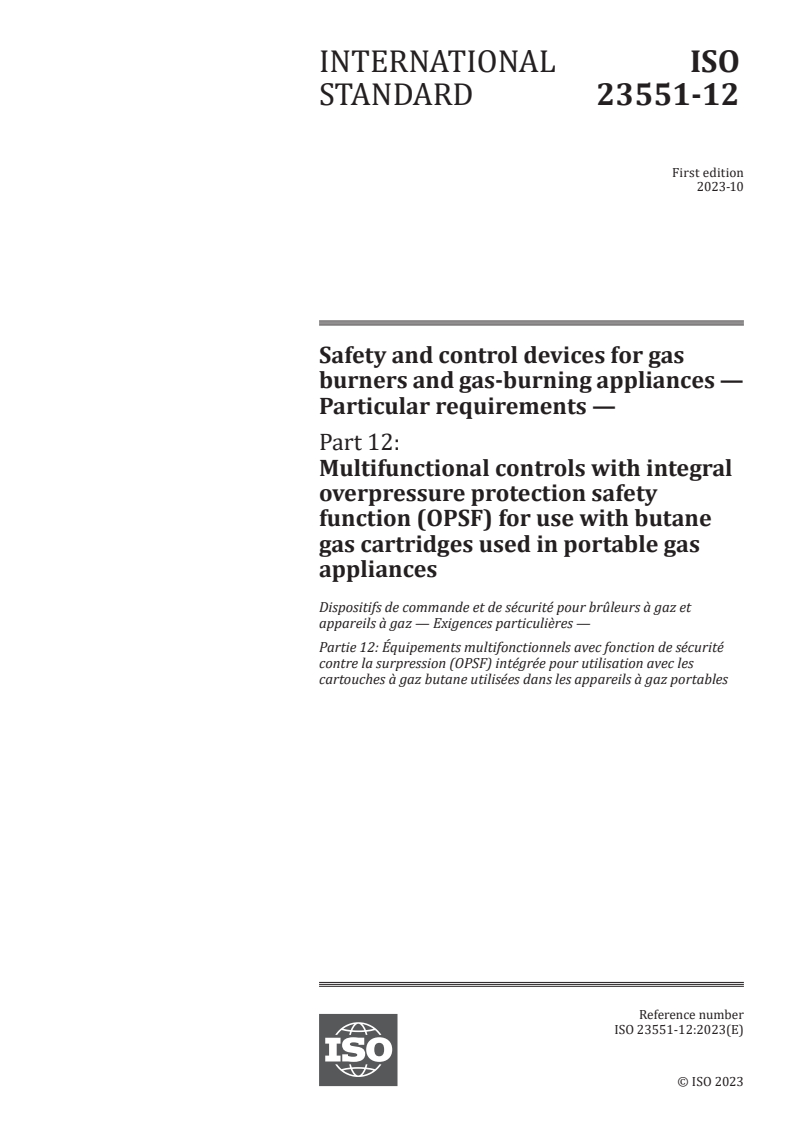
INTERNATIONAL ISO
STANDARD 23551-12
First edition
2023-10
Safety and control devices for gas
burners and gas-burning appliances —
Particular requirements —
Part 12:
Multifunctional controls with integral
overpressure protection safety
function (OPSF) for use with butane
gas cartridges used in portable gas
appliances
Dispositifs de commande et de sécurité pour brûleurs à gaz et
appareils à gaz — Exigences particulières —
Partie 12: Équipements multifonctionnels avec fonction de sécurité
contre la surpression (OPSF) intégrée pour utilisation avec les
cartouches à gaz butane utilisées dans les appareils à gaz portables
Reference number
© ISO 2023
All rights reserved. Unless otherwise specified, or required in the context of its implementation, no part of this publication may
be reproduced or utilized otherwise in any form or by any means, electronic or mechanical, including photocopying, or posting on
the internet or an intranet, without prior written permission. Permission can be requested from either ISO at the address below
or ISO’s member body in the country of the requester.
ISO copyright office
CP 401 • Ch. de Blandonnet 8
CH-1214 Vernier, Geneva
Phone: +41 22 749 01 11
Email: copyright@iso.org
Website: www.iso.org
Published in Switzerland
ii
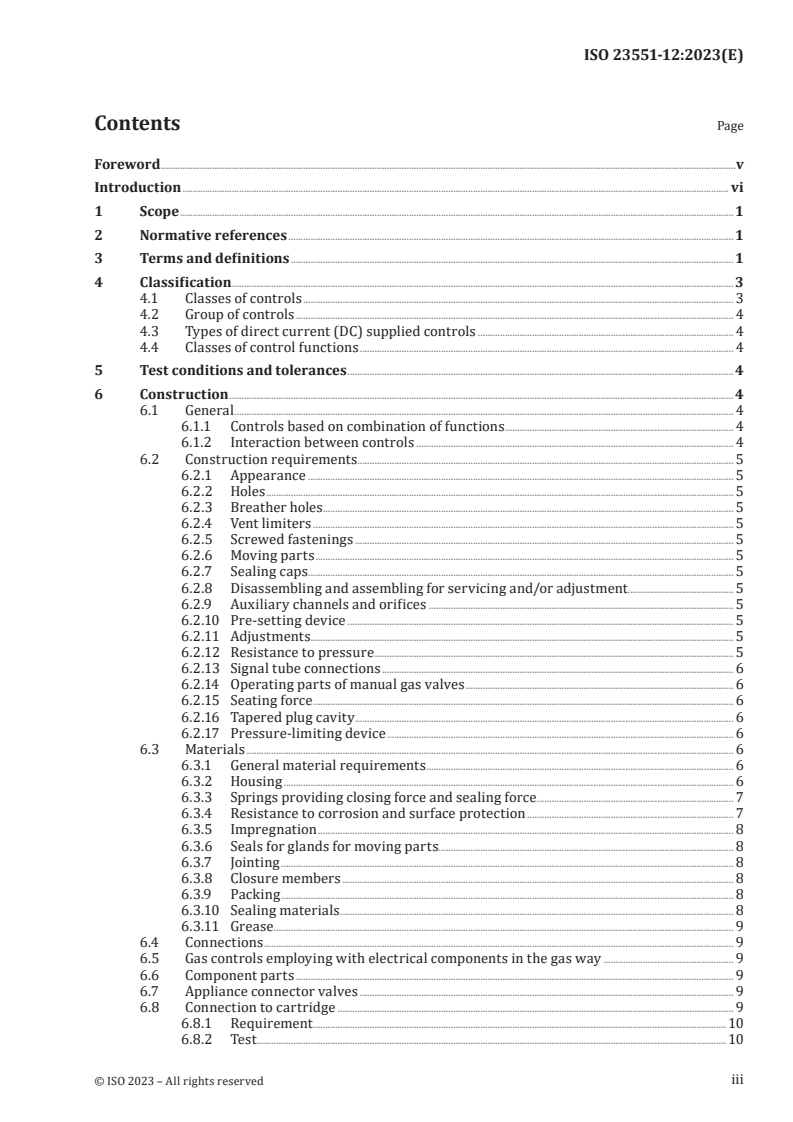
Contents Page
Foreword .v
Introduction . vi
1 Scope . 1
2 Normative references . 1
3 Terms and definitions . 1
4 Classification . 3
4.1 Classes of controls . 3
4.2 Group of controls . 4
4.3 Types of direct current (DC) supplied controls . 4
4.4 Classes of control functions . 4
5 Test conditions and tolerances .4
6 Construction . 4
6.1 General . 4
6.1.1 Controls based on combination of functions . 4
6.1.2 Interaction between controls . 4
6.2 Construction requirements. 5
6.2.1 Appearance . 5
6.2.2 Holes . 5
6.2.3 Breather holes . 5
6.2.4 Vent limiters . 5
6.2.5 Screwed fastenings . 5
6.2.6 Moving parts . 5
6.2.7 Sealing caps . 5
6.2.8 Disassembling and assembling for servicing and/or adjustment . 5
6.2.9 Auxiliary channels and orifices . 5
6.2.10 Pre-setting device . 5
6.2.11 Adjustments . . 5
6.2.12 Resistance to pressure . 5
6.2.13 Signal tube connections . 6
6.2.14 Operating parts of manual gas valves . 6
6.2.15 Seating force . 6
6.2.16 Tapered plug cavity . 6
6.2.17 Pressure-limiting device . 6
6.3 Materials . 6
6.3.1 General material requirements . 6
6.3.2 Housing . 6
6.3.3 Springs providing closing force and sealing force . 7
6.3.4 Resistance to corrosion and surface protection . 7
6.3.5 Impregnation . 8
6.3.6 Seals for glands for moving parts. 8
6.3.7 Jointing . 8
6.3.8 Closure members . 8
6.3.9 Packing . 8
6.3.10 Sealing materials . 8
6.3.11 Grease . 9
6.4 Connections . 9
6.5 Gas controls employing with electrical components in the gas way . 9
6.6 Component parts . 9
6.7 Appliance connector valves . 9
6.8 Connection to cartridge . 9
6.8.1 Requirement . 10
6.8.2 Test . . . 10
iii
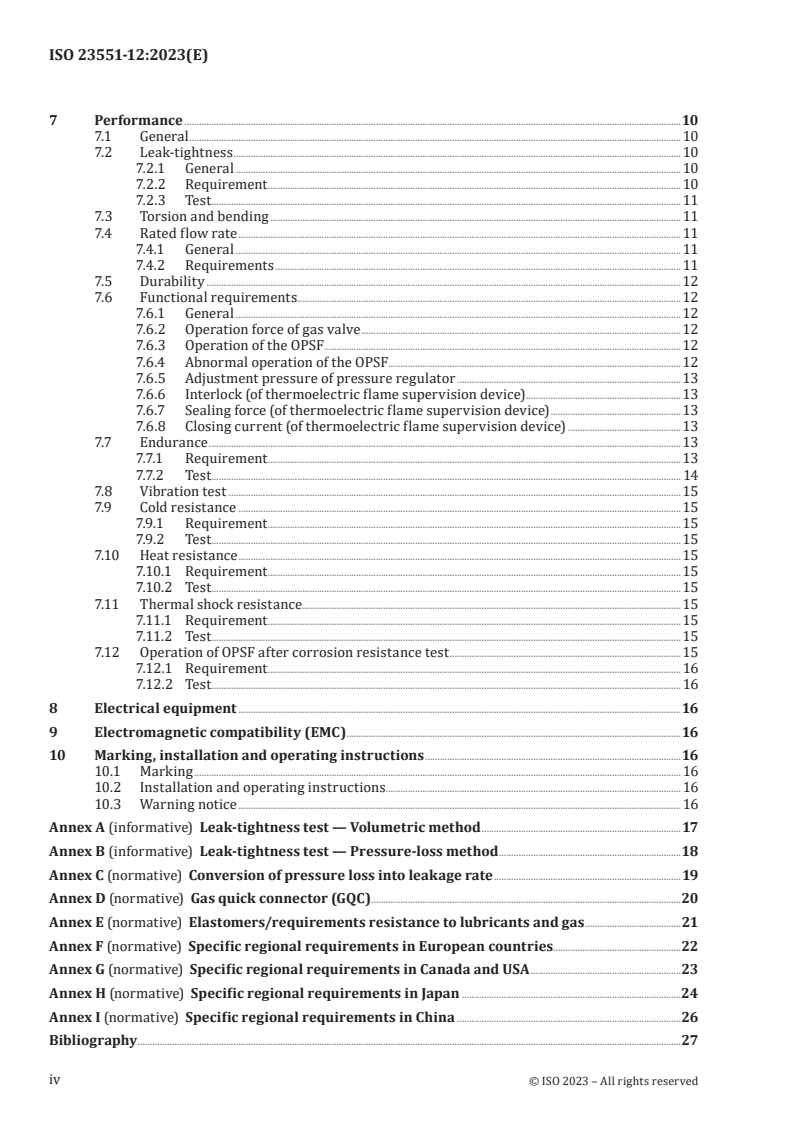
7 Performance .10
7.1 General . 10
7.2 Leak-tightness . 10
7.2.1 General . 10
7.2.2 Requirement . 10
7.2.3 Test . . . 11
7.3 Torsion and bending . 11
7.4 Rated flow rate . 11
7.4.1 General . 11
7.4.2 Requirements . 11
7.5 Durability . 12
7.6 Functional requirements . .12
7.6.1 General .12
7.6.2 Operation force of gas valve .12
7.6.3 Operation of the OPSF .12
7.6.4 Abnormal operation of the OPSF . .12
7.6.5 Adjustment pressure of pressure regulator .13
7.6.6 Interlock (of thermoelectric flame supervision device) .13
7.6.7 Sealing force (of thermoelectric flame supervision device) .13
7.6.8 Closing current (of thermoelectric flame supervision device) .13
7.7 Endurance . 13
7.7.1 Requirement .13
7.7.2 Test . . . 14
7.8 Vibration test . 15
7.9 Cold resistance .15
7.9.1 Requirement .15
7.9.2 Test . . . 15
7.10 Heat resistance . 15
7.10.1 Requirement .15
7.10.2 Test . . . 15
7.11 Thermal shock resistance . 15
7.11.1 Requirement .15
7.11.2 Test . . . 15
7.12 Operation of OPSF after corrosion resistance test . 15
7.12.1 Requirement . 16
7.12.2 Test . . . 16
8 Electrical equipment .16
9 Electromagnetic compatibility (EMC) .16
10 Marking, installation and operating instructions .16
10.1 Marking . 16
10.2 Installation and operating instructions . 16
10.3 Warning notice . 16
Annex A (informative) Leak-tightness test — Volumetric method .17
Annex B (informative) Leak-tightness test — Pressure-loss method .18
Annex C (normative) Conversion of pressure loss into leakage rate .19
Annex D (normative) Gas quick connector (GQC).20
Annex E (normative) Elastomers/requirements resistance to lubricants and gas .21
Annex F (normative) Specific regional requirements in European countries.22
Annex G (normative) Specific regional requirements in Canada and USA .23
Annex H (normative) Specific regional requirements in Japan .24
Annex I (normative) Specific regional requirements in China .26
Bibliography .27
iv
Foreword
ISO (the International Organization for Standardization) is a worldwide federation of national standards
bodies (ISO member bodies). The work of preparing International Standards is normally carried out
through ISO technical committees. Each member body interested in a subject for which a technical
committee has been established has the right to be represented on that committee. International
organizations, governmental and non-governmental, in liaison with ISO, also take part in the work.
ISO collaborates closely with the International Electrotechnical Commission (IEC) on all matters of
electrotechnical standardization.
The procedures used to develop this document and those intended for its further maintenance are
described in the ISO/IEC Directives, Part 1. In particular, the different approval criteria needed for the
different types of ISO document should be noted. This document was drafted in accordance with the
editorial rules of the ISO/IEC Directives, Part 2 (see www.iso.org/directives).
ISO draws attention to the possibility that the implementation of this document may involve the use
of (a) patent(s). ISO takes no position concerning the evidence, validity or applicability of any claimed
patent rights in respect thereof. As of the date of publication of this document, ISO had not received
notice of (a) patent(s) which may be required to implement this document. However, implementers are
cautioned that this may not represent the latest information, which may be obtained from the patent
database available at www.iso.org/patents. ISO shall not be held responsible for identifying any or all
such patent rights.
Any trade name used in this document is information given for the convenience of users and does not
constitute an endorsement.
For an explanation of the voluntary nature of standards, the meaning of ISO specific terms and
expressions related to conformity assessment, as well as information about ISO's adherence to
the World Trade Organization (WTO) principles in the Technical Barriers to Trade (TBT), see
www.iso.org/iso/foreword.html.
This document was prepared by Technical Committee ISO/TC 161, Controls and protective devices for
gaseous and liquid fuels.
A list of all parts in the ISO 23551 series can be found on the ISO website.
Any feedback or questions on this document should be directed to the user’s national standards body. A
complete listing of these bodies can be found at www.iso.org/members.html.
v
Introduction
This document is designed to be used in combination with ISO 23550. Together, they establish the full
requirements applicable to the product such as the multifunctional controls mounted on portable gas
appliances (cookers, space heaters, etc.) covered by this document.
Where needed, this document adapts ISO 23550 by stating the corresponding clause number and
adding:
— “with the following modification”;
— “with the following addition”;
— “is replaced by the following”; or
— “is not applicable”.
In order to identify specific requirements that are particular to this document and that are not already
covered by ISO 23550, this document contains certain clauses or subclauses that are additional to the
structure of ISO 23550. These subclauses are indicated by the introductory sentence: “Subclause (or
Annex) specific to this document.”.
To ensure the global relevance of this document, the differing requirements resulting from practical
experience and installation practices in various regions of the world have been taken into account.
The variations in basic infrastructure associated with gas controls and appliances have also been
recognized, some of which are addressed in Annexes F, G and H. This document intends to provide a
basic framework of requirements that recognize these differences.
vi
INTERNATIONAL STANDARD ISO 23551-12:2023(E)
Safety and control devices for gas burners and gas-burning
appliances — Particular requirements —
Part 12:
Multifunctional controls with integral overpressure
protection safety function (OPSF) for use with butane gas
cartridges used in portable gas appliances
1 Scope
This document specifies safety, construction, performance and testing requirements for multifunctional
controls with integral overpressure protection safety function (OPSF) intended for use with portable
gas appliances.
This document is applicable to:
— multifunctional controls which consist of a pressure-limiting device and at least one or more
controls, including but not limited to a manual gas valve, a pressure regulator and a thermoelectric
flame supervision device; and
— multifunctional controls with declared maximum operating pressures in normal use, up to and
including 500 kPa for use with a butane gas cartridge specified by ISO/TS 21985.
This document does not apply to multifunctional controls with OPSF having thread connections for
mounting butane gas cartridges.
This document covers type testing only.
2 Normative references
The following documents are referred to in the text in such a way that some or all of their content
constitutes requirements of this document. For dated references, only the edition cited applies. For
undated references, the latest edition of the referenced document (including any amendments) applies.
ISO 301, Zinc alloy ingots intended for castings
ISO 9227:2022, Corrosion tests in artificial atmospheres — Salt spray tests
ISO 23550:2018, Safety and control devices for gas and/or oil burners and appliances — General
requirements
ISO 23551-5:2023, Safety and control devices for gas burners and gas-burning appliances — Particular
requirements — Part 5: Manual gas valves
ISO 23551-6:2021, Safety and control devices for gas burners and gas-burning appliances — Particular
requirements — Part 6: Thermoelectric flame supervision controls
3 Terms and definitions
For the purposes of this document, the terms and definitions given in ISO 23550 and the following apply.
ISO and IEC maintain terminology databases for use in standardization at the following addresses:
— ISO Online browsing platform: available at https:// www .iso .org/ obp
— IEC Electropedia: available at https:// www .electropedia .org/
3.1
portable gas appliance
portable appliance using vaporized butane from a replaceable, non-refillable, horizontally-mounted,
butane gas cartridge specified by ISO/TS 21985 as the primary fuel source
3.2
pressure regulator
device that maintains the outlet pressure constant within given limits, independently of the variations
in inlet pressure and/or flow rate
[SOURCE: ISO 23551-2:2018, 3.1.1]
3.3
pressure limiting device
device having overpressure safety function (OPSF) as a function
3.4
overpressure safety function
OPSF
safety function for portable gas appliances which shuts off gas supply to the burner when the supply
pressure from the butane gas cartridge reaches the declared pressure range of the OPSF either by
shutting off the gas passage or by releasing the cartridge
Note 1 to entry: Examples are shown in Figure 1 and Figure 2.
a) Side view b) Top view
Key
1 butane gas cartridge 3 pressure regulator
2 pressure limiting device 4 manual gas valve
a
Gas passage which is shut off by the shut-off valve mounted on the pressure limiting device when the pressure
of the cartridge increases.
Figure 1 — Multifunctional control with gas passage shut-off function
a) Before OPSF operation b) After OPSF operation
Key
1 butane gas cartridge 4 pressure regulator
2 magnet 5 manual gas valve
3 pressure limiting device 6 component for cartridge disengagement
NOTE When the pressure of cartridge increases to the operation pressure of OPSF, OPSF operates and
disengages the butane gas cartridge from multifunctional control by a force stronger than the force joining the
magnet and the cartridge shuts off the gas supply.
Figure 2 — Multifunctional control with cartridge-release function (top view)
3.5
gas passage shut-off function
function which shuts off the gas flow of the gas passage in controls
Note 1 to entry: An example is shown in Figure 1.
3.6
cartridge-release function
function which detaches the cartridge from the control by mechanical means
Note 1 to entry: An example is shown in Figure 2.
3.7
applicable butane gas cartridge
cartridge specified by manufacturer and ISO/TS 21985 intended for use with multifunctional controls
using gas with no less than 95 % of butane
Note 1 to entry: The cartridge is classified as UN 2037 as specified in the scope of ISO/TS 21985.
4 Classification
4.1 Classes of controls
Shall be according to ISO 23550:2018, 4.1.
4.2 Group of controls
ISO 23550:2018, 4.2 is not applicable.
4.3 Types of direct current (DC) supplied controls
ISO 23550:2018, 4.3 is not applicable.
4.4 Classes of control functions
ISO 23550:2018, 4.4 is not applicable.
5 Test conditions and tolerances
Shall be according to ISO 23550:2018, Clause 5.
6 Construction
6.1 General
ISO 23550:2018, 6.1 is applicable with the following additions:
This document covers requirements for the safety related interactions between the different functions
of the controls (see 6.1.2).
Where there are no requirements for these interactions between two or more functions, a risk
assessment shall be performed.
6.1.1 Controls based on combination of functions
6.1.1.1 General
Controls consist of OPSF and a combination of the functions provided by the controls as given by the
following list:
— Pressure regulators according to ISO 23551-2;
— Manual gas valves according to ISO 23551-5;
— Thermoelectric flame supervision devices according to ISO 23551-6.
6.1.2 Interaction between controls
6.1.2.1 Closing mechanism for closure member
Each valve shall consist of a separate, independent closing mechanism controlling only one closure
member. Verification of internal leak-tightness shall be possib
...
Questions, Comments and Discussion
Ask us and Technical Secretary will try to provide an answer. You can facilitate discussion about the standard in here.
Loading comments...