

ISO 2030:2018
(Main)Granulated cork — Size analysis by mechanical sieving
General Information
- Abstract
This document specifies a method to obtain granule size distribution of granulated cork by mechanical sieving.
- Status
- Published
- Publication Date
- 16-Oct-2018
- Technical Committee
- ISO/TC 87 - Cork
- Drafting Committee
- ISO/TC 87 - Cork
- Current Stage
- 9093 - International Standard confirmed
- Start Date
- 24-Sep-2025
- Completion Date
- 29-Aug-2026
Buy Documents


ISO 2030:2018 - Granulated cork -- Size analysis by mechanical sieving
ISO 2030:2018 - Granulated cork — Size analysis by mechanical sieving/17/2018
Overview
ISO 2030:2018, "Granulated cork - Size analysis by mechanical sieving," specifies a standardized method to obtain the granule size distribution of granulated cork using mechanical sieving. This third edition (2018) updates the procedure for preparing, sieving and reporting results so manufacturers, testing laboratories and quality-control teams can produce consistent, comparable particle-size data for granulated cork products.
Key Topics and Requirements
- Scope: Method for determining granule size distribution of granulated cork by mechanical sieving.
- Apparatus: A screening column with:
- cover and base that fit the sieves,
- a sequence of sieves whose mesh apertures conform to the ISO/R 40/3 series (see ISO 565),
- a vibrator capable, as specified, of producing 300 vertical vibrations with an amplitude of 5 mm/min and rotating speed of 1 r/min,
- a balance with accuracy of 0.1 g.
- Sampling: Sampling must be carried out in accordance with ISO 2067.
- Test portion: Three test portions taken at random:
- ~50 g each for granulated cork with bulk density ≤ 60 kg/m³,
- ~100 g each for bulk density > 60 kg/m³.
- Procedure: Place a test portion in the upper sieve of the screening column, vibrate for 9–11 minutes, then weigh the material retained on each sieve and the powder at the base.
- Expression of results: Report mass retained on each sieve and powder at the base as percentages of the test portion (arithmetic mean of three tests, rounded to the nearest integer).
- Test report: Must include sample identification, results, reference to ISO 2030:2018, any optional operational details, and any occurrences affecting results.
Applications and Who Uses It
- Quality control and product specification in the cork processing and composites industries.
- Laboratories performing particle size distribution analysis for granulated cork used in gaskets, insulation, sealing, construction materials and molded cork products.
- Manufacturers specifying granule fractions for downstream processing, packing, or blending.
- Procurement and compliance teams requiring consistent, reproducible test methods for supplier verification.
Related Standards
- ISO 2067 - Granulated cork: Sampling (normative reference)
- ISO 565 - Test sieves: Nominal sizes of openings (for sieve selection)
- ISO 1997 - Granulated cork and cork powder: Classification, properties and packing (bibliography)
Keywords: ISO 2030:2018, granulated cork, size analysis, mechanical sieving, granule size distribution, screening column, test sieves, ISO 2067, particle size distribution, quality control.
Relations
- Effective Date
- 03-Jun-2017
Buy Documents
ISO 2030:2018 - Granulated cork -- Size analysis by mechanical sieving
ISO 2030:2018 - Granulated cork — Size analysis by mechanical sieving/17/2018
Get Certified
Connect with accredited certification bodies for this standard

Gozdarski inštitut Slovenije
Slovenian Forestry Institute. Forest management certification support, timber testing.
Sponsored listings
Frequently Asked Questions
ISO 2030:2018 is a standard published by the International Organization for Standardization (ISO). Its full title is "Granulated cork — Size analysis by mechanical sieving". This standard covers: This document specifies a method to obtain granule size distribution of granulated cork by mechanical sieving.
This document specifies a method to obtain granule size distribution of granulated cork by mechanical sieving.
ISO 2030:2018 is classified under the following ICS (International Classification for Standards) categories: 79.100 - Cork and cork products. The ICS classification helps identify the subject area and facilitates finding related standards.
ISO 2030:2018 has the following relationships with other standards: It is inter standard links to ISO 2030:1990. Understanding these relationships helps ensure you are using the most current and applicable version of the standard.
ISO 2030:2018 is available in PDF format for immediate download after purchase. The document can be added to your cart and obtained through the secure checkout process. Digital delivery ensures instant access to the complete standard document.
Standards Content (Sample)
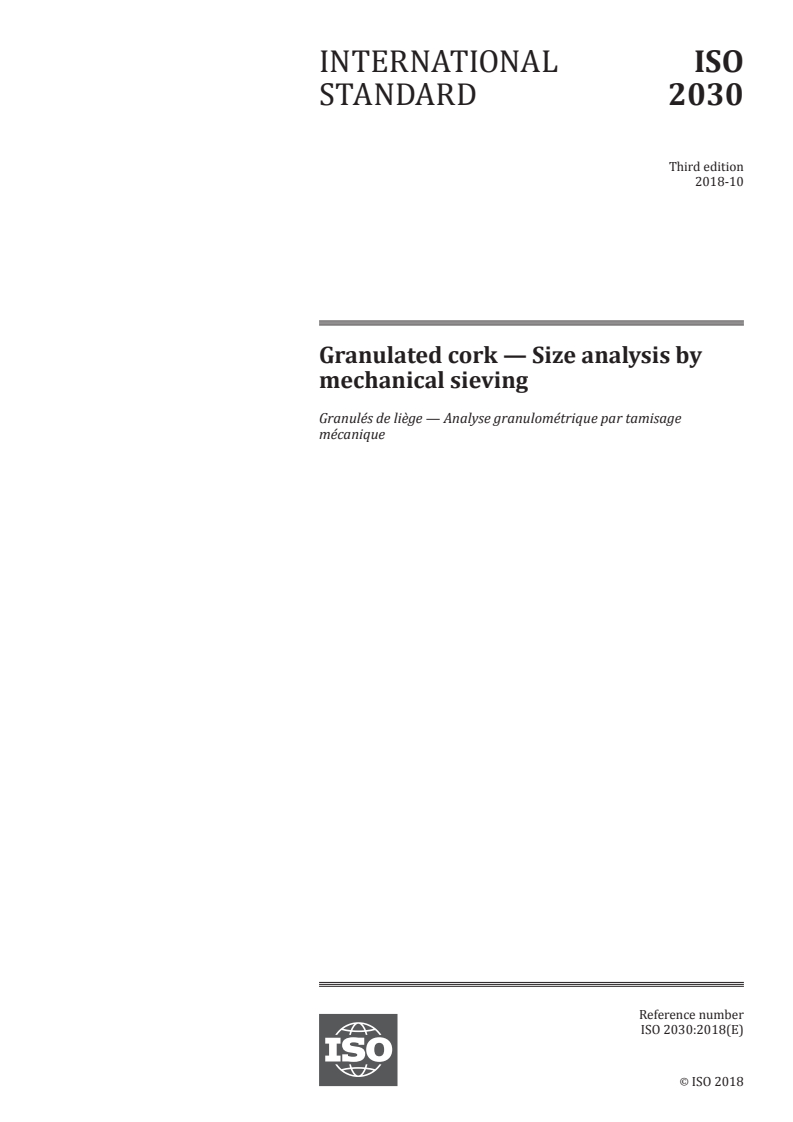
INTERNATIONAL ISO
STANDARD 2030
Third edition
2018-10
Granulated cork — Size analysis by
mechanical sieving
Granulés de liège — Analyse granulométrique par tamisage
mécanique
Reference number
©
ISO 2018
© ISO 2018
All rights reserved. Unless otherwise specified, or required in the context of its implementation, no part of this publication may
be reproduced or utilized otherwise in any form or by any means, electronic or mechanical, including photocopying, or posting
on the internet or an intranet, without prior written permission. Permission can be requested from either ISO at the address
below or ISO’s member body in the country of the requester.
ISO copyright office
CP 401 • Ch. de Blandonnet 8
CH-1214 Vernier, Geneva
Phone: +41 22 749 01 11
Fax: +41 22 749 09 47
Email: copyright@iso.org
Website: www.iso.org
Published in Switzerland
ii © ISO 2018 – All rights reserved
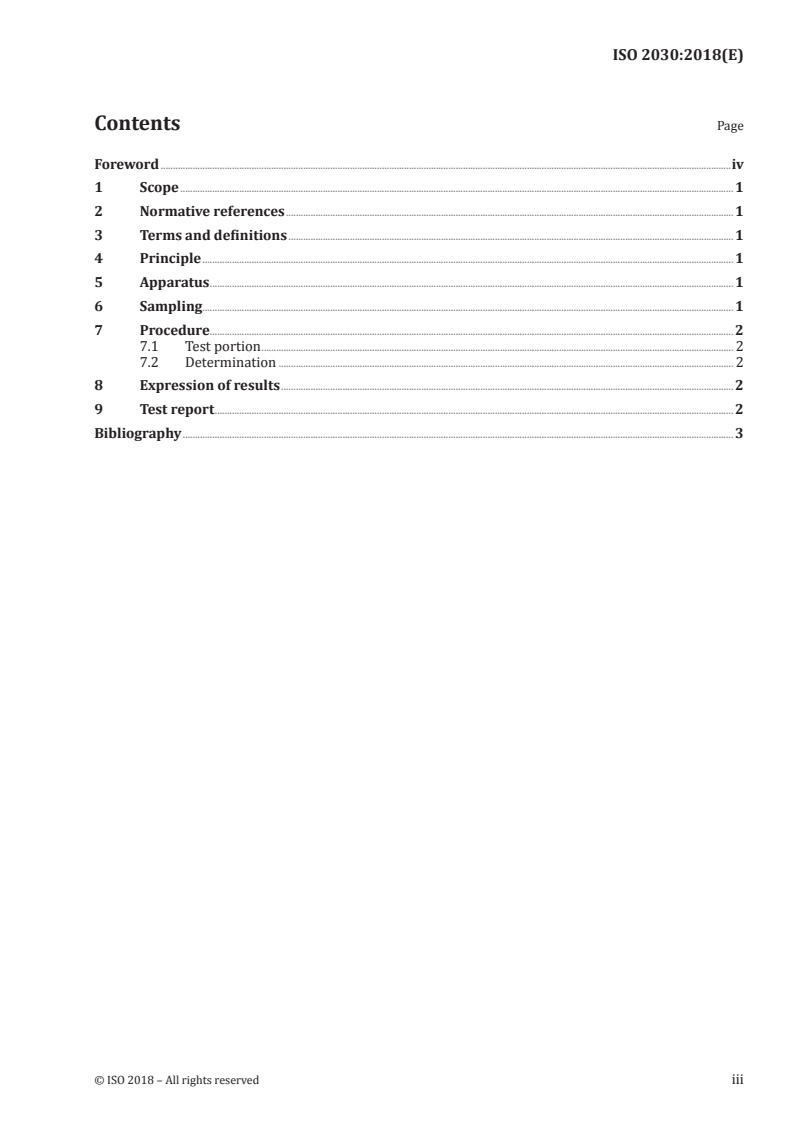
Contents Page
Foreword .iv
1 Scope . 1
2 Normative references . 1
3 Terms and definitions . 1
4 Principle . 1
5 Apparatus . 1
6 Sampling . 1
7 Procedure. 2
7.1 Test portion . 2
7.2 Determination . 2
8 Expression of results . 2
9 Test report . 2
Bibliography . 3
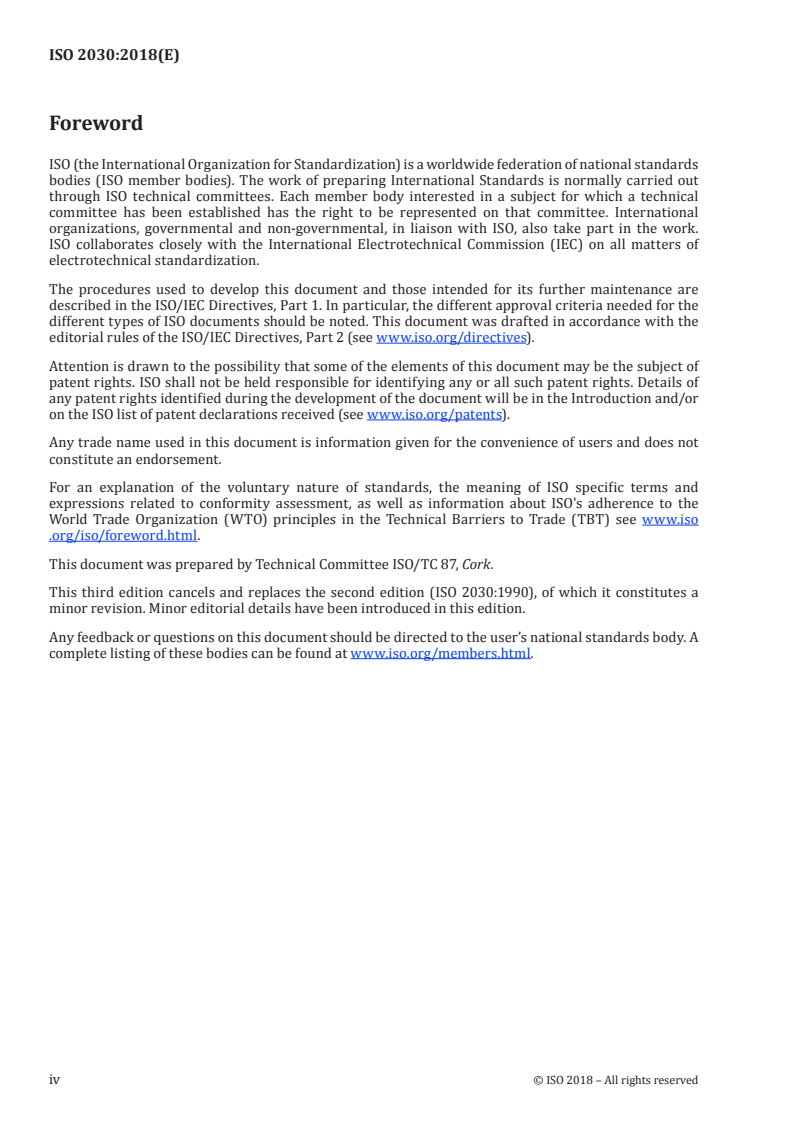
Foreword
ISO (the International Organization for Standardization) is a worldwide federation of national standards
bodies (ISO member bodies). The work of preparing International Standards is normally carried out
through ISO technical committees. Each member body interested in a subject for which a technical
committee has been established has the right to be represented on that committee. International
organizations, governmental and non-governmental, in liaison with ISO, also take part in the work.
ISO collaborates closely with the International Electrotechnical Commission (IEC) on all matters of
electrotechnical standardization.
The procedures used to develop this document and those intended for its further maintenance are
described in the ISO/IEC Directives, Part 1. In particular, the different approval criteria needed for the
different types of ISO documents should be noted. This document was drafted in accordance with the
editorial rules of the ISO/IEC Directives, Part 2 (see www .iso .org/directives).
Attention is drawn to the possibility that some of the elements of this document may be the subject of
patent rights. ISO shall not be held responsible for identifying any o
...
INTERNATIONAL ISO
STANDARD 2030
Third edition
2018-10
Granulated cork — Size analysis by
mechanical sieving
Granulés de liège — Analyse granulométrique par tamisage
mécanique
Reference number
©
ISO 2018
© ISO 2018
All rights reserved. Unless otherwise specified, or required in the context of its implementation, no part of this publication may
be reproduced or utilized otherwise in any form or by any means, electronic or mechanical, including photocopying, or posting
on the internet or an intranet, without prior written permission. Permission can be requested from either ISO at the address
below or ISO’s member body in the country of the requester.
ISO copyright office
CP 401 • Ch. de Blandonnet 8
CH-1214 Vernier, Geneva
Phone: +41 22 749 01 11
Fax: +41 22 749 09 47
Email: copyright@iso.org
Website: www.iso.org
Published in Switzerland
ii © ISO 2018 – All rights reserved
Contents Page
Foreword .iv
1 Scope . 1
2 Normative references . 1
3 Terms and definitions . 1
4 Principle . 1
5 Apparatus . 1
6 Sampling . 1
7 Procedure. 2
7.1 Test portion . 2
7.2 Determination . 2
8 Expression of results . 2
9 Test report . 2
Bibliography . 3
Foreword
ISO (the International Organization for Standardization) is a worldwide federation of national standards
bodies (ISO member bodies). The work of preparing International Standards is normally carried out
through ISO technical committees. Each member body interested in a subject for which a technical
committee has been established has the right to be represented on that committee. International
organizations, governmental and non-governmental, in liaison with ISO, also take part in the work.
ISO collaborates closely with the International Electrotechnical Commission (IEC) on all matters of
electrotechnical standardization.
The procedures used to develop this document and those intended for its further maintenance are
described in the ISO/IEC Directives, Part 1. In particular, the different approval criteria needed for the
different types of ISO documents should be noted. This document was drafted in accordance with the
editorial rules of the ISO/IEC Directives, Part 2 (see www .iso .org/directives).
Attention is drawn to the possibility that some of the elements of this document may be the subject of
patent rights. ISO shall not be held responsible for identifying any o
...