


ISO 6317:2000
(Main)Hot-rolled carbon steel strip of commercial and drawing qualities
Hot-rolled carbon steel strip of commercial and drawing qualities
Feuillards en acier au carbone laminés à chaud de qualités commerciale et pour emboutissage
General Information
- Status
- Withdrawn
- Publication Date
- 05-Jul-2000
- Withdrawal Date
- 05-Jul-2000
- Technical Committee
- ISO/TC 17/SC 12 - Continuous mill flat rolled products
- Drafting Committee
- ISO/TC 17/SC 12 - Continuous mill flat rolled products
- Current Stage
- 9599 - Withdrawal of International Standard
- Start Date
- 19-May-2008
- Completion Date
- 12-Feb-2026
Relations
- Effective Date
- 15-Apr-2008
- Effective Date
- 15-Apr-2008
ISO 6317:2000 - Hot-rolled carbon steel strip of commercial and drawing qualities
ISO 6317:2000 - Feuillards en acier au carbone laminés a chaud de qualités commerciale et pour emboutissage
Get Certified
Connect with accredited certification bodies for this standard

Element Materials Technology
Materials testing and product certification.

Inštitut za kovinske materiale in tehnologije
Institute of Metals and Technology. Materials testing, metallurgical analysis, NDT.
Sponsored listings
Frequently Asked Questions
ISO 6317:2000 is a standard published by the International Organization for Standardization (ISO). Its full title is "Hot-rolled carbon steel strip of commercial and drawing qualities". This standard covers: Hot-rolled carbon steel strip of commercial and drawing qualities
Hot-rolled carbon steel strip of commercial and drawing qualities
ISO 6317:2000 is classified under the following ICS (International Classification for Standards) categories: 77.140.50 - Flat steel products and semi-products. The ICS classification helps identify the subject area and facilitates finding related standards.
ISO 6317:2000 has the following relationships with other standards: It is inter standard links to ISO 6317:2008, ISO 6317:1982. Understanding these relationships helps ensure you are using the most current and applicable version of the standard.
ISO 6317:2000 is available in PDF format for immediate download after purchase. The document can be added to your cart and obtained through the secure checkout process. Digital delivery ensures instant access to the complete standard document.
Standards Content (Sample)
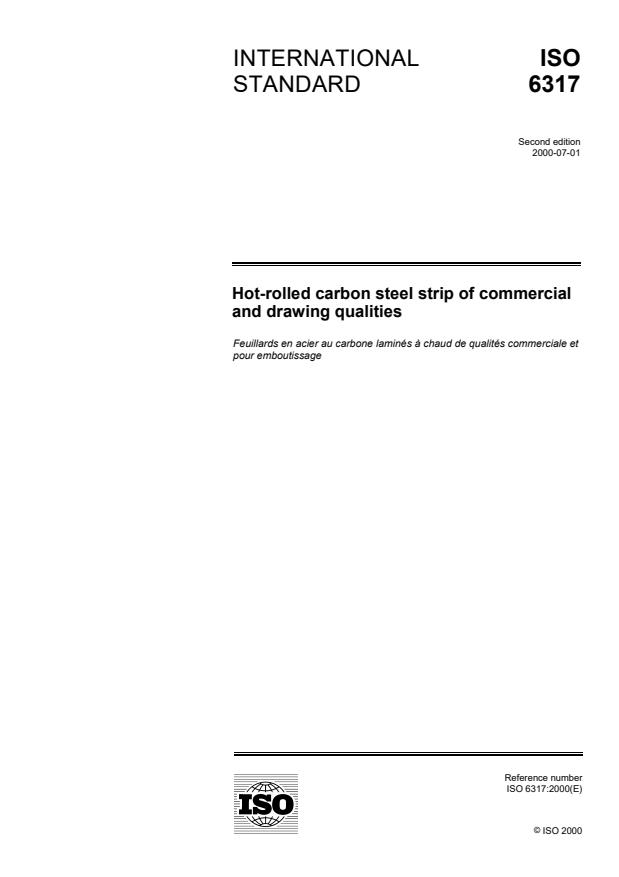
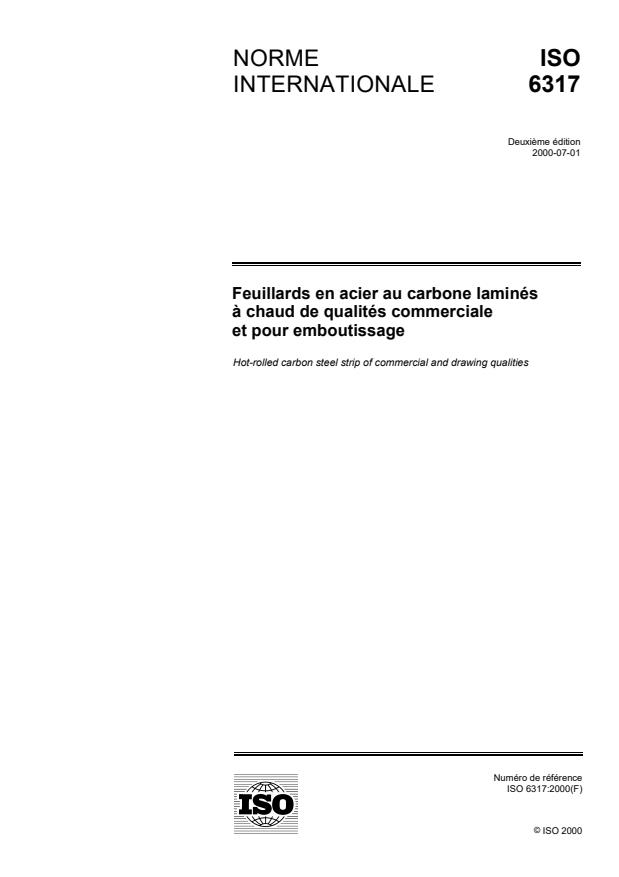
INTERNATIONAL ISO
STANDARD 6317
Second edition
2000-07-01
Hot-rolled carbon steel strip of commercial
and drawing qualities
Feuillards en acier au carbone laminés à chaud de qualités commerciale et
pour emboutissage
Reference number
©
ISO 2000
PDF disclaimer
This PDF file may contain embedded typefaces. In accordance with Adobe's licensing policy, this file may be printed or viewed but shall not
be edited unless the typefaces which are embedded are licensed to and installed on the computer performing the editing. In downloading this
file, parties accept therein the responsibility of not infringing Adobe's licensing policy. The ISO Central Secretariat accepts no liability in this
area.
Adobe is a trademark of Adobe Systems Incorporated.
Details of the software products used to create this PDF file can be found in the General Info relative to the file; the PDF-creation parameters
were optimized for printing. Every care has been taken to ensure that the file is suitable for use by ISO member bodies. In the unlikely event
that a problem relating to it is found, please inform the Central Secretariat at the address given below.
All rights reserved. Unless otherwise specified, no part of this publication may be reproduced or utilized in any form or by any means, electronic
or mechanical, including photocopying and microfilm, without permission in writing from either ISO at the address below or ISO's member body
in the country of the requester.
ISO copyright office
Case postale 56 � CH-1211 Geneva 20
Tel. + 41 22 749 01 11
Fax + 41 22 749 09 47
E-mail copyright@iso.ch
Web www.iso.ch
Printed in Switzerland
ii © ISO 2000 – All rights reserved
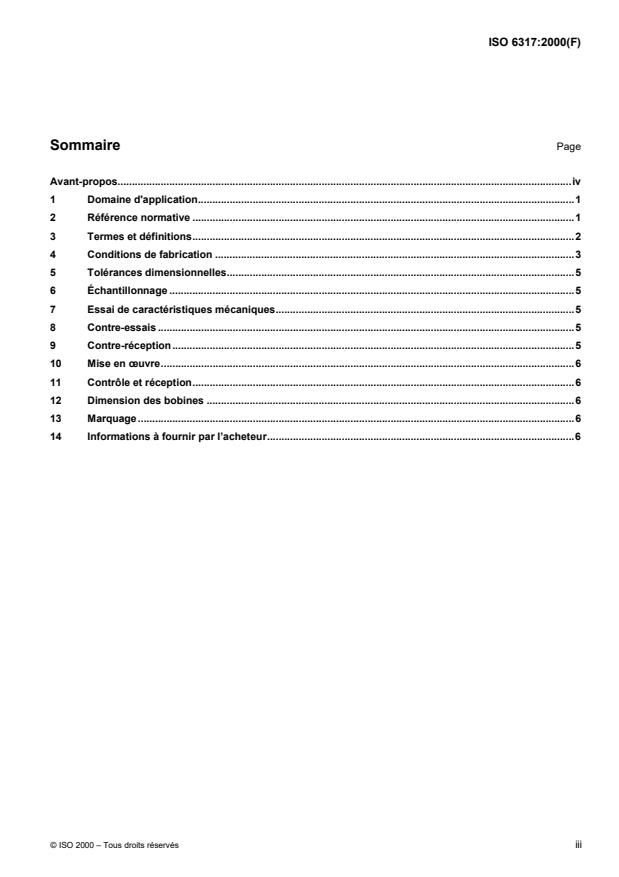
Contents Page
Foreword.iv
1 Scope .1
2 Normative reference .1
3 Terms and definitions .1
4 Conditions of manufacture .2
5 Dimensional tolerances .4
6 Sampling.5
7 Mechanical-property tests .5
8 Retests .5
9 Resubmission .5
10 Workmanship .5
11 Inspection and acceptance.6
12 Coil size .6
13 Marking .6
14 Information to be supplied by the purchaser .7
Foreword
ISO (the International Organization for Standardization) is a worldwide federation of national standards bodies (ISO
member bodies). The work of preparing International Standards is normally carried out through ISO technical
committees. Each member body interested in a subject for which a technical committee has been established has
the right to be represented on that committee. International organizations, governmental and non-governmental, in
liaison with ISO, also take part in the work. ISO collaborates closely with the International Electrotechnical
Commission (IEC) on all matters of electrotechnical standardization.
International Standards are drafted in accordance with the rules given in the ISO/IEC Directives, Part 3.
Draft International Standards adopted by the technical committees are circulated to the member bodies for voting.
Publication as an International Standard requires approval by at least 75 % of the member bodies casting a vote.
Attention is drawn to the possibility that some of the elements of this International Standard may be the subject of
patent rights. ISO shall not be held responsible for identifying any or all such patent rights.
International Standard ISO 6317 was prepared by Technical Committee ISO/TC 17, Steel, Subcommittee SC 12,
Continuous mill flat rolled products.
This second edition cancels and replaces the first edition (ISO 6317:1982), which has been technically revised.
iv © ISO 2000 – All rights reserved
INTERNATIONAL STANDARD ISO 6317:2000(E)
Hot-rolled carbon steel strip of commercial and drawing qualities
1 Scope
1.1 This International Standard applies to hot-rolled carbon steel strip of commercial and drawing qualities.
NOTE Steel strip that is to be subjected to subsequent rerolling is not covered by this International Standard.
Hot-rolled steel strip is suitable for many applications where the presence of oxide or scale, or normal surface
imperfections disclosed after removal of oxide or scale, are not objectionable. It is not suitable for applications
where surface is of prime importance. It is rolled on a narrow strip mill.
1.2 Commercial-quality strip (HR1) is intended for general fabrication purposes where strip is used in the flat, or
for bending, moderate forming and welding operations. It is commonly produced in the range of thicknesses
0,65 mm to 12 mm inclusive, and widths up to 600 mm exclusive, in coils and cut lengths.
1.3 Drawing-quality strip (HR2, HR3, HR4) is intended for drawing or severe forming, including welding. It is
commonly produced in the range of thicknesses 0,65 mm to 12 mm inclusive, and widths up to 600 mm exclusive,
in coils and cut lengths. Drawing-quality strip is furnished to all the requirements of this International Standard or,
by agreement when ordered, to fabricate an identified part, in which case the mechanical properties in Table 2 do
not apply. Specific drawing qualities are identified as follows:
HR2 Drawing quality
HR3 Deep-drawing quality
HR4 Deep-drawing quality, aluminium-killed
2 Normative reference
The following normative document contains provisions which, through reference in this text, constitute provisions of
this International Standard. For dated references, subsequent amendments to, or revisions of, this publication do
not apply. However, parties to agreements based on this International Standard are encouraged to investigate the
possibility of applying the most recent edition of the normative document indicated below. For undated references,
the latest edition of the normative document referred to applies. Members of ISO and IEC maintain registers of
currently valid International Standards.
ISO 6892, Metallic materials — Tensile testing at ambient temperature.
3 Terms and definitions
For the purposes of this International Standard, the following terms and definitions apply.
3.1
aluminium-killed steel
steel which has been deoxidized with aluminium sufficient to prevent the evolution of gas during solidification
3.2
hot-rolled steel strip
a product obtained usually by rolling heated steel (billet or slab) through a continuous-type mill to the required strip
thickness and tolerances
NOTE The product has a surface covered with oxide or scale resulting from the hot-rolling operation.
3.3
hot-rolled descaled steel strip
hot-rolled steel strip from the surface of which oxide or scale has been removed, commonly by pickling in an acid
solution
NOTE Descaling may also be performed by mechanical means such as grit blasting. Some increase in hardness and some
loss of ductility may result from descaling.
3.4
skin pass
a light cold rolling of the product
NOTE 1 The purpose of skin passing is one or more of the following:
a) to minimize the appearance of coil breaks, stretcher strains and fluting;
b) to control the shape;
c) to obtain the required surface finish.
NOTE 2 Some increase in hardness and some loss in ductility will result from skin passing.
3.5
mill edge
a normal side edge produced without any definite contour in hot rolling
NOTE 1 Mill edges may contain some irregularities such as cracked or torn edges or thin (feathered) edges.
NOTE 2 A square mill edge can be produced by hot-edge rolling (with the corners not as square as a square-edge bar).
3.6
sheared edge
a normal edge obtained by shearing, slitting or trimming a mill-edge product
NOTE Normal processing does not necessarily provide a definite positioning of the slitting burr.
4 Conditions of manufacture
4.1 Steelmaking
The processes used in making the steel and in manufacturing hot-rolled strip are left to the discretion of the
manufacturer. On request, the purchaser shall be informed of the steelmaking process being used.
2 © ISO 2000 – All rights reserved
4.2 Chemical composition
The chemical composition (heat analysis) shall be as agreed upon between the interested parties at the time of
ordering. The ranges or limits shall be in accordance with the requirements of Table 1 for the designation specified.
Table 1 — Chemical composition (heat analysis)
Quality C Mn P S
Designation Name %max. %max. %max. %max.
HR1 Commercial 0,12 0,60 0,045 0,045
HR2 Drawing 0,10 0,45 0,035 0,035
HR3 Deep drawing 0,08 0,40 0,030 0,030
Deep drawing,
HR4 0,08 0,35 0,025 0,025
aluminium-killed
4.3 Chemical analysis
4.3.1 Heat analysis
A heat analysis of each heat of steel shall be made by the manufacturer to determine compliance with the
requirements of Table 1. When requested at the time of ordering, this analysis shall be reported to the purchaser or
his representative.
4.3.2 Product analysis
A product analysis may be made by the purchaser to verify the specified analysis of the semi-finished or finished
steel and shall take into consideration any normal heterogeneity. For killed steels, the sampling method and
deviation limits shall be agreed upon between the manufacturer and purchaser at the time of ordering.
4.4 Weldability
This product is normally suitable for welding if appropriate welding conditions are selected. For undescaled steel, it
may be necessary to remove the scale or oxide, depending upon the welding method.
4.5 Application
It is desirable that hot-rolled steel strip be identified for fabrication by name of the part or by the intended
application. Hot-rolled steel strip (HR1, HR2, HR3, HR4) may be produced to make an identified part within a
properly established breakage allowance which shall be previously agreed upon between the interested parties. In
this case, part name, details of fabrication and special requirements such as freedom from stretcher strains or from
fluting shall be specified and the mechanical properties in Table 2 do not apply.
4.6 Mechanical properties
Except when
...
NORME ISO
INTERNATIONALE 6317
Deuxième édition
2000-07-01
Feuillards en acier au carbone laminés
à chaud de qualités commerciale
et pour emboutissage
Hot-rolled carbon steel strip of commercial and drawing qualities
Numéro de référence
©
ISO 2000
PDF – Exonération de responsabilité
Le présent fichier PDF peut contenir des polices de caractères intégrées. Conformément aux conditions de licence d'Adobe, ce fichier peut
être imprimé ou visualisé, mais ne doit pas être modifiéà moins que l'ordinateur employéà cet effet ne bénéficie d'une licence autorisant
l'utilisation de ces polices et que celles-ci y soient installées. Lors du téléchargement de ce fichier, les parties concernées acceptent de fait la
responsabilité de ne pas enfreindre les conditions de licence d'Adobe. Le Secrétariat central de l'ISO décline toute responsabilité en la
matière.
Adobe est une marque déposée d'Adobe Systems Incorporated.
Les détails relatifs aux produits logiciels utilisés pour la créationduprésent fichier PDF sont disponibles dans la rubrique General Info du
fichier; les paramètres de création PDF ont été optimisés pour l'impression. Toutes les mesures ont été prises pour garantir l'exploitation de
ce fichier par les comités membres de l'ISO. Dans le cas peu probable où surviendrait un problème d'utilisation, veuillez en informer le
Secrétariat central à l'adresse donnée ci-dessous.
Droits de reproduction réservés. Sauf prescription différente, aucune partie de cette publication ne peut être reproduite ni utilisée sous quelque
forme que ce soit et par aucun procédé, électronique ou mécanique, y compris la photocopie et les microfilms, sans l'accord écrit de l’ISO à
l’adresse ci-aprèsouducomité membre de l’ISO dans le pays du demandeur.
ISO copyright office
Case postale 56 � CH-1211 Geneva 20
Tel. + 41 22 749 01 11
Fax. + 41 22 749 09 47
E-mail copyright@iso.ch
Web www.iso.ch
Imprimé en Suisse
ii © ISO 2000 – Tous droits réservés
Sommaire Page
Avant-propos.iv
1 Domaine d'application.1
2Référence normative .1
3Termesetdéfinitions.2
4 Conditions de fabrication .3
5Tolérances dimensionnelles.5
6 Échantillonnage .5
7 Essai de caractéristiques mécaniques.5
8 Contre-essais .5
9 Contre-réception.5
10 Mise en œuvre.6
11 Contrôle et réception.6
12 Dimension des bobines .6
13 Marquage.6
14 Informations à fournir par l’acheteur.6
Avant-propos
L'ISO (Organisation internationale de normalisation) est une fédération mondiale d'organismes nationaux de
normalisation (comités membres de l'ISO). L'élaboration des Normes internationales est en général confiéeaux
comités techniques de l'ISO. Chaque comité membre intéressé par une étude aledroit de fairepartie ducomité
technique créé à cet effet. Les organisations internationales, gouvernementales et non gouvernementales, en
liaison avec l'ISO participent également aux travaux. L'ISO collabore étroitement avec la Commission
électrotechnique internationale (CEI) en ce qui concerne la normalisation électrotechnique.
Les Normes internationales sont rédigées conformément aux règles données dans les Directives ISO/CEI, Partie 3.
Les projets de Normes internationales adoptés par les comités techniques sont soumis aux comités membres pour
vote. Leur publication comme Normes internationales requiert l'approbation de 75 % au moins des comités
membres votants.
L’attention est appelée sur le fait que certains des éléments delaprésente Norme internationale peuvent faire
l’objet de droits de propriété intellectuelle ou de droits analogues. L’ISO ne saurait être tenue pour responsable de
ne pas avoir identifié de tels droits de propriété et averti de leur existence.
La Norme internationale ISO 6317 a étéélaborée par le comité technique ISO/TC 17, Acier, sous-comité SC 12,
Produits plats laminés en continu.
Cette deuxième édition annule et remplace la première édition (ISO 6317:1982), dont elle constitue une révision
technique.
iv © ISO 2000 – Tous droits réservés
NORME INTERNATIONALE ISO 6317:2000(F)
Feuillards en acier au carbone laminés à chaud de qualités
commerciale et pour emboutissage
1 Domaine d'application
1.1 La présente Norme internationale est applicable aux feuillards en acier au carbone laminés à chaud de
qualités commerciale et pour emboutissage.
NOTE Les feuillards soumis ultérieurement à un nouveau laminage ne sont pas traités dans la présente Norme
internationale.
Les feuillards en acier laminés à chaud sont utilisables pour toutes sortes d'applications autorisant la présence
d'oxyde ou de calamine ou d'imperfections normales de surface découvertes après élimination de l'oxyde ou de la
calamine. Ils ne conviennent pas là où l'état de surface est d'importance primordiale. Ce produit est laminé sur un
train à feuillards.
1.2 Les feuillards de qualité commerciale (HR1) sont destinés aux usages de fabrication générale, où le feuillard
est utiliséà plat ou plié,légèrement formé et pour les opérations de soudage. Ils se fabriquent couramment dans la
gamme d'épaisseurs de 0,65 mm à 12 mm inclus, et dans des largeurs inférieures à 600 mm, en bobines et en
feuilles.
1.3 Les feuillards pour emboutissage (HR2, HR3, HR4) sont destinés à l'emboutissage ou à d'autres opérations
sévères de formage, y compris le soudage. Ils se fabriquent couramment dans la gamme d'épaisseurs de 0,65 mm
à 12 mm inclus, et dans des largeurs inférieures à 600 mm, en bobines et en feuilles. Les feuillards pour
emboutissage sont fournis conformes à toutes les prescriptions de la présente Norme internationale ou, par accord
à la commande, pour fabriquer une pièce particulière, auquel cas les caractéristiques mécaniques du Tableau 2 ne
sont pas à prendre en considération. Les feuillards sont identifiés delamanière suivante:
HR2 pour emboutissage
HR3 pour emboutissage profond
HR4 pour emboutissage profond, avec calmage à l'aluminium
2Référence normative
Le document normatif suivant contient des dispositions qui, par suite de la référence qui y est faite, constituent des
dispositions valables pour la présente Norme internationale. Pour les références datées, les amendements
ultérieurs ou les révisions de ces publications ne s’appliquent pas. Toutefois, les parties prenantes aux accords
fondés sur la présente Norme internationale sont invitées à rechercher la possibilité d'appliquer l'édition la plus
récente du document normatif indiqué ci-après. Pour les références non datées, la dernière édition du document
normatif en référence s’applique. Les membres de l'ISO et de la CEI possèdent le registre des Normes
internationales en vigueur.
ISO 6892, Matériaux métalliques — Essai de traction à température ambiante.
3 Termes et définitions
Pour les besoins de la présente Norme internationale, les termes et définitions suivants s'appliquent.
3.1
calméà l'aluminium
acier qui a été désoxydé en présence d'une quantité suffisante d'aluminium pour empêcher l'évolution du gaz au
cours de la solidification
3.2
feuillard en acier laminéà chaud
produit obtenu habituellement par laminage d'acier chauffé dans un laminoir de type continu (billette ou brame)
jusqu'àépaisseur et tolérances requises du feuillard
NOTE Le produit est recouvert en surface d’une couche d’oxyde ou de calamine due à l’opération de laminage à chaud.
3.3
feuillard en acier laminéà chaud et décalaminé
feuillard en acier laminéà chaud dont la couche d'oxyde ou de calamine a été enlevée, généralement par
décapage dans une solution d'acide
NOTE Le décalaminage peut aussi se faire par des moyens mécaniques tels que le grenaillage. Le décalaminage peut
provoquer une légère augmentation de la dureté et une certaine perte de ductilité.
3.4
légère passe d'écrouissage
léger laminage àfroidduproduit
NOTE 1 La passe d'écrouissage vise à l'un ou plusieurs des objectifs suivants:
a) éviter la formation de cassures au déroulage, de vermiculures (lignes de Lüders) ou de côtelage à la mise en forme;
b) agir sur la planéité;
c) obtenir le fini de surface requis.
NOTE 2 Un certain accroissement de dureté et une certaine perte de ductilité résulteront de la passe d’écrouissage.
3.5
rive brute de laminage
rive latérale normale sans contour défini, produite par le laminage à chaud
NOTE 1 Les rives brutes de laminage peuvent présenter certaines irrégularités telles que craquelures, déchirures ou rives
amincies.
NOTE 2 Un équerrage de rives brutes de laminage peut être produit par laminage à chaud de la rive (avec les angles pas
aussi droits qu'une barre de section rectangulaire).
3.6
rive ébarbée
rive normale obtenue par cisaillage ou refendage et ébarbage d'une rive brute de laminage
NOTE Le procédé normal ne permet pas nécessairement une position définie de la bavure de découpage.
2 © ISO 2000 – Tous droits réservés
4 Conditions de fabrication
4.1 Élaboration de l’acier
Les procédésd’élaboration de l’acier et de fabrication des feuillards laminés à chaud sont laissés à l’initiative du
producteur. Sur sa demande, l’acheteur doit être informé du procédé d’élaboration utilisé.
4.2 Composition chimique
La composition chimique (analyse de coulée) doit faire l’objet d’un accord entre les parties intéressées lors de la
commande. Les fourchettes ou limites doivent être en accord avec les prescriptions du Tableau 1 pour la
désignation spécifiée.
Tableau 1 — Composition chimique (analyse de coulée)
Teneurs en pourcentage
Qualité
C Mn P S
max. max. max. max.
Désignation Nom
HR1 Commerciale 0,12 0,60 0,045 0,045
HR2 Emboutissage 0,10 0,45 0,035 0,035
HR3 Emboutissage profond 0,08 0,40 0,030 0,030
Emboutissage profond
avec calmage à
HR4 0,08 0,35 0,025 0,025
l'aluminium
4.3 Analyse chimique
4.3.1 Analyse de coulée
Une analyse de chaque couléed’acier doit être effectuée par le producteur pour déterminer la conformité aux
exigences du Tableau 1. Elle doit être communiquée, sur demande, au moment de la commande à l’acheteur ou à
son représentant.
4.3.2 Analyse sur produit
Une analyse sur produit peut être faite par l’acheteur pour vérifier l’analyse spécifiéede l’acier semi-fini ou fini, elle
doit tenir compte de l’hétérogénéité normale de l’acier. Pour les aciers calmés, la méthode d’échantillonnage et les
écarts de l’analyse chimique doivent faire l’objet d’un accord entre le producteur et l’acheteur au moment de la
commande.
4.4 Soudabilité
Le produit est normalement apte au soudage dans des conditions appropriées. Pour les aciers non décalaminés, il
peut être nécessaire, selon la méthode de soudage choisie, d’enlever lacalamineoul’oxyde.
4.5 Application
Il est souhaitable pour la fabrication d'identifier un feuillard laminéà chaud soit par le nom de la pièce,soitpar son
application prévue. Les feuillards laminés à chaud pour emboutissage (HR1, HR2, HR3 et HR4) peuvent servir à
fabriquer une pièce déterminée compte tenu de tolérances de rupture convenablement définies et convenues
antérieurement entre les parties intéressées. Dans ce cas, le nom de la pièce, les détails de fabrication et les
conditions spéciales, telles que absence de lignes de contrainte ou de cannelures, doivent être spécifiées sans
tenir compte des caractéristiques mécaniques données dans le Tableau 2.
4.6 Caractéristiques mécaniques
Sauf si la commande porte sur une pièce particulière comme spécifié en 4.5, au moment où l'acier est disponible à
la livr
...
Questions, Comments and Discussion
Ask us and Technical Secretary will try to provide an answer. You can facilitate discussion about the standard in here.
Loading comments...