

ISO/TS 16569:2026
(Main)Health informatics — Standardized data set for exchanging exercise therapy recommendations for degenerative arthritis and backpain
- Abstract
This document specifies a standardized data set for exercise recommendations to facilitate data exchange between healthcare providers and patients. This document specifically focuses on degenerative arthritis and backpain because these conditions commonly require long-term structured rehabilitation exercise exchange. This document defines the structure of exercise recommendation data for electronic exchange between healthcare providers and patients with degenerative arthritis and back pain. This document focuses on data exchange of exercise recommendations for backache and degenerative arthritis; other musculoskeletal disorders are outside the scope of this document. This document is not intended to provide a data set for symptoms of other musculoskeletal disorders, or for the patient’s pain intensity. This document does not cover medication orders, observation data measured by personal health devices, or other information that can be relevant in the context of recommendations for musculoskeletal disorders.
- Status
- Published
- Publication Date
- 01-Oct-2026
- Technical Committee
- ISO/TC 215 - Health informatics
- Drafting Committee
- ISO/TC 215 - Health informatics
- Current Stage
- 6060 - International Standard published
- Start Date
- 02-Oct-2026
- Due Date
- 14-Feb-2027
- Completion Date
- 02-Oct-2026


ISO/TS 16569:2026 is an ISO Technical Specification from ISO for exchanging exercise therapy recommendations for degenerative arthritis and backpain. It specifies a standardized data set for electronic exchange between healthcare providers and patients so the same exercise plan can be represented consistently across systems. The document is aimed at health informatics implementers, rehabilitation teams, and anyone who needs to encode, send, receive, or store these recommendations.
What does ISO/TS 16569:2026 specify?
ISO/TS 16569:2026 specifies the structure of exercise recommendation data for electronic exchange between healthcare providers and patients with degenerative arthritis and back pain. It is focused on long-term structured rehabilitation exercise exchange, especially for home use and related care settings.
The scope is narrow and practical. ISO/TS 16569:2026 covers exercise recommendations for backache and degenerative arthritis, while other musculoskeletal disorders, the patient’s pain intensity, medication orders, and observation data measured by personal health devices are outside its scope.
The document is organized into five clauses and two informative annexes:
| Part | What it covers |
|---|---|
| Clause 1 | Scope |
| Clause 2 | Normative references |
| Clause 3 | Terms and definitions |
| Clause 4 | Symbols and abbreviated terms |
| Clause 5 | Data structure, including Period, Exercise Program, Healthcare Provider, and Subject of Care |
| Annex A | Examples of exercise recommendations |
| Annex B | Applicable codes for codable data elements |
What are the key requirements of ISO/TS 16569:2026?
ISO/TS 16569:2026 defines a data model with four main objects and specific data elements for each one. In practice, implementers need to map exercise advice into these objects so systems can exchange a complete recommendation rather than an unstructured note.
The recommendation is built from four objects
Clause 5.2 states that an exercise therapy recommendation is composed of a Period, an Exercise Program, a Healthcare Provider, and a Subject of Care. This matters because the recommendation needs both the clinical content and the context of who gives it, who receives it, and when it applies.
Period defines the time window
Clause 5.3 requires Start and End in the Period object, with ConsecutiveDays and RestDays as optional elements. The document allows DateTime for Start and End, and Integer for the day counts. In practice, this lets systems describe not just the date range, but also a repeating exercise rhythm such as days in a row followed by rest days.
Exercise Program defines what exercise is to be done
Clause 5.4.1 requires Category, Type, and at least one Session in the Exercise Program object. Number of sessions and Equipment are optional. This means the exchange can carry the main exercise prescription, including whether it is stretching, strength exercise, or cool down, plus the specific exercise type and any equipment needed.
Session defines how each exercise is performed
Clause 5.4.2 requires BodyPart and Repetition in each Session, with Narrative optional. A Session can include free text when more detail is needed, and the document even notes that Narrative is recommended for clearer understanding. In practice, this helps the receiving system show the patient exactly what body part to work on and how many repetitions to perform.
Healthcare Provider and Subject of Care carry identity data
Clause 5.5 requires ID, Name, and Telecom for the Healthcare Provider, with Address and Qualification ID optional. Clause 5.6 requires ID, Name, Telecom, Birthdate, and Gender for the Subject of Care, with Address optional. This supports record keeping and message routing, which is important when exercise advice is exchanged between clinical systems and patient-facing devices.
The document points implementers to shared coding systems
Annex B provides recommended codes for exercise-category, exercise-type, and session-bodypart, and it also lists related SNOMED CT concepts. Clause 5 says the recommended codes in the document can be used, and SNOMED CT codes are recommended as well. In practice, this gives organizations a common vocabulary when they do not already have one.
Person data is aligned with ISO/TS 22220 where applicable
Clause 5.5 and 5.6 state that identification-related, name-related, address-related, birth-related, and sex/gender-related data elements use the corresponding groups in ISO/TS 22220:2026 where applicable. This matters because it helps person identifiers, names, addresses, and demographics fit into a broader health informatics identification model.
What terms does ISO/TS 16569:2026 define?
ISO/TS 16569:2026 defines a small set of core terms that shape the data set.
- Disorder - an alteration or attribute of health status that may cause distress, interfere with daily activities, or lead to contact with health care.
- Musculoskeletal disorders - a set of diverse conditions affecting bones, joints, muscles, and connective tissues.
- Exercise therapy - a regimen or plan of physical activities prescribed to support recovery or maintain well-being.
- FHIR (Fast Healthcare Interoperability Resources) - a health data exchange framework referenced for administrative gender handling.
- HL7 (Health Level Seven) - the standards family behind FHIR and related clinical interoperability concepts.
- SNOMED CT (Systematized Nomenclature of Medicine - Clinical Terms) - the recommended clinical terminology for coding categories, types, and body parts.
- Subject of Care - the person who receives the exercise therapy recommendation and performs the activities.
- Exercise Program - the structured description of the exercise to be performed.
Who uses ISO/TS 16569:2026?
ISO/TS 16569:2026 is used by healthcare providers, especially doctors and physiotherapists, when they create exercise therapy recommendations for patients with degenerative arthritis or back pain. It is also used by health informatics teams and software vendors that build electronic patient records, personal health records, international patient summary content, or patient apps that display exercise plans.
For buyers and implementers, the practical tasks are coding the recommendation, exchanging it between systems, storing it consistently, and displaying it to patients on devices such as smartphones or tablets. For rehabilitation services, it supports long-term exercise management at home and in supervised or semi-supervised settings.
Which standards are used with ISO/TS 16569:2026?
ISO/TS 16569:2026 is aligned with ISO/TS 22220:2026 for person, provider, address, birth, and sex/gender data groups. It also cites ISO/TR 21835:2020 as the source for the definition of disorder.
The document recommends SNOMED CT concepts for exercise-category, exercise-type, and session-bodypart, and it recommends HL7 FHIR R5 administrative-gender for patient gender representation. In practice, these references support interoperable coding and consistent person identification across health information systems.
What does the ISO/TS 16569:2026 document contain?
ISO/TS 16569:2026 contains a structured data model, field definitions, and coding guidance for exercise therapy recommendations. Clause 5 includes figures that show the object structure and tables that define each data element, its type, and whether it is required or optional.
Annex A provides worked examples of exercise recommendations, including sample exercise types, repetitions, backache exercise sequences, degenerative knee arthritis examples, a daily exercise program, and an example of the overall exercise therapy structure. Annex B provides code lists for exercise-category, exercise-type, and session-bodypart, along with related SNOMED CT concepts, which are used for implementation and data mapping.
Get Certified
Connect with accredited certification bodies for this standard

BSI Group
BSI (British Standards Institution) is the business standards company that helps organizations make excellence a habit.

NYCE
Mexican standards and certification body.
Sponsored listings
Frequently Asked Questions
ISO/TS 16569:2026 is a technical specification published by the International Organization for Standardization (ISO). Its full title is "Health informatics — Standardized data set for exchanging exercise therapy recommendations for degenerative arthritis and backpain". This standard covers: This document specifies a standardized data set for exercise recommendations to facilitate data exchange between healthcare providers and patients. This document specifically focuses on degenerative arthritis and backpain because these conditions commonly require long-term structured rehabilitation exercise exchange. This document defines the structure of exercise recommendation data for electronic exchange between healthcare providers and patients with degenerative arthritis and back pain. This document focuses on data exchange of exercise recommendations for backache and degenerative arthritis; other musculoskeletal disorders are outside the scope of this document. This document is not intended to provide a data set for symptoms of other musculoskeletal disorders, or for the patient’s pain intensity. This document does not cover medication orders, observation data measured by personal health devices, or other information that can be relevant in the context of recommendations for musculoskeletal disorders.
This document specifies a standardized data set for exercise recommendations to facilitate data exchange between healthcare providers and patients. This document specifically focuses on degenerative arthritis and backpain because these conditions commonly require long-term structured rehabilitation exercise exchange. This document defines the structure of exercise recommendation data for electronic exchange between healthcare providers and patients with degenerative arthritis and back pain. This document focuses on data exchange of exercise recommendations for backache and degenerative arthritis; other musculoskeletal disorders are outside the scope of this document. This document is not intended to provide a data set for symptoms of other musculoskeletal disorders, or for the patient’s pain intensity. This document does not cover medication orders, observation data measured by personal health devices, or other information that can be relevant in the context of recommendations for musculoskeletal disorders.
ISO/TS 16569:2026 is classified under the following ICS (International Classification for Standards) categories: 35.240.80 - IT applications in health care technology. The ICS classification helps identify the subject area and facilitates finding related standards.
ISO/TS 16569:2026 is available in PDF format for immediate download after purchase. The document can be added to your cart and obtained through the secure checkout process. Digital delivery ensures instant access to the complete standard document.
Standards Content (Sample)
Technical
Specification
ISO/TS 16569
First edition
Health informatics — Standardized
2026-10
data set for exchanging exercise
therapy recommendations for
degenerative arthritis and backpain
Informatique de santé — Jeu de données normalisé pour
l'échange de recommandations concernant la thérapie par
l'exercice dans les cas d'arthrite dégénérative et de douleurs
dorsales
Reference number
© ISO 2026
All rights reserved. Unless otherwise specified, or required in the context of its implementation, no part of this publication may
be reproduced or utilized otherwise in any form or by any means, electronic or mechanical, including photocopying, or posting on
the internet or an intranet, without prior written permission. Permission can be requested from either ISO at the address below
or ISO’s member body in the country of the requester.
ISO copyright office
CP 401 • Ch. de Blandonnet 8
CH-1214 Vernier, Geneva
Phone: +41 22 749 01 11
Email: copyright@iso.org
Website: www.iso.org
Published in Switzerland
ii
Contents Page
Foreword .iv
Introduction .v
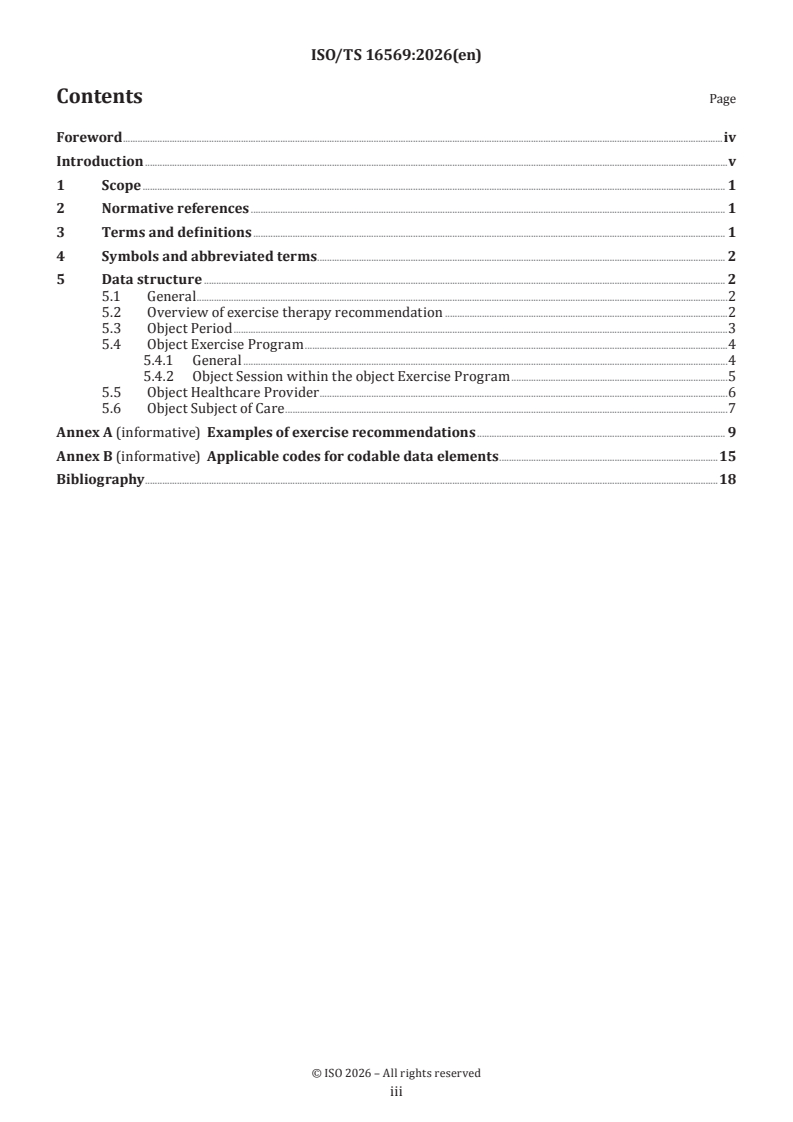
1 Scope . 1
2 Normative references . 1
3 Terms and definitions . 1
4 Symbols and abbreviated terms. 2
5 Data structure . 2
5.1 General .2
5.2 Overview of exercise therapy recommendation .2
5.3 Object Period .3
5.4 Object Exercise Program .4
5.4.1 General .4
5.4.2 Object Session within the object Exercise Program .5
5.5 Object Healthcare Provider .6
5.6 Object Subject of Care .7
Annex A (informative) Examples of exercise recommendations . 9
Annex B (informative) Applicable codes for codable data elements .15
Bibliography .18
iii
Foreword
ISO (the International Organization for Standardization) is a worldwide federation of national standards
bodies (ISO member bodies). The work of preparing International Standards is normally carried out through
ISO technical committees. Each member body interested in a subject for which a technical committee
has been established has the right to be represented on that committee. International organizations,
governmental and non-governmental, in liaison with ISO, also take part in the work. ISO collaborates closely
with the International Electrotechnical Commission (IEC) on all matters of electrotechnical standardization.
The procedures used to develop this document and those intended for its further maintenance are described
in the ISO/IEC Directives, Part 1. In particular, the different approval criteria needed for the different types
of ISO documents should be noted. This document was drafted in accordance with the editorial rules of the
ISO/IEC Directives, Part 2 (see www.iso.org/directives).
ISO draws attention to the possibility that the implementation of this document may involve the use of (a)
patent(s). ISO takes no position concerning the evidence, validity or applicability of any claimed patent
rights in respect thereof. As of the date of publication of this document, ISO had not received notice of (a)
patent(s) which may be required to implement this document. However, implementers are cautioned that
this may not represent the latest information, which may be obtained from the patent database available at
www.iso.org/patents. ISO shall not be held responsible for identifying any or all such patent rights.
Any trade name used in this document is information given for the convenience of users and does not
constitute an endorsement.
For an explanation of the voluntary nature of standards, the meaning of ISO specific terms and expressions
related to conformity assessment, as well as information about ISO’s adherence to the World Trade
Organization (WTO) principles in the Technical Barriers to Trade (TBT), see www.iso.org/iso/foreword.html.
This document was prepared by Technical Committee ISO/TC 215, Health informatics.
Any feedback or questions on this document should be directed to the user’s national standards body. A
complete listing of these bodies can be found at www.iso.org/members.html.
iv
Introduction
Numerous people have musculoskeletal disorders related to chronic diseases and need steady and long-
term exercise therapy. In rehabilitation medicine, appropriate and clinically validated exercises are as
important as medication prescriptions or medical procedures for symptom relief. Therefore, patients
receive personalized exercise therapy recommendations from their physicians or physiotherapists, and
carry out rehabilitation activity at home, which can also include supervised or semi-supervised session
where applicable. For example, in order to treat backache or degenerative arthritis, combining long-term
exercise therapy at home with medical treatment is significantly efficient.
However, there are no widely adopted technical documents that provide guidelines on how to electronically
exchange data and how to represent exercise therapy recommendation for patients with degenerative
arthritis and back pain.
A standardized data set to deliver exercise recommendations can contribute to support interoperability
and consistent electronic exchange in the context of long-term exercise management at home. Additionally,
information collected in accordance with the data definition in this document can be included in patient’s
records such as the international patient summary (IPS), personal health record (PHR) or patient-generated
health data (PGHD).
The purpose of this document is to define a standardized data set of exercise recommendations for data
exchange between healthcare providers and patients with degenerative arthritis and back pain. Using the
data set, patients can receive their exercise recommendations on electronic devices such as smartphones
or tablets and perform their exercises for long-term therapy in various settings and with different types of
instruments.
v
Technical Specification ISO/TS 16569:2026(en)
Health informatics — Standardized data set for exchanging
exercise therapy recommendations for degenerative arthritis
and backpain
1 Scope
This document specifies a standardized data set for exercise recommendations to facilitate data exchange
between healthcare providers and patients.
This document specifically focuses on degenerative arthritis and backpain because these conditions
commonly require long-term structured rehabilitation exercise exchange.
This document defines the structure of exercise recommendation data for electronic exchange between
healthcare providers and patients with degenerative arthritis and back pain.
This document focuses on data exchange of exercise recommendations for backache and degenerative
arthritis; other musculoskeletal disorders are outside the scope of this document.
This document is not intended to provide a data set for symptoms of other musculoskeletal disorders, or for
the patient’s pain intensity.
This document does not cover medication orders, observation data measured by personal health devices,
or other information that can be relevant in the context of recommendations for musculoskeletal disorders.
2 Normative references
There are no normative references in this document.
3 Terms and definitions
For the purposes of this document, the following terms and definitions apply.
ISO and IEC maintain terminology databases for use in standardization at the following addresses:
— ISO Online browsing platform: available at https:// www .iso .org/ obp
— IEC Electropedia: available at https:// www .electropedia .org/
3.1
disorder
alterations or attributes of the health status of an individual which might lead to distress, interference with
daily activities, or contact with health
[SOURCE: ISO/TR 21835:2020, 3.4]
3.2
musculoskeletal disorders
set of diverse conditions affecting bones, joints, muscles and connective tissues
Note 1 to entry: Adapted from Reference [7].
3.3
exercise therapy
regimen or plan of physical activities designed and prescribed to facilitate the recovery of patients from
diseases and any conditions which disturb their movement and activity of daily life, or to maintain a state of
well-being
Note 1 to entry: Adapted from Reference [8].
4 Symbols and abbreviated terms
FHIR Fast Healthcare Interoperability Resources
HL7 Health Level Seven
SNOMED CT Systematized Nomenclature of Medicine – Clinical Terms
5 Data structure
5.1 General
In order to electronically exchange exercise recommendations for musculoskeletal disorders such as
degenerative arthritis and back pain, it is necessary to define a standardized data structure that supports
communication from healthcare providers to patients.
The information necessary for delivering exercise therapy recommendations consists of period, exercise
program, healthcare provider and subject of care. The exercise program consists of exercise type, session
(which refers to unit of a specific physical activity within an exercise program), and number of sessions. Each
session consists of the body part primarily targeted in exercise, repetition (that indicates how many times
the exercise is repeated), and the equipment used in exercise. For examples of exercise recommendations,
see Annex A.
5.2 Overview of exercise therapy recommendation
The exercise therapy recommendation is composed of the following objects:
— Period: this object represents the period during which the subject of care performs the exercise program.
It includes the start time, end time, consecutive days and rest time.
— Exercise Program: this object consists of details of the exercise to be performed by the subject of care. It
includes category, type, session, number of sessions and equipment.
— Healthcare Provider: this object represents the role of the person making exercise recommendations
and providing them to the subject of care. These can primarily be doctors or physiotherapists.
— Subject of Care: this object is intended to represent the subject who receives exercise therapy
recommendations and performs them. It can primarily be patients with degenerative arthritis and back
pain.
The relationship between the objects that make up the exercise therapy recommendation is shown in
Figure 1. The exercise therapy recommendations delivered from healthcare providers to subjects of care
can be structured with a Period object, a Healthcare Provider object, a Subject of Care object, and more than
one of the Exercise Program objects.
Figure 1 — Data structure and components of exercise therapy recommendation
5.3 Object Period
The Period object represents the period during which the subject of care performs the exercise therapy
recommendations given by healthcare providers.
The Start and End data elements are required in this object; the ConsecutiveDays and RestDays data
elements are optional depending on the characteristics of the exercise therapy recommendation.
Both the Start and End data elements can be expressed in the DateTime data type; the ConsecutiveDays and
RestDays can be expressed in an Integer data type.
The data elements which make up the Period object are shown in Figure 2, and the data types and
descriptions of characteristics for each data element are shown in Table 1.
Figure 2 — Data elements of the object Period
Table 1 — Data fields of the object Period
Data
No. Cardinality Datatype Description Example
elements
Starting time for recommended
1 Start 1.1 DateTime exercise program with inclusive 2022-04-01
boundary
End time for recommended
2 End 1.1 DateTime exercise program with inclusive 2022-04-30
boundary
Con- It describes how many days a
3 secu-tive- 0.1 Integer subject of care performs exercise 3
Days in a row.
It describes how many days the
4 RestDays 0.1 Integer subject of care should rest after 2
exercising in a row.
EXAMPLE Start = 2022-04-01, End = 2022-04-30, ConsecutiveDays = 3, RestDays = 2. This means the
subject exercises for 3 consecutive days followed by 2 days of rest.
5.4 Object Exercise Program
5.4.1 General
The object Exercise Program represents the types and methods of the exercise program recommended by
healthcare providers for subjects of care to relieve or treat degenerative arthritis and back pain. The Exercise
Program object includes the category of exercise, type of exercise, the number of sessions, equipment to be
utilized during the exercise, and one or more sessions.
The Category, Type and Session data elements are required in this object. One or more Session object can
be contained in the Exercise program object. The Number of sessions and Equipment data elements are
optional.
The Number of session data element can be expressed in the Integer data type; the Category, Type and
Equipment data element should be represented in Enumeration data type.
The data elements that make up the Exercise program object are shown in Figure 3, and the data types and
descriptions of characteristics for each data element are shown in Table 2.
Figure 3 — Data elements of the object Exercise Program
Table 2 — Data fields of the object Exercise Program
Data
No. Cardinality Datatype Description Example
element
Classification of the general type of exer-
cise
The recommended codes defined in this
document. SNOMED CT codes are recom-
mended as well.
1 Category 1.1 Code STRET
Each organization may utilize its pre-
ferred coding system for categorizing
exercises.
Recommended codes defined in this
document and SNOMED CT to represent
category are provided in Annex B.
Type of exercise
The recommended codes defined in this
document.
Each organization may utilize its pre-
INNER_THIGH_
2 Type 1.1 Code
ferred coding system for categorizing
STRET
exercises.
Recommended codes defined in this doc-
ument to represent type are provided in
Annex B.
Ses-
It indicates a specific exercise and how it
[1]
3 Session 1.* sion(Com- Session
is performed.
plex)
Number of Total number of sessions included in the
4 0.1 Integer 2
Session recommendation.
Enumera-
5 Equipment 0.1 Types of equipment used for the exercise Exercise_band
tion
5.4.2 Object Session within the object Exercise Program
The Exercise Program object should contain one or more Session objects to indicate a specific exercise and
how it should be performed. The Session object includes the BodyPart data element to represent which part
of the body should be exercised, the Repetition data element to represent how many times exercise should
be performed, and the Narrative data element which can be prescribed with free text.
The BodyPart and Repetition data elements are required in this object. One or more objects can be contained
in the Session object. The Narrative data element is optional.
The BodyPart data element should be expressed in the Enumeration data type; the Repetition data element
should be represented in Integer data type; and the Narrative data element should be expressed in the String
data type.
The data elements which make up the Session object are shown in Figure 4, and the data types and
description of characteristics for each data element are shown in Table 3.
Figure 4 — Data elements of the object Session
Table 3 — Data fields of the object Session
Data
No. Cardinality Datatype Description Example
element
Indicates the site on the subject’s
body where the s
...