

ISO 11971:2020
(Main)Steel and iron castings — Visual testing of surface quality
General Information
- Abstract
1.1 This document covers the acceptance criteria for the visual testing of the surface of steel and iron castings. 1.2 Acceptance levels utilize Bureau de Normalisation des Industries de la Fonderie (BNIF) and Steel Castings Research and Trade Association (SCRATA) or Casting Technology International (CTI) reference comparators for the visual determination of surface roughness and surface discontinuities described as follows: — surface roughness; — thermal dressing; — mechanical dressing; — non-metallic inclusions; — gas porosity; — fusion discontinuities; — expansion discontinuities; — metal inserts.
- Status
- Published
- Publication Date
- 12-Jan-2020
- Technical Committee
- ISO/TC 17/SC 11 - Steel castings
- Drafting Committee
- ISO/TC 17/SC 11 - Steel castings
- Current Stage
- 9060 - Close of review
- Completion Date
- 02-Sep-2030
Buy Documents


ISO 11971:2020 - Steel and iron castings -- Visual testing of surface quality
ISO 11971:2020 - Steel and iron castings — Visual testing of surface quality/13/2020
Overview
ISO 11971:2020 - "Steel and iron castings - Visual testing of surface quality" specifies acceptance criteria for the visual inspection of steel and iron casting surfaces. The standard defines how to use established visual/tactile comparators (BNIF and SCRATA/CTI) to assess surface roughness and common casting discontinuities, and sets out ordering, test, and reporting requirements for consistent, repeatable surface-quality decisions.
Key topics and requirements
- Scope: Acceptance criteria for visual testing of steel and iron castings, including surface roughness and specific discontinuities.
- Comparator systems: Uses BNIF (BNIF 359) and SCRATA or CTI comparators as reference standards for visual/tactile assessment. Comparators are intended to represent the worst (roughest) condition for an acceptance level.
- Surface conditions covered:
- Surface roughness
- Thermal dressing
- Mechanical dressing
- Non‑metallic inclusions
- Gas porosity
- Fusion discontinuities
- Expansion discontinuities
- Metal inserts
- Test method: Surfaces are examined visually without optical aids exceeding 1× magnification. Large-format comparators (recommended ≥ 15 000 mm²) are preferred to reflect the irregular nature of cast surfaces and improve repeatability.
- Acceptance criteria:
- SCRATA comparator set applicable to steel and iron castings.
- BNIF comparator categories S1 and S2 usable for all alloys; category S3 for steel castings only.
- Annex A provides optional roughness and discontinuity acceptance levels and equivalency guidance between BNIF and SCRATA systems.
- Ordering information: Purchaser and supplier should agree on areas to be inspected, number of castings, designated acceptance levels (multiple levels may apply to different surfaces), and any unacceptable discontinuity types.
- Test report contents: Identification of castings, tester name and qualification, comparator reference used, designated category/level for each area, and date of testing.
Applications and users
ISO 11971:2020 is used by:
- Foundries and casting manufacturers performing quality control and delivery inspection
- Quality, inspection, and NDT engineers defining acceptance limits for cast parts
- Purchasing and design engineers specifying surface acceptance criteria on drawings or models
- Third‑party inspectors and certification bodies assessing conformance to agreed surface standards
Practical applications include final inspection of as‑cast or finished cast surfaces, contract acceptance checks, and supplier quality agreements where visual surface quality is critical to function or appearance.
Related standards
- BNIF 359 (BNIF recommendation for reference samples)
- SCRATA / CTI comparator sets (surface quality comparators available from Casting Technology International)
- ISO 11971 references these comparator systems but contains no normative references to other ISO documents.
Keywords: ISO 11971:2020, visual testing, surface quality, steel castings, iron castings, BNIF, SCRATA, CTI, surface roughness, casting discontinuities, casting inspection.
Relations
- Effective Date
- 23-Apr-2020
Buy Documents
ISO 11971:2020 - Steel and iron castings -- Visual testing of surface quality
ISO 11971:2020 - Steel and iron castings — Visual testing of surface quality/13/2020
Get Certified
Connect with accredited certification bodies for this standard

Element Materials Technology
Materials testing and product certification.

Inštitut za kovinske materiale in tehnologije
Institute of Metals and Technology. Materials testing, metallurgical analysis, NDT.
Sponsored listings
Frequently Asked Questions
ISO 11971:2020 is a standard published by the International Organization for Standardization (ISO). Its full title is "Steel and iron castings — Visual testing of surface quality". This standard covers: 1.1 This document covers the acceptance criteria for the visual testing of the surface of steel and iron castings. 1.2 Acceptance levels utilize Bureau de Normalisation des Industries de la Fonderie (BNIF) and Steel Castings Research and Trade Association (SCRATA) or Casting Technology International (CTI) reference comparators for the visual determination of surface roughness and surface discontinuities described as follows: — surface roughness; — thermal dressing; — mechanical dressing; — non-metallic inclusions; — gas porosity; — fusion discontinuities; — expansion discontinuities; — metal inserts.
1.1 This document covers the acceptance criteria for the visual testing of the surface of steel and iron castings. 1.2 Acceptance levels utilize Bureau de Normalisation des Industries de la Fonderie (BNIF) and Steel Castings Research and Trade Association (SCRATA) or Casting Technology International (CTI) reference comparators for the visual determination of surface roughness and surface discontinuities described as follows: — surface roughness; — thermal dressing; — mechanical dressing; — non-metallic inclusions; — gas porosity; — fusion discontinuities; — expansion discontinuities; — metal inserts.
ISO 11971:2020 is classified under the following ICS (International Classification for Standards) categories: 77.040.20 - Non-destructive testing of metals; 77.140.80 - Iron and steel castings. The ICS classification helps identify the subject area and facilitates finding related standards.
ISO 11971:2020 has the following relationships with other standards: It is inter standard links to ISO 11971:2008. Understanding these relationships helps ensure you are using the most current and applicable version of the standard.
ISO 11971:2020 is available in PDF format for immediate download after purchase. The document can be added to your cart and obtained through the secure checkout process. Digital delivery ensures instant access to the complete standard document.
Standards Content (Sample)
INTERNATIONAL ISO
STANDARD 11971
Third edition
2020-01
Steel and iron castings — Visual
testing of surface quality
Pièces moulées en acier ou en fonte — Contrôle visuel de l'état de
surface
Reference number
©
ISO 2020
© ISO 2020
All rights reserved. Unless otherwise specified, or required in the context of its implementation, no part of this publication may
be reproduced or utilized otherwise in any form or by any means, electronic or mechanical, including photocopying, or posting
on the internet or an intranet, without prior written permission. Permission can be requested from either ISO at the address
below or ISO’s member body in the country of the requester.
ISO copyright office
CP 401 • Ch. de Blandonnet 8
CH-1214 Vernier, Geneva
Phone: +41 22 749 01 11
Fax: +41 22 749 09 47
Email: copyright@iso.org
Website: www.iso.org
Published in Switzerland
ii © ISO 2020 – All rights reserved
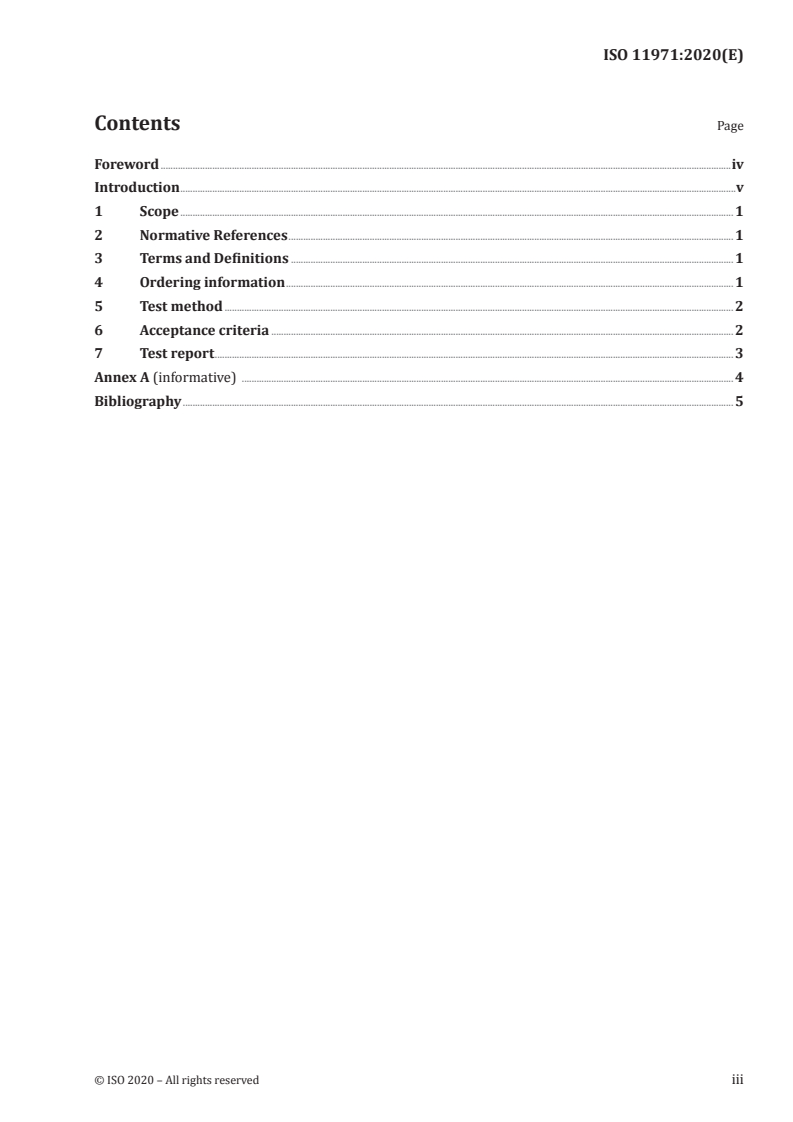
Contents Page
Foreword .iv
Introduction .v
1 Scope . 1
2 Normative References . 1
3 Terms and Definitions . 1
4 Ordering information . 1
5 Test method . 2
6 Acceptance criteria . 2
7 Test report . 3
Annex A (informative) . 4
Bibliography . 5
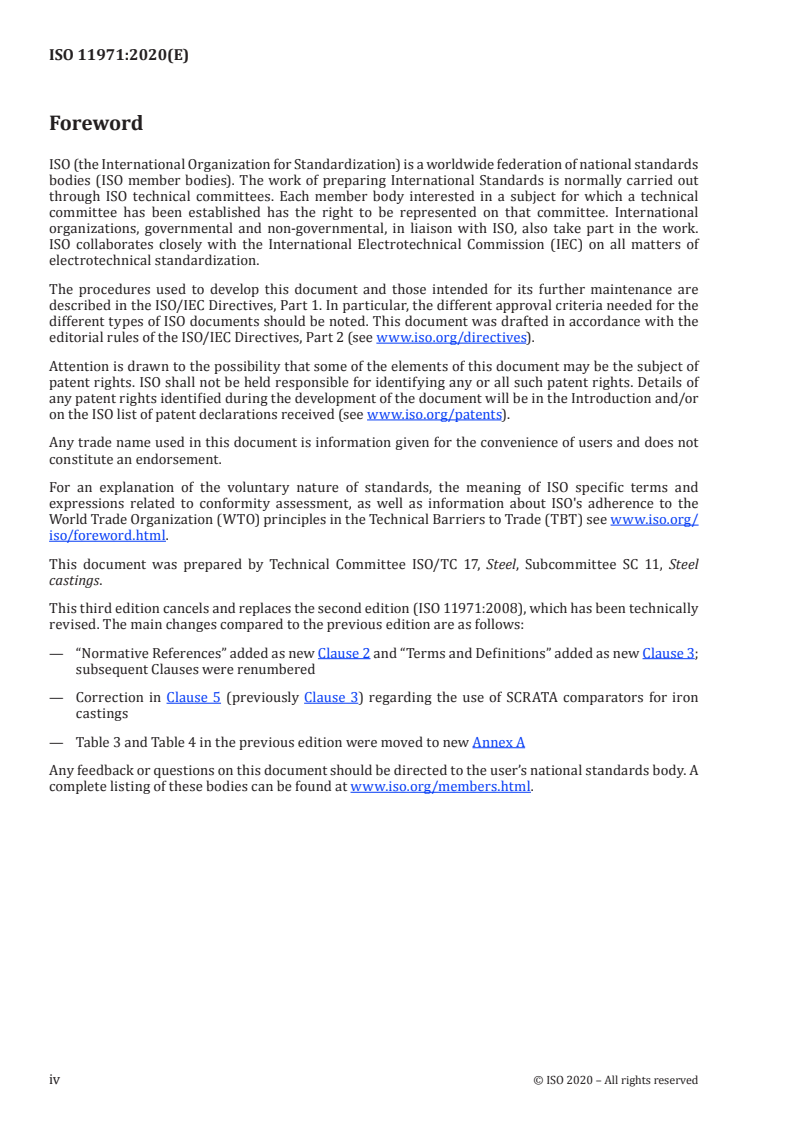
Foreword
ISO (the International Organization for Standardization) is a worldwide federation of national standards
bodies (ISO member bodies). The work of preparing International Standards is normally carried out
through ISO technical committees. Each member body interested in a subject for which a technical
committee has been established has the right to be represented on that committee. International
organizations, governmental and non-governmental, in liaison with ISO, also take part in the work.
ISO collaborates closely with the International Electrotechnical Commission (IEC) on all matters of
electrotechnical standardization.
The procedures used to develop this document and those intended for its further maintenance are
described in the ISO/IEC Directives, Part 1. In particular, the different approval criteria needed for the
different types of ISO documents should be noted. This document was drafted in accordance with the
editorial rules of the ISO/IEC Directives, Part 2 (see www .iso .org/ directives).
Attention is drawn to the possibility that some of the elements of this document may be the subject of
patent rights. ISO shall not be held responsible for identifying any or all such patent rights. Details of
any patent rights identified during the development of the document will be in the Introduction and/or
on the ISO list of patent declarations received (see www .iso .org/ patents).
Any trade name used in this document is information given for the convenience of users and does not
constitute an endorsement.
For an explanation of the voluntary nature of standards, the meaning of ISO specific terms and
expressions related to conformity assessment, as well as information about ISO's adherence to the
World Trade Organization (WTO) principles in the Technical Barriers to Trade (TBT) see www .iso .org/
iso/ foreword .html.
This document was prepared by Technical Committee ISO/TC 17, Steel, Subcommittee SC 11, Steel
castings.
This third edition cancels and replaces the second edition (ISO 11971:2008), which has been technically
revised. The main changes compared to the previous edition are as follows:
— “Normative References” added as new Clause 2 and “Terms and Definitions” added as new Clause 3;
subsequent Clauses were renumbered
— Correction in Clause 5 (previously Clause 3) regarding the use of SCRATA comparators for iron
castings
— Table 3 and Table 4 in the previous edition were moved to new Annex A
Any feedback or questions on this document should be directed to the user’s national standards body. A
complete listing of these bodies can be found at www .iso .org/ members .html.
iv © ISO 2020 – All rights reserved
Introduction
The surface roughness of a casting is influenced by the manufacturing process (moulding, grinding,
finishing, etc.), the moulding materials used (sand, coating, etc.), the equipment available and the
alloy cast.
Since cast surfaces do not exhibit the same cyclic regularity as machined surfaces, it is difficult to
evaluate their roughness using conventional mechanical, optical, or pneumatic devices.
The use of visual/tactile comparators is therefore preferred in these circu
...
INTERNATIONAL ISO
STANDARD 11971
Third edition
2020-01
Steel and iron castings — Visual
testing of surface quality
Pièces moulées en acier ou en fonte — Contrôle visuel de l'état de
surface
Reference number
©
ISO 2020
© ISO 2020
All rights reserved. Unless otherwise specified, or required in the context of its implementation, no part of this publication may
be reproduced or utilized otherwise in any form or by any means, electronic or mechanical, including photocopying, or posting
on the internet or an intranet, without prior written permission. Permission can be requested from either ISO at the address
below or ISO’s member body in the country of the requester.
ISO copyright office
CP 401 • Ch. de Blandonnet 8
CH-1214 Vernier, Geneva
Phone: +41 22 749 01 11
Fax: +41 22 749 09 47
Email: copyright@iso.org
Website: www.iso.org
Published in Switzerland
ii © ISO 2020 – All rights reserved
Contents Page
Foreword .iv
Introduction .v
1 Scope . 1
2 Normative References . 1
3 Terms and Definitions . 1
4 Ordering information . 1
5 Test method . 2
6 Acceptance criteria . 2
7 Test report . 3
Annex A (informative) . 4
Bibliography . 5
Foreword
ISO (the International Organization for Standardization) is a worldwide federation of national standards
bodies (ISO member bodies). The work of preparing International Standards is normally carried out
through ISO technical committees. Each member body interested in a subject for which a technical
committee has been established has the right to be represented on that committee. International
organizations, governmental and non-governmental, in liaison with ISO, also take part in the work.
ISO collaborates closely with the International Electrotechnical Commission (IEC) on all matters of
electrotechnical standardization.
The procedures used to develop this document and those intended for its further maintenance are
described in the ISO/IEC Directives, Part 1. In particular, the different approval criteria needed for the
different types of ISO documents should be noted. This document was drafted in accordance with the
editorial rules of the ISO/IEC Directives, Part 2 (see www .iso .org/ directives).
Attention is drawn to the possibility that some of the elements of this document may be the subject of
patent rights. ISO shall not be held responsible for identifying any or all such patent rights. Details of
any patent rights identified during the development of the document will be in the Introduction and/or
on the ISO list of patent declarations received (see www .iso .org/ patents).
Any trade name used in this document is information given for the convenience of users and does not
constitute an endorsement.
For an explanation of the voluntary nature of standards, the meaning of ISO specific terms and
expressions related to conformity assessment, as well as information about ISO's adherence to the
World Trade Organization (WTO) principles in the Technical Barriers to Trade (TBT) see www .iso .org/
iso/ foreword .html.
This document was prepared by Technical Committee ISO/TC 17, Steel, Subcommittee SC 11, Steel
castings.
This third edition cancels and replaces the second edition (ISO 11971:2008), which has been technically
revised. The main changes compared to the previous edition are as follows:
— “Normative References” added as new Clause 2 and “Terms and Definitions” added as new Clause 3;
subsequent Clauses were renumbered
— Correction in Clause 5 (previously Clause 3) regarding the use of SCRATA comparators for iron
castings
— Table 3 and Table 4 in the previous edition were moved to new Annex A
Any feedback or questions on this document should be directed to the user’s national standards body. A
complete listing of these bodies can be found at www .iso .org/ members .html.
iv © ISO 2020 – All rights reserved
Introduction
The surface roughness of a casting is influenced by the manufacturing process (moulding, grinding,
finishing, etc.), the moulding materials used (sand, coating, etc.), the equipment available and the
alloy cast.
Since cast surfaces do not exhibit the same cyclic regularity as machined surfaces, it is difficult to
evaluate their roughness using conventional mechanical, optical, or pneumatic devices.
The use of visual/tactile comparators is therefore preferred in these circu
...