

ISO 17694:2016
(Main)Footwear — Test methods for uppers and lining — Flex resistance
General Information
- Abstract
ISO 17694:2016 specifies a test method for determining the flex resistance of uppers and linings irrespective of the material in order to assess the suitability for the end use.
- Status
- Published
- Publication Date
- 28-Apr-2016
- Technical Committee
- ISO/TC 216 - Footwear
- Drafting Committee
- ISO/TC 216 - Footwear
- Current Stage
- 9093 - International Standard confirmed
- Start Date
- 04-May-2022
- Completion Date
- 29-Aug-2026
Buy Documents
ISO 17694:2016 - Footwear -- Test methods for uppers and lining -- Flex resistance
ISO 17694:2016 - Footwear — Test methods for uppers and lining — Flex resistance/29/2016
ISO 17694:2016 - Chaussures -- Méthodes d'essai pour les tiges et les doublures -- Résistance à la flexion
ISO 17694:2016 - Chaussures — Méthodes d'essai pour les tiges et les doublures — Résistance à la flexion/29/2016
Overview
ISO 17694:2016 - Footwear - Test methods for uppers and lining - Flex resistance specifies a laboratory test method to determine the flex resistance of footwear uppers and linings irrespective of material. The method assesses a material’s tendency to crack, crease, flake or develop salt spue under repeated bending (flexing) to help judge suitability for end use. The procedure simulates the inward folding of a shoe vamp and can be performed in dry, wet or sub-zero conditions.
Key technical topics and requirements
- Test principle: Rectangular specimens are folded and clamped in a flexing machine (flexometer) so that inward and vertical folds are repeatedly flexed through a defined angle. Damage is visually assessed at set cycle intervals.
- Apparatus and parameters:
- Flexing angle: 22°30' ± 0°30';
- Oscillation speed: 100 ± 5 cycles/min;
- Distance between clamps (horizontal position): 25 ± 1 mm;
- Specimen press knife size typically 70 × 45 mm; specimen length must be 70 ± 1 mm.
- Conditioning and environments:
- Tests may be conducted dry, wet (using deionised water and vacuum impregnation) or cold (e.g., around –5 °C; lower temperatures may be used).
- Conditioning follows referenced atmospheres (see Related Standards).
- Sampling and orientation:
- Specimens are cut along and across the material’s backbone/warp directions; for uppers specimens should be taken from the forepart at the point of greatest flexing.
- Test direction: uppers tested face up, linings face down.
- Inspection stages:
- Recommended inspection cycle points include 1 000, 2 000, 5 000, 10 000, 25 000, 50 000 and 100 000 cycles (applicability varies by dry/wet/cold).
- Assessment criteria:
- Record creasing, visible or fine cracks (with magnifier), loss of adhesion, greying, powdering/flaking, broken yarns (textiles), and salt spue grading (light/marked/heavy).
Practical applications and users
- Who uses it: footwear manufacturers, material suppliers, independent testing laboratories, R&D and QA teams, product developers and certification bodies.
- Typical uses:
- Compare flex durability of leathers, coated fabrics, textiles and lining materials.
- Support material selection and design decisions for durability and end-use performance.
- Quality control and batch verification to detect manufacturing or coating failures.
- Failure analysis (cracking, adhesion loss, salt spue) to drive corrective actions.
Related standards
- ISO 5402-1:2011 - Determination of flex resistance (flexometer method)
- ISO 17709 - Sampling location and conditioning of footwear test pieces
- ISO 18454 - Standard atmospheres for conditioning and testing
- ISO 3696 - Water for analytical laboratory use
Keywords: ISO 17694:2016, flex resistance, footwear testing, uppers and lining, flexometer, durability testing, salt spue, material selection, quality control.
Relations
- Effective Date
- 08-Apr-2026
- Effective Date
- 08-Apr-2026
- Consolidates
EN ISO 17694:2016 - Footwear - Test methods for uppers and lining - Flex resistance (ISO 17694:2016) - Effective Date
- 12-Feb-2026
- Effective Date
- 19-Nov-2011
Buy Documents
ISO 17694:2016 - Footwear -- Test methods for uppers and lining -- Flex resistance
ISO 17694:2016 - Footwear — Test methods for uppers and lining — Flex resistance/29/2016
ISO 17694:2016 - Chaussures -- Méthodes d'essai pour les tiges et les doublures -- Résistance à la flexion
ISO 17694:2016 - Chaussures — Méthodes d'essai pour les tiges et les doublures — Résistance à la flexion/29/2016
Frequently Asked Questions
ISO 17694:2016 is a standard published by the International Organization for Standardization (ISO). Its full title is "Footwear — Test methods for uppers and lining — Flex resistance". This standard covers: ISO 17694:2016 specifies a test method for determining the flex resistance of uppers and linings irrespective of the material in order to assess the suitability for the end use.
ISO 17694:2016 specifies a test method for determining the flex resistance of uppers and linings irrespective of the material in order to assess the suitability for the end use.
ISO 17694:2016 is classified under the following ICS (International Classification for Standards) categories: 61.060 - Footwear. The ICS classification helps identify the subject area and facilitates finding related standards.
ISO 17694:2016 has the following relationships with other standards: It is inter standard links to CEN ISO/TS 20953:2026, CEN ISO/TS 20952:2026, EN ISO 17694:2016, ISO 17694:2003. Understanding these relationships helps ensure you are using the most current and applicable version of the standard.
ISO 17694:2016 is available in PDF format for immediate download after purchase. The document can be added to your cart and obtained through the secure checkout process. Digital delivery ensures instant access to the complete standard document.
Standards Content (Sample)
INTERNATIONAL ISO
STANDARD 17694
Second edition
2016-05-01
Footwear — Test methods for uppers
and lining — Flex resistance
Chaussures — Méthodes d’essai pour les tiges et les doublures —
Résistance à la flexion
Reference number
©
ISO 2016
© ISO 2016, Published in Switzerland
All rights reserved. Unless otherwise specified, no part of this publication may be reproduced or utilized otherwise in any form
or by any means, electronic or mechanical, including photocopying, or posting on the internet or an intranet, without prior
written permission. Permission can be requested from either ISO at the address below or ISO’s member body in the country of
the requester.
ISO copyright office
Ch. de Blandonnet 8 • CP 401
CH-1214 Vernier, Geneva, Switzerland
Tel. +41 22 749 01 11
Fax +41 22 749 09 47
copyright@iso.org
www.iso.org
ii © ISO 2016 – All rights reserved
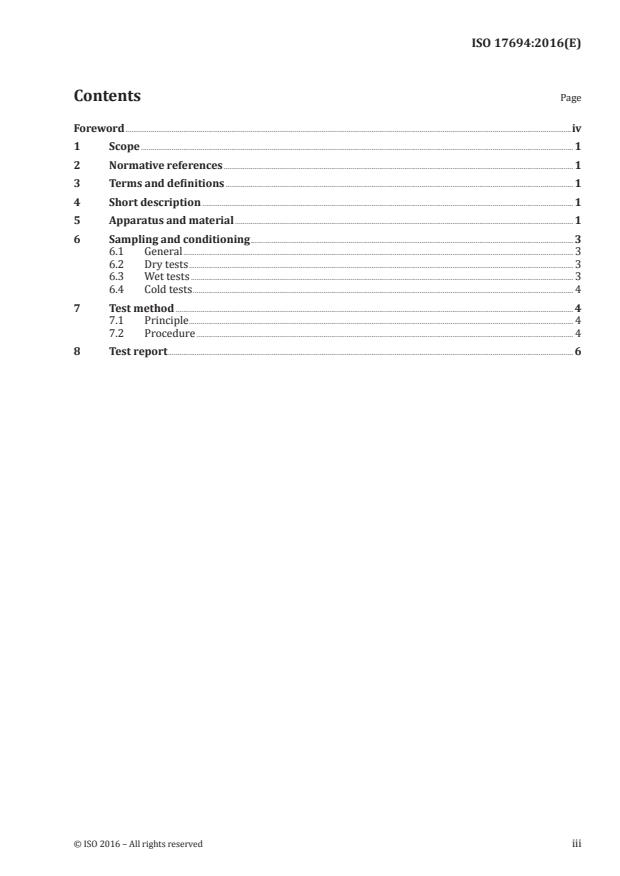
Contents Page
Foreword .iv
1 Scope . 1
2 Normative references . 1
3 Terms and definitions . 1
4 Short description . 1
5 Apparatus and material . 1
6 Sampling and conditioning . 3
6.1 General . 3
6.2 Dry tests . 3
6.3 Wet tests . 3
6.4 Cold tests . 4
7 Test method . 4
7.1 Principle . 4
7.2 Procedure . 4
8 Test report . 6
Foreword
ISO (the International Organization for Standardization) is a worldwide federation of national standards
bodies (ISO member bodies). The work of preparing International Standards is normally carried out
through ISO technical committees. Each member body interested in a subject for which a technical
committee has been established has the right to be represented on that committee. International
organizations, governmental and non-governmental, in liaison with ISO, also take part in the work.
ISO collaborates closely with the International Electrotechnical Commission (IEC) on all matters of
electrotechnical standardization.
The procedures used to develop this document and those intended for its further maintenance are
described in the ISO/IEC Directives, Part 1. In particular the different approval criteria needed for the
different types of ISO documents should be noted. This document was drafted in accordance with the
editorial rules of the ISO/IEC Directives, Part 2 (see www.iso.org/directives).
Attention is drawn to the possibility that some of the elements of this document may be the subject of
patent rights. ISO shall not be held responsible for identifying any or all such patent rights. Details of
any patent rights identified during the development of the document will be in the Introduction and/or
on the ISO list of patent declarations received (see www.iso.org/patents).
Any trade name used in this document is information given for the convenience of users and does not
constitute an endorsement.
For an explanation on the meaning of ISO specific terms and expressions related to conformity
assessment, as well as information about ISO’s adherence to the WTO principles in the Technical
Barriers to Trade (TBT) see the following URL: Foreword - Supplementary information
ISO 17694 was prepared by the European Committee Standardization (CEN) Technical Committee
CEN/TC 309, Footwear, in collaboration with ISO Technical Committee TC 216, Footwear, in accordance
with the agreement on technical cooperation between ISO and CEN (Vienna Agreement).
This second edition cancels and replaces the first edition (ISO 17694:2003), which has been technically
revised.
iv © ISO 2016 – All rights reserved
INTERNATIONAL STANDARD ISO 17694:2016(E)
Footwear — Test methods for uppers and lining — Flex
resistance
1 Scope
This International Standard specifies a test method for determining the flex resistance of uppers and
linings irrespective of the material in order to assess the suitability for the end use.
2 Normative references
The following documents, in whole or in part, are normatively referenced in this document and are
indispensable for its application. For dated references, only the edition cited applies. For undated
references, the latest edition of the referenced document (including any amendments) applies.
ISO 3696, Water for analytical laboratory use — Specification and test methods
ISO 5402-1:2011, Leather — Determination of flex resistance — Part 1: Flexometer method
1)
ISO 17709 , Footwear — Sampling location, preparation and duration of conditioning of samples and
test pieces
2)
ISO 18454 , Footwear — Standard atmospheres for conditioning and testing of footwear and components
for footwear
3 Terms and definitions
For the purposes of this document, the following terms and definitions apply.
3.1
flex resistance
resistance of a material to crack or otherwise fail at flexing creases
3.2
surface
visible site of the material during the use at the shoe
Note 1 to entry: The visible site of the material can be by upper the grain site of the leather or the coated site of a
coated textile, by lining the site of the material visible from the inside of the shoe.
4 Short description
Test specimens are cut from a shoe vamp or from material for shoes, folded and inserted in the test
machine. The test simulates the damage caused by the inward folding of the vamp of the upper, but
does not readily reproduce damage occurring on outward folds. It is carried out humid, dry or in a cold
climate.
5 Apparatus and material
The following apparatus and material shall be used.
1) EN 13400 is equivalent to ISO 17709.
2) EN 12222 is equivalent to ISO 18454.
5.1 Test machine, in accordance with ISO 5402-1:2011, 4.1 including the following.
5.1.1 At least four pairs of clamps. The upper clamp consists of a pair of flat plates as shown in
Figure 1.
The lower clamp is fixed and lies in the same vertical plane as the upper clamp.
Dimensions in millimetres
15 ± 1
G
H
C
B
F
E
Key
1 flexing angle 22°30’ ± 0°30’
2 clamp tightening screw
3 2 mm radius
4 horizontal axle
Figure 1 — Upper clamp dimensions
5.1.2 Means of applying a simple harmonic reciprocating action, to repeatedly move the upper
clamp through an angle of 22°30’ ± 0°30’. The speed of oscillation shall be (100 ± 5) cycles/min.
The distance between the upper and lower clamp, when the upper clamp is
...
INTERNATIONAL ISO
STANDARD 17694
Second edition
2016-05-01
Footwear — Test methods for uppers
and lining — Flex resistance
Chaussures — Méthodes d’essai pour les tiges et les doublures —
Résistance à la flexion
Reference number
©
ISO 2016
© ISO 2016, Published in Switzerland
All rights reserved. Unless otherwise specified, no part of this publication may be reproduced or utilized otherwise in any form
or by any means, electronic or mechanical, including photocopying, or posting on the internet or an intranet, without prior
written permission. Permission can be requested from either ISO at the address below or ISO’s member body in the country of
the requester.
ISO copyright office
Ch. de Blandonnet 8 • CP 401
CH-1214 Vernier, Geneva, Switzerland
Tel. +41 22 749 01 11
Fax +41 22 749 09 47
copyright@iso.org
www.iso.org
ii © ISO 2016 – All rights reserved
Contents Page
Foreword .iv
1 Scope . 1
2 Normative references . 1
3 Terms and definitions . 1
4 Short description . 1
5 Apparatus and material . 1
6 Sampling and conditioning . 3
6.1 General . 3
6.2 Dry tests . 3
6.3 Wet tests . 3
6.4 Cold tests . 4
7 Test method . 4
7.1 Principle . 4
7.2 Procedure . 4
8 Test report . 6
Foreword
ISO (the International Organization for Standardization) is a worldwide federation of national standards
bodies (ISO member bodies). The work of preparing International Standards is normally carried out
through ISO technical committees. Each member body interested in a subject for which a technical
committee has been established has the right to be represented on that committee. International
organizations, governmental and non-governmental, in liaison with ISO, also take part in the work.
ISO collaborates closely with the International Electrotechnical Commission (IEC) on all matters of
electrotechnical standardization.
The procedures used to develop this document and those intended for its further maintenance are
described in the ISO/IEC Directives, Part 1. In particular the different approval criteria needed for the
different types of ISO documents should be noted. This document was drafted in accordance with the
editorial rules of the ISO/IEC Directives, Part 2 (see www.iso.org/directives).
Attention is drawn to the possibility that some of the elements of this document may be the subject of
patent rights. ISO shall not be held responsible for identifying any or all such patent rights. Details of
any patent rights identified during the development of the document will be in the Introduction and/or
on the ISO list of patent declarations received (see www.iso.org/patents).
Any trade name used in this document is information given for the convenience of users and does not
constitute an endorsement.
For an explanation on the meaning of ISO specific terms and expressions related to conformity
assessment, as well as information about ISO’s adherence to the WTO principles in the Technical
Barriers to Trade (TBT) see the following URL: Foreword - Supplementary information
ISO 17694 was prepared by the European Committee Standardization (CEN) Technical Committee
CEN/TC 309, Footwear, in collaboration with ISO Technical Committee TC 216, Footwear, in accordance
with the agreement on technical cooperation between ISO and CEN (Vienna Agreement).
This second edition cancels and replaces the first edition (ISO 17694:2003), which has been technically
revised.
iv © ISO 2016 – All rights reserved
INTERNATIONAL STANDARD ISO 17694:2016(E)
Footwear — Test methods for uppers and lining — Flex
resistance
1 Scope
This International Standard specifies a test method for determining the flex resistance of uppers and
linings irrespective of the material in order to assess the suitability for the end use.
2 Normative references
The following documents, in whole or in part, are normatively referenced in this document and are
indispensable for its application. For dated references, only the edition cited applies. For undated
references, the latest edition of the referenced document (including any amendments) applies.
ISO 3696, Water for analytical laboratory use — Specification and test methods
ISO 5402-1:2011, Leather — Determination of flex resistance — Part 1: Flexometer method
1)
ISO 17709 , Footwear — Sampling location, preparation and duration of conditioning of samples and
test pieces
2)
ISO 18454 , Footwear — Standard atmospheres for conditioning and testing of footwear and components
for footwear
3 Terms and definitions
For the purposes of this document, the following terms and definitions apply.
3.1
flex resistance
resistance of a material to crack or otherwise fail at flexing creases
3.2
surface
visible site of the material during the use at the shoe
Note 1 to entry: The visible site of the material can be by upper the grain site of the leather or the coated site of a
coated textile, by lining the site of the material visible from the inside of the shoe.
4 Short description
Test specimens are cut from a shoe vamp or from material for shoes, folded and inserted in the test
machine. The test simulates the damage caused by the inward folding of the vamp of the upper, but
does not readily reproduce damage occurring on outward folds. It is carried out humid, dry or in a cold
climate.
5 Apparatus and material
The following apparatus and material shall be used.
1) EN 13400 is equivalent to ISO 17709.
2) EN 12222 is equivalent to ISO 18454.
5.1 Test machine, in accordance with ISO 5402-1:2011, 4.1 including the following.
5.1.1 At least four pairs of clamps. The upper clamp consists of a pair of flat plates as shown in
Figure 1.
The lower clamp is fixed and lies in the same vertical plane as the upper clamp.
Dimensions in millimetres
15 ± 1
G
H
C
B
F
E
Key
1 flexing angle 22°30’ ± 0°30’
2 clamp tightening screw
3 2 mm radius
4 horizontal axle
Figure 1 — Upper clamp dimensions
5.1.2 Means of applying a simple harmonic reciprocating action, to repeatedly move the upper
clamp through an angle of 22°30’ ± 0°30’. The speed of oscillation shall be (100 ± 5) cycles/min.
The distance between the upper and lower clamp, when the upper clamp is
...
NORME ISO
INTERNATIONALE 17694
Deuxième édition
2016-05-01
Chaussures — Méthodes d’essai pour
les tiges et les doublures — Résistance
à la flexion
Footwear — Test methods for uppers and lining — Flex resistance
Numéro de référence
©
ISO 2016
DOCUMENT PROTÉGÉ PAR COPYRIGHT
© ISO 2016, Publié en Suisse
Droits de reproduction réservés. Sauf indication contraire, aucune partie de cette publication ne peut être reproduite ni utilisée
sous quelque forme que ce soit et par aucun procédé, électronique ou mécanique, y compris la photocopie, l’affichage sur
l’internet ou sur un Intranet, sans autorisation écrite préalable. Les demandes d’autorisation peuvent être adressées à l’ISO à
l’adresse ci-après ou au comité membre de l’ISO dans le pays du demandeur.
ISO copyright office
Ch. de Blandonnet 8 • CP 401
CH-1214 Vernier, Geneva, Switzerland
Tel. +41 22 749 01 11
Fax +41 22 749 09 47
copyright@iso.org
www.iso.org
ii © ISO 2016 – Tous droits réservés
Sommaire Page
Avant-propos .iv
1 Domaine d’application . 1
2 Références normatives . 1
3 Termes et définitions . 1
4 Brève description . 1
5 Appareillage et matériel . 2
6 Échantillonnage et conditionnement . 3
6.1 Généralités . 3
6.2 Essais à l’état sec . 3
6.3 Essais à l’état humide . 4
6.4 Essais à froid . 4
7 Méthode d’essai . 4
7.1 Principe . 4
7.2 Mode opératoire . 4
8 Rapport d’essai . 6
Avant-propos
L’ISO (Organisation internationale de normalisation) est une fédération mondiale d’organismes
nationaux de normalisation (comités membres de l’ISO). L’élaboration des Normes internationales est
en général confiée aux comités techniques de l’ISO. Chaque comité membre intéressé par une étude
a le droit de faire partie du comité technique créé à cet effet. Les organisations internationales,
gouvernementales et non gouvernementales, en liaison avec l’ISO participent également aux travaux.
L’ISO collabore étroitement avec la Commission électrotechnique internationale (IEC) en ce qui
concerne la normalisation électrotechnique.
Les procédures utilisées pour élaborer le présent document et celles destinées à sa mise à jour sont
décrites dans les Directives ISO/IEC, Partie 1. Il convient, en particulier de prendre note des différents
critères d’approbation requis pour les différents types de documents ISO. Le présent document a été
rédigé conformément aux règles de rédaction données dans les Directives ISO/IEC, Partie 2 (voir www.
iso.org/directives).
L’attention est appelée sur le fait que certains des éléments du présent document peuvent faire l’objet de
droits de propriété intellectuelle ou de droits analogues. L’ISO ne saurait être tenue pour responsable
de ne pas avoir identifié de tels droits de propriété et averti de leur existence. Les détails concernant
les références aux droits de propriété intellectuelle ou autres droits analogues identifiés lors de
l’élaboration du document sont indiqués dans l’Introduction et/ou dans la liste des déclarations de
brevets reçues par l’ISO (voir www.iso.org/brevets).
Les appellations commerciales éventuellement mentionnées dans le présent document sont données
pour information, par souci de commodité, à l’intention des utilisateurs et ne sauraient constituer un
engagement.
Pour une explication de la signification des termes et expressions spécifiques de l’ISO liés à
l’évaluation de la conformité, ou pour toute information au sujet de l’adhésion de l’ISO aux principes
de l’OMC concernant les obstacles techniques au commerce (OTC), voir le lien suivant: Avant-propos —
Informations supplémentaires.
L’ISO 17694 a été élaborée par le comité technique CEN/TC 309, Chaussure, du Comité européen de
normalisation (CEN) en collaboration avec le comité technique ISO/TC 216, Chaussure, conformément à
l’Accord de coopération technique entre l’ISO et le CEN (Accord de Vienne).
Cette deuxième édition annule et remplace la première édition (ISO 17694:2003), qui a fait l’objet d’une
révision technique.
iv © ISO 2016 – Tous droits réservés
NORME INTERNATIONALE ISO 17694:2016(F)
Chaussures — Méthodes d’essai pour les tiges et les
doublures — Résistance à la flexion
1 Domaine d’application
La présente Norme internationale spécifie une méthode d’essai pour déterminer la résistance à la
flexion des tiges et des doublures, quel que soit le matériau qui les compose, afin d’évaluer leur aptitude
à l’utilisation finale.
2 Références normatives
Les documents suivants, en totalité ou en partie, sont référencés de manière normative dans le présent
document et sont indispensables pour son application. Pour les références datées, seule l’édition citée
s’applique. Pour les références non datées, la dernière édition du document de référence s’applique (y
compris les éventuels amendements).
ISO 3696, Eau pour laboratoire à usage analytique — Spécification et méthodes d’essai
ISO 5402-1:2011, Cuir — Détermination de la résistance à la flexion — Partie 1: Méthode au flexomètre
1)
ISO 17709 , Chaussures — Localisation de l’échantillonnage, préparation et durée de conditionnement des
échantillons et éprouvettes
2)
ISO 18454 , Chaussures — Atmosphères normales de conditionnement et d’essai des chaussures et de leurs
éléments constitutifs
3 Termes et définitions
Pour les besoins du présent document, les termes et définitions suivants s’appliquent.
3.1
résistance à la flexion
capacité d’un matériau à ne pas se gercer ou se détériorer lorsqu’il est plié
3.2
surface
côté visible du matériau lors de son utilisation sur la chaussure
Note 1 à l’article: Le côté visible du matériau peut être, pour la tige, le côté grain du cuir ou le côté revêtu d’un
textile enduit et, pour la doublure, le côté du matériau qui est visible depuis l’intérieur de la chaussure.
4 Brève description
Des éprouvettes sont découpées dans la claque ou dans le matériau d’une chaussure avant d’être pliées
et insérées dans la machine d’essai. L’essai simule la détérioration causée par le pliage vers l’intérieur
de la claque de la tige mais ne reproduit pas la détérioration survenant sur les plis extérieurs. Il est
réalisé à l’état humide, à l’état sec ou dans un climat froid.
1) L’EN 13400 est équivalente à l’ISO 17709.
2) L’EN 12222 est équivalente à l’ISO 18454.
5 Appareillage et matériel
L’appareillage et le matériel suivants doivent être utilisés.
5.1 Machine d’essai, conformément à l’ISO 5402-1:2011, 4.1 comprenant ce qui suit.
5.1.1 Au moins quatre paires de colliers de serrage. Le collier supérieur comporte deux plaques
plates comme indiqué à la Figure 1.
Le collier inférieur est fixe et repose sur le même plan vertical que le collier supérieur.
Dimensions en millimètres
15 ± 1
G
H
C
B
F
E
Légende
1 angle de flexion de 22°30’ ± 0°30’
2 vis de serrage du collier
3 rayon de 2 mm
4 axe horizontal
Figure 1 — Dimensions du collier de serrage supérieur
5.1.2 Dispositif permettant d’appliquer une action réciproque harmonique simple pour
déplacer de manière répétée le collier de serrage supérieur selon un angle de 22°30’ ± 0°30’. La vitesse
de mouvement pendulaire doit être de (100 ± 5) cycles/min.
Lorsque le collier supérieur est en position horizontale, la distance entre les colliers de serrage
supérieur et inférieur doit être de (25 ± 1) mm.
5.1.3 Dispositif permettant de compter le nombre total de cycles.
5.2 Emporte-pièce de (70 ± 1) mm × (45 ± 1) mm ou dispositif équivalent pour découper les
éprouvettes.
5.3 Loupe avec un grossissement de quatre à six fois environ.
2 © ISO 2016 – Tous droits réservés
50 ± 1
25 ± 1
...
NORME ISO
INTERNATIONALE 17694
Deuxième édition
2016-05-01
Chaussures — Méthodes d’essai pour
les tiges et les doublures — Résistance
à la flexion
Footwear — Test methods for uppers and lining — Flex resistance
Numéro de référence
©
ISO 2016
DOCUMENT PROTÉGÉ PAR COPYRIGHT
© ISO 2016, Publié en Suisse
Droits de reproduction réservés. Sauf indication contraire, aucune partie de cette publication ne peut être reproduite ni utilisée
sous quelque forme que ce soit et par aucun procédé, électronique ou mécanique, y compris la photocopie, l’affichage sur
l’internet ou sur un Intranet, sans autorisation écrite préalable. Les demandes d’autorisation peuvent être adressées à l’ISO à
l’adresse ci-après ou au comité membre de l’ISO dans le pays du demandeur.
ISO copyright office
Ch. de Blandonnet 8 • CP 401
CH-1214 Vernier, Geneva, Switzerland
Tel. +41 22 749 01 11
Fax +41 22 749 09 47
copyright@iso.org
www.iso.org
ii © ISO 2016 – Tous droits réservés
Sommaire Page
Avant-propos .iv
1 Domaine d’application . 1
2 Références normatives . 1
3 Termes et définitions . 1
4 Brève description . 1
5 Appareillage et matériel . 2
6 Échantillonnage et conditionnement . 3
6.1 Généralités . 3
6.2 Essais à l’état sec . 3
6.3 Essais à l’état humide . 4
6.4 Essais à froid . 4
7 Méthode d’essai . 4
7.1 Principe . 4
7.2 Mode opératoire . 4
8 Rapport d’essai . 6
Avant-propos
L’ISO (Organisation internationale de normalisation) est une fédération mondiale d’organismes
nationaux de normalisation (comités membres de l’ISO). L’élaboration des Normes internationales est
en général confiée aux comités techniques de l’ISO. Chaque comité membre intéressé par une étude
a le droit de faire partie du comité technique créé à cet effet. Les organisations internationales,
gouvernementales et non gouvernementales, en liaison avec l’ISO participent également aux travaux.
L’ISO collabore étroitement avec la Commission électrotechnique internationale (IEC) en ce qui
concerne la normalisation électrotechnique.
Les procédures utilisées pour élaborer le présent document et celles destinées à sa mise à jour sont
décrites dans les Directives ISO/IEC, Partie 1. Il convient, en particulier de prendre note des différents
critères d’approbation requis pour les différents types de documents ISO. Le présent document a été
rédigé conformément aux règles de rédaction données dans les Directives ISO/IEC, Partie 2 (voir www.
iso.org/directives).
L’attention est appelée sur le fait que certains des éléments du présent document peuvent faire l’objet de
droits de propriété intellectuelle ou de droits analogues. L’ISO ne saurait être tenue pour responsable
de ne pas avoir identifié de tels droits de propriété et averti de leur existence. Les détails concernant
les références aux droits de propriété intellectuelle ou autres droits analogues identifiés lors de
l’élaboration du document sont indiqués dans l’Introduction et/ou dans la liste des déclarations de
brevets reçues par l’ISO (voir www.iso.org/brevets).
Les appellations commerciales éventuellement mentionnées dans le présent document sont données
pour information, par souci de commodité, à l’intention des utilisateurs et ne sauraient constituer un
engagement.
Pour une explication de la signification des termes et expressions spécifiques de l’ISO liés à
l’évaluation de la conformité, ou pour toute information au sujet de l’adhésion de l’ISO aux principes
de l’OMC concernant les obstacles techniques au commerce (OTC), voir le lien suivant: Avant-propos —
Informations supplémentaires.
L’ISO 17694 a été élaborée par le comité technique CEN/TC 309, Chaussure, du Comité européen de
normalisation (CEN) en collaboration avec le comité technique ISO/TC 216, Chaussure, conformément à
l’Accord de coopération technique entre l’ISO et le CEN (Accord de Vienne).
Cette deuxième édition annule et remplace la première édition (ISO 17694:2003), qui a fait l’objet d’une
révision technique.
iv © ISO 2016 – Tous droits réservés
NORME INTERNATIONALE ISO 17694:2016(F)
Chaussures — Méthodes d’essai pour les tiges et les
doublures — Résistance à la flexion
1 Domaine d’application
La présente Norme internationale spécifie une méthode d’essai pour déterminer la résistance à la
flexion des tiges et des doublures, quel que soit le matériau qui les compose, afin d’évaluer leur aptitude
à l’utilisation finale.
2 Références normatives
Les documents suivants, en totalité ou en partie, sont référencés de manière normative dans le présent
document et sont indispensables pour son application. Pour les références datées, seule l’édition citée
s’applique. Pour les références non datées, la dernière édition du document de référence s’applique (y
compris les éventuels amendements).
ISO 3696, Eau pour laboratoire à usage analytique — Spécification et méthodes d’essai
ISO 5402-1:2011, Cuir — Détermination de la résistance à la flexion — Partie 1: Méthode au flexomètre
1)
ISO 17709 , Chaussures — Localisation de l’échantillonnage, préparation et durée de conditionnement des
échantillons et éprouvettes
2)
ISO 18454 , Chaussures — Atmosphères normales de conditionnement et d’essai des chaussures et de leurs
éléments constitutifs
3 Termes et définitions
Pour les besoins du présent document, les termes et définitions suivants s’appliquent.
3.1
résistance à la flexion
capacité d’un matériau à ne pas se gercer ou se détériorer lorsqu’il est plié
3.2
surface
côté visible du matériau lors de son utilisation sur la chaussure
Note 1 à l’article: Le côté visible du matériau peut être, pour la tige, le côté grain du cuir ou le côté revêtu d’un
textile enduit et, pour la doublure, le côté du matériau qui est visible depuis l’intérieur de la chaussure.
4 Brève description
Des éprouvettes sont découpées dans la claque ou dans le matériau d’une chaussure avant d’être pliées
et insérées dans la machine d’essai. L’essai simule la détérioration causée par le pliage vers l’intérieur
de la claque de la tige mais ne reproduit pas la détérioration survenant sur les plis extérieurs. Il est
réalisé à l’état humide, à l’état sec ou dans un climat froid.
1) L’EN 13400 est équivalente à l’ISO 17709.
2) L’EN 12222 est équivalente à l’ISO 18454.
5 Appareillage et matériel
L’appareillage et le matériel suivants doivent être utilisés.
5.1 Machine d’essai, conformément à l’ISO 5402-1:2011, 4.1 comprenant ce qui suit.
5.1.1 Au moins quatre paires de colliers de serrage. Le collier supérieur comporte deux plaques
plates comme indiqué à la Figure 1.
Le collier inférieur est fixe et repose sur le même plan vertical que le collier supérieur.
Dimensions en millimètres
15 ± 1
G
H
C
B
F
E
Légende
1 angle de flexion de 22°30’ ± 0°30’
2 vis de serrage du collier
3 rayon de 2 mm
4 axe horizontal
Figure 1 — Dimensions du collier de serrage supérieur
5.1.2 Dispositif permettant d’appliquer une action réciproque harmonique simple pour
déplacer de manière répétée le collier de serrage supérieur selon un angle de 22°30’ ± 0°30’. La vitesse
de mouvement pendulaire doit être de (100 ± 5) cycles/min.
Lorsque le collier supérieur est en position horizontale, la distance entre les colliers de serrage
supérieur et inférieur doit être de (25 ± 1) mm.
5.1.3 Dispositif permettant de compter le nombre total de cycles.
5.2 Emporte-pièce de (70 ± 1) mm × (45 ± 1) mm ou dispositif équivalent pour découper les
éprouvettes.
5.3 Loupe avec un grossissement de quatre à six fois environ.
2 © ISO 2016 – Tous droits réservés
50 ± 1
25 ± 1
...