


ISO/IEC 15944-4:2007
(Main)Information technology — Business Operational View — Part 4: Business transaction scenarios — Accounting and economic ontology
Information technology — Business Operational View — Part 4: Business transaction scenarios — Accounting and economic ontology
ISO/IEC 15944-4:2007 focuses on providing a definition of the concepts and the relationships that exist among those concepts in an Open-edi business transaction. Such a repository of conceptual definitions is termed a domain ontology for Open-edi. It addresses the fundamental and definable aspects of a business transaction as it unfolds with business partners: first planning their activities, then identifying their prospective trading partners, then negotiating commitments for economic exchanges, and finally fulfilling those commitments with reciprocated transfers of economic resources. The key concepts required for an Open-edi business transaction, which are derived from the fields of accounting and economics, are defined. ISO/IEC 15944-4:2007 provides the ontological specification with an enumeration of the primitive and derived data classes needed in a full economic exchange. These definitions are specified with class diagrams from the Unified Modelling Language (UML). This is the declarative component of the Open-edi Business Transaction Ontology (OeBTO). ISO/IEC 15944-4:2007 identifies the procedural components of the OeBTO: its computable mechanisms for tracking progress through an actual business process where partners exchange information with each other as they progress through the Open-edi trading phases of planning, identification, negotiation, actualization and post-actualization. This progress is determined with specified state machine mechanics. ISO/IEC 15944-4:2007 finishes by identifying the constraint component of the OeBTO: its repository for business rules and assertions. Cultural adaptability and integration with the other parts of ISO/IEC 15944 is provided by supplying a list of consolidated French definitions and by enumerating the two classes of Open-edi constraints. Theoretical background for the ontological components of the OeBTO is provided by enumerating the Resource-Event-Agent (REA) ontology as that work is being used in standards work with the United Nations Centre for Trade Facilitation and Electronic Business (UN/CEFACT). Use of ISO/IEC 15944-4:2007 (and related standards) will facilitate the integration of these ontological definitions into specified, registered and re-useable eBusiness scenarios and scenario components.
Technologies de l'information — Vue opérationelle d'affaires — Partie 4: Scénarios de transactions d'affaires — Ontologie comptable et économique
General Information
- Status
- Withdrawn
- Publication Date
- 04-Nov-2007
- Withdrawal Date
- 04-Nov-2007
- Technical Committee
- ISO/IEC JTC 1/SC 32 - Data management and interchange
- Drafting Committee
- ISO/IEC JTC 1/SC 32/WG 1 - eBusiness
- Current Stage
- 9599 - Withdrawal of International Standard
- Start Date
- 26-Mar-2015
- Completion Date
- 12-Feb-2026
Relations
- Effective Date
- 09-Aug-2014

Get Certified
Connect with accredited certification bodies for this standard

BSI Group
BSI (British Standards Institution) is the business standards company that helps organizations make excellence a habit.

NYCE
Mexican standards and certification body.
Sponsored listings
Frequently Asked Questions
ISO/IEC 15944-4:2007 is a standard published by the International Organization for Standardization (ISO). Its full title is "Information technology — Business Operational View — Part 4: Business transaction scenarios — Accounting and economic ontology". This standard covers: ISO/IEC 15944-4:2007 focuses on providing a definition of the concepts and the relationships that exist among those concepts in an Open-edi business transaction. Such a repository of conceptual definitions is termed a domain ontology for Open-edi. It addresses the fundamental and definable aspects of a business transaction as it unfolds with business partners: first planning their activities, then identifying their prospective trading partners, then negotiating commitments for economic exchanges, and finally fulfilling those commitments with reciprocated transfers of economic resources. The key concepts required for an Open-edi business transaction, which are derived from the fields of accounting and economics, are defined. ISO/IEC 15944-4:2007 provides the ontological specification with an enumeration of the primitive and derived data classes needed in a full economic exchange. These definitions are specified with class diagrams from the Unified Modelling Language (UML). This is the declarative component of the Open-edi Business Transaction Ontology (OeBTO). ISO/IEC 15944-4:2007 identifies the procedural components of the OeBTO: its computable mechanisms for tracking progress through an actual business process where partners exchange information with each other as they progress through the Open-edi trading phases of planning, identification, negotiation, actualization and post-actualization. This progress is determined with specified state machine mechanics. ISO/IEC 15944-4:2007 finishes by identifying the constraint component of the OeBTO: its repository for business rules and assertions. Cultural adaptability and integration with the other parts of ISO/IEC 15944 is provided by supplying a list of consolidated French definitions and by enumerating the two classes of Open-edi constraints. Theoretical background for the ontological components of the OeBTO is provided by enumerating the Resource-Event-Agent (REA) ontology as that work is being used in standards work with the United Nations Centre for Trade Facilitation and Electronic Business (UN/CEFACT). Use of ISO/IEC 15944-4:2007 (and related standards) will facilitate the integration of these ontological definitions into specified, registered and re-useable eBusiness scenarios and scenario components.
ISO/IEC 15944-4:2007 focuses on providing a definition of the concepts and the relationships that exist among those concepts in an Open-edi business transaction. Such a repository of conceptual definitions is termed a domain ontology for Open-edi. It addresses the fundamental and definable aspects of a business transaction as it unfolds with business partners: first planning their activities, then identifying their prospective trading partners, then negotiating commitments for economic exchanges, and finally fulfilling those commitments with reciprocated transfers of economic resources. The key concepts required for an Open-edi business transaction, which are derived from the fields of accounting and economics, are defined. ISO/IEC 15944-4:2007 provides the ontological specification with an enumeration of the primitive and derived data classes needed in a full economic exchange. These definitions are specified with class diagrams from the Unified Modelling Language (UML). This is the declarative component of the Open-edi Business Transaction Ontology (OeBTO). ISO/IEC 15944-4:2007 identifies the procedural components of the OeBTO: its computable mechanisms for tracking progress through an actual business process where partners exchange information with each other as they progress through the Open-edi trading phases of planning, identification, negotiation, actualization and post-actualization. This progress is determined with specified state machine mechanics. ISO/IEC 15944-4:2007 finishes by identifying the constraint component of the OeBTO: its repository for business rules and assertions. Cultural adaptability and integration with the other parts of ISO/IEC 15944 is provided by supplying a list of consolidated French definitions and by enumerating the two classes of Open-edi constraints. Theoretical background for the ontological components of the OeBTO is provided by enumerating the Resource-Event-Agent (REA) ontology as that work is being used in standards work with the United Nations Centre for Trade Facilitation and Electronic Business (UN/CEFACT). Use of ISO/IEC 15944-4:2007 (and related standards) will facilitate the integration of these ontological definitions into specified, registered and re-useable eBusiness scenarios and scenario components.
ISO/IEC 15944-4:2007 is classified under the following ICS (International Classification for Standards) categories: 35.240.60 - IT applications in transport; 35.240.63 - IT applications in trade. The ICS classification helps identify the subject area and facilitates finding related standards.
ISO/IEC 15944-4:2007 has the following relationships with other standards: It is inter standard links to ISO/IEC 15944-4:2015. Understanding these relationships helps ensure you are using the most current and applicable version of the standard.
ISO/IEC 15944-4:2007 is available in PDF format for immediate download after purchase. The document can be added to your cart and obtained through the secure checkout process. Digital delivery ensures instant access to the complete standard document.
Standards Content (Sample)
INTERNATIONAL ISO
STANDARD 15944-4
First edition
2007-11-01
Information technology — Business
Operational View —
Part 4:
Business transaction scenarios —
Accounting and economic ontology
Technologies de l'information — Vue opérationelle d'affaires —
Partie 4: Scénarios de transactions d'affaires — Ontologie comptable et
économique
Reference number
©
ISO/IEC 2007
PDF disclaimer
This PDF file may contain embedded typefaces. In accordance with Adobe's licensing policy, this file may be printed or viewed but
shall not be edited unless the typefaces which are embedded are licensed to and installed on the computer performing the editing. In
downloading this file, parties accept therein the responsibility of not infringing Adobe's licensing policy. The ISO Central Secretariat
accepts no liability in this area.
Adobe is a trademark of Adobe Systems Incorporated.
Details of the software products used to create this PDF file can be found in the General Info relative to the file; the PDF-creation
parameters were optimized for printing. Every care has been taken to ensure that the file is suitable for use by ISO member bodies. In
the unlikely event that a problem relating to it is found, please inform the Central Secretariat at the address given below.
© ISO/IEC 2007
All rights reserved. Unless otherwise specified, no part of this publication may be reproduced or utilized in any form or by any means,
electronic or mechanical, including photocopying and microfilm, without permission in writing from either ISO at the address below or
ISO's member body in the country of the requester.
ISO copyright office
Case postale 56 • CH-1211 Geneva 20
Tel. + 41 22 749 01 11
Fax + 41 22 749 09 47
E-mail copyright@iso.org
Web www.iso.org
Published in Switzerland
ii © ISO/IEC 2007 – All rights reserved
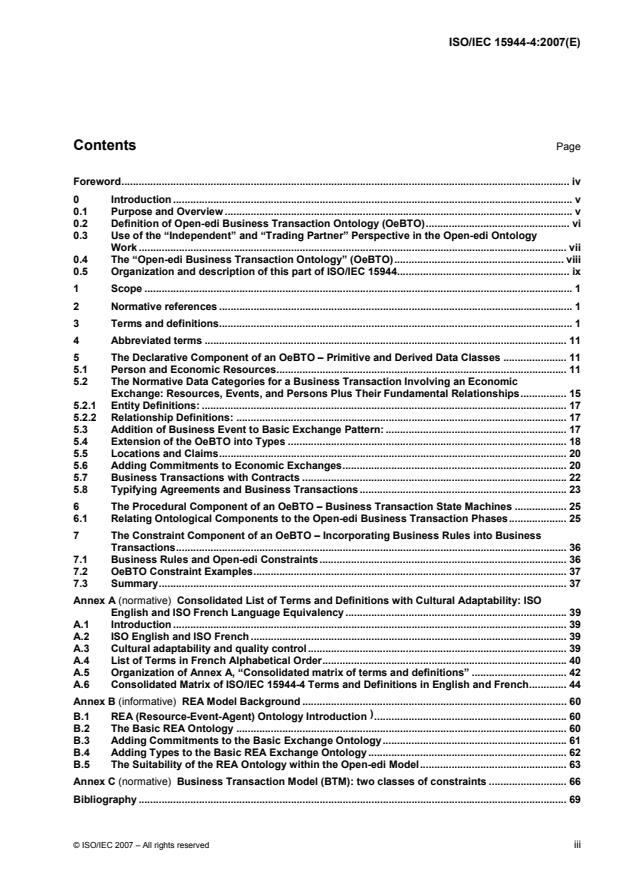
Contents Page
Foreword. iv
0 Introduction . v
0.1 Purpose and Overview . v
0.2 Definition of Open-edi Business Transaction Ontology (OeBTO). vi
0.3 Use of the “Independent” and “Trading Partner” Perspective in the Open-edi Ontology
Work . vii
0.4 The “Open-edi Business Transaction Ontology” (OeBTO). viii
0.5 Organization and description of this part of ISO/IEC 15944. ix
1 Scope . 1
2 Normative references . 1
3 Terms and definitions. 1
4 Abbreviated terms . 11
5 The Declarative Component of an OeBTO – Primitive and Derived Data Classes . 11
5.1 Person and Economic Resources. 11
5.2 The Normative Data Categories for a Business Transaction Involving an Economic
Exchange: Resources, Events, and Persons Plus Their Fundamental Relationships. 15
5.2.1 Entity Definitions: . 17
5.2.2 Relationship Definitions: . 17
5.3 Addition of Business Event to Basic Exchange Pattern: . 17
5.4 Extension of the OeBTO into Types . 18
5.5 Locations and Claims. 20
5.6 Adding Commitments to Economic Exchanges. 20
5.7 Business Transactions with Contracts .22
5.8 Typifying Agreements and Business Transactions . 23
6 The Procedural Component of an OeBTO – Business Transaction State Machines . 25
6.1 Relating Ontological Components to the Open-edi Business Transaction Phases. 25
7 The Constraint Component of an OeBTO – Incorporating Business Rules into Business
Transactions. 36
7.1 Business Rules and Open-edi Constraints. 36
7.2 OeBTO Constraint Examples. 37
7.3 Summary. 37
Annex A (normative) Consolidated List of Terms and Definitions with Cultural Adaptability: ISO
English and ISO French Language Equivalency . 39
A.1 Introduction . 39
A.2 ISO English and ISO French . 39
A.3 Cultural adaptability and quality control. 39
A.4 List of Terms in French Alphabetical Order. 40
A.5 Organization of Annex A, “Consolidated matrix of terms and definitions” . 42
A.6 Consolidated Matrix of ISO/IEC 15944-4 Terms and Definitions in English and French. 44
Annex B (informative) REA Model Background . 60
)
B.1 REA (Resource-Event-Agent) Ontology Introduction . 60
B.2 The Basic REA Ontology . 60
B.3 Adding Commitments to the Basic Exchange Ontology. 61
B.4 Adding Types to the Basic REA Exchange Ontology. 62
B.5 The Suitability of the REA Ontology within the Open-edi Model. 63
Annex C (normative) Business Transaction Model (BTM): two classes of constraints . 66
Bibliography . 69
© ISO/IEC 2007 – All rights reserved iii
Foreword
ISO (the International Organization for Standardization) and IEC (the International Electrotechnical
Commission) form the specialized system for worldwide standardization. National bodies that are members of
ISO or IEC participate in the development of International Standards through technical committees
established by the respective organization to deal with particular fields of technical activity. ISO and IEC
technical committees collaborate in fields of mutual interest. Other international organizations, governmental
and non-governmental, in liaison with ISO and IEC, also take part in the work. In the field of information
technology, ISO and IEC have established a joint technical committee, ISO/IEC JTC 1.
International Standards are drafted in accordance with the rules given in the ISO/IEC Directives, Part 2.
The main task of the joint technical committee is to prepare International Standards. Draft International
Standards adopted by the joint technical committee are circulated to national bodies for voting. Publication as
an International Standard requires approval by at least 75 % of the national bodies casting a vote.
Attention is drawn to the possibility that some of the elements of this document may be the subject of patent
rights. ISO and IEC shall not be held responsible for identifying any or all such patent rights.
ISO/IEC 15944-4 was prepared by Joint Technical Committee ISO/IEC JTC 1, Information technology,
Subcommittee SC 32, Data management and interchange.
ISO/IEC 15944 consists of the following parts, under the general title Information technology — Business
Operational View:
⎯ Part 1: Operational aspects of Open-edi for implementation
⎯ Part 2: Registration of scenarios and their components as business objects
⎯ Part 4: Business transaction scenarios — Accounting and economic ontology
⎯ Part 5: Identification and referencing of requirements of jurisdictional domains as sources of external
constraints
The following part is under preparation:
⎯ Part 6: Technical introduction of eBusiness modeling [Technical Report]
eBusiness vocabulary will form the subject of a future Part 7.
iv © ISO/IEC 2007 – All rights reserved
0 Introduction
0.1 Purpose and overview
This work is motivated with important ideas from the ISO Open-edi specifications as represented in
ISO/IEC 15944-1, Information technology — Business agreement semantic descriptive techniques — Part 1:
Operational aspects of Open-edi for implementation. In ISO/IEC 15944-1 and in some of its earlier
foundational expositions, such as ISO/IEC 14662, there were important concepts defined and interrelated
such as business transaction, fundamental activities of a business transaction, commitment, Person, role,
scenario and others. A need for relating all of these concepts in a formal framework for the Open-edi work is
apparent.
This is a question of ontology: a formal specification of the concepts that exist in some domain of interest and
the relationships that hold among them [8]. In this case, the domains of interest are those that encompass
Open-edi activities; that is: law, economics and accounting in an extended sense — not the internal
accounting of one particular firm, but the accountabilities of each of the participants in an external business
transaction.
Ontologies are generally classified as either upper-level ontologies — dealing with generalized phenomena
like time, space and causality — or domain ontologies, dealing with phenomena in a specific field like military
operations, manufacturing, medical practice or business. The economic and accounting ontology being used
in electronic business eXtended Markup Language (ebXML), in the UN/CEFACT modeling methodology, and
E-Commerce Integration Meta-Framework (ECIMF) work is entitled the Resource-Event-Agent Ontology
1)
(REA) . REA is used here as an ontological framework for specifying the concepts and relationships involved
in business transactions and scenarios in the Open-edi sense of those terms. The resulting framework is titled
the Open-edi business transaction ontology (OeBTO).
The REA ontology is actually an elementary set of concepts derived from basic definitions in accounting and
economics. These concepts are illustrated most simply with a UML class diagram. See Figure 1, which
illustrates the simple Resource-Event-Agent structure that gives REA its name. A business transaction or
exchange has two REA constellations joined together, noting that the two parties to a simple market transfer
expect to receive something of value in return when they trade. For example, a seller, who delivers a product
to a buyer, expects a requiting cash payment in return.
from
Person
resource-flow
Economic Economic
(Economic
Resource Event
Agent)
to
duality
Figure 1 — Basic Economic Primitives of the Open-edi Ontology
There are some specific points of synergy between the REA ontology and the ISO Open-edi specifications as
represented in ISO/IEC 15944-1.
ISO/IEC 15944-1:2002, 3.9 defines commitment as “the making or accepting of a right, obligation, liability or
responsibility by a Person.”. Commitment is a central concept in REA. Commitments are promises to
execute future economic events, for example to fulfill an order by executing a delivery event.
1) Elements of the REA ontology as they are used in other standards work are explained in Annex B.
© ISO/IEC 2007 – All rights reserved v
ISO/IEC 15944-1:2002, 6.1.3, Rule 1 states: “Business transactions require both information exchange and
commitment exchange.” REA firmly agrees with and helps give definition to this assertion. Reciprocal
commitments are exchanged in REA via economic contracts that govern exchanges, while information
exchange is tracked via business events that govern the state transitions of business transaction entities that
represent various economic phenomena.
ISO/IEC 15944-1:2002, 6.3.1, Rule 39 states: “Conceptually a business transaction can be considered to be
constructed from a set of fundamental activities. They are planning, identification, negotiation, actualization
and post-actualization.” For REA, actualization is the execution of economic events that fulfill
commitments. Planning and identification involve business partners with types of economic resources, events
and persons, while negotiation is finalized by an economic contract which is a bundle of commitments. The
UN/CEFACT Business Process Group has also defined negotiation protocols that assist in forming
commitments. The Open-edi set of activities and the REA economic concepts will help each other tie together
all the activities into a cohesive business transaction, and then unite that transaction definition with its related
information models.
Finally, with regard to the preliminary agreement between Open-edi and REA, the two major sets of ideas that
characterize the Open-edi work — the specification of Business Transactions and the configuration of
Scenarios — correspond well at the aggregate level to what the REA ontology calls the accountability
infrastructure and the policy infrastructure. A business transaction specifies in a descriptive sense actual
business events what has occurred or has been committed to. Conversely, a scenario is more prescriptive: it
configures what could be or should be. The realm of both descriptions and prescriptions is important to
Open-edi and to REA, and they can work well in developing standards for each.
0.2 Definition of Open-edi Business Transaction Ontology (OeBTO)
According to the most widely accepted definition from Tom Gruber [7], “ontology is a formal, explicit
2)
specification of a shared conceptualization.” The individual components of this meaning are each worth
examining.
⎯ formal = machine-readable;
⎯ explicit specification = concepts, properties, relations, constraints and axioms are explicitly defined;
⎯ of a shared = consensual knowledge;
⎯ conceptualization = abstract model of some phenomenon in the real world.
At present, the REA model is certainly an explicit specification of a shared conceptualization of economic
phenomena in the accounting community. A formal, machine-readable specification is not proposed in this
part of ISO/IEC 15944; however, such extensions may follow in other standards work.
This part of ISO/IEC 15944 focuses on integrating the Gruber definition of ontology with an REA-based
approach. It does so from an accounting and economic ontology perspective within an Open-edi Reference
Model context. This is achieved through the introduction of the concept (or construct) of “Open-edi Business
Transaction Ontology (OeBTO)”, which is defined as follows:
formal, rule-based specification and definition of the concepts pertaining to business transactions and
scenarios and the relationships that hold among those concepts
2) See also the expert contribution by Dr. Jake V. Knoppers in the JTC1/SC32/WG1 document N0220, “Draft Definition
for Open-edi Business Transaction Ontology (OeBTO)”, 2002-05-06.
vi © ISO/IEC 2007 – All rights reserved
0.3 Use of the “independent” and “trading partner” perspective in the Open-edi ontology
work
In normal business use, the naming perspective for the ontological primitives would be that of the
entrepreneur or of one of the two trading partners engaged in collaborative commerce. The other trading
partner would ordinarily have a mirror-image view. Thus a sale, a cash receipt or a resource inflow for a
particular entrepreneur would become a purchase, a cash disbursement or a resource outflow for a
corresponding trading partner. From this perspective, business events and their accompanying economic
phenomena would be modeled twice, once in the database of each trading partner. However, for Open-edi
purposes, or for that matter for any other independent modeling of business collaborations like the BRV level
of the UN/CEFACT modeling methodology, this redundancy is not acceptable because it allows the states of
the two representations to become inconsistent. This difference in naming perspective is explained below and
3)
illustrated in Figure 2.
Collaboration Perspective: Trading Partner vs. Independent
Independent view of
Enterprise #1
Inter-enterprise events
Business
Process
Enterprise #2
Business
Business
Process
Process
Business
Business
Process Enterprise #3
Process
Business
Process
Business
Trading Partner view of
Process
Inter-enterprise events
(upstream vendors and
Business
downstream customers)
Process
Business
Dotted arrows represent flow of goods, services, and cash between
Process
different companies; solid arrows represent flows within companies
Figure 2 — Different Views of Business Collaboration
3) Figure 2 was contributed by the Japanese delegation to SC 32, led by Katsuhiro Morita during the Open-edi group
meeting in Victoria in October 2001. (See further, the JTC1/SC32/WG1 document N1 N0190 “AIW15944-4, Information
technology — Business Agreement Descriptive techniques Part 4: Open-edi Ontology”, 2001-10-22.). Some naming
conventions have been added since that first contribution (See further Annex H in document SC32/WG1 N0123).
© ISO/IEC 2007 – All rights reserved vii
Figure 2 illustrates three independent value chains for three different enterprises. Each company has a
connected network of business processes that takes its initial input of resources (called factor inputs for their
production functions) and transforms them via cumulative flows of goods, services and cash into an output for
that firm’s downstream customers. For Open-edi collaboration modeling, these internal processes are not
relevant until a resource flow crosses enterprise boundaries, as is illustrated for Enterprise #2 which accepts
materials from Enterprise #1 and which delivers materials to Enterprise #3 (most probably in both cases for
cash payments in return). The two dotted lines with double-headed arrows show these inter-enterprise events.
The independent or collaboration perspective of resource flows is anchored on the view of the eye outside of
Enterprise #2. This view sees both exchanges as conceptually similar with flows of materials being requited by
flows of funds. Such a perspective is quite different from that of the eye inside of Enterprise #2, which sees
the flow between Enterprise #1 and Enterprise #2 as a “purchase” and the flow between Enterprise #2 and
Enterprise #3 as a “sale”. Note that an eye inside of Enterprise #1 (not shown on diagram) would have
modeled the “purchase” of Enterprise #2 as a “sale” of Enterprise #1, hence the redundancy and the inevitable
inconsistency.
Business process modeling can take either of the perspectives shown by the eyes of Figure 2, but the
independent perspective is clearly the choice for Open-edi. This leads to the concept of a business
4)
collaboration that is illustrated in Figure 3 . Most generally, there is a value exchange between two Persons,
with one assuming the role of a “buyer” (has money, desires goods or services) and the other assuming the
role of a “seller” (has goods or services, desires money). It is also possible to anchor the independent view on
time, with one event being the initiating flow and the requiting event being the responding flow. For internal
database purposes of corporate accountability, “trading partner perspective” terms are directly derivable from
“independent perspective” terms.
Collaboration Space
Value Exchange
Buyer Seller
Figure 3 — Concept of a Business Collaboration
0.4 The “Open-edi Business Transaction Ontology” (OeBTO)
Subclause 0.2 and 0.3 have suggested:
• that the components of the REA domain ontology model are sufficiently well-defined, stable and well-
known that they can clearly serve as the basis for an ontological specification of the concepts involved
in collaborative exchanges between trading partners; and
4) Figure 3 was contributed by the Japanese delegation to SC 32, led by Katsuhiro Morita, during the Open-edi group
meeting in Seoul, in May 2002.
viii © ISO/IEC 2007 – All rights reserved
• that the components of that model must be viewed from the outside perspective of a modeler viewing
the economic phenomena independently.
Because the primitive economic terms are being adopted here for use with the operational aspects of
Open-edi from ISO/IEC 15944-1, the ontology to be defined will be termed the “Open-edi Business
Transaction Ontology” (OeBTO). Its definition is:
formal, rule-based specification and definition of the concepts pertaining to business transactions and
scenarios and the relationships that hold among these concepts
From the definitional foundations of both ISO/IEC 15944-1 and the REA model, it follows that the OeBTO will
follow these principles:
• As a business transaction ontology, a distinguishing characteristic of OeBTO is that in addition to
information exchange, it incorporates commitment exchange among autonomous Persons.
• An OeBTO requires the use of clear and pre-defined rules, principles and guidelines (see 5.1 of
ISO/IEC 15944-1:2002).
• An OeBTO is neutral in terms of technology, representation, and application.
• The scope of OeBTO covers all areas of business transactions (public/private, industry sectors,
international, regional, etc.).
• The semantics of the concepts represented in the OeBTO are explicitly specified and constrained.
0.5 Organization and description of this part of ISO/IEC 15944
Clause 1 and Clause 2 provide scope and normative references for OeBTO. The basic OeBTO definitions are
first enumerated in Clause 3, while Clause 4 provides a table of symbols and abbreviations. Clause 5 provides
the declarative substance for this part of ISO/IEC 15944 — a set of UML class diagrams and conceptual
explanations that circumscribe the Open-edi Business Transaction Ontology. Clause 6 explains the
mechanics of a business transaction state machine — the procedural component of an OeBTO — while
Clause 7 explains the (internal) constraint component of OeBTO — its repository for business rules.
At the end of this part of ISO/IEC 15944 are some helpful Annexes that provide elaboration on the points
raised in the main body. Normative Annex A is a consolidated list of all the terms and definitions used in this
part of ISO/IEC 15944 in both ISO English and ISO French. The other normative annex is Annex C, which is
common to Parts 2, 4 and 5 of ISO/IEC 15944. Annex B is informative text providing more detailed
background information on the REA Model. This part of ISO/IEC 15944 concludes with a bibliography.
© ISO/IEC 2007 – All rights reserved ix
INTERNATIONAL STANDARD ISO/IEC 15944-4:2007(E)
Information technology — Business Operational View —
Part 4:
Business transaction scenarios — Accounting and economic
ontology
1 Scope
This part of ISO/IEC 15944 provides a set of UML class diagrams and conceptual explanations that
circumscribe the Open-edi Business Transaction Ontology. It explains the mechanics of a business
transaction state machine — the procedural component of an OeBTO — and the (internal) constraint
component of OeBTO — its repository for business rules.
This part of ISO/IEC 15944 addresses collaborations among independent trading partners as defined in
ISO/IEC 15944-1. This part of ISO/IEC 15944 applies to both binary collaborations (buyer and seller) and
mediated collaborations (buyer, seller, third-party). The ontological features described herein propose
standards only for the BOV — that is, the business aspects of business transactions as they are defined in
ISO/IEC 15944-1.
2 Normative references
The following referenced documents are indispensable for the application of this document. For dated
references, only the edition cited applies. For undated references, the latest edition of the referenced
document (including any amendments) applies.
ISO/IEC 15944-1:2002, Information technology — Business agreement semantic descriptive techniques —
Part 1: Operational aspects of Open-edi for implementation
ISO/IEC 15944-5:2006, Information technology — Business Operational View — Part 5: Identification and
referencing of requirements of jurisdictional domains as sources of external constraints
3 Terms and definitions
For the purposes of this document, the following terms and definitions apply.
3.1
agent
Person acting for another Person in a clearly specified capacity in the context of a business transaction
NOTE Excluded here are agents as “automatons” (or robots, bobots, etc.). In ISO/IEC 14662, “automatons” are
recognized and provided for but as part of the Functional Services View (FSV) where they are defined as an “Information
Processing Domain (IPD)”.
[ISO/IEC 15944-1:2002 (3.1)]
© ISO/IEC 2007 – All rights reserved 1
3.2
attribute
characteristic of an object or entity
[ISO/IEC 11179-3:2003 (3.1.3)]
3.3
bilateral transaction
subtype of a business transaction where the Persons include only the buyer and the seller, or alternatively
other Persons acting as agents for the buyer and/or seller
3.4
business
series of processes, each having a clearly understood purpose, involving more than one Person, realized
through the exchange of recorded information and directed towards some mutually agreed upon goal,
extending over a period of time
NOTE Adapted from ISO/IEC 14662:2004 (3.1.2).
3.5
business event
occurrence in time that partners to a business transaction wish to monitor or control
NOTE 1 Business events are the workflow tasks that business partners need to accomplish to complete a business
transaction among themselves. As business events occur, they cause a business transaction to move through its various
phases of planning, identification, negotiation, actualization and post-actualization.
NOTE 2 Occurrences in time can either
⎯ be internal as mutually agreed to among the parties to a business transaction; and/or,
⎯ reference some common publicly available and recognized date/time referencing schema (e.g. one based on using
ISO 8601 and/or ISO 19135).
3.6
business location
geographic site where an economic event is deemed to occur with its attendant transfer of an economic
resource from one Person to another
3.7
Business Operational View
BOV
perspective of business transactions limited to those aspects regarding the making of business decisions
and commitments among Persons, which are needed for the description of a business transaction
[ISO/IEC 14662:2004 (3.1.3)]
3.8
business transaction
predefined set of activities and/or processes of Persons which is initiated by a Person to accomplish an
explicitly shared business goal and terminated upon recognition of one of the agreed conclusions by all the
involved Persons although some of the recognition may be implicit
NOTE Adapted from ISO/IEC 14662:2004 (3.1.4).
3.9
business transaction entity
computable representation of any real-world entity that participates, occurs or is materialized during a
business transaction
2 © ISO/IEC 2007 – All rights reserved
3.10
business transaction entity type
abstract specification of a business transaction entity, detailing its recommended characteristics, its
recommended methods and its recommended life-cycle states
NOTE A business transaction entity type will usually specify the types of business events that cause a business
transaction entity of this type to proceed through its different states as the business transaction itself progresses through
its phases of planning, identification, negotiation, actualization and post-actualization.
3.11
buyer
Person who aims to get possession of a good, service and/or right through providing an acceptable
equivalent value, usually in money, to the Person providing such a good, service and/or right
[ISO/IEC 15944-1:2002 (3.8)]
3.12
collaboration space
business activity space where an economic exchange of valued resources is viewed independently and not
from the perspective of any business partner
NOTE In collaboration space, an individual partner’s view of economic phenomena is de-emphasized. Thus, the use
of common business and accounting terms like purchase, sale, cash receipt, cash disbursement, raw materials and
finished goods is not allowed because they view resource flows from a participant’s perspective.
3.13
commitment
making or accepting of a right, obligation, liability or responsibility by a Person that is capable of enforcement
in the jurisdiction in which the commitment is made
[ISO/IEC 15944-1:2002 (3.9)]
3.14
constraint
rule, explicitly stated, that prescribes, limits, governs or specifies any aspect of a business transaction
NOTE 1 Constraints are specified as rules forming part of components of Open-edi scenarios, i.e. as scenario
attributes, roles and/or information bundles.
NOTE 2 For constraints to be registered for implementation in Open-edi, they must have unique and unambiguous
identifiers.
NOTE 3 A constraint may be agreed to among parties (condition of contract) and is therefore considered an “internal
constraint”. Or a constraint may be imposed on parties (e.g. laws, regulations, etc.) and is therefore considered an
“external constraint”.
[ISO/IEC 15944-1:2002 (3.11)]
3.15
custody
association between a Person and an economic resource where the Person has physical control only over
the resource or controls access
NOTE Having custody of a good, service and/or right does not imply and is differentiated from having economic
control of the same (e.g. a Person may have economic control of a good even though it is not under its custody).
3.16
data
〈business transaction〉 representations of recorded information that are being prepared or have been
prepared in a form suitable for use in a computer system
[ISO/IEC 15944-1:2002 (3.14)]
© ISO/IEC 2007 – All rights reserved 3
3.17
defined market model
trade model where the buyer and seller accept the entry terms of a specified market in advance and where
that market has an accepted and recognized source for business rules and conventions
NOTE In a defined market, the phases of a business transaction — planning, identification, negotiation, actualization
and post-actualization — are governed by the rules and conventions of the particular defined market.
3.18
duality
association between economic events where one is the legal or economic consideration for the other in an
exchange
NOTE Duality is the conceptual analog of double entry in traditional bookkeeping. For example, a shipment from a
partner requires a matching flow in, like a payment, to balance accounts between the parties.
3.19
economic agreement
arrangement of reciprocated economic commitments between two partners where the abstract specification
of terms of trade is incomplete and not subject to legal enforcement
3.20
economic bundle
association between economic commitments and the economic contract that bundles those promises and
binds them to the two partners who negotiated them
3.21
economic claim
expectation of one Person to receive a future inflow of economic resources from another Person because
of an economic exchange which is currently incomplete
3.22
economic commitment
type of commitment by one Person to transfer economic resources to another Person at some specified
point in the future
3.23
economic contract
bundling of reciprocated economic commitments between two partners where the abstract specification of
the proposed economic exchange is deemed to be complete
3.24
economic control
association between a Person and an economic resource where the Person either owns the economic
resource or is otherwise able to derive economic benefit (utility) from it
3.25
economic event
occurrence in time wherein ownership of an economic resource is transferred from one Person to another
Person
NOTE Occurrences in time can either
⎯ be internal as mutually agreed to among the parties to a business transaction; and/or
⎯ reference some common publicly available and recognized date/time referencing schema (e.g. one based on using
ISO 8601 and/or ISO 19135).
4 © ISO/IEC 2007 – All rights reserved
3.26
economic event type
abstract specification of an economic event where its grouped properties can be designated without
attachment to an actual, specific occurrence in time
NOTE Example of attributes at the type level for events might be expected-duration or standard-pricing-percentage.
3.27
economic exchange
type of a business transaction where the goal is an exchange of economic resources between two
Persons where both parties derive higher utility after the completed business transaction
NOTE An economic exchange usually involves two economic events with different types of economic resources
flowing in opposite directions. For example, an exchange of cash for a good involves a shipment with a requited payment
following.
3.28
economic resource
good, right or service of value, under the control of a Person
3.29
economic resource type
abstract specification of an economic resource where its grouped properties can be designated without
attachment to an actual, specific economic resource
NOTE Example attributes at the type level for an economic resource like an automobile might include its designated
fuel capacity or its maximum expected range.
3.30
economic role
abstract specification of a Person for economic purposes where its grouped properties can be designated
without attachment to an actual Person
NOTE An example economic role might be qualified buyer or approved shipper, i.e. from an economic perspective
only.
3.31
economic specification
association between an economic commitment and the abstract properties of an economic event, an
economic resource, a partner or a business location
3.32
entity
concrete or abstract thing that exists, did exist or might exist including associations among these things
EXAMPLE A person, object, event, idea, process, etc.
NOTE An entity exists whether data about it are available or not.
[ISO/IEC 2382-17:1999 (17.02.05)]
3.33
external constraint
constraint which takes precedence over internal constraints in a business transaction, i.e. is external to
those agreed upon by the parties to a business transaction
NOTE 1 Normally external constraints are created by law, regulation, orders, treaties, conventions or similar
instruments.
NOTE 2 Other sources of external constraints are those of a sectorial nature, those which pertain to a particular
jurisdiction or mutually agreed to common business conventions (e.g. INCOTERMS, exchanges, etc.).
© ISO/IEC 2007 – All rights reserved 5
NOTE 3 External constraints can apply to the nature of the good, service and/or right provided in a business
transaction.
NOTE 4 External constraints can demand that a party to a business transaction meet specific requirements of a
particular role.
EXAMPLE 1 Only a qualified medical doctor may issue a prescription for a controlled drug.
EXAMPLE 2 Only an accredited share dealer may place transactions on the New York Stock Exchange.
EXAMPLE 3 Hazardous wastes may only be conveyed by a licensed enterprise.
NOTE 5 Where the information bundles (IBs), including their Semantic Components (SCs), of a business transaction
are also to form the whole of a business transaction (e.g. for legal or audit purposes), all constraints must be recorded.
EXAMPLE There may be a legal or audit requirement to maintain the complete set of recorded information
pertaining to a business transaction, i.e. as the information bundles exchanged, as a “record”.
NOTE 6 A minimum external constraint applicable to a business transaction often requires one to differentiate whether
the Person, i.e. that is a party to a business transaction, is an “individual”, “organization” or “public administration”. For
example, privacy rights apply only to a Person as an “individual”.
[ISO/IEC 15944-1:2002 (3.23)]
3.34
fulfillment
association between an economic commitment and an economic event where the event executes the
promised resource flow from one Person to another
NOTE For example, a delivery to a customer would fulfill that customer’s sale order.
3.35
governed
association between an economic agreement and the business transaction whose conduct and phases are
subject to that economic agreement
3.36
individual
Person who is a human being, i.e. a natural person, who acts as a distinct indivisible entity or is considered
as such
[ISO/IEC 15944-1:2002 (3.28)]
3.37
information bundle
IB
formal description of the semantics of the information to be exchanged by Open-edi Parties playing roles in
an Open-edi scenario
[ISO/IEC 14662:2004 (4.1.2.2)]
3.38
internal constraint
constraint which forms part of the commitment(s) mutually agreed to among the parties to a business
transaction
NOTE Internal constraints are self-imposed. They provide a simplified view for modeling and re-use of scenario
components of a business transaction for which there are no external constraints or restrictions on the nature of the
conduct of a business transaction other than those mutually agreed to by the buyer and seller.
[ISO/IEC 15944-1:2002 (3.33)]
6 © ISO/IEC 2007 – All rights reserved
3.39
location type
abstract specification of an economic location where its grouped properties can be designated without
attachment to an actual place
NOTE An example location type might be an accepted shipping facility or approved hospital location.
3.40
materialized
association between an economic event and an economic claim where the occurrence of the economic
event causes the economic claim to come into existence
3.41
mediated transaction
subtype of a business transaction where a third party mediates between the partners as mutually agreed
to by the partners
3.42
object
anything perceivable or conceivable
NOTE Objects may be material (e.g. an engine, a sheet of paper, a diamond), immaterial (e.g. a conversion ratio, a
project plan) or imagined (e.g. a unicorn).
[ISO 1087-1:2000 (3.1.1)]
3.43
Open-edi
electronic data interchange among multiple autonomous Persons to accomplish an explicit shared
business goal according to Open-edi standards
[ISO/IEC 14662:2004 (3.1.9)]
3.44
Open-edi Business Transaction Ontology
OeBTO
formal, rule-based specification and definition of the concepts pertaining to business transactions and
scenarios and the relationships that hold among those concepts
3.45
Open-edi Party
OeP
Person that participates in Open-edi
NOTE 1 Adapted from ISO/IEC 14662:2004 (3.1.11).
NOTE 2 Often in ISO/IEC 15944 referred to generically as “party” or “parties” for any entity modeled as a Person as
playing a role in Open-edi scenarios.
3.46
Open-edi scenario
OeS
formal specification of a class of business transactions having the same business goal
[ISO/IEC 14662:2004 (3.1.12)]
3.47
organization
unique framework of authority within which a person or persons act, or are designated to act, towards some
purpose
© ISO/IEC 2007 – All rights reserved 7
NOTE The kinds of organizations covered by this part of ISO/IEC 15944 include the following examples:
a) an organization incorporated under law;
b) an unincorporated organization or activity providing goods and/or services including:
1) partnerships,
2) social or other non-profit organizations or similar bodies in which ownership or control is vested in a group of
individuals,
3) sole proprietorships,
4) governmental bodies;
c) groupings of the above types of organizations where there is a need to identify these in information interchange.
[ISO/IEC 6523-1:1998 (3.1)]
3.48
organization part
department, service or other entity within an organization, which needs to be identified for information
interchange
[ISO/IEC 6523-1:1998 (3.2)]
3.49
organization Person
organization part which has the properties of a Person and thus is able to make commitments on behalf of
that organization
NOTE 1 An organization can have one or more organization Persons.
NOTE 2 An organization Person is deemed to represent and act on behalf of the organization and to do so in a
specified capacity.
NOTE 3 An organization Person can be a “natural person” such as an employee or officer of the organization.
NOTE 4 An organization Person can be a legal person, i.e. another organization.
[ISO/IEC 15944-1:2002 (3.46)]
3.50
participates
association between an economic event and each of the two Persons participating in the economic event
NOTE Usually there is a “from” association and a “to” association, depending upon the direction of the flow of the
economic resource.
3.51
partner
subtype of Person that includes buyer and seller
3.52
Person
entity, i.e. a natural or legal person, recognized by law as having legal rights and duties, able to make
commitment(s), assume and fulfill resulting obligation(s), and able to be held accountable for its action(s)
NOTE 1 Synonyms for “legal person” include “artificial person”, “body corporate”, etc., depending on the terminology
used in competent jurisdictions.
NOTE 2 Person is capitalized to ind
...
Questions, Comments and Discussion
Ask us and Technical Secretary will try to provide an answer. You can facilitate discussion about the standard in here.
Loading comments...