

ISO/TR 18228-8:2026
(Main)Design using geosynthetics — Part 8: Surface erosion control
- Abstract
This document provides information on the design of geosynthetics for surface erosion control on slopes and river or channel banks. It does not apply to the design of geosynthetics for the stability of slopes and river or channel banks. It does not apply to coastal protection issues.
- Status
- Published
- Publication Date
- 24-Jun-2026
- Technical Committee
- ISO/TC 221 - Geosynthetics
- Drafting Committee
- ISO/TC 221/WG 6 - Design using geosynthetics
- Current Stage
- 6060 - International Standard published
- Start Date
- 25-Jun-2026
- Completion Date
- 25-Jun-2026


ISO/TR 18228-8:2026 is an ISO Technical Report on design using geosynthetics for surface erosion control. It gives guidance for selecting and designing geosynthetics for slopes and river or channel banks, for engineers and specifiers who need to control soil loss rather than slope stability or coastal protection.
What does ISO/TR 18228-8 specify?
ISO/TR 18228-8:2026 provides design information for geosynthetics used to limit surface erosion on slopes and on river or channel banks. The report is organized from erosion mechanisms and design factors to product types, testing, and two informative annexes with design methods for slopes and channels.
The main structure is:
- Clause 1 - Scope
- Clause 2 - Normative references
- Clause 3 - Terms and definitions
- Clause 4 - Types of erosion
- Clause 5 - Design considerations for erosion and sediment control
- Clause 6 - Types of geosynthetics for erosion and sediment control
- Clause 7 - Testing of erosion and sediment control products
- Annex A - Revised universal soil loss equation (RUSLE)
- Annex B - Detailed design for erosion control with geosynthetics on channel banks
| Annex | What it covers |
|---|---|
| Annex A | RUSLE factors, soil-loss calculation, and design guidance for slope erosion control |
| Annex B | Hydraulic design for geosynthetics on channel banks, including allowable velocity and shear stress |
What are the key requirements of ISO/TR 18228-8?
How ISO/TR 18228-8 frames the erosion problem
ISO/TR 18228-8:2026 separates erosion into water erosion and wind erosion, then breaks water erosion into splash, sheet, rill, gully, and channel erosion. That matters because the controlling mechanism changes the product and the design check. For example, rainfall impact, runoff, and concentrated flow do not behave the same way.
The report also treats wind erosion as suspension, saltation, and surface creep. That helps a designer decide whether the main problem is water, wind, or both before selecting a geosynthetic and a cover strategy.
How ISO/TR 18228-8 guides site-based design
ISO/TR 18228-8:2026 says the designer should base erosion and sediment control on soil survey information, climate and precipitation data, topography, and a field visit. In practice, this means checking how erodible the soil is, how much rain the site gets, how long and steep the slopes are, and how much existing vegetation can be kept.
Clause 5 presents a stepwise design process: identify likely erosion and sediment problems, define design objectives, evaluate alternatives, select suitable best management practices, and prepare a plan. That is useful because erosion control usually depends on combining measures, not on one product alone.
How ISO/TR 18228-8 uses RUSLE for slopes
Annex A uses the Revised universal soil loss equation (RUSLE) for slope erosion. RUSLE combines rainfall-runoff erosivity, soil erodibility, slope length and steepness, cover-management, and support practice factors. For construction sites, the report notes that the support practice factor is generally taken as 1,0.
This matters because RUSLE is the report’s main tool for comparing design options and identifying critical source areas. Annex A also makes clear that RUSLE predicts sheet and rill erosion, not concentrated runoff, so it is a planning tool rather than a complete description of every erosion mode.
How ISO/TR 18228-8 treats product selection
Clause 6 groups geosynthetics by function and structure, including light geogrids and geonets, geomats, reinforced geomats, pre-filled geomats, geoblankets and natural fibres geotextiles, geocells, geotextiles for a silt fence, georolls, hard armour systems, and other products such as mulches and fibre roving. The report distinguishes temporary products from permanent ones and notes that some products are intended to work with vegetation, while others provide direct surface protection.
That distinction matters in practice because the right product depends on whether the site needs temporary cover during establishment, long-term erosion protection, or sediment capture. Clause 6 also points to ISO/TR 18228-3 for sediment retention systems and notes that hard armour systems are not considered in this document’s design guidance.
How ISO/TR 18228-8 recommends testing
Clause 7 divides testing into index testing, bench-scale testing, and large-scale performance testing. Index tests are used for quality control and comparison of product properties; bench-scale tests compare products under controlled laboratory conditions; large-scale tests simulate installed performance and are acceptable for design calculations.
This hierarchy matters because material data alone do not show how a product behaves on a slope or in a channel. The large-scale tests in Clause 7 are the most relevant when a designer needs performance data for actual field conditions.
How ISO/TR 18228-8 handles channel-bank design
Annex B gives a design approach for non-navigable channels with intermittent flow and relatively low velocities. It uses two limit checks: allowable velocity and allowable shear stress, with a factor of safety. The annex also discusses freeboard, bends, downstream protection length, and the effect of vegetation on flow conditions.
For practice, this means channel-bank protection is checked against hydraulic demand, not only against soil cover. Annex B also notes that allowable velocities and shear stresses can be taken from flume testing such as ASTM D6460, and that design should reflect whether the lining is vegetated or unvegetated.
What terms does ISO/TR 18228-8 define?
ISO/TR 18228-8:2026 uses the terms and definitions from ISO 10318-1 and adds several product terms of its own.
- Erosion control revegetation mat (ECRM) - a geomat placed on a slope without being infilled, used to protect the surface while vegetation develops.
- Reinforced geomat - a geocomposite made from an erosion control product plus a reinforcing element such as a geogrid, steel mesh, or yarns.
- Prefilled geomat - a factory-filled erosion control product with a bitumen-bound mineral filler or other filler that still leaves space for vegetation to grow through.
- Georoll (GRO) - a permeable tube-like structure of natural and/or synthetic fibres inside netting, also known as a sediment retention fibre roll (SRFR).
- Turf reinforcement mat (TRM) - a geomat placed on a slope with topsoil or seeds, or both, to support vegetation and root reinforcement.
Who uses ISO/TR 18228-8?
ISO/TR 18228-8:2026 is used by geosynthetics designers, civil and environmental engineers, contractors, specifiers, quality managers, and buyers who need to choose and justify erosion control systems. It is relevant to road and highway works, construction sites, drainage channels, river-bank protection, earthworks, and land development where surface runoff can remove soil.
Testing laboratories and manufacturers also use it to compare products, run quality-control tests, and report performance properties in a way that supports design decisions. Environmental and site managers use it when they need to reduce sediment leaving a disturbed area.
Which standards are used with ISO/TR 18228-8?
ISO/TR 18228-8:2026 refers to a number of standards that support its vocabulary, design checks, and test methods.
- ISO 10318-1 - provides the geosynthetics terms and definitions used in Clause 3.
- ISO/TR 18228-1 - gives general information for the ISO/TR 18228 series.
- ISO/TR 18228-3 - is referenced in Clause 6.8 for sediment retention systems.
- ISO 9863-1, ISO 9864, ISO 10319, ISO 13426-1, ISO 13426-2, ISO 25619-2, ISO 12956, ISO 11058, ISO 11925-2, EN 12224, EN 12225 - provide the material-property tests listed in Table 1.
- ASTM D7101, ASTM D7207, ASTM D7322, ASTM D5141, ASTM D6459, ASTM D6460, CEN/TS 17445 - provide bench-scale and large-scale performance tests for erosion control, filtration, plant growth, and channel or slope protection.
- ISO 22476-3 - supports the standard penetration test used in Annex B when soil compaction class is needed for channel-bank design.
What does the ISO/TR 18228-8 document contain?
ISO/TR 18228-8:2026 contains a practical mix of design guidance, test references, and worked examples. Clause 7 lists the index, bench-scale, and large-scale tests used for erosion and sediment control products, with the test methods grouped by the property they measure.
Annex A contains the RUSLE formulas, factor definitions, unit conversions, soil texture guidance, C-factor examples, and example soil-loss calculations for a construction site. Annex B contains channel-flow concepts, allowable velocity and shear-stress methods, flow and bend calculations, typical lining data, and an example design for a trapezoidal channel with geomats and reinforced geomats.
Get Certified
Connect with accredited certification bodies for this standard

Control Union Certifications
Global certification for agriculture and sustainability.

Hohenstein Institut
Textile testing and certification.

Bureau Veritas Bangladesh
Bureau Veritas certification services in Bangladesh.
Sponsored listings
Frequently Asked Questions
ISO/TR 18228-8:2026 is a technical report published by the International Organization for Standardization (ISO). Its full title is "Design using geosynthetics — Part 8: Surface erosion control". This standard covers: This document provides information on the design of geosynthetics for surface erosion control on slopes and river or channel banks. It does not apply to the design of geosynthetics for the stability of slopes and river or channel banks. It does not apply to coastal protection issues.
This document provides information on the design of geosynthetics for surface erosion control on slopes and river or channel banks. It does not apply to the design of geosynthetics for the stability of slopes and river or channel banks. It does not apply to coastal protection issues.
ISO/TR 18228-8:2026 is classified under the following ICS (International Classification for Standards) categories: 59.080.70 - Geotextiles. The ICS classification helps identify the subject area and facilitates finding related standards.
ISO/TR 18228-8:2026 is available in PDF format for immediate download after purchase. The document can be added to your cart and obtained through the secure checkout process. Digital delivery ensures instant access to the complete standard document.
Standards Content (Sample)
Technical
Report
ISO/TR 18228-8
First edition
Design using geosynthetics —
2026-06
Part 8:
Surface erosion control
Dimensionnement utilisant des géosynthétiques —
Partie 8: Lutte contre l'érosion de surface
Reference number
© ISO 2026
All rights reserved. Unless otherwise specified, or required in the context of its implementation, no part of this publication may
be reproduced or utilized otherwise in any form or by any means, electronic or mechanical, including photocopying, or posting on
the internet or an intranet, without prior written permission. Permission can be requested from either ISO at the address below
or ISO’s member body in the country of the requester.
ISO copyright office
CP 401 • Ch. de Blandonnet 8
CH-1214 Vernier, Geneva
Phone: +41 22 749 01 11
Email: copyright@iso.org
Website: www.iso.org
Published in Switzerland
ii
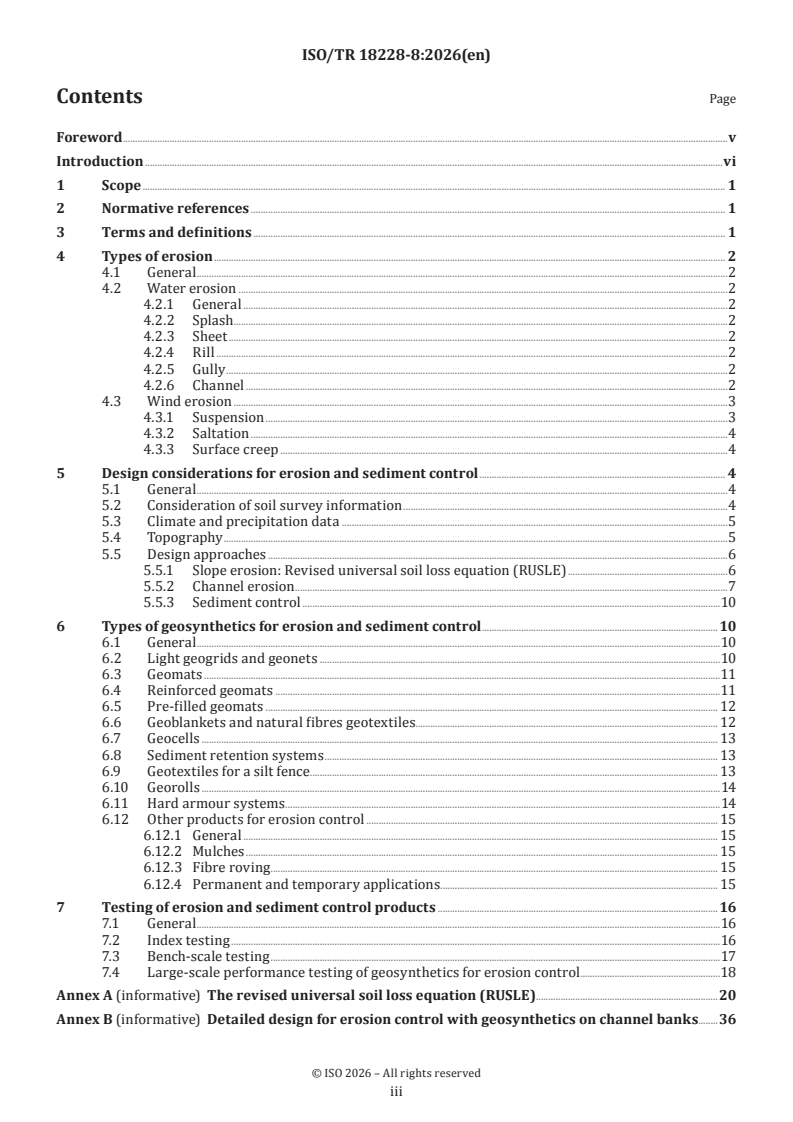
Contents Page
Foreword .v
Introduction .vi
1 Scope . 1
2 Normative references . 1
3 Terms and definitions . 1
4 Types of erosion . 2
4.1 General .2
4.2 Water erosion .2
4.2.1 General .2
4.2.2 Splash . .2
4.2.3 Sheet .2
4.2.4 Rill .2
4.2.5 Gully .2
4.2.6 Channel .2
4.3 Wind erosion .3
4.3.1 Suspension .3
4.3.2 Saltation .4
4.3.3 Surface creep .4
5 Design considerations for erosion and sediment control . 4
5.1 General .4
5.2 Consideration of soil survey information .4
5.3 Climate and precipitation data .5
5.4 Topography .5
5.5 Design approaches .6
5.5.1 Slope erosion: Revised universal soil loss equation (RUSLE) .6
5.5.2 Channel erosion .7
5.5.3 Sediment control .10
6 Types of geosynthetics for erosion and sediment control .10
6.1 General .10
6.2 Light geogrids and geonets .10
6.3 Geomats .11
6.4 Reinforced geomats .11
6.5 Pre-filled geomats . 12
6.6 Geoblankets and natural fibres geotextiles. 12
6.7 Geocells . 13
6.8 Sediment retention systems . 13
6.9 Geotextiles for a silt fence. 13
6.10 Georolls .14
6.11 Hard armour systems .14
6.12 Other products for erosion control . 15
6.12.1 General . 15
6.12.2 Mulches . 15
6.12.3 Fibre roving . . . 15
6.12.4 Permanent and temporary applications. 15
7 Testing of erosion and sediment control products .16
7.1 General .16
7.2 Index testing .16
7.3 Bench-scale testing .17
7.4 Large-scale performance testing of geosynthetics for erosion control .18
Annex A (informative) The revised universal soil loss equation (RUSLE) .20
Annex B (informative) Detailed design for erosion control with geosynthetics on channel banks.36
iii
Bibliography .53
iv
Foreword
ISO (the International Organization for Standardization) is a worldwide federation of national standards
bodies (ISO member bodies). The work of preparing International Standards is normally carried out through
ISO technical committees. Each member body interested in a subject for which a technical committee
has been established has the right to be represented on that committee. International organizations,
governmental and non-governmental, in liaison with ISO, also take part in the work. ISO collaborates closely
with the International Electrotechnical Commission (IEC) on all matters of electrotechnical standardization.
The procedures used to develop this document and those intended for its further maintenance are described
in the ISO/IEC Directives, Part 1. In particular, the different approval criteria needed for the different types
of ISO document should be noted. This document was drafted in accordance with the editorial rules of the
ISO/IEC Directives, Part 2 (see www.iso.org/directives).
ISO draws attention to the possibility that the implementation of this document may involve the use of (a)
patent(s). ISO takes no position concerning the evidence, validity or applicability of any claimed patent
rights in respect thereof. As of the date of publication of this document, ISO had not received notice of (a)
patent(s) which may be required to implement this document. However, implementers are cautioned that
this may not represent the latest information, which may be obtained from the patent database available at
www.iso.org/patents. ISO shall not be held responsible for identifying any or all such patent rights.
Any trade name used in this document is information given for the convenience of users and does not
constitute an endorsement.
For an explanation of the voluntary nature of standards, the meaning of ISO specific terms and expressions
related to conformity assessment, as well as information about ISO's adherence to the World Trade
Organization (WTO) principles in the Technical Barriers to Trade (TBT), see www.iso.org/iso/foreword.html.
This document was prepared by Technical Committee ISO/TC 221, Geosynthetics.
A list of all parts in the ISO 18228 series can be found on the ISO website.
Any feedback or questions on this document should be directed to the user’s national standards body. A
complete listing of these bodies can be found at www.iso.org/members.html.
v
Introduction
The ISO/TR 18228 series provides information regarding designs using geosynthetics for soils and below
ground structures in contact with natural soils, fills and asphalt. The series contains ten parts which
cover designs using geosynthetics, including guidance for characterization of the materials to be used and
other factors affecting the design and performance of the systems which are particular to each part, with
ISO/TR 18228-1 providing general information relevant to the subsequent parts of the series.
The series is written in a limit state format and information is provided in terms of partial material factors
and load factors for various applications and design lives, where appropriate.
This document includes information relating to the erosion control function on slopes and river or channel
banks. Details of design methodology adopted in current practice are provided.
Erosion is a natural process by which soil and rock material is loosened and transported. Natural erosion
occurs primarily on a geologic timescale, but when human activities alter the landscape the process of
erosion can be greatly accelerated. Construction site erosion causes serious and costly problems, both on-
site and off-site. Fluid borne soil erosion process begins by water or wind detaching particles by mechanical
forces and fluid stream over the surface.
When land is disturbed at a construction site, the erosion rate accelerates dramatically. Since ground cover
on an undisturbed site protects the surface, the removal of that cover increases the site’s susceptibility to
erosion. Disturbed land can have an erosion rate 1 000 times greater than the reconstruction rate. Even
though the process of construction necessitates that land be left bare for periods of time, proper planning
and use of erosion prevention measures can reduce the impact of accelerated erosion caused by land
development.
Attempting to quantify the costs of soil erosion is challenging at best. The number of variables contributing
to erosion along with the costs for cleaning up the effects are extensive. Soil erosion impairs water resources
used for drinking, navigation, recreation or irrigation.
vi
Technical Report ISO/TR 18228-8:2026(en)
Design using geosynthetics —
Part 8:
Surface erosion control
1 Scope
This document provides information on the design of geosynthetics for surface erosion control on slopes
and river or channel banks.
It does not apply to the design of geosynthetics for the stability of slopes and river or channel banks. It does
not apply to coastal protection issues.
2 Normative references
The following documents are referred to in the text in such a way that some or all of their content constitutes
requirements of this document. For dated references, only the edition cited applies. For undated references,
the latest edition of the referenced document (including any amendments) applies.
ISO 10318-1, Geosynthetics — Part 1: Terms and definitions
3 Terms and definitions
For the purposes of this document, the terms and definitions given in ISO 10318-1 and the following terms
apply.
ISO and IEC maintain terminology databases for use in standardization at the following addresses:
— ISO Online browsing platform: available at https:// www .iso .org/ obp
— IEC Electropedia: available at https:// www .electropedia .org/
3.1
erosion control revegetation mat
ECRM
geomat placed on a slope without being infilled
3.2
reinforced geomat
geocomposite composed of an erosion control product and a reinforcing element
Note 1 to entry: Examples of reinforced geomats include a geogrid, a steel mesh, yarns or other elements.
3.3
prefilled geomat
erosion control product prefilled at factory with a bitumen bound mineral filler of stone chippings, or
another filler, affording a sufficiently open structure to allow the vegetation to grow through it
3.4
georoll
GRO
permeable structure of loose, either natural or synthetic, or both, fibres and other elements (natural or
synthetic) formed into tubes inserted inside either natural or synthetic, or both, netting
Note 1 to entry: A georoll is also known as a sediment retention fibre roll (SRFR).
3.5
turf reinforcement mat
TRM
geomat placed on a slope with either topsoil or seeds, or both
4 Types of erosion
4.1 General
Erosion is often described as the detachment of soil particles by some force. This force can be due to rainfall,
wind, or other forces. Once detachment occurs, the particles are transported. This is most often caused by
water action, although wind can also be a major contributor. The major types of water erosion are covered
in 4.2.
4.2 Water erosion
4.2.1 General
The main forms of onsite erosion are splash, sheet, rill and gully (see Figure 1). Offsite erosion includes
stream and channel erosion.
4.2.2 Splash
When vegetative cover is stripped away, the soil surface is directly exposed to impact from rainfall. Splash
erosion results, when the force of raindrops falling on bare or sparsely vegetated soil, detaches soil particles
that can easily be transported by water runoff. This pounding action destroys the soil structure and often
a hard crust forms when the soil dries. This crust inhibits water infiltration and plant establishment,
increasing runoff and future erosion.
4.2.3 Sheet
The removal of exposed surface soil can be caused by the action of unchanneled surface runoff. Shallow
“sheets” of water flowing over the soil surface cause sheet flow. Sheet flow transports soil particles that
have been detached by splash erosion. The shallow surface flow rarely moves as a uniform sheet for more
than a few metres before absorption into the surface irregularities.
4.2.4 Rill
As surface flow changes from sheet flow to deeper concentrated flow along the low spots of the soil surface,
it creates rivulets, cutting grooves called rills into the soil surface. The energy of this concentrated flow can
both detach and transport soil particles. The rills are small but well-defined channels that are, at most, only
a few centimetres deep.
4.2.5 Gully
Some gullies are formed when runoff cuts rills deeper and wider or when the flows from several rills come
together and form a large channel. If the flow of water is enough, large chunks of soil can fall from a gully
headwall in a process called mass wasting. Once a gully is created, it is very difficult to control, and costly to
repair.
4.2.6 Channel
When stream bank vegetation is disturbed or when the velocity or volume of a stream is increased, channel
erosion can occur. Natural streams have adjusted over time to the quantity and velocity of runoff that
normally occurs within a watershed. The vegetation and rocks lining the banks are enough to prevent erosion
under these steady-state conditions. When a watershed is altered by removing vegetation, by increasing the
number of impervious surfaces, or by paving tributaries, stream flows are changed. Increased volume and
velocity of runoff can cause expansion of gullies into well-defined channels. These changes can disturb the
equilibrium of the stream and cause channel erosion to begin. Channel erosion is commonly found at stream
bends, constrictions where installed structures control the stream flow, or discharge points where storm
drain culverts release storm water into a stream.
Key
1 raindrop erosion
2 sheet erosion
3 rill erosion
4 gully erosion
5 channel erosion
Figure 1 — Types of soil erosion
4.3 Wind erosion
Wind erosion is a form of erosion occurring in flat, bare areas with dry, sandy soils, or where the soils
are loose, dry, and finely granulated. Wind erosion damages land and natural vegetation by removing soil
from one place and depositing it in another. It causes soil loss, dryness, deterioration and desertification
of soil structure, nutrient and productivity losses, air pollution and sediment transport and deposition.
Soil movement is initiated as a result of wind forces exerted against the surface of the ground. For each
specific soil type and surface condition, there is a minimum velocity to move soil particles. This is called the
threshold velocity. Once this velocity is reached, the quantity of soil moved is dependent upon particle size,
the cloddiness of particles, and wind velocity itself.
4.3.1 Suspension
Suspension occurs when very fine dirt and dust particles are lifted into the wind. They can be thrown into
the air through impact with other particles or by the wind itself. Once in the atmosphere, these particles
can be carried very high and be transported over extremely long distances. Soil moved by suspension is the
most spectacular and easiest to recognize of the three forms of movement.
4.3.2 Saltation
The major fraction of soil moved by wind is through the process of saltation. In saltation, fine soil particles
are lifted into the air by the wind and drift horizontally across the surface, increasing in velocity as they go.
Soil particles moved in the process of saltation cause severe damage to the soil surface and vegetation. They
travel approximately four times longer in distance than in height. When they strike the surface again, they
either rebound back into the air or knock other particles into the air.
4.3.3 Surface creep
The large particles which are too heavy to be lifted into the air are moved through a process called surface
creep. In this process, the particles are rolled across the surface after coming into contact with the soil
particles in saltation.
Wind erosion is not addressed in this document.
5 Design considerations for erosion and sediment control
5.1 General
A designer plans for erosion and sediment control measures based upon information provided from
resources obtained from local and regional agencies, and a detailed field site visit. In addition, the designer
can identify potential erosion and sediment problems, develop design objectives, formulate and evaluate
alternatives, select best erosion prevention measures, and develop a plan. A determination is made about
what best management practices are appropriate. The stepped process described in Clause 5 is an example
of best practice.
5.2 Consideration of soil survey information
Soil is a product of its environment. A soil’s erodibility, or the vulnerability of soil to erosion, is a result of a
number of soil characteristics which can be divided into two groups:
— those influencing infiltration, or the movement of water into the ground;
— those affecting the resistance to detachment and transported by rainfall and runoff.
Key factors that affect erodibility are soil texture, amount of organic matter, soil structure, and soil
permeability.
Soil texture refers to the size and proportions of the particles making up a particular soil. Sand, silt, and
clay are the three major classes of soil particles. Soils high in sand content are said to be coarse-textured.
Because water readily infiltrates sandy soils, the runoff, and consequently the erosion potential, is relatively
low. Soils high in content of silts and clays are said to be fine-textured or heavy. Clay, because of its stickiness,
binds soil particles together and makes a soil resistant to erosion. However, once heavy rain or fast flowing
water erodes the fine particles, they will travel great distances before settling.
Organic matter consists of plant and animal litter in various stages of decomposition. Organic matter
improves soil structure and increases permeability, water holding capacity, and soil fertility. Organic matter
in an undisturbed soil or a mulch covering over a disturbed soil reduces runoff and erosion potential. Mulch
on the surface also cushions the soil from the erosive impact of rainfall.
Soil structure is the arrangement of soil particles into a larger structural mass. Soil structure affects the
soil’s ability to absorb water. When soil is compacted or crusted, water tends to run off rather than infiltrate.
Erosion hazard increases with increased runoff. A more granular structure is the most effective against
slope erosion since it will more readily absorb and retain water, which reduces runoff and (with sufficient
nutrients) encourages plant growth.
Soil permeability refers to the ability of the soil to allow air and water movement through the soil. Soil
texture, structure, and organic matter all contribute to permeability. As noted above, soils that are least
subject to erosion from rainfall and shallow surface runoff are those with high permeability rates, such as
well graded gravels and gravel-sand mixtures, or those with high cohesion, such as a “fat” clay.
Knowing the type of soil present on the project site helps the designer decide upon the degree of erosion
protection required. The soil type will determine its vulnerability to erosion and its ability to support
vegetation.
Vegetative cover is an extremely important factor in reducing erosion from a site, see Figure 2. Vegetation
can absorb energy of rainfall, bind soil particles, slow velocity of runoff water, increase the ability of a soil to
absorb water and remove subsurface water between rainfalls through the process of evapotranspiration. By
limiting the amount of vegetation disturbed and the exposure of soils to erosive elements, soil erosion can
be greatly reduced.
Key
1 vegetation absorbs the energy of falling rain
2 vegetation helps to maintain absorptive capacity
3 vegetation slows the velocity of runoff and acts as a filter to catch sediment
4 roots hold soil particles in place
Figure 2 — Benefits of vegetation
5.3 Climate and precipitation data
The frequency, intensity and duration of rainfall and temperature extremes are principle factors influencing
the volume of runoff from a given area. As the volume and intensity of rainfall increases, the ability of water
to detach and transport soil particles increases. When storms are frequent, intense, and of long duration, the
potential for erosion of bare soils is high. Temperature has a major influence on soil erosion. Frozen soils are
relatively erosion resistant. However, soils with high moisture content are subject to “spew,” or uplift when
frozen and are usually very easily eroded upon thawing.
5.4 Topography
The size, shape and slope characteristics of a watershed influence the amount and duration of water runoff.
The greater the slope length and gradient, the greater the potential for both runoff and erosion. Velocities
of water will increase as the distance from the top of the slope or the gradient of the slope increases. The
term “ground cover” refers principally to vegetation, but it also includes surface treatments such as mulches,
matting, wood chips, and crushed rock. Vegetation is the most effective means of stabilizing soils and
controlling erosion. It shields the surface from the impact of falling rain, reduces flow velocity and disperses
flow.
Vegetation provides a rough surface that slows the runoff velocity and promotes infiltration and deposition
of sediment. Plants remove water from the soil and thus increase the soil’s capacity to absorb water. Plant
leaves and stems protect the soil surface from the impact of rainfall and the roots help maintain the soil
structure while holding the soil in place.
5.5 Design approaches
5.5.1 Slope erosion: Revised universal soil loss equation (RUSLE)
In order to properly design retention and erosion control measures, a designer must calculate the quantities
of water and sediment that will be managed.
Monitoring and modelling of the erosion processes can help to better understand the causes of soil erosion,
make erosion predictions under a range of possible conditions and plan the application of preventive and
restorative strategies for erosion. The current most commonly used model for predicting soil loss from water
erosion on slopes is the revised universal soil loss equation (RUSLE), developed by the U.S. Department of
Agriculture in the 1960s and 1970s.
RUSLE is expressed by Formula (1):
A = R ˑ K ˑ L ˑ S ˑ C ˑ P (1)
where:
A estimated average soil loss (Mg/hectare/year);
R rainfall-runoff erosivity factor (MJˑmm/haˑhrˑyr);
K soil erodibility factor (tonˑhaˑhours/haˑMJˑmm);
L slope length factor;
S slope steepness factor;
C cover-management factor;
P support practice factor.
The RUSLE equation can be used to predict the amount of soil that can be eroded, for example, from
construction sites. Specifically, it enables the most critical source areas to be identified and allows
predictions of the benefits of erosion control measures.
RUSLE is based on a very large number of measurements made on the “standard plot" (see Annex A). The plot
had a constant gradient of 9 %, with a down slope length of 22,13 m (72 feet) and a width of 1,83 m (6 feet).
Recent research on geosynthetics (GSY) for erosion control on slopes has been carried out with setups
of various lengths and steepness for obtaining values of the cover management factor (C) when a slope is
protected with a specific GSY. The standardized test method in ASTM D6459 is normally a preferred method
for slope erosion performance testing because:
— at present, it is the only international standard that simulates full-scale conditions of rainfall induced
erosion on a slope;
— the test procedure has been standardized since 1999 and provides detailed instructions for any labs use
in setting up and performing the tests;
— it has been used to evaluate a wide variety of erosion control products;
— test setup allows an actual installation simulation, including anchor pattern, density, depth and joint
overlaps to be examined;
— test setup is large enough to address all relevant erosion issues, including surface drilling;
— test results have demonstrated that ASTM D6459 produces performance results that correlate well with
the theoretical results predicted by the RUSLE, as reported by Reference [36];
— thanks to this correlation, the test can provide relevant input to the RUSLE (see Annex A).
For a given slope (for example, a road cut with a sandy silt surface soil layer) the correct evaluation of the
C-factor for different GSY is fundamental for the design of the erosion control system.
The C-factor for a specific GSY product can be obtained either by a test on a real slope under calibrated
rainfall, or laboratory tests with a calibrated rain simulator, or both, with both working to simulate
installation configuration (pin placement and configuration).
For fallow unprotected ground the C-factor is equal to 1,0; covering the slope with an appropriate GSY for
erosion control can reduce the C-factor down to 0,01 – 0,05, or lower, when still unvegetated, and even lower
when vegetated.
Table A.9 presents a sample of results from publicly posted ASTM D6459 test reports.
These values of the C-factor provide an immediate impression of the efficacy of GSY in protecting slopes
against erosion.
While RUSLE is a tool to estimate the rate of soil loss based on site-specific environmental conditions and a
guide for the selection and design of sediment and erosion control systems for the site, it does not estimate
gully or stream-channel erosion. RUSLE does not determine when soil loss is excessive at a site, when erosion
control systems have failed or sediment yield once it has left the site. The RUSLE user makes such decisions
based upon numerous criteria, of which soil-loss and sediment-yield estimates are an important aspect of
design.
The most critical parameter in an engineering design is flow resistance before, during and long after
vegetative establishment. Some erosion control materials can be washed away before the vegetation takes
hold while others can temporarily exhibit excellent flow resistance only to lose their effectiveness as they
degrade or decompose over time.
RUSLE and its application to civil engineering problems is presented in detail in Annex A.
5.5.2 Channel erosion
Erosion on river and channel banks develop from the shear stresses applied by the stream. If not properly
addressed, riverine erosion can cause significant issues for navigation and human activities. Moreover,
uncontrolled erosion can produce the failure of dikes, with consequent flooding of surrounding areas.
The water flow in rivers and channels produces shear stresses on the bottom and side banks, which are
proportional to water depth and velocity. Such shear stresses can remove soil particles and excavate
progressively deeper into the channel bottom and sides, which can lead to slope failure. Channel bottom and
sides can be protected by lining with different materials (concrete, riprap, GSY, etc.). The calculation (design
or verification) of a bank protection can be made using two different methods based on Formula (2) and (3):
— Water velocity: V
all
— Shear stresses applied by the water stream: τ <τ (3)
all
V and τ are the limit values of velocity and shear stresses just before the movement of soil particles start.
all all
The design and selection of GSY for protecting river and channel banks require performance tests, in either
unvegetated or vegetated configuration, or both, to assess the limit values of water velocity and shear stress
when the bank is protected with a specific product.
Two basic design concepts are used to evaluate and define a channel configuration that performs within
the accepted limits of stability. These methods are defined as the permissible velocity approach and the
permissible tractive force (shear stress) approach. Under the permissible velocity approach, the channel is
assumed stable if the adopted velocity is lower than the maximum permissible velocity.
The tractive force (boundary shear stress) approach focuses on stresses developed at the interface between
[2]
flowing water and the materials forming the channel boundary. The permissible velocity approach uses
the Gauckler–Manning formula where, with a given depth of flow, D, the mean velocity of water flow (V) can
be calculated as shown in Formula (4):
2/3 1/2
V = (1 / n) ˑ R ˑ S (4)
h
where:
V cross-sectional mean velocity (m/s);
1/3
n Gauckler–Manning roughness coefficient (s/m );
R hydraulic radius (m);
h
S slope of the hydraulic grade line or the linear hydraulic head loss (-), which is equal to the channel
bed slope when the water depth is constant.
The hydraulic radius is defined as the ratio of the channel's cross-sectional area of the flow to its wetted
perimeter (the portion of the cross-section's perimeter that is "wet") as shown in Formula (5):
R = A/P (5)
h
where:
A cross sectional area of flow (m );
P wetted perimeter (m).
The tractive shear stress applied by the water stream is:
τ = γ ˑ D ˑ S (6)
w
where:
τ tractive shear stress (kPa);
γ unit weight of water (kN/m );
w
D maximum depth of flow (m);
S average bed slope (-).
Design criteria based on flow velocity can be limited because maximum velocities vary widely with channel
length (L), shape (R ), and roughness coefficients (n). In reality, it is the force developed by the flow, not
h
the flow velocity itself, that challenges the performance of erosion control systems. Tractive forces caused
by flowing water over the ground surface create shear stresses which can be used as a design parameter
independent of channel shape and roughness. Moreover, the higher stresses developed in channel bends
or other changes in stream channel geometry can be quantified by simplified shear stress calculations,
providing a higher level of design confidence than otherwise possible (see Reference [37]).
Critical shear stress determinations are meant to be used with velocity calculations for pre-screening of
channel lining designs. Manning's equation remains the primary hydraulic research and design tool.
However, as everyday practice has determined, a simplified screening criterion such as maximum shear
stress is necessary to ensure properly engineered design of channel lining erosion control systems.
The duration of flow is of some importance. In general, the design of erosion control materials is based on
relatively short flow durations during testing, e.g. 30 minutes for unvegetated and 60 minutes for vegetated
conditions. Though flow velocities decrease over time, it has been assumed in standard testing protocols
that soil loss does not continue to increase with flow duration. Thus, manufacturers of geosynthetics for
erosion control often express the erosion resistance of their materials in terms of maximum allowable flow
velocity that has been determined by relatively short-term testing. This erosion resistance does not reflect
any additional erosion damage resulting from flows continuing over a period of several hours. It can be
important for a designer to consider flow duration in appropriate design.
Design examples for erosion control with geosynthetics in channel applications is presented in Annex B.
Figure 3 shows the allowable design water velocity, V , for various classes of erosion control materials.
allow
Key
X flow duration (h)
Y long term allowable velocity (m/s)
1 fully vegetated TRM
2 non-vegetated TRM or ECRM
3 100 % cover
4 poor cover
A hard armor systems
B soft armor zone
C limits of natural vegetation
D bare soil erosion
[SOURCE: Reference [3], reproduced with the permission of the authors.]
Figure 3 — Allowable design water velocity V
allow
5.5.3 Sediment control
Going hand in hand with aggressive erosion control measures is typically a well-conceived sediment control
plan. Vegetation is clearly the finest sediment control product on the planet, but in lieu of vegetation,
sediment retention devices are usually needed.
Geosynthetic silt fences have become a standard construction practice over much of the world, replacing
straw and hay bales, brush layers and rock check dams. Silt fences are generally installed at the beginning
of the construction project and usually consist of woven slit tape geotextiles mounted on a prefabricated
fence. A well-designed silt fence will initially screen silt and sand particles from runoff. A soil filter is formed
adjacent to the silt fence and reduces the ability of water to flow through the fence. This leads to the creation
of a pond behind the fence which serves as a sedimentation basin to collect suspended soils from runoff
water. To meet such needs, the geotextile typically has properly sized openings to form the soil filter, and the
storage capacity of the fence is usually adequate to contain the volume of water and sediment anticipated
during a major storm.
Porous sediment control structures are an additional geosynthetic approach to sediment control. A three-
dimensional mouldable mass of crimped synthetic fibres can be placed in fills or gullies to provide passive
sediment control. Placed by hand with its size and shape determined by the installer, applications include fill
and gully repair, ditch checks, sediment traps, and perimeter berming.
Design for sediment control is typically event based and is not considered in this document.
6 Types of geosynthetics for erosion and sediment control
6.1 General
Various GSY are widely used for erosion control applications. GSY can be in the form of a mat, sheet, grid or
web of either natural fibre, such as jute, coir or wood wool, or artificial fibre, such as polyethylene, nylon or
polypropylene. Several products are commercially available for use in erosion control, where they interact
as a composite with the soil and vegetation. The general goal of erosion control GSY is to protect the soil
from erosion, either indefinitely or until vegetation can establish itself.
Geosynthetics can serve as the complete erosion and sediment control product, or a part of a composite
structure serving the designed product function. Clause 6 presents some of the geosynthetic and
geosynthetic-related products used for erosion and sediment control.
6.2 Light geogrids and geonets
Biaxially oriented light geogrids and geonets are two-dimensional products typically manufactured from
polypropylene or polyethylene resins (see Figure 4). They vary in composition, strength, elongation,
aperture size and shape. Colour and ultraviolet stability can be designed into the product for specific site
requirements and service life durations. They can be placed on a slope to assist vegetation in resisting
erosion forces and, since they do not absorb moisture, they do not shrink and swell. Biaxially oriented light
geogrids and geonets are often used to create more complex products and are even used alone to anchor
loose fibre mulches such as straw, hay and wood chips.
Figure 4 — Examples of biaxially oriented light geogrids and geonets
6.3 Geomats
Geomats (see Figure 5) are generally made of synthetic material filaments or nets, tangled together to form a
highly deformable layer 10 mm to 20 mm thick, featuring very high porosity (greater than 90 % on average).
Geomats can protect the soil against rainfall splash and runoff by keeping in place soil particles; moreover,
geomats can increase the shear resis
...