

ISO/IEC 2382-37:2022
(Main)Information technology — Vocabulary — Part 37: Biometrics
General Information
- Abstract
This document establishes a systematic description of the concepts in the field of biometrics pertaining to recognition of human beings. This document also reconciles variant terms in use in pre-existing International Standards on biometrics against the preferred terms, thereby clarifying the use of terms in this field. This document does not cover concepts (represented by terms) from information technology, pattern recognition, biology, mathematics, etc. Biometrics uses such fields of knowledge as a basis. In principle, mode-specific terms are outside of scope of this document.
- Status
- Published
- Publication Date
- 28-Mar-2022
- Technical Committee
- ISO/IEC JTC 1/SC 37 - Biometrics
- Drafting Committee
- ISO/IEC JTC 1/SC 37/WG 1 - Harmonized biometric vocabulary
- Current Stage
- 9092 - International Standard to be revised
- Start Date
- 20-Jan-2025
- Completion Date
- 29-Aug-2026
Buy Documents


ISO/IEC 2382-37:2022 - Information technology — Vocabulary — Part 37: Biometrics Released:3/29/2022

ISO/IEC 2382-37:2022 - Technologies de l'information — Vocabulaire — Partie 37: Biométrie/4/2023
Overview
ISO/IEC 2382-37:2022 - "Information technology - Vocabulary - Part 37: Biometrics" is an international vocabulary standard that provides a systematic, harmonized set of terms and definitions for the field of biometric recognition of human beings. Published as the third edition in 2022 and prepared by ISO/IEC JTC 1/SC 37 (Biometrics), the standard reconciles variant terms used in earlier biometric standards, clarifies preferred terminology, and organizes entries into a consistent numbering scheme (37.xx).
Key points:
- Focuses on vocabulary specific to biometric recognition (biological and behavioural characteristics).
- Excludes mode-specific terms and core concepts from other fields (e.g., pattern recognition, biology, mathematics).
- Entries follow a consistent format (entry number, preferred/admitted/deprecated terms, definition, examples, notes).
- No normative references; intended as a reference vocabulary.
Key topics and technical scope
ISO/IEC 2382-37:2022 defines and categorizes terms across the biometric domain, including:
- General concepts - e.g., biometric characteristic, biometric recognition and preferred usages (deprecated noun use of “biometric”).
- Biometric systems - e.g., biometric system, biometric capture subsystem, biometric identification system, biometric verification system, multimodal, multibiometric, monobiometric, biometric fusion.
- Data constructs - e.g., biometric data, biometric data record, anonymized biometric data record, biometric application database.
- Devices, functioning, interaction, personnel, application and performance - structured term sets covering sensors, capture processes, transactions, operator roles and measurement/performance vocabulary.
- Numbering and editorial practice - all terms begin with “37” to indicate SC 37; third edition added new terms and revised others while preserving earlier term numbers.
Practical applications
This vocabulary standard enables:
- Consistent technical documentation, specifications and requirement statements for biometric systems.
- Clear communication in procurement, interoperability testing, regulatory submissions and compliance reports.
- Harmonized terminology for standards development, research papers, user guides, training materials and legal/policy drafting.
- Reduced ambiguity when integrating biometric components (capture devices, algorithms, databases) from multiple vendors.
Who should use this standard
- Biometrics standardizers and standards committees (ISO/IEC and national bodies)
- System architects, product managers and R&D teams developing biometric systems
- Security engineers, identity management and access control professionals
- Procurement officers, compliance and legal teams, and researchers in biometrics
Related standards
- Other parts of the ISO/IEC 2382 vocabulary series
- ISO 10241-1 editorial guidance (used for the systematic order and entry format)
Relations
- Effective Date
- 02-Sep-2026
- Effective Date
- 09-Feb-2026
- Effective Date
- 09-Feb-2026
- Effective Date
- 01-Apr-2017
Buy Documents
ISO/IEC 2382-37:2022 - Information technology — Vocabulary — Part 37: Biometrics Released:3/29/2022
ISO/IEC 2382-37:2022 - Technologies de l'information — Vocabulaire — Partie 37: Biométrie/4/2023
Get Certified
Connect with accredited certification bodies for this standard

BSI Group
BSI (British Standards Institution) is the business standards company that helps organizations make excellence a habit.

NYCE
Mexican standards and certification body.
Sponsored listings
Frequently Asked Questions
ISO/IEC 2382-37:2022 is a standard published by the International Organization for Standardization (ISO). Its full title is "Information technology — Vocabulary — Part 37: Biometrics". This standard covers: This document establishes a systematic description of the concepts in the field of biometrics pertaining to recognition of human beings. This document also reconciles variant terms in use in pre-existing International Standards on biometrics against the preferred terms, thereby clarifying the use of terms in this field. This document does not cover concepts (represented by terms) from information technology, pattern recognition, biology, mathematics, etc. Biometrics uses such fields of knowledge as a basis. In principle, mode-specific terms are outside of scope of this document.
This document establishes a systematic description of the concepts in the field of biometrics pertaining to recognition of human beings. This document also reconciles variant terms in use in pre-existing International Standards on biometrics against the preferred terms, thereby clarifying the use of terms in this field. This document does not cover concepts (represented by terms) from information technology, pattern recognition, biology, mathematics, etc. Biometrics uses such fields of knowledge as a basis. In principle, mode-specific terms are outside of scope of this document.
ISO/IEC 2382-37:2022 is classified under the following ICS (International Classification for Standards) categories: 01.040.35 - Information technology (Vocabularies); 35.020 - Information technology (IT) in general. The ICS classification helps identify the subject area and facilitates finding related standards.
ISO/IEC 2382-37:2022 has the following relationships with other standards: It is inter standard links to CEN/TS 18212-3:2026, CEN/TR 18030:2023, CEN/TS 18139:2025, ISO/IEC 2382-37:2017. Understanding these relationships helps ensure you are using the most current and applicable version of the standard.
ISO/IEC 2382-37:2022 is available in PDF format for immediate download after purchase. The document can be added to your cart and obtained through the secure checkout process. Digital delivery ensures instant access to the complete standard document.
Standards Content (Sample)
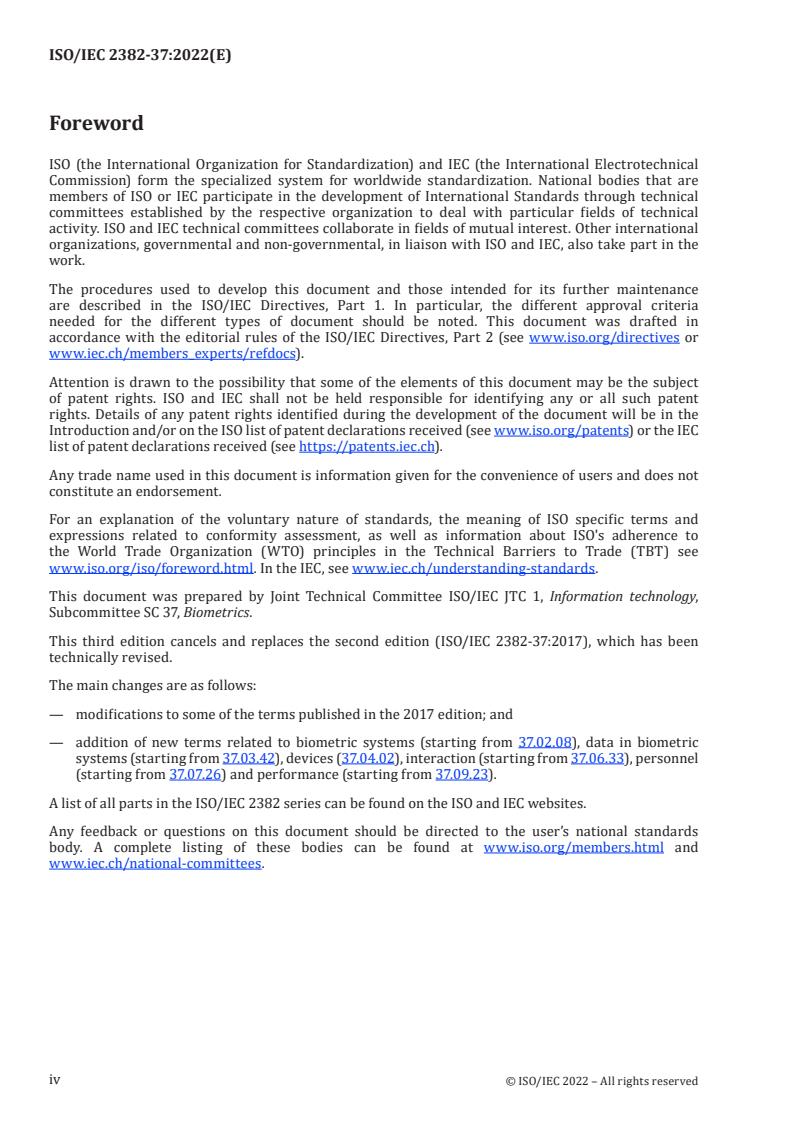
INTERNATIONAL ISO/IEC
STANDARD 2382-37
Third edition
2022-03
Information technology —
Vocabulary —
Part 37:
Biometrics
Technologies de l'information — Vocabulaire —
Partie 37: Biométrie
Информационные технологии — Словарь —
Часть 37: Часть 37: Биометрия
Reference number
© ISO/IEC 2022
© ISO/IEC 2022
All rights reserved. Unless otherwise specified, or required in the context of its implementation, no part of this publication may
be reproduced or utilized otherwise in any form or by any means, electronic or mechanical, including photocopying, or posting on
the internet or an intranet, without prior written permission. Permission can be requested from either ISO at the address below
or ISO’s member body in the country of the requester.
ISO copyright office
CP 401 • Ch. de Blandonnet 8
CH-1214 Vernier, Geneva
Phone: +41 22 749 01 11
Email: copyright@iso.org
Website: www.iso.org
Published in Switzerland
ii
© ISO/IEC 2022 – All rights reserved
Contents Page
Foreword .iv
Introduction .v
1 Scope . 1
2 Normative references . 1
3 Terms and definitions . 1
3.1 Terms related to general concepts . 1
3.2 Terms related to biometric systems . 2
3.3 Terms related to data in biometric systems . 4
3.4 Terms related to devices . 11
3.5 Terms related to functioning . 11
3.6 Terms related to interaction . 14
3.7 Terms related to personnel . 19
3.8 Terms related to application .23
3.9 Terms related to performance .23
Bibliography .30
Alphabetical Index.31
iii
© ISO/IEC 2022 – All rights reserved
Foreword
ISO (the International Organization for Standardization) and IEC (the International Electrotechnical
Commission) form the specialized system for worldwide standardization. National bodies that are
members of ISO or IEC participate in the development of International Standards through technical
committees established by the respective organization to deal with particular fields of technical
activity. ISO and IEC technical committees collaborate in fields of mutual interest. Other international
organizations, governmental and non-governmental, in liaison with ISO and IEC, also take part in the
work.
The procedures used to develop this document and those intended for its further maintenance
are described in the ISO/IEC Directives, Part 1. In particular, the different approval criteria
needed for the different types of document should be noted. This document was drafted in
accordance with the editorial rules of the ISO/IEC Directives, Part 2 (see www.iso.org/directives or
www.iec.ch/members_experts/refdocs).
Attention is drawn to the possibility that some of the elements of this document may be the subject
of patent rights. ISO and IEC shall not be held responsible for identifying any or all such patent
rights. Details of any patent rights identified during the development of the document will be in the
Introduction and/or on the ISO list of patent declarations received (see www.iso.org/patents) or the IEC
list of patent declarations received (see https://patents.iec.ch).
Any trade name used in this document is information given for the convenience of users and does not
constitute an endorsement.
For an explanation of the voluntary nature of standards, the meaning of ISO specific terms and
expressions related to conformity assessment, as well as information about ISO's adherence to
the World Trade Organization (WTO) principles in the Technical Barriers to Trade (TBT) see
www.iso.org/iso/foreword.html. In the IEC, see www.iec.ch/understanding-standards.
This document was prepared by Joint Technical Committee ISO/IEC JTC 1, Information technology,
Subcommittee SC 37, Biometrics.
This third edition cancels and replaces the second edition (ISO/IEC 2382-37:2017), which has been
technically revised.
The main changes are as follows:
— modifications to some of the terms published in the 2017 edition; and
— addition of new terms related to biometric systems (starting from 37.02.08), data in biometric
systems (starting from 37.03.42), devices (37.04.02), interaction (starting from 37.06.33), personnel
(starting from 37.07.26) and performance (starting from 37.09.23).
A list of all parts in the ISO/IEC 2382 series can be found on the ISO and IEC websites.
Any feedback or questions on this document should be directed to the user’s national standards
body. A complete listing of these bodies can be found at www.iso.org/members.html and
www.iec.ch/national-committees.
iv
© ISO/IEC 2022 – All rights reserved
Introduction
The main purpose of this document is to provide a systematic description of the concepts in the subject
field of biometrics and to clarify the use of the terms in this subject field. The subject field of biometrics
is broken down into sub-fields.
This document is addressed to biometrics standardizers and to users of these standards.
The terms defined in this document are to be understood within the context of the subject field of
biometrics. When terms exist in various subject fields, the relevant subject field is indicated in angle
brackets.
Words that are written in italics are defined in this document. Words that are written in upright font
are to be understood in their natural language sense. The authority for natural language use of terms
in this document is the Concise Oxford English Dictionary (COED), Thumb Index Edition (tenth edition,
revised, 2002).
The numbering of all terms in this document begins with “37” to indicate the Subcommittee of Joint
Technical Committee ISO/IEC JTC 1 that created the terms. This is consistent will all other parts of the
ISO/IEC 2382 series. The subsequent numerical heading for each entry within this document (37.xx)
represents the number of the highest-level category in the concept map in which the term primarily
falls. This is consistent with “Systematic Order” as described in ISO 10241-1:2011, 5.1.2, in which the
heading reflects the concept system. In the first edition of this document (ISO/IEC 2382-37:2012),
the third numerical designator (37.xx.yy) was also consistent with “Systematic Order”, moving from
most general to more specific terms within each highest-level category of the concept map. With the
development of the current edition of this document, the decision was made to append the new terms
in each category such that the numbering of the earlier terms inherited from the 2012 edition would
not change. This implies that the third numerical designator is now in “Mixed Order” as described in
ISO 10241-1:2011, 5.1.3.
So, terms are added to this document in batches for each updated version. These terms are added in
alphabetical order. This ensures that the numbers allocated to a term remain the same and that they
can be referred to consistently.
The terms in this document are listed under a number of general headings.
The layout follows the directions given in ISO 10241-1. Thus, the elements of an entry appear in the
following order:
— Entry number (mandatory)
— Preferred term(s) (mandatory)
— Admitted term(s)
— Deprecated term(s)
— Definition (mandatory)
— Example(s)
— Note(s) to entry
The alphabetical index includes preferred and admitted terms.
v
© ISO/IEC 2022 – All rights reserved
INTERNATIONAL STANDARD ISO/IEC 2382-37:2022(E)
Information technology — Vocabulary —
Part 37:
Biometrics
1 Scope
This document establishes a systematic description of the concepts in the field of biometrics pertaining
to recognition of human beings. This document also reconciles variant terms in use in pre-existing
International Standards on biometrics against the preferred terms, thereby clarifying the use of terms
in this field.
This document does not cover concepts (represented by terms) from information technology, pattern
recognition, biology, mathematics, etc. Biometrics uses such fields of knowledge as a basis.
In principle, mode-specific terms are outside of scope of this document.
2 Normative references
There are no normative references in this document.
3 Terms and definitions
ISO and IEC maintain terminology databases for use in standardization at the following addresses:
— ISO Online browsing platform: available at https:// www .iso .org/ obp
— IEC Electropedia: available at https:// www .electropedia .org/
3.1 Terms related to general concepts
37.01.01
biometric, adj
of or having to do with biometrics (37.01.03)
Note 1 to entry: The use of biometric as a noun, to mean for example, biometric characteristic (37.01.02), is
deprecated.
EXAMPLE 1 Incorrect usage #1: ICAO resolved that face is the biometric most suited to the practicalities of
travel documents.
EXAMPLE 2 Correct usage #1: ICAO resolved that face recognition is the biometric mode (37.02.05) most
suited to the practicalities of travel documents.
EXAMPLE 3 Incorrect usage #2: The biometric recorded in my passport is a facial image.
EXAMPLE 4 Correct usage #2: The biometric characteristic recorded in my passport is a facial image.
th
Note 2 to entry: Since the late 19 century the terms biometrics and biometry have been used with the general
meaning of counting, measuring and statistical analysis of any kind of data in the biological sciences including
the relevant medical sciences.
© ISO/IEC 2022 – All rights reserved
37.01.02
biometric characteristic
DEPRECATED biometric
biological and behavioural characteristic of an individual from which distinguishing, repeatable
biometric features (37.03.11) can be extracted for the purpose of biometric recognition (37.01.03)
EXAMPLE Examples of biometric characteristics are Galton ridge structure, face topography, facial skin
texture, hand topography, finger topography, iris structure, vein structure of the hand, ridge structure of the
palm, retinal pattern, handwritten signature dynamics, etc.
37.01.03
biometric recognition
biometrics
automated recognition of individuals based on their biological and behavioural characteristics
Note 1 to entry: In the field of biometrics (as defined in this document), “Individual" is restricted in scope to refer
only to humans.
Note 2 to entry: The general meaning of biometrics encompasses counting, measuring and statistical analysis of
any kind of data in the biological sciences including the relevant medical sciences.
Note 3 to entry: Biometric recognition encompasses biometric verification (37.08.03) and biometric identification
(37.08.02).
Note 4 to entry: Automated recognition implies that a machine-based system is used for the recognition either
for the full process or assisted by a human being.
Note 5 to entry: Behavioural and biological characteristics cannot be completely separated which is why
the definition uses ‘and’ instead of ‘and/or’. For example, a fingerprint image results from the biological
characteristics of the finger ridge patterns and the behavioural act of presenting the finger.
Note 6 to entry: Use of 'authentication' as a synonym for “biometric verification or biometric identification” is
deprecated; the term biometric recognition is preferred.
3.2 Terms related to biometric systems
37.02.01
biometric capture subsystem
biometric capture devices (37.04.01) and any sub-processes required to execute a biometric capture
process (37.05.02)
Note 1 to entry: In some biometric systems (37.02.03), converting a signal from a biometric characteristic (37.01.02)
to a captured biometric sample (37.03.25) can include multiple components such as a camera, photographic paper,
printer, digital scanner, ink and paper.
Note 2 to entry: A biometric capture subsystem can consist of only a single biometric capture device.
37.02.02
biometric identification system
system that aims to perform biometric identification (37.08.02)
37.02.03
biometric system
system for the purpose of the biometric recognition (37.01.03) of individuals based on their behavioural
and biological characteristics
Note 1 to entry: A biometric system will contain both biometric (37.01.01) and non-biometric components.
37.02.04
biometric verification system
system that aims to perform biometric verification (37.08.03)
© ISO/IEC 2022 – All rights reserved
37.02.05
mode
DEPRECATED biometric, noun
combination of a biometric characteristic (37.01.02) type, a sensor type and a processing method
Note 1 to entry: The processing algorithm may contain multiple methods, details of which are not necessarily
externally apparent. Thus, a biometric system (37.02.03) is considered as using one processing method, until it is
otherwise specified.
Note 2 to entry: Determining what constitutes a single type of sensor, processing method or biometric
characteristic will depend on convention. For example, current convention is that images of ridge patterns
from both thumbs and fingers represent a single biometric characteristic type, i.e. fingerprints. With respect to
sensors, infrared and optical bandwidth sensors are considered different types, but optical bandwidth sensors
are considered a single type despite imaging red, green and blue bandwidths.
37.02.06
multimodal
multiple in at least two out of three constituents of a mode (37.02.05) in a single biometric system
(37.02.03)
Note 1 to entry: Multiple implies difference in type.
37.02.07
system participation ratio
proportion of individuals eligible to use the system who do use the system
Note 1 to entry: Enrolled individuals are a subset of eligible individuals.
Note 2 to entry: This term is used to express the extent of take-up and use of a biometric system (37.02.03).
37.02.08
biometric fusion
combination of biometric (37.01.01) information from different sources to inform a comparison decision
(37.03.26) within a biometric transaction (37.06.45)
Note 1 to entry: The sources can be at the signal, feature, score, rank or decision level.
37.02.09
monobiometric system
biometric system (37.02.03) of which all of the following components are required to be singular:
biometric capture subsystem (37.02.01), biometric instance (37.03.46), biometric characteristic (37.01.02)
type, biometric algorithm (37.04.02) and biometric presentation (37.06.07)
Note 1 to entry: This term is needed for completeness. It can be the case that few systems are monobiometric, as
multiple instances and multipresentations are normally allowed.
37.02.10
multibiometric system
biometric system (37.02.03) of which at least one of the following components is required to be multiple:
biometric capture subsystem (37.02.01), biometric instance (37.03.46), biometric characteristic (37.01.02)
type, biometric algorithm (37.04.02) or biometric presentation (37.06.07)
37.02.11
multipresentation system
system that accepts multiple interactions of the biometric capture subject (37.07.03) with the biometric
capture subsystem (37.02.01) to obtain signals from a biometric characteristic (37.01.02) needed for a
single transaction (37.06.45)
Note 1 to entry: The interaction is seen from the perspective of the biometric capture subject.
© ISO/IEC 2022 – All rights reserved
37.02.12
multibiometric, adj
based on multiple types of biometric characteristics (37.01.02)
EXAMPLE A biometric system that is based on two or more biometric characteristic types such as two or
more of face, voice, finger, iris, retina, hand geometry, signature/sign, keystroke, lip movement, gait, vein, DNA,
ear, foot, scent, etc.
3.3 Terms related to data in biometric systems
37.03.01
anonymized biometric data record
biometric data record (37.03.08) purposely disassociated from individual metadata
Note 1 to entry: The biometric data (37.03.06) within the biometric data record ultimately remains attributable
to an individual.
37.03.02
biometric application database
database of biometric data (37.03.06) and associated metadata developed from and supporting the
operation of a biometric (37.01.01) application
Note 1 to entry: The metadata may include transaction (37.06.45) history; authorizations (e.g. age) of the
biometric data subject (37.07.05); and archived biometric data.
Note 2 to entry: The term application includes the policies that govern the operation of the biometric system
(37.02.03) and evidence of that operation.
37.03.03
biometric application decision
decision to perform an action at the application level based on the results of a biometric (37.01.01)
process
Note 1 to entry: The application decision may include more than a comparison (37.05.07) process. For example,
a biometric capture process (37.05.02) may show that there are no biometric characteristics (37.01.02) to capture
and a decision can be made on this before any biometric characteristics are compared.
Note 2 to entry: Biometric application decisions can be made on the basis of complex policies involving both
biometric data (37.03.06) and non-biometric data.
37.03.04
biometric candidate
biometric reference identifier (37.03.19) of a biometric reference (37.03.16) in the biometric reference
database (37.03.17) determined to be sufficiently similar to the biometric probe (37.03.14) to warrant
further analysis
Note 1 to entry: Identification systems can be configured to return a fixed number of the most similar candidates
and, in other cases, the system could be configured to return candidates with biometric candidate scores
(37.03.24) that exceed a threshold (37.03.36).
37.03.05
biometric candidate list
set of zero, one or more biometric candidates (37.03.04)
Note 1 to entry: The biometric candidate list can be tentative if it is to be reduced by further processing.
37.03.06
biometric data
biometric sample (37.03.21) or aggregation of biometric samples at any stage of processing
EXAMPLE Biometric reference (37.03.16), biometric probe (37.03.14), biometric feature (37.03.11) or biometric
property (37.03.15).
© ISO/IEC 2022 – All rights reserved
Note 1 to entry: Biometric data need not be attributable to a specific individual, e.g. Universal Background
Models.
37.03.07
biometric database
database of biometric data record(s) (37.03.08)
37.03.08
biometric data record
data record containing biometric data (37.03.06)
Note 1 to entry: A biometric data record may include non-biometric data.
37.03.09
biometric enrolment database
database of biometric enrolment data record(s) (37.03.10)
Note 1 to entry: A database of biometric data (37.03.06) not attributable to biometric data subjects (37.07.05)
is a biometric database (37.03.07), but not a biometric enrolment database, e.g. data for Universal Background
Models.
Note 2 to entry: The biometric enrolment database can optionally contain the biometric reference database
(37.03.17). Separation of the databases can be required due to security, privacy, legislation, architecture,
performance, etc.
Note 3 to entry: A single biometric reference (37.03.16) (e.g. a fingerprint on a storage card) can be considered as
a biometric enrolment database in some transactions (37.06.45).
37.03.10
biometric enrolment data record
data record attributed to a biometric data subject (37.07.05), containing non-biometric data and
associated with biometric reference identifier(s) (37.03.19)
Note 1 to entry: Data can be updated after enrolment.
Note 2 to entry: The biometric enrolment data record will either contain biometric reference data record(s)
(37.03.18) or pointer(s) to biometric reference data record(s).
Note 3 to entry: The associated biometric reference (37.03.16) can be null (for example, biometric enrollee
(37.07.06) lacks the biometric characteristic (37.01.02) or biometric capture process (37.05.02) is pending.
37.03.11
biometric feature
number or label extracted from biometric samples (37.03.21) and used for comparison (37.05.07)
Note 1 to entry: The set of numbers or labels are the output of a completed biometric feature extraction (37.05.04).
Note 2 to entry: The use of this term should be consistent with its use by the pattern recognition and mathematics
communities.
Note 3 to entry: A biometric feature set can also be considered a processed biometric sample.
Note 4 to entry: Biometric features may be extracted from an intermediate biometric sample (37.03.30).
Note 5 to entry: Filters applied to biometric samples are not themselves biometric features. However, the output
of the filter applied to the biometric samples can be. Therefore, eigenfaces are not biometric features, for example.
37.03.12
biometric identification decision
comparison decision (37.03.26) as to whether a biometric reference(s) (37.03.16) of a particular biometric
data subject (37.07.05) is in a biometric reference database (37.03.17)
Note 1 to entry: Return of a biometric candidate list (37.03.05) is not considered a biometric identification
decision.
© ISO/IEC 2022 – All rights reserved
Note 2 to entry: A positive biometric identification (37.08.02) process is inferred from the output of a biometric
reference identifier (37.03.19).
37.03.13
biometric model
stored function generated from biometric data (37.03.06)
EXAMPLE Examples of biometric models could be a Hidden Markov Model, Gaussian Mixture Model or an
Artificial Neural Network.
Note 1 to entry: In most occasions the biometric model is a stored function which is dependent on the biometric
data subject (37.07.05).
Note 2 to entry: The function may be determined through training.
Note 3 to entry: A biometric model may involve intermediate processing similar to biometric feature extraction
(37.05.04).
37.03.14
biometric probe
biometric query
biometric sample (37.03.21) or biometric feature (37.03.11) set input to an algorithm for comparison
(37.05.07) to a biometric reference(s) (37.03.16)
Note 1 to entry: In some comparisons a biometric reference can potentially be used as the subject of the
comparison with other biometric references or incoming biometric samples used as the objects of the
comparisons. For example, in a duplicate enrolment check a biometric reference will be used as the subject for
comparisons against all other biometric references in the database.
Note 2 to entry: Typically, in a comparison process, incoming biometric samples serve as the subject of
comparisons against objects stored as biometric references in a database.
37.03.15
biometric property
descriptive attributes of the biometric data subject (37.07.05) estimated or derived from the biometric
sample (37.03.21) by automated means
EXAMPLE Fingerprints can be classified by the biometric properties of ridge-flow, i.e. arch, whorl and loop
types. Estimates of age or gender (37.07.31) from face recognition would also be biometric properties.
37.03.16
biometric reference
one or more stored biometric samples (37.03.21), biometric templates (37.03.22) or biometric models
(37.03.13) attributed to a biometric data subject (37.07.05) and used as the object of biometric
comparison (37.05.07)
EXAMPLE Face image stored digitally on a passport; fingerprint minutiae template on a National ID card or
Gaussian Mixture Model for speaker recognition, in a database.
Note 1 to entry: A biometric reference may be created with implicit or explicit use of auxiliary data, such as
Universal Background Models.
Note 2 to entry: The subject/object labelling in a comparison can be arbitrary. In some comparisons a biometric
reference can potentially be used as the subject of the comparison with other biometric references or incoming
biometric samples and input to a biometric algorithm (37.04.02) for comparison. For example, in a duplicate
enrolment check a biometric reference will be used as the subject for comparison against all other biometric
references in the database.
© ISO/IEC 2022 – All rights reserved
37.03.17
biometric reference database
database of biometric reference data records (37.03.18)
Note 1 to entry: The biometric reference database may be a subset of the biometric enrolment database (37.03.09),
or it may be a separate database. Separation of the databases may be required due to security, privacy, legislation,
architecture, performance, etc.
37.03.18
biometric reference data record
indexed data record containing biometric reference(s) (37.03.16)
Note 1 to entry: There is not necessarily a one to one correspondence between biometric reference data records
and biometric data subjects (37.07.05). For example, a single biometric data subject can have several reference
data records and in some applications a single biometric reference data record can be associated with multiple
enrolments of a biometric data subject.
37.03.19
biometric reference identifier
pointer to a biometric reference data record (37.03.18) in the biometric reference database (37.03.17)
37.03.20
biometric representation
biometric sample (37.03.21) or biometric feature (37.03.11) set
Note 1 to entry: This term is used in the ISO/IEC 19794 series and the ISO/IEC 39794 series for labelling a sub-
record in a biometric data record (37.03.08).
37.03.21
biometric sample
analogue or digital representation of biometric characteristics (37.01.02) prior to biometric feature
extraction (37.05.04)
EXAMPLE A record containing the image of a finger is a biometric sample.
37.03.22
biometric template
reference biometric feature set
set of stored biometric features (37.03.11) comparable directly to a biometric probe (37.03.14)
EXAMPLE A record containing a set of finger minutiae is a biometric template.
Note 1 to entry: A biometric reference (37.03.16) consisting of an image, or other captured biometric sample
(37.03.25), in its original, enhanced or compressed form, is not a biometric template.
Note 2 to entry: The biometric features (37.03.11) are not considered to be a biometric template unless they are
stored for reference.
37.03.23
biometric verification decision
comparison decision (37.03.26) determining the validity of a biometric claim (37.06.04) in a verification
transaction (37.06.21)
37.03.24
biometric candidate score
comparison score (37.03.27) for a biometric candidate (37.03.04)
37.03.25
captured biometric sample
DEPRECATED raw biometric sample
biometric sample (37.03.21) resulting from a biometric capture process (37.05.02)
© ISO/IEC 2022 – All rights reserved
37.03.26
comparison decision
determination of whether the biometric probe(s) (37.03.14) and biometric reference(s) (37.03.16) have
the same biometric (37.01.01) source, based on a comparison score(s) (37.03.27), a decision policy(ies)
including a threshold (37.03.36) and possibly other inputs
Note 1 to entry: A match (37.03.31) is a positive comparison decision. A non-match (37.03.33) is a negative
comparison decision. A decision of "undetermined" may sometimes be given.
37.03.27
comparison score
DEPRECATED matching score
numerical value (or set of values) resulting from a comparison (37.05.07)
Note 1 to entry: A higher score does not necessarily mean more similar.
37.03.28
dissimilarity score
distance score
comparison score (37.03.27) that decreases with similarity
Note 1 to entry: Unlike a distance score, a dissimilarity score does not have to meet the mathematical definition
of a metric on a set.
37.03.29
fraudulent biometric enrolment data record
biometric enrolment data record (37.03.10) created or modified for the purpose of supporting wrongful
or criminal activity
Note 1 to entry: Records that are inadvertently erroneous or created for test purposes are not considered
fraudulent.
37.03.30
intermediate biometric sample
biometric sample (37.03.21) resulting from intermediate biometric sample processing (37.05.09)
EXAMPLE Biometric samples that have been cropped, down-sampled, compressed, or enhanced are
examples of intermediate biometric samples.
37.03.31
match, noun
comparison decision (37.03.26) stating that the biometric probe(s) (37.03.14) and the biometric reference
(37.03.16) are from the same source
Note 1 to entry: Historically, the word match has been used as a verb to indicate the act of comparison (37.05.07)
and decision making. As ‘match’ is the decision coming out of the comparison process, its use as a verb is
deprecated in favour of compare.
37.03.32
mated, adj
based on a paired biometric probe (37.03.14) and biometric reference (37.03.16) that are from the same
biometric characteristic (37.01.02) of the same biometric data subject (37.07.05)
Note 1 to entry: While ‘match’ (37.03.31) is the result of a comparison decision (37.03.26), ‘mated’ is a statement,
based on non-biometric information, concerning the origin of the source of the biometric probe and the biometric
reference.
37.03.33
non-match, noun
comparison decision (37.03.26) stating that the biometric probe(s) (37.03.14) and the biometric reference
(37.03.16) are not from the same source
© ISO/IEC 2022 – All rights reserved
37.03.34
non-mated, adj
based on a paired biometric probe (37.03.14) and biometric reference (37.03.16) that are not from the
same biometric characteristic (37.01.02) of the same biometric data subject (37.07.05)
Note 1 to entry: While ‘non-match' (37.03.33) is the result of a comparison decision (37.03.26), ‘non-mated’ is a
statement, based on non-biometric information, concerning the origin of the source of the biometric probe and
the biometric reference.
37.03.35
similarity score
comparison score (37.03.27) that increases with similarity
37.03.36
threshold, noun
numerical value (or set of values) at which a decision boundary exists
37.03.37
unidentified biometric data
biometric data (37.03.06) whose biometric data subject (37.07.05) is currently unknown
37.03.38
conformant biometric reference rate
proportion of biometric enrolment data records (37.03.10) containing biometric references (37.03.16)
conformant (37.06.31) with system policy
Note 1 to entry: Some biometric systems (37.02.03) require the enrolment of all applicants regardless of the
availability of acquirable biometric characteristics (37.01.02). This ratio, which depends upon system capabilities
and policies regulating acquisition of biometric samples (37.03.21), characterizes the percentage of a given
enrolled population that has conformant biometric references in the biometric enrolment data records.
Note 2 to entry: This can be enumerated individually for enrolment subsystems with distinct enrolment policies.
37.03.39
biometric reference rate
proportion of biometric enrolment data records (37.03.10) that contain a biometric reference (37.03.16)
Note 1 to entry: Some biometric systems (37.02.03) require the enrolment of all applicants regardless of the
availability of acquirable biometric characteristics (37.01.02). This ratio, which depends upon system capabilities
and policies regulating acquisition of biometric samples (37.03.21), characterizes the percentage of a given
enrolled population that has any biometric references in the biometric enrolment data records.
Note 2 to entry: This can be enumerated individually for enrolment subsystems with distinct enrolment policies.
Note 3 to entry: Non-conformant references are considered as references.
37.03.40
enrolment eligibility ratio
proportion of enrolment applications that are deemed eligible by policy for enrolment
Note 1 to entry: The closer this ratio is to unity, the more aligned the applicants are to the eligible population.
37.03.41
reference ageing
DEPRECATED template ageing
change in error rates with respect to a fixed reference caused by time-related changes in the biometric
characteristic (37.01.02)
Note 1 to entry: Error rates generally increase with the age of the reference.
Note 2 to entry: Reference ageing can include sample ageing, template ageing and model ageing.
© ISO/IEC 2022 – All rights reserved
37.03.42
acquired biometric sample
captured biometric sample (37.03.25) assessed as suitable for subsequent biometric feature extraction
(37.05.04) and comparison (37.05.07)
37.03.43
acquisition profile
list of attributes pertaining to the collection environment, the data capture subsystem, the biometric
data subject (37.07.05), subsequent processing and management of the data
Note 1 to entry: Acquisition profiles are dependent on the modality.
37.03.44
biometric application conformance profile
listing of standards to be applied for a specific function or task
Note 1 to entry: Application profiles (37.03.48) identify (37.08.05) the use of particular options in base standards
and provide a basis for conformant applications and interoperability of systems.
37.03.45
biometric data breach
unauthorized access, disclosure, alteration, transmission or processing of the biometric data (37.03.06)
of an individual
Note 1 to entry: This definition does not apply to collection and storage even if unauthorized.
Note 2 to entry: Authorization is a jurisdictional responsibility (e.g. a government or a data subject) and limited
to the purposes for which the data was collected.
37.03.46
biometric instance
occurrence of a biometric characteristic (37.01.02)
Note 1 to entry: A human hand typically has five instances of a fingerprint biometric characteristic.
Note 2 to entry: Multiple presentations of the same spoken or written phrase is a single instance.
37.03.47
multi-instance
requiring two or more instances of a biometric characteristic (37.01.02)
Note 1 to entry: The typical human hand contains more than one instance of a fingerprint biometric characteristic.
37.03.48
profile
list of attributes pertaining to an entity or a class of entities
37.03.49
pseudonymized biometric data record
biometric data record (37.03.08) purposely dis-associated from non-biometric personally identifiable
information
Note 1 to entry: The biometric data (37.03.06) within the biometric data record ultimately remain attributable to
an individual.
Note 2 to entry: This definition is consistent with the term pseudonymization in the EU General Data Protection
Regulation 2016/679.
37.03.50
normalize
rescale of values for comparison (37.05.07) against a common or standardized scale
Note 1 to entry: Rescaling can be linear or non-linear.
© ISO/IEC 2022 – All rights reserved
Note 2 to entry: The standardized scale may specify a range for the scores, a polarity or a distribution.
3.4 Terms related to devices
37.04.01
biometric capture device
device that collects a signal from a biometric characteristic (37.01.02) and converts it to a captured
biometric sample (37.03.25)
Note 1 to entry: A signal can be generated by the biometric characteristic or generated elsewhere and affected by
the biometric characteristic, for example, face illuminated by incident light.
Note 2 to entry: A biometric capture device can be any piece of hardware (and supporting software and firmware).
Note 3 to entry: A biometric capture device may comprise components such as an illumination source, one or
more sensors, etc.
37.04.02
biometric algorithm
set of instructions and rules for processing biometric samples (37.03.21)
Note 1 to entry: The complete processing of biometric signals and data may involve: signal detection,
segmentation, biometric feature extraction (37.05.04), quality assessment, biometric model (37.03.13) generation,
biometric template (37.03.22) generation, comparison (37.05.07), biometric comparison decision (37.03.26),
compression, decompression, etc.
3.5 Terms related to functioning
37.05.01
biometric acquisition process
biometric capture process (37.05.02) and additional processing to attempt to produce a suitable biometric
sample(s) (37.03.21) in accordance with the defined policy
Note 1 to entry: In addition to the biometric capture process, a biometric acquisition process may include
segmentation, quality control and other pre-processing steps.
Note 2 to entry: A biometric acquisition process may produce multiple biometric samples from a single biometric
capture (37.06.03) and each biometric sample is attributable to a single biometric characteristic (37.01.02). For
example, four fingerprints in a slap image and three segmented face samples of the three people in a captured
photograph.
Note 3 to entry: The policy defines the end point of the biometric acquisition process.
37.05.02
biometric capture process
series of actions undertaken to effect a biometric capture (37.06.03)
EXAMPLE To obtain an International Civil Aviation Organisation (ICAO) compliant passport photograph, the
biometric capture subject (37.07.03) will have to undertake a number of steps e.g. remove glasses, look directly at
the camera and not smiling, etc. These steps are the biometric capture process.
Note 1 to entry: Not all biometric capture processes result in a biometric capture.
Note 2 to entry: The biometric capture process may involve a single biometric capture device (37.04.01) or may be
distributed over time and space in such a way that there is no single definable biometric capture device.
© ISO/IEC 2022 – All rights reserved
37.05.03
biometric enrolment
DEPRECATED registration
act of creating and storing a biometric enrolment data record (37.03.10) in accordance with an enrolment
policy
Note 1 to entry: Registration has a different meaning in the signal processing community and its use is therefore
deprecated in biometrics (37.01.03) in favour of enrolment.
Note 2 to entry: Enrolment in a biometric system (37.02.03) can in some cases not involve storage of biometric
data (37.03.06), for example, when biometric data from an enrollee (37.07.06) cannot be acquired.
37.05.04
biometric feature extraction
process applied to a biometric sample (37.03.21) with the intent of isolating and outputting repeatable
and distinctive numbers or labels which can be compared to those extracted from other biometric
samples
Note 1 to entry: The creation of filters to be applied to biometric samples is not biometric feature extraction.
However, the application of filters to biometric samples can be. Therefore, for example, the creation of eigenfaces
is not biometric feature extraction.
Note 2 to entry: Repeatable implies low variation between outputs generated from biometric samples of the same
biometric data subject (37.07.05).
Note 3 to entry: Distinctive implies high variation between outputs generated from biometric samples of different
biometric data subjects.
Note 4 to entry: Biometric feature extraction can fail.
Note 5 to entry: Biometric feature extraction can be applied to an intermediate biometric sample (37.03.30).
37.05.05
biometric reference adaptation
automatic incremental updating of a biometric reference (37.03.16)
Note 1 to entry: Biometric reference adaptation can be used to improve performance (e.g. adapting the reference
to take account of variability of an individual's biometric characteristics (37.01.02) and to mitigate performance
degradation (e.g. due to changes in biometric characteristics over time).
37.05.06
biometric search
examination of a biometric reference database (37.03.17) against a biometric probe (37.03.14) to return
either a biometric candidate list (37.03.05) or a comparison decision (37.03.26) that the biometric probe
is sufficiently similar to one or more biometric references (37.03.16)
Note 1 to entry: Output of the biometric candidate list or the comparison decision implies implementation of a
policy.
Note 2 to entry: The biometric reference database need not contain biometric data (37.03.06) from multiple
biometric data subjects (37.07.05).
37.05.07
comparison
DEPRECATED match
DEPRECATED matching
estimation, calculation or measurement of similarity or dissimilarity between a biometric probe(s)
(37.03.14) and a biometric reference(s) (37.03.16)
37.05.08
enrol
create and store a biometric enrolment data record (37.03.10) in accordance with the biometric enrolment
(37.05.03) policy
© ISO/IEC 2022 – All rights reserved
37.05.09
intermediate biometric sample processing
any manipulation of a biometric sample (37.03.21) that does not produce biometric features (37.03.11)
EXAMPLE Cropping, down-sampling, compression, conversion to data interchange formats standard and
image enhancement.
Note 1 to entry: Intermediate biometric sample (37.03.30) processing changes the representation of the signal or
data.
37.05.10
one-to-one comparison
process in which a biometric probe(s) (37.03.14) from one biometric data subject (37.07.05) is compared
to a biometric reference(s) (37.03.16) from one biometric data subject to produce a comparison score
(37.03.27).
Note 1 to entry: In the case of a multimodal (37.02.06) biometric system (37.02.03), the biometric probe and the
biometric reference can contain multiple biometric modes (37.02.05).
Note 2 to entry: Some one-to-one comparison algorithms, i.e. those using score normalization, cohort models
or likelihood-ratios, can require comparisons (37.05.07) of the biometric probe from one biometric data subject
to biometric references from multiple biometric data subjects. Nevertheless, the comparison score generated
refers to the similarity between biometric probe(s) of one biometric data subje
...
NORME ISO/IEC
INTERNATIONALE 2382-37
Troisième édition
2022-03
Technologies de l'information —
Vocabulaire —
Partie 37:
Biométrie
Information technology — Vocabulary —
Part 37: Biometrics
Информационные технологии — Словарь —
Часть 37: Часть 37: Биометрия
Numéro de référence
© ISO/IEC 2022
DOCUMENT PROTÉGÉ PAR COPYRIGHT
© ISO/IEC 2022
Tous droits réservés. Sauf prescription différente ou nécessité dans le contexte de sa mise en œuvre, aucune partie de cette
publication ne peut être reproduite ni utilisée sous quelque forme que ce soit et par aucun procédé, électronique ou mécanique,
y compris la photocopie, ou la diffusion sur l’internet ou sur un intranet, sans autorisation écrite préalable. Une autorisation peut
être demandée à l’ISO à l’adresse ci-après ou au comité membre de l’ISO dans le pays du demandeur.
ISO copyright office
Case postale 401 • Ch. de Blandonnet 8
CH-1214 Vernier, Genève
Tél.: +41 22 749 01 11
Fax: +41 22 749 09 47
E-mail: copyright@iso.org
Web: www.iso.org
Publié en Suisse
ii
© ISO/IEC 2022 – Tous droits réservés
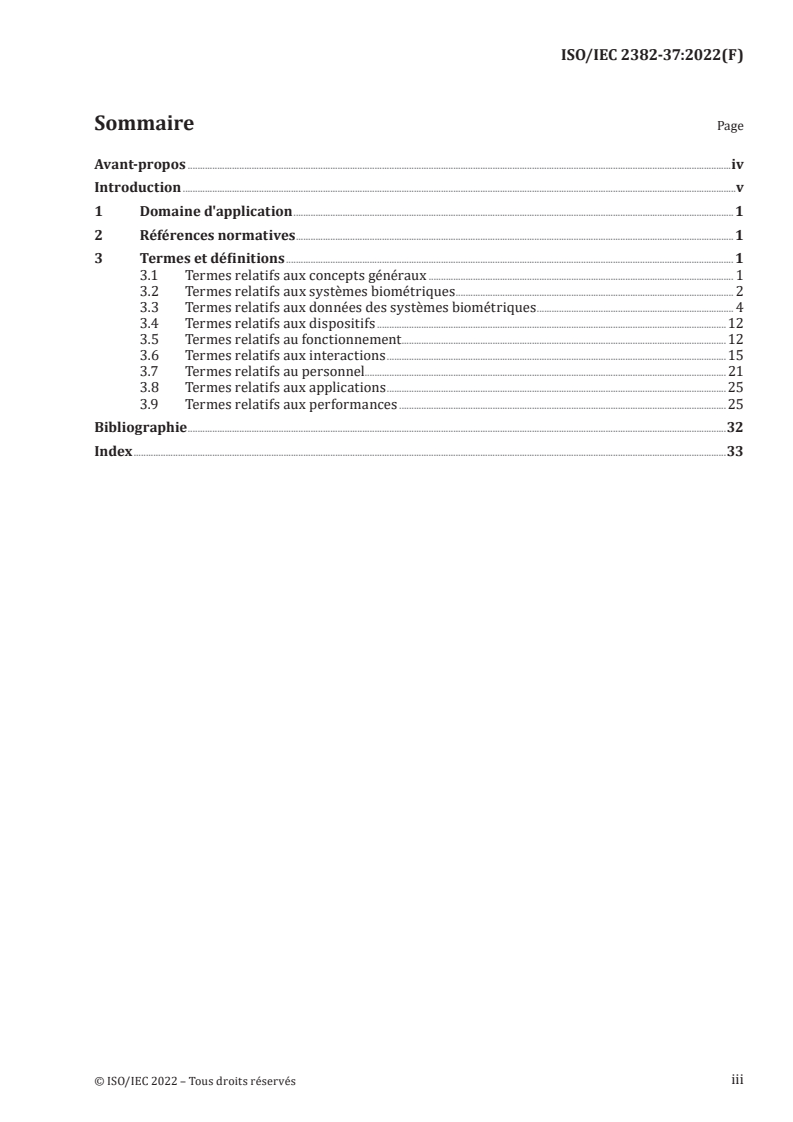
Sommaire Page
Avant-propos .iv
Introduction .v
1 Domaine d'application .1
2 Références normatives .1
3 Termes et définitions . 1
3.1 Termes relatifs aux concepts généraux . 1
3.2 Termes relatifs aux systèmes biométriques . 2
3.3 Termes relatifs aux données des systèmes biométriques . 4
3.4 Termes relatifs aux dispositifs .12
3.5 Termes relatifs au fonctionnement .12
3.6 Termes relatifs aux interactions . 15
3.7 Termes relatifs au personnel. 21
3.8 Termes relatifs aux applications . 25
3.9 Termes relatifs aux performances . 25
Bibliographie .32
Index .33
iii
© ISO/IEC 2022 – Tous droits réservés
Avant-propos
L'ISO (Organisation internationale de normalisation) et l'IEC (Commission électrotechnique
internationale) forment le système spécialisé de la normalisation mondiale. Les organismes
nationaux membres de l'ISO ou de l'IEC participent au développement de Normes Internationales
par l'intermédiaire des comités techniques créés par l'organisation concernée afin de s'occuper des
domaines particuliers de l'activité technique. Les comités techniques de l'ISO et de l'IEC collaborent
dans des domaines d'intérêt commun. D'autres organisations internationales, gouvernementales et non
gouvernementales, en liaison avec l'ISO et l'IEC participent également aux travaux.
Les procédures utilisées pour élaborer le présent document et celles destinées à sa mise à jour
sont décrites dans les Directives ISO/IEC, Partie 1. Il convient, en particulier de prendre note des
différents critères d'approbation requis pour les différents types de document. Le présent document
a été rédigé conformément aux règles de rédaction données dans les Directives ISO/IEC, Partie 2 (voir
www.iso.org/directives ou www.iec.ch/members_experts/refdocs).
L'attention est attirée sur le fait que certains des éléments du présent document peuvent faire l'objet
de droits de propriété intellectuelle ou de droits analogues. L'ISO et l'IEC ne sauraient être tenues pour
responsables de ne pas avoir identifié de tels droits de propriété et averti de leur existence. Les détails
concernant les références aux droits de propriété intellectuelle ou autres droits analogues identifiés
lors de l'élaboration du document sont indiqués dans l'Introduction et/ou dans la liste des déclarations
de brevets reçues par l'ISO (voir www.iso.org/brevets) ou dans la liste des déclarations de brevets
reçues par l'IEC (voir https://patents.iec.ch).
Les appellations commerciales éventuellement mentionnées dans le présent document sont données
pour information, par souci de commodité, à l'intention des utilisateurs et ne sauraient constituer un
engagement.
Pour une explication de la nature volontaire des normes, la signification des termes et expressions
spécifiques de l'ISO liés à l'évaluation de la conformité, ou pour toute information au sujet de
l'adhésion de l'ISO aux principes de l'Organisation mondiale du commerce (OMC) concernant les
obstacles techniques au commerce (OTC), voir www.iso.org/iso/fr/avant-propos. Pour l'IEC, voir
www.iec.ch/understanding-standards.
Le présent document a été élaboré par le comité technique mixte ISO/IEC JTC 1, Technologies de
l'information, sous-comité SC 37, Biométrie.
Cette troisième édition annule et remplace la deuxième édition (ISO/IEC 2382-37:2017), qui a fait l'objet
d'une révision technique.
Les principales modifications sont les suivantes:
— modification de certains termes publiés dans l'édition 2017; et
— ajout de nouveaux termes relatifs aux systèmes biométriques (à partir de 37.02.08), aux données
des systèmes biométriques (à partir de 37.03.42), aux dispositifs (37.04.02),à l'interaction (à partir
de 37.06.33), au personnel (à partir de 37.07.26) et aux performances (à partir de 37.09.23).
Une liste de toutes les parties de la série ISO/IEC 2382 se trouve sur les sites Web de l'ISO et de l'IEC.
Il convient que l’utilisateur adresse tout retour d’information ou toute question concernant le présent
document à l’organisme national de normalisation de son pays. Une liste exhaustive desdits organismes
se trouve aux adresses www.iso.org/fr/members.html et www.iec.ch/national-committees.
iv
© ISO/IEC 2022 – Tous droits réservés
Introduction
Le principal objectif du présent document est de fournir une description systématique des concepts
dans le domaine de la biométrie et de clarifier l'usage des termes dans le domaine en question. Le
domaine de la biométrie est subdivisé en sous-domaines.
Le présent document s'adresse aux spécialistes en normalisation dans le domaine de la biométrie ainsi
qu'aux utilisateurs des normes concernées.
Les termes définis dans le présent document doivent être compris dans le contexte du domaine de la
biométrie. Lorsque des termes existent dans différents domaines, le domaine concerné est indiqué
entre des chevrons.
Les termes écrits en italique sont définis dans le présent document. Les mots qui sont écrits en
caractères droits doivent être compris au sens de leur langage naturel. La référence faisant foi pour
l'utilisation des termes en langage naturel dans le présent document est le dictionnaire Larousse.
Dictionnaire de français en ligne (2022).
La numérotation de tous les termes du présent document commence par «37», afin d'indiquer le sous-
comité du comité technique mixte ISO/IEC JTC 1 par lequel les termes ont été créés. Cette règle est
cohérente avec toutes les autres parties de la série ISO/IEC 2382. Le désignateur numérique suivant
(37.xx) représente, pour chaque article du présent document, le numéro de la catégorie de niveau le
plus élevé dans la carte conceptuelle dans laquelle le terme s'inscrit prioritairement. Ce principe est
cohérent avec l'«ordre systématique» décrit dans l'ISO 10241-1:2011, 5.1.2, dans lequel l’intitulé reflète
le système de concepts. Dans la première édition du présent document (ISO/IEC 2382-37:2012), le
troisième désignateur numérique (37.xx.yy) était également conforme à l'«ordre systématique», allant
des termes les plus généraux à des termes plus spécifiques au sein de chaque catégorie de niveau le
plus élevé de la carte conceptuelle. Lors de l'élaboration de l'édition actuelle du présent document, il a
été décidé, pour chaque catégorie, d'ajouter les nouveaux termes de manière à ce que la numérotation
des termes antérieurs hérités de l'édition 2012 ne soit pas modifiée. Cela signifie que le troisième
désignateur numérique est désormais en «ordre mixte», comme décrit dans l'ISO 10241-1:2011, 5.1.3.
Ainsi, pour chaque version mise à jour, les termes sont ajoutés par lots au présent document, en
respectant l'ordre alphabétique. Cela garantit que les numéros attribués à un terme restent les mêmes
et qu'il est possible de s'y référer de manière cohérente.
Les termes du présent document sont répertoriés sous un certain nombre de rubriques générales.
La disposition des éléments des articles terminologiques suit les instructions de la norme ISO 10241-1.
De ce fait, les éléments de chaque entrée apparaissent dans l'ordre suivant:
— numéro d'article (obligatoire);
— terme(s) privilégié(s) (obligatoire);
— terme(s) toléré(s);
— terme(s) déconseillé(s);
— définition (obligatoire);
— exemple(s);
— note à l'article.
L'index alphabétique comprend les termes privilégiés et les termes tolérés.
v
© ISO/IEC 2022 – Tous droits réservés
NORME INTERNATIONALE ISO/IEC 2382-37:2022(F)
Technologies de l'information — Vocabulaire —
Partie 37:
Biométrie
1 Domaine d'application
Le présent document établit une description systématique des concepts du domaine de la biométrie, en
rapport avec la reconnaissance des êtres humains. Il fait le rapprochement entre les variantes de termes
utilisées dans des Normes internationales préexistantes sur la biométrie et les termes privilégiés,
permettant ainsi de clarifier l'usage des termes dans ce domaine.
Le présent document ne couvre pas les concepts (représentés par des termes) issus des technologies
de l'information, de la reconnaissance des formes, de la biologie, des mathématiques, etc. La biométrie
s'appuie sur ces domaines de connaissance.
En principe, les termes spécifiques à des modes ne relèvent pas du domaine d'application du présent
document.
2 Références normatives
Le présent document ne contient aucune référence normative.
3 Termes et définitions
L'ISO et l'IEC tiennent à jour des bases de données terminologiques destinées à être utilisées en
normalisation, consultables aux adresses suivantes:
— ISO Online browsing platform: disponible à l'adresse https:// www .iso .org/ obp
— IEC Electropedia: disponible à l'adresse https:// www .electropedia .org/
3.1 Termes relatifs aux concepts généraux
37.01.01
biométrique, adj
en relation avec la biométrie (37.01.03)
Note 1 à l'article: L'usage du terme biométrique en tant que nom, pour désigner par exemple, une caractéristique
biométrique (37.01.02) est déconseillé.
EXEMPLE 1 Usage incorrect n° 1: L'OACI a décidé que le visage est la biométrique la plus adaptée pour les
valeurs concrètes des titres de voyage.
EXEMPLE 2 Usage correct n° 1: L'OACI a décidé que la reconnaissance faciale est le mode biométrique (37.02.05)
le plus adapté pour les valeurs concrètes des titres de voyage.
EXEMPLE 3 Usage incorrect n° 2: La biométrique enregistrée dans mon passeport est une image faciale.
EXEMPLE 4 Usage correct n° 2: La caractéristique biométrique enregistrée dans mon passeport est une image
faciale.
Note 2 à l'article: Depuis la fin du XIXe siècle, les termes de «reconnaissance biométrique» et «biométrie» sont
utilisés dans le sens général de comptage, de mesurage et d'analyse statistique de tout type de données ayant
trait aux sciences biologiques, y compris les sciences médicales correspondantes.
© ISO/IEC 2022 – Tous droits réservés
37.01.02
caractéristique biométrique
biométrique, nom: DÉCONSEILLÉ
caractéristique biologique et comportementale d'une personne à partir de laquelle des attributs
biométriques (37.03.11) distinctifs et répétables peuvent être extraits aux fins de reconnaissance
biométrique (37.01.03)
EXEMPLE Exemples de caractéristiques biométriques: structure des crêtes de Galton, topographie faciale,
texture de la peau du visage, topographie de la main, topographie digitale, structure de l'iris, structure des veines
de la main, structure des plis palmaires, motif rétinien, dynamique de la signature manuscrite, etc.
37.01.03
reconnaissance biométrique
biométrie
reconnaissance automatique d'une personne à partir de ses caractéristiques biologiques et
comportementales
Note 1 à l'article: Dans le domaine de la biométrie (tel que défini dans le présent document), le terme «individu»
fait uniquement référence aux êtres humains.
Note 2 à l'article: La signification générale de la biométrie englobe le comptage, le mesurage et l'analyse statistique
de tout type de données ayant trait aux sciences biologiques, y compris les sciences médicales correspondantes.
Note 3 à l'article: Le terme reconnaissance biométrique englobe la vérification biométrique (37.08.03) et
l'identification biométrique (37.08.02).
Note 4 à l'article: La reconnaissance automatique implique l'utilisation d'un système à base de machines pour la
reconnaissance, le processus étant totalement automatisé ou assisté par l'homme.
Note 5 à l'article: Les caractéristiques comportementales ne peuvent pas être complètement séparées des
caractéristiques biologiques; c'est la raison pour laquelle la définition utilise «et» au lieu de «et/ou». Par exemple,
une image d'empreinte digitale résulte des caractéristiques biologiques des motifs des crêtes digitales et de l'acte
de présentation du doigt.
Note 6 à l'article: L'usage du terme «authentification» comme synonyme de «vérification biométrique ou
identification biométrique» est déconseillé; le terme reconnaissance biométrique est privilégié.
3.2 Termes relatifs aux systèmes biométriques
37.02.01
sous-système de capture biométrique
dispositifs de capture biométrique (37.04.01) et tout sous-processus requis pour exécuter un processus de
capture biométrique (37.05.02)
Note 1 à l'article: Dans certains systèmes biométriques (37.02.03), la conversion d'un signal d'une caractéristique
biométrique (37.01.02) en un échantillon biométrique capturé (37.03.25) peut impliquer de multiples composants
tels qu'appareil photographique, papier photographique, imprimante, scanner numérique, encre et papier.
Note 2 à l'article: Un sous-système de capture biométrique peut être constitué d'un seul dispositif de capture
biométrique.
37.02.02
système d'identification biométrique
système dont le but est d'effectuer une identification biométrique (37.08.02)
37.02.03
système biométrique
système dont l'objectif est la reconnaissance biométrique (37.01.03) des individus sur la base de leurs
caractéristiques comportementales et biologiques
Note 1 à l'article: Un système biométrique contiendra à la fois des composants biométriques (37.01.01) et des
composants non biométriques.
© ISO/IEC 2022 – Tous droits réservés
37.02.04
système de vérification biométrique
système dont le but est d'effectuer une vérification biométrique (37.08.03)
37.02.05
mode
biométrique, nom: DÉCONSEILLÉ
combinaison d'un type de caractéristique biométrique (37.01.02), d'un type de capteur et d'une méthode
de traitement
Note 1 à l'article: L'algorithme de traitement peut comprendre plusieurs méthodes, dont les détails ne sont pas
nécessairement perçus de l'extérieur. Par conséquent, on considère qu'un système biométrique (37.02.03) utilise
une seule méthode de traitement, sauf spécification contraire.
Note 2 à l'article: C'est par convention que sera déterminé ce qui constitue un seul type de capteur, de méthode
de traitement ou de caractéristique biométrique. Par exemple, la convention actuelle veut que les dessins formés
par les crêtes des pouces et des autres doigts constituent un seul type de caractéristique biométrique, à savoir,
des empreintes digitales. Pour ce qui est des capteurs, les capteurs à infrarouge et les capteurs à largeur de bande
optique sont considérés comme des capteurs de types différents, mais les capteurs à largeur de bande optique
sont considérés comme appartenant à un seul type de capteurs, malgré le fait qu'ils produisent des images de
largeurs de bandes rouges, vertes et bleues.
37.02.06
multi-modal
multiple dans au moins deux constituants sur trois d'un mode (37.02.05) au sein d'un seul système
biométrique (37.02.03)
Note 1 à l'article: Le terme «multiple» implique une différence de type.
37.02.07
taux de participation au système
proportion d'individus éligibles à l'utilisation du système, qui l'utilisent réellement
Note 1 à l'article: Les individus enrôlés sont un sous-ensemble des individus éligibles.
Note 2 à l'article: Ce terme est utilisé pour exprimer le degré d'acceptation et d'utilisation d'un système
biométrique (37.02.03).
37.02.08
fusion biométrique
combinaison d'informations biométriques (37.01.01) provenant de différentes sources et visant à
éclairer une décision de comparaison (37.03.26) dans le cadre d'une transaction (37.06.45) biométrique
Note 1 à l'article: Les sources peuvent se trouver au niveau du signal, de l'attribut, du score, du rang ou de la
décision.
37.02.09
système mono-biométrique
système biométrique (37.02.03) dont tous les composants suivants doivent être uniques: sous-système
de capture biométrique (37.02.01), instance biométrique (37.03.46), type de caractéristique biométrique
(37.01.02), algorithme biométrique (37.04.02) et présentation biométrique (37.06.07)
Note 1 à l'article: Ce terme est en fait nécessaire pour des raisons d'exhaustivité. Il est possible qu'il y ait peu
de systèmes mono-biométriques, car les instances multiples et les multi-présentations sont généralement
autorisées.
37.02.10
système multi-biométrique
système biométrique (37.02.03) dont l'un au moins des composants suivants doit être multiple: sous-
système de capture biométrique (37.02.01), instance biométrique (37.03.46), type de caractéristique
biométrique (37.01.02), algorithme biométrique (37.04.02) ou présentation biométrique (37.06.07)
© ISO/IEC 2022 – Tous droits réservés
37.02.11
système multi-présentation
système qui accepte de multiples interactions entre le sujet de capture biométrique (37.07.03) et le sous-
système de capture biométrique (37.02.01) afin d'obtenir des signaux d'une caractéristique biométrique
(37.01.02) nécessaire à une transaction (37.06.45) unique
Note 1 à l'article: L'interaction est considérée du point de vue du sujet de capture biométrique.
37.02.12
multi-biométrique, adj
basé sur plusieurs types de caractéristiques biométriques (37.01.02)
EXEMPLE Système biométrique basé sur au moins deux types de caractéristiques biométriques parmi
les types suivants: visage, voix, doigt, iris, rétine, géométrie de la main, signature/signe, frappe au clavier,
mouvement des lèvres, démarche, veine, ADN, oreille, pied, odeur, etc.
3.3 Termes relatifs aux données des systèmes biométriques
37.03.01
registre de données biométriques anonymes
registre de données biométriques (37.03.08) volontairement dissociées des métadonnées individuelles
Note 1 à l'article: Les données biométriques (37.03.06) figurant dans le registre de données biométriques restent
en dernier lieu imputables à un individu.
37.03.02
base de données d'application biométrique
base de données contenant les données biométriques (37.03.06) et les métadonnées associées, élaborée à
partir d'une application biométrique (37.01.01) et contribuant à son fonctionnement
Note 1 à l'article: Les métadonnées peuvent comprendre l'historique des transactions (37.06.45), les autorisations
(par exemple, âge) du sujet de données biométriques (37.07.05) et les données biométriques archivées.
Note 2 à l'article: Le terme «application» comprend les politiques qui régissent le fonctionnement du système
biométrique (37.02.03) et la preuve du fonctionnement en question.
37.03.03
décision d'application biométrique
décision d'exécuter une action au niveau de l'application sur la base des résultats d'un processus
biométrique (37.01.01)
Note 1 à l'article: La décision d'application peut comporter plusieurs processus de comparaison (37.05.07).
Par exemple, un processus de capture biométrique (37.05.02) peut indiquer qu'il n'y a pas de caractéristiques
biométriques (37.01.02) à capturer et une décision peut être prise à ce propos avant qu'une quelconque
caractéristique biométrique ne soit comparée.
Note 2 à l'article: Les décisions d'application biométrique peuvent être prises sur la base de politiques complexes
impliquant à la fois des données biométriques (37.03.06) et des données non biométriques.
37.03.04
candidat biométrique
identificateur de référence biométrique (37.03.19) d'une référence biométrique (37.03.16) dans la base
de données de références biométriques (37.03.17) déterminé comme étant assez similaire à la requête
biométrique (37.03.14) pour justifier une autre analyse
Note 1 à l'article: Les systèmes d'identification peuvent être configurés pour retourner un nombre fixe de
candidats présentant les plus grandes similitudes et, dans d'autres cas, le système peut être configuré pour
retourner les candidats dont les scores de candidat biométrique (37.03.24) dépassent un certain seuil (37.03.36).
© ISO/IEC 2022 – Tous droits réservés
37.03.05
liste de candidats biométriques
ensemble (vide ou non vide) de candidats biométriques (37.03.04)
Note 1 à l'article: La liste des candidats biométriques peut être considérée comme provisoire si elle doit être
réduite par un traitement ultérieur.
37.03.06
données biométriques
échantillon biométrique (37.03.21) ou ensemble d'échantillons biométriques à tout stade de traitement
EXEMPLE Référence biométrique (37.03.16), requête biométrique (37.03.14), attribut biométrique (37.03.11)
ou propriété biométrique (37.03.15).
Note 1 à l'article: Il n'est pas nécessaire que les données biométriques soient imputables à un individu spécifique,
par exemple modèles de fond universel (Universal Background Models).
37.03.07
base de données biométriques
base de données de registres de données biométriques (37.03.08)
37.03.08
registre de données biométriques
registre de données contenant des données biométriques (37.03.06)
Note 1 à l'article: Un registre de données biométriques peut contenir des données non biométriques.
37.03.09
base de données d'enrôlement biométrique
base de données de registres de données d'enrôlement biométrique (37.03.10)
Note 1 à l'article: Une base de données contenant des données biométriques (37.03.06) non imputables à des sujets
de données biométriques (37.07.05) est une base de données biométriques (37.03.07) et non une base de données
d'enrôlement biométrique. Par exemple, données de modèles de fond universel.
Note 2 à l'article: La base de données d'enrôlement biométrique peut éventuellement contenir la base de données
de références biométriques (37.03.17). La séparation des bases de données peut être exigée pour des raisons de
sécurité, de respect de la vie privée, de législation, d'architecture, de performances, etc.
Note 3 à l'article: Il est possible qu'une seule référence biométrique (37.03.16) (par exemple une empreinte digitale
sur une carte mémoire) puisse être prise en compte en tant que base de données d'enrôlement biométrique dans
certaines transactions (37.06.45).
37.03.10
registre de données d'enrôlement biométrique
registre de données imputé à un sujet de données biométriques (37.07.05), contenant des données non
biométriques et associé à un ou plusieurs identificateurs de référence biométrique (37.03.19)
Note 1 à l'article: Les données peuvent être mises à jour après l'enrôlement.
Note 2 à l'article: Le registre de données d'enrôlement biométrique contiendra soit un ou plusieurs registres de
données de références biométriques (37.03.18), soit un ou plusieurs pointeurs liés à un ou plusieurs registres de
données de références biométriques.
Note 3 à l'article: La référence biométrique (37.03.16) associée peut avoir une valeur Null (par exemple, l'enrôlé
biométrique (37.07.06) ne possède pas la caractéristique biométrique (37.01.02) ou le processus de capture
biométrique (37.05.02) est en suspens).
© ISO/IEC 2022 – Tous droits réservés
37.03.11
attribut biométrique
numéro ou étiquette extraits des échantillons biométriques (37.03.21) et utilisés à des fins de comparaison
(37.05.07)
Note 1 à l'article: L'ensemble de numéros ou d'étiquettes est le résultat d'une extraction d'attributs biométriques
(37.05.04) menée à son terme.
Note 2 à l'article: Il convient que l'usage de ce terme soit en accord avec son utilisation par la reconnaissance des
formes et les sciences mathématiques.
Note 3 à l'article: Un ensemble d'attributs biométriques peut être également considéré comme un échantillon
biométrique traité.
Note 4 à l'article: Les attributs biométriques peuvent être extraits d'un échantillon biométrique intermédiaire
(37.03.30).
Note 5 à l'article: Les filtres appliqués aux échantillons biométriques ne sont pas eux-mêmes des attributs
biométriques. Mais, le résultat du filtre appliqué à ces échantillons peut l'être. Par conséquent, les vecteurs de
reconnaissance faciale (eigenfaces) ne sont pas, par exemple, des attributs biométriques.
37.03.12
décision d'identification biométrique
décision de comparaison (37.03.26) prise pour déterminer si une ou plusieurs références biométriques
(37.03.16) d'un sujet de données biométriques (37.07.05) particulier figurent dans une base de données de
références biométriques (37.03.17)
Note 1 à l'article: Le retour d'une liste de candidats biométriques (37.03.05) n'est pas considéré comme une
décision d'identification biométrique.
Note 2 à l'article: Un processus d'identification biométrique (37.08.02) positive est déduit à partir du résultat d'un
identificateur de référence biométrique (37.03.19).
37.03.13
modèle biométrique
fonction mémorisée générée à partir de données biométriques (37.03.06)
EXEMPLE Exemples de modèles biométriques: modèle de Markov caché, modèle de mélange gaussien ou
réseau de neurones artificiels.
Note 1 à l'article: Dans la plupart des situations, le modèle biométrique est une fonction mémorisée qui dépend
du sujet de données biométriques (37.07.05).
Note 2 à l'article: La fonction peut être déterminée par apprentissage.
Note 3 à l'article: Un modèle biométrique peut impliquer un traitement intermédiaire similaire à l'extraction
d'attributs biométriques (37.05.04).
37.03.14
requête biométrique
sonde biométrique
ensemble d'échantillons biométriques (37.03.21) ou d'attributs biométriques (37.03.11) soumis à un
traitement algorithmique pour comparaison (37.05.07) avec une ou plusieurs références biométriques
(37.03.16)
Note 1 à l'article: Dans certaines comparaisons, une référence biométrique peut éventuellement être utilisée
en tant que sujet de comparaison avec d'autres références biométriques ou échantillons biométriques entrants
utilisés en tant qu'objets des comparaisons. Par exemple, lors d'un contrôle d'enrôlement en double, une référence
biométrique sera utilisée comme sujet de comparaisons par rapport à toutes les autres références biométriques
de la base de données.
Note 2 à l'article: En général, lors d'un processus de comparaison, les échantillons biométriques entrants servent
de sujet de comparaisons par rapport à des objets stockés en tant que références biométriques dans une base de
données.
© ISO/IEC 2022 – Tous droits réservés
37.03.15
propriété biométrique
attributs descriptifs du sujet de données biométriques (37.07.05), estimés ou établis à partir de
l'échantillon biométrique (37.03.21) par des moyens automatisés
EXEMPLE Les empreintes digitales peuvent être classées selon les propriétés biométriques de la direction
des crêtes, c'est-à-dire types d'arcs, de verticilles et de boucles. Les estimations de l'âge ou du genre (37.07.31) à
partir de la reconnaissance faciale seraient également des propriétés biométriques.
37.03.16
référence biométrique
un ou plusieurs échantillons biométriques (37.03.21), gabarits biométriques (37.03.22) ou modèles
biométriques (37.03.13) imputés à un sujet de données biométriques (37.07.05) et utilisés comme objet de
comparaison (37.05.07) biométrique
EXEMPLE Image du visage stockée numériquement sur un passeport, gabarit de points caractéristiques
d'empreinte digitale sur une carte d'identité nationale ou modèle de mélange gaussien pour la reconnaissance
vocale, dans une base de données.
Note 1 à l'article: Une référence biométrique peut être créée avec l'utilisation implicite ou explicite de données
auxiliaires, par exemple, des modèles de fond universel.
Note 2 à l'article: Dans une comparaison, l'étiquetage sujet/objet peut être arbitraire. Dans certaines
comparaisons, une référence biométrique peut éventuellement être utilisée en tant que sujet de comparaison par
rapport à d'autres références biométriques ou échantillons biométriques entrants, et soumise à un algorithme
biométrique (37.04.02) pour comparaison. Par exemple, lors d'un contrôle d'enrôlement en double, une référence
biométrique sera utilisée comme sujet de comparaison par rapport à toutes les autres références biométriques
de la base de données.
37.03.17
base de données de références biométriques
base de données de registres de données de références biométriques (37.03.18)
Note 1 à l'article: La base de données de références biométriques peut être un sous-ensemble de la base de données
d'enrôlement biométrique (37.03.09), ou il peut s'agir d'une base de données distincte. La séparation des bases de
données peut être exigée pour des raisons de sécurité, de respect de la vie privée, de législation, d'architecture,
de performances, etc.
37.03.18
registre de données de références biométriques
registre de données indexé contenant une ou plusieurs références biométriques (37.03.16)
Note 1 à l'article: Il n'y a pas nécessairement de correspondance 1:1 (de un à un) entre les registres de données
de références biométriques et les sujets de données biométriques (37.07.05). Par exemple, un seul sujet de données
biométriques peut avoir plusieurs registres de données de références et, dans certaines applications, un seul
registre de données de références biométriques peut être associé à de multiples enrôlements d'un sujet de
données biométriques.
37.03.19
identificateur de référence biométrique
pointeur lié à un registre de données de références biométriques (37.03.18) dans la base de données de
références biométriques (37.03.17)
37.03.20
représentation biométrique
échantillon biométrique (37.03.21) ou ensemble d'attributs biométriques (37.03.11)
Note 1 à l'article: Ce terme est utilisé dans les séries ISO/IEC 19794 et ISO/IEC 39794 pour l'étiquetage d'un sous-
registre dans un registre de données biométriques (37.03.08).
© ISO/IEC 2022 – Tous droits réservés
37.03.21
échantillon biométrique
représentation analogique ou numérique des caractéristiques biométriques (37.01.02) avant l'extraction
des attributs biométriques (37.05.04)
EXEMPLE Un registre contenant l'image d'un doigt est un échantillon biométrique.
37.03.22
gabarit biométrique
ensemble d'attributs biométriques de référence
ensemble d'attributs biométriques (37.03.11) stockés pouvant être directement comparés à une requête
biométrique (37.03.14)
EXEMPLE Un registre contenant un ensemble de points caractéristiques d'un doigt est un gabarit
biométrique.
Note 1 à l'article: Une référence biométrique (37.03.16) constituée d'une image ou d'un échantillon biométrique
capturé (37.03.25) n'est pas un gabarit biométrique, même si l'image est dans sa forme originelle, sa forme
compressée ou sa forme enrichie.
Note 2 à l'article: Les attributs biométriques (37.03.11) ne sont pas considérés comme étant des gabarits
biométriques, à moins qu'ils ne soient stockés à des fins de référence.
37.03.23
décision de vérification biométrique
décision de comparaison (37.03.26) déterminant la validité d'une déclaration biométrique (37.06.04) lors
d'une transaction de vérification (37.06.21)
37.03.24
score de candidat biométrique
score de comparaison (37.03.27) pour un candidat biométrique (37.03.04)
37.03.25
échantillon biométrique capturé
échantillon biométrique brut: DÉCONSEILLÉ
échantillon biométrique (37.03.21) résultant d'un processus de capture biométrique (37.05.02)
37.03.26
décision de comparaison
action servant à déterminer si la ou les requêtes biométriques (37.03.14) et la ou les références
biométriques (37.03.16) proviennent de la même source biométrique (37.01.01), sur la base d'un ou de
plusieurs scores de comparaison (37.03.27), d'une ou de plusieurs politiques décisionnelles comprenant
un seuil (37.03.36) et éventuellement d'autres données d'entrée
Note 1 à l'article: Une correspondance (37.03.31) est une décision de comparaison positive. Une non-correspondance
(37.03.33) est une décision de comparaison négative. Une décision sous forme de «indéterminé» peut parfois être
donnée.
37.03.27
score de comparaison
score de correspondance: DÉCONSEILLÉ
valeur numérique (ou ensemble de valeurs numériques) résultant d'une comparaison (37.05.07)
Note 1 à l'article: Un score plus élevé n'implique pas forcément une plus grande similitude.
37.03.28
score de dissimilarité
score de distance
score de comparaison (37.03.27) qui décroît en même temps que la similarité
Note 1 à l'article: Contrairement à un score de distance, un score de dissimilarité n'est pas obligé de répondre à la
définition mathématique d'une métrique sur un ensemble.
© ISO/IEC 2022 – Tous droits réservés
37.03.29
registre frauduleux de données d'enrôlement biométrique
registre de données d'enrôlement biométrique (37.03.10) créé ou modifié dans le but de soutenir une
activité illicite ou criminelle
Note 1 à l'article: Les registres qui sont involontairement erronés ou créés à des fins d'essais ne sont pas
considérés comme frauduleux.
37.03.30
échantillon biométrique intermédiaire
échantillon biométrique (37.03.21) résultant du traitement d'échantillon biométrique intermédiaire
(37.05.09)
EXEMPLE Les échantillons biométriques recadrés, sous-échantillonnés, comprimés ou améliorés sont des
exemples d'échantillons biométriques intermédiaires.
37.03.31
correspondance, nom
décision de comparaison (37.03.26) établissant que la ou les requêtes biométriques (37.03.14) et la
référence biométrique (37.03.16) proviennent de la même source
Note 1 à l'article: Dans le passé, le terme anglais «match» a été utilisé comme verbe pour désigner l'action de
comparaison (37.05.07) et de prise de décision. Mais, comme «match» est la décision prise à l'issue du processus
de comparaison, son utilisation en tant que verbe a été abandonnée au profit de «comparer».
37.03.32
apparié, adj
basé sur une requête biométrique (37.03.14) et une référence biométrique (37.03.16) couplées, se
rapportant à la même caractéristique biométrique (37.01.02) d'un même sujet de données biométriques
(37.07.05)
Note 1 à l'article: Alors que le terme «correspondance» (37.03.31) est le résultat d'une décision de comparaison
(37.03.26), le terme «apparié» est une déclaration, basée sur des informations non biométriques, concernant
l'origine de la source de la requête biométrique et de la référence biométrique.
37.03.33
non-correspondance, nom
décision de comparaison (37.03.26) établissant que la ou les requêtes biométriques (37.03.14) et la
référence biométrique (37.03.16) ne proviennent pas de la même source
37.03.34
non apparié, adj
basé sur une requête biométrique (37.03.14) et une référence biométrique (37.03.16) couplées, ne
se rapportant pas à la même caractéristique biométrique (37.01.02) d'un même sujet de données
biométriques (37.07.05)
Note 1 à l'article: Alors que le terme «non-correspondance» (37.03.33) est le résultat d'une décision de comparaison
(37.03.26), le terme «non apparié» est une déclaration, basée sur des informations non biométriques, concernant
l'origine de la source de la requête biométrique et de la référence biométrique.
37.03.35
score de similarité
score de comparaison (37.03.27) qui croît en même temps que la similarité
37.03.36
seuil, nom
valeur numérique (ou ensemble de valeurs numériques) au niveau de laquelle (duquel) il existe une
limite de décision
© ISO/IEC 2022 – Tous droits réservés
37.03.37
données biométriques non identifiées
données biométriques (37.03.06) dont le sujet de données biométriques (37.07.05) est actuellement
inconnu
37.03.38
taux de références biométriques conformes
proportion de registres de données d'enrôlement biométriques (37.03.10) contenant des références
biométriques (37.03.16) conformes (37.06.31) à la politique du système
Note 1 à l'article: Certains systèmes biométriques (37.02.03) exigent l'enrôlement de tous les postulants, sans
tenir compte de la disponibilité des caractéristiques biométriques (37.01.02) pouvant être acquises. Ce ratio, qui
dépend des capacités du système et des politiques régissant l'acquisition des échantillons biométriques (37.03.21),
caractérise le pourcentage d'une population enrôlée donnée qui possède des références biométriques conformes
dans les registres de données d'enrôlement biométriques.
Note 2 à l'article: Cet élément peut être énuméré individuellement pour les sous-systèmes d'enrôlement ayant des
politiques d'enrôlement distinctes.
37.03.39
taux de références biométriques
proportion de registres de données d'enrôlement biométriques (37.03.10) contenant une référence
biométrique (37.03.16)
Note 1 à l'article: Certains systèmes biométriques (37.02.03) exigent l'enrôlement de tous les postulants, sans
tenir compte de la disponibilité des caractéristiques biométriques (37.01.02) pouvant être acquises. Ce ratio, qui
dépend des capacités du système et des politiques régissant l'acquisition des échantillons biométriques (37.03.21),
caractérise le pourcentage d'une population enrôlée donnée qui possède des références biométriques dans les
registres de données d'enrôlement biométriques.
Note 2 à l'article: Cet élément peut être énuméré individuellement pour les sous-systèmes d'enrôlement ayant des
politiques d'enrôlement distinctes.
Note 3 à l'article: Les références non conformes sont quand même considérées comme des références.
37.03.40
ratio d'éligibilité des enrôlements
proportion des demandes d'enrôlement qui sont jugées éligibles par la politique d'enrôlement
Note 1 à l'article: Plus ce ratio est proche de l'unité, plus les postulants sont alignés sur la population éligible.
37.03.41
vieillissement d'une référence
vieillissement d’un gabarit: DÉCONSEILLÉ
variation des taux d'erreur par rapport à une référence fixe, causée par des modifications de la
caractéristique biométrique (37.01.02) liées au temps
Note 1 à l'article: Les taux d'erreur augmentent généralement avec l'âge de la référence.
Note 2 à l'article: Le vieillissement d'une référence peut englober le vieillissement d'un échantillon, le
vieillissement d'un gabarit et le vieillissement d'un modèle.
37.03.42
échantillon biométrique acquis
échantillon biométrique capturé (37.03.25), évalué comme convenant à l'extraction d'attributs
biométriques (37.05.04) et à la comparaison (37.05.07) lors d'une étape ultérieure
37.03.43
profil d'acquisition
liste d'attributs relatifs à l'environnement de collecte, au sous-système de capture des données, au sujet
de données biométriques (37.07.05), au traitement et à la gestion ultérieurs des données
Note 1 à l'article: Les profils d'acquisition dépendent de la modalité.
© ISO/IEC 2022 – Tous droits réservés
37.03.44
profil de conformité des applications biométriques
liste des normes à appliquer dans le cas d'une fonction ou d'une tâche spécifique
Note 1 à l'article: Les profils (37.03.48) d'applications permettent d'identifier (37.08.05) l'utilisation d'options
particulières dans les normes de base et constituent une base pour la conformité des applications et
l'interopérabilité des systèmes.
37.03.45
violation de données biométriques
accès non autorisé à des données biométriques (37.03.06) d'un individu ainsi que divulgation,
modification, transmission ou traitement non autorisés de celles-ci
Note 1 à l'article: Cette définition ne s'applique pas à la collecte ni au stockage, même s'ils ne sont pas autorisés.
Note 2 à l'article: L'autorisation est une responsabilité d'ordre juridique (par exemple, gouvernement ou sujet de
données) et est limitée aux objectifs pour lesquels les données ont été collectées.
37.03.46
instance biométrique
occurrence d'une caractéristique biométrique (37.01.02)
Note 1 à l'article: Une main humaine possède généralement cinq instances de la caractéristique biométrique
qu'est l'empreinte digitale.
Note 2 à l'article: De multiples présentations d'une même phrase, orale ou écrite, ne constituent qu'une seule
instance.
37.03.47
multi-instance
qui nécessite au moins deux instances d'une caractéristique biométrique (37.01.02)
Note 1 à l'article: En règle générale, une main humaine contient plusieurs instances de la caractéristique
biométrique qu'est l'empreinte digitale.
37.03.48
profil
liste d'attributs relatifs à une entité ou à une classe d'entités
37.03.49
registre de données biométriques pseudonymisées
registre de données biométriques (37.03.08) dissociées intentionnellement des informations non
biométriques permettant d'identifier une personne
Note 1 à l'article: Les données biométriques (37.03.06) figurant dans le registre de données biométriques restent
en dernier lieu imputables à un individu.
Note 2 à l'article: Cette définition est cohérente avec le terme de pseudonymisation, tel que défini dans le
Règlement général sur la protection des données de l'UE 2016/679.
37.03.50
normaliser
rééchelonner des valeurs en vue de leur comparaison (37.05.07) par rapport à une échelle commune ou
standardisée
Note 1 à l'article: Le rééchelonnement peut être linéaire ou non linéaire.
Note 2 à l'article: L'échelle standardisée peut spécifier une plage pour les score
...