

ISO 25319
(Main)Determination of metallic Fe in reduced iron (sponge Iron) and briquette — Iron (III) chloride titrimetric method
- Abstract
This method covers the determination of metallic iron in all the reduced samples by titrimetric method using dichromate.
- Status
- Not Published
- Technical Committee
- ISO/TC 102/SC 2 - Chemical analysis
- Drafting Committee
- ISO/TC 102/SC 2/WG 55 - Fe Metal in sponge iron and briquettes
- Current Stage
- 6000 - International Standard under publication
- Start Date
- 29-Aug-2026
- Completion Date
- 10-Oct-2026
Buy Documents
ISO/FDIS 25319 - Determination of metallic Fe in reduced iron (sponge Iron) and briquette — Iron (III) chloride titrimetric method
REDLINE ISO/FDIS 25319 - Determination of metallic Fe in reduced iron (sponge Iron) and briquette — Iron (III) chloride titrimetric method
ISO 25319 is an ISO International Standard for determining metallic Fe in reduced iron, including sponge Iron and briquette, by an iron(III) chloride titrimetric method. It is written for laboratories that measure metallic iron content in these materials and need a controlled procedure, calculation rule, and result-checking approach. The document covers sample preparation, the titration sequence, calculation of the metallic iron content, acceptance of duplicate results, and the test report.
What does ISO 25319 specify?
ISO 25319 specifies a titrimetric method for metallic Fe in reduced iron and briquette samples within a metallic Fe concentration range of 52.80 % to 86.40 % by mass. The method uses iron(III) chloride to release metallic iron into solution and potassium dichromate to titrate the ferrous iron formed.
The document is organized into clauses for scope, normative references, terms and definitions, principle, reagents, apparatus, sampling and sample preparation, procedure, expression of results, and test report. It also includes three annexes.
| Annex | What it covers |
|---|---|
| Annex A | Flowsheet for acceptance of test results |
| Annex B | Calculation of the correction factor F for potassium dichromate |
| Annex C | Interlaboratory study results, calculations, and statistical assessment |
What are the key requirements of ISO 25319?
Sample preparation and test portions
ISO 25319 requires the sample to be dried at or below 105 °C until constant mass, then cooled in a desiccator. For analysis, the laboratory sample must be finer than 160 µm and taken and prepared in accordance with ISO 10835.
This matters because moisture and coarse particles can change the measured metallic Fe content. A dry, fine, representative laboratory sample reduces variation between test portions.
The test portion mass is 1.000 g ± 0.0050 g. The method requires duplicate determinations, and further determinations if needed according to the flowsheet in Annex A.
Titration principle and reagents
ISO 25319 uses iron(III) chloride solution and ammonium chloride to convert the metallic iron in the sample, then titrates the resulting iron(II) with standard potassium dichromate solution. The endpoint is detected with sodium diphenylamine sulfonate or barium diphenylamine sulfonate indicator, which the document treats as equivalent.
This means the analyst must prepare the stated reagents correctly and watch for the permanent purple endpoint. The standard also requires a blank test in parallel with the sample, and a new blank for each new batch of iron(III) chloride solution.
The reagent list includes:
- iron(III) chloride solution 7 %
- standard potassium dichromate solution 0.01667 mol/L
- sulfuric acid-phosphoric acid mixed acid
- sodium diphenylamine sulfonate solution
- barium diphenylamine sulfonate solution
- ammonium chloride solution
- ammonium iron(II) sulfate hexahydrate for Annex B
Procedure
ISO 25319 instructs the analyst to add 100 mL of iron(III) chloride solution and 50 mL of ammonium chloride solution to the test portion, then stir with a magnetic stirrer for at least 30 minutes at high speed, around 600 to 700 rpm. After decomposition, the method calls for adding the mixed acid, indicator, and distilled water before titration.
In practice, the stirring time, stirring speed, and endpoint recognition affect the result. The blank run is part of the same procedure and is used to correct the titration volume.
Calculation and result acceptance
ISO 25319 calculates metallic iron from the difference between the sample titration volume and the blank titration volume, together with the dichromate concentration, the correction factor F, the sample mass, the molar mass of iron, and the stoichiometric factor given in the principle. The standard does not give the calculation as a narrative estimate - it requires use of the stated formula.
The correction factor F is not assumed; Annex B gives the procedure for determining it using ammonium iron(II) sulfate hexahydrate. That matters because the actual concentration of the dichromate titrant must be verified for accurate results.
Clause 9.2 links the reported result to repeatability and reproducibility data. It tells users to compare independent replicate results with the independent duplicate limit Rd using the acceptance procedure in Annex A. In practice, this is the control step that tells the laboratory whether the two determinations are close enough to report.
Test report
ISO 25319 requires the test report to include the laboratory identity, test report date, sample name, test date, reference to the standard, sample identification details, the test result to one decimal place, any observations that may have influenced the result, any optional or non-specified operations, and reference to verification activities.
For users, this means the report must show enough detail to trace the measurement and understand anything that may have affected the value, such as drying time or the titration endpoint.
What terms does ISO 25319 define?
ISO 25319 uses the terms and definitions from ISO 11323 for this subject area. The key terms used in the method are:
- metallic Fe - the iron in the sample that the method measures as the analyte of interest.
- reduced iron - the material type covered by the standard, including sponge Iron and briquette.
- briquette - a compacted reduced-iron product that can be tested by this method.
- laboratory sample - the prepared sample used for analysis after sampling and size reduction.
- test portion - the weighed portion taken from the laboratory sample for one determination.
- blank test - a parallel run without sample, used to correct the titration volume.
- correction factor F - the factor used to adjust the potassium dichromate concentration in the calculation.
- independent duplicate limit Rd - the limit used in Annex A to judge whether duplicate results are acceptable.
Who uses ISO 25319?
ISO 25319 is used by chemical analysis laboratories that test direct reduced iron products. It is also relevant to iron and steel producers, quality control teams, and buyers or inspectors who need a reported metallic Fe content for reduced iron or briquette.
In practice, these users apply the standard for routine quality control, incoming inspection, product release, and dispute checking. The method is especially useful when a consistent wet-chemical result is needed for materials in the specified metallic Fe range.
Which standards are used with ISO 25319?
ISO 25319 refers to several companion standards that support the method:
- ISO 385 - specifies burettes, which supports the titration equipment.
- ISO 1042 - specifies one-mark volumetric flasks, which supports solution preparation.
- ISO 10835 - gives sampling and sample preparation for direct reduced iron and hot briquetted iron.
- ISO 11323 - provides the vocabulary used for the terms and definitions in this document.
These references matter because they set the glassware and sample-preparation framework that the method depends on.
What does the ISO 25319 document contain?
ISO 25319 contains the full wet-chemical procedure for metallic Fe determination, including reagent preparation, apparatus requirements, sample drying, size reduction, duplicate testing, decomposition with iron(III) chloride, titration with potassium dichromate, and the calculation of metallic iron content. It also gives the blank correction step and the acceptance approach for duplicate results.
The document includes the formula for calculating metallic iron, a precision table, and the rules for expressing and reporting results. Annex B provides the correction-factor calculation for the dichromate solution using ammonium iron(II) sulfate hexahydrate.
Annex C presents interlaboratory study data, calculation work, and statistical assessment for the method. That material supports users who need to understand how the method behaved in collaborative testing and how the precision values were derived.
Buy Documents
ISO/FDIS 25319 - Determination of metallic Fe in reduced iron (sponge Iron) and briquette — Iron (III) chloride titrimetric method
REDLINE ISO/FDIS 25319 - Determination of metallic Fe in reduced iron (sponge Iron) and briquette — Iron (III) chloride titrimetric method
Get Certified
Connect with accredited certification bodies for this standard

Bureau Veritas Chile
Bureau Veritas certification services in Chile.
Bureau Veritas Peru
Bureau Veritas certification services in Peru.
BVQI Peru
Bureau Veritas certification in Peru.
Sponsored listings
Frequently Asked Questions
ISO 25319 is a draft published by the International Organization for Standardization (ISO). Its full title is "Determination of metallic Fe in reduced iron (sponge Iron) and briquette — Iron (III) chloride titrimetric method". This standard covers: This method covers the determination of metallic iron in all the reduced samples by titrimetric method using dichromate.
This method covers the determination of metallic iron in all the reduced samples by titrimetric method using dichromate.
ISO 25319 is classified under the following ICS (International Classification for Standards) categories: 73.060.10 - Iron ores. The ICS classification helps identify the subject area and facilitates finding related standards.
ISO 25319 is available in PDF format for immediate download after purchase. The document can be added to your cart and obtained through the secure checkout process. Digital delivery ensures instant access to the complete standard document.
Standards Content (Sample)
FINAL DRAFT
International
Standard
ISO/FDIS 25319
ISO/TC 102/SC 2
Determination of metallic Fe in
Secretariat: SA
reduced iron (sponge Iron) and
Voting begins on:
briquette — Iron (III) chloride
2026-07-03
titrimetric method
Voting terminates on:
2026-08-28
RECIPIENTS OF THIS DRAFT ARE INVITED TO SUBMIT,
WITH THEIR COMMENTS, NOTIFICATION OF ANY
RELEVANT PATENT RIGHTS OF WHICH THEY ARE AWARE
AND TO PROVIDE SUPPOR TING DOCUMENTATION.
IN ADDITION TO THEIR EVALUATION AS
BEING ACCEPTABLE FOR INDUSTRIAL, TECHNO
LOGICAL, COMMERCIAL AND USER PURPOSES, DRAFT
INTERNATIONAL STANDARDS MAY ON OCCASION HAVE
TO BE CONSIDERED IN THE LIGHT OF THEIR POTENTIAL
TO BECOME STAN DARDS TO WHICH REFERENCE MAY BE
MADE IN NATIONAL REGULATIONS.
Reference number
ISO/FDIS 25319:2026(en) © ISO 2026
FINAL DRAFT
ISO/FDIS 25319:2026(en)
International
Standard
ISO/FDIS 25319
ISO/TC 102/SC 2
Determination of metallic Fe in
Secretariat: SA
reduced iron (sponge Iron) and
Voting begins on:
briquette — Iron (III) chloride
titrimetric method
Voting terminates on:
RECIPIENTS OF THIS DRAFT ARE INVITED TO SUBMIT,
WITH THEIR COMMENTS, NOTIFICATION OF ANY
RELEVANT PATENT RIGHTS OF WHICH THEY ARE AWARE
AND TO PROVIDE SUPPOR TING DOCUMENTATION.
© ISO 2026
IN ADDITION TO THEIR EVALUATION AS
All rights reserved. Unless otherwise specified, or required in the context of its implementation, no part of this publication may
BEING ACCEPTABLE FOR INDUSTRIAL, TECHNO
LOGICAL, COMMERCIAL AND USER PURPOSES, DRAFT
be reproduced or utilized otherwise in any form or by any means, electronic or mechanical, including photocopying, or posting on
INTERNATIONAL STANDARDS MAY ON OCCASION HAVE
the internet or an intranet, without prior written permission. Permission can be requested from either ISO at the address below
TO BE CONSIDERED IN THE LIGHT OF THEIR POTENTIAL
or ISO’s member body in the country of the requester.
TO BECOME STAN DARDS TO WHICH REFERENCE MAY BE
MADE IN NATIONAL REGULATIONS.
ISO copyright office
CP 401 • Ch. de Blandonnet 8
CH-1214 Vernier, Geneva
Phone: +41 22 749 01 11
Email: copyright@iso.org
Website: www.iso.org
Published in Switzerland Reference number
ISO/FDIS 25319:2026(en) © ISO 2026
ii
ISO/FDIS 25319:2026(en)
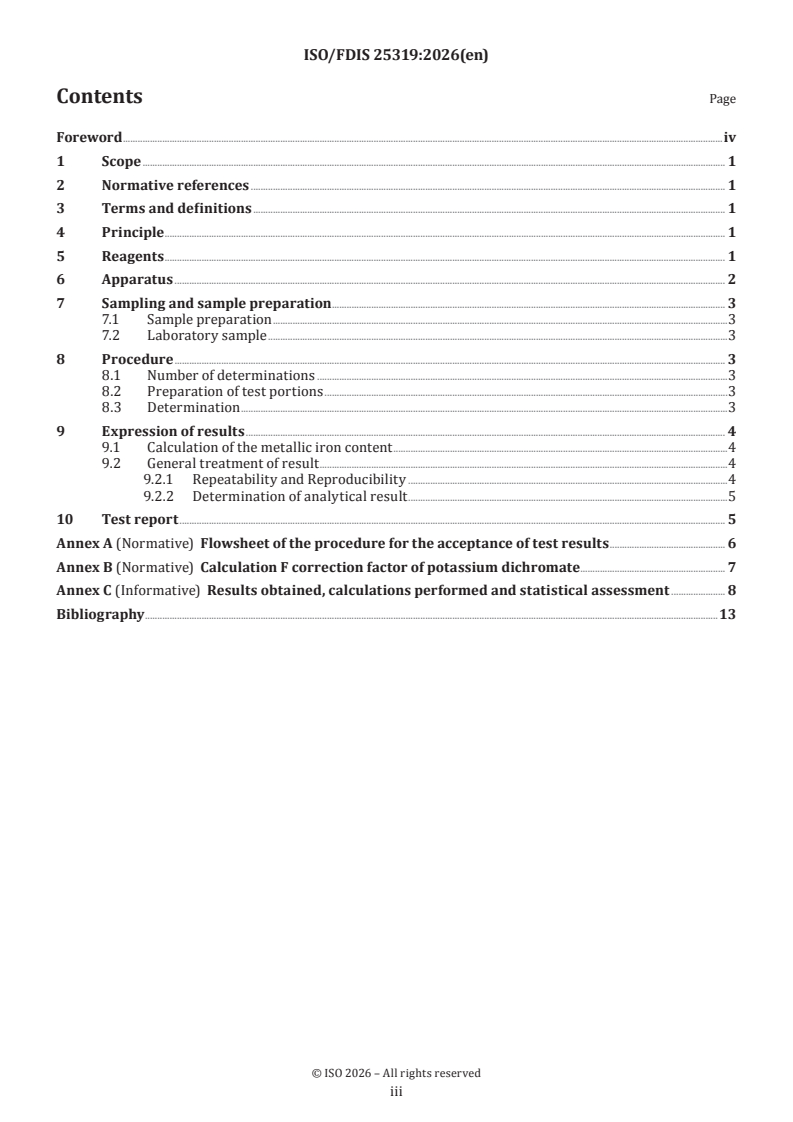
Contents Page
Foreword .iv
1 Scope . 1
2 Normative references . 1
3 Terms and definitions . 1
4 Principle . 1
5 Reagents . 1
6 Apparatus . 2
7 Sampling and sample preparation . 3
7.1 Sample preparation .3
7.2 Laboratory sample .3
8 Procedure . 3
8.1 Number of determinations .3
8.2 Preparation of test portions .3
8.3 Determination .3
9 Expression of results . 4
9.1 Calculation of the metallic iron content .4
9.2 General treatment of result .4
9.2.1 Repeatability and Reproducibility .4
9.2.2 Determination of analytical result .5
10 Test report . 5
Annex A (Normative) Flowsheet of the procedure for the acceptance of test results . 6
Annex B (Normative) Calculation F correction factor of potassium dichromate . 7
Annex C (Informative) Results obtained, calculations performed and statistical assessment . 8
Bibliography .13
iii
ISO/FDIS 25319:2026(en)
Foreword
ISO (the International Organization for Standardization) is a worldwide federation of national standards
bodies (ISO member bodies). The work of preparing International Standards is normally carried out through
ISO technical committees. Each member body interested in a subject for which a technical committee
has been established has the right to be represented on that committee. International organizations,
governmental and non-governmental, in liaison with ISO, also take part in the work. ISO collaborates closely
with the International Electrotechnical Commission (IEC) on all matters of electrotechnical standardization.
The procedures used to develop this document and those intended for its further maintenance are described
in the ISO/IEC Directives, Part 1. In particular, the different approval criteria needed for the different types
of ISO document should be noted. This document was drafted in accordance with the editorial rules of the
ISO/IEC Directives, Part 2 (see www.iso.org/directives).
ISO draws attention to the possibility that the implementation of this document may involve the use of (a)
patent(s). ISO takes no position concerning the evidence, validity or applicability of any claimed patent
rights in respect thereof. As of the date of publication of this document, ISO had not received notice of (a)
patent(s) which may be required to implement this document. However, implementers are cautioned that
this may not represent the latest information, which may be obtained from the patent database available at
www.iso.org/patents. ISO shall not be held responsible for identifying any or all such patent rights.
Any trade name used in this document is information given for the convenience of users and does not
constitute an endorsement.
For an explanation of the voluntary nature of standards, the meaning of ISO specific terms and expressions
related to conformity assessment, as well as information about ISO's adherence to the World Trade
Organization (WTO) principles in the Technical Barriers to Trade (TBT), see www.iso.org/iso/foreword.html.
This document was prepared by Technical Committee ISO/TC 102, Iron ore and direct reduced iron,
Subcommittee SC 2, Chemical analysis.
Any feedback or questions on this document should be directed to the user’s national standards body. A
complete listing of these bodies can be found at www.iso.org/members.html.
iv
FINAL DRAFT International Standard ISO/FDIS 25319:2026(en)
Determination of metallic Fe in reduced iron (sponge Iron)
and briquette — Iron (III) chloride titrimetric method
1 Scope
This method is applicable to a concentration range of 52,80 % mass fraction to 86,40 % mass fraction of the
metallic Fe.
2 Normative references
The following documents are referred to in the text in such a way that some or all of their content constitutes
requirements of this document. For dated references, only the edition cited applies. For undated references,
the latest edition of the referenced document (including any amendments) applies.
ISO 385, Laboratory glassware — Burettes
ISO 10835, Direct reduced iron and hot briquetted iron — Sampling and sample preparation
ISO 11323, Iron ore and direct reduced iron — Vocabulary
3 Terms and definitions
For the purposes of this document, the terms and definitions given in ISO 11323 apply.
ISO and IEC maintain terminology databases for use in standardization at the following addresses:
— ISO Online browsing platform: available at https:// www .iso .org/ obp
— IEC Electropedia: available at https:// www .electropedia .org/
4 Principle
0 +2
Iron present in the oxidation state Fe in the sample is oxidized to Fe by the action of FeCl . This reaction is
catalysed by ammonium chloride according to the following reaction:
2FeCl + Fe 3FeCl
3 2
2+
Fe is oxidized and titrated with potassium dichromate solution using the sodium diphenylamine sulfonate
indicator (or barium diphenylamine sulfonate) according to the following reaction:
2+ 2- + 3+ 3+
6Fe + Cr O + 14H 6Fe + 2Cr + 7H O
2 7 2
5 Reagents
During the analysis, use only reagents of recognized analytical reagent grade and only distilled water or
water of equivalent purity.
ISO/FDIS 25319:2026(en)
5.1 Iron (III) chloride solution 7 %
Add 117 g of iron (III) chloride hexahydrate to a 2 000 ml container holding 600 ml of water and agitate until
it is completely dissolved. Dilute with water to a volume of 1000 ml.
NOTE For better dissolution of the FeCl , use hot water (60 °C to 80 °C). The ideal condition is a complete
dissolution of the salt resulting in a translucent solution.
5.2 Standard potassium dichromate solution, 0,016 67 mol/L
Add 4,903 1 g of dried potassium dichromate to a 2 000 ml container holding 600 ml of water and agitate
until it is completely dissolved. Dilute with water to a volume of 1000 ml.
Prepare a standard potassium dichromate solution following the di
...
Formatted
...
Style Definition
...
Style Definition
...
Style Definition
...
Style Definition
...
ISO/FDIS 25319:2026(en)
Style Definition
...
ISO/TC 102/SC 2
Style Definition
...
Style Definition
...
Secretariat: SA
Style Definition
...
Date: 2026-03-02
Style Definition
...
Style Definition
...
Style Definition
...
Style Definition
...
Style Definition
...
Style Definition
...
Determination of metallic Fe in reduced iron (sponge Iron) and
Style Definition
...
briquette — Iron (III) chloride titrimetric method
Style Definition
...
Style Definition
...
Style Definition
...
Style Definition
...
Style Definition
...
Style Definition
...
Style Definition
...
Style Definition
...
FDIS stage
Style Definition
...
Style Definition
...
Style Definition
...
Style Definition
...
Style Definition
...
Style Definition
...
Style Definition
...
Style Definition
...
Style Definition
...
Style Definition
...
Style Definition
...
Style Definition
...
Style Definition
...
Style Definition
...
Style Definition
...
Style Definition
...
Style Definition
...
Style Definition
...
Style Definition
...
Style Definition
...
Style Definition
...
Style Definition
...
Style Definition
...
Style Definition
...
Style Definition
...
Style Definition
...
Style Definition
...
Style Definition
...
Style Definition
...
Style Definition
...
Style Definition
...
Style Definition
...
Style Definition
...
St l D fi iti
ISO/FDIS 25319:2026(en)
Formatted: Font: Bold
Formatted: HeaderCentered
Formatted: Default Paragraph Font
Formatted: Adjust space between Latin and Asian text,
All rights reserved. Unless otherwise specified, or required in the context of its implementation, no part of this publication
Adjust space between Asian text and numbers
may be reproduced or utilized otherwise in any form or by any means, electronic or mechanical, including photocopying,
or posting on the internet or an intranet, without prior written permission. Permission can be requested from either ISO
Formatted: Left: 1.5 cm, Right: 1.5 cm, Top: 1.4 cm,
at the address below or ISO’s member body in the country of the requester.
Bottom: 1 cm, Width: 21 cm, Height: 29.7 cm, Footer
distance from edge: 0.5 cm
ISO copyright office
CP 401 • Ch. de Blandonnet 8
CH-1214 Vernier, Geneva
Phone: + 41 22 749 01 11
Formatted: French (France)
EmailE-mail: copyright@iso.org
Formatted: French (France)
Website: www.iso.orgwww.iso.org
Formatted: French (France)
Published in Switzerland
Formatted: French (France)
Formatted: English (United Kingdom)
Formatted: Font: Calibri, 10 pt, Dutch (Netherlands)
Formatted: FooterPageRomanNumber
ii
ISO/FDIS 25319:2026(en)
Formatted: Font: 11 pt, Font color: Auto
Formatted: Font: Bold
Formatted: HeaderCentered, Left
Contents Page
Foreword . v
1 Scope . 1
2 Normative references . 1
3 Terms and definitions . 1
4 Principle . 1
5 Reagents . 2
6 Apparatus . 2
7 Sampling and sample preparation . 3
7.1 Sample preparation . 3
7.2 Laboratory sample . 3
8 Procedure . 3
8.1 Number of determinations . 3
8.2 Preparation of test portions . 3
8.3 Determination . 3
9 Expression of results . 4
9.1 Calculation of the metallic iron content . 4
9.2 General treatment of result . 5
10 Test report . 5
Annex A (Normative) Flowsheet of the procedure for the acceptance of test results . 7
Annex B (Normative) Calculation F correction factor of potassium dichromate . 11
Annex C (Informative) Results obtained, calculations performed and statistical assessment. 12
Bibliography . 24
Foreword……………………………………………….…….………………………………………………iv
1 Scope ………………………………………………….………………………………………………1
2 Normative references……………………………………………………….……………….…….1
3 Terms and definitions……………………………………………………….………….………….1
4 Principle……………………………………………………………….………….………….……….1
5 Reagents………………………………………………………………………………………………2
6 Apparatus…………………………………………………………………………….………………2
7 Sampling and sample preparation………….………………………………………….……….3
8 7.1 Sample preparation………………….………………………………………………………….3
7.2 Laboratory sample………………….……………………….………………………………….3
Formatted: Font: 10 pt
9 Procedure……………………………………………………………………….……………………3
Formatted: Font: 10 pt
8-1. Number of determinations……………………………………….…………………………….3
Formatted: FooterCentered, Left, Space Before: 0 pt,
Tab stops: Not at 17.2 cm
8-2. Preparation of test portions………………………………………………………….…………3
Formatted: Font: 11 pt
8-3. Determination….…………………………………….……………………….……………….3
Formatted: FooterPageRomanNumber, Left, Space
10 Expression of results………………….………………………………………………………….4
After: 0 pt, Tab stops: Not at 17.2 cm
iii
ISO/FDIS 25319:2026(en)
Formatted: Font: Bold
Formatted: HeaderCentered
9-1. Calculation of the metallic iron content…………………………….………….………….4
9-2. General treatment of result…………………………………….…………… ….………….4
9-2-1. Repeatability and permissible tolerances………………….………….…………….4
9-2-2. Determination of analytical result………….……………………….…………………4
11 Test report……………………………………………………………………………………………5
Annex A (normative) Flowsheet of the procedure for the acceptance of test results………….6
Annex B (normative) Calculation(F) correction factor of potassium dichromate…………….….7
Annex C (informative) Results obtained, calculations performed and statistical assessment.8
Bibliography…………………………………………………………………………………………….….13
Formatted: FooterPageRomanNumber
iv
ISO/FDIS 25319:2026(en)
Formatted: Font: 11 pt, Font color: Auto
Formatted: Font: Bold
Formatted: HeaderCentered, Left
Foreword
Formatted: Adjust space between Latin and Asian text,
Adjust space between Asian text and numbers
ISO (the International Organization for Standardization) is a worldwide federation of national standards
bodies (ISO member bodies). The work of preparing International Standards is normally carried out through
ISO technical committees. Each member body interested in a subject for which a technical committee has been
established has the right to be represented on that committee. International organizations, governmental and
non-governmental, in liaison with ISO, also take part in the work. ISO collaborates closely with the
International Electrotechnical Commission (IEC) on all matters of electrotechnical standardization.
The procedures used to develop this document and those intended for its further maintenance are described
in the ISO/IEC Directives, Part 1. In particular, the different approval criteria needed for the different types of
ISO document should be noted. This document was drafted in accordance with the editorial rules of the
ISO/IEC Directives, Part 2 (see www.iso.org/directives).
Formatted: English (United Kingdom)
ISO draws attention to the possibility that the implementation of this document may involve the use of (a)
patent(s). ISO takes no position concerning the evidence, validity or applicability of any claimed patent rights
in respect thereof. As of the date of publication of this document, ISO had not received notice of (a) patent(s)
which may be required to implement this document. However, implementers are cautioned that this may not
represent the latest information, which may be obtained from the patent database available at
www.iso.org/patents.www.iso.org/patents. ISO shall not be held responsible for identifying any or all such
patent rights.
Any trade name used in this document is information given for the convenience of users and does not
constitute an endorsement.
For an explanation of the voluntary nature of standards, the meaning of ISO specific terms and expressions
related to conformity assessment, as well as information about ISO's adherence to the World Trade
Organization (WTO) principles in the Technical Barriers to Trade (TBT), see
www.iso.org/iso/foreword.htmlwww.iso.org/iso/foreword.html.
Formatted: English (United Kingdom)
This document was prepared by Technical Committee ISO/TC 102, Iron ore and direct reduced iron,
Subcommittee SC 2, Chemical analysis.
Any feedback or questions on this document should be directed to the user’s national standards body. A
Formatted: English (United Kingdom)
complete listing of these bodies can be found at www.iso.org/members.htmlwww.iso.org/members.html.
Formatted: English (United Kingdom)
Formatted: Font: 10 pt
Formatted: Font: 10 pt
Formatted: FooterCentered, Left, Space Before: 0 pt,
Tab stops: Not at 17.2 cm
Formatted: Font: 11 pt
Formatted: FooterPageRomanNumber, Left, Space
After: 0 pt, Tab stops: Not at 17.2 cm
v
DRAFT International Standard ISO/DIS 25319:2025(en)
Formatted: Font: Not Bold
Formatted: Header, Space After: 0 pt, Line spacing:
single
Formatted: Font: 16 pt, (Asian) Japanese
Determination of metallic Fe in reduced iron (sponge Iron) and
Formatted: Font: 16 pt, (Asian) Japanese
briquette — Iron (III) chloride titrimetric method
1 Scope Formatted: Left: 1.5 cm, Right: 1.5 cm, Top: 1.4 cm,
Bottom: 1 cm, Width: 21 cm, Height: 29.7 cm, Footer
distance from edge: 0.5 cm
This method is applicable to a concentration range of 52,80 % mass fraction to 86,40 % mass fraction of the
metallic Fe.
Formatted: Adjust space between Latin and Asian text,
Adjust space between Asian text and numbers
2 Normative references
The following documents are referred to in the text in such a way that some or all of their content constitutes
Formatted: Default Paragraph Font
requirements of this document. For dated references, only the edition cited applies. For undated references,
Formatted: Default Paragraph Font
the latest edition of the referenced document (including any amendments) applies.
Formatted: Default Paragraph Font
ISO 385, Laboratory glassware — Burettes
Formatted: Adjust space between Latin and Asian text,
Adjust space between Asian text and numbers, Tab
ISO 1042, Laboratory glassware — One-mark volumetric flasks
stops: Not at 0.7 cm + 1.4 cm + 2.1 cm + 2.8 cm +
3.5 cm + 4.2 cm + 4.9 cm + 5.6 cm + 6.3 cm + 7 cm
ISO 10835, Direct reduced iron and hot briquetted iron — Sampling and sample preparation
Formatted: Default Paragraph Font
ISO 11323, Iron ore and direct reduced iron — Vocabulary
Formatted: Default Paragraph Font
Formatted: Default Paragraph Font
3 Terms and definitions
Formatted: Adjust space between Latin and Asian text,
Adjust space between Asian text and numbers, Tab
For the purposes of this document, the terms and definitions given in ISO 11323 apply.
stops: Not at 0.7 cm + 1.4 cm + 2.1 cm + 2.8 cm +
3.5 cm + 4.2 cm + 4.9 cm + 5.6 cm + 6.3 cm + 7 cm
sUAS when referenced in this document, refers to small Unmanned Aerial Systems.
Formatted: Default Paragraph Font
ISO and IEC maintain terminology databases for use in standardization at the following addresses:
Formatted: Default Paragraph Font
Formatted: Default Paragraph Font
— — ISO Online browsing platform: available at https://www.iso.org/obphttps://www.iso.org/obp
Formatted: Adjust space between Latin and Asian text,
— — IEC Electropedia: available at https://www.electropedia.org/https://www.electropedia.org/
Adjust space between Asian text and numbers
Formatted: Default Paragraph Font
4 Principle
Formatted: Default Paragraph Font
0 +2
Iron present in the oxidation state Fe in the sample is oxidized to Fe by the action of FeCl3. thisThis reaction
Formatted: Adjust space between Latin and Asian text,
is catalysed by ammonium chloride according to the following reaction:
Adjust space between Asian text and numbers
Formatted: Adjust space between Latin and Asian text,
2FeCl + Fe ⇄ 3FeCl
3 2
Adjust space between Asian text and numbers, Tab
stops: Not at 0.7 cm + 1.4 cm + 2.1 cm + 2.8 cm +
2+
Fe is oxidized and titrated with potassium dichromate solution using the sodium diphenylamine sulfonate
3.5 cm + 4.2 cm + 4.9 cm + 5.6 cm + 6.3 cm + 7 cm
indicator (or barium diphenylamine sulfonate) according to the following reaction:
Formatted: Adjust space between Latin and Asian text,
Adjust space between Asian text and numbers
2+ 2- + + 3+ 3+
6Fe + Cr O + 14H ⇄ 6Fe + 2Cr + 7H O
2 7 2
Formatted
...
Formatted: English (United Kingdom)
Formatted: English (United Kingdom)
Formatted
...
ISO/FDIS 25319:2026(en)
Formatted: Font: Bold
Formatted: HeaderCentered
5 Reagents
Formatted: Adjust space between Latin and Asian text,
Adjust space between Asian text and numbers
During the analysis, use only reagents of recognized analytical reagent grade and only distilled water or water
of equivalent purity.
5.1 5.1 Iron (III) chloride solution 7 %.%
Formatted: Font: Not Bold
Add 117 g of iron (III) chloride hexahydrate to a 2 000 ml container holding 600 ml of water and agitate until
Formatted: Adjust space between Latin and Asian text,
it is completely dissolved. Dilute with water to a volume of 1 l1000 ml. Adjust space between Asian text and numbers
NOTE: For better dissolution of the FeCl3, it is recommended to use hot water (60 °C to 80 °C). The ideal condition is
Formatted: Adjust space between Latin and Asian text,
a complete dissolution of the salt resulting in a translucent solution.
Adjust space between Asian text and numbers, Tab
stops: Not at 0.7 cm + 1.4 cm + 2.1 cm + 2.8 cm +
5.2 5.2 Standard potassium dichromate solution, 0,016 67 mol/L.
3.5 cm + 4.2 cm + 4.9 cm + 5.6 cm + 6.3 cm + 7 cm
Formatted: Dutch (Netherlands)
Add 4,903 1 g of dried potassium dichromate to a 2 000 ml container holding 600 ml of water and agitate until
Formatted: Font: Not Bold, Dutch (Netherlands)
it is completely dissolved. Dilute with water to a volume of 1 l1000 ml.
Formatted: Adjust space between Latin and Asian text,
Prepare a standard potassium dichromate solution following the directions in Annex BAnnex B
Adjust space between Asian text and numbers
5.3 Solution 15 % sulfuric acid 1,84 g/ml&15 % phosphoric acid 1,7 g/ml mixture.
5.3 Mixed acid
Add 700 ml of water to a 2 000 ml beaker. Place the beaker in a cool place and add slowly with stirring 150 ml
Formatted: Adjust space between Latin and Asian text,
of phosphoric acid, 1,7 b/ml. Allow cooling. Add slowly with stirring 150 ml of sulfuric acid, 1,84 g/ml and
Adjust space between Asian text and numbers
allow cooling (it is optional: placing the beaker in an ice-water bath). Dilute this mixture to 1 000 ml with
stirring.
5.4 5.4 Sodium diphenylamine sulfonate 2 g/l.
Formatted: Font: Not Bold
Dissolve 0, 2 g of powdered sodium diphenylamine sulfonate (C6H5NHC6H4SO3Na) in a small volume of water
Formatted: Adjust space between Latin and Asian text,
and dilute to 100 ml. storeStore this solution in a brown glass bottle.
Adjust space between Asian text and numbers
5.5 5.5 Barium diphenylamine sulfonate 2 g/l.
Formatted: Dutch (Netherlands)
Formatted: Font: Not Bold, Dutch (Netherlands)
Dissolve 0, 2 g of powdered barium diphenylamine sulfonate ((C H NHC H SO ) Ba) in 15 ml of hydrochloric
6 5 6 4 3 2
Formatted: Adjust space between Latin and Asian text,
acid 1 mol/L and put the container on the heater and heat (heat under 100 °C to prevent HCl volatilization or
Adjust space between Asian text and numbers
reagent decomposition due to excessive temperature) until the salt is completely solved. (Approximate time
of dissolution is 15-30 minutes). Dilute this mixture to 100 ml and store this solution in a brown glass bottle.
NOTE As both sodium and barium diphenylamine sulfonate are equal as an indicator, there is no difference in the
Formatted: Font: Not Bold
use of either of them.
Formatted: Adjust space between Latin and Asian text,
Adjust space between Asian text and numbers
5.6 5.6 Ammonium chloride solution 100 g/l.
Formatted: Font: Not Bold
Dissolve 100 g ammonium chloride (NH4Cl) to a small volume of water and dilute to 1 000 ml.
Formatted: Adjust space between Latin and Asian text,
Adjust space between Asian text and numbers
5.7 5.7 Ammonium iron(ΙΙ) sulfate hexahydrate
Formatted: Font: 11 pt, Not Bold
Ammonium iron(ΙΙ) sulfate hexahydrate1.86g/cm (20 °C), Molar mass 392.14 g/mol.
Formatted: Font: Not Bold
Formatted: Adjust space between Latin and Asian text,
6 Apparatus
Adjust space between Asian text and numbers, Tab
stops: Not at 0.7 cm + 1.4 cm + 2.1 cm + 2.8 cm +
6.1 6.1 Analytical balance, capable of weighing to the nearest 0,1 mg.
3.5 cm + 4.2 cm + 4.9 cm + 5.6 cm + 6.3 cm + 7 cm
Formatted: FooterPageNumber
ISO/FDIS 25319:2026(en)
Formatted
...
Formatted
...
Formatted
...
6.2 6.2 Erlenmeyer flask, wide mouth (500 ml).
Formatted
...
6.3 6.3 Magnet stirrer, with magnetic stirring bar.
Formatted
...
Formatted
...
6.4 6.4 Measuring cylinder, of appropriate volume.
Formatted
...
6.5 6.5 A grade burette, mark A, conformingshall conform to the specifications of ISO 385.
Formatted
...
6.6 6.6 Non-magnetic spatula.
Formatted
...
Formatted
...
6.7 Beaker
Formatted
...
7 Sampling and sample preparation Formatted
...
Formatted
...
7.1 Sample preparation
Formatted
...
After receiving the sample, the sample shall be dried at or below a temperature of 105 °C until a constant
Formatted
...
weight is reached. Then let the sample cool to room temperature in a desiccator.
Formatted
...
7.2 Laboratory sample
Formatted
...
Formatted
...
For analysis, use a laboratory sample of particle size of less than 160 µm which has been taken and prepared
Formatted
in accordance with ISO 10835.
...
Formatted
...
8 Procedure
Formatted
...
Formatted
8.1 Number of determinations .
Formatted
...
All determinations should be carried out in duplicate. If necessary, make further determinations in accordance
Formatted
...
with the flowsheet presented in Annex A.Annex A.
Formatted
...
8.2 Preparation of test portions
Formatted
...
Formatted
Accurately weigh 0, 1 000 g ± 0,005 0 g of the test sample (7.2(7.2 laboratory sample). Record the sample
...
mass (m). Add the test sample to an Erlenmeyer flask or beaker with appropriate volume.
Formatted
...
Formatted
...
8.3 Determination
Formatted
...
8.3.1 8.3.1 Decomposition of the test portion
Formatted
...
Add 100 ml Iron (III) chloride solution 7 % and 50 ml Ammonium chloride solution to the Erlenmeyer flask
Formatted
...
containing sample, put a magnet bar into the container and then cover the Erlenmeyer flask with a watch glass
and stir the solution with a magnetic agitator for at least 30 min with high speed (600 to 700 rpm).
3+ 2+ 3+
2Fe + Fe → 3Fe + Fe residual
Formatted
...
8.3.2 8.3.2 Titration Formatted
...
Formatted
...
After 30 min, add 30 ml of sulfuric acid-phosphoric acid solution, 5- to 10 drops of sodium or barium
Formatted
diphenylamine sulfonate indicator and 200- ml to 300 ml distilled water. .
Formatted
...
NOTE: The consumption amount of the indicator can be different depending on the type of brand used.
Formatted
...
Titrate the solution with potassium dichromate solution 0,1 N016 67 mol/l. The end point is reached when a Formatted
...
final drop of the titrant imparts a permanent purple colour. In each run, one blank test shall be carried out in
Formatted
...
parallel with the analysis of the sample(s) under the same conditions. Perform a blank test by following the
Formatted
...
ISO/FDIS 25319:2026(en)
Formatted: Font: Bold
Formatted: HeaderCentered
procedure without the sample. Record the blank titration volume as V0. For every new batch of iron (II
...