


ISO 22222:2005
(Main)Personal financial planning — Requirements for personal financial planners
Personal financial planning — Requirements for personal financial planners
ISO 22222:2005 defines the personal financial planning process and specifies ethical behaviour, competences and experience requirements for personal financial planners. ISO 22222:2005 is applicable to all personal financial planners regardless of their employment status. ISO 22222:2005 describes and addresses the various methods of conformity assessment and specifies requirements applying to each of them.
Conseil en gestion de patrimoine — Exigences pour les conseillers en gestion de patrimoine
L'ISO 22222:2005 définit le processus de conseil en gestion de patrimoine et spécifie les exigences relatives au comportement éthique, aux compétences et à l'expérience requis pour exercer la profession de conseiller en gestion de patrimoine. L'ISO 22222:2005 s'applique à tous les conseillers en gestion de patrimoine, quel que soit leur statut professionnel. L'ISO 22222:2005 décrit et aborde les diverses méthodes d'évaluation de conformité et spécifie les exigences qui s'appliquent à chacune d'entre elles.
General Information
- Status
- Published
- Publication Date
- 15-Dec-2005
- Technical Committee
- ISO/TC 222 - Personal financial planning
- Drafting Committee
- ISO/TC 222 - Personal financial planning
- Current Stage
- 9093 - International Standard confirmed
- Start Date
- 27-Mar-2023
- Completion Date
- 14-Feb-2026
Overview
ISO 22222:2005 - Personal financial planning - Requirements for personal financial planners - defines a global benchmark for delivering professional personal financial planning services. The standard specifies the personal financial planning process, required ethical behaviour, competence and experience criteria for individual financial planners and explains acceptable conformity assessment methods. ISO 22222 applies to all personal financial planners regardless of employment status and emphasizes consumer protection through reliable certification.
Key topics and requirements
- Personal financial planning process - A six-step, repeatable process covering:
- establishing the client–planner relationship,
- gathering client data and goals,
- analysing and evaluating financial status,
- developing and presenting a financial plan,
- implementing recommendations,
- monitoring the plan and relationship.
- Client engagement and disclosure - Planners must provide written information at engagement start: scope of service, qualifications/experience and how conformity with ISO 22222 was demonstrated (independent certification, other-party or self-assessment), including country-specific testing details.
- Terms of engagement - Written terms must disclose remuneration basis, known conflicts of interest, deliverables/timeframes, agreement duration, contact frequency and confidentiality provisions.
- Data protection and record keeping - Confidentiality of client information is required; client files (electronic or hard copy) must be kept for the period required by local law or, if none, five years from engagement/termination.
- Ethics, competence and experience - The standard sets out professional behaviour expectations, general and specific competence requirements, and rules for demonstrating initial and continuing competence. Experience is defined as applied knowledge/skills; a “year” equals 12 months full-time or part‑time equivalent.
- Conformity assessment - ISO 22222 describes methods (independent third‑party certification, other‑party assessment, self‑assessment) and recommends third‑party certification accredited to ISO/IEC 17024 for the strongest consumer protection.
Applications and who uses it
- Personal financial planners seeking to align practice with international best practices and demonstrate competence to clients.
- Certification bodies creating certification schemes for individual financial planners.
- Financial services firms and employers that hire or credential planners and want consistent competence/ethics criteria.
- Regulators, consumer groups and professional associations using the standard as a benchmark for consumer protection, credential recognition and professional education frameworks.
Related standards
- ISO/IEC 17024 - Conformity assessment: general requirements for bodies certifying persons (recommended accreditation for third‑party certification)
- ISO/IEC 17000 - Conformity assessment vocabulary and principles
- ISO/IEC 17050 - Supplier’s declaration of conformity
Keywords: ISO 22222, personal financial planning, financial planner certification, ethical behaviour, competence requirements, conformity assessment, ISO/IEC 17024, client confidentiality.
Buy Documents
ISO 22222:2005 - Personal financial planning -- Requirements for personal financial planners
ISO 22222:2005 - Conseil en gestion de patrimoine -- Exigences pour les conseillers en gestion de patrimoine

Get Certified
Connect with accredited certification bodies for this standard

Great Wall Tianjin Quality Assurance Center
Established 1993, first batch to receive national accreditation with IAF recognition.
Hong Kong Quality Assurance Agency (HKQAA)
Hong Kong's leading certification body.

Innovative Quality Certifications Pvt. Ltd. (IQCPL)
Known for integrity, providing ethical & impartial Assessment & Certification. CMMI Institute Partner.
Sponsored listings
Frequently Asked Questions
ISO 22222:2005 is a standard published by the International Organization for Standardization (ISO). Its full title is "Personal financial planning — Requirements for personal financial planners". This standard covers: ISO 22222:2005 defines the personal financial planning process and specifies ethical behaviour, competences and experience requirements for personal financial planners. ISO 22222:2005 is applicable to all personal financial planners regardless of their employment status. ISO 22222:2005 describes and addresses the various methods of conformity assessment and specifies requirements applying to each of them.
ISO 22222:2005 defines the personal financial planning process and specifies ethical behaviour, competences and experience requirements for personal financial planners. ISO 22222:2005 is applicable to all personal financial planners regardless of their employment status. ISO 22222:2005 describes and addresses the various methods of conformity assessment and specifies requirements applying to each of them.
ISO 22222:2005 is classified under the following ICS (International Classification for Standards) categories: 03.060 - Finances. Banking. Monetary systems. Insurance. The ICS classification helps identify the subject area and facilitates finding related standards.
ISO 22222:2005 is available in PDF format for immediate download after purchase. The document can be added to your cart and obtained through the secure checkout process. Digital delivery ensures instant access to the complete standard document.
Standards Content (Sample)
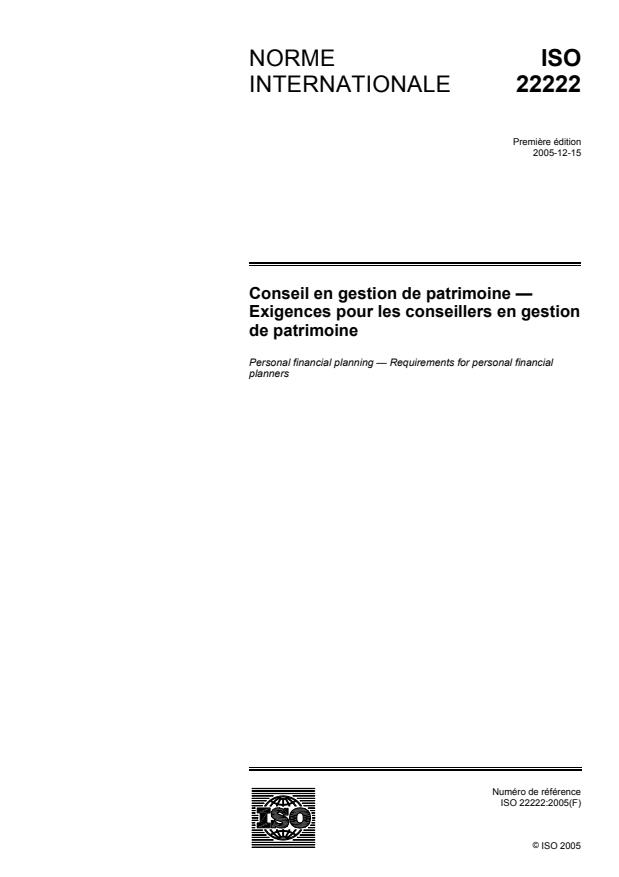
INTERNATIONAL ISO
STANDARD 22222
First edition
2005-12-15
Personal financial planning —
Requirements for personal financial
planners
Conseil en gestion de patrimoine — Exigences pour les conseillers en
gestion de patrimoine
Reference number
©
ISO 2005
PDF disclaimer
This PDF file may contain embedded typefaces. In accordance with Adobe's licensing policy, this file may be printed or viewed but
shall not be edited unless the typefaces which are embedded are licensed to and installed on the computer performing the editing. In
downloading this file, parties accept therein the responsibility of not infringing Adobe's licensing policy. The ISO Central Secretariat
accepts no liability in this area.
Adobe is a trademark of Adobe Systems Incorporated.
Details of the software products used to create this PDF file can be found in the General Info relative to the file; the PDF-creation
parameters were optimized for printing. Every care has been taken to ensure that the file is suitable for use by ISO member bodies. In
the unlikely event that a problem relating to it is found, please inform the Central Secretariat at the address given below.
© ISO 2005
All rights reserved. Unless otherwise specified, no part of this publication may be reproduced or utilized in any form or by any means,
electronic or mechanical, including photocopying and microfilm, without permission in writing from either ISO at the address below or
ISO's member body in the country of the requester.
ISO copyright office
Case postale 56 • CH-1211 Geneva 20
Tel. + 41 22 749 01 11
Fax + 41 22 749 09 47
E-mail copyright@iso.org
Web www.iso.org
Published in Switzerland
ii © ISO 2005 – All rights reserved
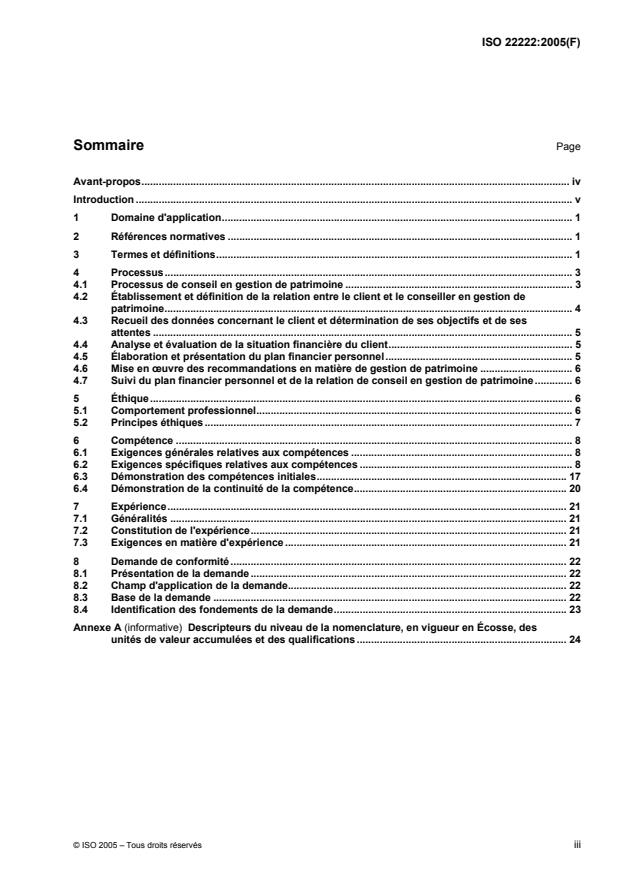
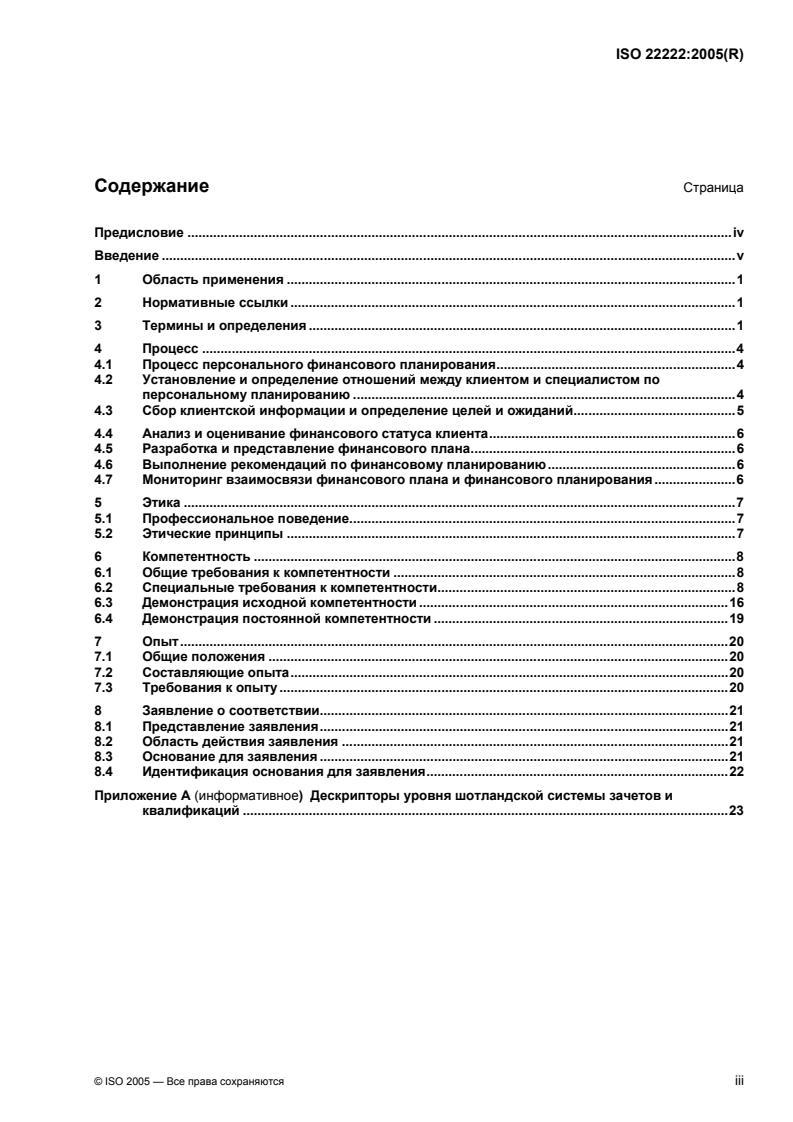
Contents Page
Foreword. iv
Introduction . v
1 Scope . 1
2 Normative references . 1
3 Terms and definitions. 1
4 Process . 3
4.1 Personal financial planning process . 3
4.2 Establishing and defining the client and personal financial planner relationship . 3
4.3 Gathering client data and determining goals and expectations. 4
4.4 Analysing and evaluating the client's financial status . 5
4.5 Developing and presenting the financial plan . 5
4.6 Implementing the financial planning recommendations . 5
4.7 Monitoring the financial plan and the financial planning relationship. 6
5 Ethics . 6
5.1 Professional behaviour . 6
5.2 Ethical principles . 6
6 Competence . 7
6.1 General requirements for competence. 7
6.2 Specific requirements for competence . 7
6.3 Demonstration of initial competence. 15
6.4 Demonstration of continuing competence. 17
7 Experience. 18
7.1 General. 18
7.2 Constitution of experience . 19
7.3 Experience requirements. 19
8 Claiming conformity . 19
8.1 Presentation of claim. 19
8.2 Scope of claim. 19
8.3 Basis of claim. 20
8.4 Identification of the basis of claim. 20
Annex A (informative) Scottish credit and qualifications framework level descriptors . 21
Foreword
ISO (the International Organization for Standardization) is a worldwide federation of national standards bodies
(ISO member bodies). The work of preparing International Standards is normally carried out through ISO
technical committees. Each member body interested in a subject for which a technical committee has been
established has the right to be represented on that committee. International organizations, governmental and
non-governmental, in liaison with ISO, also take part in the work. ISO collaborates closely with the
International Electrotechnical Commission (IEC) on all matters of electrotechnical standardization.
International Standards are drafted in accordance with the rules given in the ISO/IEC Directives, Part 2.
The main task of technical committees is to prepare International Standards. Draft International Standards
adopted by the technical committees are circulated to the member bodies for voting. Publication as an
International Standard requires approval by at least 75 % of the member bodies casting a vote.
Attention is drawn to the possibility that some of the elements of this document may be the subject of patent
rights. ISO shall not be held responsible for identifying any or all such patent rights.
ISO 22222 was prepared by Technical Committee ISO/TC 222, Personal financial planning.
iv © ISO 2005 – All rights reserved
Introduction
This International Standard has been drawn up with the objective of achieving and promoting a globally
accepted benchmark for individuals who provide the professional service of personal financial planning.
Personal financial planning is a process designed to enable consumers to achieve their personal financial
goals. The service of personal financial planning is provided by a personal financial planner to assist clients
with their personal financial planning.
Consumers need to have confidence in their personal financial planner. This International Standard specifies
the ethical behaviour, competences and experience required of a professional personal financial planner.
This International Standard describes and addresses the various methods of conformity assessment and
specifies requirements applying to each of them. Conformity assessment of personal financial planners is a
complex task requiring access to specialized knowledge, skills and experience. The technical committee
(comprising practitioners, industry and consumer representatives) for this International Standard strongly
believes that accredited independent third-party certification provides the most reliable method of conformity
assessment and thus protection for consumers.
Therefore, the technical committee recommends that consumers seek the services of personal financial
planners who can demonstrate that they have undergone conformity assessment by independent third-party
certification bodies which have been accredited as complying with the requirements set out in ISO/IEC 17024.
INTERNATIONAL STANDARD ISO 22222:2005(E)
Personal financial planning — Requirements for personal
financial planners
1 Scope
This International Standard defines the personal financial planning process and specifies ethical behaviour,
competences and experience requirements for personal financial planners.
This International Standard is applicable to all personal financial planners regardless of their employment
status.
This International Standard describes and addresses the various methods of conformity assessment and
specifies requirements applying to each of them.
2 Normative references
The following referenced documents are indispensable for the application of this document. For dated
references, only the edition cited applies. For undated references, the latest edition of the referenced
document (including any amendments) applies.
ISO/IEC 17000, Conformity assessment — Vocabulary and general principles
ISO/IEC 17024, Conformity assessment — General requirements for bodies operating certification of persons
ISO/IEC 17050 (all parts), Conformity assessment — Supplier's declaration of conformity
3 Terms and definitions
For the purposes of this document, the terms and definitions given in ISO/IEC 17000, ISO/IEC 17024 and the
following apply.
3.1
broad general knowledge
awareness and basic understanding over the breadth of the subject, but not to the depth that would be
expected of a specialist in the specific subject area
3.2
certificate
attestation document issued by an independent third-party certification body
3.3
client
consumer who has accepted the terms of engagement as described in 4.2.3
3.4
cognitive level
hierarchy of thinking
NOTE The hierarchy of thinking is listed in 6.2.
3.5
conformity assessment
demonstration that specified requirements relating to a product, process, system, person or body are fulfilled
[ISO/IEC 17000]
NOTE Conformity assessment covers such activities as testing, inspection and certification, as well as the
accreditation of conformity assessment bodies.
3.6
consumer
individual or group of individuals who share financial interests
NOTE A family would be considered a group of individuals.
3.7
continuing education
education, training and development undertaken by personal financial planners to maintain ongoing
professional competence
3.8
declaration
attestation document issued by any body other than an independent third-party certification body
NOTE 1 This definition differs from the definition of declaration in ISO/IEC 17000.
NOTE 2 “Body” includes any individual.
3.9
employment status
present state of a consumer's income-earning capabilities
EXAMPLES Employee, self-employed, independent contractor, freelancer, business owner, not employed, retiree, or
student.
3.10
experience
knowledge and skills acquired while participating in the application of the personal financial planning process
and related activities
3.11
financial goal
quantifiable financial outcome or target which is intended to be met at some future point in time or over a
period of time
3.12
financial risk tolerance
extent to which a consumer is willing to risk experiencing a less favourable financial outcome in the pursuit of
a more favourable financial outcome
3.13
individual performance measurements
methods and indicators used to evaluate the performance of a personal financial planner
3.14
personal financial plan
document that specifies how a consumer should organize and manage his/her/their personal financial affairs,
in whole or in part, so as to satisfy present and future personal goals, needs and priorities
2 © ISO 2005 – All rights reserved
3.15
personal financial planner
individual who provides a service of personal financial planning to clients and who meets all of the ethics,
competence and experience requirements contained in this International Standard
NOTE A personal financial planner is also commonly referred to as a “financial planner” or “financial planning
practitioner.”
3.16
personal financial planning
process designed to enable a consumer to achieve his/her/their personal financial goals
3.17
personal financial planning relationship
relationship between a client and his/her/their personal financial planner
3.18
personal goal
outcome which a consumer wishes to achieve that may be quantitative or qualitative in nature
3.19
remuneration
direct and indirect financial benefits received by a personal financial planner in exchange for providing the
service of personal financial planning to a client
3.20
service of personal financial planning
service performed interactively by a personal financial planner to assist a client with his/her/their personal
financial planning
3.21
year
〈of experience〉 twelve months of full-time activity or the part-time equivalent
4 Process
4.1 Personal financial planning process
As provided by a personal financial planner, the personal financial planning process shall include, but is not
limited to, six steps that can be repeated throughout the client and personal financial planner relationship. The
client can decide to end the process before having completed all of the steps.
In providing clients with the service of personal financial planning, the personal financial planner shall use
documented procedures to respond to and resolve all client complaints and claims, and be supported by
financial, security, operational, risk management and business continuation plans.
4.2 Establishing and defining the client and personal financial planner relationship
4.2.1 The personal financial planner shall, at the beginning of each engagement, provide, in writing, to the
consumer:
a) the scope of the financial planning service being offered,
b) their qualifications and experience, and
c) the full disclosure as to which method they have used or are using to demonstrate their conformity with
this International Standard (independent third-party certification, other-party assessment, or
self-assessment); against which country-specific knowledge they have been tested; when conformity was
established; and by which body.
4.2.2 The personal financial planner shall request and should gather the following information:
a) consumer profile, including composition of household,
b) age, health and factors affecting life expectancy,
c) employment status,
d) relationships,
e) financial position,
f) public and private benefits, insurances and entitlements,
g) immediate needs, and
h) short-term and long-term goals,
NOTE Methods for gathering information can include:
⎯ interviews,
⎯ questionnaires,
⎯ face-to-face meetings,
⎯ telephone conversations, and
⎯ correspondence.
4.2.3 The personal financial planner shall provide written terms of engagement for services that disclose:
a) the basis of remuneration,
b) any known conflicts of interest,
c) service deliverables and timeframes,
d) duration of the agreement,
e) frequency of contact, and
f) confidentiality provisions.
4.3 Gathering client data and determining goals and expectations
4.3.1 The personal financial planner shall use the outputs from 4.2.
4.3.2 The personal financial planner shall request appropriate additional data that should normally include,
but is not limited to:
a) individual and household asset, liability and cash flow details,
b) relevant risk management arrangements,
c) contracts,
d) statements,
e) forms,
4 © ISO 2005 – All rights reserved
f) legal documents,
g) details of needs, goals and objectives, including timeframes,
h) economic assumptions,
i) information relating to their financial risk tolerance, and
j) attitude to social, ethical, environmental and religious considerations.
4.3.3 The personal financial planner shall protect the confidentiality of client information.
4.3.4 The personal financial planner shall maintain an electronic or hard copy database of files and/or
records for the client with relevant values and dates for the timeframe mandated by local law, or in the
absence of local law, five years from the date of the terms of engagement or termination of the engagement,
whichever is later.
4.4 Analysing and evaluating the client's financial status
4.4.1 The personal financial planner shall use the outputs from 4.2 and 4.3.
4.4.2 The personal financial planner shall take into account the client's current situation and circumstances,
and should reflect anticipated future changes.
4.4.3 The personal financial planner shall include the client's goals and preferences.
4.4.4 The personal financial planner shall produce and provide to the client, in a clear and reasonable
manner, an evaluation of the client's status that identifies areas of strengths and vulnerability, comparing them
against the client's goals, plans, restrictions and assessment of financial risk tolerance.
4.5 Developing and presenting the financial plan
4.5.1 The personal financial planner shall use the outputs from 4.2, 4.3 and 4.4.
4.5.2 The personal financial planner shall review, discuss and resolve with the client issues pertaining to
understanding:
a) the client's information and circumstances,
b) the client's goals and interpretation of the goals,
c) the client's tolerance for financial risk, and
d) the methods used to assist in achieving the client's goals.
4.5.3 The personal financial planner shall produce and provide to the client a financial plan that includes a
list of suitable and usable recommendations.
4.6 Implementing the financial planning recommendations
4.6.1 The personal financial planner shall use the output from 4.5.
4.6.2 The personal financial planner shall assist the client directly or indirectly with implementation of the
recommendations in accordance with the terms of engagement.
4.6.3 The personal financial planner should produce appropriate documentation wherein each
recommendation has evidence of acceptance, modification, completion, deferral or rejection, pursuant to local
and national requirements.
4.7 Monitoring the financial plan and the financial planning relationship
4.7.1 The personal financial planner shall use the input from 4.2, outputs from 4.5 and actions from 4.6 as
updated over time, and as defined and outlined in the terms of engagement.
4.7.2 The personal financial planner should use a method that repeats, as necessary, all or part of the
previous steps identified as 4.2 through 4.6 of the financial planning process.
4.7.3 The personal financial planner shall produce an updated list of recommendations in accordance with
the terms of engagement wherein each recommendation has evidence of acceptance, modification,
completion, deferral or rejection.
5 Ethics
5.1 Professional behaviour
A personal financial planner shall strive for conduct that reflects honourably upon the profession of personal
financial planning.
NOTE Ethical behaviour is at the core of the personal financial planner's practice. Recognizing, valuing and applying
ethical principles day-to-day is fundamental to professional life. This clause sets out a limited number of key ethical
principles that apply broadly to all aspects of a personal financial planning service. Ethical behaviour presumes and goes
beyond compliance with applicable rules and regulations.
5.2 Ethical principles
5.2.1 Integrity
Personal financial planners shall be open, honest, responsive, accountable and committed to acting
competently, responsibly, reliably, fairly and with respect in all professional relationships.
5.2.2 Priority of client's interests
Personal financial planners shall make the legitimate interests of the client paramount.
5.2.3 Due care and diligence
Personal financial planners shall conduct their professional activities with due skill, care, diligence and
competence.
5.2.4 Compliance and professionalism
Personal financial planners shall comply with relevant rules and regulations and observe standards of
professional good practice.
5.2.5 Conflicts of interests
Personal financial planners shall disclose and fairly manage all conflicts of interest.
5.2.6 Communication
Personal financial planners shall convey information and recommendations in an understandable, effective
and constructive manner.
6 © ISO 2005 – All rights reserved
5.2.7 Objectivity
Personal financial planners shall act objectively and recommend solutions that fit the client's situation.
5.2.8 Confidentiality
Personal financial planners shall safeguard client confidentiality unless subject to regulatory and or legal
obligations.
5.2.9 Disclosure
Personal financial planners shall provide accurate and relevant information, including statements of
qualifications, credentials and type of conformity assessment with this International Standard.
5.2.10 Competence
Personal financial planners shall not accept or perform work which they are not competent to undertake
unless they obtain such advice and assistance as should enable them to carry out the work competently.
6 Competence
6.1 General requirements for competence
Personal financial planners shall have knowledge specific to the jurisdictions in respect of which they are
performing a service of personal financial planning.
Personal financial planners shall have a broad general knowledge of the rules and regulations that apply to
personal financial planning.
Personal financial planners shall abide by the applicable rules and regulations to which they are subject,
including those of any professional bodies or regulators.
Personal financial planners shall understand what services should be rendered based on the scope of an
engagement.
6.2 Specific requirements for competence
Each task to be carried out by a personal financial planner is defined in Table 1 and then broken down into
knowledge/understanding and skill required to carry out the task competently.
NOTE The following hierarchy of thinking is used in Table 1 to reflect increasing levels of complexity in the thought
processes required:
a) Knowledge: ability to recognize and recall a piece of information presented in the assessment.
b) Understanding: ability to understand how and why a principle operates within a particular environment.
c) Application: ability to select an appropriate known principle in a new situation, to restructure data in a suitable form,
and to apply the principle.
d) Analysis: ability to split a concept into its constituent elements.
e) Evaluation: ability to judge the extent to which material satisfies specified criteria.
Table 1 — Specific requirements for competence of a personal financial planner
Step Process
1 Establishing and defining the client and personal financial planner relationship
A
Personal financial planners shall be able to assist a client in the establishment of reasonable
expectations based on the scope of the financial planning engagement.
a) Knowledge/understanding b) Skills
⎯ Shall understand the nature and scope of the ⎯ Shall communicate with the client in
engagement. a way that will help the client to
establish clearly defined
expectations for the engagement.
⎯ Shall be able to communicate with
the client in a way that builds a
candid and trusting relationship.
2 Gathering client data and determining goals and expectations
A Personal financial planners shall be able to gather client's data and establish initial goals and
expectations.
a) Knowledge/understanding b) Skills
⎯ Shall understand the need for establishing time horizons ⎯ Shall be able to assist in identifying
for individual objectives, quantifying needs and and understanding the client's
objectives and prioritizing needs and objectives based needs and objectives.
on the goals of the client.
⎯ Shall be able to assist a client in
⎯ Shall understand how certain events and stages within identifying time horizons for each
the life cycle could have an impact on a client's needs. need and objective.
⎯ Shall be able to assist in
establishing and prioritizing the
client's goals and expectations.
B Personal financial planners shall be able to work with a client to develop the client's quantitative and
qualitative financial goals.
a) Knowledge/understanding b) Skills
⎯ Shall possess a broad general knowledge of the ⎯ Shall be able to clearly state the
financial and economic concepts required to develop objectives as developed with and
financial objectives. agreed to by the client.
⎯ Shall possess the basic analytical abilities required to
develop financial objectives.
⎯ Shall possess a basic understanding of how risk and
time frames can affect financial objectives.
C Personal financial planners shall be able to obtain a client's personal non-financial data, such as health,
gender, age, lifestyle, occupation, marital status, family needs and priorities.
a) Knowledge/understanding b) Skills
⎯ Shall know the questions that need to be asked to gather ⎯ Should be able to communicate
the non-financial data. effectively so that accurate data can
be collected.
⎯ Should be able to explain why
complete and accurate data is
essential and relevant to the
engagement.
8 © ISO 2005 – All rights reserved
Table 1 (continued)
Step Process
D
Personal financial planners shall be able to collect and record accurately a client's relevant financial data
such as past, current and expected future income, expenditures, assets and liabilities.
a) Knowledge/understanding b) Skills
⎯ Shall know the general types of information relevant to a ⎯ Should be able to communicate
client's past, current, and expected future income, effectively so that accurate data is
expenditure, assets and liabilities. collected.
⎯ Should know where and how to obtain the information. ⎯ Shall be able to explain why
complete and accurate data is
essential and relevant to the
engagement.
⎯ Shall be able to prepare a statement
of net worth and statement of cash
flow, and record other relevant
information accurately and
comprehensively.
E Personal financial planners shall be able to collect all other information relevant to the engagement, such
as insurance, investments, retirement, gifting, tax and estate data.
a) Knowledge/understanding b) Skills
⎯ Shall understand why the information is needed. ⎯ Shall be able to explain the need for
the information to the client.
⎯ Shall know how to collect the relevant data.
⎯ Shall be able to use appropriate
methods to collect relevant
information.
F Personal financial planners shall be able to gather information on a client's tolerance and capacity for
financial risks.
a) Knowledge/understanding b) Skills
⎯ Shall understand the general concepts of risk capacity ⎯ Shall be able to gather the relevant
and risk tolerance levels and understand how those information to assess risk tolerance.
factors combine to impact investment and other financial
decisions.
G
Personal financial planners shall be able to assemble and consolidate relevant data and information for
analysis.
a) Knowledge/understanding b) Skills
⎯ Shall know how to organize the relevant information ⎯ Shall be able to identify gaps and
collected. discrepancies and organize the
information for analysis.
3 Analysing and evaluating the client's financial status
A
Personal financial planners shall be able to prepare a time line of a client's life events taking into account
the client's situation and intentions as defined in the objectives.
a) Knowledge/understanding b) Skills
⎯ Shall possess a general knowledge of significant events ⎯ Shall possess the analytical skills
and circumstances in life that may cause an individual to necessary to prepare a time line of a
seek advice and an understanding of their financial client's life events.
implications.
⎯ Shall be able to integrate economic,
financial, and social factors in
preparing the time line of events.
Table 1 (continued)
Step Process
B
Personal financial planners shall be able to analyse the implications of a client's current and projected
net worth and cash flow statements.
a) Knowledge/understanding b) Skills
⎯ Shall understand the current and future implications of a ⎯ Shall be able to identify the financial
client's net worth and cash flow statements. strengths and weaknesses reflected
in the net worth and cash flow
statements.
⎯ Shall be able to determine
appropriate assumptions in
conjunction with the information
provided by the client.
⎯ Shall be able to develop appropriate
projections according to the
assumptions.
C Personal financial planners shall be able to identify and analyse relevant tax issues and related
implications for their clients.
a) Knowledge/understanding b) Skills
⎯ Shall possess a broad general knowledge of individual ⎯ Shall be able to analyse tax
and business taxes as they relate to personal financial situations and understand the
planning. implications and effects of the
situation.
⎯ Shall possess a general knowledge of how the timing of
an event can affect taxes.
D
Personal financial planners shall be able to analyse and evaluate economic, financial and social factors
relevant to a client's situation.
a) Knowledge/understanding b) Skills
⎯ Shall possess a broad general knowledge of financial, ⎯ Shall be able to analyse and
economic and social events relevant to personal evaluate the implications of external
financial planning. events on the client's financial
situation.
⎯ Shall be able to develop appropriate
projections according to the
assumptions.
E Personal financial planners shall be able to analyse and evaluate a client's risk management and
insurance situation.
a) Knowledge/understanding b) Skills
⎯ Shall possess a broad general knowledge of risk ⎯ Shall be able to analyse and
management and insurance as it applies to personal evaluate the risk management and
financial planning. insurance needs of a client.
⎯ Shall be able to analyse and
evaluate the risk management and
current insurance coverage of a
client and determine if it meets the
needs and objectives of the client.
10 © ISO 2005 – All rights reserved
Table 1 (continued)
Step Process
F Personal financial planners shall be able to analyse and evaluate a client's retirement situation.
a) Knowledge/understanding b) Skills
⎯ Shall possess a broad general knowledge of private, ⎯ Shall be able to analyse and
business and government retirement programmes as evaluate the retirement needs and
they relate to personal financial planning. objectives of a client.
⎯ Shall be able to analyse and
evaluate the current retirement
plans and assets of a client and
determine if they sufficiently meet
the needs and objectives of the
client.
G Personal financial planners shall be able to analyse and evaluate a client's estate situation.
a) Knowledge/understanding b) Skills
⎯ Shall possess a broad general knowledge of estate ⎯ Shall be able to analyse and
planning techniques. evaluate the estate needs of the
client.
⎯ Shall be able to analyse and
evaluate the current estate plan and
determine if it meets the client's
objectives.
H Personal financial planners shall be able to analyse and evaluate a client's investment situation.
a) Knowledge/understanding b) Skills
⎯ Shall possess a broad general knowledge of investment ⎯ Shall be able to analyse and
options. evaluate the risks and returns of
various investments as compared to
commonly used benchmarks.
⎯ Shall be able to analyse and
evaluate the investment needs of a
client.
⎯ Shall be able to analyse and
evaluate a client's current
investments and determine if they
meet the stated objectives and risk
tolerance level of the client.
I Personal financial planners shall be able to analyse and evaluate a client's overall financial position.
a) Knowledge/understanding b) Skills
⎯ Shall understand the comprehensive and integrated ⎯ Shall be able to analyse and
nature of financial planning. evaluate a client's overall financial
situation.
⎯ Shall understand how the various areas of a client's
financial life interact.
4 Developing and presenting the financial plan
A
Personal financial planners shall be able to develop recommendations based on the statement of net
worth and the statement of cash flows and present these recommendations in a way that assists the
client in understanding how these recommendations meet his/her/their needs.
a) Knowledge/understanding b) Skills
⎯ Shall possess a basic understanding of the calculations, ⎯ Shall be able to develop and
presentation and categories of personal financial evaluate present recommendations
statements. based on the information provided in
the statement of net worth and the
statement of cash flows.
⎯ Shall be able to explain why the
recommendations are appropriate
for the client.
Table 1 (continued)
Step Process
B
Personal financial planners shall be able to develop recommendations for tax strategies and present
these recommendations in a way that can assist the client in understanding how these recommendations
meet his/her/their needs.
a) Knowledge/understanding b) Skills
⎯ Shall possess a broad general knowledge of individual ⎯ Shall be able to evaluate alternative
and business taxes as they relate to personal financial tax strategies and determine how
planning. they can affect the outcomes
desired by the client.
⎯ Shall possess a general knowledge of how the timing of
an event can affect taxes. ⎯ Shall be able to explain why the
recommendations are appropriate
for the client.
C Personal financial planners shall be able to develop and present recommendations for a personal risk
management and insurance plan.
a) Knowledge/understanding b) Skills
⎯ Shall possess a broad general knowledge of risk ⎯ Shall be able to evaluate alternative
management and insurance as it applies to personal personal risk management and
financial planning. insurance plans and determine how
they can affect the outcomes
desired by the client.
⎯ Shall be able to explain why the
recommended plan is appropriate
for the client.
D Personal financial planners shall be able to develop and present recommendations for a retirement plan.
a) Knowledge/understanding b) Skills
⎯ Shall possess a broad general knowledge of private, ⎯ Shall be able to evaluate alternative
business and government retirement programmes as retirement plans and determine how
they relate to personal financial planning. they can affect the outcomes
desired by the client.
⎯ Shall be able to explain why the
recommendations are appropriate
for the client.
E Personal financial planners shall be able to develop and present recommendations for an investment
plan.
a) Knowledge/understanding b) Skills
⎯ Shall possess a broad general knowledge of investment ⎯ Shall be able to evaluate alternative
options. investment plans and determine
how they can affect the outcomes
desired by the client.
⎯ Shall be able to explain why the
recommendations are appropriate
for the client.
F
Personal financial planners shall be able to develop and present estate planning recommendations.
a) Knowledge/understanding b) Skills
⎯ Shall possess a broad general knowledge of estate ⎯ Shall be able to evaluate alternative
planning techniques. estate plans and determine how
they can affect the outcomes
desired by the client.
⎯ Shall be able to explain why the
recommendations are appropriate
for the client.
12 © ISO 2005 – All rights reserved
Table 1 (continued)
Step Process
G
Personal financial planners shall be able to compare the client's tolerance for financial risks and the
financial risks that may be involved in achieving his or her goals and assist the client in resolving any
differences.
a) Knowledge/understanding b) Skills
⎯ Shall understand personal financial risk tolerance. ⎯ Shall be able to explain to the client
how to reconcile any differences.
⎯ Shall understand the risks in financial strategies.
⎯ Shall assist the client in resolving
any differences.
H Personal financial planners shall be able to integrate the various financial plan components, explain the
resulting comprehensive financial plan and obtain the properly informed commitment of the client to
proceed.
a) Knowledge/understanding b) Skills
⎯ Shall understand the comprehensive nature of financial ⎯ Shall be able to compile the various
planning. components into a logical and
appropriate financial plan for a
⎯ Shall understand how the various areas of a client's
client.
financial life interact.
⎯ Shall be sure the recommendations
answer the questions of who, what,
when, where, why and how.
⎯ Shall be able to evaluate alternative
strategies and determine how they
could affect the overall financial
plan.
⎯ Shall be able to evaluate a
comprehensive financial plan to
determine if it meets the needs and
stated objectives of a client.
⎯ Shall be able to explain the plan.
⎯ Shall be able to obtain an
agreement to the assumptions
utilized.
⎯ Shall be able to obtain an
agreement to proceed.
Table 1 (continued)
Step Process
5 Implementing the financial planning recommendations
A
Personal financial planners shall be able to prepare documentation that summarizes the objectives and
implementation strategies as agreed with the client.
a) Knowledge/understanding b) Skills
⎯ Shall know implementation procedures, products and ⎯ Shall be able to communicate,
legal requirements. coordinate and reconcile the agreed
solutions with the client.
⎯ Shall be able to carry out the agreed
implementation strategies with the
client.
⎯ Shall be able to review the financial
plan with the client's other
professional advisors.
B
Personal financial planners shall either carry out the implementation strategy or assist the client in
implementing the plan as agreed with the client.
a) Knowledge/understanding b) Skills
⎯ Shall understand the various applicable legal and ⎯ Shall be able to establish which
regulatory requirements in respect to products and/or strategies the personal financial
services recommended. planner will be implementing.
⎯ Shall know the roles and responsibilities of other ⎯ Shall be able to establish which
professionals. strategies the client will be
implementing.
⎯ Shall know their own professional limitations and
restrictions. ⎯ Shall be able to establish who will
be implementing the remaining
strategies as agreed with the client.
⎯ Shall be able to communicate with
the client to determine the status of
the plan implementation.
⎯ Shall be able to work with the client
to modify the plan if a change is
indicated during the implementation
stage.
14 © ISO 2005 – All rights reserved
Table 1 (continued)
Step Process
6 Monitoring the financial plan and the financial planning relationship
A
Personal financial planners shall be able to monitor changes in a client's situation, needs, and objectives
on an ongoing basis and revise the financial plan if necessary.
a) Knowledge/understanding b) Skills
⎯ Shall understand how changes in a client's personal ⎯ Shall be able to monitor changes in
circumstances and tolerance for risk may impact the a client's situation in accordance
financial plan. with the terms of engagement and
recognize when changes are
needed in the financial plan.
⎯ Shall be able to update a client's
financial plan as situations dictate.
⎯ Shall be able to explain the changes
to the financial plan along with the
expected impact of the changes to
the client.
B
Personal financial planners shall be able to monitor changes in the financial, economic, regulatory,
legislative and political environment that could affect a client's situation and revise the financial plan if
necessary while the client relationship is maintained.
a) Knowledge/understanding b) Skills
⎯ Shall understand changes in financial, economic, ⎯ Shall be able to recognize when
regulatory, legislative and political areas and the effect financial, economic, regulatory,
such changes might have on the personal situation and legislative and political changes
financial plan of a client. create a situation where a client's
financial plan should be updated.
⎯ Shall be able to update a client's
financial plan as financial, economic,
regulatory, legislative and political
situations dictate.
⎯ Shall be able to explain the changes
to the financial plan along with the
expected impact of the changes to
the client.
6.3 Demonstration of initial competence
Candidates for assessment shall demonstrate the cognitive level described in Table 1 for measuring
knowledge, understanding, application and/or skills.
Candidates for assessment shall demonstrate characteristic outcomes equal to or greater than the level set
out in Table 2.
NOTE This is Level 8 in the Scottish Credit and Qualification Framework, as described in Annex A.
Table 2 — Necessary characteristic outcomes for minimum assessment level
Communication,
Practise: Autonomy,
Knowledge and Generic cognitive information
Applied knowledge accountability and
understanding skills technology and
and understanding working with others
numeracy skills
Demonstrate and/or a) Use a range of a) Undertake critical Use a range of a) Exercise
work with: routine skills, analysis, routine skills and autonomy and
techniques, evaluation and/or some advanced and initiative in some
⎯ a broad knowledge
practises and/or synthesis of specialized skills activities at a
of the scope,
materials ideas, concepts, associated with a professional
defining features,
associated with information and subject/ discipline, for l
...
NORME ISO
INTERNATIONALE 22222
Première édition
2005-12-15
Conseil en gestion de patrimoine —
Exigences pour les conseillers en gestion
de patrimoine
Personal financial planning — Requirements for personal financial
planners
Numéro de référence
©
ISO 2005
PDF – Exonération de responsabilité
Le présent fichier PDF peut contenir des polices de caractères intégrées. Conformément aux conditions de licence d'Adobe, ce fichier
peut être imprimé ou visualisé, mais ne doit pas être modifié à moins que l'ordinateur employé à cet effet ne bénéficie d'une licence
autorisant l'utilisation de ces polices et que celles-ci y soient installées. Lors du téléchargement de ce fichier, les parties concernées
acceptent de fait la responsabilité de ne pas enfreindre les conditions de licence d'Adobe. Le Secrétariat central de l'ISO décline toute
responsabilité en la matière.
Adobe est une marque déposée d'Adobe Systems Incorporated.
Les détails relatifs aux produits logiciels utilisés pour la création du présent fichier PDF sont disponibles dans la rubrique General Info
du fichier; les paramètres de création PDF ont été optimisés pour l'impression. Toutes les mesures ont été prises pour garantir
l'exploitation de ce fichier par les comités membres de l'ISO. Dans le cas peu probable où surviendrait un problème d'utilisation,
veuillez en informer le Secrétariat central à l'adresse donnée ci-dessous.
© ISO 2005
Droits de reproduction réservés. Sauf prescription différente, aucune partie de cette publication ne peut être reproduite ni utilisée sous
quelque forme que ce soit et par aucun procédé, électronique ou mécanique, y compris la photocopie et les microfilms, sans l'accord écrit
de l'ISO à l'adresse ci-après ou du comité membre de l'ISO dans le pays du demandeur.
ISO copyright office
Case postale 56 • CH-1211 Geneva 20
Tel. + 41 22 749 01 11
Fax. + 41 22 749 09 47
E-mail copyright@iso.org
Web www.iso.org
Publié en Suisse
ii © ISO 2005 – Tous droits réservés
Sommaire Page
Avant-propos. iv
Introduction . v
1 Domaine d'application. 1
2 Références normatives . 1
3 Termes et définitions. 1
4 Processus. 3
4.1 Processus de conseil en gestion de patrimoine . 3
4.2 Établissement et définition de la relation entre le client et le conseiller en gestion de
patrimoine. 4
4.3 Recueil des données concernant le client et détermination de ses objectifs et de ses
attentes . 5
4.4 Analyse et évaluation de la situation financière du client. 5
4.5 Élaboration et présentation du plan financier personnel. 5
4.6 Mise en œuvre des recommandations en matière de gestion de patrimoine . 6
4.7 Suivi du plan financier personnel et de la relation de conseil en gestion de patrimoine. 6
5 Éthique. 6
5.1 Comportement professionnel. 6
5.2 Principes éthiques. 7
6 Compétence . 8
6.1 Exigences générales relatives aux compétences . 8
6.2 Exigences spécifiques relatives aux compétences . 8
6.3 Démonstration des compétences initiales. 17
6.4 Démonstration de la continuité de la compétence. 20
7 Expérience. 21
7.1 Généralités . 21
7.2 Constitution de l'expérience. 21
7.3 Exigences en matière d'expérience . 21
8 Demande de conformité. 22
8.1 Présentation de la demande . 22
8.2 Champ d'application de la demande. 22
8.3 Base de la demande . 22
8.4 Identification des fondements de la demande. 23
Annexe A (informative) Descripteurs du niveau de la nomenclature, en vigueur en Écosse, des
unités de valeur accumulées et des qualifications . 24
Avant-propos
L'ISO (Organisation internationale de normalisation) est une fédération mondiale d'organismes nationaux de
normalisation (comités membres de l'ISO). L'élaboration des Normes internationales est en général confiée
aux comités techniques de l'ISO. Chaque comité membre intéressé par une étude a le droit de faire partie du
comité technique créé à cet effet. Les organisations internationales, gouvernementales et non
gouvernementales, en liaison avec l'ISO participent également aux travaux. L'ISO collabore étroitement avec
la Commission électrotechnique internationale (CEI) en ce qui concerne la normalisation électrotechnique.
Les Normes internationales sont rédigées conformément aux règles données dans les Directives ISO/CEI,
Partie 2.
La tâche principale des comités techniques est d'élaborer les Normes internationales. Les projets de Normes
internationales adoptés par les comités techniques sont soumis aux comités membres pour vote. Leur
publication comme Normes internationales requiert l'approbation de 75 % au moins des comités membres
votants.
L'attention est appelée sur le fait que certains des éléments du présent document peuvent faire l'objet de
droits de propriété intellectuelle ou de droits analogues. L'ISO ne saurait être tenue pour responsable de ne
pas avoir identifié de tels droits de propriété et averti de leur existence.
L'ISO 22222 a été élaborée par le comité technique ISO/TC 222, Conseil en gestion de patrimoine.
iv © ISO 2005 – Tous droits réservés
Introduction
La présente Norme internationale a été rédigée avec, pour objectif, de réaliser et de promouvoir une
référence, globalement acceptée, pour des individus qui fournissent, à titre professionnel, un service de
conseil en gestion de patrimoine. Le conseil en gestion de patrimoine est un processus conçu pour permettre
aux consommateurs de réaliser leurs objectifs financiers personnels. Le service de conseil en gestion de
patrimoine est assuré par un conseiller en gestion de patrimoine, dans le but d'aider la clientèle dans la
gestion de son patrimoine personnel.
Les consommateurs ont besoin d'avoir confiance en leur conseiller en gestion de patrimoine. La présente
Norme internationale spécifie le comportement éthique, les compétences et l'expérience requis pour un
conseiller en gestion de patrimoine professionnel.
La présente Norme internationale décrit et aborde les diverses méthodes d'évaluation de la conformité et
spécifie les exigences qui s'appliquent à chacune d'entre elles. L'évaluation de la conformité des conseillers
en gestion de patrimoine est une tâche complexe, qui exige la possession de connaissances, de
compétences et d'une expérience spécialisées. Le Comité technique (qui comprend des praticiens, des
représentants de l'Industrie et des consommateurs) pour la présente Norme internationale croit fermement
qu'une certification par tierce partie indépendante et accréditée, représenterait la méthode la plus fiable
d'évaluation de la conformité et, ainsi, une protection pour les consommateurs.
Le Comité technique recommande, par conséquent, que les consommateurs recherchent les services de
conseillers en gestion de patrimoine qui soient à même de démontrer qu'ils ont eu une évaluation de
conformité par le biais d'organismes de certification tierce partie indépendants, qui ont été accrédités comme
satisfaisant les exigences exposées dans l'ISO/CEI 17024.
NORME INTERNATIONALE ISO 22222:2005(F)
Conseil en gestion de patrimoine — Exigences pour les
conseillers en gestion de patrimoine
1 Domaine d'application
La présente Norme internationale définit le processus de conseil en gestion de patrimoine et spécifie les
exigences relatives au comportement éthique, aux compétences et à l'expérience requises pour exercer la
profession de conseiller en gestion de patrimoine.
La présente Norme internationale s'applique à tous les conseillers en gestion de patrimoine, quel que soit leur
statut professionnel.
La présente Norme internationale décrit et aborde les diverses méthodes d'évaluation de conformité et
spécifie les exigences qui s'appliquent à chacune d'entre elles.
2 Références normatives
Les documents de référence suivants sont indispensables pour l'application du présent document. Pour les
références datées, seule l'édition citée s'applique. Pour les références non datées, la dernière édition du
document de référence s'applique (y compris les éventuels amendements).
ISO/CEI 17000, Évaluation de la conformité — Vocabulaire et principes généraux
ISO/CEI 17024, Évaluation de la conformité — Exigences générales pour les organismes de certification
procédant à la certification de personnes
ISO/CEI 17050 (toutes les parties), Évaluation de la conformité — Déclaration de conformité du fournisseur
3 Termes et définitions
Pour les besoins du présent document, les termes et définitions donnés dans l'ISO/CEI 17000,
l'ISO/CEI 17024 ainsi que les suivants s'appliquent.
3.1
connaissance générale
connaissance et compréhension de base, et non connaissance approfondie, du sujet qui serait attendue d'un
spécialiste dans ce domaine de compétence spécifique
3.2
certificat
document d'attestation émis par un organisme de certification tierce partie indépendant
3.3
client
consommateur qui a accepté les modalités de la lettre de mission, telles que décrites en 4.2.3
3.4
niveau cognitif
hiérarchie de la pensée
NOTE La hiérarchie de la pensée est listée en 6.2.
3.5
évaluation de la conformité
démonstration que des exigences spécifiées relatives à un produit, un processus, un système, une personne
ou un organisme sont respectées
[ISO/CEI 17000]
NOTE L'évaluation de la conformité recouvre des activités telles que des essais, l'inspection et la certification, de
même que l'accréditation des organismes d'évaluation de la conformité.
3.6
consommateur
individu ou groupe d'individus qui partagent des intérêts financiers
NOTE Une famille serait considérée comme un groupe d'individus.
3.7
formation continue
études, formation et développement suivis par les conseillers en gestion de patrimoine en vue de maintenir
leur niveau de compétence professionnelle
3.8
déclaration
document d'attestation établi par tout organisme autre qu'un organisme de certification tierce partie
indépendant
NOTE 1 La présente définition diffère de la définition de la déclaration contenue dans l'ISO/CEI 17000.
NOTE 2 «Organisme» inclut tout individu.
3.9
statut professionnel
état actuel des capacités de perception de revenu d'un consommateur
EXEMPLES employé, employé indépendant, entrepreneur indépendant, libéral, propriétaire d'une affaire, sans emploi,
retraité ou étudiant.
3.10
expérience
connaissance et compétences acquises en participant à la mise en œuvre du processus de conseil en gestion
de patrimoine et des activités connexes
3.11
objectif financier
résultat ou objectif financier quantifiable, conçu pour être atteint ultérieurement, à un certain moment ou sur
une période donnée
3.12
tolérance au risque financier
mesure dans laquelle un consommateur accepte de prendre le risque d'obtenir un résultat financier moins
favorable, dans la recherche d'un résultat financier plus favorable
2 © ISO 2005 – Tous droits réservés
3.13
mesure des performances individuelles
méthodes et indicateurs utilisés pour évaluer les performances d'un conseiller en gestion de patrimoine
3.14
plan financier personnel
document qui spécifie la manière selon laquelle un consommateur organise et gère ses affaires financières
personnelles, en totalité ou en partie, de façon à satisfaire des objectifs, des besoins et des priorités
personnels, présents et futurs
3.15
conseiller en gestion de patrimoine
individu, qui fournit un service de conseil en gestion de patrimoine à des clients et qui satisfait l'ensemble des
exigences en matière d'éthique, de compétence et d'expérience, exigences contenues dans la présente
Norme internationale
NOTE Il est aussi fait communément référence à un conseiller en gestion de patrimoine en tant que «conseiller
financier» ou «praticien du conseil en gestion de patrimoine».
3.16
conseil en gestion de patrimoine
processus conçu pour permettre à un consommateur d'atteindre ses buts financiers personnels
3.17
relation entourant le conseil en gestion de patrimoine
relation entre un client et son conseiller en gestion de patrimoine
3.18
objectif personnel
résultat qu'un consommateur désire atteindre et qui peut être d'une nature quantitative ou qualitative
3.19
rémunération
prestations financières directes et indirectes reçues par un conseiller en gestion de patrimoine en échange de
la fourniture du service de conseil en gestion de patrimoine à un client
3.20
service de conseil en gestion de patrimoine
service fourni de manière interactive par un conseiller en gestion de patrimoine pour assister un client dans la
gestion de son patrimoine personnel
3.21
année
〈d'expérience〉 douze mois d'activité à plein temps ou l'équivalent à temps partiel
4 Processus
4.1 Processus de conseil en gestion de patrimoine
En tant que service fourni par un conseiller en gestion de patrimoine, le processus de conseil en gestion de
patrimoine doit comprendre, sans s'y limiter, six étapes pouvant se répéter tout au long de la relation entre le
client et le conseiller en gestion de patrimoine. Le client peut décider de mettre fin au processus avant d'avoir
exécuté la totalité des étapes.
En fournissant à la clientèle le service de conseil en gestion de patrimoine, le conseiller en gestion de
patrimoine doit utiliser des procédures documentées pour résoudre et répondre à toutes les plaintes et
réclamations du client et pour être soutenu par des plans financier, de sécurité, des opérations, de gestion
des risques et de continuation de l'activité.
4.2 Établissement et définition de la relation entre le client et le conseiller en gestion de
patrimoine
4.2.1 Le conseiller en gestion de patrimoine doit fournir par écrit au consommateur, au début de chaque
mission
a) le champ d'application du service de gestion de patrimoine proposé,
b) ses qualifications et son expérience, et
c) un exposé complet quant à la méthode qui a été utilisée ou qui est utilisée pour démontrer sa conformité
avec la présente Norme internationale (certification tierce partie indépendante, évaluation par une autre
partie ou auto-évaluation); par rapport à quelles connaissances propres à un pays, il a été mis à
l'épreuve; quand la conformité a été établie et par quel organisme.
4.2.2 Le conseiller en gestion de patrimoine doit demander et il convient également qu'il les recueille les
informations suivantes:
a) le profil du consommateur, y compris la composition du foyer;
b) l'âge, l'état de santé et les facteurs affectant l'espérance de vie;
c) le statut professionnel;
d) les relations;
e) la situation financière;
f) les sources de revenus publiques et privées, les assurances et les droits acquis;
g) les besoins immédiats;
h) les objectifs à court et long termes.
NOTE Les méthodes pour recueillir l'information peuvent inclure
⎯ des entrevues,
⎯ des questionnaires,
⎯ des entretiens en face-à-face,
⎯ des conversations téléphoniques, et
⎯ une correspondance.
4.2.3 Le conseiller en gestion de patrimoine doit fournir par écrit les modalités de la lettre de mission qui
énoncent
a) la base de rémunération,
b) tout conflit d'intérêt connu,
c) les prestations de services à fournir ainsi que le cadre temporel dans lequel elles s'inscrivent,
d) la durée de l'accord,
e) la fréquence des contacts, et
f) les clauses de confidentialité.
4 © ISO 2005 – Tous droits réservés
4.3 Recueil des données concernant le client et détermination de ses objectifs et de ses
attentes
4.3.1 Le conseiller en gestion de patrimoine doit utiliser les données obtenues à la suite des démarches de
4.2.
4.3.2 Le conseiller en gestion de patrimoine doit demander les données additionnelles appropriées. Il
convient normalement que celles-ci portent, sans y être limitées, sur
a) les actifs personnels et les actifs du foyer, le passif et la trésorerie disponible,
b) les dispositions pertinentes, prises en matière de gestion des risques,
c) les contrats,
d) l'état financier,
e) les dispositions,
f) les documents juridiques,
g) le détail des besoins, buts et objectifs, y compris les échéances dans lesquels ils s'inscrivent,
h) les hypothèses économiques,
i) des informations relatives à sa tolérance au risque financier, et
j) son attitude face à des considérations sociales, éthiques, environnementales et religieuses.
4.3.3 Le conseiller en gestion de patrimoine doit protéger la confidentialité des informations émanant du
client.
4.3.4 Le conseiller en gestion de patrimoine doit tenir une base de données électronique ou papier des
fichiers et/ou des dossiers établis pour le client contenant les valeurs et les dates indispensables pendant la
durée légale obligatoire en vertu du droit local ou, en l'absence de dispositions de droit local, pendant cinq
ans à compter de la date de signature de la lettre de mission ou de la fin de celle-ci, la date la plus
contraignante étant retenue.
4.4 Analyse et évaluation de la situation financière du client
4.4.1 Le conseiller en gestion de patrimoine doit utiliser les données résultant des démarches de 4.2 et 4.3.
4.4.2 Le conseiller en gestion de patrimoine doit prendre en considération la situation actuelle et
l'environnement du client et il convient qu'il fasse état des changements futurs prévus.
4.4.3 Le conseiller en gestion de patrimoine doit inclure les objectifs et les préférences du client.
4.4.4 Le conseiller en gestion de patrimoine doit établir et fournir au client, d'une manière claire et
raisonnable, une évaluation de la situation du client qui identifie les zones de points forts et de points faibles,
en les confrontant aux objectifs, plans et contraintes du client, ainsi qu'à l'évaluation de la tolérance de celui-ci
au risque financier.
4.5 Élaboration et présentation du plan financier personnel
4.5.1 Le conseiller en gestion de patrimoine doit utiliser les données résultant des démarches de 4.2, 4.3 et
4.4.
4.5.2 Le conseiller en gestion de patrimoine doit vérifier, discuter et résoudre avec le client les questions en
vue de comprendre
a) les informations ainsi que l'environnement du client,
b) les objectifs du client et l'interprétation de ceux-ci,
c) la tolérance du client au risque financier, et
d) les méthodes utilisées pour aider à la réalisation des objectifs du client.
4.5.3 Le conseiller en gestion de patrimoine doit établir et fournir au client un plan financier qui comporte
une liste de recommandations convenables et utilisables.
4.6 Mise en œuvre des recommandations en matière de gestion de patrimoine
4.6.1 Le conseiller en gestion de patrimoine doit utiliser les données résultant des démarches de 4.5.
4.6.2 Le conseiller en gestion de patrimoine doit, directement ou indirectement, aider le client, à mettre en
œuvre les recommandations, en accord avec les modalités de la lettre de mission.
4.6.3 Il convient que le conseiller en gestion de patrimoine produise une documentation appropriée,
apportant, pour chaque recommandation, la preuve qu'elle a été acceptée, modifiée, exécutée, reportée ou
rejetée conformément aux exigences locales ou nationales.
4.7 Suivi du plan financier personnel et de la relation de conseil en gestion de patrimoine
4.7.1 Le conseiller en gestion de patrimoine doit utiliser les données visées en 4.2, les données résultant
des démarches de 4.5 et les actions visées en 4.6, telles qu'actualisées dans le temps, et telles que définies
et exposées dans la lettre de mission.
4.7.2 Il convient que le conseiller en gestion de patrimoine utilise une méthode qui répète si nécessaire,
tout ou partie des étapes précédentes, identifiées de 4.2 à 4.6 du processus de conseil en gestion de
patrimoine.
4.7.3 Le conseiller en gestion de patrimoine doit établir une liste actualisée de recommandations en accord
avec les modalités de la lettre de mission, laquelle apporte pour chaque recommandation la preuve qu'elle a
été acceptée, modifiée, exécutée, reportée ou rejetée.
5 Éthique
5.1 Comportement professionnel
Un conseiller en gestion de patrimoine doit s'efforcer d'adopter un comportement qui se reflète honorablement
sur la profession de conseil en gestion de patrimoine.
NOTE Le comportement éthique est l'un des piliers de la profession de conseiller en gestion de patrimoine. La
reconnaissance, l'appréciation et l'application de principes éthiques au jour le jour sont fondamentales pour la pratique
professionnelle. Le présent article expose un nombre limité de principes éthiques clés qui s'appliquent largement à tous
les aspects du service de conseil en gestion de patrimoine. Un comportement éthique suppose et va au-delà de la simple
conformité aux règles et réglementations applicables.
6 © ISO 2005 – Tous droits réservés
5.2 Principes éthiques
5.2.1 Intégrité
Les conseillers en gestion de patrimoine doivent être ouverts, honnêtes, réactifs, responsables et soucieux
d'agir de manière compétente, responsable, fiable, juste et avec respect dans toutes leurs relations
professionnelles.
5.2.2 Priorité aux intérêts du client
Les conseillers en gestion de patrimoine doivent accorder la priorité absolue aux intérêts légitimes du client.
5.2.3 Attention et diligence nécessaires
Les conseillers en gestion de patrimoine doivent mener leurs activités professionnelles avec le savoir-faire, le
soin, la diligence et la compétence qui s'imposent.
5.2.4 Conformité et professionnalisme
Les conseillers en gestion de patrimoine doivent se conformer aux règles et réglementations applicables en la
matière et respecter les normes de bonnes pratiques professionnelles.
5.2.5 Conflits d'intérêts
Les conseillers en gestion de patrimoine doivent signaler et gérer équitablement tout conflit d'intérêt.
5.2.6 Communication
Les conseillers en gestion de patrimoine doivent transmettre les informations et recommandations d'une
manière compréhensible, efficace et constructive.
5.2.7 Objectivité
Les conseillers en gestion de patrimoine doivent agir objectivement et recommander des solutions adaptées à
la situation du client.
5.2.8 Confidentialité
Les conseillers en gestion de patrimoine doivent protéger la confidentialité du client, sauf dispositions
réglementaires ou légales contraires.
5.2.9 Obligations en matière d'information
Les conseillers en gestion de patrimoine doivent fournir des informations exactes et pertinentes, y compris les
états de qualifications, les références professionnelles et le type d'évaluation de conformité à la présente
Norme internationale.
5.2.10 Compétence
Les conseillers en gestion de patrimoine ne doivent pas accepter ou effectuer des travaux pour lesquels ils ne
disposent pas des compétences requises, à moins qu'ils n'obtiennent les conseils et l'assistance pouvant leur
permettre d'effectuer lesdits travaux de manière compétente.
6 Compétence
6.1 Exigences générales relatives aux compétences
Les conseillers en gestion de patrimoine doivent avoir des connaissances propres aux juridictions en respect
desquelles ils fournissent un service de conseil en gestion de patrimoine.
Les conseillers en gestion de patrimoine doivent avoir une connaissance générale étendue des règles et
réglementations qui s'appliquent au conseil en gestion de patrimoine personnel.
Les conseillers en gestion de patrimoine doivent respecter les règles et réglementations applicables
auxquelles ils sont soumis, y compris celles de tout autre organisme professionnel ou de régulateurs.
Les conseillers en gestion de patrimoine doivent comprendre quels services il convient de fournir sur la base
du champ d'application d'une mission.
6.2 Exigences spécifiques relatives aux compétences
Chaque tâche à exécuter par un conseiller en gestion de patrimoine est définie dans le Tableau 1 puis
ventilée en connaissance/compréhension et compétence, requises pour exécuter la tâche de manière
compétente.
NOTE La présente hiérarchie de la pensée est utilisée dans le Tableau 1 pour refléter des niveaux croissants de
complexité dans les processus de pensée requis:
a) connaissance: aptitude à reconnaître et à se rappeler un élément d'information, présenté dans l'évaluation;
b) compréhension: aptitude à comprendre comment et pourquoi un principe fonctionne dans un environnement
particulier;
c) application: aptitude à sélectionner un principe connu approprié dans une nouvelle situation, à restructurer des
données dans une forme convenable et à appliquer le principe;
d) analyse: aptitude à fractionner un concept en ses éléments constituants;
e) évaluation: aptitude à juger la mesure dans laquelle la substance satisfait les critères spécifiés.
8 © ISO 2005 – Tous droits réservés
Tableau 1 — Exigences spécifiques relatives aux compétences des conseillers
en gestion de patrimoine
Étape Processus
1 Établissement et définition de la relation entre le client et le conseiller en gestion de patrimoine
A Le conseiller en gestion de patrimoine doit être capable d'aider ses clients à formuler des attentes
raisonnables sur la base du champ d'application de la mission de planification financière.
a) Connaissance/compréhension b) Compétences
⎯ doit comprendre la nature et le champ d'application ⎯ doit communiquer avec le client en vue
de la mission. d'aider celui-ci à formuler des attentes
clairement définies à l'égard de sa
mission;
⎯ doit être capable de communiquer avec
le client afin de nouer avec lui une
relation sincère et basée sur la
confiance.
2 Recueil des données concernant le client et détermination de ses objectifs et de ses attentes
A Le conseiller en gestion de patrimoine doit être capable de collecter les données client et de déterminer
les attentes et les objectifs initiaux.
a) Connaissance/compréhension b) Compétences
⎯ doit comprendre la nécessité de définir des horizons ⎯ doit être capable d'aider à identifier et à
temporels pour les objectifs individuels, de comprendre les besoins et objectifs du
quantifier et de prioriser les besoins et les objectifs client;
sur la base des objectifs du client;
⎯ doit être capable d'aider le client à
définir l'horizon temporel de chaque
⎯ doit comprendre comment certains événements et
besoin et objectif;
certaines étapes dans le cycle de vie peuvent avoir
un impact sur les besoins du client.
⎯ doit être capable d'aider à définir et à
prioriser les objectifs et attentes du
client.
B Le conseiller en gestion de patrimoine doit être capable de travailler avec son client pour définir les
objectifs financiers quantitatifs et qualitatifs du client.
a) Connaissance/compréhension b) Compétence
⎯ doit posséder une connaissance générale des ⎯ doit être capable d'énoncer clairement
notions financières et économiques nécessaires à les objectifs développés conjointement
l'élaboration des objectifs financiers; avec le client et acceptés par celui-ci.
⎯ doit posséder les aptitudes analytiques de base
requises pour élaborer des objectifs financiers;
⎯ doit avoir une compréhension de base de la
manière dont les risques et les cadres temporels
sont susceptibles d'affecter les objectifs financiers.
C Le conseiller en gestion de patrimoine doit être capable d'obtenir les données personnelles non
financières de son client, y compris son état de santé, son sexe, son âge, son mode de vie, sa
profession, son état civil, ses besoins ainsi que les priorités de son ménage.
a) Connaissance/compréhension b) Compétences
⎯ doit connaître les questions à poser pour recueillir ⎯ il convient que le conseiller soit capable
les données non financières. de communiquer efficacement afin que
les données exactes puissent être
recueillies;
⎯ il convient que le conseiller soit capable
d'expliquer la raison pour laquelle des
données complètes et exactes sont
essentielles et pertinentes pour
l'exécution de sa mission.
Tableau 1 (suite)
Étape Processus
D
Le conseiller en gestion de patrimoine doit être capable de recueillir et d'enregistrer de manière exacte
les données financières pertinentes de son client, y compris ses revenus passés, actuels et anticipés
ainsi que ses charges, ses actifs et ses passifs.
a) Connaissance/compréhension b) Compétences
⎯ doit connaître les types généraux d'informations ⎯ il convient que le conseiller soit capable
pertinentes relatives aux revenus passés, actuels et de communiquer efficacement pour
futurs, aux charges, aux actifs et aux passifs; pouvoir collecter des données exactes;
⎯ doit être capable d'expliquer pourquoi
⎯ il convient que le conseiller sache où et comment
des données complètes et exactes sont
obtenir les informations.
essentielles et pertinentes pour
l'exécution de sa mission;
⎯ doit être capable de préparer l'état des
actifs nets ainsi que les flux de
trésorerie et de consigner, de manière
exacte et exhaustive, toute autre
information pertinente.
E Le conseiller en gestion de patrimoine doit être capable de collecter toute autre information pertinente
pour sa mission, telles que les données relatives aux contrats d'assurance, aux investissements, à la
retraite, aux donations, à la situation fiscale et successorale.
a) Connaissance/compréhension b) Compétences
⎯ doit comprendre pourquoi ces informations sont ⎯ doit être capable d'expliquer au client la
nécessaires; raison pour laquelle cette information
est nécessaire;
⎯ doit savoir comment collecter les données
pertinentes. ⎯ doit être capable d'utiliser les méthodes
appropriées pour collecter les
informations pertinentes.
F
Le conseiller en gestion de patrimoine doit être capable de collecter des informations relatives aux
seuils de tolérance et de capacité en matière de risque du client.
a) Connaissance/compréhension b) Compétence
⎯ doit comprendre les notions générales des niveaux ⎯ doit être capable de collecter les
de capacité de risque et de tolérance au risque et informations pertinentes pour évaluer la
comprendre comment ces facteurs se combinent tolérance au risque.
pour influer sur les décisions d'investissement et
autres décisions financières.
G
Le conseiller en gestion de patrimoine doit être capable d'assembler et de consolider les données et les
informations pertinentes à des fins d'analyse.
a) Connaissance/compréhension b) Compétence
⎯ doit savoir comment organiser les informations ⎯ doit être capable d'identifier les lacunes
pertinentes collectées. et les incohérences et d'organiser
l'information à des fins d'analyse.
3 Analyse et évaluation de la situation financière du client
A
Le conseiller en gestion de patrimoine doit être capable de préparer une chronologie des événements
de la vie du client tenant compte de la situation et des souhaits du client, tels qu'ils sont définis dans les
objectifs.
a) Connaissance/compréhension b) Compétences
⎯ doit posséder une connaissance générale des ⎯ doit posséder les aptitudes analytiques
événements et circonstances importantes dans la nécessaires pour préparer une
vie qui peuvent conduire un individu à rechercher chronologie des événements de la vie
les conseils et la compréhension de leurs de son client;
répercussions financières.
⎯ doit être capable d'intégrer les facteurs
économiques, financiers et sociaux
dans la préparation de la chronologie
des événements.
10 © ISO 2005 – Tous droits réservés
Tableau 1 (suite)
Étape Processus
B
Le conseiller en gestion de patrimoine doit être capable d'analyser les répercussions actuelles et à long
terme de l'état des actifs nets et des flux de trésorerie du client.
a) Connaissance/compréhension b) Compétences
⎯ doit comprendre les implications actuelles et futures ⎯ doit être capable d'identifier les points
de l'état des actifs nets et des flux de trésorerie de forts et les points faibles, en termes
son client. financiers, reflétés par l'état des actifs
nets et les flux de trésorerie;
⎯ doit être capable d'élaborer des
hypothèses pertinentes par rapport aux
informations fournies par le client;
⎯ doit être capable d'élaborer des
projections pertinentes sur la base des
hypothèses.
C Le conseiller en gestion de patrimoine doit être capable d'identifier et d'analyser les problèmes fiscaux
pertinents et les répercussions de ceux-ci sur son client.
a) Connaissance/compréhension b) Compétence
⎯ doit posséder une connaissance générale des ⎯ doit être capable d'analyser les
impôts sur les revenus des personnes et sur les différentes situations fiscales et de
revenus professionnels en relation avec le conseil comprendre les répercussions
en gestion de patrimoine; financières de ces situations.
⎯ doit posséder une connaissance générale de la
façon dont la survenance d'un événement dans le
temps peut influer sur la fiscalité.
D Le conseiller en gestion de patrimoine doit être capable d'analyser et d'évaluer les facteurs
économiques, financiers et sociaux pertinents pour la situation d'un client.
a) Connaissance/compréhension b) Compétences
⎯ doit posséder une connaissance générale des ⎯ doit être capable d'analyser et d'évaluer
événements financiers, économiques et sociaux les effets exercés par les événements
pertinents pour le conseil en gestion de patrimoine extérieurs sur la situation financière du
client;
⎯ doit être capable d'élaborer des
projections appropriées sur la base des
hypothèses.
E
Le conseiller en gestion de patrimoine doit être capable d'analyser et d'évaluer la situation du client en
terme de gestion des risques et d'assurances.
a) Connaissance/compréhension b) Compétences
⎯ doit posséder une connaissance générale de la ⎯ doit être capable d'analyser et d'évaluer
gestion des risques et de l'assurance en relation la gestion des risques et les besoins en
avec le conseil en gestion de patrimoine. assurance d'un client;
⎯ doit être capable d'analyser et d'évaluer
la gestion des risques et l'étendue de la
couverture d'assurance d'un client et de
déterminer si celles-ci répondent à ses
besoins et objectifs.
Tableau 1 (suite)
Étape Processus
F
Le conseiller en gestion de patrimoine doit être capable d'analyser et d'évaluer la situation d'un client en
matière de retraite.
a) Connaissance/compréhension b) Compétences
⎯ doit posséder une connaissance générale des ⎯ doit être capable d'analyser et d'évaluer
régimes de retraite privés, professionnels et les besoins et objectifs d'un client en
gouvernementaux en relation avec le conseil en matière de régime de retraite;
gestion de patrimoine.
⎯ doit être capable d'analyser et d'évaluer
les régimes de retraite actuels ainsi que
les actifs d'un client et de déterminer si
ceux-ci sont suffisants pour répondre
aux besoins et aux objectifs du client.
G Le conseiller en gestion de patrimoine doit être capable d'analyser et d'évaluer la situation du client en
matière de transmission du patrimoine.
a) Connaissance/compréhension b) Compétences
⎯ doit posséder une connaissance générale des ⎯ doit être capable d'analyser et d'évaluer
techniques de transmission de patrimoine. les besoins d'un client en matière
successorale;
⎯ doit être capable d'analyser et d'évaluer
l'organisation de transmission de
patrimoine en cours et de déterminer s'il
répond aux objectifs du client.
H Le conseiller en gestion de patrimoine doit être capable d'analyser et d'évaluer la situation d'un client en
termes d'investissements.
a) Connaissance/compréhension b) Compétences
⎯ doit posséder une connaissance générale des ⎯ doit être capable d'analyser et d'évaluer
options d'investissement. les risques et la rentabilité des
différents investissements par rapport
aux références communément utilisées;
⎯ doit être capable d'analyser et d'évaluer
les besoins en investissements d'un
client;
⎯ doit être capable d'analyser et d'évaluer
les investissements en cours d'un client
et de déterminer s'ils atteignent les
objectifs fixés et correspondent au
niveau de tolérance au risque du client.
I Le conseiller en gestion de patrimoine doit être capable d'analyser et d'évaluer la situation financière
globale d'un client.
a) Connaissance/compréhension b) Compétence
⎯ doit avoir une compréhension complète et intégrée ⎯ doit être capable d'analyser et d'évaluer
de la nature du plan financier personnel; la situation financière globale d'un
client.
⎯ doit comprendre comment les différents aspects de
la vie financière d'un client interagissent.
12 © ISO 2005 – Tous droits réservés
Tableau 1 (suite)
Étape Processus
4 Élaboration et présentation du plan financier personnel
A
Le conseiller en gestion de patrimoine doit être capable d'élaborer des recommandations basées sur
l'état des actifs nets et les flux de trésorerie et de présenter ces recommandations au client de façon à
lui permettre de comprendre comment elles répondent à ses besoins.
a) Connaissance/compréhension b) Compétences
⎯ doit avoir une compréhension de base des calculs, ⎯ doit être capable d'élaborer et d'évaluer
de la présentation et des catégories d'états les recommandations formulées sur la
financiers personnels. base des informations contenues dans
l'état des actifs nets et des flux de
trésorerie;
⎯ doit être capable d'expliquer les raisons
pour lesquelles les recommandations
sont adaptées au client.
B Le conseiller en gestion de patrimoine doit être capable d'élaborer des recommandations en matière de
politique fiscale et de présenter ces recommandations de manière à permettre au client de comprendre
comment celles-ci répondent à ses besoins.
a) Connaissance/compréhension b) Compétences
⎯ doit posséder une connaissance générale des ⎯ doit être capable d'évaluer des
impôts sur les revenus des personnes et sur les stratégies fiscales alternatives et de
revenus professionnels en relation avec le conseil déterminer comment celles-ci peuvent
en gestion de patrimoine; influer sur les résultats souhaités par le
client;
⎯ doit posséder une connaissance générale de la
façon dont la survenance dans le temps d'un ⎯ doit être capable d'expliquer les raisons
événement peut influer sur la fiscalité. pour lesquelles les recommandations
sont adaptées au client.
C
Le conseiller en gestion de patrimoine doit être capable d'élaborer et de présenter des
recommandations relatives à un plan de couverture des risques personnels et d'assurance.
a) Connaissance/compréhension b) Compétences
⎯ doit posséder une connaissance générale de la ⎯ doit être capable d'évaluer les plans
gestion des risques et de l'assurance en relation alternatifs de gestion des risques
avec le conseil en gestion de patrimoine. personnels et d'assurance et de
déterminer comment ceux-ci sont
susceptibles d'influer sur les résultats
souhaités par le client;
⎯ doit être capable d'expliquer pourquoi le
plan recommandé est adapté au client.
D Le conseiller en gestion de patrimoine doit être capable d'élaborer et de présenter des
recommandations portant sur un régime de retraite.
a) Connaissance/compréhension b) Compétences
⎯ doit posséder une connaissance générale des ⎯ doit être capable d'évaluer les régimes
régimes de retraite privés, professionnels et de retraite alternatifs et de déterminer
gouvernementaux en relation avec le conseil en comment ils peuvent influer sur les
gestion de patrimoine. résultats souhaités par le client;
⎯ doit être capable d'expliquer les raisons
pour lesquelles les recommandations
sont adaptées au client.
Tableau 1 (suite)
Étape Processus
E
Le conseiller en gestion de patrimoine doit être capable d'élaborer et de présenter des
recommandations au sujet d'un plan d'investissement.
a) Connaissance/compréhension b) Compétences
⎯ doit posséder une connaissance générale des ⎯ doit être capable d'évaluer les plans
options d'investissement. d'investissement alternatifs et de
déterminer comment ils sont
susceptibles d'influer sur les résultats
souhaités par le client;
⎯ doit être capable d'expliquer pourquoi
les recommandations sont adaptées au
client.
F Le conseiller en gestion de patrimoine doit être capable d'élaborer et de présenter des
...
МЕЖДУНАРОДНЫЙ ISO
СТАНДАРТ 22222
Первое издание
2005-12-15
Персональное финансовое
планирование. Требования к
специалистам по персональному
финансовому планированию
Personal financial planning – Requirements for personal financial
planners
Ответственность за подготовку русской версии несёт GOST R
(Российская Федерация) в соответствии со статьёй 18.1 Устава ISO
Ссылочный номер
©
ISO 2005
Отказ от ответственности при работе в PDF
Настоящий файл PDF может содержать интегрированные шрифты. В соответствии с условиями лицензирования, принятыми
фирмой Adobe, этот файл можно распечатать или смотреть на экране, но его нельзя изменить, пока не будет получена
лицензия на интегрированные шрифты, и они не будут установлены на компьютере, на котором ведется редактирование. В
случае загрузки настоящего файла заинтересованные стороны принимают на себя ответственность за соблюдение
лицензионных условий фирмы Adobe. Центральный секретариат ISO не несет никакой ответственности в этом отношении.
Adobe - торговый знак фирмы Adobe Systems Incorporated.
Подробности, относящиеся к программным продуктам, использованные для создания настоящего файла PDF, можно найти в
рубрике General Info файла; параметры создания PDF были оптимизированы для печати. Были приняты во внимание все
меры предосторожности с тем, чтобы обеспечить пригодность настоящего файла для использования комитетами-членами
ISO. В редких случаях возникновения проблемы, связанной со сказанным выше, просьба проинформировать Центральный
секретариат по адресу, приведенному ниже.
ДОКУМЕНТ ЗАЩИЩЕН АВТОРСКИМ ПРАВОМ
Все права сохраняются. Если не оговорено другое, никакая часть этой публикации не может быть воспроизведена или
использована в любой форме или любыми средствами, электронными или механическими, включая фотокопирование и
микрофильмирование, без предварительного письменного разрешения либо от ISO по нижеприведенному адресу, либо от
комитета-члена ISO страны запрашивающей организации.
ISO copyright office
Case postale 56 • CH-1211 Geneva 20
Tel. + 41 22 749 01 11
Fax + 41 22 749 09 47
E-mail copyright@iso.org
Web www.iso.org
Опубликовано в Швейцарии
ii © ISO 2005 — Все права сохраняются
Cодержание Страница
Предисловие .iv
Введение .v
1 Область применения .1
2 Нормативные ссылки .1
3 Термины и определения .1
4 Процесс .4
4.1 Процесс персонального финансового планирования.4
4.2 Установление и определение отношений между клиентом и специалистом по
персональному планированию .4
4.3 Сбор клиентской информации и определение целей и ожиданий.5
4.4 Анализ и оценивание финансового статуса клиента.6
4.5 Разработка и представление финансового плана.6
4.6 Выполнение рекомендаций по финансовому планированию.6
4.7 Мониторинг взаимосвязи финансового плана и финансового планирования.6
5 Этика .7
5.1 Профессиональное поведение.7
5.2 Этические принципы .7
6 Компетентность .8
6.1 Общие требования к компетентности .8
6.2 Специальные требования к компетентности.8
6.3 Демонстрация исходной компетентности .16
6.4 Демонстрация постоянной компетентности .19
7 Опыт.20
7.1 Общие положения .20
7.2 Составляющие опыта.20
7.3 Требования к опыту.20
8 Заявление о соответствии.21
8.1 Представление заявления.21
8.2 Область действия заявления .21
8.3 Основание для заявления .21
8.4 Идентификация основания для заявления.22
Приложение А (информативное) Дескрипторы уровня шотландской системы зачетов и
квалификаций .23
Предисловие
Международная организация по стандартизации (ISO) является всемирной федерацией национальных
организаций по стандартизации (комитетов-членов ISO). Разработка международных стандартов
обычно осуществляется техническими комитетами ISO. Каждый комитет-член, заинтересованный в
деятельности, для которой был создан технический комитет, имеет право быть представленным в этом
комитете. Международные правительственные и неправительственные организации, имеющие связи с
ISO, также принимают участие в работах. ISO осуществляет тесное сотрудничество с международной
электротехнической комиссией (IEC) по всем вопросам стандартизации в области электротехники.
Проекты международных стандартов разрабатываются согласно правилам, привёденным в Директивах
ISO/IEC, Часть 2.
Основной задачей технических комитетов является подготовка международных стандартов. Проекты
международных стандартов, принятые техническими комитетами, рассылаются комитетам-членам на
голосование. Для публикации в качестве международного стандарта требуется одобрение не менее
75 % комитетов-членов, принявших участие в голосовании.
Следует иметь в виду, что, возможно, некоторые элементы настоящего документа могут быть
объектом патентных прав. ISO не несет ответственность за определение некоторых или всех таких
патентных прав.
ISO 22222 разработан Техническим комитетом ISO/TC 222, Персональное финансовое планирование.
iv © ISO 2005 — Все права сохраняются
Введение
Этот международный стандарт был разработан с целью установления и продвижения принятого в
мировом масштабе базового уровня для отдельных лиц, предоставляющих профессиональную услугу
по персональному финансовому планированию. Персональное финансовое планирование является
процессом, предназначенным способствовать потребителям в достижении их персональных
финансовых целей. Услуга по персональному финансовому планированию предоставляется
специалистами в этой области, которые помогают клиентам планировать свои финансы.
Потребители должны доверять этим специалистам. В стандарте содержатся этические правила,
уровни компетентности и опыта, требуемые от специалистов по персональному финансовому
планированию.
В стандарте описаны и рассмотрены различные методы оценивания соответствия и установлены
требования к каждому из них. Оценка соответствия специалистов по персональному финансовому
планированию представляет собой комплексную задачу, выполнение которой требует понимания их
специальных знаний, навыков и опыта. Технический комитет, ведущий этот стандарт (куда входят
профессионалы, а также представители промышленности и потребителей), уверены в том, что
сертификация, выполненная независимой третьей стороной, является самым надежным методом
оценки соответствия и, таким образом, защиты потребителя.
По этой причине технический комитет рекомендует потребителям обращаться за услугой по
персональному финансовому планированию к специалистам, которые могут доказать, что они прошли
оценку соответствия независимым органом третьей стороны, аккредитованным в качестве
отвечающего требованиям, установленным в стандарте ISO/IEC 17024.
МЕЖДУНАРОДНЫЙ СТАНДАРТ ISO 22222:2005(R)
Персональное финансовое планирование. Требования к
специалистам по персональному финансовому
планированию
1 Область применения
В этом международном стандарте определен процесс персонального финансового планирования, а
также установлены этические правила и требования к уровню компетентности и опыта специалистов
по персональному финансовому планированию.
Стандарт применим ко всем специалистам, независимо от их статуса занятости.
В стандарте описаны и рассмотрены различные методы оценивания соответствия и установлены
требования к каждому из них.
2 Нормативные ссылки
Для применения этого документа необходимы следующие ссылочные документы. Для жестких ссылок
применимо только указанное издание. Для плавающих ссылок применимо самое последнее издание
ссылочного документа (включая все изменения).
ISO/IEC 17000, Оценка соответствия. Словарь и общие принципы
ISO/IEC 17024, Оценка соответствия. Общие требования к органам, проводящим сертификацию
отдельных лиц
ISO/IEC 17050 (все части), Оценка соответствия. Декларация поставщика о соответствии
3 Термины и определения
Применительно к этому стандарту используются следующие термины и определения.
3.1
широкие общие знания
broad general knowledge
осведомленность и базовое, широкое понимание предмета, но не глубокое, которое можно ожидать от
специалиста в данной области
3.2
сертификат
certificate
засвидетельствованный документ, выдаваемый независимым органом по сертификации третьей
стороной
3.3
клиент
client
потребитель, который принимает условия обязательства, оговоренные в 4.2.3
3.4
уровень познания
cognitive level
иерархия мышления
ПРИМЕЧАНИЕ Иерархия мышления приведена в 6.2.
3.5
оценка соответствия
conformity assessment
демонстрация того, что установленные требования к продукту, процессу, системе, лицу или органу
выполнены
[ISO/IEC 17000]
ПРИМЕЧАНИЕ Оценка соответствия распространяется на такие виды деятельности, как испытания, контроль и
сертификация, а также аккредитация органов по оценке соответствия.
3.6
потребитель
consumer
отдельное лицо или группа, участвующих в финансовых интересах
ПРИМЕЧАНИЕ Семья рассматривается как группа лиц.
3.7
постоянное обучение
continuing education
образование, подготовка и профессиональный рост специалистов по персональному планированию
3.8
декларация
declaration
засвидетельствованный документ, выдаваемый любым органом, кроме независимого органа по
сертификации третьей стороной
ПРИМЕЧАНИЕ 1 Это определение отличается от определения в ISO/IEC 17000.
ПРИМЕЧАНИЕ 2 Термин “орган” включает любое отдельное лицо.
3.9
статус экономически активного лица
employment status
возможность потребителя получать доход в настоящее время
ПРИМЕРЫ Работник по найму, работник не по найму, независимый подрядчик, внештатный работник, владелец
предприятия, безработный, пенсионер или студент or student.
3.10
опыт
experience
знания и умения, приобретенные при участии в процессе персонального финансового планирования и
в связанных с этим видах деятельности
3.11
финансовая цель
financial goal
определяемый количественно финансовый результат или цель, предназначенный быть достигнутым в
некоторой временной точке в будущем или через какой-то промежуток времени
2 © ISO 2005 — Все права сохраняются
3.12
толерантность к финансовому риску
financial risk tolerance
степень, в которой потребитель готов пойти на риск и получить менее благоприятный финансовый
результат в стремлении к более благоприятному финансовому результату
3.13
критерии качества индивидуальной работы
individual performance measurements
методы и показатели, используемые для оценки качества работы специалиста
3.14
персональный финансовый план
personal financial plan
документ, в котором установлено, каким образом следует потребителю организовать свои
персональные финансовые дела и управлять ими, в целом или в какой-либо части, так чтобы
удовлетворять текущим и будущим личным целям, потребностям и приоритетам
3.15
специалист по персональному финансовому планированию
personal financial planner
лицо, которое предоставляет клиентам услугу по персональному финансовому планированию и
которое отвечает всем этическим требованиям и требованиям к компетентности и опыту,
содержащимся в этом международном стандарте
ПРИМЕЧАНИЕ Специалист по персональному финансовому планированию обычно также называется
“специалист по финансовому планированию” или “профессионал в области финансового планирования.”
3.16
персональное финансовое планирование
personal financial planning
процесс, предназначенный содействовать потребителю/потребителям в достижении его/ее/их личных
финансовых целей
3.17
отношения при персональном финансовом планировании
personal financial planning relationship
отношения между клиентом/клиентами и специалистом/специалистами по персональному
планированию его/ее/их финансов
3.18
личная цель
personal goal
результат, который потребитель хочет достичь и который может быть по своему характеру
количественным или качественным
3.19
вознаграждение
remuneration
прямые или косвенные финансовые выгоды, получаемые специалистом по персональному
финансовому планированию в обмен на предоставление клиенту соответствующей услуги
3.20
услуга по персональному финансовому планированию
service of personal financial planning
услуга, интерактивно предоставляемая специалистом по персональному финансовому планированию
клиенту/клиентам с целью оказания ему/ей/им помощи в этой области
3.21
год
year
〈приобретение опыта〉 двенадцать месяцев деятельности, занимающей полный рабочий день, или ее
эквивалент при частичной занятости
4 Процесс
4.1 Процесс персонального финансового планирования
Процесс персонального планирования должен включать, но не ограничиваться этим, шесть ступеней,
которые могут повторяться в отношениях между клиентом и специалистом по персональному
планированию. Клиент может принять решение о прекращении процесса до завершения всех этих
ступеней.
При предоставлении клиенту услуги по персональному планированию специалист должен
использовать документированные процедуры ответа на жалобы и заявления, сделанные клиентом, и
их разрешения. Помочь специалисту должны планы: финансовый, безопасности, оперативный,
управления рисками, и продолжения бизнеса.
4.2 Установление и определение отношений между клиентом и специалистом по
персональному планированию
4.2.1 Специалист должен перед заключением каждого договора с потребителем предоставить ему в
письменном виде:
a) объем предлагаемой услуги по финансовому планированию,
b) сведения о своей квалификации и опыте, и
c) полностью раскрыть, какой метод он использовал или использует для демонстрации соответствия
этому международному стандарту, (независимая сертификация третьей стороной, оценка другой
стороной или самооценка); по какой ориентированной на страну программе знаний его проверяли;
когда и каким органом было установлено соответствие.
4.2.2 Специалист по персональному финансовому планированию должен запросить, и ему следует
собрать, следующие данные:
a) профиль потребителя, включая состав его домашнего хозяйства,
b) возраст, состояние здоровья и факторы, влияющие на среднюю продолжительность жизни,
c) статус занятости,
d) взаимозависимости,
e) финансовое положение,
f) государственные и частные льготы, страховки и права,
g) насущные потребности и
h) краткосрочные, а также долгосрочные цели,
ПРИМЕЧАНИЕ Методы сбора данных могут включать:
⎯ интервью,
4 © ISO 2005 — Все права сохраняются
⎯ анкетирование,
⎯ личные встречи,
⎯ телефонные разговоры, и
⎯ переписку.
4.2.3 Специалист по персональному планированию должен представить в письменном виде условия
договора по предоставлению услуг, где оговариваются:
a) основания для выплаты вознаграждения,
b) все известные конфликты интересов,
c) доставку и ее сроки,
d) срок действия соглашения,
e) частоту контактов, и
f) положения о конфиденциальности.
4.3 Сбор клиентской информации и определение целей и ожиданий
4.3.1 Специалист по персональному планированию должен использовать выходные данные из 4.2.
4.3.2 Специалист по персональному планированию должен запросить дополнительные данные,
которые обычно включают, но не ограничиваются этим, следующее:
a) индивидуальные и домашние активы, обязательства и подробности движения денежной
наличности,
b) соответствующие соглашения по управлению рисками,
c) контракты,
d) расчеты,
e) формы,
f) юридические документы,
g) подробности о потребностях, целях, задачах, включая сроки
h) экономические допущения,
i) данные о толерантности к финансовому риску, и
j) отношение к социальным, этическим, экологическим и религиозным соображениям.
4.3.3 Специалист по персональному финансовому планированию должен сохранять
конфиденциальность клиентских данных.
4.3.4 Специалист по персональному финансовому планированию должен хранить в электронной
или бумажной базе данных файлы и/или записи о клиентах с соответствующими расценками и датами
определенное время, установленное местным законодательством. Если такового не имеется, то в
течение пяти лет с момента подписания условий договора или окончания этого договора, что позже.
4.4 Анализ и оценивание финансового статуса клиента
4.4.1 Специалист по персональному финансовому планированию должен использовать выходные
данные из 4.2 и 4.3.
4.4.2 Специалист по персональному финансовому планированию должен принять во внимание
текущую ситуацию и обстоятельства клиента. Также ему следует учесть предполагаемые в будущем
изменения.
4.4.3 Специалист по персональному финансовому планированию должен учесть цели и
предпочтения клиента.
4.4.4 Специалист по персональному финансовому планированию должен произвести и предоставить
клиенту в четкой и обоснованной манере оценку клиентского статуса, который определяет его сильные
и слабые стороны, и сопоставить их с целями, планами, ограничениями и оценкой толерантности к
финансовому риску.
4.5 Разработка и представление финансового плана
4.5.1 Специалист по персональному финансовому планированию должен использовать выходные
данные из 4.2, 4.3 и 4.4.
4.5.2 Специалист по персональному финансовому планированию должен проанализировать,
обсудить и разрешить с клиентом вопросы, относящиеся к пониманию:
a) данных и обстоятельств клиента,
b) целей клиента и интерпретации их,
c) толерантности клиента к риску, и
d) методов, используемых для содействия достижению этих целей.
4.5.3 Специалист по персональному финансовому планированию должен составить и предъявить
клиенту финансовый план, который включает перечень подходящих и выполнимых рекомендаций.
4.6 Выполнение рекомендаций по финансовому планированию
4.6.1 Специалист по персональному финансовому планированию должен использовать выходные
данные из 4.5.
4.6.2 . Специалист по персональному финансовому планированию должен прямо или косвенно
помогать клиенту в выполнении рекомендаций согласно условиям договора.
4.6.3 Специалисту по персональному финансовому планированию следует подготовить
соответствующую документацию, в которой о каждой рекомендации содержатся сведения о ее
принятии, изменении, завершении, откладывании или отказе от нее в соответствии с местными и
национальными требованиями.
4.7 Мониторинг взаимосвязи финансового плана и финансового планирования
4.7.1 Специалист по персональному финансовому планированию должен использовать входные
данные из 4.2, выходные данные из 4.5 и действия из 4.6 с изменениями, произошедшими с течением
времени, так, как они определены в условиях договора.
6 © ISO 2005 — Все права сохраняются
4.7.2 Специалисту по персональному финансовому планированию следует использовать метод,
который, при необходимости, повторяет все или часть предыдущих ступеней, указанных в 4.2 - 4.6
процесса финансового планирования.
4.7.3 Специалист по персональному финансовому планированию должен подготовить
актуализированный перечень рекомендаций согласно условиям договора, в котором о каждой
рекомендации содержатся сведения о ее принятии, изменении, завершении, откладывании или отказе
от нее.
5 Этика
5.1 Профессиональное поведение
Специалист по персональному финансовому планированию должен стремиться так себя вести, чтобы
его поведение не бросало тень на его профессию.
ПРИМЕЧАНИЕ Этическое поведение лежит в основе практики специалиста по финансовому планированию.
Признание ценности и применение этических принципов изо дня в день является фундаментальным фактором
профессиональной жизни. Здесь установлено ограниченное количество ключевых этических принципов, широко
применяемых ко всем аспектам услуги по персональному финансовому планированию. Этическое поведение
предполагает, но не ограничивается рамками соответствия применяемым правилам и регламентам.
5.2 Этические принципы
5.2.1 Честность
Специалисты по персональному финансовому планированию должны быть открытыми, честными,
отзывчивыми, надежными людьми и действовать компетентно, ответственно, справедливо,
уважительно во всех профессиональных взаимоотношениях.
5.2.2 Приоритет интересов клиента
Специалисты по персональному финансовому планированию должны ставить на первое место
законные интересы клиентов.
5.2.3 Надлежащая забота и старательность
Специалисты по персональному финансовому планированию должны вести свою профессиональную
деятельность с надлежащим умением, заботой, старательностью и компетентностью.
5.2.4 Соответствие и профессионализм
Специалисты по персональному финансовому планированию должны соответствовать применяемым
правилам и регламентам, а также соблюдать стандарты устоявшейся профессиональной практики.
5.2.5 Конфликты интересов
Специалисты по персональному финансовому планированию должны раскрывать и справедливо
разрешать все конфликты интересов.
5.2.6 Передача данных
Специалисты по персональному финансовому планированию должны передавать данные и
рекомендации в понятной, эффективной и конструктивной манере.
5.2.7 Объективность
Специалисты по персональному финансовому планированию должны действовать объективно и
рекомендовать решения, подходящие к ситуации клиента.
5.2.8 Конфиденциальность
Специалисты по персональному финансовому планированию должны сохранять конфиденциальность
клиента, если только она не является объектом регламентных и/или юридических обязательств.
5.2.9 Раскрытие информации
Специалисты по персональному финансовому планированию должны предоставлять точную и
соответствующую вопросу информацию, включая заявления о квалификации, рекомендательные
письма и вид оценки соответствия этому международному стандарту.
5.2.10 Специалисты по персональному финансовому планированию не должны принимать или
выполнять работу без необходимой компетентности, если только они не получат советы и помощь,
которые будут способствовать им в выполнении работы компетентным образом.
6 Компетентность
6.1 Общие требования к компетентности
Специалисты по персональному финансовому планированию должны обладать знаниями, специфичными
для полномочий, с которыми они выполняют услугу по персональному финансовому планированию.
Специалисты по персональному финансовому планированию должны обладать широкими общими
знаниями правил и регламентов, применимых к персональному финансовому планированию.
Специалисты по персональному финансовому планированию должны выполнять применяемые
правила и регламенты, которым они подлежат, включая те, что которые приняты профессиональными
органами или органами, выпустившими регламенты.
Специалисты по персональному финансовому планированию должны понимать, какие услуги они
поставляют на основе области распространения договора.
6.2 Специальные требования к компетентности
Каждая задача, которую должен выполнить специалист по персональному финансовому планированию,
определена в Таблице 1. Затем она сопровождается знаниями/пониманием и навыками, требуемыми
для ее компетентного выполнения.
ПРИМЕЧАНИЕ В таблице 1 использована приведенная ниже иерархия мышления, чтобы отразить
возрастающие уровни сложности необходимого процесса осмысления:
a) Знания: способность распознавать и извлекать отрывок информации, представленный в оценке.
b) Понимание: способность понять, как и почему тот или иной принцип работает в конкретном окружении.
c) Применение: способность выбирать соответствующий известный принцип в новой ситуации,
реструктурировать данные в подобающей форме и применить принцип.
d) Анализ: способность разбить концепцию на составляющие элементы.
e) Оценивание: способность определить степень, в которой материал удовлетворяет установленным критериям.
8 © ISO 2005 — Все права сохраняются
Таблица 1 — Специальные требования к компетентности специалистов по персональному финансовому
планированию
Сту- Процесс
пень
1 Установление и определение отношений между клиентом и специалистом по персональному планированию
A Специалисты по персональному финансовому планированию должны уметь помочь клиенту в установлении
обоснованных ожиданий на базе области применения договора о финансовом планировании.
a) Знания/понимание b) Умение
⎯ Должны понимать характер и область применения ⎯ Должны общаться с клиентом так,
договора. чтобы это помогало ему установить
ясно определяемые ожидания от
договора.
⎯ Должны уметь общаться с клиентом
так, чтобы между ними
устанавливались непосредственные
доверительные отношения.
2 Сбор клиентских данных и определение целей и ожиданий
A Специалисты по персональному финансовому планированию должны уметь собрать клиентские данные и
установить первоначальные цели и ожидания.
a) Знания/понимание b) Умение
⎯ Должны понимать необходимость установления временных ⎯ Должны уметь помочь в
горизонтов для отдельно взятых целей, количественного идентификации клиентских
определения целей и распределения приоритетов потребностей и задач.
удовлетворения потребностей и выполнения задач на
⎯ Должны уметь помочь клиенту
основе целей клиента.
идентифицировать временные
⎯ Должны понимать, как некоторые события и стадии в горизонты для каждой потребности и
рамках жизненного цикла могут влиять на потребности каждой задачи.
клиента.
⎯ Должны уметь помочь в установлении
и определении приоритетов целей и
задач клиента.
B Специалисты по персональному финансовому планированию должны уметь работать с клиентом над
разработкой количественных и качественных финансовых целей клиента.
a) Знания/понимание b) Умение
⎯ Должны обладать широкими общими знаниями финансовых ⎯ Должны уметь четко сформулировать
и экономических концепций, необходимых для разработки задачи, разработанные и
финансовых задач. согласованные с клиентом.
⎯ Должны обладать базовыми аналитическими
способностями, необходимыми для разработки
финансовых задач.
⎯ Должны обладать пониманием того, как риск и временные
рамки могут повлиять на финансовые задачи.
C Специалисты по персональному финансовому планированию должны уметь получить от клиента
персональные нефинансовые данные, например, о здоровье, поле, возрасте, стиле жизни, занятии, семейном
положении, потребностях и приоритетах в семье.
a) Знания/понимание b) Умение
⎯ Должны знать вопросы, которые нужно задать, чтобы ⎯ Следует уметь общаться, чтобы
собрать нефинансовые данные. эффективно собирать точные данные.
⎯ Следует уметь объяснять, почему,
полные и точные данные важны для
выполнения договора.
Таблица 1 (продолжение)
Сту-
Процесс
пень
D Специалисты по персональному финансовому планированию должны уметь собирать и аккуратно
фиксировать такие финансовые данные, как прошлые, настоящие и ожидаемые в будущем доходы, расходы,
активы и долги клиента.
a) Знания/понимание b) Умение
⎯ Должны знать общие виды информации, относящейся к ⎯ Следует уметь общаться, чтобы
прошлым, настоящим и ожидаемым в будущем доходам, эффективно собирать точные данные.
расходам, активам и долгам клиента.
⎯ Следует уметь объяснять, почему,
⎯ Следует знать, где и как получать эту информацию. полные и точные данные важны для
выполнения договора
⎯ Должны уметь подготовить заявление
о стоимости имущества за вычетом
обязательств и заявление о денежном
потоке, а также записать другие
соответствующие данные точно и
полно.
E Специалисты по персональному финансовому планированию должны уметь собирать все необходимые
данные, относящиеся к договору, например, о страховании, инвестициях, пенсии, подарках, налогах и данные
об имуществе.
a) Знания/понимание b) Умение
⎯ Должны понимать, зачем нужна информация. ⎯ Должны уметь объяснить клиенту
необходимость информации.
⎯ Должны знать, как собирать информацию.
⎯ Должны уметь использовать
подходящие методы сбора
необходимой информации.
F Специалисты по персональному финансовому планированию должны уметь собирать данные о толерантности
и способности к финансовому риску.
a) Знания/понимание b) Умение
⎯ Должны понимать общие понятия уровня способности и ⎯ Должны уметь собирать
толерантности к риску и понимать, как эти факторы соответствующую информацию для
сочетаются в своем влиянии на инвестиции и другие оценки толерантности к риску.
финансовые решения.
G Специалисты по персональному финансовому планированию должны уметь скомпоновать и соединить
соответствующие данные и информацию для анализа.
a) Знания/понимание b) Умение
⎯ Должны знать, как организовать собранную информацию. ⎯ Должны уметь определять пропуски и
несоответствия и организовать
информацию для анализа
3 Анализ и оценка финансового статуса клиента
A Специалисты по персональному финансовому планированию должны уметь подготовить линию временного
типа для событий жизни клиента с учетом ситуации и намерений клиента, которые определены в его задачах.
a) Знания/понимание b) Умение
⎯ Должны обладать общим знанием значительных событий и ⎯ Должны обладать аналитическими
жизненных обстоятельств, которые могут заставить клиента способностями , необходимыми для
искать совета и понимания их финансовых последствий. подготовки линии временного типа
событий в жизни клиента.
⎯ Должны уметь интегрировать
экономические, финансовые и
социальные факторы в подготовку
линии временного типа событий.
10 © ISO 2005 — Все права сохраняются
Таблица 1 (продолжение)
Сту-
Процесс
пень
B Специалисты по персональному финансовому планированию должны уметь проанализировать текущие и
проектируемые последствия заявлений о стоимости имущества за вычетом обязательств и о денежном
потоке.
a) Знания/понимание b) Умение
⎯ Должны понимать текущие и будущие последствия ⎯ Должны уметь идентифицировать
заявлений о стоимости имущества за вычетом сильные и слабые финансовые
обязательств и о денежном потоке. стороны, отражаемые в заявлениях о
стоимости имущества за вычетом
обязательств и о денежном потоке.
⎯ Должны уметь определять
соответствующие предположения в
связи с информацией,
предоставленной клиентом.
⎯ Должны уметь разрабатывать планы
согласно этим предположениям.
C Специалисты по персональному финансовому планированию должны уметь идентифицировать и
анализировать соответствующие вопросы налогообложения и связанные с ними последствия для клиента.
a) Знания/понимание b) Умение
⎯ Должны обладать широкими общими знаниями личного и ⎯ Должны уметь анализировать
делового налогообложения, связанного с персональным ситуацию с налогами и понимать
финансовым планированием. последствия и воздействия этой
ситуации.
⎯ Должны обладать общим знанием того, как событие по
времени может повлиять на налоги.
D Специалисты по персональному финансовому планированию должны уметь анализировать и оценивать
экономические, финансовые и социальные факторы, связанные с персональным финансовым планированием.
a) Знания/понимание b) Умение
⎯ Должны обладать широкими общими знаниями ⎯ Должны уметь анализировать и
финансовых, экономических и социальных событий, оценивать последствия внешних
связанных с персональным финансовым планированием. событий для финансовой ситуации
клиента.
⎯ Должны уметь разрабатывать
соответствующие проекты согласно
предположениям.
E Специалисты по персональному финансовому планированию должны уметь анализировать и оценивать
ситуацию клиента, связанную с менеджментом рисков и страхованием.
a) Знания/понимание b) Умение
⎯ Должны обладать широким общим знанием менеджмента ⎯ Должны уметь анализировать и
рисков и страхования применительно к персональному оценивать потребности клиента в
финансовому планированию. менеджменте рисков и страховании.
⎯ Должны уметь анализировать и
оценивать объем менеджмента рисков
и текущего страхования клиента и
определять, отвечает ли он его
потребностям и задачам.
Таблица 1 (продолжение)
Сту-
Процесс
пень
F Специалисты по персональному финансовому планированию должны уметь анализировать и оценивать
ситуацию клиента, связанную с пенсией.
a) Знания/понимание b) Умение
⎯ Должны обладать широкими общими знаниями частных, ⎯ Должны уметь анализировать и
деловых и правительственных пенсионных программ, оценивать пенсионные потребности и
связанных с персональным финансовым планированием. задачи клиента.
⎯ Должны уметь анализировать и оценивать
текущие планы и активы клиента и
определять, удовлетворяют ли они
потребностям и задачам клиента.
G Специалисты по персональному финансовому планированию должны уметь анализировать и оценивать
ситуацию клиента, связанную с собственностью.
a) Знания/понимание b) Умение
⎯ Должны обладать широкими общими знаниями методов ⎯ Должны уметь анализировать и
планирования, касающихся собственности . оценивать потребности клиента в
собственности.
⎯ Должны уметь анализировать и оценивать
текущий план клиента, касающийся
собственности, и определять, отвечает ли
он его задачам.
H Специалисты по персональному финансовому планированию должны уметь анализировать и оценивать
ситуацию клиента, связанную с ситуацией с инвестированием.
a) Знания/понимание b) Умение
⎯ Должны обладать широкими общими знаниями вариантов
⎯ Должны уметь анализировать и оценивать
инвестирования. риски и поступления от различных
инвестиций по общепринятому базовому
уровню.
⎯ Должны уметь анализировать и оценивать
потребности клиента в инвестициях.
⎯ Должны уметь анализировать и оценивать
текущие инвестиции клиента и определять,
отвечают ли они его задачам и уровню
толерантности к риску.
I Специалисты по персональному финансовому планированию должны уметь анализировать и оценивать
общее финансовое положение клиента.
a) Знания/понимание b) Умение
⎯ Должны понимать всесторонний и комплексный характер ⎯ Должны уметь анализировать и
финансового планирования. оценивать общую финансовую
ситуацию клиента.
⎯ Должны разбираться в том, как взаимодействуют
различные области финансовой деятельности клиента.
4 Разработка и представление финансового плана
A Специалисты по персональному финансовому планированию должны уметь разрабатывать рекомендации на
основе заявлений о стоимости имущества за вычетом долгов и о денежных потоках, и представлять эти
рекомендации таким образом, чтобы помочь клиенту понять, как они отвечают его/ее/их потребностям.
a) Знания/понимание b) Умение
⎯ Должны понимать базовые расчеты, представление и ⎯ Должны уметь разрабатывать и
категории персональных финансовых заявлений. оценивать представленные
рекомендации на базе данных,
содержащихся в заявлениях о
стоимости имущества за вычетом
долгов и о денежных потоках.
⎯ Должны уметь объяснить, почему
рекомендации подходят клиенту.
12 © ISO 2005 — Все права сохраняются
Таблица 1 (продолжение)
Сту-
Процесс
пень
B Специалисты по персональному финансовому планированию должны уметь разрабатывать рекомендации,
касающиеся налоговой стратегии, и представлять эти рекомендации таким образом, чтобы помочь клиенту
понять, как эти рекомендации отвечают его/ее/их потребностям.
a) Знания/понимание b) Умение
⎯ Должны обладать широкими общими знаниями налогов, ⎯ Должны уметь оценивать
взимаемых с индивидуальной и предпринимательской альтернативные налоговые стратегии
деятельности применительно к персональному и определять, как они могут повлиять
финансовому планированию. на результаты, которые хочет
получить клиент.
⎯ Должны обладать широкими общими знаниями того, как
⎯ Должны уметь объяснить клиенту,
события по времени могут влиять на налоги.
почему рекомендации подходят
ему/ей/им.
C Специалисты по персональному финансовому планированию должны уметь разрабатывать рекомендации,
касающиеся персонального плана менеджмента рисков и страхования.
a) Знания/понимание b) Умение
⎯ Должны обладать широкими общими знаниями ⎯ Должны уметь оценивать
менеджмента рисков и страхования применительно к альтернативные персональные планы
персональному финансовому планированию. менеджмента рисков и страхования и
определять, как они могут повлиять на
результаты, ожидаемые клиентом.
⎯ Должны уметь объяснить, почему
рекомендованный план подходит клиенту.
D Специалисты по персональному финансовому планированию должны уметь разрабатывать рекомендации,
касающиеся плана пенсионного обеспечения.
a) Знания/понимание b) Умение
⎯ Должны обладать широкими общими знаниями частных, ⎯ Должны уметь оценивать
предпринимательских и правительственных программ альтернативные персональные планы
пенсионного обеспечения применительно к персональному пенсионного обеспечения и
финансовому планированию. определять, как они могут повлиять на
результаты, ожидаемые клиентом.
⎯ Должны уметь объяснить, почему
рекомендации подходят клиенту.
E Специалисты по персональному финансовому планированию должны уметь разрабатывать рекомендации,
касающиеся плана инвестирования.
a) Знания/понимание b) Умение
⎯ Должны обладать широкими общими знаниями вариантов ⎯ Должны уметь оценивать
инвестирования. альтернативные персональные планы
инвестирования и определять, как они
могут повлиять на результаты,
ожидаемые клиентом.
⎯ Должны уметь объяснить, почему
рекомендаци и подходят клиенту.
F Специалисты по персональному финансовому планированию должны уметь разрабатывать представлять
рекомендации, касающиеся плана собственности.
a) Знания/понимание b) Умение
⎯ Должны обладать широкими общими знаниями методов ⎯ Должны уметь оценивать
планирования собственности. альтернативные персональные планы
собственности и определять, как они
могут повлиять на результаты,
ожидаемые клиентом.
⎯ Должны уметь объяснить, почему
рекомендации подходят клиенту.
Таблица 1 (продолжение)
Сту-
Процесс
пень
G Специалисты по персональному финансовому планированию должны уметь сопоставить толерантность к
финансовым рискам клиента и финансовые риски, которые могут иметь место на пути к достижению его или
ее целей, и помочь клиенту в разрешении противоречий.
a) Знания/понимание b) Умение
⎯ Должны понимать толерантность к финансовым рискам. ⎯ Должны уметь объяснить клиенту, как
примирить противоречия.
⎯ Должны понимать риски в финансовых стратегиях.
⎯ Должны помочь клиенту в разрешении
противоречий.
H Специалисты по персональному финансовому планированию должны уметь интегрировать различные
составляющие финансового плана, объяснить принятый всесторонний план и получить должным образом
информированное решение клиента продолжить работу.
a) Знания/понимание b) Умение
⎯ Должны понимать всесторонний характер финансового ⎯ Должны уметь собрать различные
планирования. компоненты в логический и
подходящий финансовый план для
⎯ Должны понимать, как взаимодействуют различные
клиента.
стороны финансовой деятельности клиента.
⎯ Должны быть уверены в том. что
рекомендации отвечают на вопросы
кто, что, когда. Где, почему и как.
⎯ Должны уметь оценить
альтернативные стратегии и
определить, как они могут
воздействовать на общий финансовый
план.
⎯ Должны всесторонний финансовый
план, чтобы определить, отвечает ли
он потребностям и задачам клиента.
⎯ Должны уметь объяснить план.
⎯ Должны уметь получать согласие на
используемые предположения.
⎯ Должны уметь получать согласие на
продолжение работы.
14 © ISO 2005 — Все права сохраняются
Таблица 1 (продолжение)
Сту-
Процесс
пень
5 Выполнение рекомендаций по финансовому планированию
A Специалисты по персональному финансовому планированию должны уметь подготавливать документацию,
где суммируются задачи и стратегии выполнения, согласованные с клиентом.
a) Знания/понимание b) Умение
⎯ Должны знать процедуры, продукты и законные ⎯ Должны уметь сообщать,
требования. координировать и примирять
согласованные с клиентом решения.
⎯ Должны уметь выполнять
согласованные стратегии.
⎯ Должны уметь анализировать
финансовый план с другими
профессиональными советниками
клиента.
B Специалисты по персональному финансовому планированию должны либо заняться реализацией стратегии
выполнения рекомендаций, либо помогать клиенту в выполнении планы, согласованного с ним.
a) Знания/понимание b) Умение
⎯ Должны понимать различные применяемые законные и ⎯ Должны уметь устанавливать, какую
регламентные требования к рекомендованным продукции стратегию будет реализовывать
и/или услугам. специалист .
⎯ Должны знать роли и обязанности других профессионалов. ⎯ Должны уметь устанавливать, какую
стратегию будет реализовывать
⎯ Должны знать свои собственные профессиональные
клиент.
ограничения.
⎯ Должны уметь устанавливать, кто
будет реализовывать остальные
стратегии, с
...
Questions, Comments and Discussion
Ask us and Technical Secretary will try to provide an answer. You can facilitate discussion about the standard in here.
Loading comments...