


ISO/FDIS 18741
(Main)Ship and marine technology — High manganese austenitic steel — Specification for high manganese austenitic steel forgings for cryogenic temperature
Ship and marine technology — High manganese austenitic steel — Specification for high manganese austenitic steel forgings for cryogenic temperature
This document specifies minimum requirements for high manganese austenitic steel forgings for valves, flanges, fittings and other pressure-containing components for cryogenic temperature. The specification of high manganese austenitic steel forgings can be applicable to all pressure retaining components and any non-pressure retaining component. The selection of high manganese austenitic steel forgings for a specific service including any necessary additional material requirements remains the responsibility of the end user.
Titre manque
General Information
Standards Content (Sample)
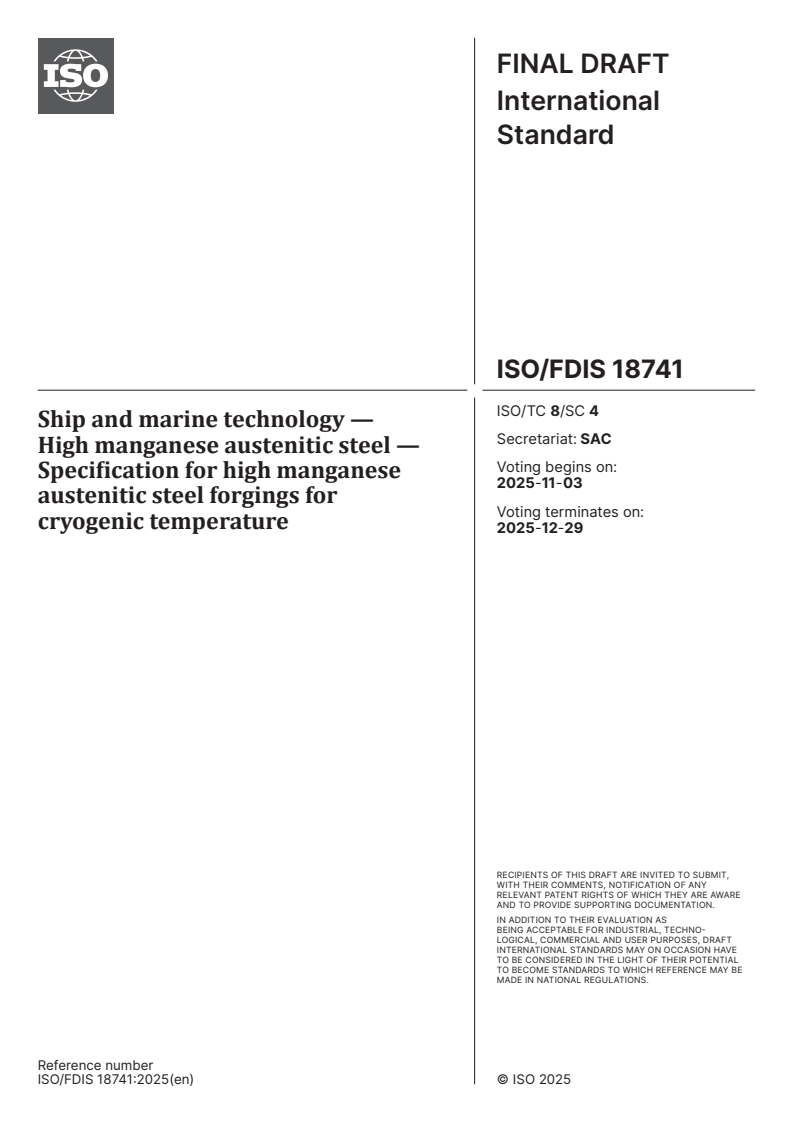
FINAL DRAFT
International
Standard
ISO/TC 8/SC 4
Ship and marine technology —
Secretariat: SAC
High manganese austenitic steel —
Voting begins on:
Specification for high manganese
2025-11-03
austenitic steel forgings for
Voting terminates on:
cryogenic temperature
2025-12-29
RECIPIENTS OF THIS DRAFT ARE INVITED TO SUBMIT,
WITH THEIR COMMENTS, NOTIFICATION OF ANY
RELEVANT PATENT RIGHTS OF WHICH THEY ARE AWARE
AND TO PROVIDE SUPPOR TING DOCUMENTATION.
IN ADDITION TO THEIR EVALUATION AS
BEING ACCEPTABLE FOR INDUSTRIAL, TECHNO
LOGICAL, COMMERCIAL AND USER PURPOSES, DRAFT
INTERNATIONAL STANDARDS MAY ON OCCASION HAVE
TO BE CONSIDERED IN THE LIGHT OF THEIR POTENTIAL
TO BECOME STAN DARDS TO WHICH REFERENCE MAY BE
MADE IN NATIONAL REGULATIONS.
Reference number
FINAL DRAFT
International
Standard
ISO/TC 8/SC 4
Ship and marine technology —
Secretariat: SAC
High manganese austenitic steel —
Voting begins on:
Specification for high manganese
austenitic steel forgings for
Voting terminates on:
cryogenic temperature
RECIPIENTS OF THIS DRAFT ARE INVITED TO SUBMIT,
WITH THEIR COMMENTS, NOTIFICATION OF ANY
RELEVANT PATENT RIGHTS OF WHICH THEY ARE AWARE
AND TO PROVIDE SUPPOR TING DOCUMENTATION.
© ISO 2025
IN ADDITION TO THEIR EVALUATION AS
All rights reserved. Unless otherwise specified, or required in the context of its implementation, no part of this publication may
BEING ACCEPTABLE FOR INDUSTRIAL, TECHNO
LOGICAL, COMMERCIAL AND USER PURPOSES, DRAFT
be reproduced or utilized otherwise in any form or by any means, electronic or mechanical, including photocopying, or posting on
INTERNATIONAL STANDARDS MAY ON OCCASION HAVE
the internet or an intranet, without prior written permission. Permission can be requested from either ISO at the address below
TO BE CONSIDERED IN THE LIGHT OF THEIR POTENTIAL
or ISO’s member body in the country of the requester.
TO BECOME STAN DARDS TO WHICH REFERENCE MAY BE
MADE IN NATIONAL REGULATIONS.
ISO copyright office
CP 401 • Ch. de Blandonnet 8
CH-1214 Vernier, Geneva
Phone: +41 22 749 01 11
Email: copyright@iso.org
Website: www.iso.org
Published in Switzerland Reference number
ii
Contents Page
Foreword .iv
Introduction .v
1 Scope . 1
2 Normative references . 1
3 Terms and definitions . 1
4 Abbreviated terms . 3
5 Health, safety and quality requirements . 3
5.1 Health and safety requirements .3
5.2 Quality requirements .3
6 Material designation . . 4
7 Manufacture . 4
7.1 Steel making .4
7.2 Forging .4
8 Chemical composition . 4
9 Heat treatment . 5
10 Mechanical properties . 6
10.1 Preparation of test specimens .6
10.2 Extent of testing .6
10.3 Mechanical properties .7
10.3.1 General .7
10.3.2 Tensile testing .7
10.3.3 Impact testing .7
10.4 Retesting .8
11 Inspection . 8
11.1 General requirements .8
11.2 Visual inspection .8
11.3 Liquid penetrant inspection .9
11.4 Ultrasonic inspection.9
11.5 Hydrostatic testing .9
12 Repairs . 10
13 Dimension . 10
14 Traceability, handling and packing .10
15 Documentation . 10
Bibliography .12
iii
Foreword
ISO (the International Organization for Standardization) is a worldwide federation of national standards
bodies (ISO member bodies). The work of preparing International Standards is normally carried out through
ISO technical committees. Each member body interested in a subject for which a technical committee
has been established has the right to be represented on that committee. International organizations,
governmental and non-governmental, in liaison with ISO, also take part in the work. ISO collaborates closely
with the International Electrotechnical Commission (IEC) on all matters of electrotechnical standardization.
The procedures used to develop this document and those intended for its further maintenance are described
in the ISO/IEC Directives, Part 1. In particular, the different approval criteria needed for the different types
of ISO document should be noted. This document was drafted in accordance with the editorial rules of the
ISO/IEC Directives, Part 2 (see www.iso.org/directives).
ISO draws attention to the possibility that the implementation of this document may involve the use of (a)
patent(s). ISO takes no position concerning the evidence, validity or applicability of any claimed patent
rights in respect thereof. As of the date of publication of this document, ISO had not received notice of (a)
patent(s) which may be required to implement this document. However, implementers are cautioned that
this may not represent the latest information, which may be obtained from the patent database available at
www.iso.org/patents. ISO shall not be held responsible for identifying any or all such patent rights.
Any trade name used in this document is information given for the convenience of users and does not
constitute an endorsement.
For an explanation of the voluntary nature of standards, the meaning of ISO specific terms and expressions
related to conformity assessment, as well as information about ISO's adherence to the World Trade
Organization (WTO) principles in the Technical Barriers to Trade (TBT), see www.iso.org/iso/foreword.html.
This document was prepared by Technical Committee TC 8, Ships and marine technology, Subcommittee SC
4, Outfitting and deck machinery.
Any feedback or questions on this document should be directed to the user’s national standards body. A
complete listing of these bodies can be found at www.iso.org/members.html.
iv
Introduction
The aim of this document is to provide a set of common requirements for metallic materials used in cryogenic
[1] [2]
applications, in alignment with the IGC Code and IGF Code adopted by the International Maritime
Organization (IMO).
The newly developed high manganese austenitic steel is expected to possess mechanical properties including
Charpy impact energy values comparable to those materials for cryogenic service listed in both the IGC Code
and IGF Code. Consequently, high manganese steel is intended to satisfy the strength requirements of the
structure of cargo tanks, fuel tanks and piping systems.
In addition, upon agreement with a purchaser, this document can be applied to piping system for liquefied
hydrogen.
This document provides a standard specification of high manganese austenitic steel castings for material
suppliers, ship owners, ship yards, manufacturers and shipping companies with regard to producing,
purchasing and using such materials.
v
FINAL DRAFT International Standard ISO/FDIS 18741:2025(en)
Ship and marine technology — High manganese austenitic
steel — Specification for high manganese austenitic steel
forgings for cryogenic temperature
1 Scope
This document specifies minimum requirements for high manganese austenitic steel forgings for valves,
flanges, fittings and other pressure-containing components used at cryogenic temperature.
The specification of high manganese austenitic steel forgings can be applicable to all pressure retaining
components and any non-pressure retaining component.
2 Normative references
The following documents are referred to in the text in such a way that some or all of their content constitutes
requirements of this document. For dated references, only the edition cited applies. For undated references,
the latest edition of the referenced document (including any amendments) applies.
ISO 148-1, Metallic materials — Charpy pendulum impact test — Part 1: Test method
ISO 2566-1, Steel — Conversion of elongation values — Part 1: Carbon and low-alloy steels
ISO 2566-2, Steel — Conversion of elongation values — Part 2: Austenitic steels
ISO 5208, Industrial valves — Pressure testing of metallic valves
ISO 6892-1, Metallic materials —
...
Formatted
...
Style Definition
...
Style Definition
...
Style Definition
...
Style Definition
...
Style Definition
...
ISO/TC 8/SC 4
Style Definition
...
Style Definition
...
Secretariat: SAC
Style Definition
...
Date: 2025-09-0210-20
Style Definition
...
Style Definition
...
Style Definition
...
Style Definition
...
Style Definition
...
Style Definition
...
ShipsShip and marine technology — High manganese austenitic steel
Style Definition
...
— Specification for high manganese austenitic steel forgings for
Style Definition
...
cryogenic temperature
Style Definition
...
Style Definition
...
Style Definition
...
Style Definition
...
Style Definition
...
Style Definition
...
Style Definition
...
Style Definition
...
FDIS stage
Style Definition
...
Style Definition
...
Style Definition
...
Style Definition
...
Style Definition
...
Style Definition
...
Style Definition
...
Style Definition
...
Style Definition
...
Style Definition
...
Style Definition
...
Style Definition
...
Style Definition
...
Style Definition
...
Style Definition
...
Style Definition
...
Style Definition
...
Style Definition
...
Style Definition
...
Style Definition
...
Style Definition
...
Style Definition
...
Style Definition
...
Style Definition
...
Style Definition
...
Style Definition
...
Style Definition
...
Style Definition
...
Style Definition
...
Style Definition
...
Style Definition
...
Style Definition
...
St l D fi iti
Formatted: Font: Bold
Formatted: HeaderCentered
Formatted: Default Paragraph Font
Formatted: Default Paragraph Font
All rights reserved. Unless otherwise specified, or required in the context of its implementation, no part of this publication
may be reproduced or utilized otherwise in any form or by any means, electronic or mechanical, including photocopying,
or posting on the internet or an intranet, without prior written permission. Permission can be requested from either ISO
at the address below or ISO’s member body in the country of the requester.
ISO copyright office
CP 401 • Ch. de Blandonnet 8
CH-1214 Vernier, Geneva
Phone: + 41 22 749 01 11
Formatted: English (United Kingdom)
Formatted: English (United Kingdom)
Fax: +41 22 749 09 47
EmailE-mail: copyright@iso.org
Formatted: German (Germany)
Website: www.iso.orgwww.iso.org
Formatted: zzCopyright address, Adjust space between
Latin and Asian text, Adjust space between Asian text
Published in Switzerland
and numbers
Formatted: German (Germany)
Formatted: FooterPageRomanNumber
ii
Formatted: Font: Bold
Formatted: HeaderCentered, Left
Contents Formatted: Adjust space between Latin and Asian text,
Adjust space between Asian text and numbers
Foreword . v
Introduction . vi
1 Scope . 1
2 Normative references . 1
3 Terms and definitions . 2
4 Abbreviated terms . 3
5 Health, safety and quality requirements . 4
5.1 Health and safety requirements . 4
5.2 Quality requirements . 4
6 Material designation . 4
7 Manufacture . 5
7.1 Steel making . 5
7.2 Forging . 5
8 Chemical composition . 5
9 Heat treatment . 6
10 Mechanical properties . 7
10.1 Preparation of test specimens . 7
10.2 Extent of testing . 7
10.3 Mechanical properties . 7
10.4 Retesting . 9
11 Inspection . 9
11.1 General requirements . 9
11.2 Visual inspection . 10
11.3 Liquid penetrant inspection . 10
11.4 Ultrasonic inspection. 10
11.5 Hydrostatic testing . 10
12 Repairs . 11
13 Dimension . 11
14 Traceability, handling and packing . 11
15 Documentation . 12
Bibliography . 13
Foreword . iv
Introduction . v
Formatted: Font: 10 pt
1 Scope . 1
Formatted: Font: 10 pt
2 Normative references . 1
Formatted: Font: 10 pt
3 Terms and definitions . 2
Formatted: FooterCentered, Left, Space Before: 0 pt,
Tab stops: Not at 17.2 cm
4 Acronyms . 3
Formatted: Font: 11 pt
5 Health, safety and quality requirements . 4
Formatted: FooterPageRomanNumber, Left, Space
5.1 Health and safety requirements . 4
After: 0 pt, Tab stops: Not at 17.2 cm
© ISO 2025 – All rights reserved
iii
Formatted: Font: Bold
Formatted: HeaderCentered
5.2 Quality Requirements . 4
6 Material designation . 4
7 Manufacture . 5
7.1 Steel making . 5
7.2 Forging . 5
8 Chemical composition . 5
9 Heat treatment . 6
10 Mechanical properties . 7
10.1 Preparation of test specimens . 7
10.2 Extend of testing . 7
10.3 Mechanical properties . 7
10.3.1 General. 7
10.3.2 Tensile testing . 8
10.3.3 Impact testing . 8
10.4 Retesting . 8
11 Inspection . 9
11.1 General requirements . 9
11.2 Visual inspection . 9
11.3 Liquid penetrant inspection . 9
11.4 Ultrasonic inspection. 10
11.5 Hydrostatic testing . 10
12 Repairs . 10
13 Dimension . 11
14 Traceability, handling and packing . 11
15 Documentation . 11
Bibliography . 13
Formatted: FooterPageRomanNumber
iv
Formatted: Font: Bold
Formatted: HeaderCentered, Left
Foreword Formatted: Adjust space between Latin and Asian text,
Adjust space between Asian text and numbers
ISO (the International Organization for Standardization) is a worldwide federation of national standards
bodies (ISO member bodies). The work of preparing International Standards is normally carried out through
ISO technical committees. Each member body interested in a subject for which a technical committee has been
established has the right to be represented on that committee. International organizations, governmental and
non-governmental, in liaison with ISO, also take part in the work. ISO collaborates closely with the
International Electrotechnical Commission (IEC) on all matters of electr
...
Questions, Comments and Discussion
Ask us and Technical Secretary will try to provide an answer. You can facilitate discussion about the standard in here.