

ISO 11500:2022/Amd 1:2026
(Amendment)Hydraulic fluid power — Determination of the particulate contamination level of a liquid sample by automatic particle counting using the light-extinction principle — Amendment 1
- Status
- Published
- Publication Date
- 10-Aug-2026
- Technical Committee
- ISO/TC 131/SC 6 - Contamination control
- Drafting Committee
- ISO/TC 131/SC 6/WG 2 - Filter and separator evaluation
- Current Stage
- 6060 - International Standard published
- Start Date
- 11-Aug-2026
- Due Date
- 10-Oct-2026
- Completion Date
- 11-Aug-2026
Buy Documents
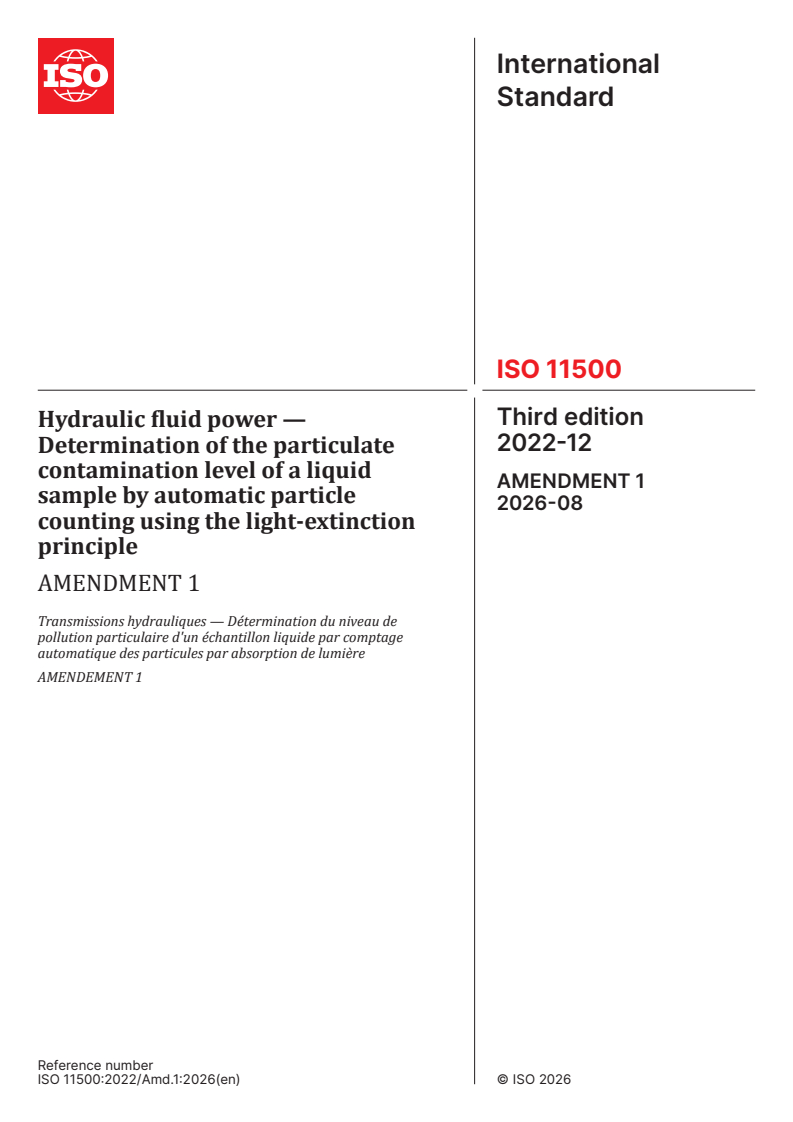

ISO 11500:2022/Amd 1:2026 - Hydraulic fluid power — Determination of the particulate contamination level of a liquid sample by automatic particle counting using the light-extinction principle — Amendment 1
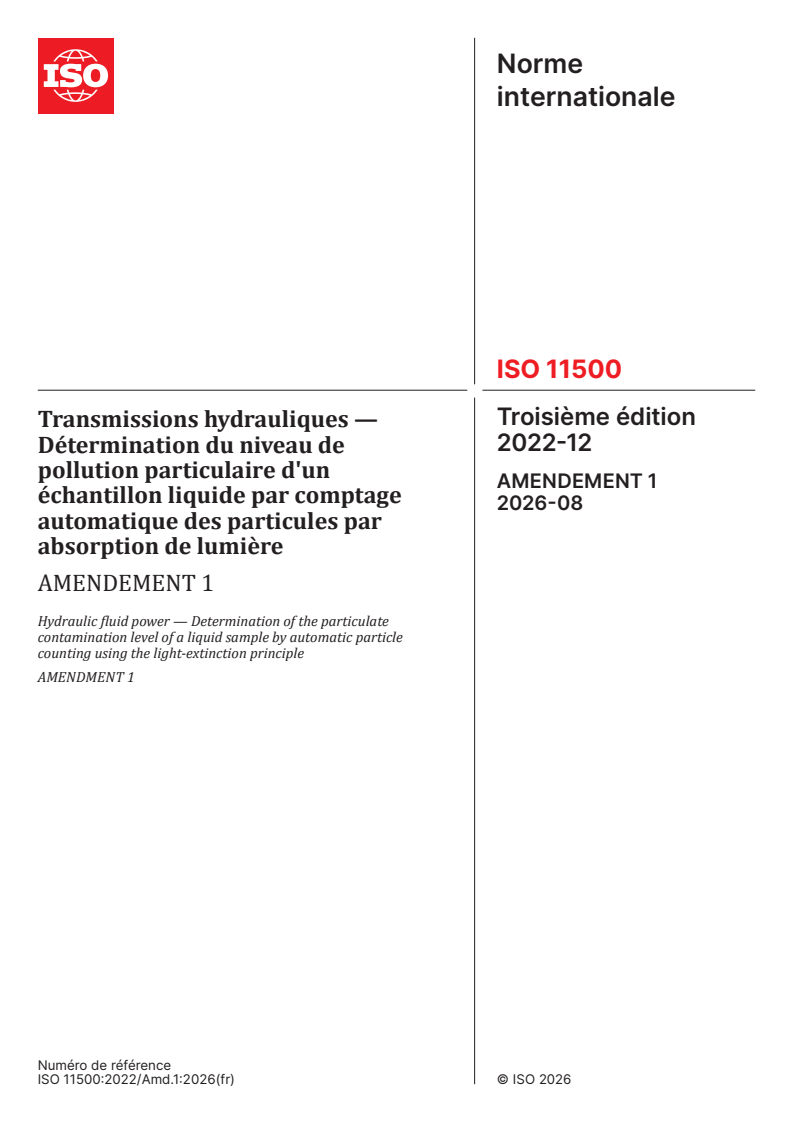

ISO 11500:2022/Amd 1:2026 - Transmissions hydrauliques — Détermination du niveau de pollution particulaire d'un échantillon liquide par comptage automatique des particules par absorption de lumière — Amendement 1
ISO 11500:2022/Amd.1:2026 is an ISO amendment to ISO 11500 for hydraulic fluid power. It updates the method for determining the particulate contamination level of a liquid sample by automatic particle counting using the light-extinction principle, with practical changes to sample bottles and glassware used in the procedure.
This amendment matters to laboratories, fluid power manufacturers, and contamination-control teams that prepare and test hydraulic liquid samples. It tightens the handling of containers so the particle count reflects the sample, not contamination from the bottle or glassware.
What does ISO 11500:2022/Amd.1:2026 specify?
ISO 11500:2022/Amd.1:2026 specifies replacement text for two parts of ISO 11500:2022: clause 4.7 on sample bottles and clause 6.2.2 on the cleanliness of glassware. The amendment is focused on preventing container-related contamination from affecting automatic particle counting results.
Clause 4.7 covers the bottle used to hold the sample for automatic particle counting (APC). Clause 6.2.2 covers the required cleanliness level for glassware used in the work.
What are the key requirements of ISO 11500:2022/Amd.1:2026?
ISO 11500:2022/Amd.1:2026 changes the sample-handling requirements that support APC measurements. In practice, the amendment asks the user to control the container and glassware cleanliness closely enough that they do not distort the reported contamination level.
Sample bottles
Clause 4.7 describes sample bottles as normally cylindrical bottles made of glass or high-density polyethylene. They are fitted with either a non-shedding threaded cap that seals without an insert, or a cap with an internal seal.
The bottle should normally have a capacity of not less than 250 ml, and it should be flat-bottomed and wide-necked to make cleaning easier. This matters because a difficult-to-clean bottle can add stray particles to the sample.
Sample bottles are to be cleaned and verified in accordance with ISO 3722. That means the bottle preparation step is part of the measurement control, not an informal housekeeping task.
Glassware cleanliness
Clause 6.2.2 states that the required cleanliness level (RCL) of all glassware must be such that contamination on the glassware cannot significantly contribute to the result. In practice, glassware cleanliness has to be good enough that it does not become a source of false particle counts.
The note in this clause gives example cleanliness levels considered adequate. The practical message is that the glassware used around the sample should be controlled and verified, not simply rinsed and assumed acceptable.
Why these changes matter in practice
The amendment is about measurement integrity. Automatic particle counting is sensitive to contamination introduced during sampling and handling, so bottle selection, cap sealing, cleaning, and verification directly affect the credibility of the reported cleanliness level.
What terms does ISO 11500:2022/Amd.1:2026 define?
Automatic particle counting (APC) - The method used in this standard to count particles in a liquid sample automatically.
Light-extinction principle - The measuring principle used in which particles are detected by their effect on transmitted light.
Particulate contamination level - The amount of solid particle contamination present in the liquid sample.
Sample bottles - The containers used to hold the liquid sample for APC measurement.
Glassware - The glass laboratory items used in handling the sample, which must be clean enough not to affect the result.
Required cleanliness level (RCL) - The cleanliness condition that a surface or item must meet so it does not significantly influence the measured contamination level.
Who uses ISO 11500:2022/Amd.1:2026?
ISO 11500:2022/Amd.1:2026 is used by laboratories that perform automatic particle counting on hydraulic liquids, by contamination-control personnel, and by manufacturers or users of hydraulic fluid power systems who need reliable cleanliness data. It is also relevant to quality managers and buyers who specify sample preparation practices for testing and acceptance work.
What changed in ISO 11500:2022/Amd.1:2026 from the previous edition?
ISO 11500:2022/Amd.1:2026 amends ISO 11500:2022 by replacing the text in clause 4.7 and clause 6.2.2. The changes update the requirements for sample bottles and the cleanliness level of glassware used with the APC method.
Which standards are used with ISO 11500:2022/Amd.1:2026?
ISO 3722 - ISO 11500:2022/Amd.1:2026 uses ISO 3722 for cleaning and verifying sample bottles before use.
What does the ISO 11500:2022/Amd.1:2026 document contain?
ISO 11500:2022/Amd.1:2026 contains replacement text for two clauses of ISO 11500:2022. It gives the revised requirements for sample bottles, including bottle type, cap sealing, cleaning, and verification, and for the cleanliness of glassware so it does not influence APC results.
The document also includes notes that give practical cleanliness guidance for containers and glassware. These details support sample preparation, contamination control, and trustworthy particle-counting results in hydraulic fluid power testing.
Relations
- Effective Date
- 12-Oct-2024
Buy Documents
ISO 11500:2022/Amd 1:2026 - Hydraulic fluid power — Determination of the particulate contamination level of a liquid sample by automatic particle counting using the light-extinction principle — Amendment 1
ISO 11500:2022/Amd 1:2026 - Transmissions hydrauliques — Détermination du niveau de pollution particulaire d'un échantillon liquide par comptage automatique des particules par absorption de lumière — Amendement 1
Get Certified
Connect with accredited certification bodies for this standard

Institut za varilstvo d.o.o. (Welding Institute)
Slovenia's leading welding institute since 1952. ISO 3834, EN 1090, pressure equipment certification, NDT personnel, welder qualification. Only IIW Au
Sponsored listings
Frequently Asked Questions
ISO 11500:2022/Amd 1:2026 is a standard published by the International Organization for Standardization (ISO). Its full title is "Hydraulic fluid power — Determination of the particulate contamination level of a liquid sample by automatic particle counting using the light-extinction principle — Amendment 1". This standard covers: Hydraulic fluid power — Determination of the particulate contamination level of a liquid sample by automatic particle counting using the light-extinction principle — Amendment 1
Hydraulic fluid power — Determination of the particulate contamination level of a liquid sample by automatic particle counting using the light-extinction principle — Amendment 1
ISO 11500:2022/Amd 1:2026 is classified under the following ICS (International Classification for Standards) categories: 23.100.60 - Filters, seals and contamination of fluids. The ICS classification helps identify the subject area and facilitates finding related standards.
ISO 11500:2022/Amd 1:2026 has the following relationships with other standards: It is inter standard links to ISO 11500:2022. Understanding these relationships helps ensure you are using the most current and applicable version of the standard.
ISO 11500:2022/Amd 1:2026 is available in PDF format for immediate download after purchase. The document can be added to your cart and obtained through the secure checkout process. Digital delivery ensures instant access to the complete standard document.
Standards Content (Sample)
International
Standard
ISO 11500
Third edition
Hydraulic fluid power —
2022-12
Determination of the particulate
contamination level of a liquid
AMENDMENT 1
sample by automatic particle
2026-08
counting using the light-extinction
principle
AMENDMENT 1
Transmissions hydrauliques — Détermination du niveau de
pollution particulaire d'un échantillon liquide par comptage
automatique des particules par absorption de lumière
AMENDEMENT 1
Reference number
ISO 11500:2022/Amd.1:2026(en) © ISO 2026
ISO 11500:2022/Amd.1:2026(en)
© ISO 2026
All rights reserved. Unless otherwise specified, or required in the context of its implementation, no part of this publication may
be reproduced or utilized otherwise in any form or by any means, electronic or mechanical, including photocopying, or posting on
the internet or an intranet, without prior written permission. Permission can be requested from either ISO at the address below
or ISO’s member body in the country of the requester.
ISO copyright office
CP 401 • Ch. de Blandonnet 8
CH-1214 Vernier, Geneva
Phone: +41 22 749 01 11
Email: copyright@iso.org
Website: www.iso.org
Published in Switzerland
ii
ISO 11500:2022/Amd.1:2026(en)
Foreword
ISO (the International Organization for Standardization) is a worldwide federation of national standards
bodies (ISO member bodies). The work of preparing International Standards is normally carried out through
ISO technical committees. Each member body interested in a subject for which a technical committee
has been established has the right to be represented on that committee. International organizations,
governmental and non-governmental, in liaison with ISO, also take part in the work. ISO collaborates closely
with the International Electrotechnical Commission (IEC) on all matters of electrotechnical standardization.
The procedures used to develop this document and those intended for its further maintenance are described
in the ISO/IEC Directives, Part 1. In particular, the different approval criteria needed for the different types
of ISO document should be noted. This document was drafted in accordance with the editorial rules of the
ISO/IEC Directives, Part 2 (see www.iso.org/directives).
ISO draws attention to the possibility that the implementation of this document may involve the use of (a)
patent(s). ISO takes no position concerning the evidence, validity or applicability of any claimed patent
rights in respect thereof. As of the date of publication of this document, ISO had not received notice of (a)
paten
...
Norme
internationale
ISO 11500
Troisième édition
Transmissions hydrauliques —
2022-12
Détermination du niveau de
pollution particulaire d'un
AMENDEMENT 1
échantillon liquide par comptage
2026-08
automatique des particules par
absorption de lumière
AMENDEMENT 1
Hydraulic fluid power — Determination of the particulate
contamination level of a liquid sample by automatic particle
counting using the light-extinction principle
AMENDMENT 1
Numéro de référence
ISO 11500:2022/Amd.1:2026(fr) © ISO 2026
ISO 11500:2022/Amd.1:2026(fr)
DOCUMENT PROTÉGÉ PAR COPYRIGHT
© ISO 2026
Tous droits réservés. Sauf prescription différente ou nécessité dans le contexte de sa mise en œuvre, aucune partie de cette
publication ne peut être reproduite ni utilisée sous quelque forme que ce soit et par aucun procédé, électronique ou mécanique,
y compris la photocopie, ou la diffusion sur l’internet ou sur un intranet, sans autorisation écrite préalable. Une autorisation peut
être demandée à l’ISO à l’adresse ci-après ou au comité membre de l’ISO dans le pays du demandeur.
ISO copyright office
Case postale 401 • Ch. de Blandonnet 8
CH-1214 Vernier, Genève
Tél.: +41 22 749 01 11
E-mail: copyright@iso.org
Web: www.iso.org
Publié en Suisse
ii
ISO 11500:2022/Amd.1:2026(fr)
Avant-propos
L'ISO (Organisation internationale de normalisation) est une fédération mondiale d'organismes nationaux
de normalisation (comités membres de l'ISO). L'élaboration des Normes internationales est en général
confiée aux comités techniques de l'ISO. Chaque comité membre intéressé par une étude a le droit de faire
partie du comité technique créé à cet effet. Les organisations internationales, gouvernementales et non
gouvernementales, en liaison avec l'ISO participent également aux travaux. L'ISO collabore étroitement avec
la Commission électrotechnique internationale (IEC) en ce qui concerne la normalisation électrotechnique.
Les procédures utilisées pour élaborer le présent document et celles destinées à sa mise à jour sont
décrites dans les Directives ISO/IEC, Partie 1. Il convient, en particulier, de prendre note des différents
critères d'approbation requis pour les différents types de documents ISO. Le présent document
a été rédigé conformément aux règles de rédaction données dans les Directives ISO/IEC, Partie 2
(voir www.iso.org/directives).
L'ISO attire l'attention sur le fait que la mise en application du présent document peut entraîner l'utilisation
d'un ou de plusieurs brevets. L'ISO ne prend pas position quant à la preuve, à la validité et à l'applicabilité de
tout droit de brevet revendiqué à cet égard. À la date de publication du présent document, l'ISO n’avait pas
reçu notification qu'un ou plusieurs brevets pouvaient être nécessaires à sa mise en application. Toutefois,
il y a lieu d'avertir
...