

ISO 9113:2019
(Main)Plastics — Polypropylene (PP) and propylene-copolymer thermoplastics — Determination of isotactic index
General Information
- Abstract
This document specifies a method for determining the percentage of matter which can be extracted from crystalline propylene plastics by boiling n-heptane under standard conditions of testing. Isotactic index is determined by conventional chemical extraction as an absolute method. This method provides for the identification and coding of types H, B and R propylene plastics according to ISO 19069-1[1]. This method is suitable only for base polymers and is not applicable for mixtures. This method starts with solid propylene plastics in the form of particles of specified fineness.
- Status
- Published
- Publication Date
- 23-Jun-2019
- Technical Committee
- ISO/TC 61/SC 9 - Thermoplastic materials
- Drafting Committee
- ISO/TC 61/SC 9/WG 6 - Polyolefins
- Current Stage
- 9093 - International Standard confirmed
- Start Date
- 07-Oct-2024
- Completion Date
- 29-Aug-2026
Buy Documents
ISO 9113:2019 - Plastics -- Polypropylene (PP) and propylene-copolymer thermoplastics -- Determination of isotactic index
ISO 9113:2019 - Plastics — Polypropylene (PP) and propylene-copolymer thermoplastics — Determination of isotactic index/24/2019
Overview
ISO 9113:2019 specifies a chemical-extraction method to determine the isotactic index of crystalline polypropylene (PP) and propylene‑copolymer thermoplastics. The standard measures the n‑heptane extractable matter from a solid propylene polymer sample under defined conditions, and reports isotactic index as an absolute value (II = 100 − S). It is applicable to base polymers (not mixtures) and supports identification/coding of types H, B and R in accordance with ISO 19069‑1.
Key topics and requirements
- Scope and limitation
- Applies only to solid propylene plastics in particle form and to base polymers (not blends).
- Provides results used to classify types H, B and R (see ISO 19069‑1).
- Sample preparation
- Reduce material to particles that pass a sieve (recommended mesh 0.5 mm ± 0.1 mm; not greater than 1 mm).
- For grinding: mix at least 10 g sample with solid CO2 or liquid nitrogen and mill; allow screened material to equilibrate to room temperature.
- Apparatus & consumables
- Extraction apparatus suitable for boiling n‑heptane and cartridges (glass fibre or paper, Ø 30 mm ± 3 mm, length 100 mm ± 10 mm).
- Ovens capable of 70 °C ± 2 °C and 140 °C ± 2 °C with vacuum < 25 kPa; balance accurate to 0.0001 g.
- Extraction procedure
- Dry cartridge + sample in oven at 140 °C (typically 2 h), weigh, then extract with boiling analytical‑grade n‑heptane for 24 h (300 ml solvent, 15–25 cycles/h).
- For type H powders passing 0.5 mm sieve, a 6 h extraction may be acceptable if results match 24 h; otherwise 24 h is mandatory (and always mandatory for type B or disputed results).
- After extraction, wash with acetone and dry at 70 °C to constant mass under vacuum.
- Calculation & reporting
- n‑heptane extractable matter S = (m2 − m3) / (m2 − m1) × 100, where m1 = empty cartridge, m2 = cartridge + sample before extraction, m3 = cartridge + residue after extraction.
- Report arithmetic mean of duplicate tests (values must agree within ±7.5% of mean). Isotactic index II = 100 − S (rounded to the nearest whole unit; tie-breaking rule applies).
- Test report must reference ISO 9113:2019 and include identification, individual results, mean, II and any deviations.
Applications and users
- Used by polymer manufacturers, quality control and testing laboratories, materials engineers, and spec writers who need to:
- Characterize crystalline PP and propylene‑copolymers by crystallinity/isotacticity.
- Verify material classification (H/B/R) for product specifications and regulatory compliance.
- Support failure analysis, incoming inspection and supplier qualification.
Related standards
- ISO 19069‑1 - designation system and basis for specifications for polypropylene moulding and extrusion materials (used for type coding referenced by ISO 9113:2019).
Relations
- Effective Date
- 12-Dec-2015
Buy Documents
ISO 9113:2019 - Plastics -- Polypropylene (PP) and propylene-copolymer thermoplastics -- Determination of isotactic index
ISO 9113:2019 - Plastics — Polypropylene (PP) and propylene-copolymer thermoplastics — Determination of isotactic index/24/2019
Get Certified
Connect with accredited certification bodies for this standard

DIN CERTCO
DIN Group product certification.

Smithers Quality Assessments
US management systems and product certification.
Sponsored listings
Frequently Asked Questions
ISO 9113:2019 is a standard published by the International Organization for Standardization (ISO). Its full title is "Plastics — Polypropylene (PP) and propylene-copolymer thermoplastics — Determination of isotactic index". This standard covers: This document specifies a method for determining the percentage of matter which can be extracted from crystalline propylene plastics by boiling n-heptane under standard conditions of testing. Isotactic index is determined by conventional chemical extraction as an absolute method. This method provides for the identification and coding of types H, B and R propylene plastics according to ISO 19069-1[1]. This method is suitable only for base polymers and is not applicable for mixtures. This method starts with solid propylene plastics in the form of particles of specified fineness.
This document specifies a method for determining the percentage of matter which can be extracted from crystalline propylene plastics by boiling n-heptane under standard conditions of testing. Isotactic index is determined by conventional chemical extraction as an absolute method. This method provides for the identification and coding of types H, B and R propylene plastics according to ISO 19069-1[1]. This method is suitable only for base polymers and is not applicable for mixtures. This method starts with solid propylene plastics in the form of particles of specified fineness.
ISO 9113:2019 is classified under the following ICS (International Classification for Standards) categories: 83.080.20 - Thermoplastic materials. The ICS classification helps identify the subject area and facilitates finding related standards.
ISO 9113:2019 has the following relationships with other standards: It is inter standard links to ISO 9113:1986. Understanding these relationships helps ensure you are using the most current and applicable version of the standard.
ISO 9113:2019 is available in PDF format for immediate download after purchase. The document can be added to your cart and obtained through the secure checkout process. Digital delivery ensures instant access to the complete standard document.
Standards Content (Sample)
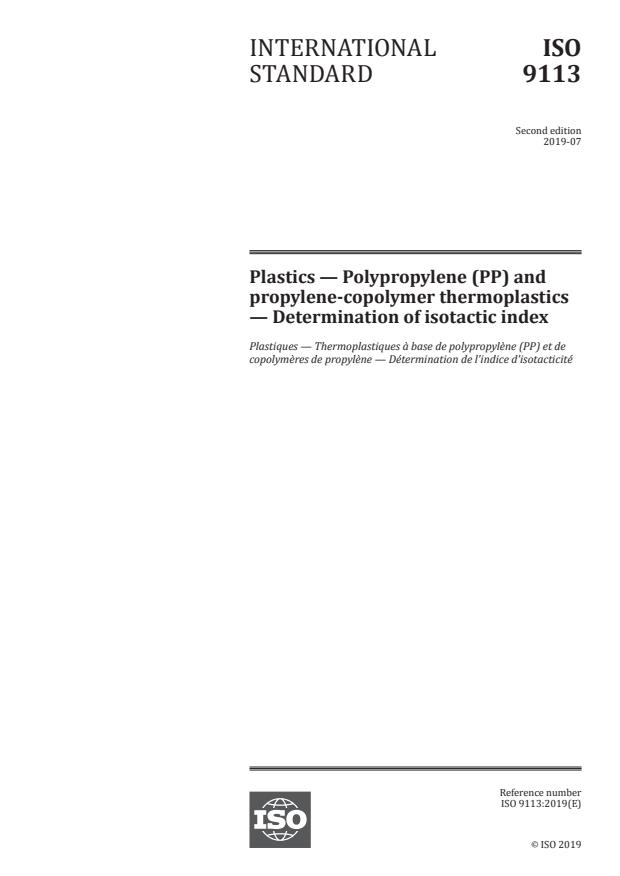
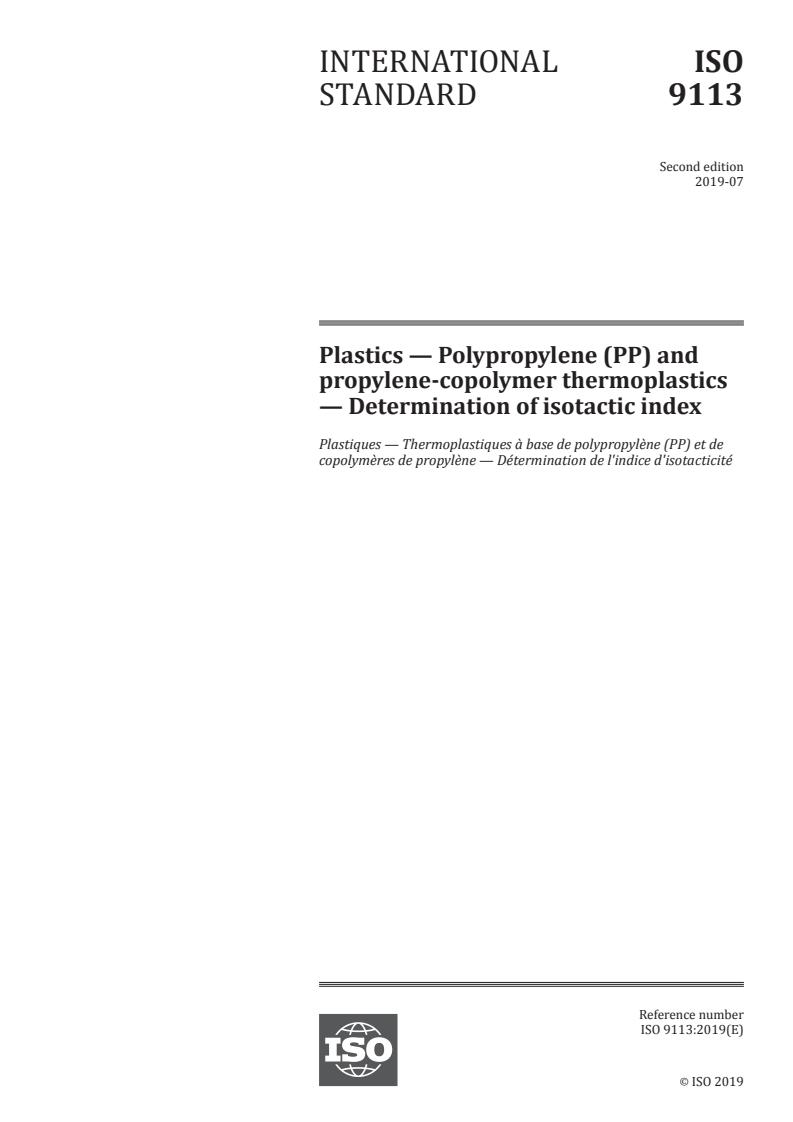
INTERNATIONAL ISO
STANDARD 9113
Second edition
2019-07
Plastics — Polypropylene (PP) and
propylene-copolymer thermoplastics
— Determination of isotactic index
Plastiques — Thermoplastiques à base de polypropylène (PP) et de
copolymères de propylène — Détermination de l'indice d'isotacticité
Reference number
©
ISO 2019
© ISO 2019
All rights reserved. Unless otherwise specified, or required in the context of its implementation, no part of this publication may
be reproduced or utilized otherwise in any form or by any means, electronic or mechanical, including photocopying, or posting
on the internet or an intranet, without prior written permission. Permission can be requested from either ISO at the address
below or ISO’s member body in the country of the requester.
ISO copyright office
CP 401 • Ch. de Blandonnet 8
CH-1214 Vernier, Geneva
Phone: +41 22 749 01 11
Fax: +41 22 749 09 47
Email: copyright@iso.org
Website: www.iso.org
Published in Switzerland
ii © ISO 2019 – All rights reserved
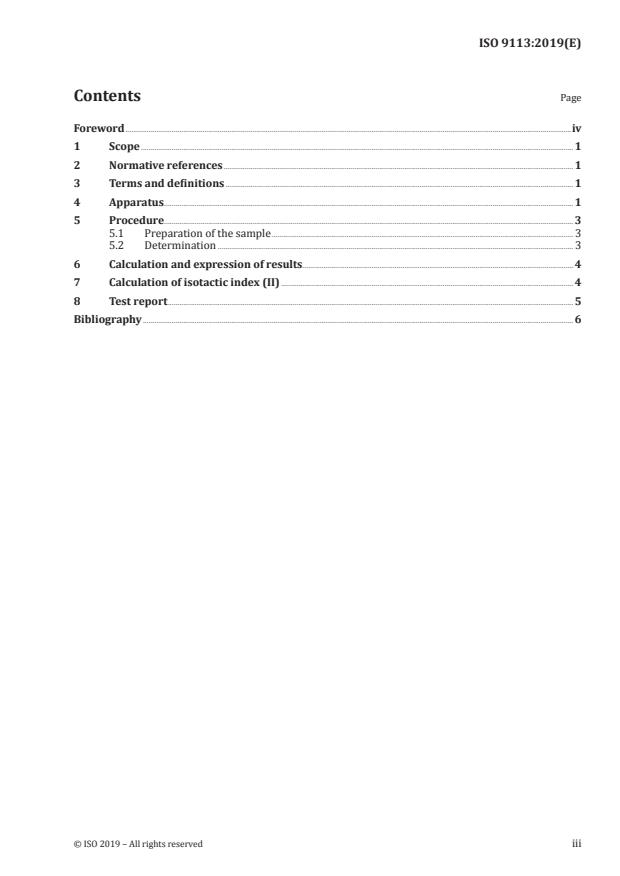
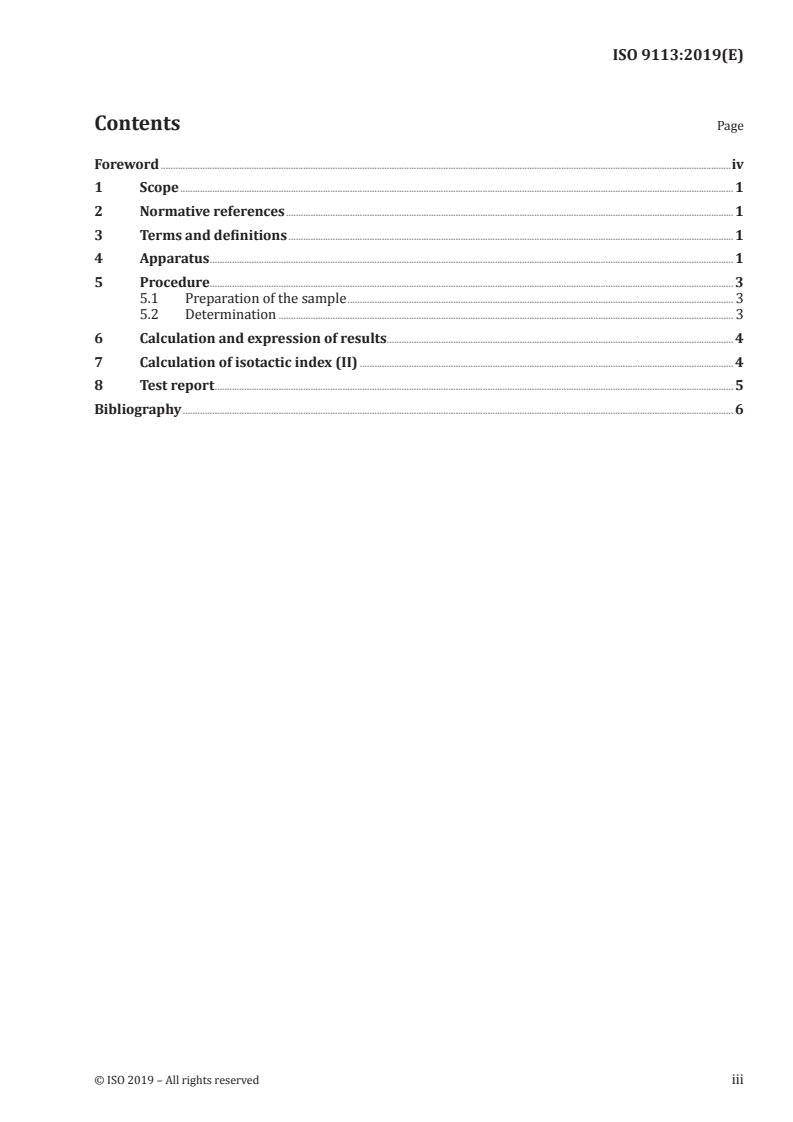
Contents Page
Foreword .iv
1 Scope . 1
2 Normative references . 1
3 Terms and definitions . 1
4 Apparatus . 1
5 Procedure. 3
5.1 Preparation of the sample . 3
5.2 Determination . 3
6 Calculation and expression of results . 4
7 Calculation of isotactic index (II) . 4
8 Test report . 5
Bibliography . 6
Foreword
ISO (the International Organization for Standardization) is a worldwide federation of national standards
bodies (ISO member bodies). The work of preparing International Standards is normally carried out
through ISO technical committees. Each member body interested in a subject for which a technical
committee has been established has the right to be represented on that committee. International
organizations, governmental and non-governmental, in liaison with ISO, also take part in the work.
ISO collaborates closely with the International Electrotechnical Commission (IEC) on all matters of
electrotechnical standardization.
The procedures used to develop this document and those intended for its further maintenance are
described in the ISO/IEC Directives, Part 1. In particular, the different approval criteria needed for the
different types of ISO documents should be noted. This document was drafted in accordance with the
editorial rules of the ISO/IEC Directives, Part 2 (see www .iso .org/directives).
Attention is drawn to the possibility that some of the elements of this document may be the subject of
patent rights. ISO shall not be held responsible for identifying any or all such patent rights. Details of
any patent rights identified during the development of the document will be in the Introduction and/or
on the ISO list of patent declarations received (see www .iso .org/patents).
Any trade name used in this document is information given for the convenience of users and does not
constitute an endorsement.
For an explanation of the voluntary nature of standards, the meaning of ISO specific terms and
expressions related to conformity assessment, as well as information about ISO's adherence to the
World Trade Organization (WTO) principles in the Technical Barriers to Trade (TBT) see www .iso
.org/iso/foreword .html.
This document was prepared by Technical Committee ISO/TC 61, Plastics, Subcommittee SC 9,
Thermoplastic materials.
This second edition cancels and replaces the first edition (ISO 9113:1986), of which it constitutes a
minor revision. The changes compared to the previous edition are as follows:
— the normative references have been updated;
— the mandatory Clause 3 has been added and the subsequent clauses have been renumbered;
— minor editorial changes have been applied.
Any feedback or questions on this document should be directed to the user’s national standards body. A
complete listing of these bodies can be found at www .iso .org/members .html.
iv © ISO 2019 – All rights reserved
INTERNATIONAL STANDARD ISO 9113:2019(E)
Plastics — Polypropylene (PP) and propylene-copolymer
thermoplastics — Determination of isotactic index
1 Scope
This document specifies a method for determining the percentage of matter which can be extracted
from crystalline propylene plastics by boiling n-heptane under standard conditions of testing. Isotactic
index is determined by conventional chemical extraction as an absolute method.
This method provides for the identification and coding of types H, B and R propylene plastics according
[1]
to ISO 19069-1 .
This method is suitable only for b
...
INTERNATIONAL ISO
STANDARD 9113
Second edition
2019-07
Plastics — Polypropylene (PP) and
propylene-copolymer thermoplastics
— Determination of isotactic index
Plastiques — Thermoplastiques à base de polypropylène (PP) et de
copolymères de propylène — Détermination de l'indice d'isotacticité
Reference number
©
ISO 2019
© ISO 2019
All rights reserved. Unless otherwise specified, or required in the context of its implementation, no part of this publication may
be reproduced or utilized otherwise in any form or by any means, electronic or mechanical, including photocopying, or posting
on the internet or an intranet, without prior written permission. Permission can be requested from either ISO at the address
below or ISO’s member body in the country of the requester.
ISO copyright office
CP 401 • Ch. de Blandonnet 8
CH-1214 Vernier, Geneva
Phone: +41 22 749 01 11
Fax: +41 22 749 09 47
Email: copyright@iso.org
Website: www.iso.org
Published in Switzerland
ii © ISO 2019 – All rights reserved
Contents Page
Foreword .iv
1 Scope . 1
2 Normative references . 1
3 Terms and definitions . 1
4 Apparatus . 1
5 Procedure. 3
5.1 Preparation of the sample . 3
5.2 Determination . 3
6 Calculation and expression of results . 4
7 Calculation of isotactic index (II) . 4
8 Test report . 5
Bibliography . 6
Foreword
ISO (the International Organization for Standardization) is a worldwide federation of national standards
bodies (ISO member bodies). The work of preparing International Standards is normally carried out
through ISO technical committees. Each member body interested in a subject for which a technical
committee has been established has the right to be represented on that committee. International
organizations, governmental and non-governmental, in liaison with ISO, also take part in the work.
ISO collaborates closely with the International Electrotechnical Commission (IEC) on all matters of
electrotechnical standardization.
The procedures used to develop this document and those intended for its further maintenance are
described in the ISO/IEC Directives, Part 1. In particular, the different approval criteria needed for the
different types of ISO documents should be noted. This document was drafted in accordance with the
editorial rules of the ISO/IEC Directives, Part 2 (see www .iso .org/directives).
Attention is drawn to the possibility that some of the elements of this document may be the subject of
patent rights. ISO shall not be held responsible for identifying any or all such patent rights. Details of
any patent rights identified during the development of the document will be in the Introduction and/or
on the ISO list of patent declarations received (see www .iso .org/patents).
Any trade name used in this document is information given for the convenience of users and does not
constitute an endorsement.
For an explanation of the voluntary nature of standards, the meaning of ISO specific terms and
expressions related to conformity assessment, as well as information about ISO's adherence to the
World Trade Organization (WTO) principles in the Technical Barriers to Trade (TBT) see www .iso
.org/iso/foreword .html.
This document was prepared by Technical Committee ISO/TC 61, Plastics, Subcommittee SC 9,
Thermoplastic materials.
This second edition cancels and replaces the first edition (ISO 9113:1986), of which it constitutes a
minor revision. The changes compared to the previous edition are as follows:
— the normative references have been updated;
— the mandatory Clause 3 has been added and the subsequent clauses have been renumbered;
— minor editorial changes have been applied.
Any feedback or questions on this document should be directed to the user’s national standards body. A
complete listing of these bodies can be found at www .iso .org/members .html.
iv © ISO 2019 – All rights reserved
INTERNATIONAL STANDARD ISO 9113:2019(E)
Plastics — Polypropylene (PP) and propylene-copolymer
thermoplastics — Determination of isotactic index
1 Scope
This document specifies a method for determining the percentage of matter which can be extracted
from crystalline propylene plastics by boiling n-heptane under standard conditions of testing. Isotactic
index is determined by conventional chemical extraction as an absolute method.
This method provides for the identification and coding of types H, B and R propylene plastics according
[1]
to ISO 19069-1 .
This method is suitable only for b
...