


ISO 3525:1979
(Main)Oil of amyris
Oil of amyris
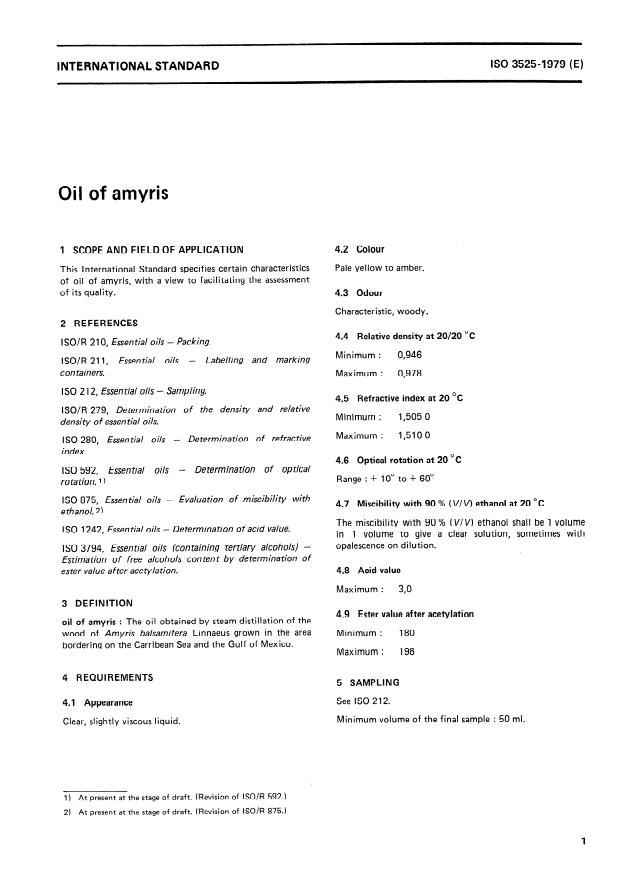
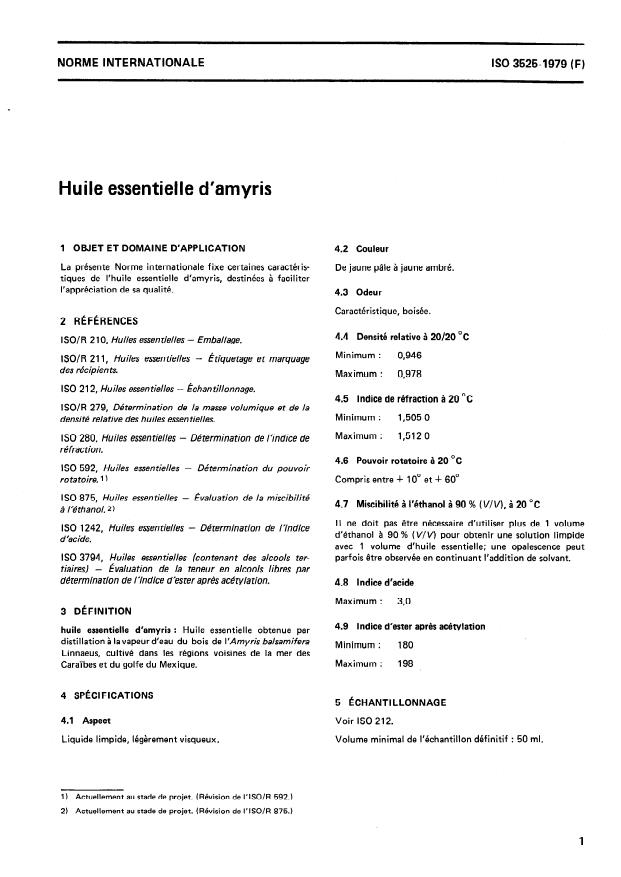
The Standard specifies the following characteristics of the oil. Appearance: Clear, slightly viscous liquid. Colour: Pale yellow to amber. Odour: Characteristic, woody. Relative density at 20/20 °C: 0,946 - 0,978. Refractive index at 20 °C: 1,5050 - 1,5100. Optical rotation at 20 °C: Range from + 10 to 60 . Miscibility with 90 % (V/V) ethanol at 20 °C: 1 : 1. Acid value: Maximum 3,0. Ester value after acetylation: 180 - 198.
Huile essentielle d'amyris
General Information
- Status
- Withdrawn
- Publication Date
- 31-Jan-1979
- Withdrawal Date
- 31-Jan-1979
- Technical Committee
- ISO/TC 54 - Essential oils
- Drafting Committee
- ISO/TC 54 - Essential oils
- Current Stage
- 9599 - Withdrawal of International Standard
- Start Date
- 02-Jul-2008
- Completion Date
- 14-Feb-2026
Relations
- Effective Date
- 15-Apr-2008







Get Certified
Connect with accredited certification bodies for this standard

ECOCERT
Organic and sustainability certification.

Eurofins Food Testing Global
Global leader in food, environment, and pharmaceutical product testing.

Intertek Bangladesh
Intertek certification and testing services in Bangladesh.
Sponsored listings
Frequently Asked Questions
ISO 3525:1979 is a standard published by the International Organization for Standardization (ISO). Its full title is "Oil of amyris". This standard covers: The Standard specifies the following characteristics of the oil. Appearance: Clear, slightly viscous liquid. Colour: Pale yellow to amber. Odour: Characteristic, woody. Relative density at 20/20 °C: 0,946 - 0,978. Refractive index at 20 °C: 1,5050 - 1,5100. Optical rotation at 20 °C: Range from + 10 to 60 . Miscibility with 90 % (V/V) ethanol at 20 °C: 1 : 1. Acid value: Maximum 3,0. Ester value after acetylation: 180 - 198.
The Standard specifies the following characteristics of the oil. Appearance: Clear, slightly viscous liquid. Colour: Pale yellow to amber. Odour: Characteristic, woody. Relative density at 20/20 °C: 0,946 - 0,978. Refractive index at 20 °C: 1,5050 - 1,5100. Optical rotation at 20 °C: Range from + 10 to 60 . Miscibility with 90 % (V/V) ethanol at 20 °C: 1 : 1. Acid value: Maximum 3,0. Ester value after acetylation: 180 - 198.
ISO 3525:1979 is classified under the following ICS (International Classification for Standards) categories: 71.100.60 - Essential oils. The ICS classification helps identify the subject area and facilitates finding related standards.
ISO 3525:1979 has the following relationships with other standards: It is inter standard links to ISO 3525:2008. Understanding these relationships helps ensure you are using the most current and applicable version of the standard.
ISO 3525:1979 is available in PDF format for immediate download after purchase. The document can be added to your cart and obtained through the secure checkout process. Digital delivery ensures instant access to the complete standard document.
Standards Content (Sample)
INTERNATIONAL STANDARD 3525
-_
INTERNATIONAL ORGANIZATION FOR STANDARDIZATIONWlE~YHAPO,WlAR OPI-AHM3AlWlR I-IO CTAH~APTM3ALWWORGANISATION INTERNATIONALE DE NORMALISATION
Oil of amyris
Huile essen tielle d’am yris
First edition - 1979-02-01
UDC 668.526.33 Ref. No. ISO 3525-1979 (E)
Descriptors : essential oils, amyris, materials specifications, physical properties, Optical properties, Chemical properties, sensorial properties.
Price based on 2 pages
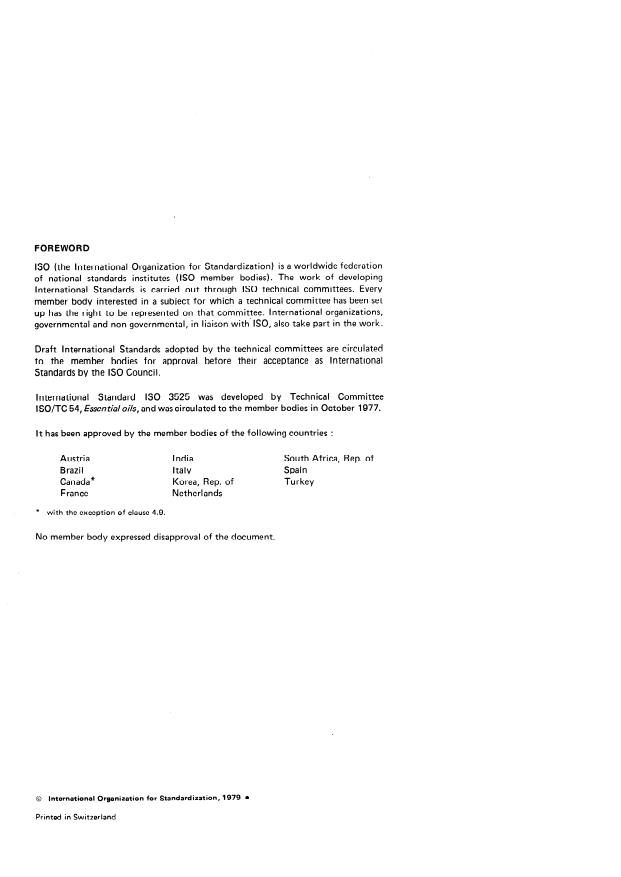
FOREWORD
ISO (the International Organization for Standardization) is a worldwide federation
of national Standards institutes (ISO member bodies). The work of developing
International Standards is carried out through ISO technical committees. Every
member body interested in a subject for which a technical committee has been set
up has the right to be represented on that committee. International organizations,
governmental and non-governmental, in liaison with’lS0, also take part in the work.
Draft International Standards adopted by the technical committees are circulated
to the member bodies for approval before their acceptance as International
Standards by the ISO Council.
International Standard ISO 3525 was developed by Technical Committee
ISO/TC 54, Essential oils, and was circulated to the member bodies in October 1977.
lt has been approved by the member bodies of the following countries :
Austria I ndia South Africa, Rep. of
Brazil Italy Spain
Canada* Korea, Rep. of Turkey
France Netherlands
* with the exception of clause 4.9.
No member body expressed disapproval of the document.
@ International Organkation for Standardkation, 1979 l
Printed in Switzerland
INTERNATIONAL STANDARD ISO 3525-1979 (E)
Oil of amyris
1 SCOPE AND FIELD OF APPLICATION 4.2 Colour
Pale yellow to amber.
This International Standard specifies certain characteristics
of oil of amyris, with a view to facilitating the assessment
of its quality.
4.3 Odour
Characteristic, woody.
2 REFERENCES
...
NORME INTERNATIONALE
INTERNATIONAL ORGANIZAflON FOR STANDARDIZATIONWlE~YHAPO~HAfl OPrAHM3AUMR n0 CTAH~APTH3Al@lM~RGANISATION INTERNATIONALE DE NORMALISATION
Huile essentielle d’amyris
Oil of am yris
Première édition - 1979-02-01
CDU 668.526.33 Réf. no : ISO 35254979 (F)
Descripteurs : huile essentielle, amyris, spécification de matière, propriété physique, propriété optique, propriété chimique, propriété
organoleptique.
Prix basé sur 2 pages
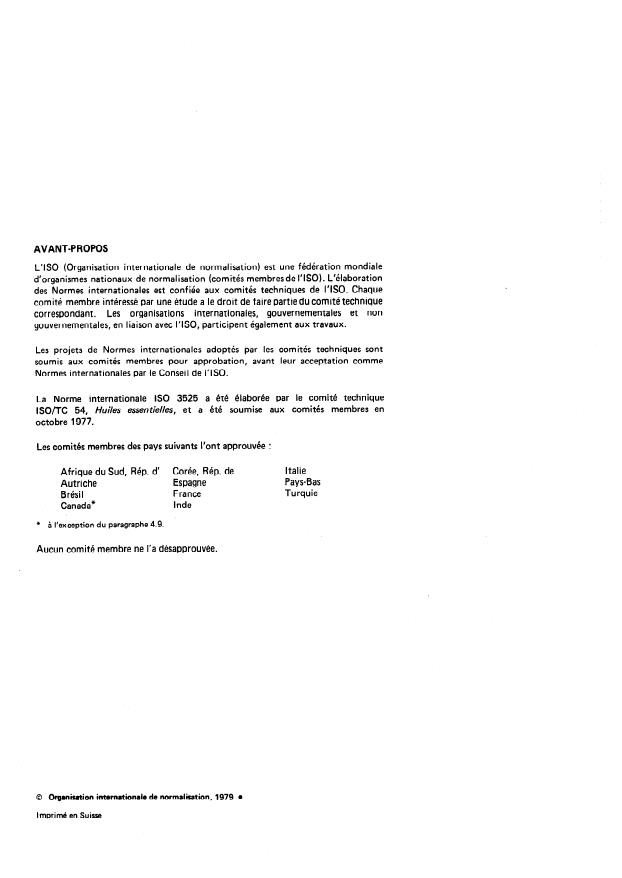
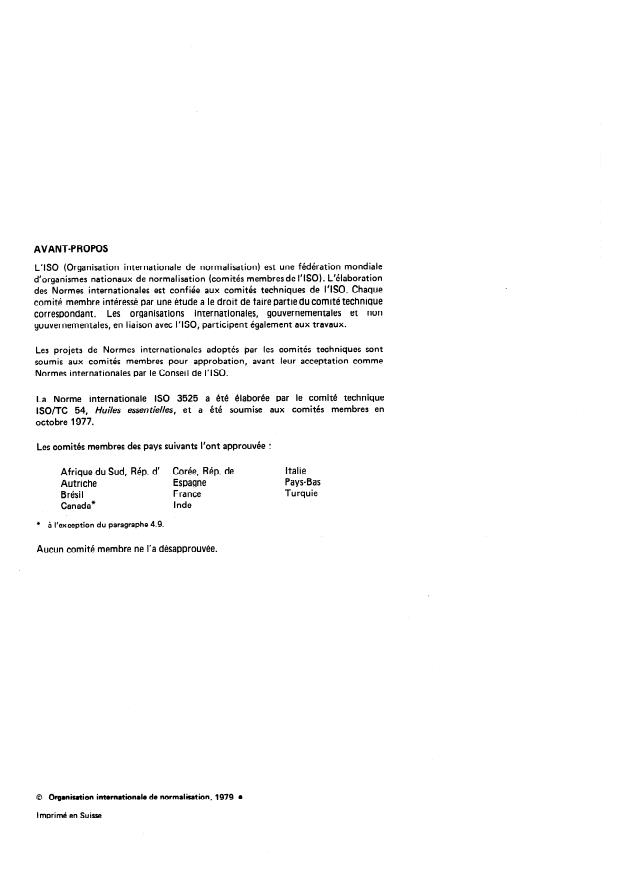
AVANT-PROPOS
L’ISO (Organisation internationale de normalisation) est une fédération mondiale
d’organismes nationaux de normalisation (comités membres de I’ISO). L’élaboration
des Normes internationales est confiée aux comités techniques de I’ISO. Chaque
comité membre intéressé par une étude a le droit de faire partiedu comité technique
correspondant. Les organisations internationales, gouvernementales et non
gouvernementales, en liaison avec I’ISO, participent également aux travaux.
Les projets de Normes internationales adoptés par les comités techniques sont
soumis aux comités membres pour approbation, avant leur acceptation comme
Normes internationales par le Conseil de I’ISO.
La Norme internationale ISO 3525 a été élaborée par le comité technique
ISO/TC 54, Huiles essentielles, et a été soumise aux comités membres en
octobre 1977.
Les comités membres des pays suivants l’ont approuvée :
Afrique du Sud, Rép. d’ Corée, Rép. de Italie
Autriche Espagne Pays-Bas
Turquie
Brésil France
Canada* Inde
* à l’exception du paragraphe 4.9.
Aucun comité membre ne l’a désapprouvée.
0 Organisation internationale de normalisation, 1979 l
Imprimé en Suisse
NORME INTERNATIONALE
ISO 35254979 (F)
Huile essentielle d’amyris
1 OBJET ET DOMAINE D’APPLICATION
4.2 Couleur
La présente Norme internationale fixe certaines caractéris-
De jaune pâle à jaune ambré.
tiques de I’huile essentielle d’amyris, destinées à faciliter
l’appréciation de sa qualité.
4.3 Odeur
Caractéristique, boisée.
2 RÉFÉRENCES
4.4 Densité relative à 20/20 “C
I SO/R 2 10, Huiles essentielles - Emballage.
Minimum : 0,946
I SO/R 211, Huiles essentielles - Étiquetage e
...
NORME INTERNATIONALE
INTERNATIONAL ORGANIZAflON FOR STANDARDIZATIONWlE~YHAPO~HAfl OPrAHM3AUMR n0 CTAH~APTH3Al@lM~RGANISATION INTERNATIONALE DE NORMALISATION
Huile essentielle d’amyris
Oil of am yris
Première édition - 1979-02-01
CDU 668.526.33 Réf. no : ISO 35254979 (F)
Descripteurs : huile essentielle, amyris, spécification de matière, propriété physique, propriété optique, propriété chimique, propriété
organoleptique.
Prix basé sur 2 pages
AVANT-PROPOS
L’ISO (Organisation internationale de normalisation) est une fédération mondiale
d’organismes nationaux de normalisation (comités membres de I’ISO). L’élaboration
des Normes internationales est confiée aux comités techniques de I’ISO. Chaque
comité membre intéressé par une étude a le droit de faire partiedu comité technique
correspondant. Les organisations internationales, gouvernementales et non
gouvernementales, en liaison avec I’ISO, participent également aux travaux.
Les projets de Normes internationales adoptés par les comités techniques sont
soumis aux comités membres pour approbation, avant leur acceptation comme
Normes internationales par le Conseil de I’ISO.
La Norme internationale ISO 3525 a été élaborée par le comité technique
ISO/TC 54, Huiles essentielles, et a été soumise aux comités membres en
octobre 1977.
Les comités membres des pays suivants l’ont approuvée :
Afrique du Sud, Rép. d’ Corée, Rép. de Italie
Autriche Espagne Pays-Bas
Turquie
Brésil France
Canada* Inde
* à l’exception du paragraphe 4.9.
Aucun comité membre ne l’a désapprouvée.
0 Organisation internationale de normalisation, 1979 l
Imprimé en Suisse
NORME INTERNATIONALE
ISO 35254979 (F)
Huile essentielle d’amyris
1 OBJET ET DOMAINE D’APPLICATION
4.2 Couleur
La présente Norme internationale fixe certaines caractéris-
De jaune pâle à jaune ambré.
tiques de I’huile essentielle d’amyris, destinées à faciliter
l’appréciation de sa qualité.
4.3 Odeur
Caractéristique, boisée.
2 RÉFÉRENCES
4.4 Densité relative à 20/20 “C
I SO/R 2 10, Huiles essentielles - Emballage.
Minimum : 0,946
I SO/R 211, Huiles essentielles - Étiquetage e
...
Questions, Comments and Discussion
Ask us and Technical Secretary will try to provide an answer. You can facilitate discussion about the standard in here.
Loading comments...