

ISO 9854-2:2023
(Main)Thermoplastics pipes for the transport of fluids — Determination of Charpy impact properties — Part 2: Test conditions for pipes of various materials
General Information
- Abstract
This document specifies the values or options chosen for the test parameters (i.e. the impact energy, specimen dimensions, specimen type, specimen supports and test temperature) for both unnotched and notched specimens, for testing the impact resistance (pendulum method) of thermoplastics pipes of the following materials, in accordance with ISO 9854-1. It applies to pipes made of unplasticized poly(vinyl chloride) (PVC-U), high-impact poly(vinyl chloride) (PVC-HI), oriented unplasticized poly(vinyl chloride) (PVC-O), chlorinated poly(vinyl chloride) (PVC-C), acrylonitrile/butadiene/styrene (ABS), acrylonitrile/styrene/acrylate (ASA), propylene homopolymer (PP-H), propylene impact polymer (PP-B), propylene random copolymer (PP-R), propylene random copolymer with modified crystallinity (PP-RCT), and polyethylene (PE).
- Status
- Published
- Publication Date
- 04-Sep-2023
- Technical Committee
- ISO/TC 138/SC 5 - General properties of pipes, fittings and valves of plastic materials and their accessories -- Test methods and basic specifications
- Drafting Committee
- ISO/TC 138/SC 5/WG 22 - Thermoplastics pipes for the transport of fluids
- Current Stage
- 6060 - International Standard published
- Start Date
- 05-Sep-2023
- Due Date
- 06-Dec-2023
- Completion Date
- 05-Sep-2023
Overview
ISO 9854-2:2023, "Thermoplastics pipes for the transport of fluids - Determination of Charpy impact properties - Part 2: Test conditions for pipes of various materials," specifies the test parameter choices required when determining Charpy impact properties of thermoplastic pipes. It is a companion to ISO 9854-1 (general test method) and defines the values or options for impact energy, specimen dimensions and type (notched and unnotched), specimen supports, and test temperature for a range of pipe materials using the pendulum (Charpy) method.
Covered materials include: PVC-U, PVC-HI, PVC-O, PVC-C, ABS, ASA, PP-H, PP-B, PP-R, PP-RCT, and PE. Test temperatures allowed include –20 °C, 0 °C and 23 °C, depending on material and pipe size.
Key Topics and Requirements
- Scope and applicability: Lists specific thermoplastic materials and clarifies that data from different specimen dimensions are not directly comparable.
- Test parameters defined: Specifies impact energy, specimen dimensions, specimen type (notched/unnotched), supports and orientations (longitudinal vs. circumferential).
- Methods A and B: Two sets of test-condition tables (Method A - Tables 1–4; Method B - Tables 5–9). Selection depends on material and pipe dimensions; Method B is recommended in certain cases (e.g., thicker PP walls > 10.5 mm).
- Material- and size-dependent tables: Detailed tables map pipe nominal outside diameter and wall thickness to the appropriate specimen type, support arrangement and test temperature. Figures and specimen details are referenced to ISO 9854-1.
- Test temperatures: Standardizes test temperature choices (23 ±2 °C, 0 ±2 °C, –20 ±2 °C) based on material and intended application.
Applications and Users
ISO 9854-2:2023 is intended for:
- Pipe manufacturers performing routine quality control and product development.
- Independent testing laboratories executing Charpy pendulum impact tests on pipes.
- Materials engineers and R&D teams comparing impact resistance across thermoplastic formulations and pipe designs.
- Product standards developers and regulators who reference harmonized test conditions for certification and compliance.
- Specifiers and procurement professionals assessing fitness-for-service for fluid transport applications.
Practical uses include establishing repeatable test protocols, comparing material performance under standardized conditions, supporting failure analysis, and informing material selection for impact-critical piping applications.
Related Standards
- ISO 9854-1:2023 - Thermoplastics pipes - Determination of Charpy impact properties - Part 1: General test method (normative reference for specimen geometry and test arrangements).
Keywords: ISO 9854-2:2023, Charpy impact properties, thermoplastics pipes, pendulum method, impact resistance testing, PVC, ABS, PP-RCT, PE, test conditions, specimen dimensions.
Relations
- Effective Date
- 09-Jun-2018
Get Certified
Connect with accredited certification bodies for this standard

Institut za varilstvo d.o.o. (Welding Institute)
Slovenia's leading welding institute since 1952. ISO 3834, EN 1090, pressure equipment certification, NDT personnel, welder qualification. Only IIW Au
Sponsored listings
Frequently Asked Questions
ISO 9854-2:2023 is a standard published by the International Organization for Standardization (ISO). Its full title is "Thermoplastics pipes for the transport of fluids — Determination of Charpy impact properties — Part 2: Test conditions for pipes of various materials". This standard covers: This document specifies the values or options chosen for the test parameters (i.e. the impact energy, specimen dimensions, specimen type, specimen supports and test temperature) for both unnotched and notched specimens, for testing the impact resistance (pendulum method) of thermoplastics pipes of the following materials, in accordance with ISO 9854-1. It applies to pipes made of unplasticized poly(vinyl chloride) (PVC-U), high-impact poly(vinyl chloride) (PVC-HI), oriented unplasticized poly(vinyl chloride) (PVC-O), chlorinated poly(vinyl chloride) (PVC-C), acrylonitrile/butadiene/styrene (ABS), acrylonitrile/styrene/acrylate (ASA), propylene homopolymer (PP-H), propylene impact polymer (PP-B), propylene random copolymer (PP-R), propylene random copolymer with modified crystallinity (PP-RCT), and polyethylene (PE).
This document specifies the values or options chosen for the test parameters (i.e. the impact energy, specimen dimensions, specimen type, specimen supports and test temperature) for both unnotched and notched specimens, for testing the impact resistance (pendulum method) of thermoplastics pipes of the following materials, in accordance with ISO 9854-1. It applies to pipes made of unplasticized poly(vinyl chloride) (PVC-U), high-impact poly(vinyl chloride) (PVC-HI), oriented unplasticized poly(vinyl chloride) (PVC-O), chlorinated poly(vinyl chloride) (PVC-C), acrylonitrile/butadiene/styrene (ABS), acrylonitrile/styrene/acrylate (ASA), propylene homopolymer (PP-H), propylene impact polymer (PP-B), propylene random copolymer (PP-R), propylene random copolymer with modified crystallinity (PP-RCT), and polyethylene (PE).
ISO 9854-2:2023 is classified under the following ICS (International Classification for Standards) categories: 23.040.20 - Plastics pipes. The ICS classification helps identify the subject area and facilitates finding related standards.
ISO 9854-2:2023 has the following relationships with other standards: It is inter standard links to ISO 9854-2:1994. Understanding these relationships helps ensure you are using the most current and applicable version of the standard.
ISO 9854-2:2023 is available in PDF format for immediate download after purchase. The document can be added to your cart and obtained through the secure checkout process. Digital delivery ensures instant access to the complete standard document.
Standards Content (Sample)
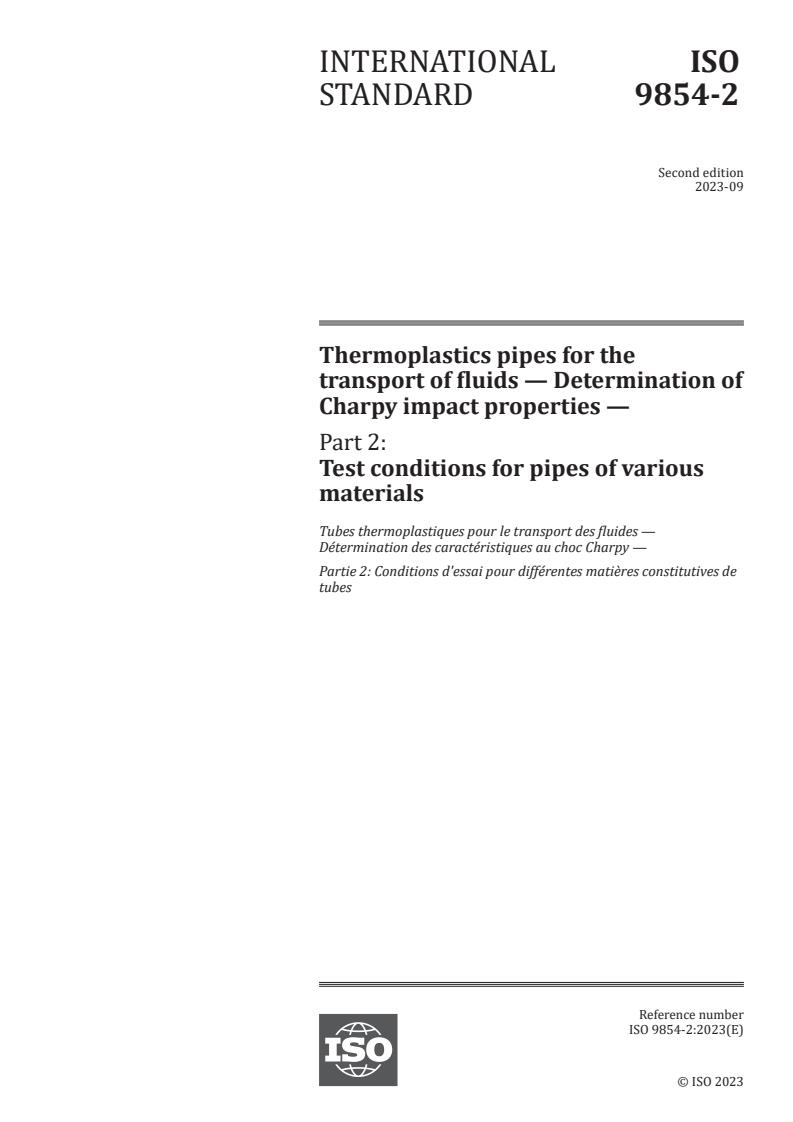
INTERNATIONAL ISO
STANDARD 9854-2
Second edition
2023-09
Thermoplastics pipes for the
transport of fluids — Determination of
Charpy impact properties —
Part 2:
Test conditions for pipes of various
materials
Tubes thermoplastiques pour le transport des fluides —
Détermination des caractéristiques au choc Charpy —
Partie 2: Conditions d'essai pour différentes matières constitutives de
tubes
Reference number
© ISO 2023
All rights reserved. Unless otherwise specified, or required in the context of its implementation, no part of this publication may
be reproduced or utilized otherwise in any form or by any means, electronic or mechanical, including photocopying, or posting on
the internet or an intranet, without prior written permission. Permission can be requested from either ISO at the address below
or ISO’s member body in the country of the requester.
ISO copyright office
CP 401 • Ch. de Blandonnet 8
CH-1214 Vernier, Geneva
Phone: +41 22 749 01 11
Email: copyright@iso.org
Website: www.iso.org
Published in Switzerland
ii
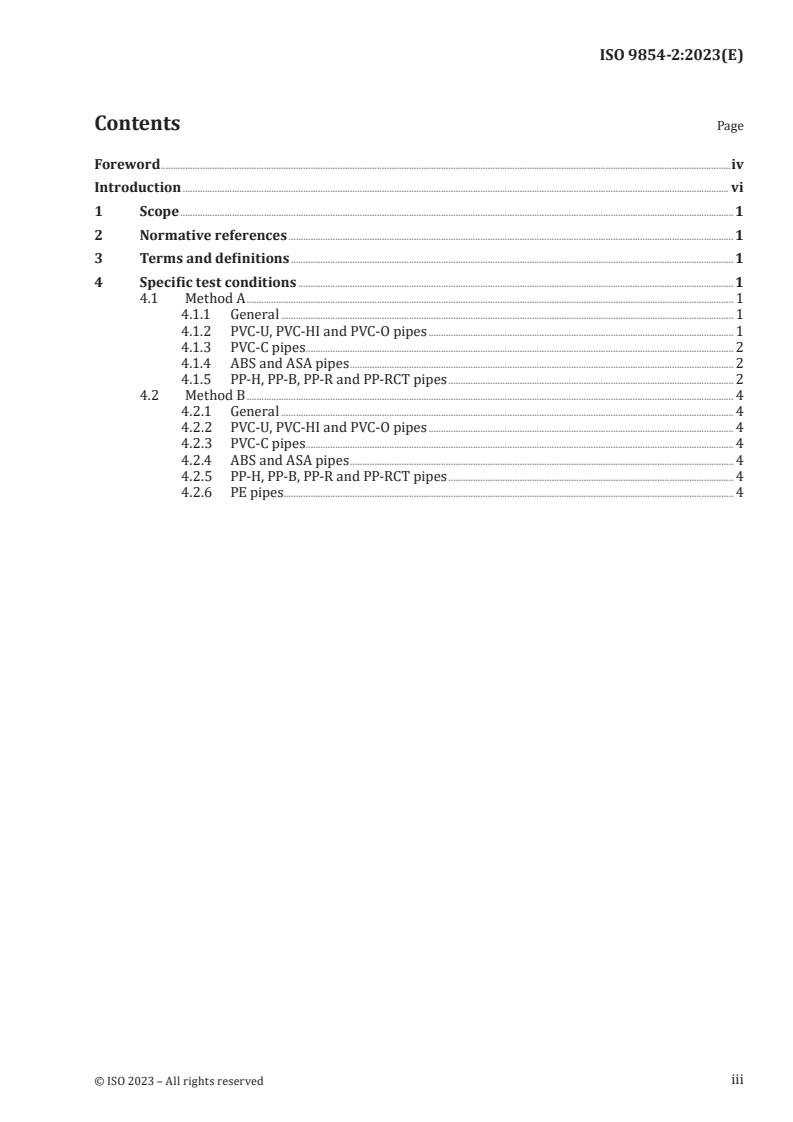
Contents Page
Foreword .iv
Introduction . vi
1 Scope . 1
2 Normative references . 1
3 Terms and definitions . 1
4 Specific test conditions . 1
4.1 Method A . 1
4.1.1 General . 1
4.1.2 PVC-U, PVC-HI and PVC-O pipes . 1
4.1.3 PVC-C pipes . . 2
4.1.4 ABS and ASA pipes . 2
4.1.5 PP-H, PP-B, PP-R and PP-RCT pipes . 2
4.2 Method B . 4
4.2.1 General . 4
4.2.2 PVC-U, PVC-HI and PVC-O pipes . 4
4.2.3 PVC-C pipes . . 4
4.2.4 ABS and ASA pipes . 4
4.2.5 PP-H, PP-B, PP-R and PP-RCT pipes . 4
4.2.6 PE pipes. 4
iii
Foreword
ISO (the International Organization for Standardization) is a worldwide federation of national standards
bodies (ISO member bodies). The work of preparing International Standards is normally carried out
through ISO technical committees. Each member body interested in a subject for which a technical
committee has been established has the right to be represented on that committee. International
organizations, governmental and non-governmental, in liaison with ISO, also take part in the work.
ISO collaborates closely with the International Electrotechnical Commission (IEC) on all matters of
electrotechnical standardization.
The procedures used to develop this document and those intended for its further maintenance are
described in the ISO/IEC Directives, Part 1. In particular, the different approval criteria needed for the
different types of ISO documents should be noted. This document was drafted in accordance with the
editorial rules of the ISO/IEC Directives, Part 2 (see www.iso.org/directives).
ISO draws attention to the possibility that the implementation of this document may involve the use
of (a) patent(s). ISO takes no position concerning the evidence, validity or applicability of any claimed
patent rights in respect thereof. As of the date of publication of this document, ISO had not received
notice of (a) patent(s) which may be required to implement this document. However, implementers are
cautioned that this may not represent the latest information, which may be obtained from the patent
database available at www.iso.org/patents. ISO shall not be held responsible for identifying any or all
such patent rights.
Any trade name used in this document is information given for the convenience of users and does not
constitute an endorsement.
For an explanation of the voluntary nature of standards, the meaning of ISO specific terms and
expressions related to conformity assessment, as well as information about ISO's adherence to
the World Trade Organization (WTO) principles in the Technical Barriers to Trade (TBT), see
www.iso.org/iso/foreword.html.
This document was prepared by Technical Committee ISO/TC 138, Plastics pipes, fittings and valves
for the transport of fluids, Subcommittee SC 5, General properties of pipes, fittings and valves of plastic
materials and their accessories -- Test methods and basic specifications.
This second edition cancels and replaces the first edition (ISO 9854-2:1994), which has been technically
revised.
The main changes are as follows:
— the title has been revised;
— throughout the document, unplasticized poly(vinyl chloride), for extrusion, impact modified (PVC-U,
EP) has been replaced by high-impact poly(vinyl chloride) (PVC-HI);
— throughout the document, polypropylene (PP) and propylene-copolymer have been replaced by
propylene homopolymer (PP-H), propylene impact polymer (PP-B) and propylene random copolymer
(PP-R);
— propylene random copolymer with modified crystallinity (PP-RCT), oriented unplasticized
poly(vinyl chloride) (PVC-O), and polyethylene (PE) have been added in the Scope;
— the normative references listed in Clause 2 have been updated;
— Clause 3, Terms and definitions, has been added;
— the title of Table 1, PVC-U and PVC-U, EP pipes, has been replaced by PVC-U, PVC-HI and PVC-O pipes;
— PVC-O has been added in Table 1;
iv
— the terms "external diameter" and "wall thickness" have been replaced by "nominal outside
diameter, d " and "nominal wall thickness, e " in Tables 1, 2, 3 and 4;
n n
— the title of Table 4, Polypropylene (PP) and propylene-copolymer pipes, has been replaced by PP-H,
PP-B, PP
...