

ISO/IEC DTS 22443
(Main)Information technology — Artificial intelligence — Guidance on addressing societal concerns and ethical considerations
- Abstract
This document provides guidance on how an organization can identify and address societal concerns and ethical considerations during the life cycle of AI systems that can potentially harm individuals and society. The document expands existing AI system governance, management system and impact assessment standards. This document is applicable to all types of organizations that develop or use AI systems, regardless of size, type and nature.
- Status
- Not Published
- Technical Committee
- ISO/IEC JTC 1/SC 42 - Artificial intelligence
- Drafting Committee
- ISO/IEC JTC 1/SC 42 - Artificial intelligence
- Current Stage
- 5020 - FDIS ballot initiated: 2 months. Proof sent to secretariat
- Start Date
- 26-Aug-2026
- Completion Date
- 26-Aug-2026
Buy Documents


ISO/IEC DTS 22443 - Information technology — Artificial intelligence — Guidance on addressing societal concerns and ethical considerations

REDLINE ISO/IEC DTS 22443 - Information technology — Artificial intelligence — Guidance on addressing societal concerns and ethical considerations
ISO/IEC DTS 22443 is an ISO/IEC document that gives guidance on addressing societal concerns and ethical considerations in artificial intelligence (AI). It helps organizations identify and manage those concerns across the AI system life cycle, especially where AI could potentially harm individuals or society. The document is written for organizations that develop or use AI systems, whatever their size, type or nature.
What does ISO/IEC DTS 22443 specify?
ISO/IEC DTS 22443 specifies guidance for identifying and addressing societal concerns and ethical considerations during the life cycle of AI systems. It supports existing AI governance, management system and impact assessment standards, so it is intended to sit alongside organizational processes rather than replace them.
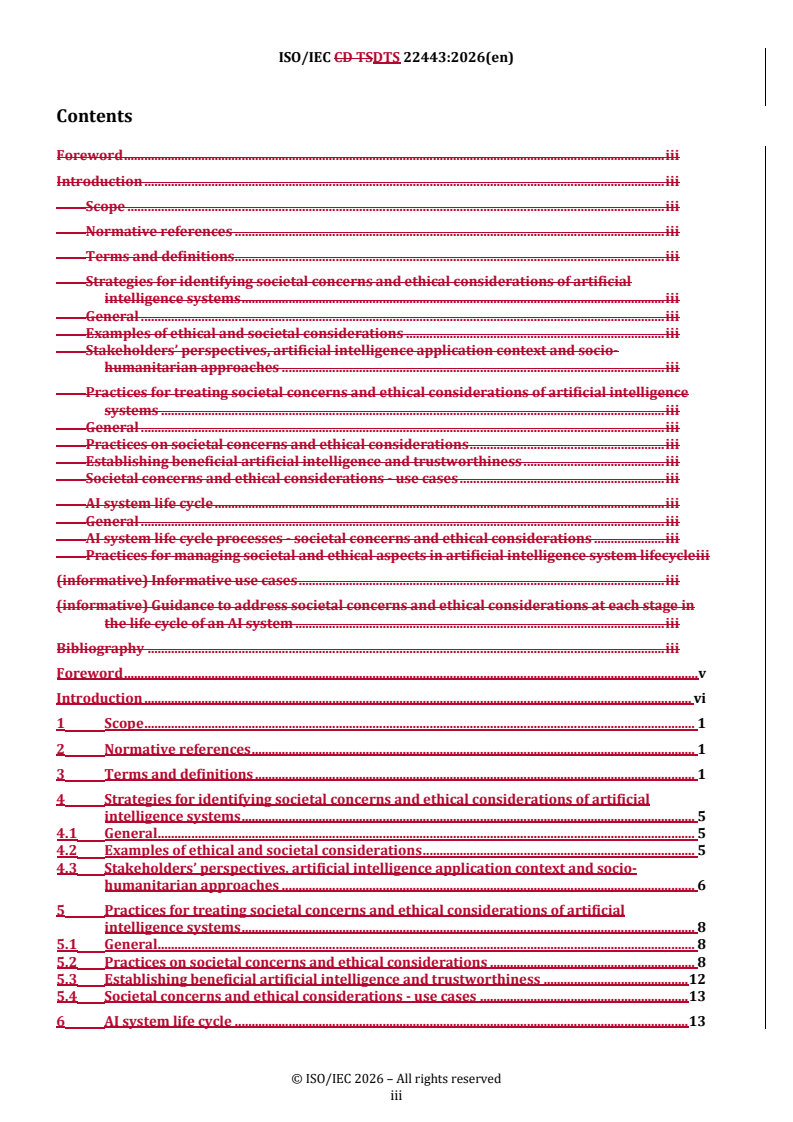
The document is organized into scope, normative references, terms and definitions, guidance on identifying concerns, guidance on treating them, guidance across the AI system life cycle, and two informative annexes.
| Annex | What it covers |
|---|---|
| Annex A | Informative use cases |
| Annex B | Guidance to address societal concerns and ethical considerations at each stage in the life cycle of an AI system |
Clause 4 focuses on strategies for identifying concerns. Clause 5 covers practices for treating them. Clause 6 links the guidance to AI system life cycle processes and stages.
What are the key requirements of ISO/IEC DTS 22443?
ISO/IEC DTS 22443 is a guidance document, so its practical value is in showing where to put ethical and social considerations into real organizational work. The main message is to build them into governance, requirements, design, deployment, operation and retirement, not to treat them as a separate review at the end.
Start early and use an ethical framework
Clause 4.1 says ethical considerations should be built into inception, requirements and organizational decision-making. In practice, that means an organization should not wait until deployment to ask whether an AI system is acceptable - it should test ideas, requirements and choices against an ethical reference framework from the start.
Clause 4.1 also highlights transparency, explainability and interpretability. For users and stakeholders, this means the organization should be able to explain what the AI system does, what limits it has, and how its decisions can be understood.
Identify the concerns that matter in context
Clause 4.2 gives a broad set of ethical and societal considerations, including human rights, accountability, fairness and non-discrimination, transparency and explainability, privacy, safety and security, human control of technology, community involvement, inclusivity, civic integrity and labour practices. The document treats these as context-dependent, so the organization has to judge which ones apply to the use case.
In practice, this means the organization should look for risks such as unwanted bias, misuse of personal data, reduced human control, harmful effects on employment, or negative effects on communities. The point is to make those risks visible before they become design choices or operating problems.
Include stakeholder perspective and application context
Clause 4.3 frames the topic from the viewpoint of stakeholders and the AI application context. It distinguishes perspectives linked to development, deployment, regulation and use, so the same system can raise different concerns for different parties.
For an organization, this means the review must include people who build the system, people who operate it, people who regulate it, and people affected by it. A system can look acceptable from a technical point of view and still create problems for users, communities or other interested parties.
Embed the topic in management system practice
Clause 5.2 ties the guidance to ISO/IEC 42001 and the artificial intelligence management system (AIMS). The document says practices on societal concerns and ethical considerations should be part of the AIMS scope and linked to leadership, planning, support, operation, performance evaluation, improvement, controls and objectives.
In practice, this means the organization should document responsibilities, objectives and controls, and should be able to show how those controls support responsible AI design and use. It also means the topic belongs in the normal management system cycle, not in a one-time checklist.
Treat trustworthiness as a working objective
Clause 5.3 connects beneficial AI with trustworthiness. It says organizations should assess value and impact, including through impact assessments and cost-benefit analysis, and should re-evaluate results when they clash with ethical or human rights concerns.
The practical meaning is simple: a system should not be judged only by performance or business value. The organization should also ask whether the outcome is trustworthy, whether harms outweigh benefits, and whether the result should be changed before release or continued use.
Apply the guidance through the AI life cycle
Clause 6 links the document to ISO/IEC 5338 and to AI system life cycle stages from inception through retirement. It says the AI system life cycle should incorporate societal concerns and ethical considerations across processes such as requirements, architecture, design, analysis, knowledge acquisition, AI data engineering, implementation, integration, verification, validation, operation, maintenance, continuous validation, re-evaluation and retirement.
For an organization, this means ethical and societal checks belong at every stage where the system can still be changed. Annex B is especially useful here because it gives stage-by-stage guidance rather than only high-level principles.
Handle retirement and recall as part of responsibility
Clause 6.3 includes retirement and decommissioning, including assessing the need for an AI system recall and implementing a recall. That matters because some ethical or societal problems only become clear after deployment.
In practice, the organization should plan for how to stop, withdraw or replace an AI system if it becomes harmful, obsolete or unacceptable. Responsible AI management includes end-of-life decisions, not only creation and deployment.
What terms does ISO/IEC DTS 22443 define?
- Bias - a systematic difference in treatment of certain objects, people or groups compared with others.
- Ethical consideration - a consideration integral to responsible AI governance, including accountability, privacy, transparency and fairness across the whole life cycle.
- Fairness - treatment, behaviour or outcomes that are not driven by favouritism or unjust discrimination.
- Impact assessment - a formal, documented process for considering impacts on individuals, groups and societies when AI is involved.
- Life cycle - the evolution of a system, product, service or project from conception and planning through retirement.
- Privacy - the right of individuals to control or influence what information about them is collected, stored and disclosed.
- Social responsibility - an organization’s responsibility for the impacts of its decisions and activities on society and the environment through transparent and ethical behaviour.
- Societal concerns - potential impacts of AI systems on society, including psychological, cultural and economic effects.
Who uses ISO/IEC DTS 22443?
ISO/IEC DTS 22443 is for organizations that develop or use AI systems. That includes teams working on governance, management systems, risk or impact assessment, and the people who define requirements, build, deploy, operate or maintain AI systems.
It is also relevant to organizations that need to consider stakeholder needs, public trust, regulation and accountability. In practice, that includes developers, deployers, operators, managers, quality teams, compliance teams and decision-makers involved in AI oversight.
Which standards are used with ISO/IEC DTS 22443?
| Standard | What it contributes |
|---|---|
| ISO/IEC 5338 | AI system life cycle processes used as the life cycle basis in clause 6 |
| ISO/IEC 22989 | AI concepts and terminology used for terms and definitions |
| ISO/IEC 42001 | AI management system requirements and scope that this document supports |
The document also cites related standards and guidance such as ISO/IEC TR 24368, ISO/IEC/IEEE 24748-7000, ISO/IEC/IEEE 12207, ISO/IEC/IEEE 15288, ISO/IEC 38507, ISO 26000 and ISO Guide 82 to support specific ethical, governance and life cycle topics.
What does the ISO/IEC DTS 22443 document contain?
The document contains a life-cycle view of AI ethics and societal concerns, including a figure that shows AI system life cycle stages. Clause 4 gives examples of concerns and stakeholder perspectives, while clause 5 links the topic to governance, trustworthiness and management system practice.
Annex A provides informative use cases. Annex B is the most operational part of the document: it maps societal and ethical guidance to life cycle processes such as stakeholder needs, system requirements, architecture, design, analysis, knowledge acquisition, AI data engineering, implementation, integration, verification, validation, operation, maintenance, continuous validation, re-evaluation and retirement.
This makes the document useful for design reviews, impact assessments, audits and operational governance, because it shows where to ask the ethical and societal questions throughout the work.
Buy Documents
ISO/IEC DTS 22443 - Information technology — Artificial intelligence — Guidance on addressing societal concerns and ethical considerations
REDLINE ISO/IEC DTS 22443 - Information technology — Artificial intelligence — Guidance on addressing societal concerns and ethical considerations
Get Certified
Connect with accredited certification bodies for this standard

BSI Group
BSI (British Standards Institution) is the business standards company that helps organizations make excellence a habit.

NYCE
Mexican standards and certification body.
Sponsored listings
Frequently Asked Questions
ISO/IEC DTS 22443 is a draft published by the International Organization for Standardization (ISO). Its full title is "Information technology — Artificial intelligence — Guidance on addressing societal concerns and ethical considerations". This standard covers: This document provides guidance on how an organization can identify and address societal concerns and ethical considerations during the life cycle of AI systems that can potentially harm individuals and society. The document expands existing AI system governance, management system and impact assessment standards. This document is applicable to all types of organizations that develop or use AI systems, regardless of size, type and nature.
This document provides guidance on how an organization can identify and address societal concerns and ethical considerations during the life cycle of AI systems that can potentially harm individuals and society. The document expands existing AI system governance, management system and impact assessment standards. This document is applicable to all types of organizations that develop or use AI systems, regardless of size, type and nature.
ISO/IEC DTS 22443 is classified under the following ICS (International Classification for Standards) categories: 35.020 - Information technology (IT) in general. The ICS classification helps identify the subject area and facilitates finding related standards.
ISO/IEC DTS 22443 is available in PDF format for immediate download after purchase. The document can be added to your cart and obtained through the secure checkout process. Digital delivery ensures instant access to the complete standard document.
Standards Content (Sample)
FINAL DRAFT
Technical
Specification
ISO/IEC JTC 1/SC 42
Information technology — Artificial
Secretariat: ANSI
intelligence — Guidance on
Voting begins on:
addressing societal concerns and
2026-08-26
ethical considerations
Voting terminates on:
2026-10-21
RECIPIENTS OF THIS DRAFT ARE INVITED TO SUBMIT,
WITH THEIR COMMENTS, NOTIFICATION OF ANY
RELEVANT PATENT RIGHTS OF WHICH THEY ARE AWARE
AND TO PROVIDE SUPPOR TING DOCUMENTATION.
IN ADDITION TO THEIR EVALUATION AS
BEING ACCEPTABLE FOR INDUSTRIAL, TECHNO
LOGICAL, COMMERCIAL AND USER PURPOSES, DRAFT
INTERNATIONAL STANDARDS MAY ON OCCASION HAVE
TO BE CONSIDERED IN THE LIGHT OF THEIR POTENTIAL
TO BECOME STAN DARDS TO WHICH REFERENCE MAY BE
MADE IN NATIONAL REGULATIONS.
Reference number
FINAL DRAFT
Technical
Specification
ISO/IEC JTC 1/SC 42
Information technology — Artificial
Secretariat: ANSI
intelligence — Guidance on
Voting begins on:
addressing societal concerns and
ethical considerations
Voting terminates on:
RECIPIENTS OF THIS DRAFT ARE INVITED TO SUBMIT,
WITH THEIR COMMENTS, NOTIFICATION OF ANY
RELEVANT PATENT RIGHTS OF WHICH THEY ARE AWARE
AND TO PROVIDE SUPPOR TING DOCUMENTATION.
© ISO/IEC 2026
IN ADDITION TO THEIR EVALUATION AS
All rights reserved. Unless otherwise specified, or required in the context of its implementation, no part of this publication may
BEING ACCEPTABLE FOR INDUSTRIAL, TECHNO
LOGICAL, COMMERCIAL AND USER PURPOSES, DRAFT
be reproduced or utilized otherwise in any form or by any means, electronic or mechanical, including photocopying, or posting on
INTERNATIONAL STANDARDS MAY ON OCCASION HAVE
the internet or an intranet, without prior written permission. Permission can be requested from either ISO at the address below
TO BE CONSIDERED IN THE LIGHT OF THEIR POTENTIAL
or ISO’s member body in the country of the requester.
TO BECOME STAN DARDS TO WHICH REFERENCE MAY BE
MADE IN NATIONAL REGULATIONS.
ISO copyright office
CP 401 • Ch. de Blandonnet 8
CH-1214 Vernier, Geneva
Phone: +41 22 749 01 11
Email: copyright@iso.org
Website: www.iso.org
Published in Switzerland Reference number
© ISO/IEC 2026 – All rights reserved
ii
Contents Page
Foreword .iv
Introduction .v
1 Scope . 1
2 Normative references . 1
3 Terms and definitions . 1
4 Strategies for identifying societal concerns and ethical considerations of artificial
intelligence systems . 5
4.1 General .5
4.2 Examples of ethical and societal considerations .5
4.3 Stakeholders’ perspectives, artificial intelligence application context and socio-
humanitarian approaches .6
4.3.1 General .6
4.3.2 Artificial intelligence stakeholders: production or use of artificial intelligence
systems .6
4.3.3 Artificial intelligence stakeholders: regulatory environment .7
4.3.4 Artificial intelligence stakeholders: deployment and application of the artificial
intelligence system .7
5 Practices for treating societal concerns and ethical considerations of artificial
intelligence systems . 7
5.1 General .7
5.2 Practices on societal concerns and ethical considerations .7
5.2.1 Leadership.8
5.2.2 Planning .8
5.2.3 Support .9
5.2.4 Operation .9
5.2.5 Performance evaluation . .10
5.2.6 Improvement.10
5.2.7 Controls and objectives .11
5.3 Establishing beneficial artificial intelligence and trustworthiness .11
5.4 Societal concerns and ethical considerations - use cases .11
6 AI system life cycle .12
6.1 General . 12
6.2 AI system life cycle processes - societal concerns and ethical considerations . 13
6.3 Practices for managing societal and ethical aspects in artificial intelligence system life
cycle .14
6.3.1 Ethics by design . . .14
6.3.2 Ethical Data Management.14
6.3.3 Model Development and Training . 15
6.3.4 AI Systems Design, Development, Deployment and Monitoring: . 15
6.3.5 Stakeholder Engagement and Public Trust .16
6.3.6 Continuous Improvement and Adaptation .16
6.3.7 Retirement and Decommissioning .16
Annex A (informative) Informative use cases . 19
Annex B (informative) Guidance to address societal concerns and ethical considerations at
each stage in the life cycle of an AI system .28
Bibliography .42
© ISO/IEC 2026 – All rights reserved
iii
Foreword
ISO (the International Organization for Standardization) and IEC (the International Electrotechnical
Commission) form the specialized system for worldwide standardization. National bodies that are
members of ISO or IEC participate in the development of International Standards through technical
committees established by the respective organization to deal with particular fields of technical activity.
ISO and IEC technical committees collaborate in fields of mutual interest. Other international organizations,
governmental and non-governmental, in liaison with ISO and IEC, also take part in the work.
The procedures used to develop this document and those intended for its further maintenance are described
in the ISO/IEC Directives, Part 1. In particular, the different approval criteria needed for the different types
of document should be noted. This document was drafted in accordance with the editorial rules of the ISO/
IEC Directives, Part 2 (see www.iso.org/directives or www.iec.ch/members_experts/refdocs).
ISO and IEC draw attention to the possibility that the implementation of this document may involve the
use of (a) patent(s). ISO and IEC take no position concerning the evidence, validity or applicability of any
claimed patent rights in respect thereof. As of the date of publication of this document, ISO and IEC had not
received notice of (a) patent(s) which may be required to implement this document. However, implementers
are cautioned that this may not represent the latest information, which may be obtained from the patent
database available at www.iso.org/patents and https://patents.iec.ch. ISO and IEC shall not be held
responsible for identifying any or all such patent rights.
Any trade name used in this document is information given for the convenience of users and does not
constitute an endorsement.
For an explanation of the voluntary nature of standards, the meaning of ISO specific terms and expressions
related to conformity assessment, as well as information about ISO's adherence to the World Trade
Organization (WTO) principles in the Technical Barriers to Trade (TBT) see www.iso.org/iso/foreword.html.
In the IEC, see www.iec.ch/understanding-standards.
This document was prepared by Joint Technical Committee ISO/IEC JTC 1, Information technology,
Subcommittee SC 42, Artificial intelligence.
Any feedback or questions on this document should be directed to the user’s national standards
body. A complete listing of these bodies can be found at www.iso.org/members.html and
www.iec.ch/national-committees.
© ISO/IEC 2026 – All rights reserved
iv
Introduction
Artificial intelligence (AI) is increasingly becoming a pivotal component across various sectors, driving
innovation and efficiency. However, its integration brings forth societal concerns and ethical considerations
that necessitate careful consideration and management.
Ethical considerations can be explicit or implicit depending on how clearly they are defined and understood
within a given context, cultural norms, and organizational policies.
This document provides guidance on addressing societal concerns and ethical considerations, without
introducing any value statements, however always anchored in universal human rights standards, when
artificial intelligence systems are developed and deployed.
Artificial intelligence systems have the potential to significantly affect individuals and society, both
positively and negatively. This document emphasizes the importance of integrating societal concerns and
ethical considerations into organizational processes and decision-making frameworks, thereby fostering
trust and accountability. This document also aims to assist organizations in responsibly managing artificial
intelligence systems by providing a framework for identifying and addressing societal concerns and ethical
considerations throughout the artificial intelligence systems life cycle processes.
The unique features of artificial intelligence systems can raise additional concerns compared to traditional
systems. This includes considerations of transparency, fairness, human control and the potential societal
effects of artificial intelligence systems, including considerations of transparency and fairness. To address
these concerns, organizations should ensure that their artificial intelligence systems not only meet technical
and operational objectives but also align with broader societal concerns and ethical considerations.
In summary, this document serves as a comprehensive guide for organizations seeking to navigate the
complex ethical landscape of artificial intelligence, providing strategies and practices to ensure that
artificial intelligence systems contribute positively to society while minimizing potential harms.
© ISO/IEC 2026 – All rights reserved
v
FINAL DRAFT Technical Specification ISO/IEC DTS 22443:2026(en)
Information technology — Artificial intelligence — Guidance
on addressing societal concerns and ethical considerations
1 Scope
This document provides guidance on how an organization can identify and address societal concerns and
ethical considerations during the life cycle of artificial intelligence systems that can potentially harm
individuals and society.
This document supports existing artificial intelligence system governance, management system and impact
assessment standards. This document is applicable to all types of organizations that develop or use artificial
intelligence systems, regardless of size, type and nature.
2 Normative references
The following documents are referred to in the text in such a way that some or all of their content constitutes
requirements of this document. For dated references, only the edition cited applies. For undated references,
the latest edition of the referenced document (including any amendments) applies.
ISO/IEC 5338, Information technology — Artificial intelligence — AI system life cycle processes
ISO/IEC 22989, Information technology — Artificial intelligence — Artificial intelligence concepts and
terminology
ISO/IEC 42001, Information technology — Artificial intelligence — Management system
3 Terms and definitions
For the purposes of this document, the terms and definitions given in ISO/IEC 22989, ISO/IEC 42001,
ISO/IEC 5338 and the following apply.
ISO and IEC maintain terminology databases for use in standardization at the following addresses:
— ISO Online browsing platform: available at https:// www .iso .org/ obp
— IEC Electropedia: available at https:// www .electropedia .org/
3.1
bias
systematic difference in treatment of certain objects, people, or groups in comparison to others
[1]
[SOURCE: ISO/IEC TR 24027:2021 , 3.2.2, modified — Removed Note to entry]
3.2
ethical behaviour
behaviour that is in accordance with accepted principles of right or good conduct in the context of a particular
situation and is consistent with human rights (3.6) and international norms of behaviour (3.9)
Note 1 to entry: A reference to human rights has been added.
[2]
[SOURCE: ISO 26000:2010 , 2.7]
© ISO/IEC 2026 – All rights reserved
3.3
ethical consideration
consideration integral to the responsible management and governance of artificial intelligence, ensuring
values throughout the whole life cycle (3.10), such as accountability, privacy (3.11), transparency and fairness
(3.4), with respect for human beings, and positive contributions to society while minimizing potential harms
Note 1 to entry: Considerations for organizations when developing artificial intelligence policies are provided in
[3]
ISO/IEC 38507 .
[4]
Note 2 to entry: Considerations for ethical review framework are provided in ISO/IEC TR 24368:2022 , 7.2.
[4]
Note 3 to entry: A non-exhaustive list of ethical and societal considerations is set out in ISO/IEC TR 24368:2022 , 8.2.
3.4
fairness
treatment, behaviour or outcomes that respect established facts, societal norms and beliefs and are not
determined or affected by favouritism or unjust discrimination
Note 1 to entry: Considerations of fairness are highly contextual and vary across cultures, generations, geographies
and political opinions.
Note 2 to entry: Fairness is not the same as the lack of bias (3.1). Bias does not always result in unfairness and
unfairness can be caused by factors other than bias.
[4]
[SOURCE: ISO/IEC TR 24368:2022 , 3.7]
3.5
governance
human-based system comprising directing, overseeing and accountability
[5]
[SOURCE: ISO/IEC 38507:2022 , 3.3]
3.6
human rights
rights inherent to all human beings, whatever their nationality, place of residence, sex, national or ethnic
origin, colour, religion, language or any other status
[4]
Note 1 to entry: Human rights practices are referred to in ISO/IEC TR 24368:2022 , 5.1.
Note 2 to entry: Human rights are: interrelated, universal and inalienable; interdependent and indivisible; equal and
non-discriminatory; and include both rights and obligations.
[6]
[SOURCE: EN ISO 22300:2021 , 3.1.115]
3.7
impact assessment
formal, documented process by which the impacts to individuals, groups of individuals and societies are
considered by an organization developing, providing, or using products or services utilizing artificial
intelligence
3.8
interested party
stakeholder
person or organization that can affect, be affected by, or perceive itself to be affected by a decision or activity
[7]
Note 1 to entry: An overview of interested parties in AI is provided in ISO/IEC 22989:2022 , 5.19.
Note 2 to entry: 4.3 states that the list of stakeholders can be viewed more broadly, to take into consideration also any
other person, entity or group, who knowingly or unknowingly is indirectly affected of the AI system.
[SOURCE: ISO/IEC 42001:2023, 3.2]
© ISO/IEC 2026 – All rights reserved
3.9
international norms of behaviour
expectations of socially responsible organizational behaviour, derived from customary international law,
generally accepted principles of international law, or intergovernmental agreements that are universally or
nearly universally recognized
Note 1 to entry: Intergovernmental agreements include treaties and conventions.
Note 2 to entry: Although customary international law, generally accepted principles of international law and
intergovernmental agreements are directed primarily at states, they express goals and principles which all
organizations can aspire.
Note 3 to entry: International norms of behaviour evolve over time.
[2]
[SOURCE: ISO 26000:2010 , 2.11]
3.10
life cycle
evolution of a system, product, service, project or other human-made entity, from conception including
planning, through retirement
Note 1 to entry: Reference to the notion of planning is added and can also be actions taken by human beings as referred
[7]
to in Note 1 to entry of the definition of planning in ISO/IEC 22989:2022 .
[7]
[SOURCE: ISO/IEC 22989:2022 , 3.1.22]
3.11
privacy
right of individuals to control or influence what information related to them may be collected and stored
and by whom and to which that information is maintained may be disclosed
Note 1 to entry: Privacy protection measures to be taken to ensure that AI systems do not infringe on individuals'
[8]
privacy rights, including data anonymization and secure data handling practices. ISO/IEC 15944-12:2020 , 3.97.
Note 2 to entry: 4.2 exemplifies ethical and societal considerations in terms of privacy as protecting personal data and
ensuring users can exercise their rights over their data, and without undue surveillance.
[9]
[SOURCE: ISO 7498-2:1989 , 3.3.43]
3.12
responsibility
obligation to act or take decisions to achieve required outcomes
Note 1 to entry: A decision can be taken not to act.
[4]
[SOURCE: ISO/IEC TR 24368:2022 , 3.12]
3.13
safety
expectation that a system does not, under defined conditions, lead to a state in which human life, health,
property, or the environment is endangered
[10]
[SOURCE: ISO/IEC/IEEE 12207:2017 , 3.1.48]
3.14
security
all aspects related to defining, achieving, and maintaining confidentiality, integrity, availability,
accountability, authenticity, and reliability
Note 1 to entry: A product, system, or service is considered to be secure to the extent that its users can rely that it
functions (or will function) in the intended way. This is usually considered in the context of an assessment of actual or
perceived threats.
[11]
[SOURCE: ISO/IEC 15444-8:2023 , 3.30]
© ISO/IEC 2026 – All rights reserved
3.15
social responsibility
responsibility (3.12) of an organization for the impacts of its decisions and activities on society and the
environment, through transparent and ethical behaviour (3.2) that:
— contributes to sustainability (3.18), including health and the welfare of society;
— takes into account the expectations of interested parties (3.8);
— is in compliance with applicable law and is consistent with local and international norms of behaviour
(3.9);
— is integrated throughout the organization and practised in its relationships
Note 1 to entry: Activities include products, services and processes.
Note 2 to entry: Relationships refer to an organization's activities within its sphere of influence.
[2]
[SOURCE: ISO 26000:2010 , 2.18, modified — replaced "stakeholders" with "interested parties".]
3.16
sphere of influence
range or extent of political, contractual, economic or other relationships through which an organization has
the ability to affect the decisions or activities of individuals or organizations
Note 1 to entry: The ability to influence does not, in itself, imply a responsibility to exercise influence.
[2]
[SOURCE: ISO 26000:2010 , 2.19, modified — replaced Note 2 to entry has been deleted.]
3.17
societal concerns
potential impacts of artificial intelligence systems on society including psychological, cultural and economic
effects
Note 1 to entry: This involves understanding how AI influences human behaviour, trust, empathy, and identity
formation.
3.18
sustainability
state of the global system, including environmental, social and economic aspects, in which the needs of the
present are met without compromising the ability of future generations to meet their own needs
Note 1 to entry: The environmental, social and economic aspects interact, are interdependent and are often referred
to as the three dimensions of sustainability.
Note 2 to entry: Sustainability is the goal of sustainable development.
[12]
[SOURCE: ISO Guide 82:2019 , 3.1]
3.19
value
value in the context of human culture that supports a judgment on what is right or wrong
[13]
Note 1 to entry: Reference to ISO/IEC/IEEE 24748-7000:2022 and applicable for any and all values, complimentary
[14]
to ISO/IEC 42001 .
[13]
[SOURCE: ISO/IEC/IEEE 24748-7000:2022 , 3.1]
© ISO/IEC 2026 – All rights reserved
4 Strategies for identifying societal concerns and ethical considerations of artificial
intelligence systems
4.1 General
To emphasize the significance of developing artificial intelligence systems with strong ethical grounding,
ethical considerations should be integrated into the inception and requirements of artificial intelligence
system development and in decision-making processes within organizations. Organizations can adopt
ethical principles to create a framework for ethical reference. Fundamental considerations about the way
the organization can operate and the standards it can comply with are key elements of such an ethical
reference framework. An ethical framework can be adaptable yet detailed enough to facilitate research and
enable managers to scrutinize and assess intricate organizational decisions. For example, managers can
have the capacity to measure new products and services against this framework, as well as guide the overall
direction of the organization (e.g. cross-functional tasks like human resources).
In terms of transparency, organizations can ensure openness and clarity of artificial intelligence systems,
making information regarding their processes, decisions, and limitations available to stakeholders, as
[7]
defined in ISO/IEC 22989:2022 , 5.15.8. Also, explainability and interpretability can be achieved by
ensuring that artificial intelligence systems are understandable and their decision-making processes clear
[7]
to stakeholders, as defined in ISO/IEC 22989:2022 , 5.15.6.
4.2 Examples of ethical and societal considerations
[15]
An overview of ethical review framework is provided in ISO/IEC TR 24368 . A non-exhaustive list
of ethical and societal considerations for building and using ethical and socially acceptable artificial
[4]
intelligence systems and applications is set out in ISO/IEC TR 24368:2022 , 8.2. Whether ethical and
societal consideration apply depends on the specific context of the use case. Some examples follow below:
— international human rights: Ensuring artificial intelligence systems respect human rights and provide
mechanisms for reporting and addressing potential violations;
— accountability: Establishing clear processes for decision-making, monitoring, and addressing misuse or
unwanted bias in artificial intelligence systems;
— fairness and non-discrimination: Identifying and mitigating unwanted biases in data and ensuring
equitable treatment of all affected populations;
— transparency and explainability: Making artificial intelligence systems understandable and their
decision-making processes clear to stakeholders;
— professional responsibility: Ensuring artificial intelligence systems are based on sound scientific
research and are secure, accurate, and fit for purpose, including reporting potential negative societal
and ethical concerns;
— promotion of human values: Consulting stakeholders to ensure artificial intelligence systems align
with human values and disclose potential concerns and unwanted biases;
— privacy: Protecting personal data and ensuring users can exercise their rights over their data;
— safety and security: Implementing measures to protect against harms, incorrect data, data loss and
unauthorized access;
— human control of technology: Ensuring human oversight and human control over AI systems respecting
human autonomy;
— community involvement and development: Engaging communities in the development and deployment
of artificial intelligence systems, especially in public services;
— human centred design: Prioritizing usability, accessibility, and the well-being of users and employees;
© ISO/IEC 2026 – All rights reserved
— respect for the rule of law: Ensuring artificial intelligence systems comply with the rule of law and
allow for review of algorithmic decisions to facilitate contestability as well as remedies mechanisms;
— respect for international norms of behaviour: Adhering to international norms and safeguarding
stakeholder rights and values;
— environmental sustainability: Evaluating and minimizing the environmental impact of artificial
intelligence systems;
— inclusivity: Ensuring that artificial intelligence systems are accessible and usable for all individuals;
— artificial intelligence civic integrity: Ensuring artificial intelligence systems do not violate civic
values, degrade the information ecosystems, and spread misinformation or manipulation;
— labour practices: Addressing the impact of artificial intelligence on employment, ensuring fair treatment
of workers, and promoting digital literacy.
4.3 Stakeholders’ perspectives, artificial intelligence application context and socio-
humanitarian approaches
4.3.1 General
The development of strategies for identifying societal concerns and ethical considerations of artificial
intelligence systems is based on the specifics of the organization’s tasks (artificial intelligence roles), the
specific projects (or models of artificial intelligence systems) and the operating environment (domain).
Stakeholders can have different perspectives on ethical issues in the field of artificial intelligence, given their
nature of activities and goals. The artificial intelligence stakeholders play one or more different roles and
sub-roles in various stages of the artificial intelligence system life cycle. The description of the stakeholder
[7]
is also indicative of its role or sub-role as described in ISO/IEC 22989:2022 , 5.19. Organizations’ treatment
of ethical considerations can be aligned with the role(s) that the organization adopts as described in
[7]
ISO/IEC 22989:2022 .
Furthermore, an organization's treatment and solution of ethical consideration can include the consideration
[16]
of the artificial intelligence application context, ISO/IEC 5339:2024 , 5.2.
[16]
ISO/IEC 5339:2024 , clause 7 identifies various issues and aspects by different stakeholders when building
their ethics framework, on a tailored basis, what actions can be taken to ensure that the organization’s
activities and products meet the ethical expectations of society and specific groups of stakeholders such as
customers, users or partners, but also bystanders. This approach can help organizations in treating societal
concerns and ethical considerations of artificial intelligence systems.
For convenience, stakeholders can be conditionally categorized into three large groups (4.3.2, 4.3.3
and 4.3.4) depending on their role in the development, deployment, regulation or application of artificial
intelligence systems. An organization can have multiple roles, emphasizing the meaningful participation of
stakeholders, such as for example patients and public health advocates, in governance processes.
Due to the nature of complex artificial intelligence systems, when looking at societal concerns and ethical
considerations in terms of effects, the artificial intelligence stakeholders’ list can be viewed more broadly, to
take into consideration also any other person, entity or group, who knowingly or unknowingly is indirectly
affected by the artificial intelligence system.
4.3.2 Artificial intelligence stakeholders: production or use of artificial intelligence systems
Artificial intelligence stakeholders involved in the production or use of an artificial intelligence system can
[16]
refer to ISO/IEC 5339:2024 , 7.1.2 - 7.1.5, and ISO/IEC 42001:2023, A.6.2 artificial intelligence system life
cycle, for activities such as:
— designing, including model engineering and machine learning;
— developing, testing, verification and validation;
© ISO/IEC 2026 – All rights reserved
— deployment and providing data for an AI system.
4.3.3 Artificial intelligence stakeholders: regulatory environment
Artificial intelligence stakeholders that define the regulatory environment and influence the context of
[16]
deployment and application of the artificial intelligence system can refer to ISO/IEC 5339:2024 , 7.3.3, in
the development and adoption of;
— laws;
— various transnational, national, regional or sectoral documents regulating and defining the regimes for
the implementation and operation of artificial intelligence systems.
4.3.4 Artificial intelligence stakeholders: deployment and application of the artificial intelligence
system
Artificial intelligence stakeholders that influence the context of deployment and application of the artificial
[16]
intelligence system can refer to ISO/IEC 5339:2024 , 7.2.2, 7.3.2, for activities such as:
— perceive the impact of artificial intelligence systems;
— form public opinion about artificial intelligence-based products.
5 Practices for treating societal concerns and ethical considerations of artificial
intelligence systems
5.1 General
In terms of artificial intelligence societal concerns and ethical considerations, for successful
[17] [18]
operationalization of socially responsible governance strategies (ISO 26000 , ISO Guide 82 , ISO 37000
[19] [3] [20] [21] [22]
, ISO/IEC 38507 , ISO Guide 84 , ISO/UNDP PAS 53002 , ISO 59004 ), it should involve the
development of high level organizational objectives for ethical behaviour, social responsibility and socially
responsible management processes, that are translated into practices that link, support, and ultimately
provide evidence that such objectives can be achieved.
In terms of artificial intelligence societal concerns and ethical considerations, whether viewed from a
governance or a management perspective, clear practices, both on an organizational level and on an artificial
intelligence system level, should provide the means with which to achieve and measure performance against
such objectives. At the highest level, practices for treating societal concerns and ethical considerations
can provide value to the organization (reducing associated risks), the customers and users, resulting in
beneficial outcomes for both the organization and the user.
5.2 Practices on societal concerns and ethical considerations
[14]
ISO/IEC 42001 requires an organization to determine the scope of an artificial intelligence management
[23]
system (AIMS) by understanding the organization and its context (ISO/IEC 42001:2023 , 4.1) and the
[23]
requirements related to the needs and expectations of interested parties (ISO/IEC 42001:2023 , 4.2).
[14] [14]
This document supports ISO/IEC 42001 . ISO/IEC 42001 also includes requirements on how to:
— assess artificial intelligence system impacts to individuals or groups of individuals, or both, and societies
affected by the artificial intelligence system throughout its life cycle (A5 controls);
— ensure that the organization identifies and documents objectives and implements processes for the
responsible design and developments of artificial intelligence systems (A.6).
The organization should include practices on societal concerns and ethical considerations as part of the
scope of the AIMS, both in relation to the organization and its context and also in relation to the needs and
expectations of interested parties.
© ISO/IEC 2026 – All rights reserved
[14]
ISO/IEC 42001 requires the scope of AIMS to be available as documented information and to determine
the organization’s activities. This includes requirements such as leadership, planning, support, operation,
performance evaluation, improvement, controls and objectives.
[3]
ISO/IEC 38507 contains topics on governance implications of the organizational use of artificial
intelligence and policies to address the use of artificial intelligence, which also can address societal concerns
and ethical considerations.
5.2.1 Leadership
[14]
ISO/IEC 42001 requires the consideration of general topics on leadership and commitment.
In terms of artificial intelligence societal concerns and ethical considerations, the culture of establishing,
encouraging and modelling a responsible approach is an important demonstration of commitment and
leadership by the top management within an organization.
In terms of artificial intelligence societal concerns and ethical considerations, an organization should decide
[14]
to follow a responsible approach, such as that put forward in ISO/IEC 42001 , for the use, development and
the governing of artificial intelligence management systems, which can include fostering an ethical culture
and promote ethical leadership related to artificial intelligence.
In terms of artificial intelligence societal concerns and ethical considerations, topics on leadership and
commitment should also include human rights compliance, and such other considerations as set out in the
[4]
non-exhaustive list of ethical and societal considerations in ISO/IEC TR 24368:2022 , 8.2, also referred to
in 4.2.
In terms of artificial intelligence societal concerns and ethical considerations, ethical leadership from top
management should set the tone and modelling desired behaviours. Leaders should demonstrate integrity,
transparency, and a commitment to ethical decision-making on artificial intelligence.
Organizations should cultivate an ethical culture where employees are encouraged to raise concerns, ask
questions, and make choices considering artificial intelligence societal concerns and ethical considerations.
Regular training on ethics illustrated with scenarios, open communication channels, and recognition for
ethical conduct should help reinforce this culture.
Ensuring awareness of and compliance with a responsible approach, in particular in relation to interested
parties, includes addressing artificial intelligence societal concerns and ethical considerations.
[14]
ISO/IEC 42001 requires considerations on leadership to include three specific sides:
— leadership and commitment;
— practices on artificial intelligence policy;
— practices on artificial intelligence roles, responsibilities and authorities.
All three of these sides should include leadership activity with regards to societal concerns and ethical
considerations.
5.2.2 Planning
[14]
ISO/IEC 42001 requires actions to address artificial intelligence objectives, planning to achieve artificial
intelligence objectives, and planning of changes.
In terms of artificial intelligence societal concerns and ethical considerations, organizations should develop
a comprehensive code of ethics that includes artificial intelligence aspects, and outlines their values,
principles and expected behaviours. This code of conduct can, in the field of societal concerns and ethical
considerations of artificial intelligence, address issues such as human rights, intellectual property rights,
labour practices, environmental stewardship, anti-corruption measures, respect for diversity, equity and
inclusion, while clearly outlining principles and values that guide decision-making processes. Such code of
conduct should be regularly reviewed and updated and also communicated to all the stakeholders.
© ISO/IEC 2026 – All rights reserved
In terms of societal concerns and ethical considerations, it is also useful for an organization to have a
schedule of major activities (or an integrated plan) for the year. Such schedule should also include various
activities in the field of artificial intelligence ethics, such as staff trainings, educational lessons and master
classes, profile lectures, conducting various evaluation activities in specific areas, reviewing complaints,
claims or recommendations of customers or partners, conducting special surveys or questionnaires among
customers and users, and to raise awareness of, and seek feedback from, the public or users on ethical
aspects of using a product or service, legal consultations in the field of law, counselling and other activities
in accordance with the profile and specifics of the organization.
5.2.3 Support
[14]
ISO/IEC 42001 requires resources, competence, awareness, communication and documented information.
In terms of artificial intelligence societal concerns and ethical considerations, to succeed with the planning
of activities that addresses societal concerns and ethical considerations,the organization should develop
measures to implement education, training activities or continuous training programs.
In terms of artificial intelligence societal concerns and ethical considerations, practices that encode ethical
considerations should be made robust with accompanying efforts to build an organizational culture that
values transparency and accountability.
Further, in terms of artificial intelligence societal concerns and ethical considerations, the organizations
should implement mechanisms for practical handling of issues. Mechanisms like anonymous reporting
channels and whistleblower protection policies can enable such a cultural shift and create a safe
environment that encourages employees to report unethical behaviour without fear of retaliation. An
organizational commitment should ensure fairness, impartiality and confidentiality through provisions that
ensure that reported incidents are investigated promptly, accompanied by appropriate action, and followed
by publishing of these actions, serving as a deterrent for future incidents. Prompt investigation of reported
incidents should also be made, as such being helpful in fostering an organizational culture that values
transparency and accountability.
5.2.4 Operation
ISO/IEC 42001 requires operational planning and control.
In terms of artificial intelligence societal concerns and ethical considerations, embedding artificial
intelligence ethical considerations into an organization's decision-making processes at every level is
important. This should be realised through the creation of artificial intelligence ethical decision-making
frameworks and tools, customised to their respective industries, values and objectives, and designed
to prompt decision-makers to carefully assess the potential ramifications of their actions on diverse
stakeholders and societal welfare. Such frameworks should not only articulate ethical principles but also
offer actionable guidance on their application in real-world situations. This application should be integrated
in artificial intelligence systems life cycle stages and processes for any artificial intelligence stakeholder
role of the organization. Further detail on that is covered in clause 6.
Furthermore, the organization should ensure artificial intelligence societal concerns
...
ISO/IEC JTC 1/SC 42
ISO/IEC CD TS 22443(en)
Secretariat: ANSI
Date: 2026-08-11
Information technology — Artificial intelligence — Guidance on
addressing societal concerns and ethical considerations
DTS stage
ISO/IEC CD TSDTS 22443:2026(en)
All rights reserved. Unless otherwise specified, or required in the context of its implementation, no part of this publication
may be reproduced or utilized otherwise in any form or by any means, electronic or mechanical, including photocopying,
or posting on the internet or an intranet, without prior written permission. Permission can be requested from either ISO
at the address below or ISO’s member body in the country of the requester.
ISO copyright office
CP 401 • Ch. de Blandonnet 8
CH-1214 Vernier, Geneva
Phone: + 41 22 749 01 11
E-mail: copyright@iso.org
Website: www.iso.org
Published in Switzerland
© ISO/IEC 2026 – All rights reserved
ii
ISO/IEC CD TSDTS 22443:2026(en)
Contents
Foreword . iii
Introduction . iii
Scope . iii
Normative references . iii
Terms and definitions . iii
Strategies for identifying societal concerns and ethical considerations of artificial
intelligence systems . iii
General . iii
Examples of ethical and societal considerations . iii
Stakeholders’ perspectives, artificial intelligence application context and socio-
humanitarian approaches . iii
Practices for treating societal concerns and ethical considerations of artificial intelligence
systems . iii
General . iii
Practices on societal concerns and ethical considerations . iii
Establishing beneficial artificial intelligence and trustworthiness . iii
Societal concerns and ethical considerations - use cases . iii
AI system life cycle . iii
General . iii
AI system life cycle processes - societal concerns and ethical considerations . iii
Practices for managing societal and ethical aspects in artificial intelligence system lifecycleiii
(informative) Informative use cases . iii
(informative) Guidance to address societal concerns and ethical considerations at each stage in
the life cycle of an AI system . iii
Bibliography . iii
Foreword . v
Introduction . vi
1 Scope . 1
2 Normative references . 1
3 Terms and definitions . 1
4 Strategies for identifying societal concerns and ethical considerations of artificial
intelligence systems . 5
4.1 General . 5
4.2 Examples of ethical and societal considerations . 5
4.3 Stakeholders’ perspectives, artificial intelligence application context and socio-
humanitarian approaches . 6
5 Practices for treating societal concerns and ethical considerations of artificial
intelligence systems . 8
5.1 General . 8
5.2 Practices on societal concerns and ethical considerations . 8
5.3 Establishing beneficial artificial intelligence and trustworthiness . 12
5.4 Societal concerns and ethical considerations - use cases . 13
6 AI system life cycle . 13
© ISO/IEC 2026 – All rights reserved
iii
ISO/IEC CD TSDTS 22443:2026(en)
6.1 General . 13
6.2 AI system life cycle processes - societal concerns and ethical considerations . 15
6.3 Practices for managing societal and ethical aspects in artificial intelligence system life
cycle . 16
Annex A (informative) Informative use cases . 21
Annex B (informative) Guidance to address societal concerns and ethical considerations at each
stage in the life cycle of an AI system . 30
Bibliography . 50
© ISO/IEC 2026 – All rights reserved
iv
ISO/IEC CD TSDTS 22443:2026(en)
Foreword
ISO (the International Organization for Standardization) and IEC (the International Electrotechnical
Commission) form the specialized system for worldwide standardization. National bodies that are members
of ISO or IEC participate in the development of International Standards through technical committees
established by the respective organization to deal with particular fields of technical activity. ISO and IEC
technical committees collaborate in fields of mutual interest. Other international organizations, governmental
and non-governmental, in liaison with ISO and IEC, also take part in the work.
The procedures used to develop this document and those intended for its further maintenance are described
in the ISO/IEC Directives, Part 1. In particular, the different approval criteria needed for the different types of
documentsdocument should be noted. This document was drafted in accordance with the editorial rules of the
ISO/IEC Directives, Part 2 (see www.iso.org/directives or
www.iec.ch/members_experts/refdocs).www.iec.ch/members_experts/refdocs).
ISO and IEC draw attention to the possibility that the implementation of this document may involve the use of
(a) patent(s). ISO and IEC take no position concerning the evidence, validity or applicability of any claimed
patent rights in respect thereof. As of the date of publication of this document, ISO and IEC had not received
notice of (a) patent(s) which may be required to implement this document. However, implementers are
cautioned that this may not represent the latest information, which may be obtained from the patent database
.
available at www.iso.org/patents and https://patents.iec.ch.www.iso.org/patents and https://patents.iec.ch
ISO and IEC shall not be held responsible for identifying any or all such patent rights.
Any trade name used in this document is information given for the convenience of users and does not
constitute an endorsement.
For an explanation of the voluntary nature of standards, the meaning of ISO specific terms and expressions
related to conformity assessment, as well as information about ISO's adherence to the World Trade
Organization (WTO) principles in the Technical Barriers to Trade (TBT) see www.iso.org/iso/foreword.html.
In the IEC, see www.iec.ch/understanding-standards.
In the IEC, see www.iec.ch/understanding-standards. This document was prepared by Joint Technical
Committee ISO/IEC JTC 1, Information technology, Subcommittee SC 42, Artificial Intelligenceintelligence.
Any feedback or questions on this document should be directed to the user’s national standards body. A
complete listing of these bodies can be found at www.iso.org/members.html and www.iec.ch/national-
committees.www.iso.org/members.html and www.iec.ch/national-committees.
© ISO/IEC 2026 – All rights reserved
v
ISO/IEC CD TSDTS 22443:2026(en)
Introduction
Artificial intelligence (AI) is increasingly becoming a pivotal component across various sectors, driving
innovation and efficiency. However, its integration brings forth societal concerns and ethical considerations
that necessitate careful consideration and management.
Ethical considerations can be explicit or implicit depending on how clearly they are defined and understood
within a given context, cultural norms, and organizational policies.
This document provides guidance on addressing societal concerns and ethical considerations, without
introducing any value statements, however always anchored in universal human rights standards, when
artificial intelligence systems are developed and deployed.
Artificial intelligence systems have the potential to significantly affect individuals and society, both positively
and negatively. This document emphasizes the importance of integrating societal concerns and ethical
considerations into organizational processes and decision-making frameworks, thereby fostering trust and
accountability. This document also aims to assist organizations in responsibly managing artificial intelligence
systems by providing a framework for identifying and addressing societal concerns and ethical considerations
throughout the artificial intelligence systems life cycle processes.
The unique features of artificial intelligence systems can raise additional concerns compared to traditional
systems. This includes considerations of transparency, fairness, human control and the potential societal
effects of artificial intelligence systems, including considerations of transparency and fairness. To address
these concerns, organizations should ensure that their artificial intelligence systems not only meet technical
and operational objectives but also align with broader societal concerns and ethical considerations.
In summary, this document serves as a comprehensive guide for organizations seeking to navigate the
complex ethical landscape of artificial intelligence, providing strategies and practices to ensure that artificial
intelligence systems contribute positively to society while minimizing potential harms.
© ISO/IEC 2026 – All rights reserved
vi
ISO/IEC CD TSDTS 22443:2026(en)
Information technology — Artificial intelligence — Guidance on
addressing societal concerns and ethical considerations
1 Scope
This document provides guidance on how an organization can identify and address societal concerns and
ethical considerations during the life cycle of artificial intelligence systems that can potentially harm
individuals and society.
This document supports existing artificial intelligence system governance, management system and impact
assessment standards. This document is applicable to all types of organizations that develop or use artificial
intelligence systems, regardless of size, type and nature.
2 Normative references
The following documents are referred to in the text in such a way that some or all of their content constitutes
requirements of this document. For dated references, only the edition cited applies. For undated references,
the latest edition of the referenced document (including any amendments) applies.
ISO/IEC 5338, Information technology — Artificial intelligence — AI system life cycle processes
ISO/IEC 22989, Information technology — Artificial intelligence — Artificial intelligence concepts and
terminology
ISO/IEC 42001, Information technology — Artificial intelligence — Management system
3 Terms and definitions
For the purposes of this document, the terms and definitions given in ISO/IEC 22989, ISO/IEC 42001, ISO/IEC
5338 and the following apply.
ISO and IEC maintain terminology databases for use in standardization at the following addresses:
— IEC Electropedia: available at http://www.electropedia.org/
— ISO Online browsing platform: available at http://www.iso.org/obphttps://www.iso.org/obp
— IEC Electropedia: available at https://www.electropedia.org/
3.1
bias
systematic difference in treatment of certain objects, people, or groups in comparison to others
[1]
[SOURCE: ISO/IEC TR 24027:2021,ISO/IEC TR 24027:2021 , 3.2.2, modified — Removed Note to entry]
3.2
ethical behaviour
behaviour that is in accordance with accepted principles of right or good conduct in the context of a particular
situation and is consistent with human rights (3.6) and international norms of behaviour (3.9)
Note 1 to entry: A reference to human rights has been added.
© ISO/IEC 2026 – All rights reserved
ISO/IEC CD TSDTS 22443:2026(en)
[2]
[SOURCE: ISO 26000:2010,ISO 26000:2010 , 2.7]
3.3
ethical consideration
consideration integral to the responsible management and governance of artificial intelligence, ensuring
values throughout the whole life cycle (3.10), such as accountability, privacy (3.11), transparency and fairness
(3.4), with respect for human beings, and positive contributions to society while minimizing potential harms
Note 1 to entry: Considerations for organizations when developing artificial intelligence policies are provided in ISO/IEC
[3]
38507.ISO/IEC 38507 .
Note 2 to entry: Considerations for ethical review framework are provided in ISO/IEC TR 24368:2022,ISO/IEC TR
[4]
24368:2022 , 7.2.
Note 3 to entry: A non-exhaustive list of ethical and societal considerations is set out in ISO/IEC TR 24368:2022,ISO/IEC
[4]
TR 24368:2022 , 8.2.
3.4
fairness
treatment, behaviour or outcomes that respect established facts, societal norms and beliefs and are not
determined or affected by favouritism or unjust discrimination
Note 1 to entry: Considerations of fairness are highly contextual and vary across cultures, generations, geographies and
political opinions.
Note 2 to entry: Fairness is not the same as the lack of bias (3.1). Bias does not always result in unfairness and unfairness
can be caused by factors other than bias.
[4]
[SOURCE: ISO/IEC TR 24368:2022,ISO/IEC TR 24368:2022 , 3.7]
3.5
governance
human-based system comprising directing, overseeing and accountability
[5]
, 3.3]
[SOURCE: ISO/IEC 38507:2022,ISO/IEC 38507:2022
3.6
human rights
rights inherent to all human beings, whatever their nationality, place of residence, sex, national or ethnic
origin, colour, religion, language or any other status
[4]
Note 1 to entry: Human rights practices are referred to in ISO/IEC TR 24368:2022,ISO/IEC TR 24368:2022 , 5.1.
Note 2 to entry: Human rights are: interrelated, universal and inalienable; interdependent and indivisible; equal and non-
discriminatory; and include both rights and obligations.
[6]
[SOURCE: EN ISO 22300:2021,EN ISO 22300:2021 , 3.1.115]
3.7
impact assessment
formal, documented process by which the impacts to individuals, groups of individuals and societies are
considered by an organization developing, providing, or using products or services utilizing artificial
intelligence
3.8
interested party (preferred term)
stakeholder (admitted term)
© ISO/IEC 2026 – All rights reserved
ISO/IEC CD TSDTS 22443:2026(en)
person or organization that can affect, be affected by, or perceive itself to be affected by a decision or activity
[7]
Note 1 to entry: An overview of interested parties in AI is provided in ISO/IEC 22989:2022, , 5.19.
Note 2 to entry: Clause 4.34.3 states that the list of stakeholders can be viewed more broadly, to take into consideration
also any other person, entity or group, who knowingly or unknowingly is indirectly affected of the AI system.
[SOURCE: ISO/IEC 42001:2023, 3.2]
3.9
international norms of behaviour
expectations of socially responsible organizational behaviour, derived from customary international law,
generally accepted principles of international law, or intergovernmental agreements that are universally or
nearly universally recognized
Note 1 to entry: Intergovernmental agreements include treaties and conventions.
Note 12 to entry: Although customary international law, generally accepted principles of international law and
intergovernmental agreements are directed primarily at states, they express goals and principles which all organizations
can aspire.
Note 23 to entry: International norms of behaviour evolve over time.
[2]
[SOURCE: ISO 26000:2010,ISO 26000:2010 , 2.11]
3.10
life cycle
evolution of a system, product, service, project or other human-made entity, from conception including
planning, through retirement
Note 1 to entry: Reference to the notion of planning is added and can also be actions taken by human beings as referred
[7]
to in Note 1 to entry of the definition of planning in ISO/IEC 22989:2022. .
[7]
[SOURCE: ISO/IEC 22989:2022,ISO/IEC 22989:2022 , 3.1.22]
3.11
privacy
the right of individuals to control or influence what information related to them may be collected and stored
and by whom and to which that information is maintained may be disclosed
Note 1 to entry: Privacy protection measures to be taken to ensure that AI systems do not infringe on individuals' privacy
rights, including data anonymization and secure data handling practices. ISO/IEC 15944-12:2020,ISO/IEC 15944-
[8]
12:2020 , 3.97.
Note 2 to entry: Clause 4.24.2 exemplifies ethical and societal considerations in terms of privacy as protecting personal
data and ensuring users can exercise their rights over their data, and without undue surveillance.
[9]
[SOURCE: ISO 7498-2:1989,ISO 7498-2:1989 , 3.3.43]
3.12
responsibility
obligation to act or take decisions to achieve required outcomes
Note 1 to entry: A decision can be taken not to act.
[4]
[SOURCE: ISO/IEC TR 24368:2022,ISO/IEC TR 24368:2022 , 3.12]
© ISO/IEC 2026 – All rights reserved
ISO/IEC CD TSDTS 22443:2026(en)
3.13
safety
expectation that a system does not, under defined conditions, lead to a state in which human life, health,
property, or the environment is endangered
[10]
[SOURCE: ISO/IEC/IEEE 12207:2017,ISO/IEC/IEEE 12207:2017 , 3.1.48]
3.14
security
all aspects related to defining, achieving, and maintaining confidentiality, integrity, availability, accountability,
authenticity, and reliability
Note 1 to entry: A product, system, or service is considered to be secure to the extent that its users can rely that it
functions (or will function) in the intended way. This is usually considered in the context of an assessment of actual or
perceived threats.
[11]
[SOURCE: ISO/IEC 15444-8:2023,ISO/IEC 15444-8:2023 , 3.30]
3.15
social responsibility
responsibility (3.12) of an organization for the impacts of its decisions and activities on society and the
environment, through transparent and ethical behaviour (3.2) that:
— contributes to sustainability (3.173.18), including health and the welfare of society;
— takes into account the expectations of interested parties (3.8);
— is in compliance with applicable law and is consistent with local and international norms of behaviour (3.9);
— is integrated throughout the organization and practicedpractised in its relationships.
Note 1 to entry: Activities include products, services and processes.
Note 2 to entry: Relationships refer to an organization's activities within its sphere of influence.
[2]
[SOURCE: ISO 26000:2010,ISO 26000:2010 , 2.18, modified — replaced "stakeholders" with "interested
parties"]".]
3.16
sphere of influence
the range or extent of political, contractual, economic or other relationships through which an organization
has the ability to affect the decisions or activities of individuals or organizations
Note 1 to entry: The ability to influence does not, in itself, imply a responsibility to exercise influence.
[SOURCE: ISO 26000:2010, 5.2.3 and 7.3.3]
[2]
[SOURCE: ISO 26000:2010 , 2.19, modified — replaced Note 2 to entry has been deleted.]
3.17
societal concerns
potential impacts of artificial intelligence systems on society including psychological, cultural and economic
effects
Note 1 to entry: This involves understanding how AI influences human behaviour, trust, empathy, and identity formation.
© ISO/IEC 2026 – All rights reserved
ISO/IEC CD TSDTS 22443:2026(en)
3.18
sustainability
state of the global system, including environmental, social and economic aspects, in which the needs of the
present are met without compromising the ability of future generations to meet their own needs
Note 1 to entry: The environmental, social and economic aspects interact, are interdependent and are often referred to
as the three dimensions of sustainability.
Note 2 to entry: Sustainability is the goal of sustainable development.
[12]
[SOURCE: ISO Guide 82:2019,ISO Guide 82:2019 , 3.1]
3.19
value
value in the context of human culture that supports a judgment on what is right or wrong
[13]
Note 1 to entry: Reference to ISO/IEC/IEEE 24748-7000:2022ISO/IEC/IEEE 24748-7000:2022 and applicable for any
and all values, complimentary to ISO/IEC 42001:2023.
[13]
[SOURCE: ISO/IEC/IEEE 24748-7000:2022,ISO/IEC/IEEE 24748-7000:2022 , 3.1]
4 Strategies for identifying societal concerns and ethical considerations of artificial
intelligence systems
4.1 General
To emphasize the significance of developing artificial intelligence systems with strong ethical grounding,
ethical considerations should be integrated into the inception and requirements of artificial intelligence
system development and in decision-making processes within organizations. Organizations can adopt ethical
principles to create a framework for ethical reference. Fundamental considerations about the way the
organization can operate and the standards it can comply with are key elements of such an ethical reference
framework. An ethical framework can be adaptable yet detailed enough to facilitate research and enable
managers to scrutinize and assess intricate organizational decisions. For example, managers can have the
capacity to measure new products and services against this framework, as well as guide the overall direction
of the organization (e.g. cross-functional tasks like human resources).
In terms of transparency, organizations can ensure openness and clarity of artificial intelligence systems,
making information regarding their processes, decisions, and limitations available to stakeholders, as defined
[7]
in ISO/IEC 22989:2022,ISO/IEC 22989:2022 , 5.15.8. Also, explainability and interpretability can be
achieved by ensuring that artificial intelligence systems are understandable and their decision-making
[7]
processes clear to stakeholders, as defined in ISO/IEC 22989:2022,ISO/IEC 22989:2022 , 5.15.6.
4.2 Examples of ethical and societal considerations
[14]
An overview of ethical review framework is provided in ISO/IEC TR 24368.ISO/IEC TR 24368 . A non-
exhaustive list of ethical and societal considerations for building and using ethical and socially acceptable
artificial intelligence systems and applications is set out in ISO/IEC TR 24368:2022, 8.2.ISO/IEC TR
[4]
24368:2022 , 8.2. Whether ethical and societal consideration apply depends on the specific context of the
use case. Some examples follow below:
— international human rights: Ensuring artificial intelligence systems respect human rights and provide
mechanisms for reporting and addressing potential violations;
— accountability: Establishing clear processes for decision-making, monitoring, and addressing misuse or
unwanted bias in artificial intelligence systems;
© ISO/IEC 2026 – All rights reserved
ISO/IEC CD TSDTS 22443:2026(en)
— fairness and non-discrimination: Identifying and mitigating unwanted biases in data and ensuring
equitable treatment of all affected populations;
— transparency and explainability: Making artificial intelligence systems understandable and their
decision-making processes clear to stakeholders;
— professional responsibility: Ensuring artificial intelligence systems are based on sound scientific
research and are secure, accurate, and fit for purpose, including reporting potential negative societal and
ethical concerns;
— promotion of human values: Consulting stakeholders to ensure artificial intelligence systems align with
human values and disclose potential concerns and unwanted biases;
— privacy: Protecting personal data and ensuring users can exercise their rights over their data;
— safety and security: Implementing measures to protect against harms, incorrect data, data loss and
unauthorized access;
— human control of technology: Ensuring human oversight and human control over AI systems respecting
human autonomy;
— community involvement and development: Engaging communities in the development and deployment
of artificial intelligence systems, especially in public services;
— human centred design: Prioritizing usability, accessibility, and the well-being of users and employees;
— respect for the rule of law: Ensuring artificial intelligence systems comply with the rule of law and allow
for review of algorithmic decisions to facilitate contestability as well as remedies mechanisms;
— respect for international norms of behaviour: Adhering to international norms and safeguarding
stakeholder rights and values;
— environmental sustainability: Evaluating and minimizing the environmental impact of artificial
intelligence systems;
— inclusivity: Ensuring that artificial intelligence systems are accessible and usable for all individuals;
— artificial intelligence civic integrity: Ensuring artificial intelligence systems do not violate civic values,
degrade the information ecosystems, and spread misinformation or manipulation;
— labour practices: Addressing the impact of artificial intelligence on employment, ensuring fair treatment
of workers, and promoting digital literacy.
4.3 Stakeholders’ perspectives, artificial intelligence application context and socio-
humanitarian approaches
4.3.1 General
The development of strategies for identifying societal concerns and ethical considerations of artificial
intelligence systems is based on the specifics of the organization’s tasks (artificial intelligence roles), the
specific projects (or models of artificial intelligence systems) and the operating environment (domain).
Stakeholders can have different perspectives on ethical issues in the field of artificial intelligence, given their
nature of activities and goals. The artificial intelligence stakeholders play one or more different roles and sub-
roles in various stages of the artificial intelligence system life cycle. The description of the stakeholder is also
[7]
indicative of its role or sub-role as described in ISO/IEC 22989:2022,ISO/IEC 22989:2022 , 5.19.
© ISO/IEC 2026 – All rights reserved
ISO/IEC CD TSDTS 22443:2026(en)
Organizations’ treatment of ethical considerations can be aligned with the role(s) that the organization adopts
[7]
as described in ISO/IEC 22989.ISO/IEC 22989:2022 .
Furthermore, an organization's treatment and solution of ethical consideration can include the consideration
[15]
of the artificial intelligence application context,ISO/IEC 5339:2024,ISO/IEC 5339:2024 , 5.2.
[15]
ISO/IEC 5339:2024,ISO/IEC 5339:2024 , clause 7 identifies various issues and aspects by different
stakeholders when building their ethics framework, on a tailored basis, what actions can be taken to ensure
that the organization’s activities and products meet the ethical expectations of society and specific groups of
stakeholders such as customers, users or partners, but also bystanders. This approach can help organizations
in treating societal concerns and ethical considerations of artificial intelligence systems.
For convenience, stakeholders can be conditionally categorized into three large groups (sub-clauses 4.3.2,
4.3.3 and 4.3.4)(4.3.2, 4.3.3 and 4.3.4) depending on their role in the development, deployment, regulation or
application of artificial intelligence systems. An organization can have multiple roles, emphasizing the
meaningful participation of stakeholders, such as for example patients and public health advocates, in
governance processes.
Due to the nature of complex artificial intelligence systems, when looking at societal concerns and ethical
considerations in terms of effects, the artificial intelligence stakeholders’ list can be viewed more broadly, to
take into consideration also any other person, entity or group, who knowingly or unknowingly is indirectly
affected by the artificial intelligence system.
4.3.2 Artificial intelligence stakeholders -: production or use of artificial intelligence systems
Artificial intelligence stakeholders involved in the production or use of an artificial intelligence system can
[15]
refer to ISO/IEC 5339:2024,ISO/IEC 5339:2024 , 7.1.2 - 7.1.5, and ISO/IEC 42001:2023, A.6.2 artificial
intelligence system lifecyclelife cycle, for activities such as:
— designing, including model engineering and machine learning;
— developing, testing, verification and validation;
— deployment and providing data for an AI system.
4.3.3 Artificial intelligence stakeholders -: regulatory environment
Artificial intelligence stakeholders that define the regulatory environment and influence the context of
deployment and application of the artificial intelligence system can refer to ISO/IEC 5339:2024,ISO/IEC
[15]
5339:2024 , 7.3.3, in the development and adoption of;
— laws;
— various transnational, national, regional or sectoral documents regulating and defining the regimes for the
implementation and operation of artificial intelligence systems.
4.3.4 Artificial intelligence stakeholders -: deployment and application of the artificial
intelligence system
Artificial intelligence stakeholders that influence the context of deployment and application of the artificial
[15]
intelligence system can refer to ISO/IEC 5339:2024,ISO/IEC 5339:2024 , 7.2.2, 7.3.2, for activities such as:
— perceive the impact of artificial intelligence systems;
— form public opinion about artificial intelligence-based products.
© ISO/IEC 2026 – All rights reserved
ISO/IEC CD TSDTS 22443:2026(en)
5 Practices for treating societal concerns and ethical considerations of artificial
intelligence systems
5.1 General
In terms of artificial intelligence societal concerns and ethical considerations, for successful operationalization
of socially responsible governance strategies (ISO 26000, ISO Guide 82, ISO 37000, ISO/IEC 38507, ISO Guide
[16] [17] [18] [5]
84, ISO/UNDP PAS 53002, ISO 59004),ISO 26000 , ISO Guide 82 , ISO 37000 , ISO/IEC 38507 , ISO
[19] [20] [21]
Guide 84 , ISO/UNDP PAS 53002 , ISO 59004 ), it should involve the development of high level
organizational objectives for ethical behaviour, social responsibility and socially responsible management
processes, that are translated into practices that link, support, and ultimately provide evidence that such
objectives can be achieved.
In terms of artificial intelligence societal concerns and ethical considerations, whether viewed from a
governance or a management perspective, clear practices, both on an organizational level and on an artificial
intelligence system level, should provide the means with which to achieve and measure performance against
such objectives. At the highest level, practices for treating societal concerns and ethical considerations can
provide value to the organization (reducing associated risks), the customers and users, resulting in beneficial
outcomes for both the organization and the user.
5.2 Practices on societal concerns and ethical considerations
[23]
ISO/IEC 42001ISO/IEC 42001 requires an organization to determine the scope of an artificial intelligence
[23]
management system (AIMS) by understanding the organization and its context (ISO/IEC 42001:2023 , 4.1)
2) [23]
and the requirements related to the needs and expectations of interested parties . (ISO/IEC 42001:2023 ,
[23] [23]
4.2). This document supports ISO/IEC 42001. ISO/IEC 42001ISO/IEC 42001 . ISO/IEC 42001 also
includes requirements on how to:
— assess artificial intelligence system impacts to individuals or groups of individuals, or both, and societies
affected by the artificial intelligence system throughout its life cycle (A5 controls);
— ensure that the organization identifies and documents objectives and implements processes for the
responsible design and developments of artificial intelligence systems (A.6).
The organization should include practices on societal concerns and ethical considerations as part of the scope
of the AIMS, both in relation to the organization and its context and also in relation to the needs and
expectations of interested parties.
[23]
ISO/IEC 42001ISO/IEC 42001 requires the scope of AIMS to be available as documented information and
to determine the organization’s activities. This includes requirements such as leadership, planning, support,
operation, performance evaluation, improvement, controls and objectives.
[5]
ISO/IEC 38507ISO/IEC 38507 contains topics on governance implications of the organizational use of
artificial intelligence and policies to address the use of artificial intelligence, which also can address societal
concerns and ethical considerations.
5.2.1 Leadership
[23]
ISO/IEC 42001ISO/IEC 42001 requires the consideration of general topics on leadership and commitment.
2)
ISO/IEC 42001:2023, 4.2.
© ISO/IEC 2026 – All rights reserved
ISO/IEC CD TSDTS 22443:2026(en)
In terms of artificial intelligence societal concerns and ethical considerations, the culture of establishing,
encouraging and modelling a responsible approach is an important demonstration of commitment and
leadership by the top management within an organization.
In terms of artificial intelligence societal concerns and ethical considerations, an organization should decide
[23]
to follow a responsible approach, such as that put forward in ISO/IEC 42001,ISO/IEC 42001 , for the use,
development and the governing of artificial intelligence management systems, which can include fostering an
ethical culture and promote ethical leadership related to artificial intelligence.
In terms of artificial intelligence societal concerns and ethical considerations, topics on leadership and
commitment should also include human rights compliance, and such other considerations as set out in the
non-exhaustive list of ethical and societal considerations in ISO/IEC TR 24368:2022,ISO/IEC TR
[4]
24368:2022 , 8.2, also referred to in clause 4.2.
In terms of artificial intelligence societal concerns and ethical considerations, ethical leadership from top
management should set the tone and modelling desired behaviours. Leaders should demonstrate integrity,
transparency, and a commitment to ethical decision-making on artificial intelligence.
Organizations should cultivate an ethical culture where employees are encouraged to raise concerns, ask
questions, and make choices considering artificial intelligence societal concerns and ethical considerations.
Regular training on ethics illustrated with scenarios, open communication channels, and recognition for
ethical conduct shouldhelpshould help reinforce this culture.
Ensuring awareness of and compliance with a responsible approach, in particular in relation to interested
parties, includes addressing artificial intelligence societal concerns and ethical considerations.
[23]
ISO/IEC 42001ISO/IEC 42001 requires considerations on leadership to include three specific sides:
— leadership and commitment;
— practices on artificial intelligence policy;
— practices on artificial intelligence roles, responsibilities and authorities.
All three of these sides should include leadership activity with regards to societal concerns and ethical
considerations.
5.2.2 Planning
[23]
ISO/IEC 42001ISO/IEC 42001 requires actions to address artificial intelligence objectives, planning to
achieve artificial intelligence objectives, and planning of changes.
In terms of artificial intelligence societal concerns and ethical considerations, organizations should develop a
comprehensive code of ethics that includes artificial intelligence aspects, and outlines their values, principles
and expected behaviours. This code of conduct can, in the field of societal concerns and ethical considerations
of artificial intelligence, address issues such as human rights, intellectual property rights, labour practices,
environmental stewardship, anti-corruption measures, respect for diversity, equity and inclusion, while
clearly outlining principles and values that guide decision-making processes. Such code of conduct should be
regularly reviewed and updated and also communicated to all the stakeholders.
In terms of societal concerns and ethical considerations, it is also useful for an organization to have a schedule
of major activities (or an integrated plan) for the year. Such schedule should also include various activities in
the field of artificial intelligence ethics, such as staff trainings, educational lessons and master classes, profile
lectures, conducting various evaluation activities in specific areas, reviewing complaints, claims or
recommendations of customers or partners, conducting special surveys or questionnaires among customers
© ISO/IEC 2026 – All rights reserved
ISO/IEC CD TSDTS 22443:2026(en)
and users, and to raise awareness of, and seek feedback from, the public or users on ethical aspects of using a
product or service, legal consultations in the field of law, counselling and other activities in accordance with
the profile and specifics of the organization.
5.2.3 Support
[23]
ISO/IEC 42001ISO/IEC 42001 requires resources, competence, awareness, communication and
documented information.
In terms of artificial intelligence societal concerns and ethical considerations, to succeed with the planning of
activities that addresses societal concerns and ethical considerations,the organization should develop
measures to implement education, training activities or continuous training programs.
In terms of artificial intelligence societal concerns and ethical considerations, practices that encode ethical
considerations should be made robust with accompanying efforts to build an organizational culture that
values transparency and accountability.
Further, in terms of artificial intelligence societal concerns and ethical considerations, the organizations
should implement mechanisms for practical handling of issues. Mechanisms like anonymous reporting
channels and whistleblower protection policies can enable such a cultural shift and create a safe environment
that encourages employees to report unethical behaviour without fear of retaliation. An organizational
commitment should ensure fairness, impartiality and confidentiality through provisions that ensure that
reported incidents are investigated promptly, accompanied by appropriate action, and followed by publishing
of these actions, serving as a deterrent for future incidents. Prompt investigation of reported incidents should
also be made, as such being helpful in fostering an organizational culture that values transparency and
accountability.
5.2.4 Operation
ISO/IEC 42001 requires operational planning and control.
In terms of artificial intelligence societal concerns and ethical considerations, embedding artificial intelligence
ethical considerations into an organization's decision-making processes at every level is important. This
should be realised through the creation of artificial intelligence ethical decision-making frameworks and tools,
customised to their respective industries, values and objectives, and designed to prompt decision-makers to
carefully assess the potential ramifications of their actions on diverse stakeholders and societal welfare. Such
frameworks should not only articulate ethical principles but also offer actionable guidance on their application
in real-world situations. This application should be integrated in artificial intelligence systems lifecyclelife
cycle stages and processes for any artificial intelligence stakeholder role of the organization. Further detail on
that is covered in clause 6.
Furthermore, the organization should ensure artificial intelligence societal concerns and ethical
considerations by considering:
[23]
— ISO/IEC 42001:ISO/IEC 42001 :2023 control A.5 and conducting the relevant and appropriate audits
through the supply chain to ensure the ethical sourcing of materials and fair treatment of workers
throughout the supply chain, and mitigate concerns associated with labour rights violations,
environmental degradation, or other societal concerns
...