

ISO 16681:2025
(Main)Ships and marine technology — Pilot transfer arrangements — Ship hull securing equipment
General Information
- Abstract
This document specifies the performance, maintenance and inspection requirements, and usage recommendations for equipment (eye pads/rings, magnetic or pneumatic systems, etc.) used to secure (bowse) pilot ladders, accommodation ladders and man-ropes to a ship hull when a combination pilot ladder arrangement is used for pilot transfer.
- Status
- Published
- Publication Date
- 10-Sep-2025
- Technical Committee
- ISO/TC 8/SC 1 - Maritime safety
- Drafting Committee
- ISO/TC 8/SC 1 - Maritime safety
- Current Stage
- 6060 - International Standard published
- Start Date
- 11-Sep-2025
- Due Date
- 17-May-2025
- Completion Date
- 11-Sep-2025


Overview
ISO 16681:2025 provides requirements and recommendations for ship hull securing equipment (commonly called bowsing) used with combination pilot ladder arrangements. It addresses performance, prototype testing, inspection and maintenance, storage and safe usage for equipment such as eye pads/rings and magnetic or pneumatic systems that secure pilot ladders, accommodation ladders and man-ropes to the ship hull.
This standard complements IMO SOLAS V/23 and IMO performance standards (MSC.576(110)) and references ISO 799-3 for holding force criteria.
Key Topics
Scope and purpose: Defines the intended use of bowsing equipment to keep side ropes, lower accommodation platforms and man-ropes against the hull during roll and seaway conditions.
Testing and prototype requirements:
- Manufacturers must test prototypes and repeat tests after any design change or failure.
- Holding force test: Equipment shall demonstrate holding capability on vertical bare steel with a load of up to 4.5 kN applied at 90° for not less than 3 minutes, remaining secured in its original position. Tests simulate real-world painted or uneven hull surfaces and are carried out in accordance with ISO 799-3 principles.
Inspection and maintenance:
- Manufacturers must supply clear inspection and maintenance instructions consistent with IMO performance standards.
- Instructions should identify factors that reduce performance (e.g., hull shape, paint thickness, incorrect air pressure), describe pre-use inspections, list damage or wear that renders equipment unserviceable, and define inspection frequency and detailed checks.
- Guidance on expected service life, permitted user repairs, and storage recommendations must be provided.
Records and traceability:
- Ships must keep records including serial or identity numbers, third-party certificates of compliance, manufacture and in-service dates, inspection dates and findings, and repair evidence (e.g., photographs).
Applications
ISO 16681:2025 is applicable to shipowners, ship operators, manufacturers and suppliers of bowsing systems, classification societies, port and flag authorities, and pilots. Practical benefits include:
- Improved safety and consistency when rigging pilot transfer arrangements.
- Clear manufacturer guidance for inspection, maintenance and storage that supports regulatory compliance.
- Traceable records to facilitate port state control, class or flag inspections.
Related Standards
- ISO 799-3: Pilot ladders - Part 3: Attachments and associated equipment (referenced for holding force requirements)
- IMO SOLAS Chapter V, Regulation 23: Pilot Transfer Arrangements
- IMO Resolution MSC.576(110): Performance Standards for Pilot Transfer Arrangements
Keywords: pilot transfer arrangements, bowsing, pilot ladder, hull securing equipment, holding force, inspection, maintenance, ISO 16681:2025.
Get Certified
Connect with accredited certification bodies for this standard

DNV
DNV is an independent assurance and risk management provider.

Lloyd's Register
Lloyd's Register is a global professional services organisation specialising in engineering and technology.

FSC International
Forest Stewardship Council certification.
Sponsored listings
Frequently Asked Questions
ISO 16681:2025 is a standard published by the International Organization for Standardization (ISO). Its full title is "Ships and marine technology — Pilot transfer arrangements — Ship hull securing equipment". This standard covers: This document specifies the performance, maintenance and inspection requirements, and usage recommendations for equipment (eye pads/rings, magnetic or pneumatic systems, etc.) used to secure (bowse) pilot ladders, accommodation ladders and man-ropes to a ship hull when a combination pilot ladder arrangement is used for pilot transfer.
This document specifies the performance, maintenance and inspection requirements, and usage recommendations for equipment (eye pads/rings, magnetic or pneumatic systems, etc.) used to secure (bowse) pilot ladders, accommodation ladders and man-ropes to a ship hull when a combination pilot ladder arrangement is used for pilot transfer.
ISO 16681:2025 is classified under the following ICS (International Classification for Standards) categories: 47.020.10 - Hulls and their structure elements. The ICS classification helps identify the subject area and facilitates finding related standards.
ISO 16681:2025 is available in PDF format for immediate download after purchase. The document can be added to your cart and obtained through the secure checkout process. Digital delivery ensures instant access to the complete standard document.
Standards Content (Sample)
International
Standard
ISO 16681
First edition
Ships and marine technology —
2025-09
Pilot transfer arrangements — Ship
hull securing equipment
Navires et technologie maritime — Dispositifs utilisés pour le
transfert des pilotes — Équipement de fixation à la coque du navire
Reference number
© ISO 2025
All rights reserved. Unless otherwise specified, or required in the context of its implementation, no part of this publication may
be reproduced or utilized otherwise in any form or by any means, electronic or mechanical, including photocopying, or posting on
the internet or an intranet, without prior written permission. Permission can be requested from either ISO at the address below
or ISO’s member body in the country of the requester.
ISO copyright office
CP 401 • Ch. de Blandonnet 8
CH-1214 Vernier, Geneva
Phone: +41 22 749 01 11
Email: copyright@iso.org
Website: www.iso.org
Published in Switzerland
ii
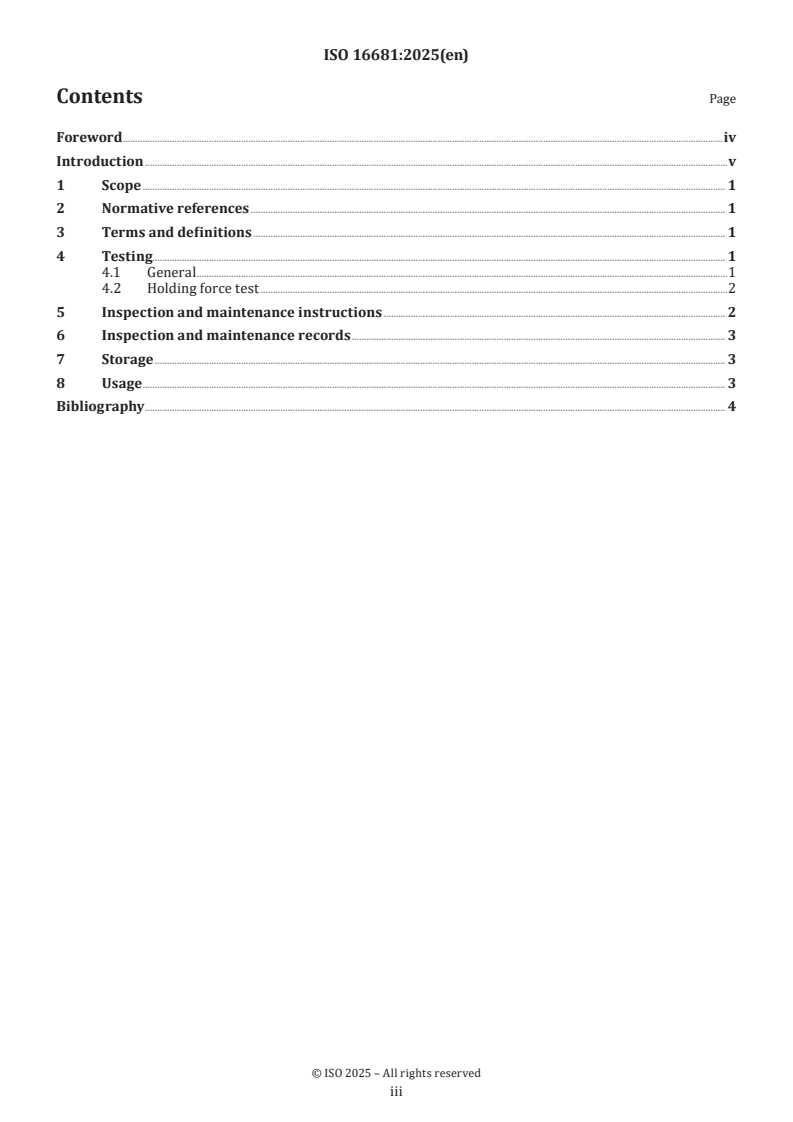
Contents Page
Foreword .iv
Introduction .v
1 Scope . 1
2 Normative references . 1
3 Terms and definitions . 1
4 Testing. 1
4.1 General .1
4.2 Holding force test .2
5 Inspection and maintenance instructions . 2
6 Inspection and maintenance records . 3
7 Storage . 3
8 Usage . 3
Bibliography . 4
iii
Foreword
ISO (the International Organization for Standardization) is a worldwide federation of national standards
bodies (ISO member bodies). The work of preparing International Standards is normally carried out through
ISO technical committees. Each member body interested in a subject for which a technical committee
has been established has the right to be represented on that committee. International organizations,
governmental and non-governmental, in liaison with ISO, also take part in the work. ISO collaborates closely
with the International Electrotechnical Commission (IEC) on all matters of electrotechnical standardization.
The procedures used to develop this document and those intended for its further maintenance are described
in the ISO/IEC Directives, Part 1. In particular, the different approval criteria needed for the different types
of ISO document should be noted. This document was drafted in accordance with the editorial rules of the
ISO/IEC Directives, Part 2 (see www.iso.org/directives).
ISO draws attention to the possibility that the implementation of this document may involve the use of (a)
patent(s). ISO takes no position concerning the evidence, validity or applicability of any claimed patent
rights in respect thereof. As of the date of publication of this document, ISO had not received notice of (a)
patent(s) which may be required to implement this document. However, implementers are cautioned that
this may not represent the latest information, which may be obtained from the patent database available at
www.iso.org/patents. ISO shall not be held responsible for identifying any or all such patent rights.
Any trade name used in this document is information given for the convenience of users and does not
constitute an endorsement.
For an explanation of the voluntary nature of standards, the meaning of ISO specific terms and expressions
related to conformity assessment, as well as information about ISO's adherence to the World Trade
Organization (WTO) principles in the Technical Barriers to Trade (TBT), see www.iso.org/iso/foreword.html.
This document was prepared by Technical Committee ISO/TC 8, Ships and marine technology, Subcommittee
SC 1, Maritime safety.
Any feedback or questions on this document should be directed to the user’s national standards body. A
complete listing of these bodies can be found at www.iso.org/members.html.
iv
Introduction
This document builds on the IMO requirements in SOLAS 74 Chapter V (Safety of Navigation) Regulation 23
[1]
(Pilot Transfer Arrangements), as amended, and IMO Resolution MSC.576(110) Performance Standards for
[2]
Pilot Transfer Arrangements. In accordance with IMO performance standards, use of ship hull securing
equipment (bowsing) for pilot ladder is mandatory for ships that employ pilots.
Since IMO instruments do not include specific requirements for prototype testing, holding performance,
maintenance, storage and use of ship hull securing equipment (bowsing) used to rig pilot transfer
arrangements, this document outlines specific requirements and recommendations for pilot boarding
arrangements. These requirements are considered necessary to ensure that hull securing (bowsing)
equipment is manufactured, maintained and stored to a standard that ensures the equipment supports safe
and efficient transfer of pilots and other personnel using pilot transfer arrangements.
v
International Standard ISO 16681:2025(en)
Ships and marine technology — Pilot transfer arrangements
— Ship hull securing equipment
1 Scope
This document specifies the performance, maintenance and inspection requirement
...