

ISO 673:1981
(Main)Soaps — Determination of content of ethanol-insoluble matter
General Information
- Abstract
The soap is dissolved in ethanol, filtrated and the undissolved residue is weighed. The constituents not dissolved correspond to the additives and foreign matter, of low solubility or insolubility in 95 % (V/V) ethanol, added to soaps and also to substances in all soap formulations, such as alkali carbonates and chlorides, borates, perborates, suphates, silicates, phosphates etc. It also may consist of organic substances like starches, dextrins, caseins, sugars, cellulose derivatives, alginates, etc.
- Status
- Published
- Publication Date
- 31-May-1981
- Technical Committee
- ISO/TC 91 - Surface active agents
- Drafting Committee
- ISO/TC 91 - Surface active agents
- Current Stage
- 9093 - International Standard confirmed
- Start Date
- 11-Jan-2022
- Completion Date
- 29-Aug-2026
Buy Documents

ISO 673:1981 - Soaps — Determination of content of ethanol-insoluble matter Released:6/1/1981

ISO 673:1981 - Savons — Détermination de la teneur en matieres insolubles dans l'éthanol Released:6/1/1981
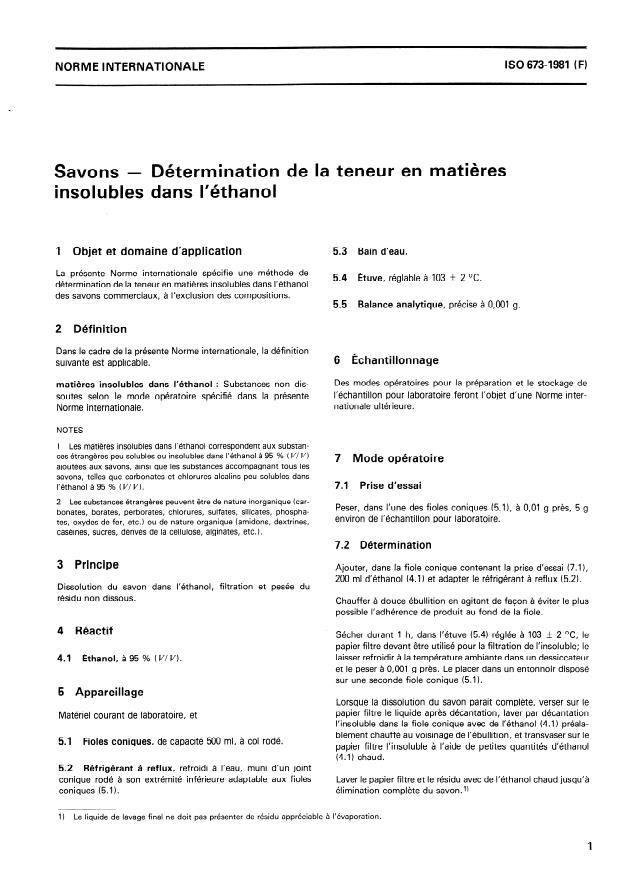

ISO 673:1981 - Savons — Détermination de la teneur en matieres insolubles dans l'éthanol Released:6/1/1981
ISO 673:1981 - Soaps — Determination of content of ethanol-insoluble matter
Overview
ISO 673:1981 specifies a standardized laboratory method for determining the content of ethanol‑insoluble matter in commercial soaps (excluding compounded products). The procedure identifies additives and foreign matter that are poorly soluble or insoluble in 95% (V/V) ethanol - for example, alkali carbonates, chlorides, borates, perborates, sulphates, silicates, phosphates and organic constituents such as starches, dextrins, caseins, sugars, cellulose derivatives and alginates.
This method provides a repeatable approach for quality control, supplier verification and batch release testing.
Key Topics
- Principle: Dissolve a measured soap sample in 95% ethanol, reflux, filter the undissolved residue, dry and weigh the residue; report as percentage by mass.
- Test portion: About 5 g of laboratory sample (weighed to 0.01 g).
- Reagent: Ethanol 95% (V/V).
- Apparatus: 500 ml conical flasks (ground glass), water-cooled reflux condenser, water bath, oven controllable at 103 ± 2 °C, analytical balance accurate to 0.001 g, filter paper, desiccator.
- Drying and weighing: Dry filter paper in oven at 103 ± 2 °C for 1 h, cool in desiccator and weigh to 0.001 g; repeat drying/cooling/weighing until successive weights differ by less than 0.001 g.
- Calculation: Content (%) = (m1 × 100) / m0, where m1 = mass of residue (g) and m0 = mass of test portion (g).
- Special cases: For residues strongly adhering to the flask (e.g., silicated soaps), dissolve the residue in hot distilled water, evaporate, dry at 103 ± 2 °C and add this mass to the filter residue.
- Reproducibility: Inter-laboratory difference shall not exceed 0.05% for contents ≤ 1% and 0.1% for contents > 1%.
Applications
- Quality control: Quantify low‑solubility or insoluble additives and contaminants in soap production.
- Raw material verification: Confirm supplier claims and detect foreign matter (inorganic salts, fillers, organic binders).
- Batch release & troubleshooting: Monitor production consistency and investigate unexpected residues or formulation issues.
- Regulatory and specification compliance: Provide documented, repeatable data for product specifications and regulatory records.
Related Standards
- Other ISO methods and national standards for surfactants and soap testing, and standards governing sampling and laboratory sample preparation (sampling procedures may be covered by separate standards).
Notes for practitioners: follow the specified apparatus and temperatures precisely, document any deviations or incidents in the test report (sample identification, method reference, results and test conditions) and ensure careful washing with hot ethanol to remove soluble soap components before final drying and weighing.
Buy Documents
ISO 673:1981 - Soaps — Determination of content of ethanol-insoluble matter Released:6/1/1981
ISO 673:1981 - Savons — Détermination de la teneur en matieres insolubles dans l'éthanol Released:6/1/1981
ISO 673:1981 - Savons — Détermination de la teneur en matieres insolubles dans l'éthanol Released:6/1/1981
ISO 673:1981 - Soaps — Determination of content of ethanol-insoluble matter
Get Certified
Connect with accredited certification bodies for this standard

ECOCERT
Organic and sustainability certification.

Eurofins Food Testing Global
Global leader in food, environment, and pharmaceutical product testing.

Intertek Bangladesh
Intertek certification and testing services in Bangladesh.
Sponsored listings
Frequently Asked Questions
ISO 673:1981 is a standard published by the International Organization for Standardization (ISO). Its full title is "Soaps — Determination of content of ethanol-insoluble matter". This standard covers: The soap is dissolved in ethanol, filtrated and the undissolved residue is weighed. The constituents not dissolved correspond to the additives and foreign matter, of low solubility or insolubility in 95 % (V/V) ethanol, added to soaps and also to substances in all soap formulations, such as alkali carbonates and chlorides, borates, perborates, suphates, silicates, phosphates etc. It also may consist of organic substances like starches, dextrins, caseins, sugars, cellulose derivatives, alginates, etc.
The soap is dissolved in ethanol, filtrated and the undissolved residue is weighed. The constituents not dissolved correspond to the additives and foreign matter, of low solubility or insolubility in 95 % (V/V) ethanol, added to soaps and also to substances in all soap formulations, such as alkali carbonates and chlorides, borates, perborates, suphates, silicates, phosphates etc. It also may consist of organic substances like starches, dextrins, caseins, sugars, cellulose derivatives, alginates, etc.
ISO 673:1981 is classified under the following ICS (International Classification for Standards) categories: 71.100.40 - Surface active agents. The ICS classification helps identify the subject area and facilitates finding related standards.
ISO 673:1981 is available in PDF format for immediate download after purchase. The document can be added to your cart and obtained through the secure checkout process. Digital delivery ensures instant access to the complete standard document.
Standards Content (Sample)
International Standard
iNTERNATIONAL ORGANIZATION FOR STANDARDIZATlON.MEIK,QYHAPOAHAR OPI-AHM3Al&lR ll0 CTAH,QAPTkl3AL&lM.ORGANlSATlON INTERNATIONALE DE NORMALISATION
Soaps - Determination of content of ethanol-insoluble
matter
Savons - D&termination de la teneur en mat&es insolubles dans l%thanol
Second edition - 1981-06-01
UDC 661.185: 543.868
Ref. No. IS0 673-1981 (E)
Descriptors : soaps, chemical analysis, determination of content, insoluble matter, impurities, ethanol.
Price based on 2 pages
Foreword
IS0 (the International Organization for Standardization) is a worldwide federation of
national standards institutes (IS0 member bodies). The work of developing Inter-
national Standards is carried out through IS0 technical committees. Every member
body interested in a subject for which a technical committee has been set up has the
right to be represented on that committee. International organizations, governmental
and non-governmental, in liaison with ISO, also take part in the work.
Draft International Standards adopted by the technical committees are circulated to
the member bodies for approval before their acceptance as International Standards by
the IS0 Council.
International Standard IS0 673 was developed by Technical Committee ISO/TC 91,
Surface active agents.
The first edition (IS0 673-1974) had been approved by the member bodies of the
following countries :
Argentina Germany, F. R. Romania
South Africa, Rep. of
Austria Hungary
Belgium Ireland Spain
Brazil Israel Sweden
Canada Japan Switzerland
Chile Netherlands United Kingdom
Colombia New Zealand Yugoslavia
Egypt, Arab Rep. of Poland
France Portugal
No member body had expressed disapproval of the document.
This second edition, which supersedes IS0 673-1974, incorporates draft Amend-
ment 1, which was circulated directly to IS0 Council for acceptance in accordance
with clause 5.10.1 of part 1 of the Directives for the technical work of ISO.
0 International Organization for Standardization, 1981
Printed in Switzerland
IS0 673-1981 (E)
INTERNATIONAL STANDARD
Determination of content of ethanol-insoluble
Soaps -
matter
5.3 Water bath.
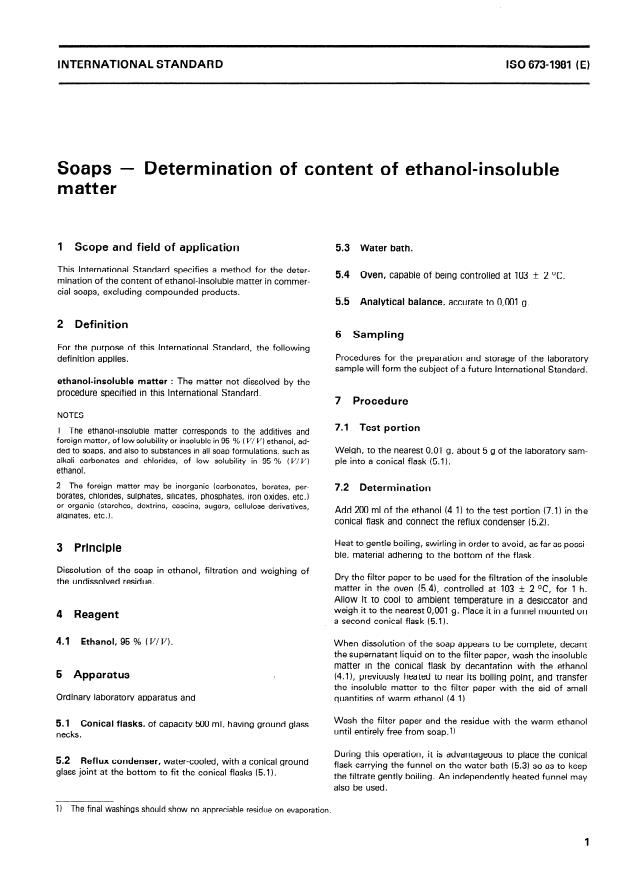
1 Scope and field of application
This International Standard specifies a method for the deter-
5.4 Oven, capable of being controlled at 103 + 2 OC.
mination of the content of ethanol-insoluble matter in commer-
cial soaps, excluding compounded products.
5.5 Analytical balance, accurate to 0,001 g.
2 Definition
6 Sampling
For the purpose of this International Standard, the following
Procedures for the preparation and storage of the laboratory
definition applies.
sample will form the subject of a future International Standard.
ethanol-insoluble matter : The matter not dissolved by the
procedure specified in this International Standard.
7 Procedure
NOTES
7.1 Test portion
1 The ethanol-insoluble matter corresponds to the additives and
foreign matter, of low solubility or insoluble in 95 % ( V/ V) ethanol, ad-
Weigh, to the nearest 0,Ol g, about 5 g of the laboratory sam-
ded to soaps, and also to substances in all soap formulations, such as
alkali carbonates and chlorides, of low solubility in 95 % ( V/V) ple into a conical flask (5.1).
ethanol.
2 The foreign matter may be inorganic (carbonates, borates, per- 7.2 Determination
borates, chlorides, sulphates, silicates, phosphates, iron oxides, etc.)
or organic (starches, dextrins, caseins, sugars, cellulose derivatives,
Add 200 ml of the ethanol (4.1) to the test portion (7.1) in the
alginates, etc. ) .
conical flask and connect the reflux condenser (5.2).
Heat to gentle boiling, swirling in order to avoid, as far as possi-
3 Principle
ble, material adhering to the bottom of the flas
...
Norme inter ationale 673
INTERNATIONAL ORGANIZATION FOR STANDARDIZATION.ME)ICqYHAPO~HAFI OPrAHM3ALWlR i-l0 CTAHAAPTM3A~WWORGANISATION INTERNATIONALE DE NORMALISATION
Détermination de la teneur en matières
Savons -
insolubles dans I’éthanol
Soaps - De termina tion of content of e thanol-insoluble matter
Deuxième édition - 1981-06-01
CDU 661.185 : 543.868 Réf. no : ISO 673-1981 (F)
Descripteurs : savon, analyse chimique, dosage, matière insoluble, impureté, éthanol.
Prix basé sur 2 pages
Avant-propos
L’ISO (Organisation internationale de normalisation) est une fédération mondiale
d’organismes nationaux de normalisation (comités membres de MO). L’élaboration
des Normes internationales est confiée aux comités techniques de I’ISO. Chaque
comité membre intéressé par une étude a le droit de faire partie du comité technique
correspondant. Les organisations internationales, gouvernementales et non gouverne-
mentales, en liaison avec I’ISO, participent également aux travaux.
Les projets de Normes internationales adoptés par les comités techniques sont soumis
aux comités membres pour approbation, avant leur acceptation comme Normes inter-
nationales par le Conseil de I’ISO.
La Norme internationale ISO 673 a été élaborée par le comité technique ISO/TC 91,
Agents de surface.
La première édition (ISO 673-1974) avait été approuvée par les comités membres des
pays suivants :
Afrique du Sud, Rép. d’ Egypte, Rép. arabe d’ Pologne
Allemagne, R.F. Espagne Portugal
Roumanie
Argentine France
Autriche l-longrie Royaume-Uni
Belgique Irlande Suisse
Brésil Israël Suède
Canada Japon Yougoslavie
Chili Nouvelle-Zélande
Colombie Pays- Bas
Aucun comité membre ne l’avait désapprouvée.
Cette deuxième édition, qui annule et remplace I’ISO 673-1974, incorpore le projet
d’Amendement 1, qui a été soumis directement au Conseil de I’ISO pour acceptation,
conformément au paragraphe 5.10.1 de la partie 1 des Directives pour les travaux tech-
niques de I’ISO.
@ Organisation internationale de normalisation, 1981 l
Imprimé en Suisse
ISO 673-1981 (FI
NORME INTERNATIONALE
Détermination de la teneur en matières
Savons -
insolubles dans I’éthanol
5.3 Bain d’eau.
1 Objet et domaine d’application
La présente Norme internationale spécifie une méthode de
5.4 Étuve, réglable à 103 + 2 OC.
détermination de la teneur en matières insolubles dans I’éthanol
des savons commerciaux, à l’exclusion des compositions.
5.5 Balance analytique, précise à 0,001 g.
2 Définition
Dans le cadre de la présente Norme internationale, la définition
6 Échantillonnage
suivante est applicable.
Des modes opératoires pour la préparation et le stockage de
matières insolubles dans l’éthanol : Substances non dis-
l’échantillon pour laboratoire feront l’objet d’une Norme inter-
soutes selon le mode opératoire spécifié dans la présente
nationale ultérieure.
Norme internationale.
NOTES
1 Les matières insolubles dans I’éthanol correspondent aux substan-
ces étrangères peu solubles ou insolubles dans I’éthanol à 95 % ( V/ V)
7 Mode opératoire
ajoutées aux savons, ainsi que les substances accompagnant tous les
savons, telles que carbonates et chlorures alcalins peu solubles dans
7.1 Prise d’essai
I’éthanol à 95 % ( Vl V).
2 Les substances étrangères peuvent être de nature inorganique (car-
Peser, dans l’une des fioles coniques (5.1), à 0,Ol g près, 5 g
bonates, borates, perborates, chlorures, sulfates, silicates, phospha-
environ de l’échantillon pour laboratoire.
tes, oxydes de fer, etc.) ou de nature organique (amidons, dextrines,
caséines, sucres, dérivés de la cellulose, alginates, etc. 1.
7.2 Détermination
3 Principe
Ajouter, dans la fiole conique contenant la prise d’essai (7.1),
200 ml d’éthanol (4.1) et adapter le réfrigérant à reflux (5.2).
Dissolution du savon dans I’éthanol, filtration et pesée du
résidu non dissous.
Chauffer à douce ébullition en agitant de facon à éviter le plus
possible l’adhérence de produit au fond de ia fiole.
4 Réactif
Sécher durant 1 h
...
Norme inter ationale 673
INTERNATIONAL ORGANIZATION FOR STANDARDIZATION.ME)ICqYHAPO~HAFI OPrAHM3ALWlR i-l0 CTAHAAPTM3A~WWORGANISATION INTERNATIONALE DE NORMALISATION
Détermination de la teneur en matières
Savons -
insolubles dans I’éthanol
Soaps - De termina tion of content of e thanol-insoluble matter
Deuxième édition - 1981-06-01
CDU 661.185 : 543.868 Réf. no : ISO 673-1981 (F)
Descripteurs : savon, analyse chimique, dosage, matière insoluble, impureté, éthanol.
Prix basé sur 2 pages
Avant-propos
L’ISO (Organisation internationale de normalisation) est une fédération mondiale
d’organismes nationaux de normalisation (comités membres de MO). L’élaboration
des Normes internationales est confiée aux comités techniques de I’ISO. Chaque
comité membre intéressé par une étude a le droit de faire partie du comité technique
correspondant. Les organisations internationales, gouvernementales et non gouverne-
mentales, en liaison avec I’ISO, participent également aux travaux.
Les projets de Normes internationales adoptés par les comités techniques sont soumis
aux comités membres pour approbation, avant leur acceptation comme Normes inter-
nationales par le Conseil de I’ISO.
La Norme internationale ISO 673 a été élaborée par le comité technique ISO/TC 91,
Agents de surface.
La première édition (ISO 673-1974) avait été approuvée par les comités membres des
pays suivants :
Afrique du Sud, Rép. d’ Egypte, Rép. arabe d’ Pologne
Allemagne, R.F. Espagne Portugal
Roumanie
Argentine France
Autriche l-longrie Royaume-Uni
Belgique Irlande Suisse
Brésil Israël Suède
Canada Japon Yougoslavie
Chili Nouvelle-Zélande
Colombie Pays- Bas
Aucun comité membre ne l’avait désapprouvée.
Cette deuxième édition, qui annule et remplace I’ISO 673-1974, incorpore le projet
d’Amendement 1, qui a été soumis directement au Conseil de I’ISO pour acceptation,
conformément au paragraphe 5.10.1 de la partie 1 des Directives pour les travaux tech-
niques de I’ISO.
@ Organisation internationale de normalisation, 1981 l
Imprimé en Suisse
ISO 673-1981 (FI
NORME INTERNATIONALE
Détermination de la teneur en matières
Savons -
insolubles dans I’éthanol
5.3 Bain d’eau.
1 Objet et domaine d’application
La présente Norme internationale spécifie une méthode de
5.4 Étuve, réglable à 103 + 2 OC.
détermination de la teneur en matières insolubles dans I’éthanol
des savons commerciaux, à l’exclusion des compositions.
5.5 Balance analytique, précise à 0,001 g.
2 Définition
Dans le cadre de la présente Norme internationale, la définition
6 Échantillonnage
suivante est applicable.
Des modes opératoires pour la préparation et le stockage de
matières insolubles dans l’éthanol : Substances non dis-
l’échantillon pour laboratoire feront l’objet d’une Norme inter-
soutes selon le mode opératoire spécifié dans la présente
nationale ultérieure.
Norme internationale.
NOTES
1 Les matières insolubles dans I’éthanol correspondent aux substan-
ces étrangères peu solubles ou insolubles dans I’éthanol à 95 % ( V/ V)
7 Mode opératoire
ajoutées aux savons, ainsi que les substances accompagnant tous les
savons, telles que carbonates et chlorures alcalins peu solubles dans
7.1 Prise d’essai
I’éthanol à 95 % ( Vl V).
2 Les substances étrangères peuvent être de nature inorganique (car-
Peser, dans l’une des fioles coniques (5.1), à 0,Ol g près, 5 g
bonates, borates, perborates, chlorures, sulfates, silicates, phospha-
environ de l’échantillon pour laboratoire.
tes, oxydes de fer, etc.) ou de nature organique (amidons, dextrines,
caséines, sucres, dérivés de la cellulose, alginates, etc. 1.
7.2 Détermination
3 Principe
Ajouter, dans la fiole conique contenant la prise d’essai (7.1),
200 ml d’éthanol (4.1) et adapter le réfrigérant à reflux (5.2).
Dissolution du savon dans I’éthanol, filtration et pesée du
résidu non dissous.
Chauffer à douce ébullition en agitant de facon à éviter le plus
possible l’adhérence de produit au fond de ia fiole.
4 Réactif
Sécher durant 1 h
...
ة�يلود ة�يسا�يق ةفصاوم
�����
ISO 673
�بوذت ال ييلا داوملا ىويحم ن�ي�يعت – نو�باصلا ة�ينايلا ةع�بطلا
������������
1981-06
لوباي�تالا يف
���
�
Soaps — Determination of content of ethanol-insoluble matter
عجرملاا م�قر International Organization for ©
ISO 673:1981(ar) Standardization 1981
ISO 673:1981(ar)
ة�يكلم قوقح�ب ة�يمحم ةق�يتو
�������
International Organization for Standardization 1981 ©
ال�ن ،ةــ�تك�تناك�تم و�ا ة�تنومتكاإا ةل�تسو �ي�ا�ن و�ا لاكس�الا نم لكس �ي�ا�ن ةماذحتسا و�ا روسنلاا اذه نم ءمجر �ي�ا خسن رو�ح�ي ال ،�كاذ �فالر ىلع صن�ي ما ام .ةظوقحم قوقحاا لك
���������������������������
وسإا وضع ةن�تهاا و�ا هانذ�ا ناونعاا ىلع وسإا نم �ي�ا نم نذإالا �تلظ نكل�ي .ق�نسم �ى�ناتك نذإا ىلع لوضحاا نوذ ،تنامتنإالا و�ا تنمتنإالا ىلع مسناا و�ا �ىنوضاا خسناا �كاذ �ى�ق
�������������������������������
.�تااطاا ذل�ن �ى�ق
ISO copyright office
CP 401 • Ch. de Blandonnet 8
CH-1214 Vernier, Geneva
Tel. + 41 22 749 01 11
E-mail copyright@iso.org
Website www.iso.org
امس�يوس �ى�ق تمسن
���
International Organization for Standardization 1981 ©
�ب
ISO 673:1981(ar)
ةحقضاا با�تويحم
��
��
د . م�تذقت
��
1 . لا�حملا 1
1 . ف�تراعيلا 2
��
1 . �اذ�بملا 3
1 . فشاكلا 4
��
1 . باود�الا 5
�
1 . باب�يعلا ذخ�ا 6
����
2 . ءار�خلالا 7
2 . �جبايبلا نع ر�ي�بعيلا 8
�����
3 . را�بيخالا ر�ترقت 9
����
International Organization for Standardization 1981 ©
�ج
ISO 673:1981(ar)
م�تذقت
��
ة�ت اوذاا تاقصاولاا ذاذعإا مت�ي ام ا�نااعو ،(وم�ي�الا ى�ق ءاضع�الا) ة�تنظواا س�ت�تقتاا تاه�حا ىلااع ذاحيا ىه (س�ت�تقتلا ة�تاوذاا ةلطنلاا) وم�ي�الا
�����������������������
ة ا نوك�ي ن�ا ى�ق قحاا وضعاا اذها نإا�ق ، ة�تن�ق ةن�حا ةا تلكس ذ�ق عوصول�ن مالتهإا اها وضعاا ةه�حاا تناك اذإاو ، وم�ي�الا ة�تنقاا نا�حلاا لالر نم
���������������������������
.وم�ي�الا ةلطنم عم لصاوي اها ىتاا ة�تموكحاا م�تعو اهنم ة�تموكحاا ة�تاوذاا تالطنلااا �كاذك للعاا ى�ق �كراس�يو .ةن�حلاا �كلي ى�ق لتلم
�����������������������
اــهذالت عا ل�نق ةققاوللا ءاضع�الا لوذاا ىلع اهع�يروي مت�ي ة�تنقاا نا�حلاا ل�نق نم اهذاذعإا مت�ي ىتاا ة�تاوذاا ة�تسا�تقاا تاقصاولاا تاذوسم نإا
�������������������������
وم�ي�الا سل�حم ل�نق نم ة�تاوذ ة�تسا�تق ةقصاولك
��������
.�ىحطساا طاسناا تاذ ذاولاا ,ISO/TC 91 ة�تاوذاا ةن�حلاا ل�ن�ق نم اهذاذعإا مي ISO 673 ة�تاوذاا ة�تسا�تقاا ةقصاولاا
��������������
: هانذ�ا ءاضع�الا لوذاا ل�نق نم ة�تلع ةق�قاولاا مي ( ISO 673-1974 ) لو�الا راذصإالا
�������
ا�تنامور ا�تنالا�ا ن�تتنجرر�الا
�����
ا�تق�يمق�ا �تونجر ا�يراعنه اسلناا
������
ا�تنا�نسا هذنام�يإا اك�ت�حل�ن
���
ذ�يوساا ل�تنامسا ل�يرام�ناا
��
امس�يوس نا�نا�تاا اذنك
��
هذحتلاا ةكلللاا اذناوه ىل�تسي
�������
ا�تكاقولسوعو�ي هذنارو�تن ا�ت�نمواوك
������
هذناو�ن مضم
��
لاعيم�ناا انسمق
����
.ةق�تيواا ىلع ةق�قاولاا مذع وضع �ي�ا ذ�ن�ي ما
������
ذن�ن لا ًاق�قو ةق�قاوللا وم�ي�الا سل�حم ىلع اهل�تلعي مي يذااو 1 ىن�ق ل�يذعي يوحي ىتااو , ISO 673-1974 ةقصاولاا ىعل�ي ىناتاا راذصإالا اذه
������������������������
.وم�ي�الا ىنقاا للعاا ل�تاذ نلص تاه�تجروتلا 1 ءم�حاا نم 5.10.1
����������
International Organization for Standardization 1981 ©
د
ISO 673:1981(ar) ة�يلود ة�يشا�يف ةقصاوم
�����
لوباي�تالا يف �بوذت ال ييلا داوملا ىويحم ن�ي�يعت – نو�باصلا
�������
�����
لا�حملا 1
ىنتتسي و ،يرا�حتاا نو�ناضاا ىق لونات�يإالا ىق نا�نوذلا ةل�ناقاا م�تع ذاولاا يوتحم ن�ت�تعي را�نترا ةق�يمط�ن ة�تاوذاا ة�تسا�تقاا ةقصاولاا هذه صتحي
����������������������������������
.ة�نكملاا تا�حتنلاا �كاذ نم
������
ف�تراعيلا 2
��
:ة�تااتاا ف�يراعتاا ق�نطي ،ة�تسا�تقاا ةقصاولاا هذه ضامع�ال
�������������
1.2
:لوباي�تلالا يف نا�بوذلل ةل�باقلا ر�يع داوملا
���������
.ة�تاوذاا ة�تسا�تقاا ةقصاولاا هذه ىق ة�تاإا راسلاا ءامجرإالا ىق ة�ناذلاا م�تع ذاولاا
��������������
:لورذاا ةطرالم
���
/ح) %95 �ى�ق نا�نو�ذــلا ةل�نا�ق م�تع و�ا ةضقحنلاا ة�تنا�نو�ذاا تا�ذ ،ة�ن�يمعاا ذاولااو ة�قاضلاا ذاولاا عم لونات�يإالا �ى�ق نا�نو�ذلا ةل�ناقاا م�تع ذاولاا لعاقتي 1
������������������������
ةضقحن لاا ة�تنا�نو�ذاا تا�ذ ،تاذ�يرولكااو ة�يولقاا تانو�نمكاا لتم ،نو�ناضاا تا�ن�تكمي ع�تلجر �ى�ق ذاولاا ىاإا ًاض�ي�او ،نو�ناضلا �فاضلاا ،لونات�يإالا نم (ح
���������������������
...