


ISO 6775:2024
(Main)Plastics — Plastics identification using Raman spectrometric methods
Plastics — Plastics identification using Raman spectrometric methods
This document is applicable to the qualitative analysis of plastic materials in their original form by Raman spectroscopy. It describes procedures to determine the composition of unknown general plastics and multi-layer film plastics.
Plastiques — Identification des plastiques par spectrométrie Raman
General Information
- Status
- Published
- Publication Date
- 14-May-2024
- Technical Committee
- ISO/TC 61/SC 5 - Physical-chemical properties
- Drafting Committee
- ISO/TC 61/SC 5 - Physical-chemical properties
- Current Stage
- 6060 - International Standard published
- Start Date
- 15-May-2024
- Due Date
- 15-Apr-2024
- Completion Date
- 15-May-2024
Overview
ISO 6775:2024 - Plastics - Plastics identification using Raman spectrometric methods - defines a standardized, qualitative approach for identifying plastic materials in their original form using Raman spectroscopy. The standard covers procedures for single-layer and multi‑layer film plastics, including instrument calibration, spectral acquisition, and spectrum analysis. It is a non‑destructive method that usually requires no sample preparation and relies on matching Raman fingerprints to reference spectra.
Key topics and technical requirements
- Scope: Identification of general plastics, multi‑layer films, particles, powders and coloured or opaque samples in their original form.
- Principle: Inelastic light scattering produces a Raman spectrum that serves as a molecular fingerprint for polymer identification.
- Apparatus:
- Stable monochromatic laser sources (recommended wavelengths include 532 nm, 638 nm, 785 nm, 1 064 nm; 785 nm is recommended as a start).
- Optical power attenuation to avoid photodamage, high‑quality objectives or fibre probes, and effective Rayleigh filters (edge/notch).
- Spectral resolution of at least 2 cm⁻¹ and pixel resolution of ≈ 0.8 cm⁻¹/pixel; recommended spectral range 100–3 500 cm⁻¹ (minimum 500–1 800 cm⁻¹).
- Detectors such as CCD, EM‑CCD or InGaAs arrays with appropriate cooling and low noise.
- Microscope‑based and confocal systems are recommended (Z‑stack, confocal pinhole control, motorised stage) for micro‑layers and multi‑layer analysis.
- Calibration & settings:
- Manufacturer wavelength calibration (using emission lamps) and daily Raman wavenumber calibration using a reference (e.g., silicon ~520.7 cm⁻¹) and recalibration after hardware changes.
- Measurement methods:
- Method 1 - General method for bulk and single-layer plastics.
- Method 2 - Specific test method for multi‑layer film plastics, with layer mapping and thickness probing.
- Analysis & reporting:
- Spectrum matching to reference libraries, interpretation of characteristic peaks (Annex A), spectral database procedures (Annex B), and example measurements (Annexes C–E).
Practical applications and users
ISO 6775:2024 is applicable to:
- Materials and polymers laboratories performing plastic identification and quality control.
- Recycling and circular‑economy operations validating polymer type for sorting and reprocessing.
- Environmental and microplastics researchers identifying polymer particles in samples.
- Product development teams and failure‑analysis labs characterizing unknown polymer components.
- Regulatory bodies, customs and forensic analysts needing consistent, standardised Raman identification.
Benefits include rapid, non‑destructive identification, support for multi‑layer film analysis, and improved comparability of results across labs via standardized calibration and reporting.
Related standards
- ISO 472 - Plastics - Vocabulary (referenced for terms and definitions).
- ISO/IEC Directives (editorial and development context referenced in the foreword).
Annexes in ISO 6775 provide characteristic Raman peaks, database identification guidance, worked examples and multi‑layer measurement examples to support practical implementation.

Get Certified
Connect with accredited certification bodies for this standard

Smithers Quality Assessments
US management systems and product certification.

DIN CERTCO
DIN Group product certification.
Sponsored listings
Frequently Asked Questions
ISO 6775:2024 is a standard published by the International Organization for Standardization (ISO). Its full title is "Plastics — Plastics identification using Raman spectrometric methods". This standard covers: This document is applicable to the qualitative analysis of plastic materials in their original form by Raman spectroscopy. It describes procedures to determine the composition of unknown general plastics and multi-layer film plastics.
This document is applicable to the qualitative analysis of plastic materials in their original form by Raman spectroscopy. It describes procedures to determine the composition of unknown general plastics and multi-layer film plastics.
ISO 6775:2024 is classified under the following ICS (International Classification for Standards) categories: 83.080.01 - Plastics in general. The ICS classification helps identify the subject area and facilitates finding related standards.
ISO 6775:2024 is available in PDF format for immediate download after purchase. The document can be added to your cart and obtained through the secure checkout process. Digital delivery ensures instant access to the complete standard document.
Standards Content (Sample)
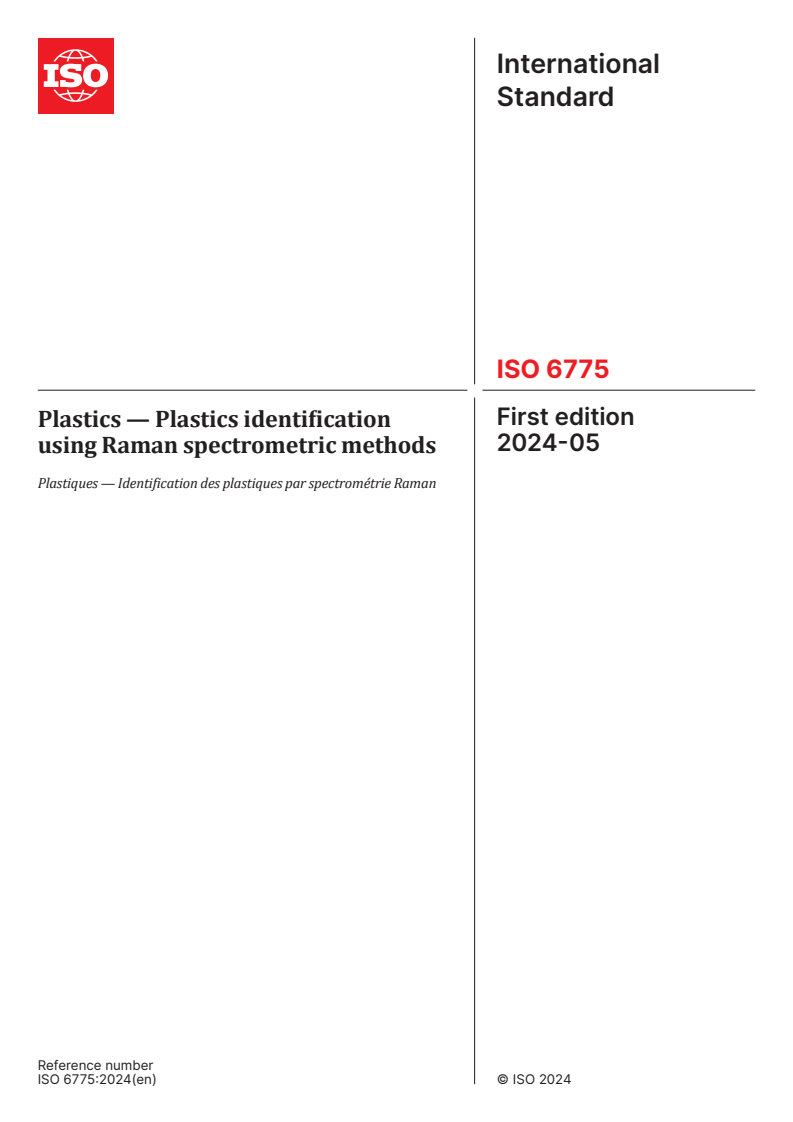
International
Standard
ISO 6775
First edition
Plastics — Plastics identification
2024-05
using Raman spectrometric methods
Plastiques — Identification des plastiques par spectrométrie Raman
Reference number
© ISO 2024
All rights reserved. Unless otherwise specified, or required in the context of its implementation, no part of this publication may
be reproduced or utilized otherwise in any form or by any means, electronic or mechanical, including photocopying, or posting on
the internet or an intranet, without prior written permission. Permission can be requested from either ISO at the address below
or ISO’s member body in the country of the requester.
ISO copyright office
CP 401 • Ch. de Blandonnet 8
CH-1214 Vernier, Geneva
Phone: +41 22 749 01 11
Email: copyright@iso.org
Website: www.iso.org
Published in Switzerland
ii
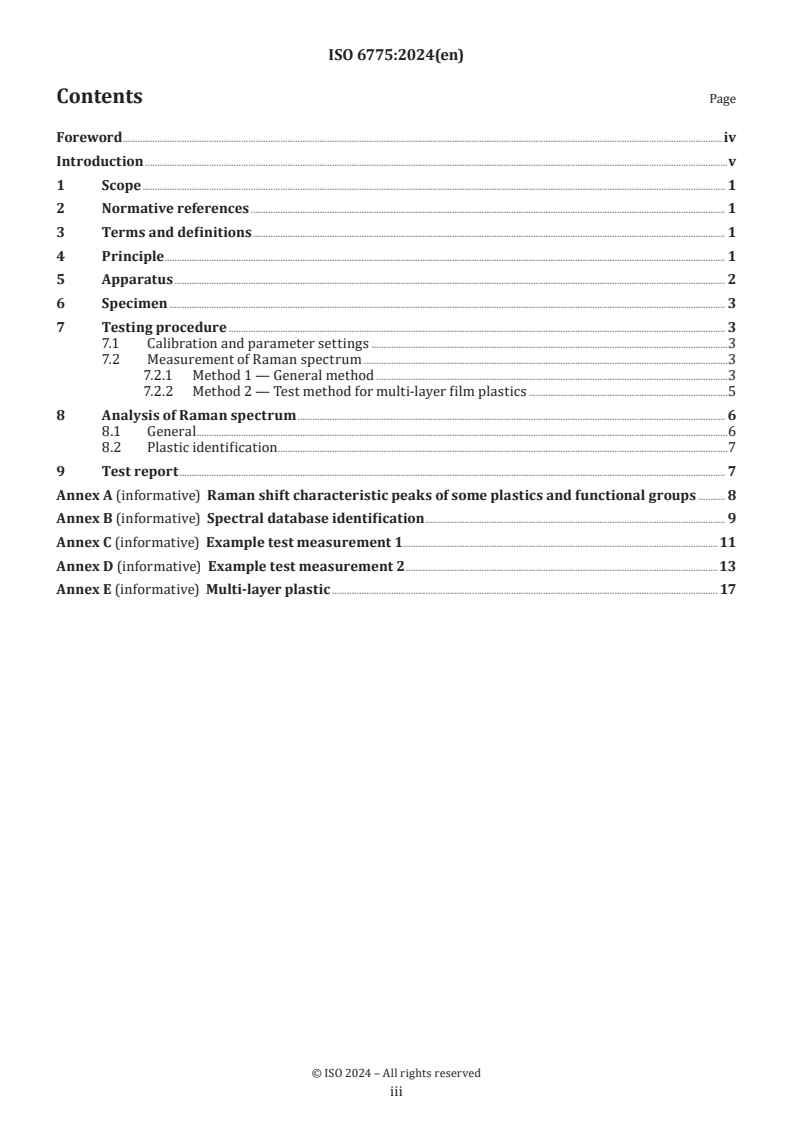
Contents Page
Foreword .iv
Introduction .v
1 Scope . 1
2 Normative references . 1
3 Terms and definitions . 1
4 Principle . 1
5 Apparatus . 2
6 Specimen . 3
7 Testing procedure . 3
7.1 Calibration and parameter settings .3
7.2 Measurement of Raman spectrum .3
7.2.1 Method 1 — General method .3
7.2.2 Method 2 — Test method for multi-layer film plastics .5
8 Analysis of Raman spectrum . 6
8.1 General .6
8.2 Plastic identification .7
9 Test report . 7
Annex A (informative) Raman shift characteristic peaks of some plastics and functional groups . 8
Annex B (informative) Spectral database identification . 9
Annex C (informative) Example test measurement 1 .11
Annex D (informative) Example test measurement 2 .13
Annex E (informative) Multi-layer plastic . 17
iii
Foreword
ISO (the International Organization for Standardization) is a worldwide federation of national standards
bodies (ISO member bodies). The work of preparing International Standards is normally carried out through
ISO technical committees. Each member body interested in a subject for which a technical committee
has been established has the right to be represented on that committee. International organizations,
governmental and non-governmental, in liaison with ISO, also take part in the work. ISO collaborates closely
with the International Electrotechnical Commission (IEC) on all matters of electrotechnical standardization.
The procedures used to develop this document and those intended for its further maintenance are described
in the ISO/IEC Directives, Part 1. In particular, the different approval criteria needed for the different types
of ISO document should be noted. This document was drafted in accordance with the editorial rules of the
ISO/IEC Directives, Part 2 (see www.iso.org/directives).
ISO draws attention to the possibility that the implementation of this document may involve the use of (a)
patent(s). ISO takes no position concerning the evidence, validity or applicability of any claimed patent
rights in respect thereof. As of the date of publication of this document, ISO had not received notice of (a)
patent(s) which may be required to implement this document. However, implementers are cautioned that
this may not represent the latest information, which may be obtained from the patent database available at
www.iso.org/patents. ISO shall not be held responsible for identifying any or all such patent rights.
Any trade name used in this document is information given for the convenience of users and does not
constitute an endorsement.
For an explanation of the voluntary nature of standards, the meaning of ISO specific terms and expressions
related to conformity assessment, as well as information about ISO's adherence to the World Trade
Organization (WTO) principles in the Technical Barriers to Trade (TBT), see www.iso.org/iso/foreword.html.
This document was prepared by Technical Committee ISO/TC 61, Plastics, Subcommittee SC 5, Physical-
chemical properties.
Any feedback or questions on this document should be directed to the user’s national standards body. A
complete listing of these bodies can be found at www.iso.org/members.html.
iv
Introduction
Plastic is an essential component used in making many types of products. Plastic formulations consist of
polymeric or resin material and additives for affecting specific functions, such as plasticizers, foaming
agents for low density parts, UV absorbers or colorants.
As a result, plastic and polymer identification and characterization is increasingly becoming more important
in several distinct areas including, but not limited to, identification of unknown substances, product
development, multi-layer materials, microplastics and environmental impact, including the ability to recycle
and to allow informed decisions to be made.
Raman spectroscopy is an inelastic light scattering analysis technique, and is used to provide a structural
fingerprint, by which materials can be identified. Monochromatic light, typically from a laser source,
interacts with molecular vibrations, resulting in an energy shift. This energy shift is displayed as a spectrum.
Raman spectra provide information about the vibrational modes in the sample, allowing materials to be
identified. For example, different types of plastics have unique Raman spectral fingerprint. According to
this principle, it is possible to identify unknown plastics by comparing them to known materials. The role of
Raman spectroscopy is to identify the chemical composition of unknown plastics.
v
International Standard ISO 6775:2024(en)
Plastics — Plastics identification using Raman
spectrometric methods
1 Scope
This document is applicable to the qualitative analysis of plastic materials in their original form by Raman
spectroscopy. It describes procedures to determine the composition of unknown general plastics and multi-
layer film plastics.
2 Normative references
The following documents are referred to in the text in such a way that some or all of their content constitutes
requirements of this document. For dated references, only the edition cited applies. For undated references,
the latest edition of the referenced document (including any amendments) applies.
ISO 472, Plastics — Vocabulary
3 Terms and definitions
For the purposes of this document, the terms and definitions given in ISO 472 and the following apply.
ISO and IEC maintain terminology databases for use in standardization at the following addresses:
— ISO Online browsing platform: available at https:// www .iso .org/ obp
— IEC Electropedia: available at https:// www .electropedia .org/
3.1
general plastics
wide range of synthetic or semi-synthetic materials that use polymers as a main ingredient, which may also
have a colourant added
3.2
multi-layer film plastic
material having two or more thermoplastic polymer layers
3.3
Z stack
set of confocal images taken from the sample so that the image area along the x- and y-axes remains the
same but the distance from the objective z-axis is different for each image
3.4
pseudo-colour
colour added during the processing of spectra acquired through mapping to aid interpretation of the
spectrum in pictorial form
4 Principle
In order to identify unknown plastics the sample is subjected to monochromatic light, such as laser light,
which upon interaction with molecular vibrations or other excitations results in a shift of photons creating
a characteristic fingerprint, the Raman spectrum. This fingerprint can be matched to reference spectra
allowing for rapid identification of the unknown plastic. The method is non-destructive and does not require
sample preparation for most materials, allowing for use of the plastic directly after identification.
5 Apparatus
5.1 Raman spectrometer, of at least one highly stable monochromatic laser source used to excite the sample.
5.1.1 Several laser wavelengths are suitable for plastics identification such as 532 nm, 638 nm, 785 nm
and 1 064 nm. Infrared excitation is recommended to reduce unwanted background fluorescence signal that
can obscure the Raman spectrum.
5.1.2 Optical power attenuation of the laser is required to prevent photodamage to the sample, this can
be controlled via adjustment of laser current or with neutral density filters.
5.1.3 The excitation light should be focussed on to the sample using high quality optical components
such as objective lenses and fibre probes. The working distance, numerical aperture and magnification
of the optics can vary between instrument types, with some systems allowing these components to be
exchangeable by the user.
5.1.4 The scattered light shall then be collected by the same optics and filtered using an edge or notch
filter to block the Rayleigh scattered light at the laser wavelength, this allows the weaker Raman scattered
light to be detected and analysed.
-1
5.1.5 A high throughput spectrometer with spectral resolution of at least 2 cm is required to analyse
the scattered light to be able to resolve and distinguish fine detail in the Raman spectrum to allow accurate
identification. Spectral resolution is defined as the full width half maximum (FWHM) of the line width of
a gas emission line measured on the spectrograph with the highest groove density grating. Typically, the
-1
pixel resolution should be at least 0,8 cm /pixel. The spectral resolution will depend on the focal length of
the spectrograph, the entrance slit width, the detector pixel size and the groove density of the diffraction
-1 -1
grating. The Raman spectrometer should at least have a spectral range of 500 cm to 1 800 cm however a
-1 -1
wider spectral range of 100 cm to 3 500 cm is recommended to ensure that the material will be correctly
identified.
5.1.6 The detector, matching the chosen laser source and with an appropriate spectral response to cover
the wavelength range required.
Several types of detectors are suitable for these measurements such as:
5.1.6.1 front or back illuminated charge coupled detectors (CCD),
5.1.6.2 electron multiplied charge coupled detectors (EM-CCD), and
5.1.6.3 InGaAs arrays for infra-red detection.
All detectors shall have high sensitivity and low noise to be able to detect the Raman signal. Detectors
should be cooled to manufacturers recommendations, most require air cooling down to -60 °C, but some
detectors require further cooling with water or liquid nitrogen. The system should have comprehensive
software to allow hardware control and acquisition of spectra along with file export options compatible
with the spectral library.
5.1.7 Use of a microscope-based system is recommended due to the versatility it offers when studying
plastic materials that come in many formats, shapes and sizes. Portable devices can successfully be used to
acquire spectra from bulk materials but have limited use determine composition of micrometre thick layers
in the case of multilayer plastics.
5.1.8 A truly confocal Raman system with the ability to change pinhole size to allow accurate analysis
of multi-layers of plastic material is also applicable and recommended. Additionally, it is recommended that
the confocal Raman system has a motorised microscope stage, so that multi-layer plastics can be analysed
by regularly taking measurements at set distances, through appropriate software, allowing the layer
thickness to be determined. Multiple excitation wavelengths are recommended as plastics can give different
background effects with different sources, and these can obscure relevant peaks. It is recommended to start
analysis of unknown materials with 785 nm excitation as this usually gives a good balance between Raman
signal strength and low background fluorescence.
6 Specimen
This method is suitable for general plastics including bulk plastics, particles, liquids, coloured plastics, single
layer and multilayer films. Both transparent and opaque samples can be identified.
Generally, the sample does not need to be pre-processed, it can be directly presented to the Raman apparatus
for identification. Depending on the requirements of the apparatus, the sample may need to be placed in a
sample holder or on to a microscope stage for testing. The maximum size and thickness of the sample suitable
for testing will be specified by the manufacturer of the apparatus, for very large samples a specimen may
need to be prepared by cutting the sample to suitable dimensions. For powdered samples, a vessel to contain
the sample will be required, such as a microscope slide, vial or dish. If the powder can contain a mixture
of materials microscopy investigation is recommended. Other plastics, especially reinforced materials and
multilayer film materials can be sliced and then their cross-sections can be tested. Microscopy is more
appropriate for identification of specimens containing micrometre thick layers.
7 Testing procedure
7.1 Calibration and parameter settings
The Raman spectrometer should have, at a minimum, two forms of calibration: an underlying wavelength
calibration that does not need to be repeated by the user and a Raman wavenumber calibration that shall be
run daily when the system is in use, as well as after any apparatus change such as change of laser source or
grating.
The wavelength calibration of the spectrometer is performed by the manufacturer using atomic emission
lines from a mercury, argon or neon discharge lamp. The wavelength of emission lines are known to a high
accuracy and precision. Measuring the position of these emission lines on the detector for each grating and
grating angle available on the spectrometer, allows for the detector pixels to be calibrated to the correct
wavelength. This is required to acquire accurate spectra that can be compared to other systems as well as
cross referenced to spectral databases. The calibration record for the system can be requested from the
instrument manufacturer. The Raman wavenumber calibration uses a suitable reference material, such as
-1
silicon, which has a known peak at approximately 520,7 cm to offset the wavelength calibration of the
system. This reference will take into account any environmental changes that can cause small drifts in the
calibration of the system. This reference material is generally provided by the manufacturer inside the
apparatus, it can also be presented to the apparatus externally by the user. The silicon peak position can
vary with stress in the material and, therefore, each manufacturer recommends the exact peak position to
use for the wavenumber calibration.
7.2 Measurement of Raman spectrum
7.2.1 Method 1 — General method
The test steps for analysing general use plastics on a Raman spectrometer are as follows.
a) Choose the appropriate excitation wavelength. If available, it is recommended that 785 nm is chosen
as the starting wavelength for any sample. If the instrument contains fully integrated lasers and is
completely software controlled, go to step c).
b) If the Raman instrument has external lasers or manually exchangeable optical components, follow
the set-up procedure given by the manufacturer for the chosen laser wavelength. This alignment and
calibration shall be checked before sample analysis begins.
c) Turn on the Raman spectrometer and selected laser. Allow the system to warm up for 30 minutes until
the system is stable.
d) Place the sample on a stage or sample holder as recommended by the manufacturer. If not using a
microscope go to step f). If using a microscope select a suitable magnification objective, such as x10,
x20, or x50.
e) Switch on the microscope lamp to illuminate the sample. Focus on the sample using the microscope
camera or eyepieces. Use the fine focus knob to precisely focus on the surface of the material.
f) It is important to a
...
Questions, Comments and Discussion
Ask us and Technical Secretary will try to provide an answer. You can facilitate discussion about the standard in here.
Loading comments...