


ISO 20954-1:2019
(Main)Digital cameras — Measurement method for image stabilization performance — Part 1: Optical systems
Digital cameras — Measurement method for image stabilization performance — Part 1: Optical systems
This document defines the measurement method of optical image stabilization performance for still images compensating for handheld blur consisting of two rotational components, yaw and pitch. It applies to consumer digital cameras with optical image stabilization for still images. Apparatuses such as camcorders and mobile phones with still image shooting functionality are within the scope of this document.
Caméras numériques — Méthode de mesure de la perfomance de stabilisation de l'image — Partie 1: Systèmes optiques
General Information
Standards Content (Sample)
INTERNATIONAL ISO
STANDARD 20954-1
First edition
2019-07
Digital cameras — Measurement
method for image stabilization
performance —
Part 1:
Optical systems
Caméras numériques — Méthode de mesure de la perfomance de
stabilisation de l'image —
Partie 1: Systèmes optiques
Reference number
©
ISO 2019
© ISO 2019
All rights reserved. Unless otherwise specified, or required in the context of its implementation, no part of this publication may
be reproduced or utilized otherwise in any form or by any means, electronic or mechanical, including photocopying, or posting
on the internet or an intranet, without prior written permission. Permission can be requested from either ISO at the address
below or ISO’s member body in the country of the requester.
ISO copyright office
CP 401 • Ch. de Blandonnet 8
CH-1214 Vernier, Geneva
Phone: +41 22 749 01 11
Fax: +41 22 749 09 47
Email: copyright@iso.org
Website: www.iso.org
Published in Switzerland
ii © ISO 2019 – All rights reserved
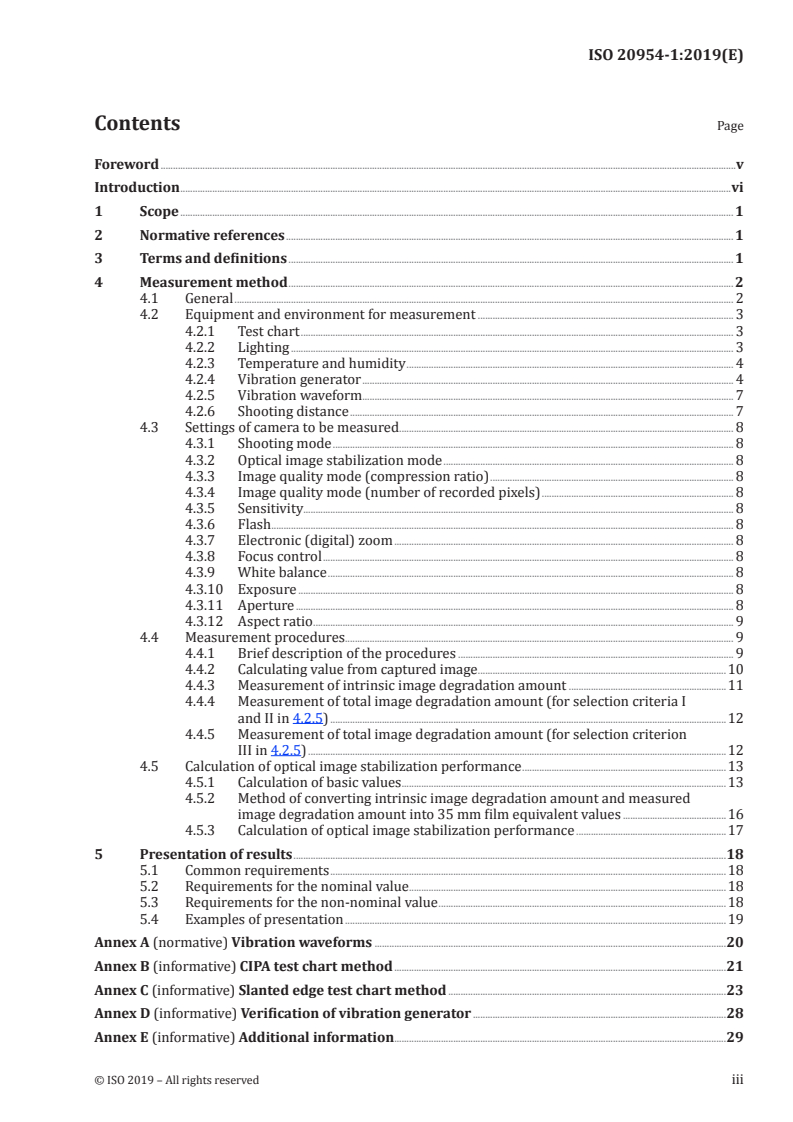
Contents Page
Foreword .v
Introduction .vi
1 Scope . 1
2 Normative references . 1
3 Terms and definitions . 1
4 Measurement method . 2
4.1 General . 2
4.2 Equipment and environment for measurement . 3
4.2.1 Test chart . 3
4.2.2 Lighting . 3
4.2.3 Temperature and humidity . 4
4.2.4 Vibration generator . 4
4.2.5 Vibration waveform. 7
4.2.6 Shooting distance . 7
4.3 Settings of camera to be measured . 8
4.3.1 Shooting mode . 8
4.3.2 Optical image stabilization mode . 8
4.3.3 Image quality mode (compression ratio) . 8
4.3.4 Image quality mode (number of recorded pixels) . 8
4.3.5 Sensitivity . . . 8
4.3.6 Flash . 8
4.3.7 Electronic (digital) zoom . 8
4.3.8 Focus control . 8
4.3.9 White balance . 8
4.3.10 Exposure . 8
4.3.11 Aperture . 8
4.3.12 Aspect ratio . 9
4.4 Measurement procedures. 9
4.4.1 Brief description of the procedures . 9
4.4.2 Calculating value from captured image .10
4.4.3 Measurement of intrinsic image degradation amount .11
4.4.4 Measurement of total image degradation amount (for selection criteria I
and II in 4.2.5) .12
4.4.5 Measurement of total image degradation amount (for selection criterion
III in 4.2.5) .12
4.5 Calculation of optical image stabilization performance .13
4.5.1 Calculation of basic values .13
4.5.2 Method of converting intrinsic image degradation amount and measured
image degradation amount into 35 mm film equivalent values .16
4.5.3 Calculation of optical image stabilization performance .17
5 Presentation of results .18
5.1 Common requirements .18
5.2 Requirements for the nominal value.18
5.3 Requirements for the non-nominal value .18
5.4 Examples of presentation .19
Annex A (normative) Vibration waveforms .20
Annex B (informative) CIPA test chart method .21
Annex C (informative) Slanted edge test chart method .23
Annex D (informative) Verification of vibration generator .28
Annex E (informative) Additional information.29
Annex F (informative) Description method in brochures .36
Bibliography .37
iv © ISO 2019 – All rights reserved
Foreword
ISO (the International Organization for Standardization) is a worldwide federation of national standards
bodies (ISO member bodies). The work of preparing International Standards is normally carried out
through ISO technical committees. Each member body interested in a subject for which a technical
committee has been established has the right to be represented on that committee. International
organizations, governmental and non-governmental, in liaison with ISO, also take part in the work.
ISO collaborates closely with the International Electrotechnical Commission (IEC) on all matters of
electrotechnical standardization.
The procedures used to develop this document and those intended for its further maintenance are
described in the ISO/IEC Directives, Part 1. In particular, the different approval criteria needed for the
different types of ISO documents should be noted. This document was drafted in accordance with the
editorial rules of the ISO/IEC Directives, Part 2 (see www .iso .org/directives).
Attention is drawn to the possibility that some of the elements of this document may be the subject of
patent rights. ISO shall not be held responsible for identifying any or all such patent rights. Details of
any patent rights identified during the development of the document will be in the Introduction and/or
on the ISO list of patent declarations received (see www .iso .org/patents).
Any trade name used in this document is information given for the convenience of users and does not
constitute an endorsement.
For an explanation of the voluntary nature of standards, the meaning of ISO specific terms and
expressions related to conformity assessment, as well as information about ISO's adherence to the
World Trade Organization (WTO) principles in the Technical Barriers to Trade (TBT) see www .iso
.org/iso/foreword .html.
This document was prepared by Technical Committee 42, Photography.
Any feedback or questions on this document should be directed to the user’s national standards body. A
complete listing of these bodies can be found at www .iso .org/members .html.
Introduction
The image stabilization function is important for digital cameras and has become a selling point in
marketing materials. Therefore, the measurement methods and its reporting method are then very
important to compare the image stabilization performance among cameras based on their brochures.
The Camera & Imaging Products Association (CIPA) issued CIPA standard DC-011 in 2012 to specify
how to measure and describe the optical image stabilization performance of digital cameras. When
image stabilization performance is measured and described according to this standard, end users have
unbiased and useful information to help them select from a variety of digital cameras (see Bibliography).
This document is based on the CIPA standard, which is referenced in the Bibliography. The standardized
measurement method primarily includes performance assessment with simulated handheld camera
movements.
The International Organization for Standardization (ISO) draws attention to the fact that it is claimed
that compliance with this document may involve the use of a patent.
ISO takes no position concerning the evidence, validity, and scope of any of the patent rights. The holders
of the patent rights have assured ISO that they are willing to negotiate licenses under reasonable and
non-discriminatory terms and conditions throughout the world. In this respect, the statement of the
holders of these patent rights is registered with ISO. Information may be obtained from:
Panasonic Corporation and Panasonic Intellectual Property Management Co.,Ltd.
1-15 Matsuo-cho, Kadoma City, Osaka 571-8504, Japan
Attention is drawn to the possibility that some of the elements of this document may be the subject of
patent rights other than those identified above. ISO shall not be held responsible for identifying any or
all such patent rights.
vi © ISO 2019 – All rights reserved
INTERNATIONAL STANDARD ISO 20954-1:2019(E)
Digital cameras — Measurement method for image
stabilization performance —
Part 1:
Optical systems
1 Scope
This document defines the measurement method of optical image stabilization performance for still
images compensating for handheld blur consisting of two rotational components, yaw and pitch.
It applies to consumer digital cameras with optical image stabilization for still images. Apparatuses
such as camcorders and mobile phones with still image shooting functionality are within the scope of
this document.
2 Normative references
There are no normative references in this document.
3 Terms and definitions
For the purposes of this document, the following terms and definitions apply.
ISO and IEC maintain terminological databases for use in standardization at the following addresses:
— ISO Online browsing platform: available at https: //www .iso .org/obp
— IEC Electropedia: available at http: //www .electropedia .org/
3.1
image stabilization
camera function that prevents handheld blur by using a means of camera movement detection
Note 1 to entry: Even if a camera function uses a means of camera movement detection, it is not regarded as
an image stabilization function if its primary means of blur mitigation is shortening exposure time based on
exposure control program optimization.
3.2
optical image stabilization
function that compensates for image displacement on the focal plane due to movement of a handheld
camera by moving a part or whole of the optical system and/or image sensor, based on a means of
camera movement detection
3.3
handheld blur
loss of image sharpness caused by movement of a handheld camera during exposure
3.4
stop
number that expresses a doubling or halving of the amount of light let in when taking a picture and
which is typically represented by an exposure value
Note 1 to entry: For instance, the difference between exposure times of 1/1 000 s (TV10) and 1/500 s (TV9) or
1/125 s (TV7) and 1/60 s (TV6) is one stop.
Note 2 to entry: “TVn" expresses that time value of APEX equals to n. See Annex C of Reference [5] for APEX.
3.5
handheld blur threshold
level of handheld blur at which image stabilization performance is determined
Note 1 to entry: In this document, this level is 63 μm of motion in the focal plane on one frame of 35 mm film,
where one frame means the picture size (24 mm × 36 mm).
3.6
average vibration angle
expected deflection angle of camera rotation under handheld vibration during exposure
Note 1 to entry: The handheld vibration is given as the vibration waveform data that is specified in document.
Note 2 to entry: The average vibration angles are given as amount of angle in degrees of each exposure time as
shown in Figure 7. The values are statistical expectation and are calculated from average of oscillation amplitude
from peak to bottom of the vibration waveform when certain exposure time is applied.
3.7
35 mm film equivalent focal length
focal length of a lens attached to a camera with a sensor size of 24 mm × 36 mm (originated from 35 mm
film) that produces the same field of view as the camera system with a lens at a given focal length for
which the 35 mm sensor equivalent focal length is specified
4 Measurement method
4.1 General
The objective of this document is to specify how to measure optical image stabilization performance
of a camera held in the user’s hands. Accordingly, a measurement session would better simulate a
real shooting situation if the camera was actually held by a test photographer. However, this makes
it difficult to eliminate variation among individual photographers or how well the camera is designed
for handheld shooting. In order to cancel these effects, the test camera shall be mounted on a
vibration generator that shakes the camera with a simulated handheld vibration waveform, and image
stabilization performance shall be measured with images of a test chart specified by this document.
This document specifies two waveforms that simulate the important characteristics of how a camera
shakes when it is held by hand. These waveforms were developed by analysing extensive measurement
data and adding further theoretical observations.
Figure 1 shows an overview of the measurement method. Annex E collaterally gives additional
explanations for background of specifying measurement method, vibration generator, vibration
waveform and reference information.
2 © ISO 2019 – All rights reserved
Key
1 chart
2 vibration generator
3 pc for handheld blur measurement
4 vibration waveform
5 variable brightness
a
Release operation.
Figure 1 — Overview of measurement method
4.2 Equipment and environment for measurement
4.2.1 Test chart
For this document, the test chart shall meet following requirements. Specifications and usage of the
test chart are described in Annex B and alternatives are described in Annex C.
a) The chart shall contain orthogonal edges consisting of a dark portion and a bright portion near
the centre.
b) The contrast ratio of the dark portion to the bright portion shall be 1:4 or more.
c) The dark and bright portions shall be wide enough to accommodate the total image degradation
which is described in 4.4.1, when the image stabilization (IS) function is OFF within the exposure
time range for measuring the image stabilization performance.
4.2.2 Lighting
Lighting shall be flicker-free. The light source should illuminate the chart with minimal direct reflection
and illuminance variation.
4.2.3 Temperature and humidity
The temperature and humidity should be (23 ± 2) °C and 30 % to 70 %, respectively.
4.2.4 Vibration generator
4.2.4.1 General
For the measurements in this document, a CIPA-certified vibration generator should be used. If a non-
certified vibration generator is used, it shall satisfy the amplitude and phase characteristics under the
excitation conditions specified in 4.2.4.2.
4.2.4.2 Excitation conditions
This subclause describes the required specifications for the amplitude and phase characteristics
of the vibrations generated by the vibration generator excited with sine waves. Table 1 shows the
properties of the sine waves that shall be used to measure the amplitude and phase characteristics.
Table 2 and 3 respectively show the input sine wave combinations that shall be used to measure the
vibration amplitude characteristics and phase characteristics. To measure the amplitude and phase
characteristics, the vibration generator shall be excited in both yaw and pitch directions simultaneously,
carrying a load weighing at least as much as the test objects, i.e. camera, storage media, battery and
lens. Figure 2 is an overview of how to verify the vibration generator using these waveforms.
4 © ISO 2019 – All rights reserved
Key
1 vibration measurement
2 measuring device (sensor, etc.)
3 weight
4 sine wave vibration
5 vibration generator
Figure 2 — Overview of vibration generator verification scheme
Table 1 — Combinations of sine wave frequency and amplitude for vibration generator
verification
Frequency Amplitude
(Hz) (degree)
a 0,1 2
b 0,5 2
c 1 1
d 5 0,2
e 10 0,1
Table 2 — Yaw and pitch combinations (for amplitude characteristic evaluation)
Pattern 1 Pattern 2 Pattern 3 Pattern 4 Pattern 5
Yaw a b c d e
Pitch c d e a b
Table 3 — Yaw and pitch combinations (for phase characteristic evaluation)
Pattern 6 Pattern 7
Yaw c d
Pitch d c
4.2.4.3 Amplitude characteristics
The amplitude of the measured vibration from the vibration generator shall be within ±5 %, inclusive,
of the amplitude of the input sine wave for all excitation conditions, Patterns 1 through 5, shown in
Table 2. See Figure 3.
Key
1 measured vibration form vibration generator
2 amplitude of input sine wave
3 amplitude of measured vibration of vibration generator
4 input sine wave
a
Difference in amplitude values.
Figure 3 — Illustration of amplitude differences
4.2.4.4 Phase characteristics
The phase difference between the measured yaw and pitch vibrations shall be 90° or less when the
vibration generator is excited by both Patterns 6 and 7 in Table 3. See Figure 4. The phase difference
between the zero cross position of the low frequency waveform and the zero cross position of the high
frequency waveform shall be within 90° of high frequency waveform.
6 © ISO 2019 – All rights reserved
Key
1 measured vibration form vibration generator
a
Phase difference.
b
Yaw or pitch.
c
Pitch or yaw.
Figure 4 — Illustration of phase differences
4.2.5 Vibration waveform
There are two types of vibration waveforms that shall be used to verify optical image stabilization
performance: WB-L and WB-H defined in Annex A. One or both shall be used based on the total mass
of the test camera according to the following criteria. Total mass refers to the camera body, including
storage media and battery, and lens.
— Selection criterion I: WB-H shall be used for a total mass of 600 g or more.
— Selection criterion II: WB-L shall be used for a total mass of less than 400 g.
— Selection criterion III: Both WB-L and WB-H shall be used for a total mass of 400 g or more but less
than 600 g.
Both waveforms consist of two axis components: yaw and pitch. Both yaw and pitch components shall
be excited at the same time (see Annex A).
4.2.6 Shooting distance
The shooting distance should be about 20 times the 35 mm film equivalent focal length.
If the space does not allow this shooting distance, the distance may be changed to the maximum amount
available. But even when in this case, in order to avoid significant shifts orthogonal to the optical axis,
it is desirable that the shooting distance is as close to 20 times the 35 mm film equivalent focal length
as possible.
4.3 Settings of camera to be measured
4.3.1 Shooting mode
a) The mode with the shortest latency time should be used because shooting shall begin as soon as
possible after the camera is turned on. (The shooting modes should retain as many of the settings
in 4.3.2 to 4.3.12 as possible after the camera is turned off. It is also convenient to use a mode
that allow for easy changing of the exposure time.) For cameras without the capability of changing
exposure time, the factory shipping setting should be used.
b) No mode that applies extreme edge enhancement to images shall be used because such modes
influence the amount of image degradation measured. Typically, these are modes optimized for
specific scenes.
4.3.2 Optical image stabilization mode
When a purpose of the measurement is a “nominal value” which is mentioned and required in 5.2, the
factory shipping setting should be used for the optical image stabilization mode.
4.3.3 Image quality mode (compression ratio)
Although no specific compression ratio is specified, a high image quality mode setting with low
compression ratio should be used.
4.3.4 Image quality mode (number of recorded pixels)
The maximum number of recorded pixels available for the camera should be set. However, settings that
use more pixels that the number of effective pixels of the image sensor by pixel interpolation, image
processing, or other means shall not be used.
4.3.5 Sensitivity
The sensitivity should be set to a constant value with minimal image noise.
4.3.6 Flash
Flash shall not be used.
4.3.7 Electronic (digital) zoom
Electronic (digital) zoom shall not be used.
4.3.8 Focus control
A focus control method that allows the camera to focus on the test chart shall be used.
4.3.9 White balance
The white balance shall be adjusted in accordance with light source.
4.3.10 Exposure
The exposure shall be such that there is no colour channel containing areas where detail is lost due to
pixel saturation or clipping in the image.
4.3.11 Aperture
The aperture shall be kept constant if possible when shooting at the same focal length and exposure time.
8 © ISO 2019 – All rights reserved
4.3.12 Aspect ratio
The factory shipping setting should be used.
4.4 Measurement procedures
4.4.1 Brief description of the procedures
Two quantities, measured handheld blur amount and reference handheld blur amount, shall be
compared to quantify optical image stabilization performance. To obtain these values, four additional
quantities are used: intrinsic image degradation amount, total image degradation amount, reference
image degradation amount, and theoretical handheld blur amount. These terms are used uniquely
as variables in the calculation procedure in this document and explained hereinafter. Table 4 gives
symbols and units of the values.
Intrinsic image degradation amount is loss of image sharpness caused by factors unique to the camera,
such as optical performance, effective number of pixels, and image processing. It does not include
handheld blur. When measuring optical image stabilization performance, subtracting intrinsic image
degradation amount excludes most of the effects of camera elements that are not part of the image
stabilization function. See 4.5.1 a).
Total image degradation amount is the measured amount of loss of sharpness of an image taken by a
test camera excited with a vibration waveform while the image stabilization function is enabled. See
4.5.1 d).
Reference image degradation amount is the expected amount of loss of sharpness in an image taken by
a test camera excited with a vibration waveform while the image stabilization function is disabled. This
value is the square root of the sum of the squares of intrinsic image degradation amount and theoretical
handheld blur amount. See 4.5.1 c).
Theoretical handheld blur amount is the theoretically calculated amount of handheld blur that would
be measured from an image taken by a test camera excited with a vibration waveform while the image
stabilization function is disabled. See 4.5.1 b).
Measured handheld blur amount is the amount of handheld blur that remains uncompensated after
enabling the image stabilization function of the camera. This value is calculated by subtracting intrinsic
image degradation amount from the total image degradation amount. See 4.5.1 f).
Reference handheld blur amount is the baseline value against which to compare measured handheld blur
amount to determine optical image stabilization performance. This value is calculated by subtracting
intrinsic image degradation amount from reference image degradation amount, and represent the
handheld blur with the image stabilization function disabled. See 4.5.1 e).
Table 4 — Symbols and unit
Symbol Meaning Unit Specified in
t Exposure time s ISO 516
E
D (t ) intrinsic image degradation amount μm 4.4.3, 4.5.1
intrinsic E
D (t ) total image degradation amount μm 4.4.4, 4.4.5, 4.5.1
total E
D (t ) reference image degradation amount μm 4.5.1
reference E
B (t ) theoretical handheld blur amount μm 4.5.1
theoretical E
B (t ) reference handheld blur amount μm 4.5.1
reference E
B (t ) measured handheld blur amount μm 4.5.1
measured E
θ(t ) average vibration angle degree 3.6
E
K handheld blur threshold μm 3.5
threshold
P optical image stabilization performance stop 4.5.3
optical
Table 4 (continued)
Symbol Meaning Unit Specified in
f 35 mm film equivalent focal length mm 4.5.1
D (t ) intrinsic image degradation amount pixel 4.5.2
intrinsic,pixel E
D (t ) measured image degradation amount pixel 4.5.2
total,pixel E
N diagonal length of one Frame of 35 mm Film μm 4.5.2
diagonal,35
N diagonal length of the captured Image pixel 4.5.2
diagonal,pixel
N the number of recorded pixels in vertical direction pixel 4.5.2
vertical,pixel
N the number of recorded pixels in horizontal direction pixel 4.5.2
horizontal,pixel
Figure 5 — Calculation flow
4.4.2 Calculating value from captured image
Analysing captured image yields the intrinsic image degradation amount and total image degradation
amount. This section describes the calculation steps from captured image.
The intrinsic image degradation amount and measured total image degradation amount shall be
measured in accordance with the following:
a) The image shall be inverse gamma corrected (typically γ = 2,2, but some variation may occur) in
order to linearize the tone reproduction as much as possible;
b) For stable measurements, multiple points on the boundary of the black and white portions near the
centre of the chart image shall be selected, and the measured results from c) shall be averaged over
them; and
10 © ISO 2019 – All rights reserved
c) The signal levels at the central points on the boundary between the black and white portions of
the captured image of the chart shall be normalized from 0 % to 100 %. In this regard, the black
level as 0 % and the white level as 100 % shall be assessed from stable and flat portion that is not
affected by undershoot or overshoot due to edge enhancement processing as shown in Figure 6.
The number of pixels in the section between 10 % to 90 % of the signal level (see A in Figure 6)
shall be calculated and then multiplied by 10/8.
Key
X pixel
Y signal level, expressed in percent
a
The number of pixels in the section between 10 % to 90 % of signal levels.
Figure 6 — Measuring blur
4.4.3 Measurement of intrinsic image degradation amount
a) Mount a camera to be measured on the vibration generator.
b) Turn on the camera. Adjust the shooting distance by adjusting the position of the camera and/or
the test chart.
c) Set the camera and the lighting for a desired exposure time.
d) Take at least 10 images with the vibration generator off. There is no specified upper limit to the
number of images, but all images shall be used without selection. Optical image stabilization should
be turned off. A remote release button or remote control should be used when possible.
e) Reduce the exposure time sequentially by at most one stop at a time. Shoot at least 10 images for
each exposure time. Continue shooting until data is collected within the necessary exposure time
range. When shooting at different exposure times, measurement conditions other than the lighting
should not be changed.
The shooting environment and camera settings in 4.4.3 should generally not be changed in the
measurement of total image degradation amount of 4.4.4 and 4.4.5.
4.4.4 Measurement of total image degradation amount (for selection criteria I and II in 4.2.5)
a) Mount the camera to be measured on the vibration generator. Oscillated movements of the vibration
generator and the whole test camera shall be the same. When measuring a camera with a long-
barrel lens (e.g. high-powered zoom lens), the vibrations of the camera body and the lens might not
match due to lens deflection of the lens barrel. In this case both the lens and the body shall be fixed
to the vibration generator respectively so that the vibrations of the camera and the lens match. The
verification of synchronization between the vibration generator and the camera shall be executed.
An example of verification method and its criteria are given in Annex D.
b) Turn on the camera. Set the exposure time so that the measured handheld blur amount is at or
around the handheld blur threshold for determining optical image stabilization performance
mentioned in 4.5.3. After the setting is completed, turn off the camera.
c) Excite the vibration generator using one of the vibration waveforms in 4.2.5. The vibration
generator should be continuously excited until h) below is completed.
d) While the generator is vibrating, turn on the camera to be measured. If the settings from b) have
changed, reset them as soon as possible.
e) Turn on the camera’s optical image stabilization and start shooting immediately. Shoot at
approximately 1 s intervals for a total of 10 shots. However, finish shooting 30 s after turning on
the camera even if 10 shots have not been taken. If shooting at 1 s intervals or acquiring a total
of 10 images is not possible, these numbers may be changed. Turn off the camera afterward
(see NOTE 1). Each shooting timing and intervals shall be performed at different position of the
waveform (see NOTE 2). The shooting operation shall not affect the vibrating state. A remote
release button or a remote control should be used when possible.
NOTE 1 The use case assumed in this document is the typical one that the user turns on the camera
power, shoots about 10 images immediately and then turns off the power subsequently. In such a use case,
there are cameras whose image stabilization performance varies depending on the time from the turning
on/off the power supply. Therefore, unless the procedure for turning on/off the power supply of the camera
is monitored and controlled, a difference can occur in the measurement result.
NOTE 2 If shooting timing is performed every time at the same position of the waveform, there is a
possibility that the measurement result is biased.
f) Repeat d) and e) and take 200 or more shots. There is no upper limit to the shooting count, but all
images shall be used without selecting only the favourable ones.
g) Reduce or increase the exposure time by at most one stop at a time and repeat Steps b) to f) above.
When shooting at different exposure times, measurement conditions other than lighting should not
be changed.
h) Finish the measurement when the following two measurement results are obtained: the longest
exposure time at which the measured handheld blur amount does not exceed the handheld blur
threshold for determining optical image stabilization performance, and the shortest exposure time
at which it exceeds the said threshold.
4.4.5 Measurement of total image degradation amount (for selection criterion III in 4.2.5)
a) Mount the camera to be measured on the vibration generator. Oscillated movements of the vibration
generator and the whole test camera shall be the same. When measuring a camera with a long-
barrel lens (e.g. high-powered zoom lens), the vibrations of the camera body and the lens might not
match due to lens deflection of the lens barrel In this case both the lens and the body shall be fixed
to the vibration generator respectively so that the vibrations of the camera and the lens match. The
verification of synchronization between the vibration generator and the camera shall be executed.
An example of verification method and its criteria are given in Annex D.
12 © ISO 2019 – All rights reserved
b) Turn on the camera. Set the exposure time so that the measured handheld blur amount is at or
around the handheld blur threshold for determining optical image stabilization performance
mentioned in 4.5.3. After the setting is completed, turn off the camera.
c) Excite the vibration generator using one of the vibration waveforms in 4.2.5. The vibration
generator should be continuously excited until h) below is completed.
d) While the generator is vibrating, turn on the camera to be measured. If the settings from b) have
changed, reset them as soon as possible.
e) Turn on the camera’s optical image stabilization and start shooting immediately. Shoot at
approximately 1 s intervals for a total of 10 shots. However, finish shooting 30 s after turning on
the camera even if 10 shots have not been taken. If shooting at 1 s intervals or acquiring a total
of 10 images is not possible, these numbers may be changed. Turn off the camera afterward
(see NOTE 1). Each shooting timing and intervals shall be performed at different position of the
waveforms (see NOTE 2). The shooting operation shall not affect the vibrating state. A remote
release button or a remote control should be used when possible.
NOTE 1 The use case assumed in this document is the typical one that the user turns on the camera
power, shoots about 10 images immediately and then turns off the power subsequently. In such a use case,
there are cameras whose image stabilization performance varies depending on the time from the turning
on/off the power supply. Therefore, unless the procedure for turning on/off the power supply of the camera
is monitored and controlled, a difference can occur in the measurement result.
NOTE 2 If shooting timing is performed every time at the same position of the waveforms, there is a
possibility that the measurement result is biased.
f) Repeat d) and e) using both kinds of waveforms and take 100 or more shots for each waveform.
There is no specified upper limit for the shooting count, but all images shall be used without
selection.
g) Reduce or increase the exposure time by at most one stop at a time and repeat b) to f) above. When
shooting at differing exposure times, measurement conditions other than the lighting should not be
changed.
h) Finish the measurement when the following two measurement results are obtained: the longest
exposure time at which the measured handheld blur amount does not exceed the handheld blur
threshold for determining optical image stabilization performance, and the shortest exposure time
at which it exceeds the said threshold.
4.5 Calculation of optical image stabilization performance
4.5.1 Calculation of basic values
The six quantitative values are used to calculate optical image stabilization performance: intrinsic image
degradation amount, theoretical handheld blur amount, reference image degradation amount, measured
image degradation amount, reference handheld blur amount, and measured handheld blur amount.
The main objectives of these values are as follows:
— Remove the effects of factors other than camera shake from the total image degradation amount
measured in 4.4.4 and 4.4.5.
— Enable the calculation of optical image stabilization performance even for cameras incapable of
turning off the optical image stabilization function.
Methods of calculating these values are shown below.
a) Intrinsic image degradation amount
For each image captured according to the method in 4.4.3, calculate the square root of the sum
of the squares of the yaw and pitch of the intrinsic image degradation amounts, and then average
the total over all of the images of each exposure time. If the averaged intrinsic image degradation
amount is in pixels, convert it into a 35 mm film equivalent amount in micrometres (μm) according
to the method in 4.5.2 below. Use at least 10 values in calculating the average.
b) Theoretical handheld blur amount
Calculate theoretical handheld blur amount for each exposure time using Formula (1). Because the
average vibration angles differ among selection criteria I, II and III in 4.2.6, use the value associated
with the vibration waveform used in the measurement. See Figure 7 and 8.
Bt =×fttan θ ×1000 (1)
() ()
()
theoreticalE 35 E
c) Reference image degradation amount
Calculate reference image degradation amount using Formula (2). Intrinsic image degradation
amount and theoretical handheld blur amount measured at the same exposure time shall be used
in this equation. See Figure 5 and 9.
Dt = Dt +Bt (2)
() () ()
referenceE intrinsicE theoreticalE
d) Total image degradation amount
For each image captured according to the methods in 4.4.4 and 4.4.5, calculate the square root
of the sum of the squares of the yaw and pitch of the total image degradation amounts, and then
average the total over all of the images of each exposure time. If the averaged measured image
degradation amount is in pixels, convert it into the 35 mm film equivalent amount in micrometres
(μm) according to the method in 4.5.2 below. Use at least 200 values to calculate the averages for
4.4.4, and at least 100 values for each case in 4.4.5. In the latter case, the same number of values
shall be averaged in each case.
e) Reference handheld blur amount
Calculate reference handheld blur amount using Formula (3). Reference image degradation amount
and intrinsic image degradation amount that were measured at the same exposure time shall
be used in this calculation. Factors that might affect images taken, such as sensitivity, should be
identical. See Figure 5.
Bt =Dt −Dt (3)
() () ()
referenceE referenceE intrinsicE
f) Measured handheld blur amount
Calculate measured handheld blur amount using Formula (4). Total image degradation amount and
intrinsic image degradation amount that were measured at the same exposure time shall be used
in this calculation. Factors that might affect images taken, such as sensitivity, should be identical. If
the measured handheld blur amount is a negative value, set the value to 0 μm. See Figure 5 and 10.
Bt =Dt −Dt (4)
() () ()
measured Etotal Eintrinsic E
14 © ISO 2019 – All rights reserved
Key
X exposure time, t
E
Y average vibration angle, expressed in degree
selection criterion I
selection criterion II
selection criterion III
Figure 7 — Average vibration angle
Key
X exposure time, t
E
Y theoretical handheld blur amount, expressed in μm
Figure 8 — Theoretical handheld blur amount
...
Questions, Comments and Discussion
Ask us and Technical Secretary will try to provide an answer. You can facilitate discussion about the standard in here.
Loading comments...