

ISO 24952
(Main)Biotechnology — Biobanking — General requirements for fully automated and semi-automated storage and retrieval equipment
- Abstract
This document specifies general requirements for (semi-)automated storage and retrieval equipment for biobanking, including their design, customization and installation, (semi-)automated storage and retrieval functions, performance, personnel, facility environment, operation and maintenance. This document specifies consumable and software systems for (semi-)automated storage and retrieval equipment for biobanking. This document is applicable to manufacturers of (semi-)automated storage and retrieval equipment, as well as to biobanks that use or operate such equipment. This document is applicable to manufactures of consumables of (semi-)automated storage and retrieval equipment.
- Status
- Not Published
- Technical Committee
- ISO/TC 276 - Biotechnology
- Drafting Committee
- ISO/TC 276/WG 2 - Biobanks and bioresources
- Current Stage
- 6000 - International Standard under publication - 60 Publication
- Start Date
- 18-Nov-2026
Buy Documents
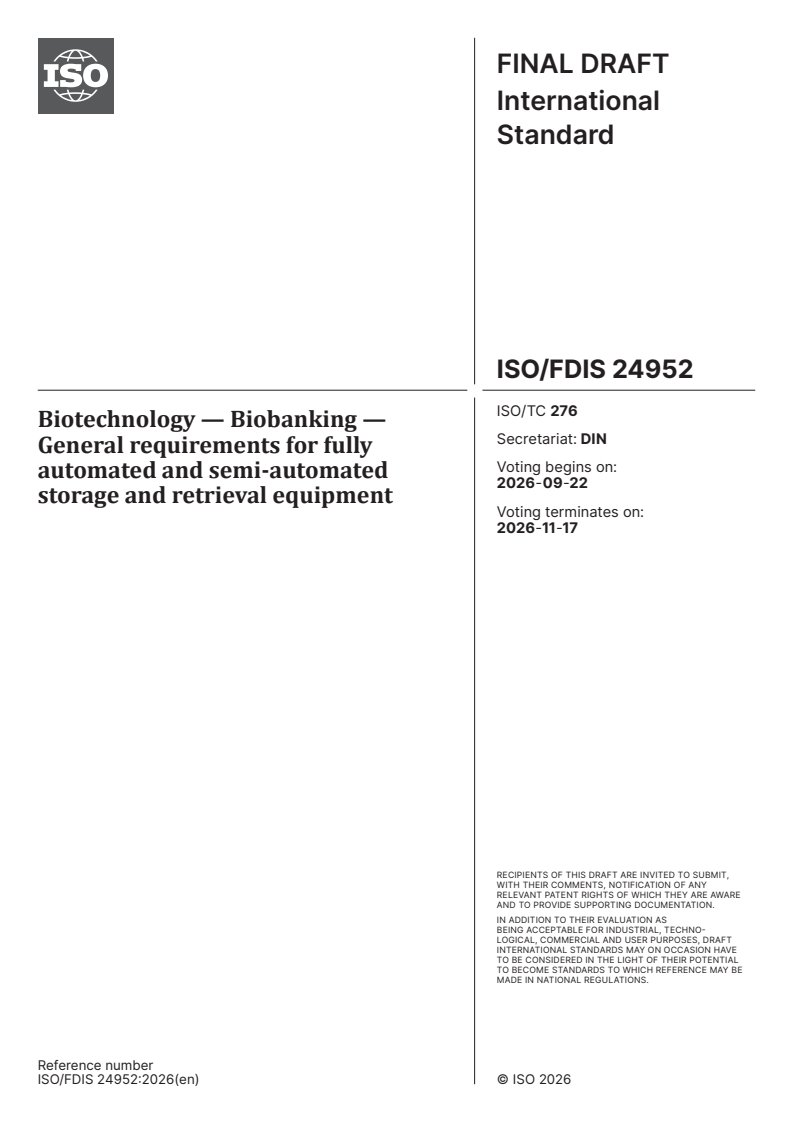
ISO/FDIS 24952 - Biotechnology — Biobanking — General requirements for fully automated and semi-automated storage and retrieval equipment
REDLINE ISO/FDIS 24952 - Biotechnology — Biobanking — General requirements for fully automated and semi-automated storage and retrieval equipment
ISO 24952 is an ISO standard for biotechnology biobanking that sets general requirements for fully automated and semi-automated storage and retrieval equipment. It covers the equipment, its consumables and software systems, and it is intended for manufacturers, consumable makers and biobanks that use or operate this equipment.
What does ISO 24952 specify?
ISO 24952 specifies the general requirements for (semi-)automated storage and retrieval equipment used in biobanking, including design, customization, installation, performance, personnel, facility environment, operation and maintenance. It also covers consumable and software systems for that equipment, so the document is not limited to the machine itself.
The document is organized into clauses 1 to 12, followed by a normative Annex A. Clause 2 names the normative references, Clause 3 defines the key terms, and Clauses 4 to 12 cover requirements for the equipment, staff, facilities, consumables, storage functions, service, monitoring and safety.
| Annex | What it covers |
|---|---|
| Annex A | Specifications for operation and management of (semi-)automated storage and retrieval equipment |
What are the key requirements of ISO 24952?
ISO 24952 requires the equipment to be specified, installed and operated under defined conditions so that biological material integrity and equipment function are maintained. The most practical focus is on temperature control, traceability, access control, alarms, maintenance and safe recovery from faults.
Equipment performance and control
Clause 5 requires the equipment to meet performance criteria for storage capacity, processing speed, transfer speed, retrieval speed and controlled temperature. In practice, this means a biobank needs equipment sized and tuned for its sample volume and turnaround times, not just a generic freezer system.
The standard requires real-time monitoring of environmental conditions, alarms for abnormal conditions, and display of actual temperature, set temperature, alarm information and sample management data. It also calls for remote monitoring, which matters when staff need to supervise equipment outside the storage room or outside normal hours.
Clause 5.3 requires the manufacturer to state the temperature range and tolerance the equipment is designed to maintain, while the biobank determines the appropriate storage temperature for its biological materials. Clause 5.5 also requires a short-term backup plan so accurate storage conditions can be maintained during an emergency.
Automation, interfaces and data handling
Clause 5.7 covers robotic arm and pneumatic automation mechanisms. These mechanisms must be suitable for the low-temperature or ultra-low-temperature environment where they are used, and they must follow the operating system instructions for transfer and re-organization of containers.
Clause 5.8 focuses on the control system. It requires a usable human-interaction interface, interoperable data interfaces, access control, task files, automatic storage-order generation, alarm handling, and reporting of task status. For users, this means the equipment must fit into a biobank’s digital workflow and not operate as an isolated machine.
Personnel, facility and safety
Clauses 6 and 7 require defined responsibilities, qualification, training and access rights for operators and administrators. The manufacturer must provide training and instructions for use and maintenance, and the biobank must document training and role-based access.
Clause 7 also requires a suitable facility environment: enough space, load-bearing capacity, fire protection, power supply, installation space, and environmental control. Where liquid nitrogen is used, the area needs oxygen monitoring and a strong exhaust system to protect personnel.
Consumables and storage functions
Clause 8 requires pre-marked primary containers, secondary containers and/or configurable (rack) containers with machine-readable codes. This matters because the equipment depends on compatible consumables for automated handling, identification and storage.
Clause 9 requires the control system to manage biological materials and tasks, define storage modes, support storage, retrieval, return and organization, and maintain a sample library. It also requires inventory reporting and tracing of inconsistencies, which supports sample control and auditability.
Service, verification and risk control
Clause 10 requires after-sales support, self-inspection, calibration, and verification and acceptance activities. The document names installation qualification (IQ), operational qualification (OQ) and performance qualification (PQ), so the equipment has to be checked at installation and then maintained over time.
Clause 12 requires personnel safety, information security, facility and environmental safety, and procedures for faults and emergency response. The equipment must be able to stop safely, alarm clearly, show the error and handling steps, and support recovery actions such as recalibration, manual changeover, database cleansing and documentation of failed processes.
What terms does ISO 24952 define?
ISO 24952 defines the key storage and handling terms used throughout the document so manufacturers and biobanks use the same language.
- Automated storage and retrieval equipment - equipment designed to store biological materials with minimal human intervention, using robotics or pneumatic devices, conveyors and computerized controls.
- Semi-automated storage and retrieval equipment - equipment designed to store biological materials with partial human intervention, while the machine handles storage, retrieval and tracking.
- Storage mode - the specific method and conditions used to preserve biological materials, such as the temperature and preservation approach selected for the sample type.
- Primary container - the receptacle in direct contact with the biological material during storage or transport.
- Secondary container - the container into which the primary container is placed.
- Configurable (rack) container - a container adapted for robot arms to transfer or store primary or secondary containers that do not match the normal size or quality specifications.
- Equipment control system - the hardware and software platform used to organize, track, manage, store and retrieve data related to biological materials stored in the equipment.
Who uses ISO 24952?
ISO 24952 is used by manufacturers of fully automated and semi-automated storage and retrieval equipment, by manufacturers of the consumables used with that equipment, and by biobanks that operate it. It is also relevant to administrators, operators, maintenance staff, service providers and quality or safety teams responsible for biobank workflows.
In practice, users rely on the standard when they select equipment, define installation conditions, validate consumables, set access rights, plan maintenance, and organize training and emergency procedures. It is especially relevant in biotechnology and biobanking environments that store human and non-human biological materials, including plants, animals, microorganisms, seeds and cells.
Which standards are used with ISO 24952?
ISO 24952 names two normative references and also cites several related standards in its bibliography and technical clauses.
- ISO 20387 - provides the general biobanking requirements that ISO 24952 uses for traceability of biological material and associated data, and for storage requirements.
- ISO/IEC 27001 - provides the information security management requirements referenced for the equipment’s information security management.
- ISO 20070 - is cited for requirements for primary containers used to store biological materials.
- ISO 20421-1 - is cited for self-pressurized liquid nitrogen supply containers.
- ISO 21009-1, ISO 21010, ISO 21014 and ISO 23208 - are cited for cryogenic vessels, material compatibility, insulation performance and cleanliness in liquid nitrogen-related installations.
- ISO 7498-1 - is cited in the discussion of interface layers and network communication.
What does the ISO 24952 document contain?
ISO 24952 contains requirements, definitions, and an annex that turns the standard into an operational checklist for automated biobanking equipment. It includes detailed clauses on performance criteria, storage temperature, storage capacity, temperature control, insulation, automation mechanisms, control systems, personnel, facility environment, consumables, storage functions, service, monitoring and safety.
It also includes an example maintenance schedule in Table 1, with activities ranging from daily checks to long-term maintenance planning. Annex A sets out operation and management specifications, including regular maintenance, emergency procedures, temperature control, biological material identification, security measures, backup systems, and training and education.
Buy Documents
ISO/FDIS 24952 - Biotechnology — Biobanking — General requirements for fully automated and semi-automated storage and retrieval equipment
REDLINE ISO/FDIS 24952 - Biotechnology — Biobanking — General requirements for fully automated and semi-automated storage and retrieval equipment
Frequently Asked Questions
ISO 24952 is a draft published by the International Organization for Standardization (ISO). Its full title is "Biotechnology — Biobanking — General requirements for fully automated and semi-automated storage and retrieval equipment". This standard covers: This document specifies general requirements for (semi-)automated storage and retrieval equipment for biobanking, including their design, customization and installation, (semi-)automated storage and retrieval functions, performance, personnel, facility environment, operation and maintenance. This document specifies consumable and software systems for (semi-)automated storage and retrieval equipment for biobanking. This document is applicable to manufacturers of (semi-)automated storage and retrieval equipment, as well as to biobanks that use or operate such equipment. This document is applicable to manufactures of consumables of (semi-)automated storage and retrieval equipment.
This document specifies general requirements for (semi-)automated storage and retrieval equipment for biobanking, including their design, customization and installation, (semi-)automated storage and retrieval functions, performance, personnel, facility environment, operation and maintenance. This document specifies consumable and software systems for (semi-)automated storage and retrieval equipment for biobanking. This document is applicable to manufacturers of (semi-)automated storage and retrieval equipment, as well as to biobanks that use or operate such equipment. This document is applicable to manufactures of consumables of (semi-)automated storage and retrieval equipment.
ISO 24952 is classified under the following ICS (International Classification for Standards) categories: 07.080 - Biology. Botany. Zoology. The ICS classification helps identify the subject area and facilitates finding related standards.
ISO 24952 is available in PDF format for immediate download after purchase. The document can be added to your cart and obtained through the secure checkout process. Digital delivery ensures instant access to the complete standard document.
Standards Content (Sample)
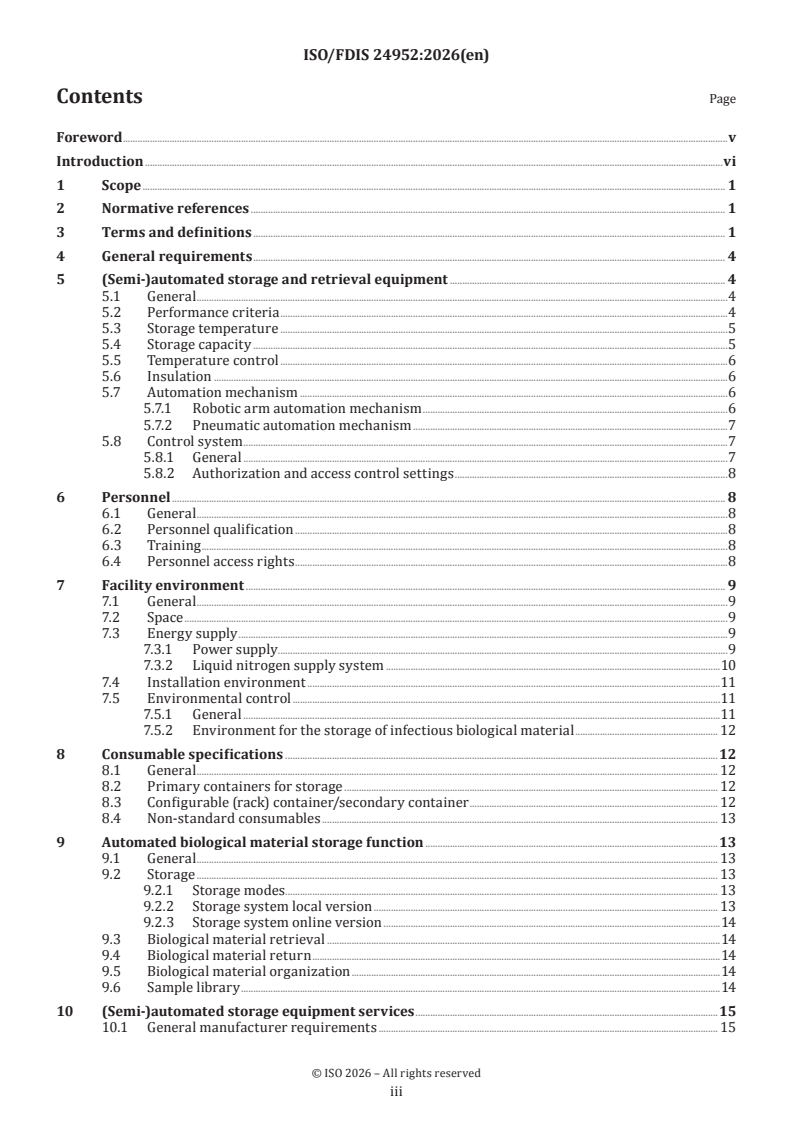
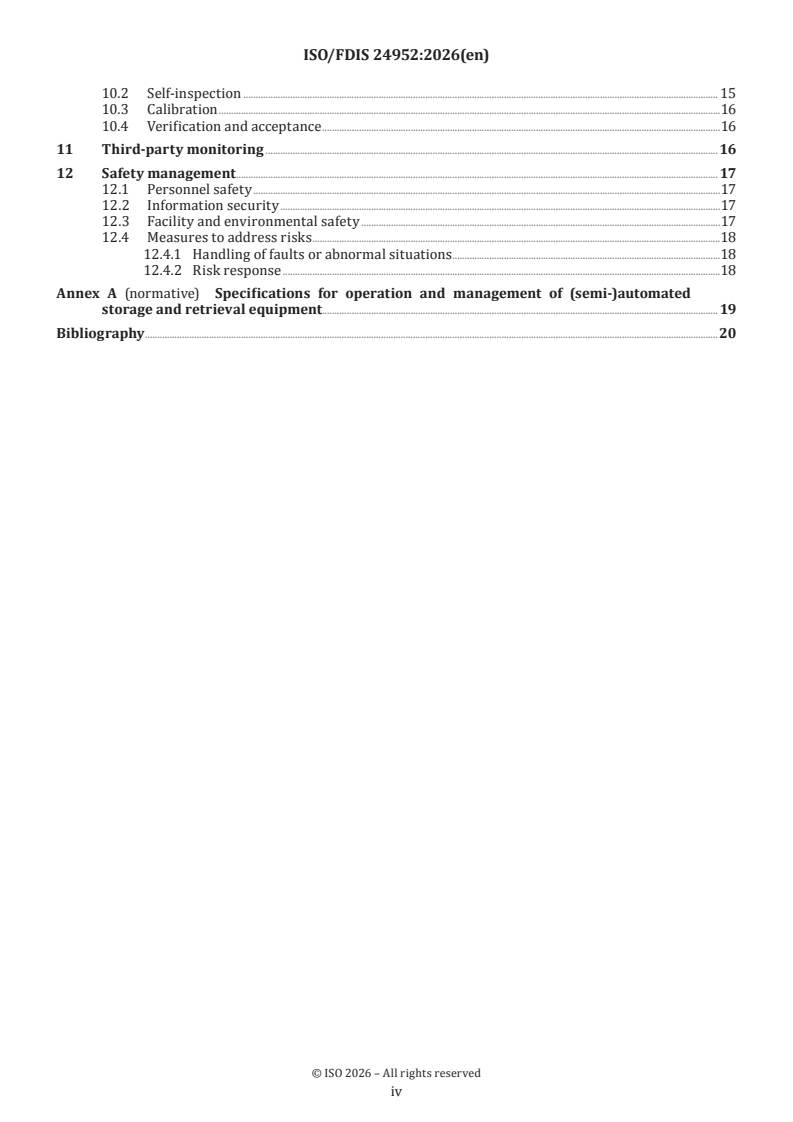
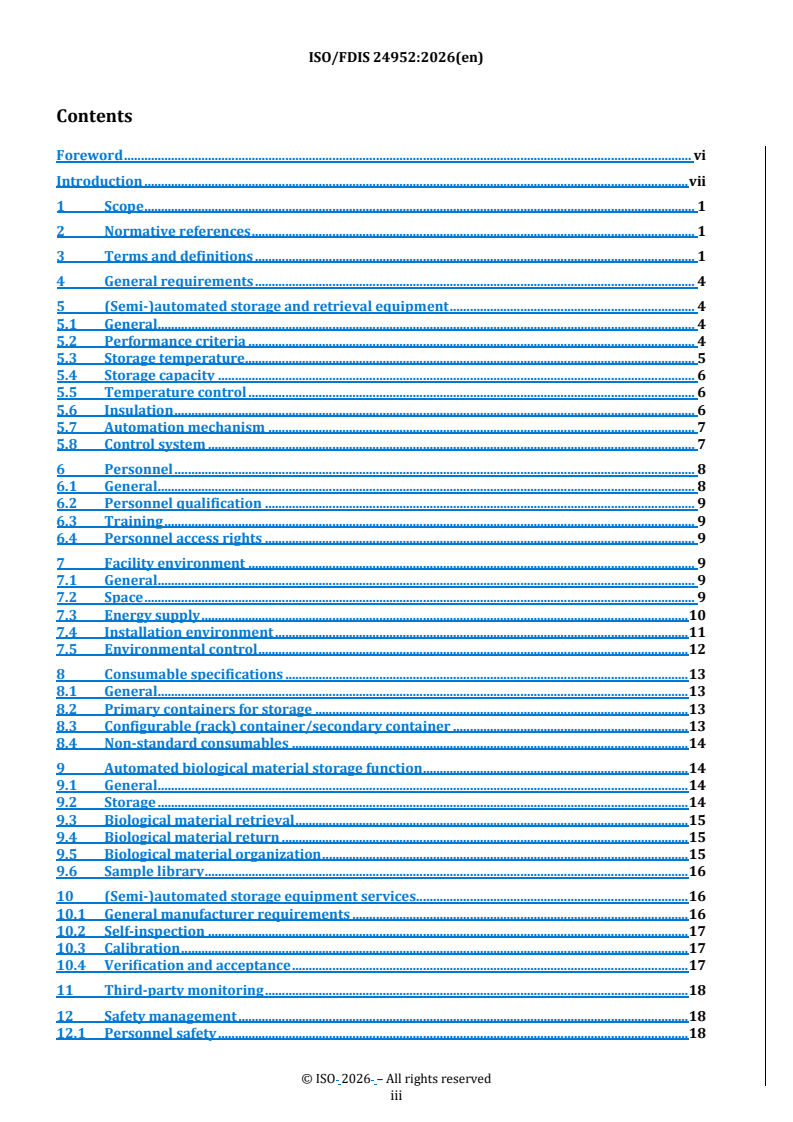
Contents
- Introduction
- 1 Scope
- 2 Normative references
- 3 Terms and definitions
- 3.1 automated picker
- 3.2 automated storage
- 3.3 automated storage and retrieval equipment
- 3.4 automation
- 3.5 buffer zone
- 3.6 configurable (rack) container
- 3.7 dedicated storage area
- 3.8 device self-inspection program
- 3.9 docking interface
- 3.10 equipment control system
- 3.11 human-interaction interface
- 3.12 inbound list
- 3.13 liquid nitrogen tower
- 3.14 outbound list
- 3.15 primary container
- 3.16 secondary container
- 3.17 semi-automated storage
- 3.18 semi-automated storage and retrieval equipment
- 3.19 storage mode
- 3.20 storage task
- 4 General requirements
- 5.1 General
- 5.2 Performance criteria
- 5.3 Storage temperature
- 5.4 Storage capacity
- 5.5 Temperature control
- 5.6 Insulation
- 5.7 Automation mechanism
- 5.8 Control system
- 6 Personnel
- 6.1 General
- 6.2 Personnel qualification
- 6.3 Training
- 6.4 Personnel access rights
- 7 Facility environment
- 7.1 General
- 7.2 Space
- 7.3 Energy supply
- 7.4 Installation environment
- 7.5 Environmental control
- 8 Consumable specifications
- 8.1 General
- 8.2 Primary containers for storage
- 8.3 Configurable (rack) container/secondary container
- 8.4 Non-standard consumables
- 9 Automated biological material storage function
- 9.1 General
- 9.2 Storage
- 9.3 Biological material retrieval
- 9.4 Biological material return
- 9.5 Biological material organization
- 9.6 Sample library
- 10.1 General manufacturer requirements
- 10.2 Self-inspection
- 10.3 Calibration
- 10.4 Verification and acceptance
- 11 Third-party monitoring
- 12 Safety management
- 12.1 Personnel safety
- 12.2 Information security
- 12.3 Facility and environmental safety
- 12.4 Measures to address risks
- Annex A
- Bibliography
Introduction
A biobank is a collection of biological materials and associated data with biological material numbers spanning from the thousands to hundreds, or less. During the past decades, more and more biobanks were established for research purposes. Recently, biobanks storing millions of biological materials and supported by governments have been established, allowing experts to focus on the quality of biological materials rather than quantity. The first international biobank standard, ISO 20387, was published by ISO/TC 276. At present, many countries have created biobanks to represent their own populations. Specialized biobanks have been established around the world, United States in 1987, the UK Biobank in 1999, the European Biological Sample Bank in 2001, the Biobank Japan (BBJ) in 2004, and the European Union established the Pan European Biological Sample Bank and Biomolecular Resource Research Platform (BBMRI) in 2008, China Beijing Biobank in 2011, China Shanghai Biobank in 2018, China National GeneBank in 2011. In these large biobanks, millions of biological materials are stored and processed. It is a challenge to store and manage those biological materials with high quality standards. The UK Biobank is well known for their automatic storage in -80 °C. However, during the last ten years, multiple biobanks (> 10 biobanks) in Europe, USA, Japan and China have implemented automatic storage solutions. There are more than 50 (semi-)automatic storage biobanks in the world and the number is growing. (Semi-)automatic storage solutions are very expensive and in this fast growth period, it is important to set/have standards for (semi-)automatic storage equipment, to cover issues, such as design, maintenance, management, and training to enable efficient storage with high quality output biological materials. (Semi-)automatic storage equipment can cause significant loss of money or damage biological materials if no standards for their setup and operation are available. The various (semi-)automatic storage equipment units can cause difficulties in transportation between the equipment. This expensive and complex equipment requires standards, and professional care or operation process(es).
Biobanking includes human and non-human biological materials, such as plants, animals, microorganisms, seeds, and cells. (Semi-)automated storage and retrieval equipment can store all types of biological material utilizing different designs for specific purposes, or applications.
FINAL DRAFT International Standard ISO/FDIS 24952:2026(en) Biotechnology — Biobanking — General requirements for fully automated and semi-automated storage and retrieval equipment
1 Scope
This document specifies general requirements for fully automated and semi-automated storage and retrieval equipment for biobanking, including their design, customization and installation, (semi-)automated storage and retrieval functions, performance, personnel, facility environment, operation and maintenance. NOTE Where this document addresses both ‘fully automated and semi-automated storage and retrieval equipment’ this is made clear by using the shortened form of ‘(semi-)automated storage and retrieval equipment’. This document specifies consumable and software systems for (semi-)automated storage and retrieval equipment for biobanking.
This document is applicable to manufacturers of (semi-)automated storage and retrieval equipment, as well as to biobanks that use or operate such equipment. This document is applicable to manufactures of consumables of (semi-)automated storage and retrieval equipment.
2 Normative references
The following documents are referred to in the text in such a way that some or all of their content constitutes requirements of this document. For dated references, only the edition cited applies. For undated references, the latest edition of the referenced document (including any amendments) applies. ISO 20387, Biotechnology — Biobanking — General requirements for biobanks
3 Terms and definitions
For the purposes of this document, the terms and definitions in ISO 20387 and the following apply. ISO and IEC maintain terminological databases for use in standardization at the following addresses:
- ISO Online browsing platform: available at https:// www .iso .org/ obp
- IEC Electropedia: available at https:// www .electropedia .org/
3.1 automated picker
automated specific arms which can pick up and place tubes or containers in automated storage and retrieval equipment (3.3)
3.2 automated storage
controlled environment or system where biological materials are systematically placed, organized, and retrieved using programmable machines with minimal human intervention Note 1 to entry: Biological material handling, tracking and retrieval are performed by robotic arms or pneumatic devices. However, when adding a sample into an equipment with automated storage, human intervention is needed in the form of forwarding the sample to the equipment for it to be scanned and/or taken into the storage.
ISO/FDIS 24952:2026(en) EXAMPLE A biobank receives a shipment of sample tubes. After manually loading the shipment into the receiving module, the system automatically identifies each tube by barcode scanning, transfers the tubes through a controlledtemperature pathway, assigns storage locations, stores the tubes in the repository, and subsequently retrieves requested tubes for distribution. No human intervention is needed during routine sample handling, storage, retrieval or inventory operations.
3.3 automated storage and retrieval equipment
equipment specifically designed for the storage of biological materials that operates with minimal human intervention, utilizing robotics or pneumatic devices, conveyor or pneumatic tube systems, and computerized controls to manage the storage, retrieval, and tracking of biological materials in a highly efficient and accurate manner Note 1 to entry: Automated pneumatic access systems do not require robotic arms. They transfer biological material through pneumatic pipelines and do not need cryopreservation tube boxes or racks for storage. EXAMPLE A biobank receives a shipment of sample tubes. After manually loading the shipment into the receiving module, the system automatically identifies each tube by barcode scanning, transfers the tubes through a controlledtemperature pathway, assigns storage locations, stores the tubes in the repository, and subsequently retrieves requested tubes for distribution. No human intervention is needed during routine sample handling, storage, retrieval or inventory operations.
3.4 automation
implement work processes through automated methods or device
3.5 buffer zone
designated space within a (semi)automated storage system for temporary holding of biological materials prior to retrieval, disposal or before being moved to long-term storage
3.6 configurable (rack) container
container adapted to robot arms, which is used to transfer or store primary containers (3.15) or secondary containers (3.16) that do not conform with relevant container quality or size specifications for use by a (semi-)automated storage and retrieval equipment (3.18) Note 1 to entry: Normally standard consumables, customized according to relevant quality or size specifications. Note 2 to entry: For pneumatic access systems, a secondary container or configurable (rack) container such as a transfer tank is not mandatory.
3.7 dedicated storage area
specifically allocated space within the biobank facility designed to house (semi-)automated storage and retrieval equipment (ASRE) which meets the power supply and infrastructure requirements necessary for the operation of the installed ASRE(s)
3.8 device self-inspection program
structured and systematic process implemented by a device manufacturer or operator to internally assess and evaluate the conformance, performance, and safety of their devices
3.9 docking interface
physical or virtual connection point where two equipment, devices, or components can be joined or integrated to enable data exchange, communication, or interaction
3.10 equipment control system
hardware and software platform designed to organize, track, manage, store and retrieve data related to biological materials stored within a (semi-)automated storage and retrieval equipment (3.18)
ISO/FDIS 24952:2026(en)
3.11 human-interaction interface
interface allows human as users to interact with and manipulate the (semi-)automated storage and retrieval equipment (3.18)
3.12 inbound list
biological material list which consists of all biological material entering the (semi-)automated storage and retrieval equipment (3.18)
3.13 liquid nitrogen tower
vessel containing the liquid nitrogen that is intended to be used for supplying the storage unit cooling system
3.14 outbound list
list of biological material which is taken out from the automated storage and retrieval equipment (3.3)
3.15 primary container
receptacle that is in direct contact with the biological material for storage and/or transportation of a biological material, and adapted to the type of biological material and on the kind of subsequent examination or analysis Note 1 to entry: Adapted from ISO 11609:2017, 3.4 and ISO 11074:2025, 4.4.19.
3.16 secondary container
container into which the primary container (3.15) is placed [SOURCE: ISO 12891-1:2015, 2.6]
3.17 semi-automated storage
controlled environment or system where biological materials are systematically placed, organized, and retrieved using a combination of human input and programable machines Note 1 to entry: Biological material handling, tracking and retrieval are performed by robotic arms or pneumatic devices.
EXAMPLE A biobank uses an automated storage unit in a semi-automated storage and retrieval equipment to maintain and organize sample racks. Operators manually scan sample identifiers, place sample tubes into racks, and remove requested tubes following system-generated location information. The storage equipment performs location management and rack movement, while sample loading, retrieval and other handling steps require human intervention.
3.18 semi-automated storage and retrieval equipment
equipment specifically designed for the storage of biological materials that operates with partial human intervention, that can utilize robotics, conveyor systems, and computerized controls to manage the storage, retrieval, and tracking of biological material EXAMPLE A biobank uses an automated storage unit in a semi-automated storage and retrieval equipment to maintain and organize sample racks. Operators manually scan sample identifiers, place sample tubes into racks, and remove requested tubes following system-generated location information. The storage equipment performs location management and rack movement, while sample loading, retrieval and other handling steps require human intervention.
ISO/FDIS 24952:2026(en)
3.19 storage mode
specific method and conditions under which biological materials are preserved to maintain their integrity, viability, and usability over time Note 1 to entry: This can include factors such as temperature (e.g., cryogenic, refrigerated, ambient), containment (e.g., liquid nitrogen tanks, freezers, desiccation chambers), and preservation techniques (e.g., freezing, lyophilization, fixation).
3.20 storage task
activity to run the (semi-)automated storage and retrieval equipment (3.18)
4 General requirements
The relevant requirements for the traceability of biological material and associated data and the storage of biological material from ISO 20387 shall be implemented.
5 (Semi-)automated storage and retrieval equipment
5.1 General
The (semi-)automated storage and retrieval equipment shall be provided, installed and operated within defined specifications to regulate storage conditions, uphold biological material integrity, and sustain equipment functionality. Annex A specifies the requirements for normal operation of storage equipment, storage temperature, etc.
5.2 Performance criteria
5.2.1 The (semi-)automated storage and retrieval equipment shall meet specific performance criteria critical to the efficient and reliable operation of the biobank. These criteria should encompass a range of factors, including but not limited to storage capacity to accommodate a large volume of biological material, processing speed to ensure rapid and accurate handling of biological material, transfer speed to guarantee the biological materials be transferred to storage and retrieval equipment safely and timely, retrieval speed for timely access to stored materials, and a precisely controlled temperature range to maintain biological material integrity.
In addition to these primary performance criteria, other essential factors can include:
a) equipment scalability to accommodate future growth; b) robust security features and access control to safeguard sensitive data and biological materials; c) redundancy and backup to ensure equipment reliability; d) intuitive human-interaction interface allowing for easy operation and management; e) the ability to integrate with equipment control system and other data management platforms; and f) the adaptability to evolving technological advancements in the field of biobank automation. 5.2.2 The manufacturer shall provide suitable devices which meet the requirements for temperature settings and accuracy specified by the biobank.
5.2.3 The (semi-)automatic storage and retrieval equipment shall perform real-time monitoring of the environmental conditions within each storage and retrieval unit to ensure that biological materials are stored and accessed in a safe and stable state.
ISO/FDIS 24952:2026(en) 5.2.4 The (semi-)automatic storage and retrieval equipment shall have an alarm function (e.g. SMS or email) to notify the user in real-time when any abnormal conditions, e.g. temperature, deviations occur. 5.2.5 The (semi-)automatic storage and retrieval equipment shall be able to real-time display the actual temperature, set temperature, alarm information and sample management data. 5.2.6 The (semi-)automatic storage and retrieval equipment shall support remote monitoring, allowing users to view equipment status and temperature data in real-time (e.g. mobile facility). NOTE The (semi-)automatic storage and retrieval equipment can be equipped with an IoT (Internet of Things) module, which can collect temperature and humidity in real time, upload real-time information and error alarm, record and analyse historical data, and can also have comprehensive information summary function. 5.2.7 The picking speed, (e.g. total time of movement, time for pick and place) shall be stated in the manufacturer’s instructions for use, if applicable.
5.2.8 The working noise of the (semi-)automated storage and retrieval equipment should fall within [1] acceptable limit, typically less than 80 dB. The manufacturer should ensure this requirement. NOTE The minimum health and safety requirements regarding exposure of workers to the risks arising from [1] physical agents (noise) introduces lower exposure action value at Leq, 8 h = 80 dB(A) . 5.2.9 The automated storage and retrieval equipment should adopt an efficient energy saving technology. 5.2.10 The liquid nitrogen automatic biological material storage equipment shall have safety devices such as an oxygen deficiency monitor and temperature alarms.
5.3 Storage temperature
The (semi-)automated storage and retrieval equipment shall be able to meet specified biological material storage temperature requirements. Different storage temperature settings should be available based on relevant types of biological materials as needed. Such requirements can be established by the manufacturer alone or in coordination with the biobank.
The manufacturer shall specify the temperature range(s) with any known tolerance that the (semi-) automated storage and retrieval equipment is designed to maintain. The appropriate biological material storage temperature shall be determined by the biobank taking into account relevant factors including but not limited to the biological material type, the intended use and expected shelf-life.
5.4 Storage capacity
The storage capacity of the (semi-)automated storage and retrieval equipment shall be planned, taking into account limitations such as the available space for the equipment, the construction budget and future expansion needs.
NOTE In a given volume of space, there is a storage capacity based on the different specifications of tubes. Within the storage space, the equipment shall be designed to accommodate and handle different types of biological materials:
a) in accordance with the specifications (i.e. required storage temperature, intended storage time, primary/secondary container dimensions and specifications) of each biological material. b) using appropriate, uniquely identifiable tagging or barcoding formats (e.g. QR code, 2D-code, 1D-barcode, RFID);
ISO/FDIS 24952:2026(en)
5.5 Temperature control
The (semi-)automated storage and retrieval equipment shall be able to establish and maintain storage conditions that meet the requirements of dedicated biological material preservation. The equipment shall be designed to operate at defined temperatures, e.g. ranging from ambient to liquid nitrogen. The reliability of the temperature regulation unit should be ensured. Temperature control systems should be adapted according to the different storage temperature requirements of biological material, environmental conditions (7.5), cost effectiveness, and safety management (Clause 12). NOTE 1 Common refrigeration methods include mechanical refrigeration, liquid nitrogen refrigeration, etc. NOTE 2 The equipment can also operate at or be designed for use at room temperature or 2 °C to 8 °C. The requirements for the storage environment temperature should meet the requirements specified in 5.3. A short-term backup plan shall be developed to ensure that accurate storage conditions (such as temperature) can be maintained in the event of an emergency that affects the predetermined storage conditions. NOTE 3 Common backup plans include backup power supply, redundant cooling systems, emergency response procedures, alternative storage equipment, etc.
5.6 Insulation
According to the biological material storage temperature requirements, the (semi-) automated storage and retrieval equipment should have insulation to ensure that the temperature distribution in the storage environment is as uniform as possible. The biobank and manufacturer can agree upon acceptable temperature distribution.
When the cooling function fails, the insulation structure should maintain storage temperature within a certain time frame to support the biological material stability until the biobank or service provider restores cooling capacity. The biobank and manufacturer should agree upon a duration, specifying the number of hours for which a defined temperature shall be maintained at a designated level. During this agreed period, the biobank and manufacturer should restore the cooling capacity as soon as possible.
5.7 Automation mechanism
5.7.1 Robotic arm automation mechanism
The automation mechanism is a mechanism used for automated transfer and the re-organization of biological material within a single piece of equipment or between different pieces of equipment. The automation mechanism shall be designed to complete a series of actions for transferring suitable primary, secondary and/or configurable (rack) containers from the docking interface to the storage area or from the storage area to the docking interface, including the process of entering and exiting the storage area. Automation mechanisms shall be able to:
...
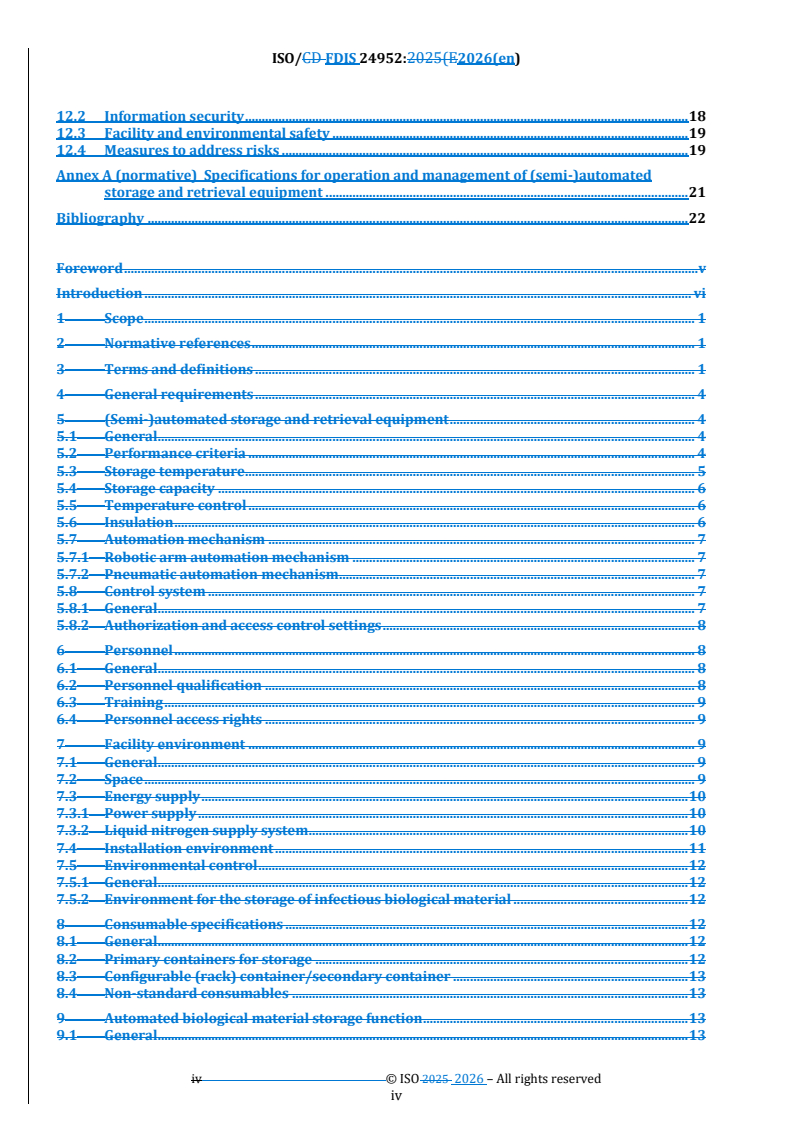
Contents
- Introduction
- 1 Scope
- 2 Normative references
- 3 Terms and definitions
- 4 General requirements
- 5.1 General
- 5.2 Performance criteria
- 5.3 Storage temperature
- 5.4 Storage capacity
- 5.5 Temperature control
- 5.6 Insulation
- 5.7 Automation mechanism
- 5.8 Control system
- 6 Personnel
- 6.1 General
- 6.2 Personnel qualification
- 6.3 Training
- 6.4 Personnel access rights
- 7 Facility environment
- 7.1 General
- 7.2 Space
- 7.3 Energy supply
- 7.4 Installation environment
- 7.5 Environmental control
- 8 Consumable specifications
- 8.1 General
- 8.2 Primary containers for storage
- 8.3 Configurable (rack) container/secondary container
- 8.4 Non-standard consumables
- 9 Automated biological material storage function
- 9.1 General
- 9.2 Storage
- 9.3 Biological material retrieval
- 9.4 Biological material return
- 9.5 Biological material organization
- 9.6 Sample library
- 10.1 General manufacturer requirements
- 10.2 Self-inspection
- 10.3 Calibration
- 10.4 Verification and acceptance
- 11 Third-party monitoring
- 12 Safety management
- 12.1 Personnel safety
- 12.2 Information security
- 12.3 Facility and environmental safety
- 12.4 Measures to address risks
- Annex A
- Bibliography
Introduction
A biobank is a collection of biological materials and associated data with biological material numbers spanning from the thousands to hundreds, or less. During the past decades, more and more biobanks were established for research purposes. Recently, biobanks storing millions of biological materials and supported by governments have been established, allowing experts to focus on the quality of biological materials rather than quantity. The first international biobank standard, ISO 20387, was published by ISO/TC 276. At present, many countries have created biobanks to represent their own populations. Specialized biobanks have been established around the world, United States in 1987, the UK Biobank in 1999, the European Biological Sample Bank in 2001, the Biobank Japan (BBJ) in 2004, and the European Union established the Pan European Biological Sample Bank and Biomolecular Resource Research Platform (BBMRI) in 2008, China Beijing Biobank in 2011, China Shanghai Biobank in 2018, China National GeneBank in 2011. In these large biobanks, millions of biological materials are stored and processed. It is a challenge to store and manage those biological materials with high quality standards. The UK Biobank is well known for their automatic storage in -80 °C. However, during the last ten years, multiple biobanks (> 10 biobanks) in Europe, USA, Japan and China have implemented automatic storage solutions. There are more than 50 (semi-)automatic storage biobanks in the world and the number is growing. (Semi-)automatic storage solutions are very expensive and in this fast growth period, it is important to set/have standards for (semi- )automatic storage equipment, to cover issues, such as design, maintenance, management, and training to enable efficient storage with high quality output biological materials. (Semi-)automatic storage equipment can cause significant loss of money or damage biological materials if no standards for their setup and operation are available. The various (semi-)automatic storage equipment units can cause difficulties in transportation between the equipment. This expensive and complex equipment requires standards, and professional care or operation process(es).
Biobanking includes human and non-human biological materials, such as plants, animals, microorganisms, seeds, and cells. (Semi-)automated storage and retrieval equipment can store all types of biological material utilizing different designs for specific purposes, or applications. In this document, the following verbal forms are used:
- — “shall” indicates a requirement;
- — “should” indicates a recommendation;
- — “may” indicates a permission;
- — “can” indicates a possibility or a capability.
Further details can be found in the ISO/IEC Directives, Part 2.
FINAL DRAFT International Standard ISO/FDIS 24952:2026(en)
Biotechnology — Biobanking — General requirements for (fully automated and semi-)-automated storage and retrieval equipment
1 Scope
This document specifies general requirements for fully automated and semi-automated storage and retrieval equipment for biobanking, including their design, customization and installation, (semi-)automated storage and retrieval functions, performance, personnel, facility environment, operation and maintenance. NOTE Where this document addresses both ‘fully automated and semi-automated storage and retrieval equipment’ this is made clear by using the shortened form of ‘(semi-)automated storage and retrieval equipment’. This document specifies consumable and software systems for (semi-)automated storage and retrieval equipment for biobanking.
This document is applicable to manufacturers of (semi-)automated storage and retrieval equipment, as well as to biobanks that use or operate such equipment. This document is applicable to manufactures of consumables of (semi-)automated storage and retrieval equipment.
2 Normative references
The following documents are referred to in the text in such a way that some or all of their content constitutes requirements of this document. For dated references, only the edition cited applies. For undated references, the latest edition of the referenced document (including any amendments) applies. <std>ISO 20387, Biotechnology — Biobanking — General requirements for biobanks</std> <std>ISO/IEC 27001, Information security, cybersecurity and privacy protection — Information security management systems — Requirements</std> ISO 20387, Biotechnology — Biobanking — General requirements for biobanks
3 Terms and definitions
For the purposes of this document, the terms and definitions in ISO 20387 and the following apply. ISO and IEC maintain terminological databases for use in standardization at the following addresses:
- — ISO Online browsing platform: available at https://www.iso.org/obphttps://www.iso.org/obp
- — IEC Electropedia: available at https://www.electropedia.org/https://www.electropedia.org/ 3.1 3.1 automated picker automated specific arms which can pick up and place tubes or containers in automated storage and retrieval equipment (3.3)(3.3)
ISO/CD FDIS 24952:2025(E2026(en) 3.2 3.2 automated storage controlled environment or system where biological materials are systematically placed, organized, and retrieved using programmable machines with minimal human intervention Note 1 to entry: Biological material handling, tracking and retrieval are performed by robotic arms or pneumatic devices. However, when adding a sample into an equipment with automated storage, human intervention is needed in the form of forwarding the sample to the equipment for it to be scanned and/or taken into the storage. EXAMPLE A biobank receives a shipment of sample tubes. After manually loading the shipment into the receiving module, the system automatically identifies each tube by barcode scanning, transfers the tubes through a controlledtemperature pathway, assigns storage locations, stores the tubes in the repository, and subsequently retrieves requested tubes for distribution. No human intervention is needed during routine sample handling, storage, retrieval or inventory operations.
3.3 3.3 automated storage and retrieval equipment equipment specifically designed for the storage of biological materials that operates with minimal human intervention, utilizing robotics or pneumatic devices, conveyor or pneumatic tube systems, and computerized controls to manage the storage, retrieval, and tracking of biological materials in a highly efficient and accurate manner Note 1 to entry: Automated pneumatic access systems do not require robotic arms. They transfer biological material through pneumatic pipelines and do not need cryopreservation tube boxes or racks for storage. EXAMPLE A biobank receives a shipment of sample tubes. After manually loading the shipment into the receiving module, the system automatically identifies each tube by barcode scanning, transfers the tubes through a controlledtemperature pathway, assigns storage locations, stores the tubes in the repository, and subsequently retrieves requested tubes for distribution. No human intervention is needed during routine sample handling, storage, retrieval or inventory operations.
3.4 3.4 automation implement work processes through automated methods or device 3.5 3.5 buffer zone designated space within a (semi)automated storage system for temporary holding of biological materials prior to retrieval, disposal or before being moved to long-term storage 3.6 3.6 configurable (rack) container container adapted to robot arms, which is used to transfer or store primary containers (3.15)(3.15) or secondary containers (3.16)(3.16) that do not conform with relevant container quality or size specifications for use by a (semi-)automated storage and retrieval equipment (3.18)(3.18) Note 1 to entry: Normally standard consumables, customized according to relevant quality or size specifications. Note 2 to entry: For pneumatic access systems, a secondary container or configurable (rack) container such as a transfer tank is not mandatory.
3.7 3.7 dedicated storage area specifically allocated space within the biobank facility designed to house (semi-)automated storage and retrieval equipment (ASRE) which meets the power supply and infrastructure requirements necessary for the operation of the installed ASRE(s)
ISO/FDIS 24952:2026(en) 3.8 3.8 device self-inspection program structured and systematic process implemented by a device manufacturer or operator to internally assess and evaluate the conformance, performance, and safety of their devices 3.9 3.9 docking interface physical or virtual connection point where two equipment, devices, or components can be joined or integrated to enable data exchange, communication, or interaction 3.10 3.10 equipment control system hardware and software platform designed to organize, track, manage, store and retrieve data related to biological materials stored within a (semi-)automated storage and retrieval equipment (3.18)(3.18) 3.11 3.11 human-interaction interface interface allows human as users to interact with and manipulate the (semi-)automated storage and retrieval equipment (3.18)(3.18) 3.12 3.12 inbound list biological material list which consists of all biological material entering the (semi-)automated storage and retrieval equipment (3.18)(3.18) 3.13 3.13 liquid nitrogen tower vessel containing the liquid nitrogen that is intended to be used for supplying the storage unit cooling system 3.14 3.14 outbound list list of biological material which is taken out from the automated storage and retrieval equipment (3.3)(3.3) 3.15 3.15 primary container receptacle that is in direct contact with the biological material for storage and/or transportation of a biological material, and adapted to the type of biological material and on the kind of subsequent examination or analysis Note 1 to entry: Adapted from ISO 11609:2017, 3.4 and ISO 11074:2025, 4.4.19. 3.16 3.16 secondary container container into which the primary container (3.15)(3.15) is placed [SOURCE: ISO 12891-1:2015, 2.6] 3.17 3.17 semi-automated storage controlled environment or system where biological materials are systematically placed, organized, and retrieved using a combination of human input and programable machines Note 1 to entry: Biological material handling, tracking and retrieval are performed by robotic arms or pneumatic devices.
EXAMPLE A biobank uses an automated storage unit in a semi-automated storage and retrieval equipment to maintain and organize sample racks. Operators manually scan sample identifiers, place sample tubes into racks, and
ISO/CD FDIS 24952:2025(E2026(en) remove requested tubes following system-generated location information. The storage equipment performs location management and rack movement, while sample loading, retrieval and other handling steps require human intervention. 3.18 3.18 semi-automated storage and retrieval equipment equipment specifically designed for the storage of biological materials that operates with partial human intervention, that can utilize robotics, conveyor systems, and computerized controls to manage the storage, retrieval, and tracking of biological material EXAMPLE A biobank uses an automated storage unit in a semi-automated storage and retrieval equipment to maintain and organize sample racks. Operators manually scan sample identifiers, place sample tubes into racks, and remove requested tubes following system-generated location information. The storage equipment performs location management and rack movement, while sample loading, retrieval and other handling steps require human intervention. 3.19 3.19 storage mode specific method and conditions under which biological materials are preserved to maintain their integrity, viability, and usability over time Note 1 to entry: This can include factors such as temperature (e.g., cryogenic, refrigerated, ambient), containment (e.g., liquid nitrogen tanks, freezers, desiccation chambers), and preservation techniques (e.g., freezing, lyophilization, fixation).
3.20 3.20 storage task activity to run the (semi-)automated storage and retrieval equipment (3.18)(3.18)
4 General requirements
The relevant requirements for the traceability of biological material and associated data and the storage of biological material from ISO 20387 shall be implemented.
5 (Semi-)automated storage and retrieval equipment
5.1 General
The (semi-)automated storage and retrieval equipment shall be provided, installed and operated within defined specifications to regulate storage conditions, uphold biological material integrity, and sustain equipment functionality. Annex AAnnex A specifies the requirements for normal operation of storage equipment, storage temperature, etc.
5.2 Performance criteria
5.2.1 5.2.1 The (semi-)automated storage and retrieval equipment shall meet specific performance criteria critical to the efficient and reliable operation of the biobank. These criteria should encompass a range of factors, including but not limited to storage capacity to accommodate a large volume of biological material, processing speed to ensure rapid and accurate handling of biological material, transfer speed to guarantee the biological materials be transferred to storage and retrieval equipment safely and timely, retrieval speed for timely access to stored materials, and a precisely controlled temperature range to maintain biological material integrity.
In addition to these primary performance criteria, other essential factors can include:
a) a) equipment scalability to accommodate future growth; b) b) robust security features and access control to safeguard sensitive data and biological materials;
ISO/FDIS 24952:2026(en) c) c) redundancy and backup to ensure equipment reliability; d) d) intuitive human-interaction interface allowing for easy operation and management; e) e) the ability to integrate with equipment control system and other data management platforms; and f) f) the adaptability to evolving technological advancements in the field of biobank automation. 5.2.2 5.2.2 The manufacturer shall provide suitable devices which meet the requirements for temperature settings and accuracy specified by the biobank.
5.2.3 5.2.3 The (semi-)automatic storage and retrieval equipment shall perform real-time monitoring of the environmental conditions within each storage and retrieval unit to ensure that biological materials are stored and accessed in a safe and stable state.
5.2.4 5.2.4 The (semi-)automatic storage and retrieval equipment shall have an alarm function (e.g. SMS or email) to notify the user in real-time when any abnormal conditions, e.g. temperature, deviations occur. 5.2.5 5.2.5 The (semi-)automatic storage and retrieval equipment shall be able to real-time display the actual temperature, set temperature, alarm information and sample management data. 5.2.6 5.2.6 The (semi-)automatic storage and retrieval equipment shall support remote monitoring, allowing users to view equipment status and temperature data in real-time (e.g. mobile facility). NOTE The (semi-)automatic storage and retrieval equipment can be equipped with an IoT (Internet of Things) module, which can collect temperature and humidity in real time, upload real-time information and error alarm, record and analyse historical data, and can also have comprehensive information summary function. 5.2.7 5.2.7 The picking speed, (e.g. total time of movement, time for pick and place) shall be stated in the manufacturer’s instructions for use, if applicable.
5.2.8 5.2.8 The working noise of the (semi-)automated storage and retrieval equipment should fall within [1] acceptable limit, typically less than 80 dB. .[1] The manufacturer should ensure this requirement. NOTE The minimum health and safety requirements regarding exposure of workers to the risks arising from [1] physical agents (noise) introduces lower exposure action value at Leq, 8 h = 80 dB(A) .)[1]. 5.2.9 5.2.9 The automated storage and retrieval equipment should adopt an efficient energy saving technology.
5.2.10 5.2.10 The liquid nitrogen automatic biological material storage equipment shall have safety devices such as an oxygen deficiency monitor and temperature alarms.
5.3 Storage temperature
The (semi-)automated storage and retrieval equipment shall be able to meet specified biological material storage temperature requirements. Different storage temperature settings should be available based on relevant types of biological materials as needed. Such requirements can be established by the manufacturer alone or in coordination with the biobank.
The manufacturer shall specify the temperature range(s) with any known tolerance that the (semi-)automated storage and retrieval equipment is designed to maintain.
The appropriate biological material storage temperature shall be determined by the biobank taking into account relevant factors including but not limited to the biological material type, the intended use and expected shelf-life.
ISO/CD FDIS 24952:2025(E2026(en)
5.4 Storage capacity
The storage capacity of the (semi-)automated storage and retrieval equipment shall be planned, taking into account limitations such as the available space for the equipment, the construction budget and future expansion needs.
NOTE In a given volume of space, there is a storage capacity based on the different specifications of tubes. Within the storage space, the equipment shall be designed to accommodate and handle different types of biological materials:
a) a) in accordance with the specifications (i.e. required storage temperature, intended storage time, primary/secondary container dimensions and specifications) of each biological material. b) b) using appropriate, uniquely identifiable tagging or barcoding formats (e.g. QR code, 2D-code, 1D-barcode, RFID);
5.5 Temperature control
The (semi-)automated storage and retrieval equipment shall be able to establish and maintain storage conditions that meet the requirements of dedicated biological material preservation. The equipment shall be designed to operate at defined temperatures, e.g. ranging from ambient to liquid nitrogen. The reliability of the temperature regulation unit should be ensured. Temperature control systems should be adapted according to the different storage temperature requirements of biological material, environmental conditions (7.5),(7.5), cost effectiveness, and safety management (Clause 12).(12).
NOTE 1 Common refrigeration methods include mechanical refrigeration, liquid nitrogen refrigeration, etc. NOTE 2 The equipment can also operate at or be designed for use at room temperature or 2 °C to 8 °C. The requirements for the storage environment temperature should meet the requirements specified in 5.3.5.3. A short-term backup plan shall be developed to ensure that accurate storage conditions (such as temperature) can be maintained in the event of an emergency that affects the predetermined storage conditions. NOTE 3 Common backup plans include backup power supply, redundant cooling systems, emergency response procedures, alternative storage equipment, etc.
5.6 Insulation
According to the biological material storage temperature requirements, the (semi-) automated storage and retrieval equipment should have insulation to ensure that the temperature distribution in the storage environment is as uniform as possible. The biobank and manufacturer can agree upon acceptable temperature distribution.
...