

ISO 23494-2:2026
(Main)Biotechnology — Provenance information model for biological material and data — Part 2: Common provenance model
- Abstract
This document specifies a common model for generating, maintaining, and provisioning provenance information on objects, such as biological material and data. This document also specifies requirements for provenance information serialization to achieve its interoperability. The provenance information covers any information relevant to the traceability, quality and fitness for purpose of the biological material and data generated throughout the life cycle of the biological material from collection to analysis, including data originating from analytical procedures applied to the biological material and further processing of the data. This document is applicable to organizations, authorities and industries that are: acquiring, collecting, processing, testing, analysing, storing, or distributing biological material in biotechnology and biomedicine (e.g., biobanks, laboratories, biomedical research as well as biotechnological development or production); generating, collecting, analysing, processing, or storing data on and related to biological material (e.g., biobanks, laboratories, developers, manufacturers, or other institutions and commercial organizations in biotechnology or biomedicine); generating, collecting, analysing, processing, or storing data or digital objects in biotechnology and biomedicine (e.g., in vitro/in vivo/in silico diagnostics developers and manufacturers, or other institutions and commercial organizations in the domain); )manufacturing devices or software for the afore mentioned tasks or providing facilities for these tasks. This document is also applicable to providers of services related to provenance information management (e.g., provenance information generation, storage, provision, or validation). Customers, regulatory authorities, organizations and schemes using peer-assessment, accreditation bodies, and others can use this document in confirming or recognizing the competence of the aforementioned parties. This document does not apply to biological material and data used for medical diagnosis and therapy. NOTE 1 This document can be applied by organizations performing laboratory or research activities as well as other activities in biotechnology and biomedicine. NOTE 2 International, national, or regional regulations, standards, or requirements can apply to specific topics covered in this document, e.g., for organizations handling human materials procured and used for diagnostic and treatment purposes.
- Status
- Published
- Publication Date
- 21-Jun-2026
- Technical Committee
- ISO/TC 276 - Biotechnology
- Drafting Committee
- ISO/TC 276/WG 5 - Data processing and integration
- Current Stage
- 6060 - International Standard published
- Start Date
- 22-Jun-2026
- Due Date
- 04-Dec-2026
- Completion Date
- 22-Jun-2026

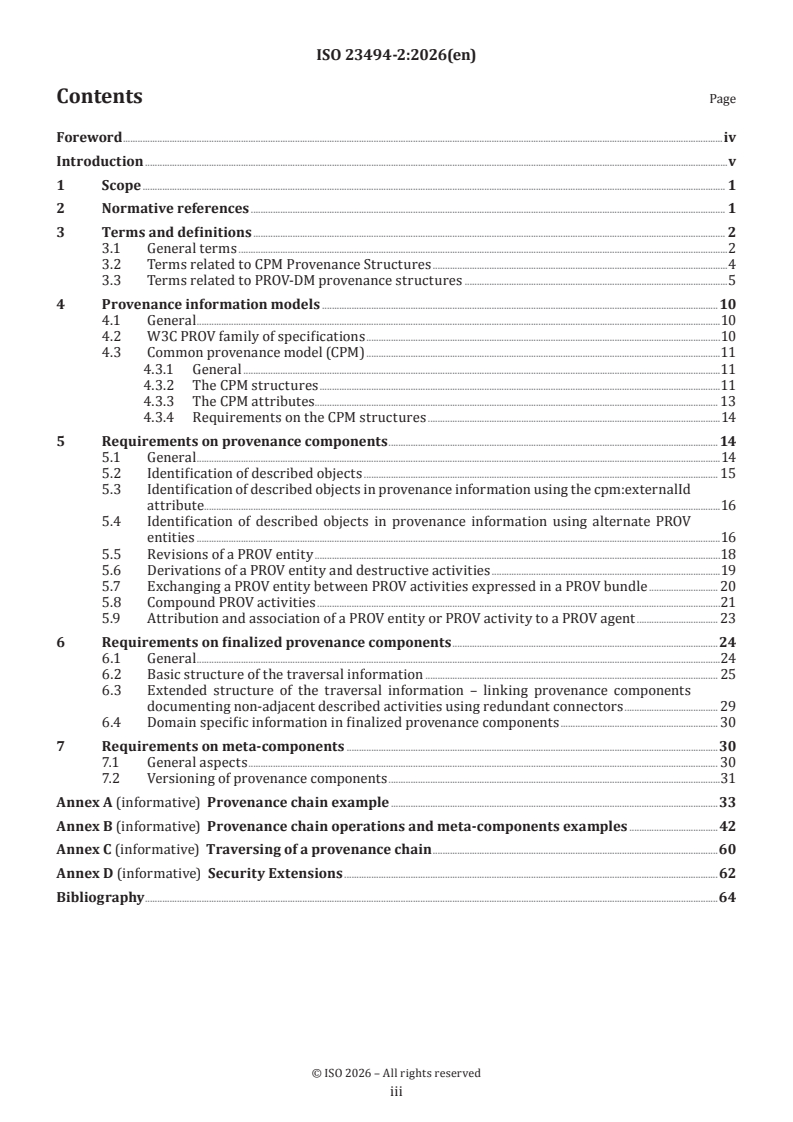
ISO 23494-2:2026 is an ISO International Standard from ISO that defines a common provenance model (CPM) for biological material and related data. It specifies how provenance information is generated, maintained, provided, and serialized so that traceability, quality, fitness for purpose, and interoperability can be assessed across biotechnology and biomedicine workflows. It is written for organizations and service providers that handle biological material, related data, or provenance management.
What does ISO 23494-2:2026 specify?
ISO 23494-2:2026 specifies a common model for provenance information on described objects such as biological material and data, and it sets serialization rules so that the information can be exchanged consistently. The document is organized around the model itself, the requirements for provenance components, finalized provenance components, and meta-components.
The standard applies to the life cycle of biological material from collection to analysis, including data created by analytical procedures and later processing of that data. It excludes biological material and data used for medical diagnosis and therapy.
| Annex | What it covers |
|---|---|
| Annex A | A full provenance-chain example for a distributed, multi-organization research pipeline |
| Annex B | How to add preceding or subsequent provenance components, including redundant connectors and versioning examples |
| Annex C | A baseline algorithm for traversing a provenance chain |
| Annex D | Security extensions, including non-repudiation support in meta-components |
Clause 4 sets out the provenance information models and shows how the CPM builds on the W3C PROV family of specifications. Clause 5 covers provenance components, Clause 6 covers finalized provenance components, and Clause 7 covers meta-components.
What are the key requirements of ISO 23494-2:2026?
ISO 23494-2:2026 is mainly about how to structure provenance so that different organizations can exchange and follow it without losing meaning. The key practical rule is that provenance is not just recorded; it is organized into components, linked by explicit connectors, and made machine-readable in a controlled way.
Core component rules
Clause 5 requires provenance information in a component to be expressed according to this document and according to PROV-DM and its valid serialization. Each provenance component must have a unique identifier, and timestamps must reflect the event order defined by the model.
Clause 5 also says that provenance components shall be valid in line with the validation rules used by the standard, and that a provenance component is realized as a PROV bundle. In practice, that means implementers need a consistent packaging and validation approach before they can exchange or archive provenance records.
Identifying described objects
Clause 5.2 to 5.4 give two main ways to identify described objects. A described object is represented as a PROV entity, and it can be identified either with the cpm:externalId attribute or with alternate PROV entities.
This matters because biological material and data often move through systems that use different local identifiers. The CPM lets you represent one object consistently even when a lab label, dataset ID, or other external identifier changes or needs more context.
Revisions, derivations, and destructive activities
Clause 5.5 treats a PROV entity as a snapshot of a described object at a point in time. Clause 5.6 covers derivation and destructive activities, including the case where a new entity results from transformation, update, or construction from a previous one.
In practice, this is how the standard models change over time. Instead of overwriting history, it records new states and can invalidate an older entity when an activity destroys or replaces it.
Activities, exchange, and compound processes
Clause 5.7 covers exchange of a PROV entity between activities in a PROV bundle, and Clause 5.8 covers compound PROV activities with multiple steps. This lets the same workflow model show both a high-level activity and the stepwise work inside it.
For users, that means a process such as preparation, analysis, and later reuse can be traced without flattening everything into a single undifferentiated event.
Responsibility and role
Clause 5.9 assigns responsibility for described activities and related objects to a PROV agent. That keeps the provenance record tied to the people, organizations, or software that carried out the work.
In practice, this supports audits, accountability, and chain-of-custody questions.
Finalized provenance components and traversal information
Clause 6 says a finalized provenance component shall conform to the provenance-component rules, and non-meta components are serialized according to PROV-JSON. Each finalized provenance component has traversal information, and it should also have domain-specific information attached through the compound described activity.
The traversal part has one main activity and uses forward connectors, backward connectors, sender agents, and receiver agents to connect provenance components. The rules also prevent cycles and self-connections, which matters because a provenance chain must be traversable and finite.
Extended linking and meta-components
Clause 6.3 allows redundant connectors so that non-adjacent finalized provenance components can still be linked for forward or backward traceability. Clause 7 says the same rules apply to meta-components, and it adds versioning of provenance components.
In practice, meta-components are what let a system track versions and follow the latest approved form of a finalized provenance component. Annex D shows how they can also carry security metadata such as hashes, certificates, and non-repudiation tokens.
What terms does ISO 23494-2:2026 define?
- Common provenance model (CPM) - The CPM is the data model used in this standard to represent provenance information.
- PROV Data Model (PROV-DM) - PROV-DM is the conceptual provenance model from the W3C PROV family that the CPM builds on.
- Finalized provenance component - A finalized provenance component is a provenance component prepared for conservation or archiving and treated as immutable.
- Provenance controller - A provenance controller is the party that decides why and how provenance information and finalized provenance components are collected, stored, and provided.
- Connector - A connector links finalized provenance components and represents a described object that is exchanged between a sender and a receiver.
- Meta-component - A meta-component is a provenance component that contains provenance information about finalized provenance components.
- Described object - A described object is the physical or digital object that the provenance record is intended to trace.
Who uses ISO 23494-2:2026?
ISO 23494-2:2026 is used by organizations, authorities, and industries that handle biological material or data in biotechnology and biomedicine. That includes biobanks, laboratories, biomedical research groups, and organizations in biotechnological development or production.
It also applies to developers and manufacturers of in vitro, in vivo, and in silico diagnostics, as well as to makers of devices or software for provenance-related tasks. Provenance service providers use it for generation, storage, provision, and validation of provenance information.
Customers, regulatory authorities, peer-assessment schemes, and accreditation bodies can use it to confirm or recognize the competence of those parties. In practice, it supports procurement, oversight, audit, and supplier evaluation where lineage and traceability matter.
Which standards are used with ISO 23494-2:2026?
| Standard | What it contributes |
|---|---|
| PROV-JSON Serialization | The JSON serialization used for non-meta finalized provenance components |
| PROV-CONSTRAINTS | The validation constraints used with the PROV model |
| ISO 23494-1:2026 | The companion part for design concepts and general requirements |
| PROV-DM | The underlying provenance data model on which the CPM is based |
| PROV-O | The ontology used for relations and inheritance of objects |
| PROV-N | The notation used in the examples for human-readable provenance expressions |
These references matter because ISO 23494-2:2026 is not a standalone notation. It is a CPM built on the W3C PROV family, with ISO 23494-1 providing the broader design framework.
What does the ISO 23494-2:2026 document contain?
The document contains the CPM structure definitions, attribute rules, and the requirements for modeling described objects as PROV entities. It also contains rules for identification, revision, derivation, exchange between activities, compound activities, and attribution or association to PROV agents.
It then defines how finalized provenance components are built from traversal information and domain-specific information, including connectors, sender and receiver roles, and traceability links. Clause 7 adds meta-component rules and versioning behavior.
The annexes provide worked examples rather than additional requirements. Annex A shows a distributed research pipeline in digital pathology, Annex B shows how provenance chains are extended and versioned, Annex C gives a traversal algorithm, and Annex D shows security extensions for non-repudiation.
Frequently Asked Questions
ISO 23494-2:2026 is a standard published by the International Organization for Standardization (ISO). Its full title is "Biotechnology — Provenance information model for biological material and data — Part 2: Common provenance model". This standard covers: This document specifies a common model for generating, maintaining, and provisioning provenance information on objects, such as biological material and data. This document also specifies requirements for provenance information serialization to achieve its interoperability. The provenance information covers any information relevant to the traceability, quality and fitness for purpose of the biological material and data generated throughout the life cycle of the biological material from collection to analysis, including data originating from analytical procedures applied to the biological material and further processing of the data. This document is applicable to organizations, authorities and industries that are: acquiring, collecting, processing, testing, analysing, storing, or distributing biological material in biotechnology and biomedicine (e.g., biobanks, laboratories, biomedical research as well as biotechnological development or production); generating, collecting, analysing, processing, or storing data on and related to biological material (e.g., biobanks, laboratories, developers, manufacturers, or other institutions and commercial organizations in biotechnology or biomedicine); generating, collecting, analysing, processing, or storing data or digital objects in biotechnology and biomedicine (e.g., in vitro/in vivo/in silico diagnostics developers and manufacturers, or other institutions and commercial organizations in the domain); )manufacturing devices or software for the afore mentioned tasks or providing facilities for these tasks. This document is also applicable to providers of services related to provenance information management (e.g., provenance information generation, storage, provision, or validation). Customers, regulatory authorities, organizations and schemes using peer-assessment, accreditation bodies, and others can use this document in confirming or recognizing the competence of the aforementioned parties. This document does not apply to biological material and data used for medical diagnosis and therapy. NOTE 1 This document can be applied by organizations performing laboratory or research activities as well as other activities in biotechnology and biomedicine. NOTE 2 International, national, or regional regulations, standards, or requirements can apply to specific topics covered in this document, e.g., for organizations handling human materials procured and used for diagnostic and treatment purposes.
This document specifies a common model for generating, maintaining, and provisioning provenance information on objects, such as biological material and data. This document also specifies requirements for provenance information serialization to achieve its interoperability. The provenance information covers any information relevant to the traceability, quality and fitness for purpose of the biological material and data generated throughout the life cycle of the biological material from collection to analysis, including data originating from analytical procedures applied to the biological material and further processing of the data. This document is applicable to organizations, authorities and industries that are: acquiring, collecting, processing, testing, analysing, storing, or distributing biological material in biotechnology and biomedicine (e.g., biobanks, laboratories, biomedical research as well as biotechnological development or production); generating, collecting, analysing, processing, or storing data on and related to biological material (e.g., biobanks, laboratories, developers, manufacturers, or other institutions and commercial organizations in biotechnology or biomedicine); generating, collecting, analysing, processing, or storing data or digital objects in biotechnology and biomedicine (e.g., in vitro/in vivo/in silico diagnostics developers and manufacturers, or other institutions and commercial organizations in the domain); )manufacturing devices or software for the afore mentioned tasks or providing facilities for these tasks. This document is also applicable to providers of services related to provenance information management (e.g., provenance information generation, storage, provision, or validation). Customers, regulatory authorities, organizations and schemes using peer-assessment, accreditation bodies, and others can use this document in confirming or recognizing the competence of the aforementioned parties. This document does not apply to biological material and data used for medical diagnosis and therapy. NOTE 1 This document can be applied by organizations performing laboratory or research activities as well as other activities in biotechnology and biomedicine. NOTE 2 International, national, or regional regulations, standards, or requirements can apply to specific topics covered in this document, e.g., for organizations handling human materials procured and used for diagnostic and treatment purposes.
ISO 23494-2:2026 is classified under the following ICS (International Classification for Standards) categories: 07.080 - Biology. Botany. Zoology. The ICS classification helps identify the subject area and facilitates finding related standards.
ISO 23494-2:2026 is available in PDF format for immediate download after purchase. The document can be added to your cart and obtained through the secure checkout process. Digital delivery ensures instant access to the complete standard document.
Standards Content (Sample)
International
Standard
ISO 23494-2
First edition
Biotechnology — Provenance
2026-06
information model for biological
material and data —
Part 2:
Common provenance model
Biotechnologie — Modèle d’information sur la provenance des
matériels et données biologiques —
Partie 2: Modèle de provenance commun
Reference number
© ISO 2026
All rights reserved. Unless otherwise specified, or required in the context of its implementation, no part of this publication may
be reproduced or utilized otherwise in any form or by any means, electronic or mechanical, including photocopying, or posting on
the internet or an intranet, without prior written permission. Permission can be requested from either ISO at the address below
or ISO’s member body in the country of the requester.
ISO copyright office
CP 401 • Ch. de Blandonnet 8
CH-1214 Vernier, Geneva
Phone: +41 22 749 01 11
Email: copyright@iso.org
Website: www.iso.org
Published in Switzerland
ii
Contents Page
Foreword .iv
Introduction .v
1 Scope . 1
2 Normative references . 1
3 Terms and definitions . 2
3.1 General terms .2
3.2 Terms related to CPM Provenance Structures .4
3.3 Terms related to PROV-DM provenance structures .5
4 Provenance information models .10
4.1 General .10
4.2 W3C PROV family of specifications .10
4.3 Common provenance model (CPM) .11
4.3.1 General .11
4.3.2 The CPM structures .11
4.3.3 The CPM attributes. 13
4.3.4 Requirements on the CPM structures .14
5 Requirements on provenance components . 14
5.1 General .14
5.2 Identification of described objects . 15
5.3 Identification of described objects in provenance information using the cpm:externalId
attribute.16
5.4 Identification of described objects in provenance information using alternate PROV
entities .16
5.5 Revisions of a PROV entity .18
5.6 Derivations of a PROV entity and destructive activities .19
5.7 Exchanging a PROV entity between PROV activities expressed in a PROV bundle . 20
5.8 Compound PROV activities .21
5.9 Attribution and association of a PROV entity or PROV activity to a PROV agent . 23
6 Requirements on finalized provenance components .24
6.1 General .24
6.2 Basic structure of the traversal information . 25
6.3 Extended structure of the traversal information – linking provenance components
documenting non-adjacent described activities using redundant connectors . 29
6.4 Domain specific information in finalized provenance components . 30
7 Requirements on meta-components .30
7.1 General aspects . 30
7.2 Versioning of provenance components .31
Annex A (informative) Provenance chain example .33
Annex B (informative) Provenance chain operations and meta-components examples .42
Annex C (informative) Traversing of a provenance chain .60
Annex D (informative) Security Extensions .62
Bibliography .64
iii
Foreword
ISO (the International Organization for Standardization) is a worldwide federation of national standards
bodies (ISO member bodies). The work of preparing International Standards is normally carried out through
ISO technical committees. Each member body interested in a subject for which a technical committee
has been established has the right to be represented on that committee. International organizations,
governmental and non-governmental, in liaison with ISO, also take part in the work. ISO collaborates closely
with the International Electrotechnical Commission (IEC) on all matters of electrotechnical standardization.
The procedures used to develop this document and those intended for its further maintenance are described
in the ISO/IEC Directives, Part 1. In particular, the different approval criteria needed for the different types
of ISO document should be noted. This document was drafted in accordance with the editorial rules of the
ISO/IEC Directives, Part 2 (see www.iso.org/directives).
ISO draws attention to the possibility that the implementation of this document may involve the use of (a)
patent(s). ISO takes no position concerning the evidence, validity or applicability of any claimed patent
rights in respect thereof. As of the date of publication of this document, ISO had not received notice of (a)
patent(s) which may be required to implement this document. However, implementers are cautioned that
this may not represent the latest information, which may be obtained from the patent database available at
www.iso.org/patents. ISO shall not be held responsible for identifying any or all such patent rights.
Any trade name used in this document is information given for the convenience of users and does not
constitute an endorsement.
For an explanation of the voluntary nature of standards, the meaning of ISO specific terms and expressions
related to conformity assessment, as well as information about ISO's adherence to the World Trade
Organization (WTO) principles in the Technical Barriers to Trade (TBT), see www.iso.org/iso/foreword.html.
This document was prepared by Technical Committee ISO/TC 276, Biotechnology.
A list of all parts in the ISO 23494 series can be found on the ISO website.
Any feedback or questions on this document should be directed to the user’s national standards body. A
complete listing of these bodies can be found at www.iso.org/members.html.
iv
Introduction
Sharing biological material and data or reuse of existing data have become indispensable for research
activities in biotechnology and biomedicine. Without meticulous documentation of the lineage of the
biological material and data, recording each step in their life cycle that can affect their fitness for purpose,
they are rendered unusable as the observations obtained therefrom become unreliable. In recent years the
scientific community has witnessed a significant number of questionable claims, not least due to unsuited or
[1]
untraceable sources of biological material or data .
Provenance is information about objects, and can be used to assess the quality, reliability, or trustworthiness,
[2]
or, more generally, the fitness for purpose of the objects. The described object is expressed in provenance
as an entity, representing a snapshot of the object and documenting the actual values of its attributes at a
certain point in time. The state of the object at different instants of time is represented by distinct entities.
Provenance documents relations between objects, activities, persons, or organizations that account for the
current state of the object.
By specifying consistent rules for the formalization and serialization of provenance of research objects,
such as biological material and data, this document establishes an integrative framework for improved
reproducibility and reliability of research results. By standardizing provenance information this document
[3]
contributes considerably to the adoption of the FAIR principles as findability, accessibility, interoperability,
and reusability of provenance information are objectives central to this specification. In addition, by utilizing
this document for the harmonization of provenance information the adoption of FAIR principles for physical
or digital objects is facilitated.
[4]
The common provenance model (CPM) described in this document specifies common entities with
defined semantics that are required along the life cycle of various objects in biotechnology and biomedicine.
By providing different abstraction layers, connectors, and encapsulations this document constitutes a
comprehensive and versatile instrument to record and maintain provenance information. The CPM does
neither prescribe the actual content, nor methods or items to be recorded in provenance information but is
rather meant to provide a foundation for domain or application specific implementations. The CPM builds on
[5]
a widely accepted standard for a generic data model of provenance information (PROV-DM ) as furnished
by the World Wide Web Consortium (W3C).
Application of the CPM on a specific use case is exemplified in Annex A. Annex B shows how a provenance
chain can be created using two elemental operations. A basic provenance chain algorithm is presented in
Annex C. Annex D shows how versioning information in a meta provenance component can be extended with
additional information. The purpose of these annexes is to provide specific examples of how the CPM can be
used.
v
International Standard ISO 23494-2:2026(en)
Biotechnology — Provenance information model for
biological material and data —
Part 2:
Common provenance model
1 Scope
This document specifies a common model for generating, maintaining, and provisioning provenance
information on objects, such as biological material and data. This document also specifies requirements for
provenance information serialization to achieve its interoperability. The provenance information covers
any information relevant to the traceability, quality and fitness for purpose of the biological material and
data generated throughout the life cycle of the biological material from collection to analysis, including data
originating from analytical procedures applied to the biological material and further processing of the data.
This document is applicable to organizations, authorities and industries that are:
a) acquiring, collecting, processing, testing, analysing, storing, or distributing biological material
in biotechnology and biomedicine (e.g., biobanks, laboratories, biomedical research as well as
biotechnological development or production);
b) generating, collecting, analysing, processing, or storing data on and related to biological material (e.g.,
biobanks, laboratories, developers, manufacturers, or other institutions and commercial organizations
in biotechnology or biomedicine);
c) generating, collecting, analysing, processing, or storing data or digital objects in biotechnology
and biomedicine (e.g., in vitro/in vivo/in silico diagnostics developers and manufacturers, or other
institutions and commercial organizations in the domain);
d) manufacturing devices or software for the afore mentioned tasks or providing facilities for these tasks.
This document is also applicable to providers of services related to provenance information management
(e.g., provenance information generation, storage, provision, or validation).
Customers, regulatory authorities, organizations and schemes using peer-assessment, accreditation bodies,
and others can use this document in confirming or recognizing the competence of the aforementioned
parties.
This document does not apply to biological material and data used for medical diagnosis and therapy.
NOTE 1 This document can be applied by organizations performing laboratory or research activities as well as
other activities in biotechnology and biomedicine.
NOTE 2 International, national, or regional regulations, standards, or requirements can apply to specific topics
covered in this document, e.g., for organizations handling human materials procured and used for diagnostic and
treatment purposes.
2 Normative references
The following documents are referred to in the text in such a way that some or all of their content constitutes
requirements of this document. For dated references, only the edition cited applies. For undated references,
the latest edition of the referenced document (including any amendments) applies.
The PROV-JSON Serialization. A JSON Representation for the PROV Data Model: W3C Member Submission.
Available also from https:// www .w3 .org/ submissions/ 2013/ SUBM -prov -json -20130424/
PROV-CONSTRAINTS. DE NIES, T. Constraints of the PROV Data Model. 2013. Available also from: https://
www .w3 .org/ TR/ 2013/ REC -prov -constraints -20130430/
3 Terms and definitions
1)
For the purposes of this document, the following terms and definitions apply .
ISO and IEC maintain terminology databases for use in standardization at the following addresses:
— ISO Online browsing platform: available at https:// www .iso .org/ obp
— IEC Electropedia: available at https:// www .electropedia .org/
3.1 General terms
3.1.1
biological material
organic entity or any substance derived or part obtained from:
a) an organic entity, such as microorganism(s) or multicellular organism(s) (e.g. human, animal, fungus,
brown seaweed, plant); or
b) an environmental sample (e.g. soil, sediment, water, air), that contains an organic entity of interest
[SOURCE: ISO/DIS 20387:2025, 3.6]
3.1.2
described activity
activity performed on a described object (3.1.3)
Note 1 to entry: Examples for activities performed on physical objects can be biobanking activities as specified in
ISO 20387, Examples for activities performed on digital objects can be data analytics as specified in ISO/IEC 20546.
[SOURCE: ISO 23494-1:2026, 3.3]
3.1.3
described object
physical or digital object to be traced
[SOURCE: ISO 23494-1:2026, 3.4]
3.1.4
provenance information
information that documents the history of a described object (3.1.3) and related described activities (3.1.2),
and that contains information about origin or source of the described object, any changes that have occurred
since it was created, and who has had custody of it since it was created
[SOURCE: ISO 23494-1:2026, 3.15]
3.1.5
finalized provenance component
provenance component (3.1.9) which is prepared to be conserved or archived and which is considered as
being immutable
[SOURCE: ISO 23494-1:2026, 3.6]
1) With permission from W3C, this document contains copied or modified definitions from the W3C PROV Data Model,
a Recommendation from 30 April 2013, available online at https:// www .w3 .org/ TR/ prov -dm/ .
3.1.6
common provenance model
CPM
data model for provenance information (3.1.4) representation
[SOURCE: ISO 23494-1:2026, 3.2]
3.1.7
PROV-DM
conceptual data model forming a basis for the World Wide Web Consortium (W3C) provenance (PROV)
family of specifications
[5]
[SOURCE: W3C PROV -DM: 2013 ]
3.1.8
finalization event
event at which provenance information (3.1.4) is transformed into a finalized provenance component (3.1.5)
[SOURCE: ISO 23494-1:2026, 3.5]
3.1.9
provenance component
provenance information (3.1.4) represented according to the common provenance model (3.1.6) with a unique
identifier assigned to it
[SOURCE: ISO 23494-1:2026, 3.12]
3.1.10
meta-component
provenance component (3.1.9) that contains provenance information (3.1.4) about finalized provenance
components (3.1.5)
[SOURCE: ISO 23494-1:2026, 3.9]
3.1.11
provenance controller
party (3.1.20) that determines the purposes for which and the means by which provenance information
(3.1.4) and finalized provenance components (3.1.5) are collected, stored, and provided, and that collects
finalized provenance components documenting relevant described activities (3.1.2)
[SOURCE: ISO 23494-1:2026, 3.13]
3.1.12
sender
provenance controller (3.1.11) that is providing a described object (3.1.3) to a provenance controller
3.1.13
receiver
provenance controller (3.1.11) that is receiving a described object (3.1.3) from a provenance controller
3.1.14
provenance structure
object in a provenance component (3.1.9), such as a PROV entity (3.3.14), PROV activity (3.3.1), PROV agent
(3.3.2) or a relation
Note 1 to entry: In PROV-DM the term is used without an exact definition. PROV-DM distinguishes core structures
which form the essence of provenance information, and extended structures, that enhance and refine core structures
with more expressive capabilities.
3.1.15
qualified name
set consisting of the [prefix], [namespace name], and [local name] properties of an element information item
or attribute information item
[SOURCE: ISO/IEC 24824-1:2007, 3.4.11]
3.1.16
specialization
property of an object with regard to another object, meaning that the former object presents all the aspects
of the latter, along with some additional aspects
3.1.17
external identifier
identifier for a physical or digital object
Note 1 to entry: An external identifier can be a label on a container for biological material (3.1.1), an identifier of a data
set, or a registration number
Note 2 to entry: an external identifier need not be persistent nor unique
3.1.18
namespace
[6]
term, identified by an IRI RFC 3987
[5]
[SOURCE: W3C PROV -DM: 2013 ]
3.1.19
persistent identifier
unique identifier that ensures permanent access for a digital object by providing access to it independently
of its physical location or current ownership
[11]
[SOURCE: ISO 24619:2011, 3.2.4 ]
3.1.20
party
natural person or legal person, whether or not incorporated, or a group of either
[SOURCE: ISO 27729:2024, 3.1]
3.2 Terms related to CPM Provenance Structures
3.2.1
connector
provenance structure (3.1.14), that serves as an interconnection between finalized provenance components
(3.1.5) and represents a described object (3.1.3), which can be or has been exchanged between a sender
(3.1.12) and a receiver (3.1.13)
3.2.2
backward connector
connector (3.2.1) that represents a received described object (3.1.3)
Note 1 to entry: The backward connector is present in the receiver’s finalized provenance component, documenting
information necessary to locate and access respective sender’s finalized provenance component.
3.2.3
forward connector
connector (3.2.1) that represents a described object (3.1.3) that can be sent from a sender (3.1.12) to a receiver
(3.1.13)
3.2.4
specialized forward connector
connector (3.2.1) that represents a described object (3.1.3) that has been sent from a sender (3.1.12) to a
receiver (3.1.13)
Note 1 to entry: A specialized forward connector is present in the sender’s finalized provenance component
documenting information necessary to locate and access respective receiver’s finalized provenance component.
3.2.5
identifier entity
provenance structure (3.1.14) that represents an external identifier (3.1.17)
3.2.6
main activity
provenance structure (3.1.14) that represents the described activity (3.1.2) documented in a particular
finalized provenance component (3.1.5)
3.2.7
receiver agent
provenance structure (3.1.14) that represents a receiver (3.1.13) in a sender’s finalized provenance component
(3.1.5) in the context of passing a described object (3.1.3) between two provenance controllers (3.1.11)
3.2.8
sender agent
provenance structure (3.1.14) that represents a sender (3.1.12) in a receiver’s finalized provenance component
(3.1.5) in the context of passing a described object (3.1.3) between two provenance controllers (3.1.11)
3.2.9
current agent
provenance structure (3.1.14) that represents a provenance controller (3.1.11)
3.3 Terms related to PROV-DM provenance structures
3.3.1
PROV activity
provenance structure (3.1.14) that represents something that occurs over a period of time and acts upon or
with PROV entities (3.3.14) and it can include consuming, processing, transforming, modifying, relocating,
using, or generating PROV entities
Note 1 to entry: The definition is derived from Reference [5]. The original definition in PROV-DM where the definition
explicitly refers to a provenance structure was modified. The term is prefixed by ”PROV” for disambiguation.
Introducing this syntax makes it possible to express things like “a real-world entity is represented by a PROV entity”
in provenance information. The original PROV definitions are saying that, for instance, “PROV entities” are “real-world
entities”.
[5]
[SOURCE: W3C PROV -DM: 2013 ]
3.3.2
PROV agent
provenance structure (3.1.14) that represents something or someone that bears some form of responsibility
for a PROV activity (3.3.1) taking place, for the existence of a PROV entity (3.3.14), or for another agent’s PROV
activity
[5]
Note 1 to entry: The definition is derived from. The original definition in PROV-DM where the definition explicitly
refers to a provenance structure was modified. The term is prefixed by ”PROV” for disambiguation.
Note 2 to entry: PROV-DM defines the following additional types of PROV agents: PROV person (3.3.21), PROV
organization (3.3.20), and PROV Software Agent (3.3.24)
[5]
[SOURCE: W3C PROV -DM: 2013 ]
3.3.3
PROV alternate
provenance structure (3.1.14) that represents a relation between two PROV entities (3.3.14) – alternates –
which present the same or different aspects of the same thing, and the alternate PROV entities can overlap
in time
Note 1 to entry: The definition is derived from Reference [5]. The original definition in PROV-DM where the definition
explicitly refers to a provenance structure was modified. The term is prefixed by ”PROV” for disambiguation. The
reference to temporal overlap was reworded in accordance with the ISO house style, without altering its original
meaning.
[5]
[SOURCE: W3C PROV -DM: 2013 ]
3.3.4
PROV association
provenance structure (3.1.14) that represents assignment of responsibility to a PROV agent (3.3.2) for a PROV
activity (3.3.1), indicating that the PROV agent had a role in the PROV activity
Note 1 to entry: The definition is derived from Reference [5]. Compared to the original definition in PROV-DM, the
definition in this document was modified by explicitly referring to a provenance structure. The term is prefixed by
”PROV” for disambiguation.
[5]
[SOURCE: W3C PROV -DM: 2013 ]
3.3.5
PROV attribution
provenance structure (3.1.14) that represents ascribing of a PROV entity (3.3.14) to a PROV agent (3.3.2)
Note 1 to entry: The definition is derived from Reference [5]. Compared to the original definition in PROV-DM, the
definition in this document was modified by explicitly referring to a provenance structure. The term is prefixed by
”PROV” for disambiguation.
[5]
[SOURCE: W3C PROV -DM: 2013 ]
3.3.6
PROV bundle
named set of provenance descriptions, and is itself a PROV entity (3.3.14), so allowing provenance of
provenance to be expressed
[5]
[SOURCE: W3C PROV -DM: 2013 ]
3.3.7
PROV communication
provenance structure (3.1.14) that represents exchange of some unspecified PROV entity (3.3.14) by two PROV
activities (3.3.1), one PROV activity using some PROV entity generated by the other
Note 1 to entry: The definition is derived from Reference [5]. Compared to the original definition in PROV-DM, the
definition in this document was modified by explicitly referring to a provenance structure. The term is prefixed by
”PROV” for disambiguation.
[5]
[SOURCE: W3C PROV -DM: 2013 ]
3.3.8
PROV collection
type of a PROV entity (3.3.14) that provides a structure to some constituents that must themselves be PROV
entities
Note 1 to entry: The definition is derived from Reference [5]. Compared to the original definition in PROV-DM, the
definition in this document was modified by explicitly referring to a type of a provenance structure. The term is
prefixed by ”PROV” for disambiguation.
[5]
[SOURCE: W3C PROV -DM: 2013 ]
3.3.9
PROV delegation
provenance structure (3.1.14) that represents assignment of authority and responsibility to a PROV agent
(by itself or by another PROV agent (3.3.2)) to carry out a specific PROV activity (3.3.1) as a delegate or
representative, while the PROV agent it acts on behalf of retains some responsibility for the outcome of the
delegated work
Note 1 to entry: The definition is derived from Reference [5]. Compared to the original definition in PROV-DM, the
definition in this document was modified by explicitly referring to a provenance structure. The term is prefixed by
”PROV” for disambiguation.
[5]
[SOURCE: W3C PROV -DM: 2013 ]
3.3.10
PROV derivation
provenance structure (3.1.14) that represents transformation of a PROV entity (3.3.14) into another, an update
of a PROV entity resulting in a new one, or the construction of a new PROV entity based on a pre-existing
PROV entity
Note 1 to entry: The definition is derived from Reference [5]. Compared to the original definition in PROV-DM, the
definition in this document was modified by explicitly referring to a provenance structure. The term is prefixed by
”PROV” for disambiguation.
[5]
[SOURCE: W3C PROV -DM: 2013 ]
3.3.11
PROV document
document that consists of an unnamed PROV instance (3.3.17) together with zero or more PROV bundles
(3.3.6)
Note 1 to entry: Technically detailed definition: let a PROV document contain n named PROV bundles b1.bn, as a tuple
(I0,[b1=I1,.,bn=In]) where I0 is the top level instance, for each i, Ii is the instance associated with the PROV bundle b .
[7]
[SOURCE: W3C PROV -CONSTRAINTS: 2013 ]
3.3.12
PROV empty collection
PROV collection (3.3.8) without members
Note 1 to entry: The definition is derived from Reference [5]. The term is prefixed by ”PROV” for disambiguation.
[5]
[SOURCE: W3C PROV -DM: 2013 ]
3.3.13
PROV end
provenance structure (3.1.14) that represents a moment, when a PROV activity (3.3.1) is deemed to have been
ended by a PROV entity (3.3.14), known as trigger
Note 1 to entry: The definition is derived from Reference [5]. Compared to the original definition in PROV-DM, the
definition in this document was modified by explicitly referring to a provenance structure. The term is prefixed by
”PROV” for disambiguation.
[5]
[SOURCE: W3C PROV -DM: 2013 ]
3.3.14
PROV entity
provenance structure (3.1.14) that represents physical, digital, conceptual, or other kind of thing with some
fixed aspects which can be real or imaginary
Note 1 to entry: The definition is derived from Reference [5]. Compared to the original definition in PROV-DM, the
definition in this document was modified by explicitly referring to a provenance structure. The term is prefixed by
”PROV” for disambiguation. The definition was reworded in accordance with the ISO house style, without altering its
original meaning.
Note 2 to entry: PROV-DM defines the additional types of PROV entities (3.3.14), e.g., PROV collection (3.3.8), PROV
empty collection (3.3.12), PROV plan (3.3.22), or PROV bundle (3.3.6)
[5]
[SOURCE: W3C PROV -DM: 2013 ]
3.3.15
PROV generation
provenance structure (3.1.14) that represents completion of production of a new PROV entity (3.3.14) by a
PROV activity (3.3.1)
Note 1 to entry: The definition is derived from Reference [5]. Compared to the original definition in PROV-DM, the
definition in this document was modified by explicitly referring to a provenance structure. The term is prefixed by
”PROV” for disambiguation.
[5]
[SOURCE: W3C PROV -DM: 2013 ]
3.3.16
PROV influence
provenance structure (3.1.14) that represents capacity of a PROV entity (3.3.14), PROV activity (3.3.1), or PROV
agent (3.3.2) to have an effect on the character, development, or behaviour of another by means of PROV
usage (3.3.29), PROV start (3.3.26), PROV end (3.3.13), PROV generation (3.3.15), PROV invalidation (3.3.18),
PROV communication (3.3.7), PROV derivation (3.3.10), PROV attribution (3.3.5), PROV association (3.3.4), or
PROV delegation (3.3.9)
Note 1 to entry: The definition is derived from Reference [5]. Compared to the original definition in PROV-DM, the
definition in this document was modified by explicitly referring to a provenance structure. The term is prefixed by
”PROV” for disambiguation.
Note 2 to entry: Some relations between provenance structures are not considered as PROV influence, e.g., PROV
membership, PROV alternate, or PROV specialization
[5]
[SOURCE: W3C PROV -DM: 2013 ]
3.3.17
PROV instance
set of PROV statements (3.3.27)
[SOURCE: W3C PROV -CONSTRAINTS: 2013 ]
3.3.18
PROV invalidation
provenance structure (3.1.14) that represents start of the destruction, cessation, or expiry of an existing
PROV entity (3.3.14) by a PROV activity (3.3.1)
Note 1 to entry: The definition is derived from Reference [5]. Compared to the original definition in PROV-DM, the
definition in this document was modified by explicitly referring to a provenance structure. The term is prefixed by
”PROV” for disambiguation.
[5]
[SOURCE: W3C PROV -DM: 2013 ]
3.3.19
PROV membership
provenance structure (3.1.14) defined for stating the members of a PROV Collection (3.3.8)
Note 1 to entry: The definition is derived from Reference [5]. Compared to the original definition in PROV-DM, the
definition in this document was modified by explicitly referring to a provenance structure. The term is prefixed by
”PROV” for disambiguation.
[5]
[SOURCE: W3C PROV -DM: 2013 ]
3.3.20
PROV organization
type of a PROV agent (3.3.2) that represents a social or legal institution, such as a company, society, etc.
Note 1 to entry: The definition is derived from Reference [5]. Compared to the original definition in PROV-DM, the
definition in this document was modified by explicitly referring to a type of a provenance structure. The term is
prefixed by ”PROV” for disambiguation.
[5]
[SOURCE: W3C PROV -DM: 2013 ]
3.3.21
PROV person
type of a PROV agent (3.3.2) that represents a person
Note 1 to entry: The definition is derived from Reference [5]. Compared to the original definition in PROV-DM, the
definition in this document was modified by explicitly referring to a type of a provenance structure. The term is
prefixed by ”PROV” for disambiguation.
[5]
[SOURCE: W3C PROV -DM: 2013 ]
3.3.22
PROV plan
type of a PROV entity (3.3.14) that represents a set of actions or steps intended by one or more agents to
achieve some goals.
Note 1 to entry: The definition is derived from Reference [5]. Compared to the original definition in PROV-DM, the
definition in this document was modified by explicitly referring to a type of a provenance structure. The term is
prefixed by ”PROV” for disambiguation.
[5]
[SOURCE: W3C PROV -DM: 2013 ]
3.3.23
PROV revision
PROV derivation (3.3.10), for which the resulting PROV entity (3.3.14) is a revised version of some original
Note 1 to entry: The definition is derived from Reference [5]. Compared to the original definition in PROV-DM, the
definition in this document was modified by explicitly referring to a provenance structure. The term is prefixed by
”PROV” for disambiguation.
[5]
[SOURCE: W3C PROV -DM: 2013 ]
3.3.24
PROV software agent
type of a PROV agent (3.3.2) that represents a running software
Note 1 to entry: The definition is derived from Reference [5]. Compared to the original definition in PROV-DM, the
definition in this document was modified by explicitly referring to a type of a provenance structure. The term is
prefixed by ”PROV” for disambiguation.
[5]
[SOURCE: W3C PROV -DM: 2013 ]
3.3.25
PROV specialization
provenance structure (3.1.14) that represents a relation between two PROV entities (3.3.14), which happens
in a case when a PROV entity shares all aspects of the latter, and additionally presents more specific aspects
of the same thing as the latter
Note 1 to entry: The definition is derived from Reference [5]. Compared to the original definition in PROV-DM, the
definition in this document was modified by explicitly referring to a provenance structure. The term is prefixed by
”PROV” for disambiguation. The original definition has been adapted accordingly.
[5]
[SOURCE: W3C PROV -DM: 2013 ]
3.3.26
PROV start
provenance structure (3.1.14) that represents a moment, when a PROV activity (3.3.1) is deemed to have been
started by a PROV entity (3.3.14), known as trigger
Note 1 to entry: The definition is derived from Reference [5]. Compared to the original definition in PROV-DM, the
definition in this document was modified by explicitly referring to a provenance structure. The term is prefixed by
”PROV” for disambiguation.
[5]
[SOURCE: W3C PROV -DM: 2013 ]
3.3.27
PROV statement
expression of the form p(t1,.,tn) or p(id;t1,.,tn) where id,t1,.,tn are PROV terms (3.3.22) and p is one of the
basic provenance structures (3.1.13)
Note 1 to entry: The definition is derived from Reference [7]. Definition of PROV statement was expanded from
relations, as defined in the PROV-CONSTRAINTS recommendation, to all provenance structures.
[7]
[SOURCE: W3C PROV -CONSTRAINTS: 2013 ]
3.3.28
PROV term
constant identifier, a placeholder, a literal value, or an existential variable
[7]
[SOURCE: W3C PROV -CONSTRAINTS: 2013 ]
3.3.29
PROV usage
provenance structure that represents beginning of utilizing a PROV entity (3.3.14) by a PROV activity (3.3.1)
Note 1 to entry: The definition is derived from Reference [5]. Compared to the original definition in PROV-DM, the
definition in this document was modified by explicitly referring to a provenance structure. The term is prefixed by
”PROV” for disambiguation.
[5]
[SOURCE: W3C PROV -DM: 2013 ]
4 Provenance information models
4.1 General
Clause 4 defines aspects of provenance information models that are used to express provenance information
in a provenance component. Provenance information from non-Common Provenance Model (CPM)
provenance structures can be connected to a CPM by developing a mapping module between two entities.
The usage of presented provenance information models including the integration with other dictionaries is
exemplified in Annex A.
4.2 W3C PROV family of specifications
[8]
The CPM, provenance model defined in this document, builds on W3C PROV family of specifications. W3C
PROV is a family of documents published by W3C defining a general model, corresponding serializations
and other supporting definitions to enable the interoperable interchange of provenance information in
[5]
heterogeneous environments. PROV-DM is a conceptual data model that forms a basis for the W3C PROV
family of specifications. The PROV-DM describes real world processes through the use and production of
PROV entities by PROV activities, which can be associated with PROV agents. The CPM is an extension of the
PROV-DM created by extending existing PROV-DM structures and by defining rules on how to use them in
multi-organizational distributed environments. Users of this document should be familiar with fundamental
concepts of W3C PROV family of documents that are necessary to understand this document (mainly
[5],[9],[7],[10]
), as the requirements stipulated by PROV specification are not repeated in this document.
The CPM builds on PROV-DM and the definitions are based on PROV-DM terminology. In general, W3C PROV
[11]
can be used for provenance information. For the CPM relations and inheritance of objects the PROV-O
[9]
ontology is used. In the examples of CPM usage, the PROV-N notation, which is commonly used as
serialization of the PROV-DM for human consumption, is used. The mapping between PROV-DM, PROV-O and
[5]
PROV-N is available in the PROV-DM specification .
4.3 Common provenance model (CPM)
4.3.1 General
4.3 contains specifications for the CPM provenance structures and their attributes. The CPM structures are
specializations of PROV entity, PROV activity, or PROV agent defined in the PROV-DM. Some of the defined
[5]
attributes can be used for provenance structures that are not defined in CPM. See W3C PROV-DM for the
[12] [13]
terms prefixed with prov, Dublin Core for terms prefixed with dct, and RDF for the terms prefixed
with rdfs.
NOTE Technically, the specializations are defined using W3C PROV extensibility points – this is the only defined
way how PROV-DM structures can be extended generically.
4.3.2 The CPM structures
Backward connector is a connector that represents a received described object.
Relation to the W3C PROV: cpm:backwardConnector rdfs: subClassOf: prov:entity;
A backward connector, specialization of the prov:entity, written as
entity(id, [prov:type=’cpm:backwardConnector’,.]) in PROV-N notation, has:
— id: an identifier
— pr ov: t y p e: a mandatory attribute; c pm: b ack war dConne c t or is a mandatory value for this attribute
— c pm: r e fer enc e dB undleId: a mandatory attribute
— c pm: r e fer enc e dMe t aB undleId: a mandatory attribute
— c pm: r e fer enc e dB undle Sp e cV: a mandatory attribute
— c pm: r e fer enc e dMe t aB undle Sp e cV: a mandatory attribute
— c pm: r e fer enc e dB undl eHa shValue: a mandatory attribute
— c pm: ha sh A lg: a mandatory attribute
Forward connector is a connector that represents a described object that can be sent from a sender to a
receiver.
Relation to the W3C PROV: cpm:forwardConnector rdfs: subClassOf: prov:entity;
A forward connector, specialization of the prov: entity, written as
entity(id, [prov:type=’cpm:forwardConnector’,.]) in PROV-N notation, has:
— id: an identifier
— pr ov: t y p e: a mandatory attribute; c pm: for war dConne c t or is a mandatory value for this attribute
Specialized forward connector is a connector that represents a described object that has been sent from a
sender to a receiver.
Relation to the W3C PROV: cpm:specForwardConnector rdfs: subClassOf: prov:entity;
A specialized forward connector, specialization of the prov: entity, written as
entity(id, [prov:type=’cpm:specForwardConnector’, .]) in PROV-N notation, has:
— id: an identifier
— pr ov: t y p e: a mandatory attribute; c pm: s p e cFor war dConne c t or is a mandatory value for this attribute
— c pm: r e fer enc e dB undleId: a mandatory attribute
— c pm: r e fer enc e dMe t aB undleId: a mandatory attribute
— c pm: r e fer enc e dB undle Sp e cV: a mandatory attribute
— c pm: r e fer enc e dMe t aB undle Sp e cV: a mandatory attribute
— c pm: pr ovenanc e S er v ic eUr i: an optional attribute
— c pm: ha sh A lg: a mandatory attribute
— c pm: r e fer enc e dB undl eHa shValue: a mandatory attribute
Identifier entity is a prove
...