

ISO 2341:1986
(Main)Clevis pins with head
General Information
- Abstract
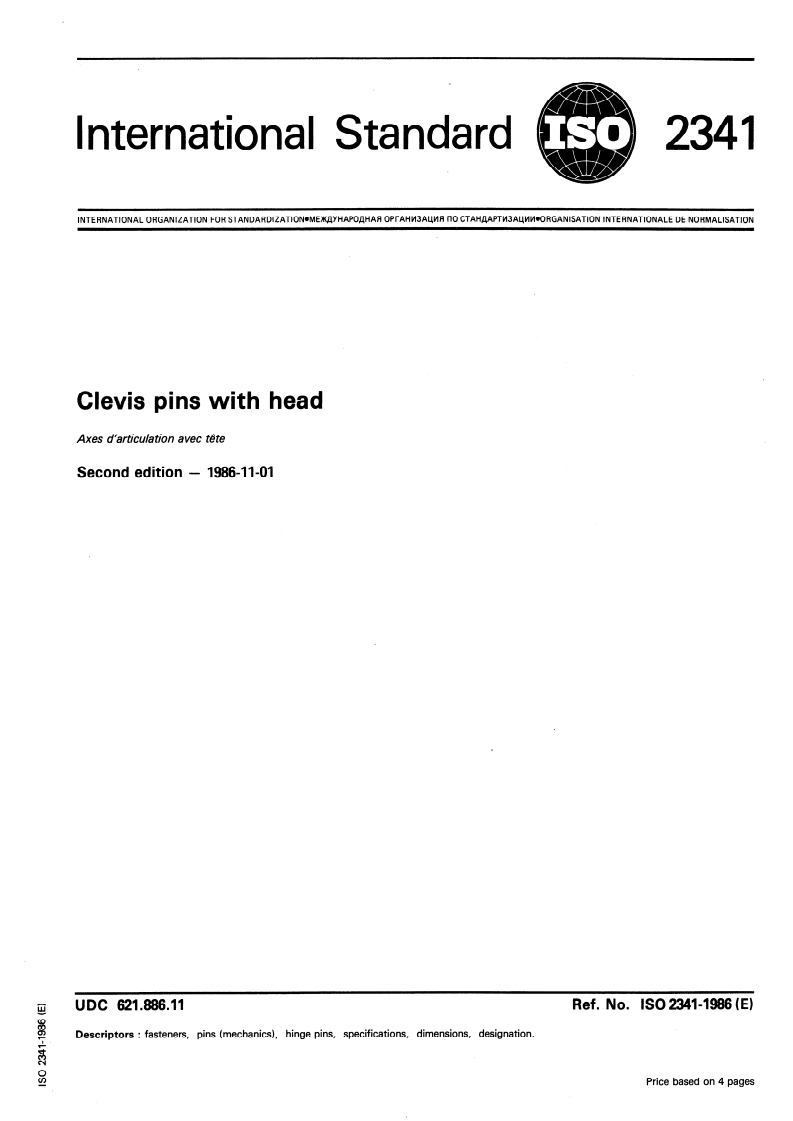
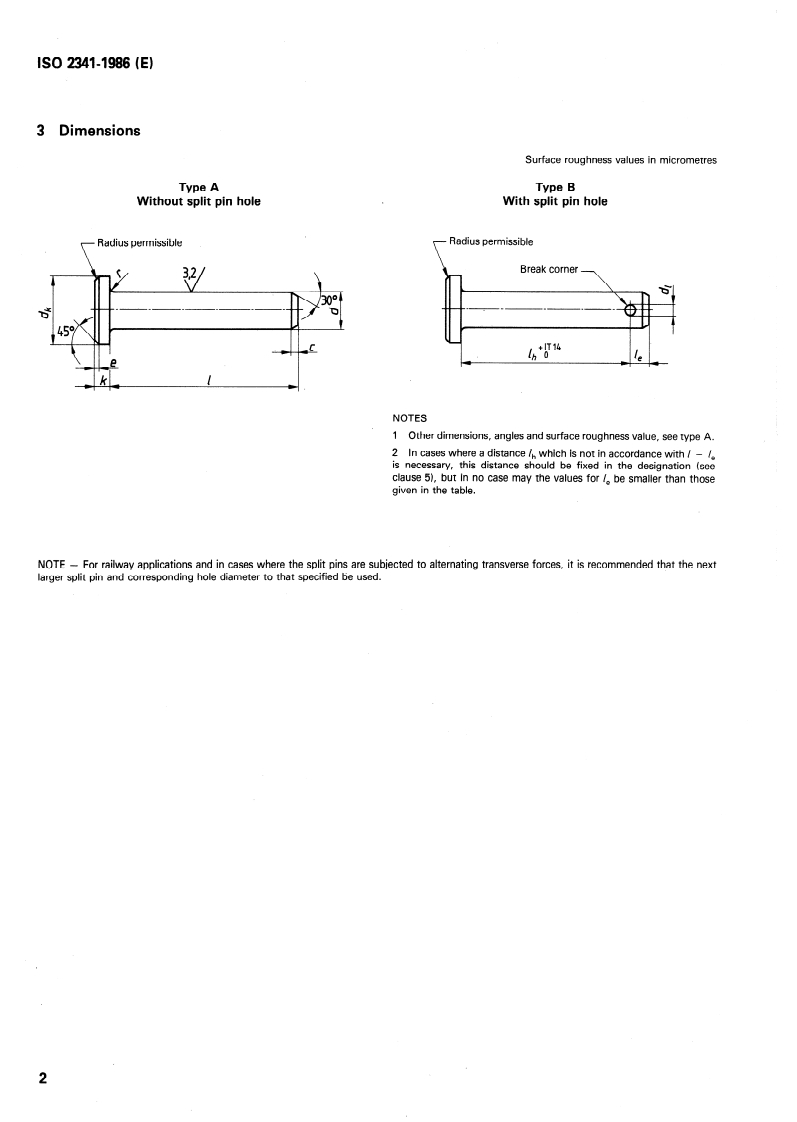
Specifies the characteristics of products without (type A) and with split pin hole (type B) with metric dimensions and nominal diameters from 3 mm up to and including 100 mm; includes specifications with reference to International Standards; gives examples for the designation.
- Status
- Published
- Publication Date
- 29-Oct-1986
- Technical Committee
- ISO/TC 2 - Fasteners
- Drafting Committee
- ISO/TC 2/WG 13 - Washer and non-threaded fasteners
- Current Stage
- 9093 - International Standard confirmed
- Start Date
- 24-Jun-2022
- Completion Date
- 29-Aug-2026
Buy Documents
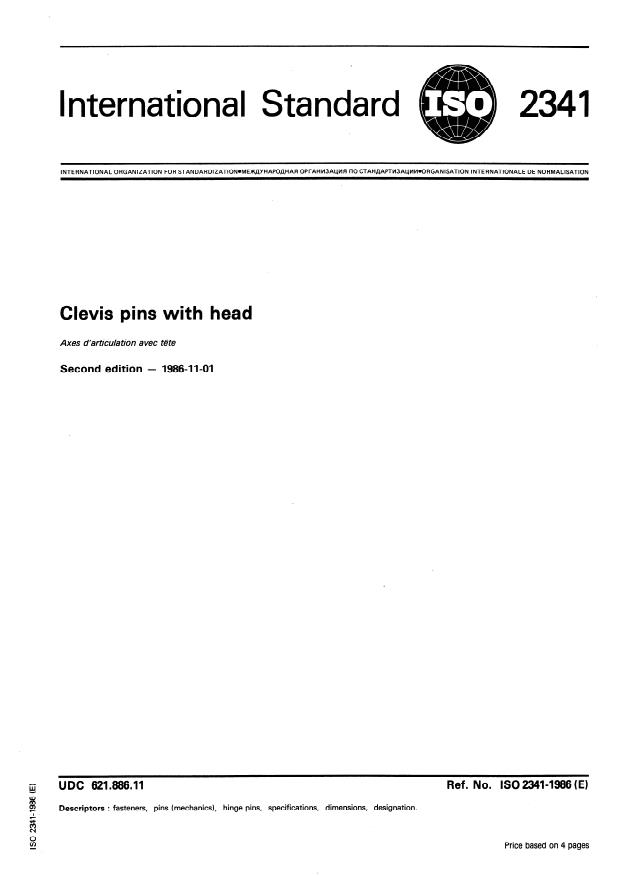
ISO 2341:1986 - Clevis pins with head/30/1986
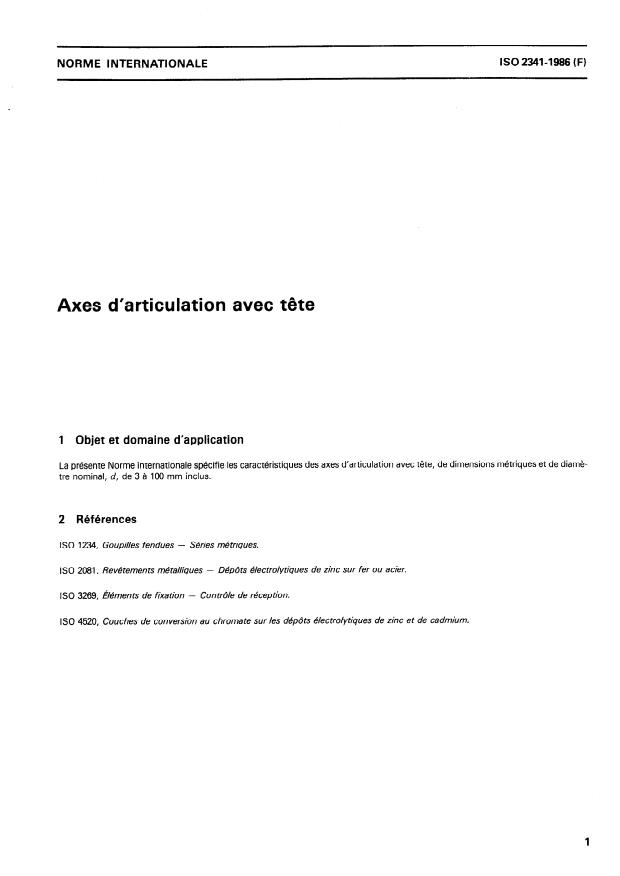
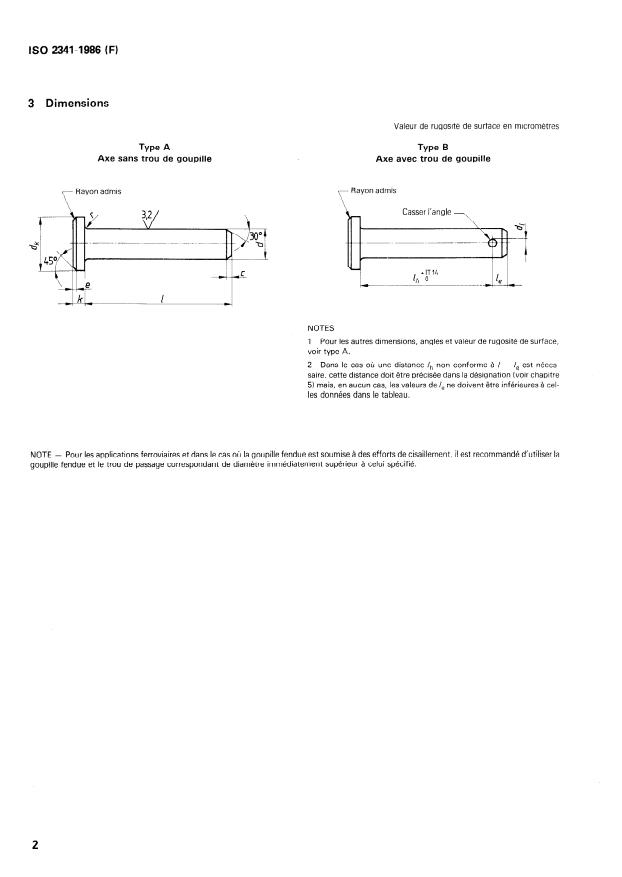
ISO 2341:1986 - Axes d'articulation avec tête/30/1986
ISO 2341:1986 - Axes d'articulation avec tête/30/1986
Overview
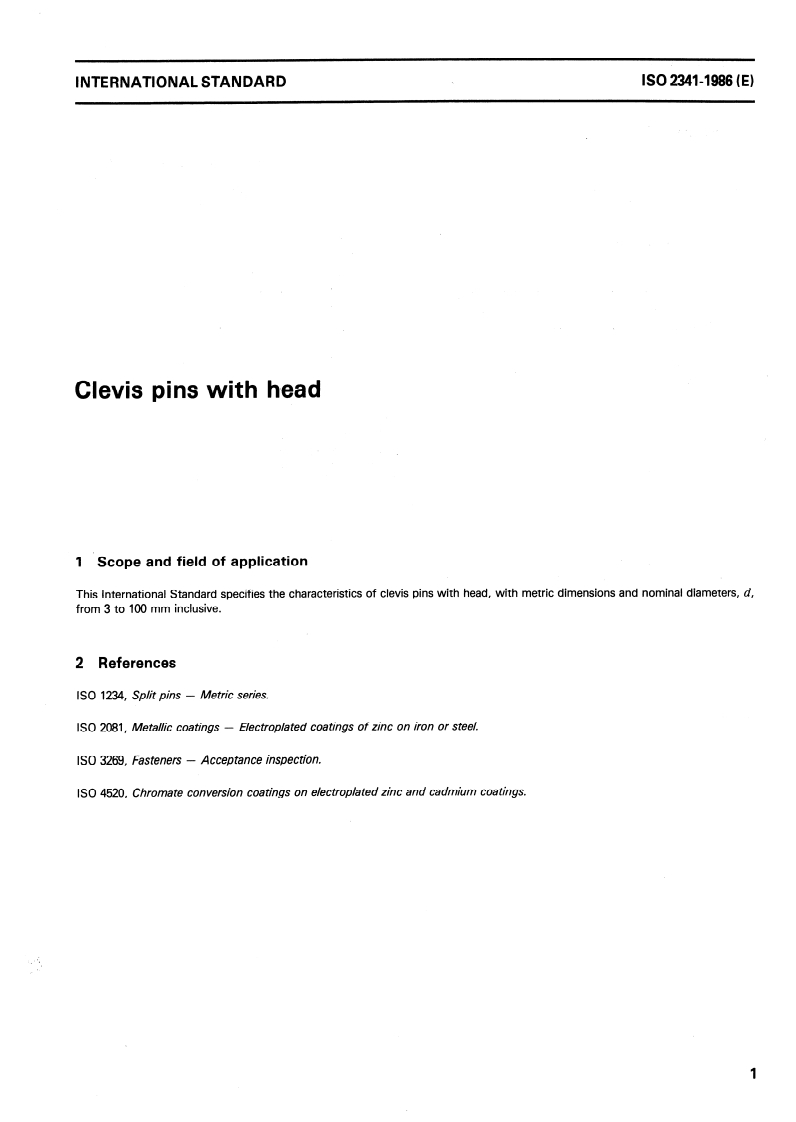
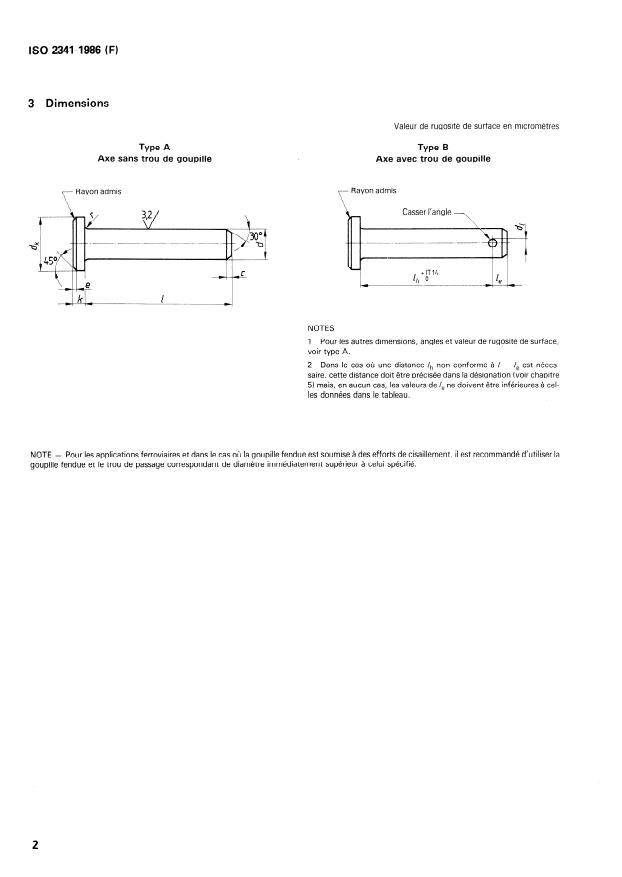
ISO 2341:1986 specifies the characteristics of clevis pins with head (articulation axes) manufactured to metric dimensions with nominal diameters from 3 mm up to and including 100 mm. The standard defines two product types: Type A (pin without split-pin hole) and Type B (pin with split-pin hole). It sets requirements for materials, surface finishes, dimensional designation and quality of execution to support interchangeable, reliable fastening in mechanical assemblies.
Key Topics
- Scope and Types
- Type A: clevis pin with head and no split-pin hole.
- Type B: clevis pin with head and a hole for a split pin (cotter pin).
- Nominal diameters: metric sizes from 3 mm to 100 mm (inclusive).
- Material designation: example designation uses "St" to indicate steel suitable for heading or cold forging, with typical hardness ranges indicated in the document.
- Surface finishes and coatings:
- Preferred finishes include black oxide, phosphating and zinc plating with chromate conversion (see referenced ISO standards).
- All tolerances apply before coating or deposition.
- Quality and acceptance:
- Parts must be uniform and free from harmful irregularities or burrs.
- Acceptance and inspection follow the referenced acceptance standard.
- Designation examples (format shown in the standard):
- Axe d’articulation ISO 2341 - B - 20 x 100 - St
- Axe d’articulation ISO 2341 - B - 20 x 100 x 6,3 - St
- Axe d’articulation ISO 2341 - B - 20 x 100 x 6,3 x 80 - St These show how to indicate type, nominal diameter, length, split-pin hole diameter and position when applicable.
Applications
Clevis pins with head standardized by ISO 2341:1986 are used where a removable pivot or hinge pin is required. Typical applications include:
- Mechanical linkages and articulation points in machinery
- Agricultural and construction equipment
- Assembly where interchangeable fasteners are needed for maintenance
- Situations requiring a split pin for positive retention (Type B)
Note: for high-shear applications (for example some railway uses), the standard notes a recommendation to select a split pin and corresponding hole diameter that is the next standardized size larger when shear forces are significant.
Related Standards
- ISO 1234 - Split pins (metric series)
- ISO 2081 - Electroplated zinc coatings on iron or steel
- ISO 3269 - Fasteners - Acceptance inspection
- ISO 4520 - Chromate conversion coatings on zinc and cadmium deposits
These referenced standards provide complementary requirements for split-pin sizes, surface treatments and inspection methods that apply to parts manufactured to ISO 2341:1986.
For procurement and design, use the designation examples in the standard to specify type, nominal diameter, length and any split-pin hole details to ensure correct manufacture and interchangeability.
Relations
- Effective Date
- 15-Apr-2008
Buy Documents
ISO 2341:1986 - Clevis pins with head/30/1986
ISO 2341:1986 - Axes d'articulation avec tête/30/1986
ISO 2341:1986 - Axes d'articulation avec tête/30/1986
Frequently Asked Questions
ISO 2341:1986 is a standard published by the International Organization for Standardization (ISO). Its full title is "Clevis pins with head". This standard covers: Specifies the characteristics of products without (type A) and with split pin hole (type B) with metric dimensions and nominal diameters from 3 mm up to and including 100 mm; includes specifications with reference to International Standards; gives examples for the designation.
Specifies the characteristics of products without (type A) and with split pin hole (type B) with metric dimensions and nominal diameters from 3 mm up to and including 100 mm; includes specifications with reference to International Standards; gives examples for the designation.
ISO 2341:1986 is classified under the following ICS (International Classification for Standards) categories: 21.060.50 - Pins, nails. The ICS classification helps identify the subject area and facilitates finding related standards.
ISO 2341:1986 has the following relationships with other standards: It is inter standard links to ISO 2341:1972. Understanding these relationships helps ensure you are using the most current and applicable version of the standard.
ISO 2341:1986 is available in PDF format for immediate download after purchase. The document can be added to your cart and obtained through the secure checkout process. Digital delivery ensures instant access to the complete standard document.
Standards Content (Sample)
>
International Standard
INTERNATIONAL ORGANIZATION FOR STANDARDIZATlON*ME~YHAPOiIHAR OPrAHM3ALlMR fl0 CTAH~APTM3Al.Wl*ORGANISATlON INTERNATIONALE DE NORMALISATION
Clevis pins with head
Axes d’artkula tion avec t& te
Second edition - 1986-11-01
UDC 621.886.11 Ref. No. ISO 23414986 (E)
w
Descriptors : fasteners, pins (mechanics), hinge Pins, specifications, dimensions, designation.
Price based on 4 pages
Foreword
ISO (the International Organization for Standardization) is a worldwide federation of
national Standards bodies (ISO member bodies). The work of preparing International
Standards is normally carried out through ISO technical committees. Esch member
body interested in a subject for which a technical committee has been established has
the right to be represented on that committee. International organizations, govern-
mental and non-governmental, in liaison with ISO, also take patt in the work.
Draft International Standards adopted by the technical committees are circulated to
the member bodies for approval before their acceptance as International Standards by
the ISO Council. They are approved in accordance with ISO procedures requiring at
least 75 % approval by the member bodies voting.
International Standard ISO 2341 was prepared by Technical Committee ISO/TC 2,
Fasteners.
This second edition cancels and replaces the first edition (ISO 2341~19721, of which it
constitutes a technical revision.
Users should note that all International Standards undergo revision from time to time
and that any reference made herein to any other International Standard implies its
latest edition, unless otherwise stated.
0 International Organkation for Standardkation, 1986 0
Printed in Switzerland
INTERNATIONAL STANDARD ISO 23414986 (E)
Clevis pins with h.ead
1 Scope and field of application
This International Standard specifies the characteristics of clevis pins with head, with metric dimensions and nominal diameters, d,
from 3 to 100 mm inclusive.
2 References
ISO 1234, Split pins - Metric series.
ISO 2081, Metallic coatings - Electroplated coatings of zinc on iron or steel.
ISO 3269, Fasteners - Acceptance inspection.
ISO 4520, Chromate conversion coatings on electroplated zinc and Cadmium cos tings.
ISO 23414986 (E)
3 Dimensions
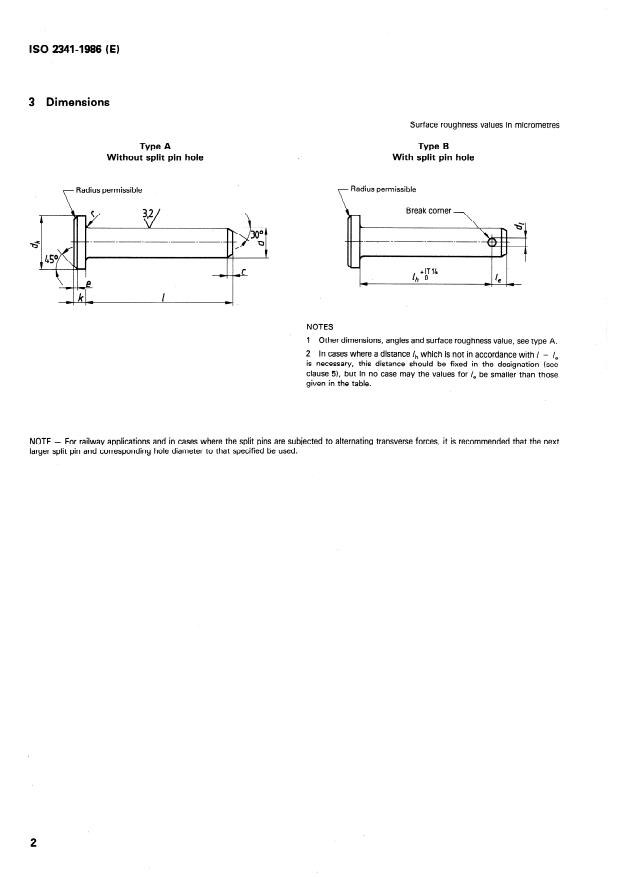
Surface roughness values in micrometres
TYPe B
TYPe A
With Split pin hole
Without Split pin hole
Radius permissible
Radius permissible
r
L-
A
------_p_- ----
m
b”
/
f
t-
-,c
)t II’
\
e
--&-
-4, 1
D.
NOTES
1 Other dimensions, angles and surface roughness value, see type A.
2 In cases where a distance I, which is not in accordance with / - /e
is necessary, this distance should be fixed in the designation (sec
clause 51, but in no case may the values for Ie be smaller than those
given in the table.
NOTE - For railway applications and in cases where the Split pins are subjected to alternating transverse forces, it is recommended that the next
larger Split pin and corresponding hole diameter to that specified be used.
-------
...
>
International Standard
INTERNATIONAL ORGANIZATION FOR STANDARDIZATlON*ME~YHAPOiIHAR OPrAHM3ALlMR fl0 CTAH~APTM3Al.Wl*ORGANISATlON INTERNATIONALE DE NORMALISATION
Clevis pins with head
Axes d’artkula tion avec t& te
Second edition - 1986-11-01
UDC 621.886.11 Ref. No. ISO 23414986 (E)
w
Descriptors : fasteners, pins (mechanics), hinge Pins, specifications, dimensions, designation.
Price based on 4 pages
Foreword
ISO (the International Organization for Standardization) is a worldwide federation of
national Standards bodies (ISO member bodies). The work of preparing International
Standards is normally carried out through ISO technical committees. Esch member
body interested in a subject for which a technical committee has been established has
the right to be represented on that committee. International organizations, govern-
mental and non-governmental, in liaison with ISO, also take patt in the work.
Draft International Standards adopted by the technical committees are circulated to
the member bodies for approval before their acceptance as International Standards by
the ISO Council. They are approved in accordance with ISO procedures requiring at
least 75 % approval by the member bodies voting.
International Standard ISO 2341 was prepared by Technical Committee ISO/TC 2,
Fasteners.
This second edition cancels and replaces the first edition (ISO 2341~19721, of which it
constitutes a technical revision.
Users should note that all International Standards undergo revision from time to time
and that any reference made herein to any other International Standard implies its
latest edition, unless otherwise stated.
0 International Organkation for Standardkation, 1986 0
Printed in Switzerland
INTERNATIONAL STANDARD ISO 23414986 (E)
Clevis pins with h.ead
1 Scope and field of application
This International Standard specifies the characteristics of clevis pins with head, with metric dimensions and nominal diameters, d,
from 3 to 100 mm inclusive.
2 References
ISO 1234, Split pins - Metric series.
ISO 2081, Metallic coatings - Electroplated coatings of zinc on iron or steel.
ISO 3269, Fasteners - Acceptance inspection.
ISO 4520, Chromate conversion coatings on electroplated zinc and Cadmium cos tings.
ISO 23414986 (E)
3 Dimensions
Surface roughness values in micrometres
TYPe B
TYPe A
With Split pin hole
Without Split pin hole
Radius permissible
Radius permissible
r
L-
A
------_p_- ----
m
b”
/
f
t-
-,c
)t II’
\
e
--&-
-4, 1
D.
NOTES
1 Other dimensions, angles and surface roughness value, see type A.
2 In cases where a distance I, which is not in accordance with / - /e
is necessary, this distance should be fixed in the designation (sec
clause 51, but in no case may the values for Ie be smaller than those
given in the table.
NOTE - For railway applications and in cases where the Split pins are subjected to alternating transverse forces, it is recommended that the next
larger Split pin and corresponding hole diameter to that specified be used.
-------
...
Norme internationale
INTERNATIONAL ORGANIZATION FOR STANDARDIZATIONoME>1(~YHAPO~HAR OPI-AHkl3ALWlR l-l0 CTAH,4APTM3AWWl~ORGANISATION INTERNATIONALE DE NORMALISATION
Axes d’articulation avec tête
Clevis pins with head
Deuxième édition - 1986-11-01
û CDU 621 l 86.11 Réf. no : ISO 23414986 (F)
Y
Descripteurs : élément de fixation, goupille, axe d’articulation, spécification, dimension, désignation.
Prix basé sur 4 pages
Avant-propos
L’ISO (Organisation internationale de normalisation) est une fédération mondiale
d’organismes nationaux de normalisation (comités membres de I’ISO). L’élaboration
des Normes internationales est confiée aux comités techniques de I’ISO. Chaque
comité membre intéressé par une étude a le droit de faire partie du comité technique
créé à cet effet. Les organisations internationales, gouvernementales et non gouverne-
mentales, en liaison avec I’ISO participent également aux travaux.
Les projets de Normes internationales adoptés par les comités techniques sont soumis
aux comités membres pour approbation, avant leur acceptation comme Normes inter-
nationales par le Conseil de I’ISO. Les Normes internationales sont approuvées confor-
mément aux procédures de I’ISO qui requièrent l’approbation de 75 % au moins des
comités membres votants.
La Norme internationale ISO 2341 a été élaborée par le comité technique ISO/TC 2,
Éléments de fixa tiens.
Cette deuxième édition annule et remplace la première édition (ISO 2341-19721, dont
elle constitue une révision technique.
L’attention des utilisateurs est attirée sur le fait que toutes les Normes internationales
sont de temps en temps soumises à révision et que toute référence faite à une autre
Norme internationale dans le présent document implique qu’il s’agit, sauf indication
contraire, de la dernière édition.
Organisation internationale de normalisation, 1986
‘0
Imprimé en Suisse
ISO 2341-1986 (F)
NORME INTERNATIONALE
Axes d’articulation avec tête
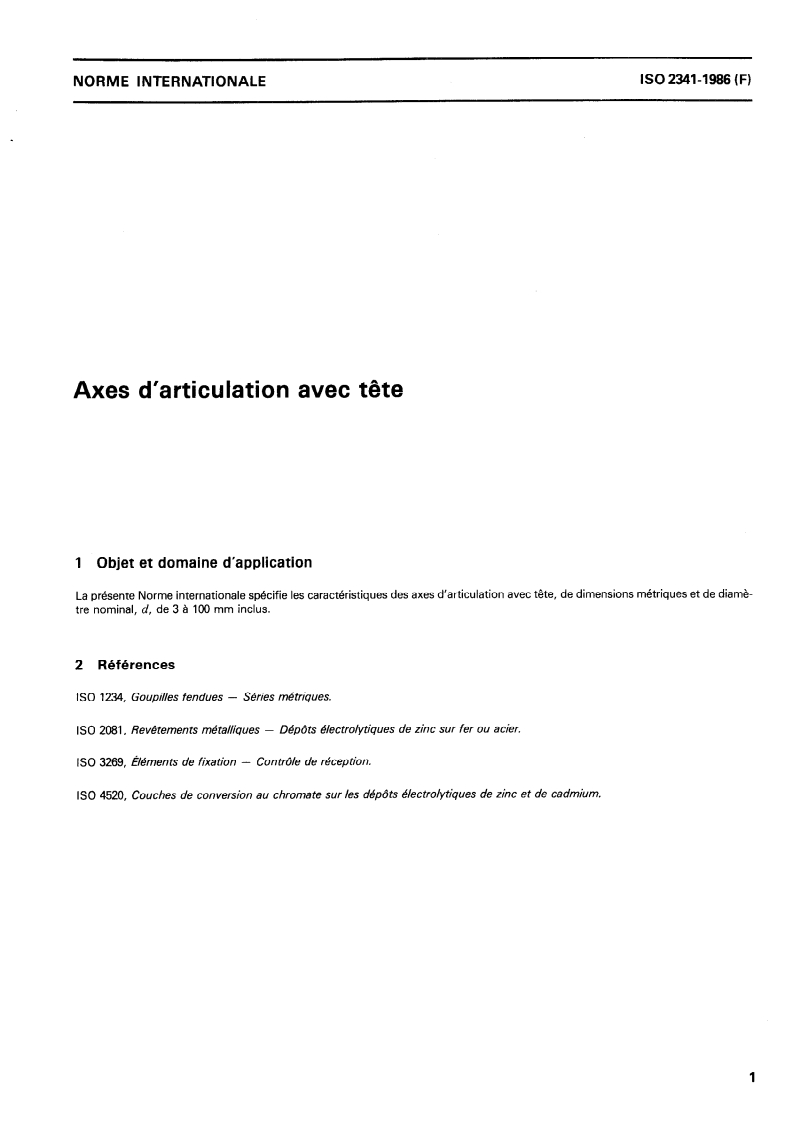
1 Objet et domaine d’application
La présente Norme internationale spécifie les caractéristiques des axes d’articulation avec tête, de dimensions métriques et de diamè-
tre nominal, d, de 3 à 100 mm inclus.
2 Références
I SO 1234, Goupilles fendues - Séries métriques.
Dépôts électrolytiques de zinc sur fer ou acier.
ISO 2081, Revêtements métalliques -
I SO 3269, &men ts de fixation - Con frôle de récep tien.
ISO 4520, Couches de conversion au chromate sur les dépôts électrolytiques de zinc et de cadmium.
ISO 2341-1986 (FI
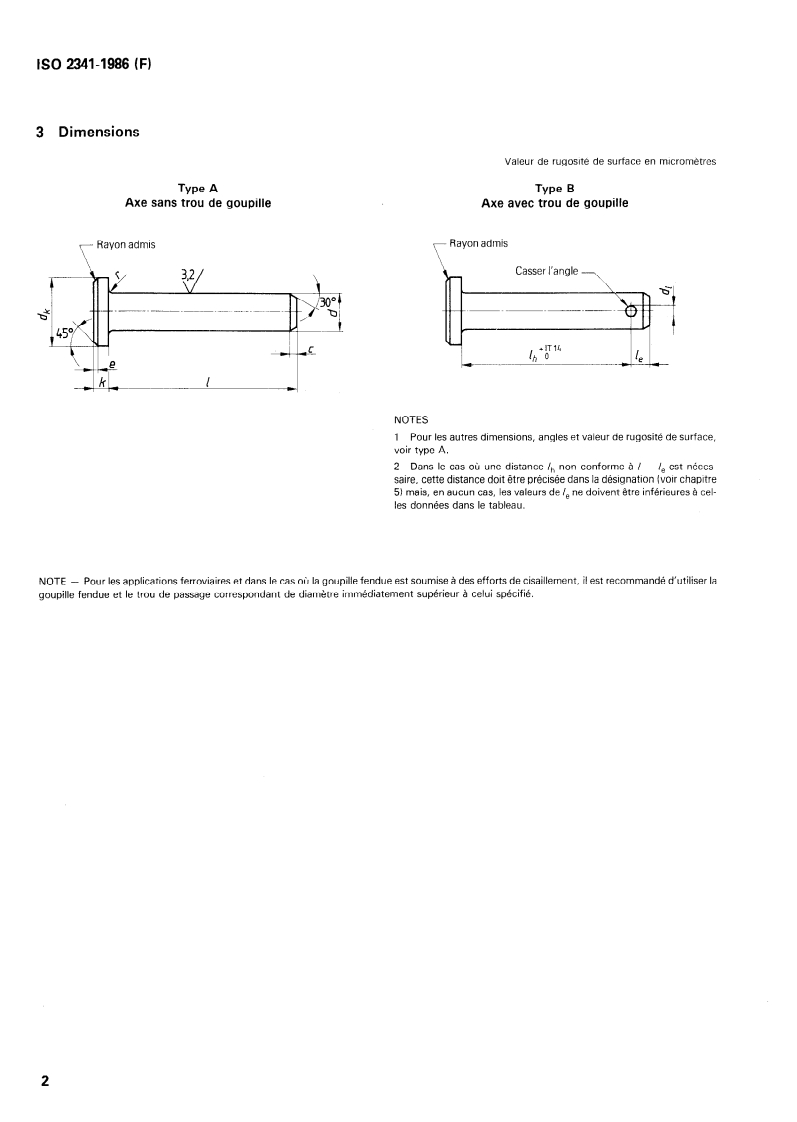
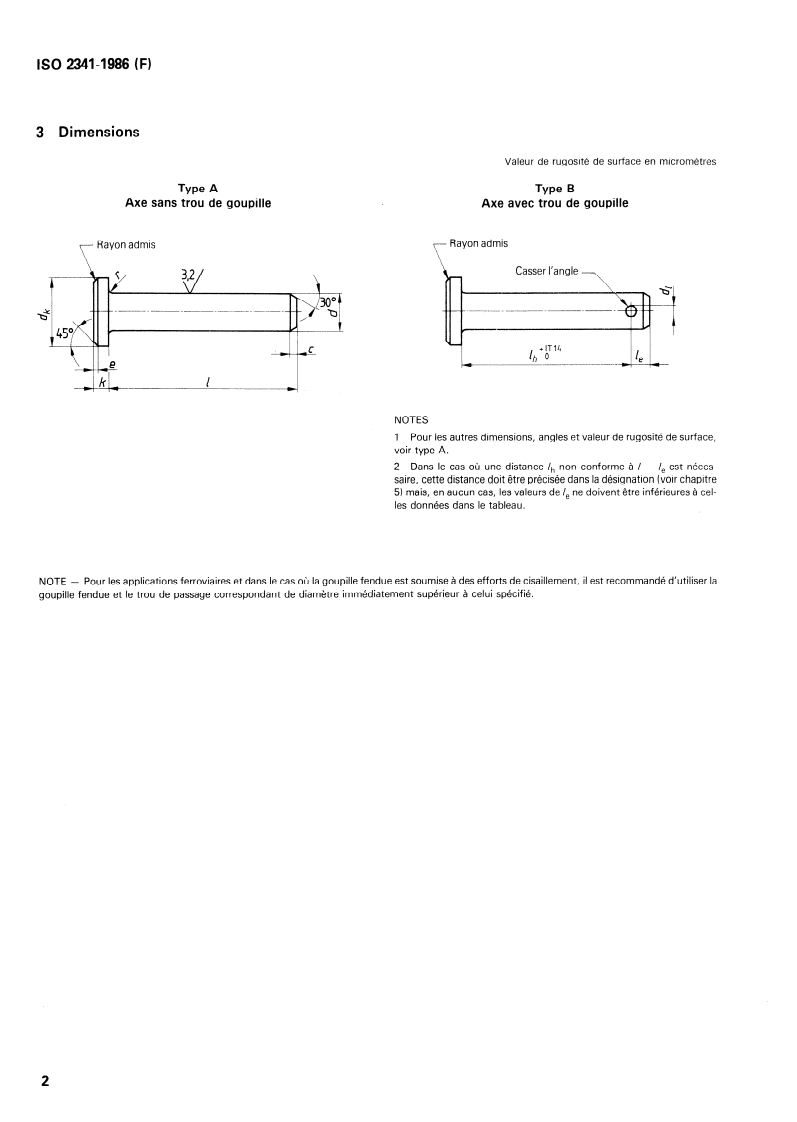
3 Dimensions
Valeur de rugosité de surface en micrometres
Type A
Type B
Axe sans trou de goupille
Axe avec trou de goupille
Rayon admis - Rayon admis
Y-
- I
\ I I
I -
NOTES
1 Pour les autres dimensions, angles et valeur de rugosité de surface,
voir type A.
2 Dans le cas où une distance I, non conforme à I - le est néces-
saire, cette distance doit être précisée dans la désignation (voir chapitre
5) mais, en aucun cas, les valeurs de I, ne doivent être inférieures à cel-
les données dans le tableau.
NOTE - Pour les applications ferroviaires et dans le cas où la goupille fendue est soumise à des efforts de cisaillement, il est recommandé d’utiliser la
gou
...
Norme internationale
INTERNATIONAL ORGANIZATION FOR STANDARDIZATIONoME>1(~YHAPO~HAR OPI-AHkl3ALWlR l-l0 CTAH,4APTM3AWWl~ORGANISATION INTERNATIONALE DE NORMALISATION
Axes d’articulation avec tête
Clevis pins with head
Deuxième édition - 1986-11-01
û CDU 621 l 86.11 Réf. no : ISO 23414986 (F)
Y
Descripteurs : élément de fixation, goupille, axe d’articulation, spécification, dimension, désignation.
Prix basé sur 4 pages
Avant-propos
L’ISO (Organisation internationale de normalisation) est une fédération mondiale
d’organismes nationaux de normalisation (comités membres de I’ISO). L’élaboration
des Normes internationales est confiée aux comités techniques de I’ISO. Chaque
comité membre intéressé par une étude a le droit de faire partie du comité technique
créé à cet effet. Les organisations internationales, gouvernementales et non gouverne-
mentales, en liaison avec I’ISO participent également aux travaux.
Les projets de Normes internationales adoptés par les comités techniques sont soumis
aux comités membres pour approbation, avant leur acceptation comme Normes inter-
nationales par le Conseil de I’ISO. Les Normes internationales sont approuvées confor-
mément aux procédures de I’ISO qui requièrent l’approbation de 75 % au moins des
comités membres votants.
La Norme internationale ISO 2341 a été élaborée par le comité technique ISO/TC 2,
Éléments de fixa tiens.
Cette deuxième édition annule et remplace la première édition (ISO 2341-19721, dont
elle constitue une révision technique.
L’attention des utilisateurs est attirée sur le fait que toutes les Normes internationales
sont de temps en temps soumises à révision et que toute référence faite à une autre
Norme internationale dans le présent document implique qu’il s’agit, sauf indication
contraire, de la dernière édition.
Organisation internationale de normalisation, 1986
‘0
Imprimé en Suisse
ISO 2341-1986 (F)
NORME INTERNATIONALE
Axes d’articulation avec tête
1 Objet et domaine d’application
La présente Norme internationale spécifie les caractéristiques des axes d’articulation avec tête, de dimensions métriques et de diamè-
tre nominal, d, de 3 à 100 mm inclus.
2 Références
I SO 1234, Goupilles fendues - Séries métriques.
Dépôts électrolytiques de zinc sur fer ou acier.
ISO 2081, Revêtements métalliques -
I SO 3269, &men ts de fixation - Con frôle de récep tien.
ISO 4520, Couches de conversion au chromate sur les dépôts électrolytiques de zinc et de cadmium.
ISO 2341-1986 (FI
3 Dimensions
Valeur de rugosité de surface en micrometres
Type A
Type B
Axe sans trou de goupille
Axe avec trou de goupille
Rayon admis - Rayon admis
Y-
- I
\ I I
I -
NOTES
1 Pour les autres dimensions, angles et valeur de rugosité de surface,
voir type A.
2 Dans le cas où une distance I, non conforme à I - le est néces-
saire, cette distance doit être précisée dans la désignation (voir chapitre
5) mais, en aucun cas, les valeurs de I, ne doivent être inférieures à cel-
les données dans le tableau.
NOTE - Pour les applications ferroviaires et dans le cas où la goupille fendue est soumise à des efforts de cisaillement, il est recommandé d’utiliser la
gou
...
Norme internationale
INTERNATIONAL ORGANIZATION FOR STANDARDIZATIONoME>1(~YHAPO~HAR OPI-AHkl3ALWlR l-l0 CTAH,4APTM3AWWl~ORGANISATION INTERNATIONALE DE NORMALISATION
Axes d’articulation avec tête
Clevis pins with head
Deuxième édition - 1986-11-01
û CDU 621 l 86.11 Réf. no : ISO 23414986 (F)
Y
Descripteurs : élément de fixation, goupille, axe d’articulation, spécification, dimension, désignation.
Prix basé sur 4 pages
Avant-propos
L’ISO (Organisation internationale de normalisation) est une fédération mondiale
d’organismes nationaux de normalisation (comités membres de I’ISO). L’élaboration
des Normes internationales est confiée aux comités techniques de I’ISO. Chaque
comité membre intéressé par une étude a le droit de faire partie du comité technique
créé à cet effet. Les organisations internationales, gouvernementales et non gouverne-
mentales, en liaison avec I’ISO participent également aux travaux.
Les projets de Normes internationales adoptés par les comités techniques sont soumis
aux comités membres pour approbation, avant leur acceptation comme Normes inter-
nationales par le Conseil de I’ISO. Les Normes internationales sont approuvées confor-
mément aux procédures de I’ISO qui requièrent l’approbation de 75 % au moins des
comités membres votants.
La Norme internationale ISO 2341 a été élaborée par le comité technique ISO/TC 2,
Éléments de fixa tiens.
Cette deuxième édition annule et remplace la première édition (ISO 2341-19721, dont
elle constitue une révision technique.
L’attention des utilisateurs est attirée sur le fait que toutes les Normes internationales
sont de temps en temps soumises à révision et que toute référence faite à une autre
Norme internationale dans le présent document implique qu’il s’agit, sauf indication
contraire, de la dernière édition.
Organisation internationale de normalisation, 1986
‘0
Imprimé en Suisse
ISO 2341-1986 (F)
NORME INTERNATIONALE
Axes d’articulation avec tête
1 Objet et domaine d’application
La présente Norme internationale spécifie les caractéristiques des axes d’articulation avec tête, de dimensions métriques et de diamè-
tre nominal, d, de 3 à 100 mm inclus.
2 Références
I SO 1234, Goupilles fendues - Séries métriques.
Dépôts électrolytiques de zinc sur fer ou acier.
ISO 2081, Revêtements métalliques -
I SO 3269, &men ts de fixation - Con frôle de récep tien.
ISO 4520, Couches de conversion au chromate sur les dépôts électrolytiques de zinc et de cadmium.
ISO 2341-1986 (FI
3 Dimensions
Valeur de rugosité de surface en micrometres
Type A
Type B
Axe sans trou de goupille
Axe avec trou de goupille
Rayon admis - Rayon admis
Y-
- I
\ I I
I -
NOTES
1 Pour les autres dimensions, angles et valeur de rugosité de surface,
voir type A.
2 Dans le cas où une distance I, non conforme à I - le est néces-
saire, cette distance doit être précisée dans la désignation (voir chapitre
5) mais, en aucun cas, les valeurs de I, ne doivent être inférieures à cel-
les données dans le tableau.
NOTE - Pour les applications ferroviaires et dans le cas où la goupille fendue est soumise à des efforts de cisaillement, il est recommandé d’utiliser la
gou
...
Norme internationale
INTERNATIONAL ORGANIZATION FOR STANDARDIZATIONoME>1(~YHAPO~HAR OPI-AHkl3ALWlR l-l0 CTAH,4APTM3AWWl~ORGANISATION INTERNATIONALE DE NORMALISATION
Axes d’articulation avec tête
Clevis pins with head
Deuxième édition - 1986-11-01
û CDU 621 l 86.11 Réf. no : ISO 23414986 (F)
Y
Descripteurs : élément de fixation, goupille, axe d’articulation, spécification, dimension, désignation.
Prix basé sur 4 pages
Avant-propos
L’ISO (Organisation internationale de normalisation) est une fédération mondiale
d’organismes nationaux de normalisation (comités membres de I’ISO). L’élaboration
des Normes internationales est confiée aux comités techniques de I’ISO. Chaque
comité membre intéressé par une étude a le droit de faire partie du comité technique
créé à cet effet. Les organisations internationales, gouvernementales et non gouverne-
mentales, en liaison avec I’ISO participent également aux travaux.
Les projets de Normes internationales adoptés par les comités techniques sont soumis
aux comités membres pour approbation, avant leur acceptation comme Normes inter-
nationales par le Conseil de I’ISO. Les Normes internationales sont approuvées confor-
mément aux procédures de I’ISO qui requièrent l’approbation de 75 % au moins des
comités membres votants.
La Norme internationale ISO 2341 a été élaborée par le comité technique ISO/TC 2,
Éléments de fixa tiens.
Cette deuxième édition annule et remplace la première édition (ISO 2341-19721, dont
elle constitue une révision technique.
L’attention des utilisateurs est attirée sur le fait que toutes les Normes internationales
sont de temps en temps soumises à révision et que toute référence faite à une autre
Norme internationale dans le présent document implique qu’il s’agit, sauf indication
contraire, de la dernière édition.
Organisation internationale de normalisation, 1986
‘0
Imprimé en Suisse
ISO 2341-1986 (F)
NORME INTERNATIONALE
Axes d’articulation avec tête
1 Objet et domaine d’application
La présente Norme internationale spécifie les caractéristiques des axes d’articulation avec tête, de dimensions métriques et de diamè-
tre nominal, d, de 3 à 100 mm inclus.
2 Références
I SO 1234, Goupilles fendues - Séries métriques.
Dépôts électrolytiques de zinc sur fer ou acier.
ISO 2081, Revêtements métalliques -
I SO 3269, &men ts de fixation - Con frôle de récep tien.
ISO 4520, Couches de conversion au chromate sur les dépôts électrolytiques de zinc et de cadmium.
ISO 2341-1986 (FI
3 Dimensions
Valeur de rugosité de surface en micrometres
Type A
Type B
Axe sans trou de goupille
Axe avec trou de goupille
Rayon admis - Rayon admis
Y-
- I
\ I I
I -
NOTES
1 Pour les autres dimensions, angles et valeur de rugosité de surface,
voir type A.
2 Dans le cas où une distance I, non conforme à I - le est néces-
saire, cette distance doit être précisée dans la désignation (voir chapitre
5) mais, en aucun cas, les valeurs de I, ne doivent être inférieures à cel-
les données dans le tableau.
NOTE - Pour les applications ferroviaires et dans le cas où la goupille fendue est soumise à des efforts de cisaillement, il est recommandé d’utiliser la
gou
...