


ISO 6441-1:1999
(Main)Paints and varnishes — Determination of micro-indentation hardness — Part 1: Knoop hardness by measurement of indentation length
Paints and varnishes — Determination of micro-indentation hardness — Part 1: Knoop hardness by measurement of indentation length
Peintures et vernis — Détermination de la dureté par micro-indentation — Partie 1: Dureté Knoop par mesurage de la longueur d'indentation
General Information
- Status
- Withdrawn
- Publication Date
- 15-Dec-1999
- Withdrawal Date
- 15-Dec-1999
- Technical Committee
- ISO/TC 35/SC 9 - General test methods for paints and varnishes
- Drafting Committee
- ISO/TC 35/SC 9 - General test methods for paints and varnishes
- Current Stage
- 9599 - Withdrawal of International Standard
- Start Date
- 07-Jan-2005
- Completion Date
- 12-Feb-2026
Relations
- Effective Date
- 15-Apr-2008
ISO 6441-1:1999 - Paints and varnishes -- Determination of micro-indentation hardness
ISO 6441-1:1999 - Peintures et vernis -- Détermination de la dureté par micro-indentation
Frequently Asked Questions
ISO 6441-1:1999 is a standard published by the International Organization for Standardization (ISO). Its full title is "Paints and varnishes — Determination of micro-indentation hardness — Part 1: Knoop hardness by measurement of indentation length". This standard covers: Paints and varnishes — Determination of micro-indentation hardness — Part 1: Knoop hardness by measurement of indentation length
Paints and varnishes — Determination of micro-indentation hardness — Part 1: Knoop hardness by measurement of indentation length
ISO 6441-1:1999 is classified under the following ICS (International Classification for Standards) categories: 87.040 - Paints and varnishes. The ICS classification helps identify the subject area and facilitates finding related standards.
ISO 6441-1:1999 has the following relationships with other standards: It is inter standard links to ISO 6441:1984. Understanding these relationships helps ensure you are using the most current and applicable version of the standard.
ISO 6441-1:1999 is available in PDF format for immediate download after purchase. The document can be added to your cart and obtained through the secure checkout process. Digital delivery ensures instant access to the complete standard document.
Standards Content (Sample)
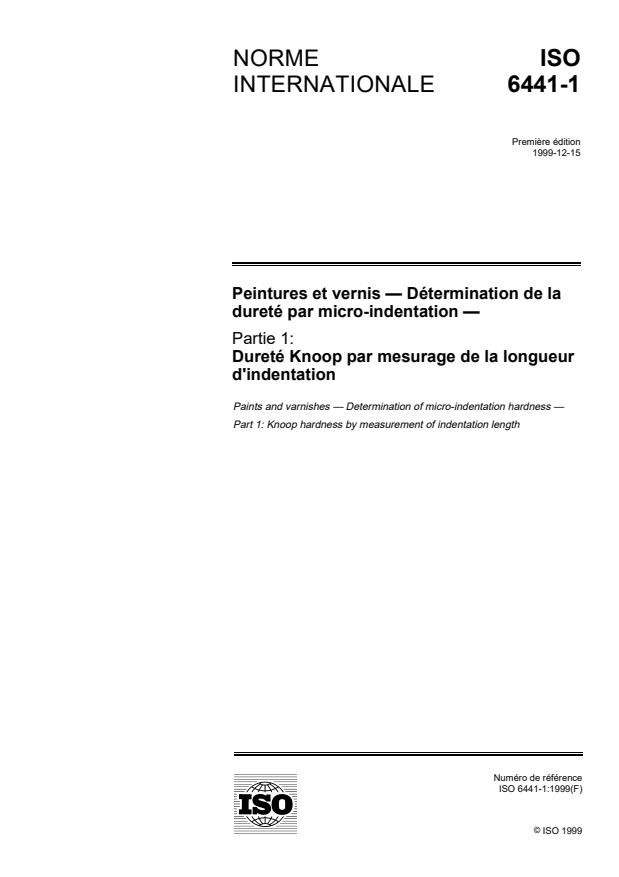
INTERNATIONAL ISO
STANDARD 6441-1
First edition
1999-12-15
Paints and varnishes — Determination of
micro-indentation hardness —
Part 1:
Knoop hardness by measurement of
indentation length
Peintures et vernis — Détermination de la dureté par micro-indentation —
Partie 1: Dureté Knoop par mesurage de la longeur d'indentation
Reference number
©
ISO 1999
PDF disclaimer
This PDF file may contain embedded typefaces. In accordance with Adobe's licensing policy, this file may be printed or viewed but shall not
be edited unless the typefaces which are embedded are licensed to and installed on the computer performing the editing. In downloading this
file, parties accept therein the responsibility of not infringing Adobe's licensing policy. The ISO Central Secretariat accepts no liability in this
area.
Adobe is a trademark of Adobe Systems Incorporated.
Details of the software products used to create this PDF file can be found in the General Info relative to the file; the PDF-creation parameters
were optimized for printing. Every care has been taken to ensure that the file is suitable for use by ISO member bodies. In the unlikely event
that a problem relating to it is found, please inform the Central Secretariat at the address given below.
© ISO 1999
All rights reserved. Unless otherwise specified, no part of this publication may be reproduced or utilized in any form or by any means, electronic
or mechanical, including photocopying and microfilm, without permission in writing from either ISO at the address below or ISO's member body
in the country of the requester.
ISO copyright office
Case postale 56 � CH-1211 Geneva 20
Tel. + 41 22 749 01 11
Fax + 41 22 734 10 79
E-mail copyright@iso.ch
Web www.iso.ch
Printed in Switzerland
ii © ISO 1999 – All rights reserved
Contents Page
1 Scope .1
2 Normative references .1
3 Principle.2
4 Required supplementary information.2
5 Apparatus .2
6 Sampling.4
7 Test panels .4
8 Calibration of the apparatus.5
9 Procedure .5
10 Expression of results .6
11 Precision.6
12 Test report .7
Annex A (normative) Required supplementary information.8
Bibliography.9
© ISO 1999 – All rights reserved iii
Foreword
ISO (the International Organization for Standardization) is a worldwide federation of national standards bodies (ISO
member bodies). The work of preparing International Standards is normally carried out through ISO technical
committees. Each member body interested in a subject for which a technical committee has been established has
the right to be represented on that committee. International organizations, governmental and non-governmental, in
liaison with ISO, also take part in the work. ISO collaborates closely with the International Electrotechnical
Commission (IEC) on all matters of electrotechnical standardization.
International Standards are drafted in accordance with the rules given in the ISO/IEC Directives, Part 3.
Draft International Standards adopted by the technical committees are circulated to the member bodies for voting.
Publication as an International Standard requires approval by at least 75 % of the member bodies casting a vote.
Attention is drawn to the possibility that some of the elements of this part of ISO 6441 may be the subject of patent
rights. ISO shall not be held responsible for identifying any or all such patent rights.
International Standard ISO 6441-1 was prepared by Technical Committee ISO/TC 35, Paints and varnishes,
Subcommittee SC 9, General test methods for paints and varnishes.
Together with the other parts (see below), it cancels and replaces ISO 6441:1984, which has been technically
revised.
ISO 6441 consists of the following parts, under the general title Paints and varnishes — Determination of micro-
indentation hardness:
� Part 1: Knoop hardness by measurement of indentation length
� Part 2: Knoop hardness by measurement of indentation depth under load
� Part 3: Creep and visco-elastic properties and elastic modulus using the Vickers indenter
Annex A forms a normative part of this part of ISO 6441.
iv © ISO 1999 – All rights reserved
Introduction
This part of ISO 6441 is one of three dealing with the determination of the micro-indentation hardness of a dried
film of paint, varnish or related product.
Part 1 specifies a method in which the hardness is calculated from the length, measured using a microscope, of a
long diagonal of the indentation made by a Knoop indenter.
In this method, the indentation length is measured after the indenter has been removed.
Part 2 specifies a method in which the hardness is calculated from the depth, measured using an electronic
technique, of the indentation made by a Knoop indenter.
In this method, the indentation depth is measured while the indenter is still under load.
Part 3 specifies a method in which the hardness, creep, visco-elasticity and modulus of elasticity are determined by
measuring the depth of the indentation made by a Vickers indenter as a function of time.
Other methods have been standardized to measure the hardness of a paint film:
� ISO 1518, Scratch test.
� ISO 15184, Determination of film hardness by pencil test.
� ISO 2815, Buchholz indentation test.
� ISO 1522, Pendulum damping test.
The method chosen depends on the property which is to be measured. All these tests differ from each other
technically, and in their accuracy. They also range from fairly simple to rather sophisticated, with the instruments
prescribed in ISO 6441, part 1, part 2 and part 3, being of a sophisticated nature.
© ISO 1999 – All rights reserved v
INTERNATIONAL STANDARD ISO 6441-1:1999(E)
Paints and varnishes — Determination of micro-indentation
hardness —
Part 1:
Knoop hardness by measurement of indentation length
1 Scope
This part of ISO 6441 is one of a series of standards dealing with the sampling and testing of paints, varnishes and
related products.
It specifies a method for determining the hardness of a dried film of a paint, varnish or related product by
conducting an indentation test in which the indentation length is measured under zero-load conditions using a
microscope.
It is applicable to single-coat and multicoat systems.
The result is expressed as a hardness value, in N/mm , calculated from the indentation produced by a pyramidal
indenter of a specified size and shape applied to the coating under specified conditions.
This method is similar to Test Method A of ASTM D 1474-92 (see reference [1] in the Bibliography).
2 Normative references
The following normative documents contain provisions which, through reference in this text, constitute provisions of
this part of ISO 6441. For dated references, subsequent amendments to, or revisions of, any of these publications
do not apply. However, parties to agreements based on this part of ISO 6441 are encouraged to investigate the
possibility of applying the most recent editions of the normative documents indicated below. For undated
references, the latest edition of the normative document referred to applies. Members of ISO and IEC maintain
registers of currently valid International Standards.
ISO 1513:1992, Paints and varnishes — Examination and preparation of samples for testing.
ISO 1514:1993, Paints and varnishes — Standard panels for testing.
ISO 2808:1997, Paints and varnishes — Determination of film thickness.
ISO 3270:1984, Paints and varnishes and their raw materials — Temperatures and humidities for conditioning and
testing.
1�
ISO 15528:— , Paints, varnishes and raw materials for paints and varnishes — Sampling.
1� To be published. (Revision of ISO 842:1984 and ISO 1512:1991)
© ISO 1999 – All rights reserved 1
3Principle
The hardness of the surface of a dried paint or varnish film is measured, under specific conditions, with a pyramidal
indenter (Knoop indenter) fitted to a micro-hardness tester.
The Knoop hardness is defined as the applied load divided by the projected area of the indentation in the plane of
the surface of the paint film (see Figure 3).
During the test, the Knoop indenter is kept under a specified load for (18� 0,5) s. After removal of the indenter, the
length of the indentation is measured.
From this length, the area of the indentation in the plane of the surface of the paint film is calculated, and hence the
Knoop hardness.
This method is applicable provided that the indentation depth does not exceed approximately 25 % of the coating
thickness.
Exceeding this limit will result in the substrate influencing the penetration depth.
Further, the hardness value of the coating can be influenced (lowered) by a substrate material of much lower
hardness than the coating.
4 Required supplementary information
For any particular application, the test method specified in this part of ISO 6441 needs to be completed by
supplementary information. The items of supplementary information are given in annex A.
5 Apparatus
5.1 Hardness tester, including a Knoop indenter (5.1.1) and a microscope (5.1.2). This apparatus shall be
capable of:
� Bringing the indenter into contact with the test surface at a specified speed, in accordance with the
manufacturer’s instructions, with negligible impact under a nearly zero load. Any impact by the indenter on the
test surface will result in errors in readings and the calculated hardness will be too low.
� Progressively applying a selected load to the indenter and maintaining the load for (18� 0,5) s.
� Removing the load and withdrawing the indenter from the test surface.
� Measuring the length of the indentation by a microscope.
NOTE
...
NORME ISO
INTERNATIONALE 6441-1
Première édition
1999-12-15
Peintures et vernis — Détermination de la
dureté par micro-indentation —
Partie 1:
Dureté Knoop par mesurage de la longueur
d'indentation
Paints and varnishes — Determination of micro-indentation hardness —
Part 1: Knoop hardness by measurement of indentation length
Numéro de référence
©
ISO 1999
PDF – Exonération de responsabilité
Le présent fichier PDF peut contenir des polices de caractères intégrées. Conformément aux conditions de licence d'Adobe, ce fichier peut
être imprimé ou visualisé, mais ne doit pas être modifié à moins que l'ordinateur employé à cet effet ne bénéficie d'une licence autorisant
l'utilisation de ces polices et que celles-ci y soient installées. Lors du téléchargement de ce fichier, les parties concernées acceptent de fait la
responsabilité de ne pas enfreindre les conditions de licence d'Adobe. Le Secrétariat central de l'ISO décline toute responsabilité en la
matière.
Adobe est une marque déposée d'Adobe Systems Incorporated.
Les détails relatifs aux produits logiciels utilisés pour la création du présent fichier PDF sont disponibles dans la rubrique General Info du
fichier; les paramètres de création PDF ont été optimisés pour l'impression. Toutes les mesures ont été prises pour garantir l'exploitation de
ce fichier par les comités membres de l'ISO. Dans le cas peu probable où surviendrait un problème d'utilisation, veuillez en informer le
Secrétariat central à l'adresse donnée ci-dessous.
© ISO 1999
Droits de reproduction réservés. Sauf prescription différente, aucune partie de cette publication ne peut être reproduite ni utilisée sous quelque
forme que ce soit et par aucun procédé, électronique ou mécanique, y compris la photocopie et les microfilms, sans l'accord écrit de l’ISO à
l’adresse ci-après ou du comité membre de l’ISO dans le pays du demandeur.
ISO copyright office
Case postale 56 � CH-1211 Geneva 20
Tel. + 41 22 749 01 11
Fax. + 41 22 734 10 79
E-mail copyright@iso.ch
Web www.iso.ch
ImpriméenSuisse
ii © ISO 1999 – Tous droits réservés
Sommaire Page
1 Domaine d'application.1
2 Références normatives .1
3 Principe.2
4 Informations supplémentaires exigées .2
5 Appareillage .2
6 Échantillonnage .4
7 Panneaux d'essai.4
8 Étalonnage de l'appareillage .5
9 Mode opératoire.5
10 Expression des résultats .6
11 Fidélité .7
12 Rapport d'essai .8
Annexe A (normative) Informations supplémentaires exigées .9
Bibliographie .10
© ISO 1999 – Tous droits réservés iii
Avant-propos
L'ISO (Organisation internationale de normalisation) est une fédération mondiale d'organismes nationaux de
normalisation (comités membres de l'ISO). L'élaboration des Normes internationales est en général confiée aux
comités techniques de l'ISO. Chaque comité membre intéressé par une étude a le droit de faire partie du comité
technique créé à cet effet. Les organisations internationales, gouvernementales et non gouvernementales, en
liaison avec l'ISO participent également aux travaux. L'ISO collabore étroitement avec la Commission
électrotechnique internationale (CEI) en ce qui concerne la normalisation électrotechnique.
Les Normes internationales sont rédigées conformément aux règles données dans les Directives ISO/CEI, Partie 3.
Les projets de Normes internationales adoptés par les comités techniques sont soumis aux comités membres pour
vote. Leur publication comme Normes internationales requiert l'approbation de 75 % au moins des comités
membres votants.
L’attention est appelée sur le fait que certains des éléments de la présente partie de l’ISO 6441 peuvent faire
l’objet de droits de propriété intellectuelle ou de droits analogues. L’ISO ne saurait être tenue pour responsable de
ne pas avoir identifié de tels droits de propriété et averti de leur existence.
La Norme internationale ISO 6441-1 a été élaborée par le comité technique ISO/TC 35, Peintures et vernis,
sous-comité SC 9, Méthodes générales d'essai des peintures et vernis.
Conjointement avec les autres parties (voir ci-dessous), elle annule et remplace l'ISO 6441:1984, qui a fait l'objet
d'une révision technique.
L'ISO 6441 comprend les parties suivantes, présentées sous le titre général Peintures et vernis — Détermination
de la dureté par micro-indentation:
— Partie 1: Dureté Knoop par mesurage de la longueur d'indentation
— Partie 2: Dureté Knoop par mesurage de la profondeur d'indentation sous charge
— Partie 3: Caractéristiques de fluage, modules de viscoélasticité et d'élasticité basés sur l'indenteur de Vickers
L'annexe A constitue un élément normatif de la présente partie de l'ISO 6441.
iv © ISO 1999 – Tous droits réservés
Introduction
La présente partie de l'ISO 6441 fait partie d'une série de trois normes, traitant de la détermination de la dureté par
micro-indentation d'un feuil séché de peinture, de vernis ou de produit assimilé.
La partie 1 spécifie une méthode dans laquelle la dureté est calculée à partir de la longueur, mesurée au moyen
d'un microscope, d'une grande diagonale de l'indentation produite par un indenteur de Knoop.
Dans cette méthode, la longueur d'indentation est mesurée une fois que l'indenteur est retiré.
La partie 2 spécifie une méthode dans laquelle la dureté est calculée à partir de la profondeur, mesurée par une
technique électronique, de l'indentation produite par un indenteur de Knoop.
Dans cette méthode, la profondeur d'indentation est mesurée pendant que l'indenteur est encore sous charge.
La partie 3 spécifie une méthode dans laquelle la dureté, le fluage, la viscoélasticité et le module d'élasticité sont
déterminés par la mesure de la profondeur de l'indentation produite par un indenteur de Vickers en fonction du
temps.
D'autres méthodes ont été normalisées pour mesurer la dureté d'un feuil de peinture:
� ISO 1518, Essai de rayure.
� ISO 15184, Détermination de la dureté d'un feuil par l'essai au crayon.
� ISO 2815, Essai d'indentation Buchholz.
� ISO 1522, Essai d'amortissement au pendule.
La méthode choisie dépend de la propriété à mesurer. Tous ces essais diffèrent les uns des autres par la
technique utilisée et par leur précision. Ils couvrent également une gamme des plus simples aux relativement
sophistiqués, avec les instruments sophistiqués prescrits dans les parties 1, 2 et 3 de l'ISO 6441.
© ISO 1999 – Tous droits réservés v
NORME INTERNATIONALE ISO 6441-1:1999(F)
Peintures et vernis — Détermination de la dureté par
micro-indentation —
Partie 1:
Dureté Knoop par mesurage de la longueur d'indentation
1 Domaine d'application
La présente partie de l'ISO 6441 fait partie d'une série de normes traitant de l'échantillonnage et des essais des
peintures, vernis et produits assimilés.
Elle spécifie une méthode pour la détermination de la dureté d'un feuil séché de peinture, de vernis ou d'un produit
assimilé en effectuant un essai d'indentation dans lequel la longueur d'indentation est mesurée dans des conditions
de charge zéro au moyen d'un microscope.
Elle est applicable aux systèmes à couche unique et multicouche.
Le résultat est exprimé par la valeur de la dureté, en N/mm , calculée à partir de l'indentation produite quand un
indenteur pyramidal, de dimensions et de forme spécifiées, est appliqué sur le revêtement dans des conditions
spécifiées.
La présente méthode est similaire à la Méthode d'essai A de l'ASTM D 1474-92 (voir référence [1] dans la
Bibliographie).
2 Références normatives
Les documents normatifs suivants contiennent des dispositions qui, par suite de la référence qui y est faite,
constituent des dispositions valables pour la présente partie de l'ISO 6441. Pour les références datées, les
amendements ultérieurs ou les révisions de ces publications ne s’appliquent pas. Toutefois, les parties prenantes
aux accords fondés sur la présente partie de l'ISO 6441 sont invitées à rechercher la possibilité d'appliquer les
éditions les plus récentes des documents normatifs indiqués ci-après. Pour les références non datées, la dernière
édition du document normatif en référence s’applique. Les membres de l'ISO et de la CEI possèdent le registre des
Normes internationales en vigueur.
ISO 1513:1992, Peintures et vernis — Examen et préparation des échantillons pour essais.
ISO 1514:1993, Peintures et vernis — Panneaux normalisés pour les essais.
ISO 2808:1997, Peintures et vernis — Détermination de l'épaisseur du feuil.
ISO 3270:1984, Peintures et vernis et leurs matières premières — Températures et humidités pour le
conditionnement et l'essai.
1)
ISO 15528:— , Peintures, vernis et matières premières pour peintures et vernis — Échantillonnage.
1) À publier. (Révision de l'ISO 842:1984 et de l'ISO 1512:1991)
© ISO 1999 – Tous droits réservés 1
3Principe
La dureté de la surface d'un feuil de peinture séché ou d'un feuil verni séché est mesurée, dans des conditions
spécifiques, avec un indenteur de forme pyramidale (indenteur de Knoop) installé sur un microduromètre.
La dureté Knoop est définie par la charge appliquée divisée par l'aire de la surface de projection de l'indentation
dans le plan de la surface du feuil de peinture (voir Figure 3).
Pendant l'essai, l'indenteur de Knoop est placé sous une charge spécifiée pendant (18� 0,5) s. Après le retrait de
l'indenteur, la longueur de l'indentation est mesurée.
À partir de cette longueur, l'aire de l'indentation dans le plan de la surface du feuil de peinture est calculée et donc
la dureté Knoop.
Cette méthode est applicable sous réserve que la longueur de l'indentation ne dépasse pas 25 % environ de
l'épaisseur du revêtement.
Le dépassement de cette limite implique une influence du subjectile sur la profondeur de pénétration.
De plus, la valeur de la dureté du revêtement peut être influencée (baissée) par un matériau subjectile de dureté
beaucoup plus faible que le revêtement.
4 Informations supplémentaires exigées
Pour toute application particulière, la méthode d'essai spécifiée dans la présente partie de l'ISO 6441 doit être
complétée par des informations supplémentaires. Les éléments d'information supplémentaires sont donnés dans
l'annexe A.
5 Appareillage
5.1 Duromètre, comprenant un indenteur de Knoop (5.1.1) et un microscope (5.1.2). Cet appareil doit être
capable
� d'amener l'indenteur au contact de la surface d'essai à une vitesse spécifiée conformément aux instructions du
fabricant, avec un impact négligeable sous une charge proche de zéro (un éventuel impact de l'indenteur à la
surface d'essai induit des erreurs sur les lectures, et la dureté calculée sera trop basse);
� d'appliquer de façon progressive une charge choisie à l'indenteur et de maintenir la charge pendant
(18� 0,5) s;
� d'enlever la charge et de retirer l'indenteur de la surface soumise à l'essai;
� de mesurer la longueur de l'indentation au moyen d'un microscope.
NOTE Plusieurs types d'appareils (électroniques) sont disponibles dans le commerce et il est possible de les utiliser, s'il
est
...
Questions, Comments and Discussion
Ask us and Technical Secretary will try to provide an answer. You can facilitate discussion about the standard in here.
Loading comments...