


ISO 6441:1984
(Main)Paints and varnishes — Indentation test (spherical or pyramidal)
Paints and varnishes — Indentation test (spherical or pyramidal)
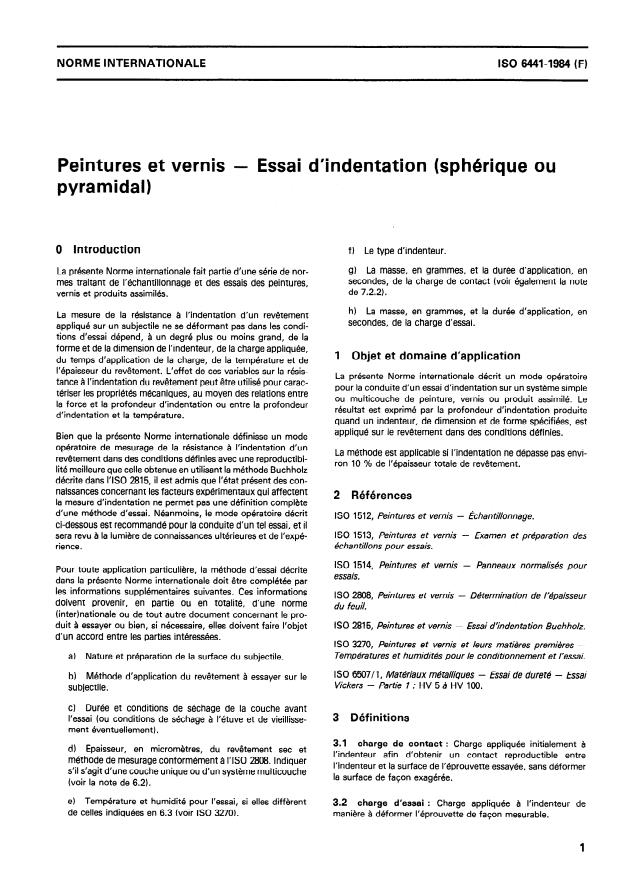
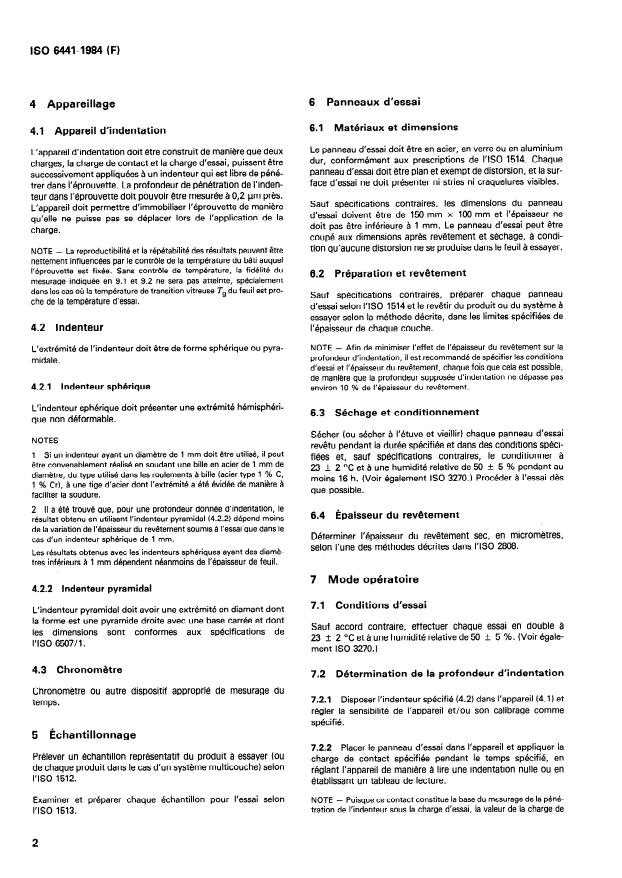
The test method is applicable on a single or multi-coat system. The result is expressed as the depth of indentation produced when an indentor of specified or between the interested parties agreed size and shape is applied to the coating under defined conditions. The method is applicable if the identation does not exceed approximately 10 % of the total coating thickness. The indentation apparatus shall be constructed so that the contact load and the test load can successively be applied to an indentor.
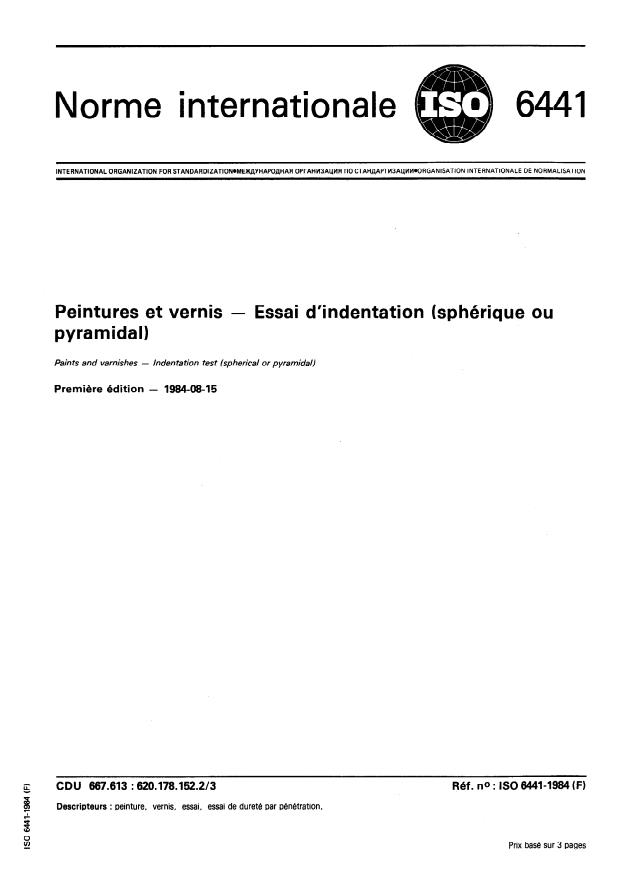
Peintures et vernis — Essai d'indentation (sphérique ou pyramidal)
General Information
- Status
- Withdrawn
- Publication Date
- 31-Jul-1984
- Withdrawal Date
- 31-Jul-1984
- Technical Committee
- ISO/TC 35/SC 9 - General test methods for paints and varnishes
- Drafting Committee
- ISO/TC 35/SC 9 - General test methods for paints and varnishes
- Current Stage
- 9599 - Withdrawal of International Standard
- Start Date
- 22-Mar-2004
- Completion Date
- 12-Feb-2026
Relations
- Effective Date
- 15-Apr-2008
- Effective Date
- 15-Apr-2008
ISO 6441:1984 - Paints and varnishes -- Indentation test (spherical or pyramidal)
ISO 6441:1984 - Peintures et vernis -- Essai d'indentation (sphérique ou pyramidal)
ISO 6441:1984 - Peintures et vernis -- Essai d'indentation (sphérique ou pyramidal)
Frequently Asked Questions
ISO 6441:1984 is a standard published by the International Organization for Standardization (ISO). Its full title is "Paints and varnishes — Indentation test (spherical or pyramidal)". This standard covers: The test method is applicable on a single or multi-coat system. The result is expressed as the depth of indentation produced when an indentor of specified or between the interested parties agreed size and shape is applied to the coating under defined conditions. The method is applicable if the identation does not exceed approximately 10 % of the total coating thickness. The indentation apparatus shall be constructed so that the contact load and the test load can successively be applied to an indentor.
The test method is applicable on a single or multi-coat system. The result is expressed as the depth of indentation produced when an indentor of specified or between the interested parties agreed size and shape is applied to the coating under defined conditions. The method is applicable if the identation does not exceed approximately 10 % of the total coating thickness. The indentation apparatus shall be constructed so that the contact load and the test load can successively be applied to an indentor.
ISO 6441:1984 is classified under the following ICS (International Classification for Standards) categories: 87.040 - Paints and varnishes. The ICS classification helps identify the subject area and facilitates finding related standards.
ISO 6441:1984 has the following relationships with other standards: It is inter standard links to ISO 6441-2:1999, ISO 6441-1:1999. Understanding these relationships helps ensure you are using the most current and applicable version of the standard.
ISO 6441:1984 is available in PDF format for immediate download after purchase. The document can be added to your cart and obtained through the secure checkout process. Digital delivery ensures instant access to the complete standard document.
Standards Content (Sample)
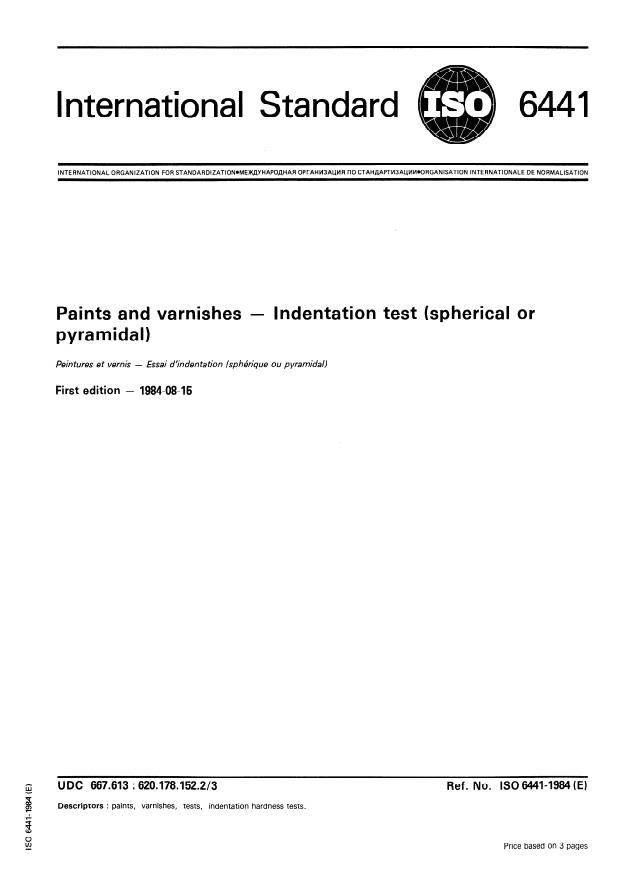
International Standard
INTERNATIONAL ORGANIZATION FOR STANDARDIZATION.ME~YHAPOfiHAR OPrAHM3AL&lR I-IO CTAHAAPTM3A~Mbl.ORGANlSATlON INTERNATIONALE DE NORMALISATION
Paints and varnishes - Indentation test (spherical or
pyramidal)
Pein tures et vernis - Essai d ’inden ta tion (sphkrique ou pyramidal)
First edition - 1984-08-15
UDC 667.613 : 620.178.152.2/3 Ref. No. IS0 6441-1984 E)
iz
-
Descriptors : paints, varnishes, tests, indentation hardness tests.
Price based on 3 pages
Foreword
IS0 (the International Organization for Standardization) is a worldwide federation of
national standards bodies (IS0 member bodies). The work of developing International
Standards is carried out through IS0 technical committees. Every member body
interested in a subject for which a technical committee has been authorized has the
right to be represented on that committee. International organizations, governmental
and non-governmental, in liaison with ISO, also take part in the work.
Draft International Standards adopted by the technical committees are circulated to
the member bodies for approval before their acceptance as International Standards by
the IS0 Council.
International Standard IS0 6441 was developed by Technical Committee ISO/TC 35,
Paints and varnishes, and was circulated to the member bodies in January 1983.
It has been approved by the member bodies of the following countries :
Australia Hungary South Africa, Rep. of
Belgium India Sri Lanka
Canada Iran Sweden
China Switzerland
Israel
Egypt, Arab Rep. of Italy United Kingdom
France Netherlands USSR
Germany, F. R. Poland
No member body expressed disapproval of the document.
International Organization for Standardization, 1984
Printed in Switzerland
IS0 64414984 (E)
INTERNATIONAL STANDARD
- Indentation test (spherical or
Paints and varnishes
pyramidal)
g) The mass, in grams, and the application time, in
0 Introduction
seconds, of the contact load (see also the note to 7.2.2).
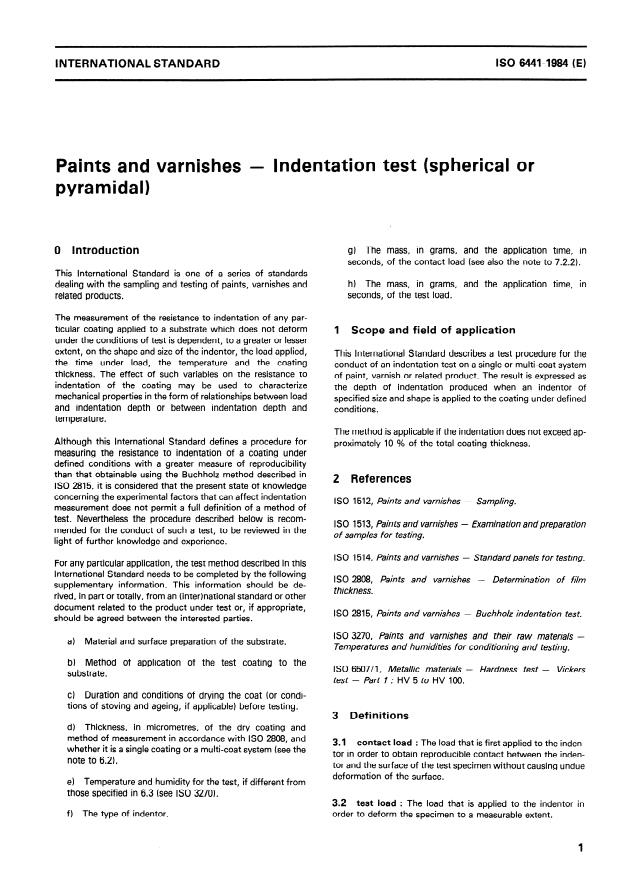
This International Standard is one of a series of standards
h) The mass, in grams, and the application time, in
dealing with the sampling and testing of paints, varnishes and
seconds, of the test load.
related products.
The measurement of the resistance to indentation of any par-
ticular coating applied to a substrate which does not deform
1 Scope and field of application
under the conditions of test is dependent, to a greater or lesser
extent, on the shape and size of the indentor, the load applied, This International Standard describes a test procedure for the
the time under load, the temperature and the coating
conduct of an indentation test on a single or multi-coat system
thickness. The effect of such variables on the resistance to
of paint, varnish or related product. The result is expressed as
indentation of the coating may be used to characterize
the depth of indentation produced when an indentor of
mechanical properties in the form of relationships between load
specified size and shape is applied to the coating under defined
and indentation depth or between indentation depth and
conditions.
temperature.
The method is applicable if the indentation does not exceed ap-
Although this International Standard defines a procedure for
proximately 10 % of the total coating thickness.
measuring the resistance to indentation of a coating under
defined conditions with a greater measure of reproducibility
than that obtainable using the Buchholz method described in
2 References
IS0 2815, it is considered that the present state of knowledge
concerning the experimental factors that can affect indentation
IS0 1512, Paints and varnishes - Sampling.
measurement does not permit a full definition of a method of
test. Nevertheless the procedure described below is recom-
IS0 1513, Paints and varnishes - Examination and preparation
mended for the conduct of such a test, to be reviewed in the
of samples for testing.
light of further knowledge and experience.
IS0 1514, Paints and varnishes - Standard panels for testing.
For any particular application, the test method described in this
International Standard needs to be completed by the following
I SO 2868, Paints and varnishes - Determination of film
supplementary information. This information should be de-
thickness.
rived, in part or totally, from an (inter)national standard or other
document related to the product under test or, if appropriate,
IS0 2815, Paints and varnishes - Buchholz indentation test.
should be agreed between the interested parties.
IS0 3270, Paints and varnishes and their raw materials -
a) Material and surface preparation of the substrate.
Temperatures and humidities for conditioning and testing.
b) Method of application of the test coating to the
I S 0 6567 I 1, Metallic ma teriafs - Hardness test - Vickers
substrate.
test - Part 7 ; HV 5 to HV 100.
c) Duration and conditions of drying the coat (or condi-
tions of stoving and ageing, if applicable) before testing.
3 Definitions
d) Thickness, in micrometres, of the dry coating and
method of measurement in accordance with IS0 2808, and
3.1 contact load : The load that is first applied to the inden-
whether it is a single coating or a multi-coat system (see the
tor in order to obtain reproducible contact between the inden-
note to 6.2).
tor and the surface of the test specimen without causing undue
deformation of the surface.
e) Temperature and humidity for the test, if different from
those specified in 6.3 (see IS0 3270).
3.2 test load : The load that is applied to the indentor in
f) The type of indentor. order to deform the specimen to a measurable extent.
Is0 64414984 (El
6 Test panels
4 Apparatus
6.1 Materials and dimensions
4.1 Indentation apparatus
The test panel shall be of steel, glass or hard aluminium com-
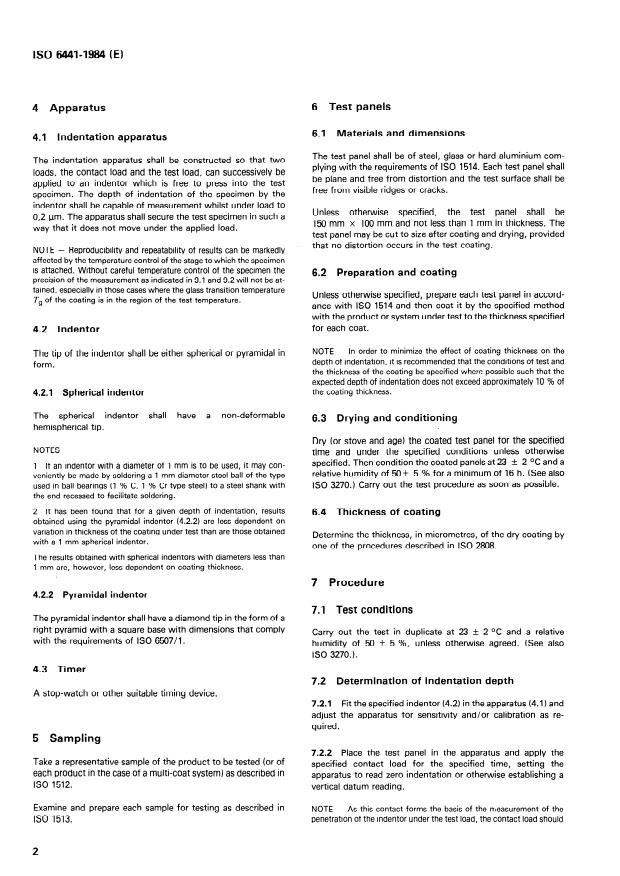
The indentation apparatus shall be constructed so that two
plying with the requirements of IS0 1514. Each test panel shall
loads, the contact load and the test load, can successively be
be plane and free from distortion and the test surface shall be
applied to an indentor which is free to press into the t
...
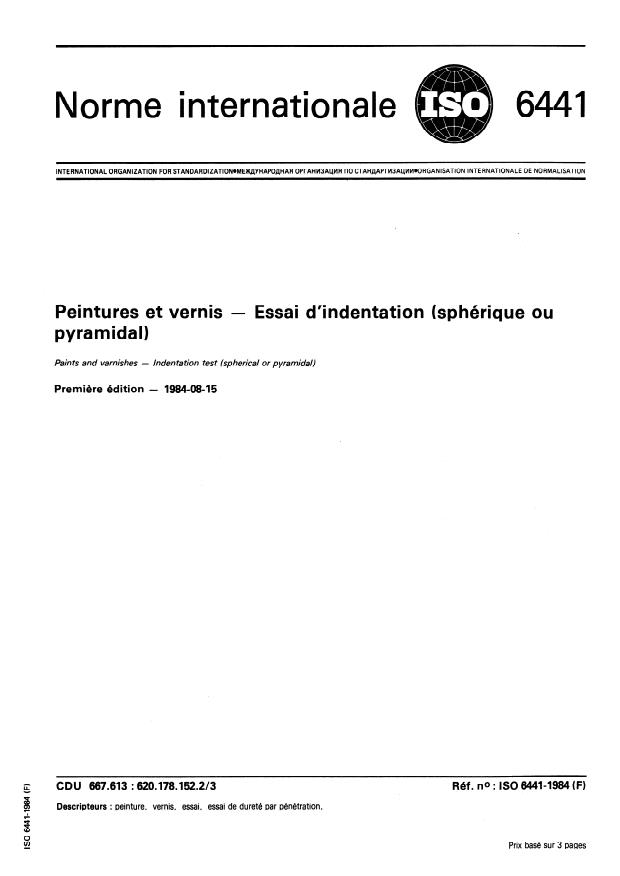
Norme internationale
INTERNATIONAL ORGANIZATION FOR STANDARDIZATION.ME~YHAPOC(HAR OPrAHMJAl@lR l-l0 CTAH~APTM3ALWlM*ORGANISATlON INTERNATIONALE DE NORMALISATION
Peintures et vernis - Essai d’indentation (sphérique ou
pyramidal)
Pain ts and varnishes - lnden ta tion test (sphericaf or p yramida/)
Première édition - 1984-08-15
CDU 667.613 : 620.178.152.2/3 Réf. no : ISO 64414984 (FI
L:
Y
Descripteurs : peinture, vernis, essai, essai de dureté par pénétration.
Prix basé sur 3 pages
Avant-propos
L’ISO (Organisation internationale de normalisation) est une fédération mondiale
d’organismes nationaux de normalisation (comités membres de I’ISO). L’élaboration
des Normes internationales est confiée aux comités techniques de 1’60. Chaque
comité membre intéressé par une étude a le droit de faire partie du comité technique
correspondant. Les organisations internationales, gouvernementales et non gouverne-
mentales, en liaison avec I’ISO, participent également aux travaux.
Les projets de Normes internationales adoptés par les comités techniques sont soumis
aux comités membres pour approbation, avant leur acceptation comme Normes inter-
nationales par le Conseil de I’ISO.
La Norme internationale ISO 6441 a été élaborée par le comité technique ISO/TC 35,
Peintures et vernis, et a été soumise aux comités membres en janvier 1983.
Les comités membres des pays suivants l’ont approuvée :
France Pologne
Afrique du Sud, Rép. d’
Allemagne, R.F. Hongrie Royaume-Uni
Australie Inde Sri Lanka
Belgique Iran Suéde
Canada Israël Suisse
Chine
Italie URSS
Égypte, Rép. arabe d’ Pays-Bas
Aucun comité membre ne l’a désapprouvée.
0 Organisation internationale de normalisation, 1984 0
Imprimé en Suisse
ISO 64414984 (FI
NORME INTERNATIONALE
- Essai d’indentation (sphérique ou
Peintures et vernis
pyramidal)
0 Introduction f) Le type d’indenteur.
9) La masse, en grammes, et la durée d’application, en
La présente Norme internationale fait partie d’une série de nor-
secondes, de la charge de contact (voir également la note
mes traitant de l’échantillonnage et des essais des peintures,
de 7.2.2).
vernis et produits assimilés.
en grammes, et la durée d’application, en
h) La masse,
La mesure de la résistance à l’indentation d’un revêtement
secondes, de la charge d’essai.
appliqué sur un subjectile ne se déformant pas dans les condi-
tions d’essai dépend, à un degré plus ou moins grand, de la
forme et de la dimension de I’indenteur, de la charge appliquée,
1 Objet et domaine d’application
du temps d’application de la charge, de la température et de
l’épaisseur du revêtement. L’effet de ces variables sur la résis-
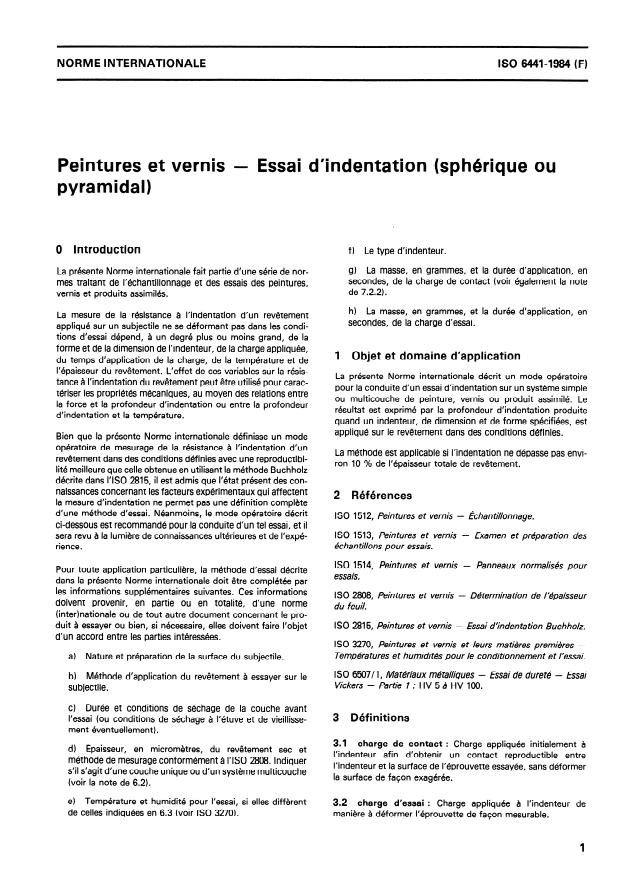
La présente Norme internationale décrit un mode opératoire
tance à l’indentation du revêtement peut être utilisé pour carac-
pour la conduite d’un essai d’indentation sur un système simple
tériser les propriétés mécaniques, au moyen des relations entre
ou multicouche de peinture, vernis ou produit assimilé. Le
la force et la profondeur d’indentation ou entre la profondeur
résultat est exprimé par la profondeur d’indentation produite
d’indentation et la température.
quand un indenteur, de dimension et de forme spécifiées, est
appliqué sur le revêtement dans des conditions définies.
Bien que la présente Norme internationale définisse un mode
opératoire de mesurage de la résistance à l’indentation d’un
La méthode est applicable si l’indentation ne dépasse pas envi-
revêtement dans des conditions définies avec une reproductibi-
ron 10 % de l’épaisseur totale de revêtement.
lité meilleure que celle obtenue en utilisant la méthode Buchholz
décrite dans I’ISO 2815, il est admis que l’état présent des con-
naissances concernant les facteurs expérimentaux qui affectent
2 Références
la mesure d’indentation ne permet pas une définition complète
d’une méthode d’essai. Néanmoins, le mode opératoire décrit
ISO 1512, Peintures et vernis - Échantillonnage.
ci-dessous est recommandé pour la conduite d’un tel essai, et il
ISO 1513, Peintures et vernis - Examen et préparation des
sera revu à la lumière de connaissances ultérieures et de I’expé-
échan tilfons pour essais.
rience.
ISO 1514, Peintures et vernis - Panneaux normalisés pour
Pour toute application particulière, la méthode d’essai décrite
essais.
dans la présente Norme internationale doit être complétée par
les informations supplémentaires suivantes. Ces informations
ISO 2868, Peintures et vernis - Dé termina tion de l’épaisseur
doivent provenir, en partie ou en totalité, d’une norme
du feuil.
(inter)nationale ou de tout autre document concernant le pro-
ISO 2815, Peintures et vernis - Essai d’indentation Buchholz.
duit à essayer ou bien, si nécessaire, elles doivent faire l’objet
d’un accord entre les parties intéressées.
ISO 3270, Peintures et vernis et leurs matières premières -
Températures et humidites pour le conditionnement et l’essai.
a) Nature et préparation de la surface du subjectile.
I S 0 650711, Ma teriaux métalfiques - Essai de dureté - Essai
b) Méthode d’application du revêtement à essayer sur le
Vickers - Partie 7 : HV 5 à HV 100.
subjectile.
c) Durée et conditions de séchage de la couche avant
3 Définitions
l’essai (ou conditions de séchage à l’étuve et de vieillisse-
ment éventuellement).
3.1 charge de contact : Charge appliquée initialement à
d) Épaisseur, en micromètres, du revêtement sec et
I’indenteur afin d’obtenir un contact reproductible entre
méthode de mesurage conformément à I’ISO 2808. Indiquer
I’indenteur et la surface de l’éprouvette essayée, sans déformer
s’il s’agit d’une couche unique ou d’un système multicouche
la surface de facon exagérée.
,
(voir la note de 6.2).
e) Température et humidité pour l’essai, si elles différent
3.2 charge d’essai : Charge appliquée à I’indenteur de
de celles indiquées en 6.3 (voir ISO 3270).
maniére à déformer l’éprouvette de façon mesurable.
ISO 64414984 (FI
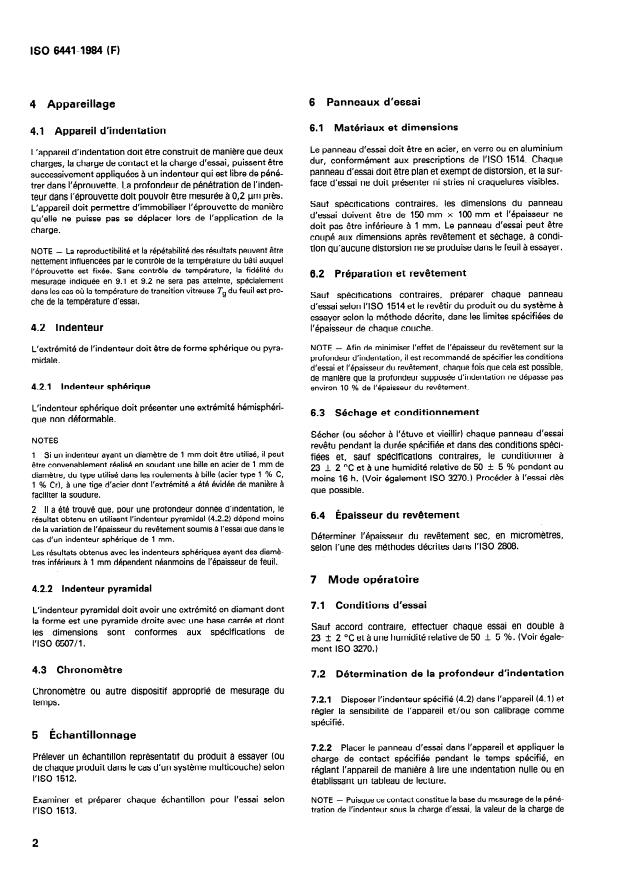
4 Appareillage 6 Panneaux d’essai
6.1 Matériaux et dimensions
4.1 Appareil d’indentation
Le panneau d’essai doit être en acier, en verre ou en aluminium
L’appareil d’indentation doit être construit de manière que deux
dur, conformément aux prescriptions de I’ISO 1514. Chaque
charges, la charge de contact et la charge d’essai, puissent être
panneau d’essai doit être plan et exempt de distorsion, et la sur-
successivement appliquées à un indenteur qui est libre de péné-
face d’essai ne doit présenter ni stries ni craquelures visibles.
trer dans l’éprouvette. La profondeur de pénétration de I’inden-
teur dans l’éprouvette doit pou
...
Norme internationale
INTERNATIONAL ORGANIZATION FOR STANDARDIZATION.ME~YHAPOC(HAR OPrAHMJAl@lR l-l0 CTAH~APTM3ALWlM*ORGANISATlON INTERNATIONALE DE NORMALISATION
Peintures et vernis - Essai d’indentation (sphérique ou
pyramidal)
Pain ts and varnishes - lnden ta tion test (sphericaf or p yramida/)
Première édition - 1984-08-15
CDU 667.613 : 620.178.152.2/3 Réf. no : ISO 64414984 (FI
L:
Y
Descripteurs : peinture, vernis, essai, essai de dureté par pénétration.
Prix basé sur 3 pages
Avant-propos
L’ISO (Organisation internationale de normalisation) est une fédération mondiale
d’organismes nationaux de normalisation (comités membres de I’ISO). L’élaboration
des Normes internationales est confiée aux comités techniques de 1’60. Chaque
comité membre intéressé par une étude a le droit de faire partie du comité technique
correspondant. Les organisations internationales, gouvernementales et non gouverne-
mentales, en liaison avec I’ISO, participent également aux travaux.
Les projets de Normes internationales adoptés par les comités techniques sont soumis
aux comités membres pour approbation, avant leur acceptation comme Normes inter-
nationales par le Conseil de I’ISO.
La Norme internationale ISO 6441 a été élaborée par le comité technique ISO/TC 35,
Peintures et vernis, et a été soumise aux comités membres en janvier 1983.
Les comités membres des pays suivants l’ont approuvée :
France Pologne
Afrique du Sud, Rép. d’
Allemagne, R.F. Hongrie Royaume-Uni
Australie Inde Sri Lanka
Belgique Iran Suéde
Canada Israël Suisse
Chine
Italie URSS
Égypte, Rép. arabe d’ Pays-Bas
Aucun comité membre ne l’a désapprouvée.
0 Organisation internationale de normalisation, 1984 0
Imprimé en Suisse
ISO 64414984 (FI
NORME INTERNATIONALE
- Essai d’indentation (sphérique ou
Peintures et vernis
pyramidal)
0 Introduction f) Le type d’indenteur.
9) La masse, en grammes, et la durée d’application, en
La présente Norme internationale fait partie d’une série de nor-
secondes, de la charge de contact (voir également la note
mes traitant de l’échantillonnage et des essais des peintures,
de 7.2.2).
vernis et produits assimilés.
en grammes, et la durée d’application, en
h) La masse,
La mesure de la résistance à l’indentation d’un revêtement
secondes, de la charge d’essai.
appliqué sur un subjectile ne se déformant pas dans les condi-
tions d’essai dépend, à un degré plus ou moins grand, de la
forme et de la dimension de I’indenteur, de la charge appliquée,
1 Objet et domaine d’application
du temps d’application de la charge, de la température et de
l’épaisseur du revêtement. L’effet de ces variables sur la résis-
La présente Norme internationale décrit un mode opératoire
tance à l’indentation du revêtement peut être utilisé pour carac-
pour la conduite d’un essai d’indentation sur un système simple
tériser les propriétés mécaniques, au moyen des relations entre
ou multicouche de peinture, vernis ou produit assimilé. Le
la force et la profondeur d’indentation ou entre la profondeur
résultat est exprimé par la profondeur d’indentation produite
d’indentation et la température.
quand un indenteur, de dimension et de forme spécifiées, est
appliqué sur le revêtement dans des conditions définies.
Bien que la présente Norme internationale définisse un mode
opératoire de mesurage de la résistance à l’indentation d’un
La méthode est applicable si l’indentation ne dépasse pas envi-
revêtement dans des conditions définies avec une reproductibi-
ron 10 % de l’épaisseur totale de revêtement.
lité meilleure que celle obtenue en utilisant la méthode Buchholz
décrite dans I’ISO 2815, il est admis que l’état présent des con-
naissances concernant les facteurs expérimentaux qui affectent
2 Références
la mesure d’indentation ne permet pas une définition complète
d’une méthode d’essai. Néanmoins, le mode opératoire décrit
ISO 1512, Peintures et vernis - Échantillonnage.
ci-dessous est recommandé pour la conduite d’un tel essai, et il
ISO 1513, Peintures et vernis - Examen et préparation des
sera revu à la lumière de connaissances ultérieures et de I’expé-
échan tilfons pour essais.
rience.
ISO 1514, Peintures et vernis - Panneaux normalisés pour
Pour toute application particulière, la méthode d’essai décrite
essais.
dans la présente Norme internationale doit être complétée par
les informations supplémentaires suivantes. Ces informations
ISO 2868, Peintures et vernis - Dé termina tion de l’épaisseur
doivent provenir, en partie ou en totalité, d’une norme
du feuil.
(inter)nationale ou de tout autre document concernant le pro-
ISO 2815, Peintures et vernis - Essai d’indentation Buchholz.
duit à essayer ou bien, si nécessaire, elles doivent faire l’objet
d’un accord entre les parties intéressées.
ISO 3270, Peintures et vernis et leurs matières premières -
Températures et humidites pour le conditionnement et l’essai.
a) Nature et préparation de la surface du subjectile.
I S 0 650711, Ma teriaux métalfiques - Essai de dureté - Essai
b) Méthode d’application du revêtement à essayer sur le
Vickers - Partie 7 : HV 5 à HV 100.
subjectile.
c) Durée et conditions de séchage de la couche avant
3 Définitions
l’essai (ou conditions de séchage à l’étuve et de vieillisse-
ment éventuellement).
3.1 charge de contact : Charge appliquée initialement à
d) Épaisseur, en micromètres, du revêtement sec et
I’indenteur afin d’obtenir un contact reproductible entre
méthode de mesurage conformément à I’ISO 2808. Indiquer
I’indenteur et la surface de l’éprouvette essayée, sans déformer
s’il s’agit d’une couche unique ou d’un système multicouche
la surface de facon exagérée.
,
(voir la note de 6.2).
e) Température et humidité pour l’essai, si elles différent
3.2 charge d’essai : Charge appliquée à I’indenteur de
de celles indiquées en 6.3 (voir ISO 3270).
maniére à déformer l’éprouvette de façon mesurable.
ISO 64414984 (FI
4 Appareillage 6 Panneaux d’essai
6.1 Matériaux et dimensions
4.1 Appareil d’indentation
Le panneau d’essai doit être en acier, en verre ou en aluminium
L’appareil d’indentation doit être construit de manière que deux
dur, conformément aux prescriptions de I’ISO 1514. Chaque
charges, la charge de contact et la charge d’essai, puissent être
panneau d’essai doit être plan et exempt de distorsion, et la sur-
successivement appliquées à un indenteur qui est libre de péné-
face d’essai ne doit présenter ni stries ni craquelures visibles.
trer dans l’éprouvette. La profondeur de pénétration de I’inden-
teur dans l’éprouvette doit pou
...
Questions, Comments and Discussion
Ask us and Technical Secretary will try to provide an answer. You can facilitate discussion about the standard in here.
Loading comments...