

ISO/IEC 8801:2026
(Main)Information technology — 3D printing and scanning — Data standard operating procedure (SOP)
- Abstract
This document describes a standard operating procedure (SOP) for the curation and quality control of test data, consisting of 3D scanned data and its corresponding label data, for the evaluation of modelling from 3D scanned data. This document classifies the main task phases and defines the required tasks in each phase of the 3D scanned and labelled data SOP. This document defines essential requirements for test data for evaluating modelling from 3D scanned data and describes how to verify conformance to these requirements.
- Status
- Published
- Publication Date
- 29-Jun-2026
- Technical Committee
- ISO/IEC JTC 1 - Information technology
- Drafting Committee
- ISO/IEC JTC 1 - Information technology
- Current Stage
- 6060 - International Standard published
- Start Date
- 30-Jun-2026
- Due Date
- 08-Mar-2026
- Completion Date
- 30-Jun-2026

ISO/IEC 8801:2026 is an International Standard from ISO/IEC for the curation and quality control of test data used to evaluate modelling from 3D scanned data. It specifies a standard operating procedure (SOP) for 3D scanned data and matching label data, so organizations can prepare, check, and improve datasets for 3D printing and scanning work. It is aimed at the people and teams responsible for dataset quality, traceability, and validation.
What does ISO/IEC 8801:2026 specify?
ISO/IEC 8801:2026 specifies a staged SOP for test data preparation, from planning through improvement. The document explains how to define requirements, acquire and preprocess data, validate the result, and update the dataset and procedure based on review outcomes.
| Clause | What it covers |
|---|---|
| 1-3 | Scope, terms and definitions, abbreviated terms |
| 4 | General SOP requirements, documentation, data levels, process flow |
| 5 | Define and design stage |
| 6 | Acquire and pre-process stage |
| 7 | Validate and analyse stage |
| 8 | Optimize and update stage |
The standard focuses on test data made up of 3D scanned data and corresponding label data. It also shows the preparation flow in Figures 1 and 2, which link each stage to the expected outputs.
What are the key requirements of ISO/IEC 8801:2026?
ISO/IEC 8801:2026 requires a documented, controlled workflow for data quality assurance. In practice, that means the organization must assign responsibilities, define quality criteria, keep records, and verify that the dataset is fit for evaluating modelling from 3D scanned data.
- Clause 4.1 requires the entity to define its roles, process sequence, risk-based controls, and the competence of the data manager. This matters because the SOP only works if someone owns each step and controls are linked to the real risks.
- Clause 4.1.2 requires criteria, resources, monitoring, records, control of changes, and oversight of outsourced processes. It also requires software validation before initial use and after relevant changes, which matters when tools are used to curate or process the data.
- Clause 4.2 requires a data quality policy, measurable quality objectives, a data quality manual, and the procedures and records needed to operate the SOP. The manual must state scope, exclusions or non-application, and how the processes interact.
- Clause 4.3 defines the data levels from raw data through de-identified, pre-processed, labelled, qualified, and structured data. This helps teams decide what can be shared, what can be evaluated, and what is ready for final use.
- Clause 5 sets the planning and design work: define the purpose, scope, quality objectives, and planning method, then keep the process integrity when changes are introduced.
- Clause 6 covers acquisition and pre-processing, including sample size justification, data source control, curation, augmentation, de-identification, transfer, preprocessing, and labelling. It also calls for a reference standard, training, and controls for intra-observer and inter-observer variability.
- Clause 7 requires validation against acquisition and labelling requirements such as relevance, size and distribution, covariate shift, origin, acceptability, annotator qualification, annotation method, accuracy, consensus strategy, and variability. In practice, this is the checkpoint that decides whether the dataset is reliable enough for evaluation.
- Clause 8 requires standard formatting and reporting for raw and labelled data, then uses the validation results to improve the dataset and repeat earlier stages if needed.
What terms does ISO/IEC 8801:2026 define?
ISO/IEC 8801:2026 defines a small set of terms that anchor the SOP and the validation workflow.
- standard operating procedure (SOP) - an authorized, documented procedure or set of procedures, work instructions and test instructions.
- annotation - the process of adding information to a data object to improve its interpretation, organization or use.
- oversampling - a method of increasing the number of observations in a dataset by adding additional data points.
- measure - a variable that is assigned a value as the result of measurement.
- measurement - a set of operations used to determine a value of a measure.
- process - a system of activities that uses resources to transform inputs into outputs.
Who uses ISO/IEC 8801:2026?
ISO/IEC 8801:2026 is for organizations and specialists who prepare, manage, or assess test data for 3D printing and scanning. The document names roles such as data provider, data management institution, software developer, manufacturer, labelling data provider, data manager, top data manager, data security manager, and external expert reviewer.
In practice, these users apply the standard to curate datasets, de-identify sensitive data, document the source, label the data with a reference standard, check quality, and publish validated datasets and reports. It is relevant where 3D scanned data come from medical images, EHR, PACS, computed tomography (CT), or non-destructive testing datasets, and where the data are used to evaluate modelling performance.
What does the ISO/IEC 8801:2026 document contain?
ISO/IEC 8801:2026 contains the full SOP structure, starting with the introductory rationale and then the technical clauses that govern each stage. Clause 4 sets out the general requirements, the data quality manual, the data levels, and the four-stage process flow.
Clauses 5 to 8 provide the stage-by-stage tasks for planning, acquisition, preprocessing, labelling, validation, reporting, and improvement. The document also describes intensity normalization, resampling and interslice interpolation, data augmentation approaches, and formatting guidance for raw data and label data. Figures 1 and 2 show the overall process flow and the relationship between stages, tasks, and outputs.
Get Certified
Connect with accredited certification bodies for this standard

BSI Group
BSI (British Standards Institution) is the business standards company that helps organizations make excellence a habit.

NYCE
Mexican standards and certification body.
Sponsored listings
Frequently Asked Questions
ISO/IEC 8801:2026 is a standard published by the International Organization for Standardization (ISO). Its full title is "Information technology — 3D printing and scanning — Data standard operating procedure (SOP)". This standard covers: This document describes a standard operating procedure (SOP) for the curation and quality control of test data, consisting of 3D scanned data and its corresponding label data, for the evaluation of modelling from 3D scanned data. This document classifies the main task phases and defines the required tasks in each phase of the 3D scanned and labelled data SOP. This document defines essential requirements for test data for evaluating modelling from 3D scanned data and describes how to verify conformance to these requirements.
This document describes a standard operating procedure (SOP) for the curation and quality control of test data, consisting of 3D scanned data and its corresponding label data, for the evaluation of modelling from 3D scanned data. This document classifies the main task phases and defines the required tasks in each phase of the 3D scanned and labelled data SOP. This document defines essential requirements for test data for evaluating modelling from 3D scanned data and describes how to verify conformance to these requirements.
ISO/IEC 8801:2026 is classified under the following ICS (International Classification for Standards) categories: 35.020 - Information technology (IT) in general. The ICS classification helps identify the subject area and facilitates finding related standards.
ISO/IEC 8801:2026 is available in PDF format for immediate download after purchase. The document can be added to your cart and obtained through the secure checkout process. Digital delivery ensures instant access to the complete standard document.
Standards Content (Sample)
International
Standard
ISO/IEC 8801
First edition
Information technology — 3D
2026-06
printing and scanning — Data
standard operating procedure
(SOP)
Technologies de l'information — Impression et numérisation 3D
— Mode opératoire normalisé (SOP) pour les données
Reference number
© ISO/IEC 2026
All rights reserved. Unless otherwise specified, or required in the context of its implementation, no part of this publication may
be reproduced or utilized otherwise in any form or by any means, electronic or mechanical, including photocopying, or posting on
the internet or an intranet, without prior written permission. Permission can be requested from either ISO at the address below
or ISO’s member body in the country of the requester.
ISO copyright office
CP 401 • Ch. de Blandonnet 8
CH-1214 Vernier, Geneva
Phone: +41 22 749 01 11
Email: copyright@iso.org
Website: www.iso.org
Published in Switzerland
© ISO/IEC 2026 – All rights reserved
ii
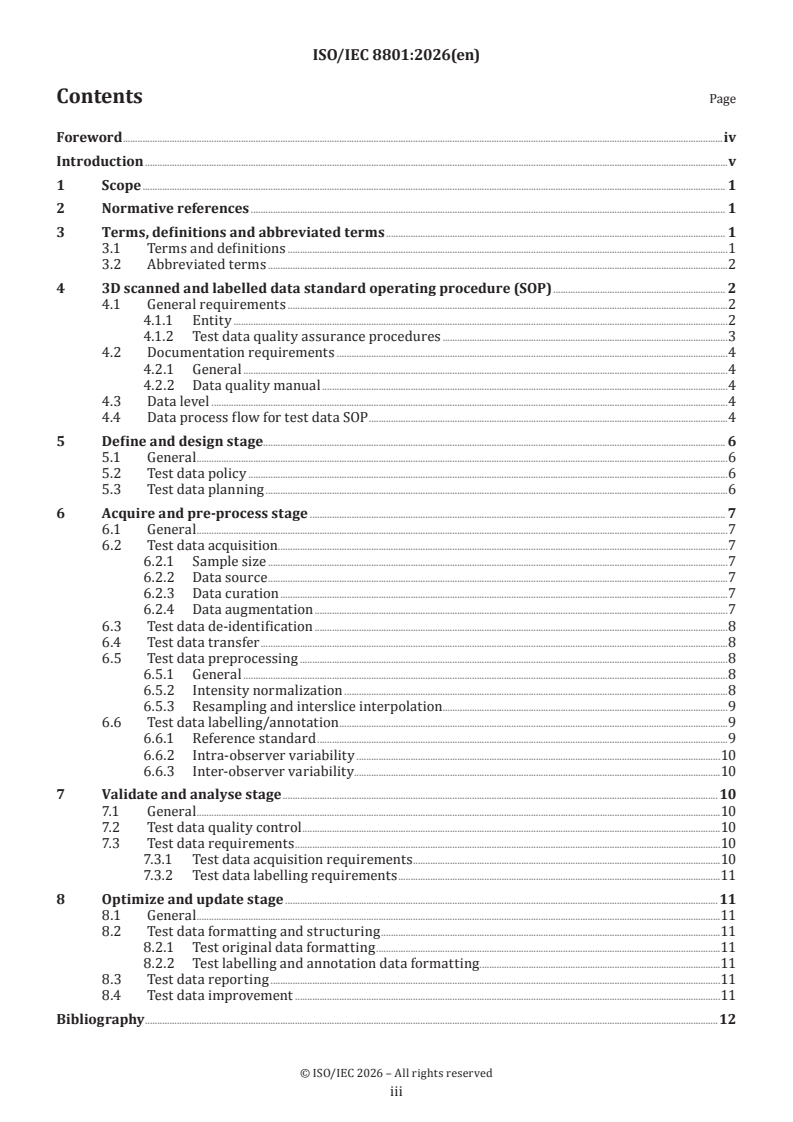
Contents Page
Foreword .iv
Introduction .v
1 Scope . 1
2 Normative references . 1
3 Terms, definitions and abbreviated terms . 1
3.1 Terms and definitions .1
3.2 Abbreviated terms .2
4 3D scanned and labelled data standard operating procedure (SOP) . 2
4.1 General requirements .2
4.1.1 Entity .2
4.1.2 Test data quality assurance procedures .3
4.2 Documentation requirements .4
4.2.1 General .4
4.2.2 Data quality manual .4
4.3 Data level .4
4.4 Data process flow for test data SOP .4
5 Define and design stage. 6
5.1 General .6
5.2 Test data policy .6
5.3 Test data planning .6
6 Acquire and pre-process stage . 7
6.1 General .7
6.2 Test data acquisition.7
6.2.1 Sample size .7
6.2.2 Data source .7
6.2.3 Data curation .7
6.2.4 Data augmentation .7
6.3 Test data de-identification .8
6.4 Test data transfer .8
6.5 Test data preprocessing .8
6.5.1 General .8
6.5.2 Intensity normalization .8
6.5.3 Resampling and interslice interpolation .9
6.6 Test data labelling/annotation .9
6.6.1 Reference standard .9
6.6.2 Intra-observer variability .10
6.6.3 Inter-observer variability.10
7 Validate and analyse stage . 10
7.1 General .10
7.2 Test data quality control .10
7.3 Test data requirements .10
7.3.1 Test data acquisition requirements .10
7.3.2 Test data labelling requirements .11
8 Optimize and update stage .11
8.1 General .11
8.2 Test data formatting and structuring .11
8.2.1 Test original data formatting .11
8.2.2 Test labelling and annotation data formatting . .11
8.3 Test data reporting .11
8.4 Test data improvement .11
Bibliography .12
© ISO/IEC 2026 – All rights reserved
iii
Foreword
ISO (the International Organization for Standardization) and IEC (the International Electrotechnical
Commission) form the specialized system for worldwide standardization. National bodies that are
members of ISO or IEC participate in the development of International Standards through technical
committees established by the respective organization to deal with particular fields of technical activity.
ISO and IEC technical committees collaborate in fields of mutual interest. Other international organizations,
governmental and non-governmental, in liaison with ISO and IEC, also take part in the work.
The procedures used to develop this document and those intended for its further maintenance are described
in the ISO/IEC Directives, Part 1. In particular, the different approval criteria needed for the different types
of document should be noted. This document was drafted in accordance with the editorial rules of the ISO/
IEC Directives, Part 2 (see www.iso.org/directives or www.iec.ch/members_experts/refdocs).
ISO and IEC draw attention to the possibility that the implementation of this document may involve the
use of (a) patent(s). ISO and IEC take no position concerning the evidence, validity or applicability of any
claimed patent rights in respect thereof. As of the date of publication of this document, ISO and IEC had not
received notice of (a) patent(s) which may be required to implement this document. However, implementers
are cautioned that this may not represent the latest information, which may be obtained from the patent
database available at www.iso.org/patents and https://patents.iec.ch. ISO and IEC shall not be held
responsible for identifying any or all such patent rights.
Any trade name used in this document is information given for the convenience of users and does not
constitute an endorsement.
For an explanation of the voluntary nature of standards, the meaning of ISO specific terms and expressions
related to conformity assessment, as well as information about ISO's adherence to the World Trade
Organization (WTO) principles in the Technical Barriers to Trade (TBT) see www.iso.org/iso/foreword.html.
In the IEC, see www.iec.ch/understanding-standards.
This document was prepared by Joint Technical Committee ISO/IEC JTC 1, Information technology.
Any feedback or questions on this document should be directed to the user’s national standards
body. A complete listing of these bodies can be found at www.iso.org/members.html and
www.iec.ch/national-committees.
© ISO/IEC 2026 – All rights reserved
iv
Introduction
This document was developed in response to the quality management needs of 3D printing and scanning
technology, with the aim of taking full advantage of information and communication technology (ICT) in
this context.
However, there is currently no standardized evaluation procedure for the process of turning scanned data
into consistent and accurate 3D printed objects, making continuous quality assessment and improvement
activities impossible. Issues with precision evaluation and inaccurate modelling from 3D scanned data exist,
but no agreed standard specifies practically acceptable measurement accuracy or an evaluation process.
Artificial intelligence/machine learning (AI/ML) technology can be used for generating and optimizing 3D
models from 3D scanned data, particularly for enhancing design accuracy and efficiency. For the training
data of an ML-based model, the collection of as much data as possible (big data) is considered to improve
the performance of the model. However, it is not practical to use big data as test data. Therefore, minimal
requirements are necessary for achieving rigorous and comprehensive evaluation.
In this context, this document describes the standard operating procedure (SOP) and necessary requirements
for curation and quality control of test data for evaluation of modelling from 3D scanned data.
© ISO/IEC 2026 – All rights reserved
v
International Standard ISO/IEC 8801:2026(en)
Information technology — 3D printing and scanning — Data
standard operating procedure (SOP)
1 Scope
This document describes a standard operating procedure (SOP) for the curation and quality control of test
data, consisting of 3D scanned data and its corresponding label data, for the evaluation of modelling from 3D
scanned data.
This document classifies the main task phases and defines the required tasks in each phase of the 3D
scanned and labelled data SOP.
This document defines essential requirements for test data for evaluating modelling from 3D scanned data
and describes how to verify conformance to these requirements.
2 Normative references
There are no normative references in this document.
3 Terms, definitions and abbreviated terms
For the purposes of this document, the following terms and definitions apply.
ISO and IEC maintain terminology databases for use in standardization at the following addresses:
— ISO Online browsing platform: available at https:// www .iso .org/ obp
— IEC Electropedia: available at https:// www .electropedia .org/
3.1 Terms and definitions
3.1.1
measure
variable to which a value is assigned as the result of measurement
Note 1 to entry: The plural form “measures” is used to refer collectively to base measures, derived measures, and
indicators.
[SOURCE: ISO/IEC/IEEE 15939:2017, 3.15]
3.1.2
measure
make a measurement
[SOURCE: ISO/IEC/IEEE 15939:2017, 3.16]
3.1.3
measurement
set of operations having the object of determining a value of a measure
[SOURCE: ISO/IEC/IEEE 15939:2017, 3.17, modified — Note 1 to entry has been removed.]
© ISO/IEC 2026 – All rights reserved
3.1.4
process
system of activities, which uses resources to transform inputs into outputs
[SOURCE: ISO/IEC 25000:2014, 4.22]
3.1.5
annotation
process of adding additional information to a data object to improve its interpretation, organization or use
3.1.6
oversampling
method of increasing the number of observations in a dataset by adding additional data points
3.1.7
standard operating procedure
SOP
authorized, documented procedure, or set of procedures, work instructions and test instructions
[SOURCE: ISO 15378:2017, 3.7.10]
3.2 Abbreviated terms
AI artificial intelligence
CNN convolutional neural network
CT computed tomography
DICOM digital imaging and communications in medicine
EHR electronic health records
GAN generative adversarial network
MAE mean absolute error
ML machine learning
MSE mean squared error
PACS picture archiving and communication system
SOP standard operating procedure
4 3D scanned and labelled data standard operating procedure (SOP)
4.1 General requirements
4.1.1 Entity
An entity may act as a data provider, data management institution, or software developer, and represents
a legal or organizational body as commonly defined in ISO data-related standards. An entity implementing
the SOP specified in this document shall document the test data quality assurance procedures and maintain
its effectiveness in accordance with the requirements of the SOP. The entity shall establish, implement and
maintain any requirement, procedure, activity or arrangement required to be documented by this SOP.
© ISO/IEC 2026 – All rights reserved
The entity shall document the role(s) undertaken by the entity under the applicable regulatory requirements.
NOTE Roles undertaken by the entity can include manufacturer, data provider, labelling data provider, data
manager or software developer.
The entity shall:
a) determine the processes needed for the data quality assurance procedures and the application of these
processes throughout the entity, taking into account the roles undertaken by the entity;
b) apply a risk-based approach to the control of the appropriate processes needed for the data quality
assurance procedures;
c) determine the sequence and interaction of these processes;
d) set and manage the competence of the data manager.
4.1.2 Test data quality assurance procedures
For each test data quality assurance procedure, the entity shall:
a) determine criteria and methods needed to ensure that both the operation and control of these processes
are effective;
b) ensure the availability of resources and information necessary to support the operation and monitoring
of these processes;
c) implement actions necessary to achieve planned results and maintain the effectiveness of these
processes;
d) monitor, measure as appropriate, and analyse these processes;
e) establish and maintain records needed to demonstrate conformance to this document and compliance
with applicable regulatory requirements (see 5.3).
The entity shall manage these data quality assurance procedures in accordance with the requirements of
this document and applicable regulatory requirements. Changes to be made to these processes shall be:
a) evaluated for their impact on the data quality assurance procedures;
b) evaluated for their impact on the 3D printing produced under these data quality assurance procedures;
c) controlled in accordance with the requirements of this SOP.
When the entity chooses to outsource any process that affects product conformity to requirements, it shall
monitor and ensure control over such processes. The entity shall retain the responsibility of conformity
to this document and to customers and applicable regulatory requirements for outsourced processes.
The controls shall be proportionate to the risk involved and the ability of the external party to meet the
requirements in accordance with 5.3. The controls shall include written quality agreements.
The ent
...