

ISO 28005-2:2021
(Main)Ships and marine technology — Electronic port clearance (EPC) — Part 2: Core data elements
General Information
- Abstract
This document provides technical specifications to facilitate an efficient exchange of electronic information between ships and shore, for coastal transit or port calls. It specifies requirements for the safety, security and efficiency enhancement of information, related mainly to the relationships between the ship and the port and coastal state authorities. This document provides the definition of core data elements for use in electronic port clearance (EPC) messages. It does not define any structuring of messages nor provides any guidance on what information is required for a particular purpose; it is a general data dictionary for safety, security or operation-related maritime information. Details about message formats and applications are defined in ISO 28005-1. The data elements in this document is a superset of the data elements and the data model defined in the IMO Reference Data Model as specified in the IMO Compendium on Facilitation and Electronic Business. It also contains data elements from other IMO instruments as described in 4.1. The specifications in this document is compatible with the definitions in the IMO Reference Data Model and the mapping between ISO 28005 and the data element list in the IMO Reference Data Model is defined in Annex B.
- Status
- Published
- Publication Date
- 30-May-2021
- Technical Committee
- ISO/TC 8/SC 11 - Intermodal and Short Sea Shipping
- Drafting Committee
- ISO/TC 8/SC 11/WG 2 - Maritime operational data model
- Current Stage
- 9092 - International Standard to be revised
- Start Date
- 26-Sep-2024
- Completion Date
- 29-Aug-2026
Buy Documents

ISO 28005-2:2021 - Ships and marine technology -- Electronic port clearance (EPC)
ISO 28005-2:2021 - Ships and marine technology — Electronic port clearance (EPC) — Part 2: Core data elements/31/2021
Overview
ISO 28005-2:2021 - part of the Electronic Port Clearance (EPC) series - defines the core data elements used for electronic ship-to-shore exchanges during coastal transit and port calls. Rather than prescribing message structures or workflow rules, this standard provides a neutral data dictionary for safety-, security- and operation-related maritime information. It is designed to improve interoperability between ship systems, port authorities, coastal state administrations and port community systems.
Key technical topics and requirements
- Core data element definitions: standardized names, definitions and types for ship identity, cargo, crew and passenger lists, certificates, security data, ship particulars and vessel operation data (examples: ShipIDType, CargoDataType, CrewListType, EPCMessageHeaderType).
- XML/XSD guidance: use of XML namespaces, creation of main XML schema files, adapted XSD data types and templates for implementation.
- Data modeling rules: structure of data element descriptions, data type definitions, enumerated types, character set guidance, and rules for minOccurs/maxOccurs and empty tags.
- Compatibility and mapping: data elements are a superset of the IMO Reference Data Model (Compendium on Facilitation and Electronic Business) and include elements from other IMO instruments; mapping between ISO 28005-2 and the IMO Reference Data Model is provided (Annex B).
- Principles for interoperability: code set specification schema, prohibition of XML attributes for EPC data elements, and templates for creating message files with core data elements.
Practical applications and who uses it
ISO 28005-2 is intended for organizations building or operating digital ship/port information exchanges, including:
- Port and coastal state authorities (harbour masters, customs, border control, coast guard)
- Ship operators and ship agents (optimizing port call clearance)
- Maritime IT vendors and system integrators (port community systems, shipboard software)
- Maritime administrations and classification societies (policy alignment and certification)
- Logistics and terminal operators (automation of arrival/departure processes)
Typical use cases:
- Replacing paper-based clearance with automated EPC messages
- Standardizing data inputs for port community systems and shore-side services
- Enabling secure, consistent data exchange for safety, security and operational decisions
Related standards
- ISO 28005-1 - message formats and application profiles for EPC (complements Part 2)
- IMO Reference Data Model and IMO Compendium on Facilitation and Electronic Business - mapped to ISO 28005-2 (see Annex B)
By adopting ISO 28005-2, maritime stakeholders can accelerate digitalization of port calls, reduce manual data re-entry, and enhance safety, security and efficiency through consistent, machine-readable EPC core data elements.
Relations
- Effective Date
- 01-Jul-2017
Buy Documents
ISO 28005-2:2021 - Ships and marine technology -- Electronic port clearance (EPC)
ISO 28005-2:2021 - Ships and marine technology — Electronic port clearance (EPC) — Part 2: Core data elements/31/2021
Get Certified
Connect with accredited certification bodies for this standard

BSI Group
BSI (British Standards Institution) is the business standards company that helps organizations make excellence a habit.

DNV
DNV is an independent assurance and risk management provider.

Lloyd's Register
Lloyd's Register is a global professional services organisation specialising in engineering and technology.
Sponsored listings
Frequently Asked Questions
ISO 28005-2:2021 is a standard published by the International Organization for Standardization (ISO). Its full title is "Ships and marine technology — Electronic port clearance (EPC) — Part 2: Core data elements". This standard covers: This document provides technical specifications to facilitate an efficient exchange of electronic information between ships and shore, for coastal transit or port calls. It specifies requirements for the safety, security and efficiency enhancement of information, related mainly to the relationships between the ship and the port and coastal state authorities. This document provides the definition of core data elements for use in electronic port clearance (EPC) messages. It does not define any structuring of messages nor provides any guidance on what information is required for a particular purpose; it is a general data dictionary for safety, security or operation-related maritime information. Details about message formats and applications are defined in ISO 28005-1. The data elements in this document is a superset of the data elements and the data model defined in the IMO Reference Data Model as specified in the IMO Compendium on Facilitation and Electronic Business. It also contains data elements from other IMO instruments as described in 4.1. The specifications in this document is compatible with the definitions in the IMO Reference Data Model and the mapping between ISO 28005 and the data element list in the IMO Reference Data Model is defined in Annex B.
This document provides technical specifications to facilitate an efficient exchange of electronic information between ships and shore, for coastal transit or port calls. It specifies requirements for the safety, security and efficiency enhancement of information, related mainly to the relationships between the ship and the port and coastal state authorities. This document provides the definition of core data elements for use in electronic port clearance (EPC) messages. It does not define any structuring of messages nor provides any guidance on what information is required for a particular purpose; it is a general data dictionary for safety, security or operation-related maritime information. Details about message formats and applications are defined in ISO 28005-1. The data elements in this document is a superset of the data elements and the data model defined in the IMO Reference Data Model as specified in the IMO Compendium on Facilitation and Electronic Business. It also contains data elements from other IMO instruments as described in 4.1. The specifications in this document is compatible with the definitions in the IMO Reference Data Model and the mapping between ISO 28005 and the data element list in the IMO Reference Data Model is defined in Annex B.
ISO 28005-2:2021 is classified under the following ICS (International Classification for Standards) categories: 35.240.60 - IT applications in transport; 47.020.99 - Other standards related to shipbuilding and marine structures. The ICS classification helps identify the subject area and facilitates finding related standards.
ISO 28005-2:2021 has the following relationships with other standards: It is inter standard links to ISO 28005-2:2011. Understanding these relationships helps ensure you are using the most current and applicable version of the standard.
ISO 28005-2:2021 is available in PDF format for immediate download after purchase. The document can be added to your cart and obtained through the secure checkout process. Digital delivery ensures instant access to the complete standard document.
Standards Content (Sample)
INTERNATIONAL ISO
STANDARD 28005-2
Second edition
2021-05
Ships and marine technology —
Electronic port clearance (EPC) —
Part 2:
Core data elements
Navires et technologie maritime — Opérations portuaires assistées
par systèmes électroniques —
Partie 2: Éléments de données principaux
Reference number
©
ISO 2021
© ISO 2021
All rights reserved. Unless otherwise specified, or required in the context of its implementation, no part of this publication may
be reproduced or utilized otherwise in any form or by any means, electronic or mechanical, including photocopying, or posting
on the internet or an intranet, without prior written permission. Permission can be requested from either ISO at the address
below or ISO’s member body in the country of the requester.
ISO copyright office
CP 401 • Ch. de Blandonnet 8
CH-1214 Vernier, Geneva
Phone: +41 22 749 01 11
Email: copyright@iso.org
Website: www.iso.org
Published in Switzerland
ii © ISO 2021 – All rights reserved
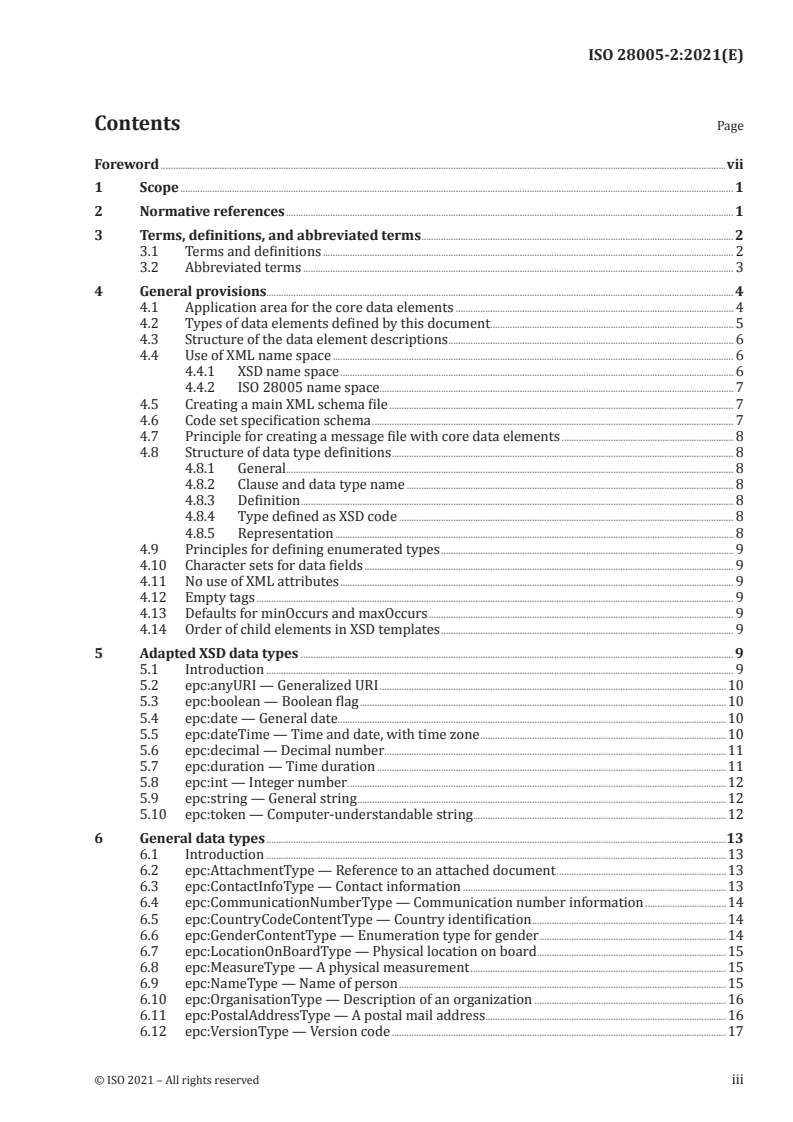
Contents Page
Foreword .vii
1 Scope . 1
2 Normative references . 1
3 Terms, definitions, and abbreviated terms . 2
3.1 Terms and definitions . 2
3.2 Abbreviated terms . 3
4 General provisions. 4
4.1 Application area for the core data elements . 4
4.2 Types of data elements defined by this document. 5
4.3 Structure of the data element descriptions . 6
4.4 Use of XML name space . 6
4.4.1 XSD name space . 6
4.4.2 ISO 28005 name space. 7
4.5 Creating a main XML schema file . 7
4.6 Code set specification schema . 7
4.7 Principle for creating a message file with core data elements . 8
4.8 Structure of data type definitions . 8
4.8.1 General. 8
4.8.2 Clause and data type name . 8
4.8.3 Definition . 8
4.8.4 Type defined as XSD code . 8
4.8.5 Representation . 8
4.9 Principles for defining enumerated types . 9
4.10 Character sets for data fields . 9
4.11 No use of XML attributes . 9
4.12 Empty tags . 9
4.13 Defaults for minOccurs and maxOccurs . 9
4.14 Order of child elements in XSD templates . 9
5 Adapted XSD data types . 9
5.1 Introduction . 9
5.2 epc: anyURI — Generalized URI .10
5.3 epc: boolean — Boolean flag .10
5.4 epc: date — General date.10
5.5 epc: dateTime — Time and date, with time zone .10
5.6 epc: decimal — Decimal number .11
5.7 epc: duration — Time duration .11
5.8 epc: int — Integer number .12
5.9 epc: string — General string .12
5.10 epc: token — Computer-understandable string.12
6 General data types .13
6.1 Introduction .13
6.2 epc: AttachmentType — Reference to an attached document .13
6.3 epc: ContactInfoType — Contact information .13
6.4 epc: Communication NumberT ype — Communication number information .14
6.5 epc: CountryCodeC ont entType — Country identification .14
6.6 epc: GenderContentType — Enumeration type for gender .14
6.7 epc: LocationOnBoardType — Physical location on board .15
6.8 epc: MeasureType — A physical measurement .15
6.9 epc: NameType — Name of person .15
6.10 epc: OrganisationType — Description of an organization .16
6.11 epc: PostalAddressType — A postal mail address.16
6.12 epc: VersionType — Version code .17
6.13 epc: DateTimeType — DateTime with type .17
6.14 epc: CrewDutyType — Duty onboard or on shore .18
7 Core data types .18
7.1 Introduction .18
7.2 Ship identity and contacts data types .19
7.2.1 Class diagram .19
7.2.2 epc: AgentType — The ship's agent .19
7.2.3 epc: CompanyType — The ship's operating Company .19
7.2.4 epc: In marsatCall NumberType — Inmarsat call number to ship .20
7.2.5 epc: MasterType — Data for the Ship Master (Deprecated) .20
7.2.6 epc: ShipIDType — Ship identity .20
7.2.7 epc: AuthenticatorType — The authenticator of the Information .21
7.2.8 epc: CompanySecurityOfficerType — The ship's company security officer.21
7.3 Cargo data types .22
7.3.1 Class diagram .22
7.3.2 Non-core data types .22
7.3.3 epc: CargoDataType — Detailed description of cargo .23
7.3.4 epc: CargoOverviewType — Brief description of onboard cargo .30
7.3.5 epc: Dut iableCrewE ffectsType — List of crew effects that may be dutiable .30
7.3.6 epc: GeneralDescrip tionOfDG Type — General description of dangerous cargo .31
7.3.7 epc: ShipStoreType — Description of ship's dutiable stores .32
7.3.8 epc: DangerousGoodsCargoIndicatorType .32
7.4 Crew and passenger data .33
7.4.1 Class diagram .33
7.4.2 Non-core data types .33
7.4.3 epc: CrewListType — Information about all crew onboard .36
7.4.4 epc: PassengerListType — Information about passengers .36
7.4.5 epc: OtherPersonListType — Information about other persons on board .37
7.4.6 epc: PersonsOnboar dNumberT ype — Number of persons onboard .37
7.5 Class and ship certificates .38
7.5.1 Class diagram .38
7.5.2 epc: CertificateType — Certificate description .38
7.5.3 epc: ISSC ertificate StatusType — Security certificate information .40
7.5.4 epc: CertificateListType — List of certificates .40
7.5.5 epc: ShipClassType — Class Notation for Ship.41
7.5.6 epc: INFClassContentType — Irradiated nuclear fuel class .41
7.6 Security data types .42
7.6.1 Class diagram .42
7.6.2 epc: CurrentP ortSecurit yLevelType — Current security level on ship .42
7.6.3 epc: CurrentS hipSecurit yLevelType — Current security level in port .42
7.6.4 epc: PortCallListsType — Last ten port calls .43
7.6.5 epc: ShipToShipA ctivityListT ype — Ship-to-ship activities .44
7.6.6 epc: HasSecurityPlanType — Approved security plan .44
7.6.7 epc: Secu rityLevelCont entType — ISPS security level .45
7.6.8 epc: SecurityOtherMattersToReportType — Other Security Matters to
Report at a Port Call .45
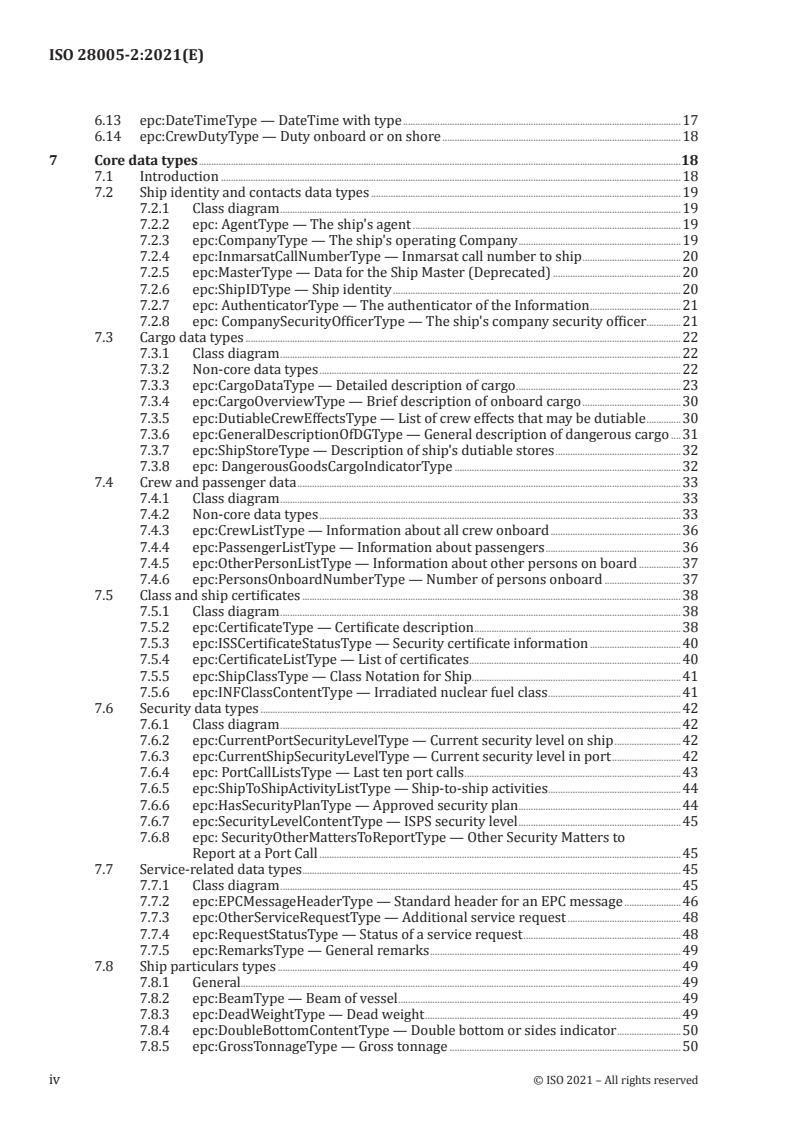
7.7 Service-related data types .45
7.7.1 Class diagram .45
7.7.2 epc: EPCMessageHeaderType — Standard header for an EPC message .46
7.7.3 epc: Oth erServiceR equestType — Additional service request .48
7.7.4 epc: RequestStatusType — Status of a service request .48
7.7.5 epc: RemarksType — General remarks .49
7.8 Ship particulars types .49
7.8.1 General.49
7.8.2 epc: BeamType — Beam of vessel .49
7.8.3 epc: DeadWeightType — Dead weight .49
7.8.4 epc: Dou bleBottomC ontentType — Double bottom or sides indicator .50
7.8.5 epc: GrossTonnageType — Gross tonnage .50
iv © ISO 2021 – All rights reserved
7.8.6 epc: IceClassType — Ship ice class .50
7.8.7 epc: LengthOverallType — Length overall .51
7.8.8 epc: NetTonnageType — Net tonnage .51
7.8.9 epc: SummerDraughtType — Summer draught .52
7.8.10 epc: ShipTypeContentType — Ship type code .52
7.9 Vessel operation data types .52
7.9.1 General.52
7.9.2 epc: AirDraughtType — Air draught .52
7.9.3 epc: ArrivalDraughtType — Arrival draught .52
7.9.4 epc: ArrivalDepartureType — Arrival or departure flag .53
7.9.5 epc: ATAType — Actual time of arrival (Deprecated) .53
7.9.6 epc: ATDType — Actual time of departure (Deprecated) .53
7.9.7 epc: ATPType — Actual time of passage .53
7.9.8 epc: Bu lkLoadUnlo adDataType — Data required for safe loading and unloading 54
7.9.9 epc: CallPurposeType — Purpose of call.56
7.9.10 epc: DepartureDraughtType — Departure draught .56
7.9.11 epc: ETAType — Estimated time of arrival (Deprecated) .56
7.9.12 epc: ETDType — Estimated time of departure (Deprecated) .57
7.9.13 epc: ETPType — Estimated time of passage .57
7.9.14 epc: NavigationalSta tusCont entType — Navigational status .57
7.9.15 epc: NextReportTimeType — Time of next report .57
7.9.16 epc: O BOLoadUnlo adDataType — Data required for safe loading and
unloading of OBO . .58
7.9.17 epc: PeriodOfStayType — Period of stay .58
7.9.18 epc: RadioCommun icationsT ype — Radiocommunication active .59
7.9.19 epc: ROBBunkersType — Bunkers remaining onboard .59
7.9.20 epc: ShipDefectsType — Any defects of important ship equipment .60
7.9.21 epc: ShipStatusType — Ship status information .60
7.9.22 epc: VoyageNumberType — Voyage identification code .61
7.9.23 epc: VoyageDescriptionType — Brief description of voyage .61
7.9.24 epc: We atherInformationT ype — Weather information as observed .62
7.10 Location types.62
7.10.1 Class diagram .62
7.10.2 Non-core data types .63
7.10.3 epc: WaypointListType — Waypoint and Waypoint list .66
7.10.4 epc: VoyageEventListType — Time and position for voyage events .66
7.10.5 epc: PortOfArrivalType — Arrival port.67
7.10.6 epc: PortOfDepartureType — Departure port .67
7.10.7 epc: NextPortOfCallType — Next port of call .68
7.10.8 epc: LastPortOfCallType — Last port of call .68
7.10.9 epc: BerthArrivalType — Identification of a berth and an arrival time .69
7.10.10 epc: BerthDepartureType — Identification of a berth and a departure time .69
7.10.11 epc: Bert hPositionA rrivalType — Position inside a berth and the arrival time.69
7.10.12 epc: BerthP ositionDep artureType — Position inside a berth and the
departure time .70
7.10.13 epc: AnchorageArrivalType — Anchorage area and arrival time .70
7.10.14 epc: An chorageDep artureType — Anchorage area and departure time .70
7.10.15 epc: TerminalArrivalType — Terminal area and arrival time .70
7.10.16 epc: T erminalDep artureType — Terminal area and departure time .71
7.10.17 epc: FacilityArrivalType — Facility area and arrival time .71
7.10.18 epc: F acilityDep artureType — Facility area and departure time.71
7.11 Waste and environmental data types .72
7.11.1 General.72
7.11.2 epc: BallastStatusType — Status of ship's ballast water when in port .72
7.11.3 epc: WasteDisposalR equir ementsType — Ship's requirements for waste
disposal .72
7.11.4 epc: WasteInformationType — Waste information .73
7.12 Health data types .74
7.12.1 Class diagram .74
7.12.2 epc: HealthDataType — Health information for the ship .75
7.12.3 epc: PersonHealthParticularsType — Health information for a person on
board .77
Annex A (normative) EPC Request Body .80
Annex B (normative) IMO FAL mapping .83
Annex C (informative) Example of IMO-ISO Mapping.95
Annex D (normative) Certificate codes .96
Annex E (normative) Classification society codes .98
Annex F (normative) Onboard and shore duty codes .100
Annex G (normative) Waste type codes .103
Annex H (normative) Message type codes .104
Annex I (normative) Service type codes .106
Annex J (informative) Examples of cargo and package codes .107
Annex K (informative) Common unit codes .108
Annex L (informative) UN hazard classes .109
Annex M (informative) Ship type codes .112
Annex N (informative) UNECE purpose of call codes .115
Annex O (normative) Crew and ship dutiable item code values .116
Annex P (informative) Dangerous goods marine pollutant type .117
Annex Q (normative) Code list for "Reason why ship has no valid ISSC or interim ISSC
certificate" .118
Annex R (normative) Ship security measures and ship additional security measures .119
Annex S (informative) Short overview of XSD coding .120
Bibliography .122
vi © ISO 2021 – All rights reserved
Foreword
ISO (the International Organization for Standardization) is a worldwide federation of national standards
bodies (ISO member bodies). The work of preparing International Standards is normally carried out
through ISO technical committees. Each member body interested in a subject for which a technical
committee has been established has the right to be represented on that committee. International
organizations, governmental and non-governmental, in liaison with ISO, also take part in the work.
ISO collaborates closely with the International Electrotechnical Commission (IEC) on all matters of
electrotechnical standardization.
The procedures used to develop this document and those intended for its further maintenance are
described in the ISO/IEC Directives, Part 1. In particular, the different approval criteria needed for the
different types of ISO documents should be noted. This document was drafted in accordance with the
editorial rules of the ISO/IEC Directives, Part 2 (see www .iso .org/ directives).
Attention is drawn to the possibility that some of the elements of this document may be the subject of
patent rights. ISO shall not be held responsible for identifying any or all such patent rights. Details of
any patent rights identified during the development of the document will be in the Introduction and/or
on the ISO list of patent declarations received (see www .iso .org/ patents).
Any trade name used in this document is information given for the convenience of users and does not
constitute an endorsement.
For an explanation of the voluntary nature of standards, the meaning of ISO specific terms and
expressions related to conformity assessment, as well as information about ISO's adherence to the
World Trade Organization (WTO) principles in the Technical Barriers to Trade (TBT), see www .iso .org/
iso/ foreword .html.
This document was prepared by Technical Committee ISO/TC 8, Ships and marine technology,
Subcommittee 11, Intermodal and Short Sea Shipping.
This second edition cancels and replaces the first edition (ISO 28005-2:2011) which has been technically
revised.
The main changes compared to the previous edition are as follows:
— new data elements have been added to cover requirements from maritime declaration of health,
advance electronic cargo information for customs risk assessment purposes, advanced notification
form for waste delivery to port reception facilities, mandatory ship reporting system (MRS) and
ETA reporting to pilot station;
— some previously defined data elements have been modified to reflect updated definitions in the IMO
Reference Data Model; this applies also to some code lists;
— some data elements have been redefined and the old definitions are marked as deprecated in the
respective clause titles.
A list of all parts in the ISO 28005 series can be found on the ISO website.
Any feedback or questions on this document should be directed to the user’s national standards body. A
complete listing of these bodies can be found at www .iso .org/ members .html.
INTERNATIONAL STANDARD ISO 28005-2:2021(E)
Ships and marine technology — Electronic port clearance
(EPC) —
Part 2:
Core data elements
1 Scope
This document provides technical specifications to facilitate an efficient exchange of electronic
information between ships and shore, for coastal transit or port calls. It specifies requirements for the
safety, security and efficiency enhancement of information, related mainly to the relationships between
the ship and the port and coastal state authorities.
This document provides the definition of core data elements for use in electronic port clearance
(EPC) messages. It does not define any structuring of messages nor provides any guidance on what
information is required for a particular purpose; it is a general data dictionary for safety, security or
operation-related maritime information. Details about message formats and applications are defined in
ISO 28005-1.
The data elements in this document is a superset of the data elements and the data model defined in the
IMO Reference Data Model as specified in the IMO Compendium on Facilitation and Electronic Business.
It also contains data elements from other IMO instruments as described in 4.1. The specifications in
this document is compatible with the definitions in the IMO Reference Data Model and the mapping
between ISO 28005 and the data element list in the IMO Reference Data Model is defined in Annex B.
2 Normative references
The following documents are referred to in the text in such a way that some or all of their content
constitutes requirements of this document. For dated references, only the edition cited applies. For
undated references, the latest edition of the referenced document (including any amendments) applies.
ISO 3166-1, Codes for the representation of names of countries and their subdivisions — Part 1: Country
code
ISO 3166-2, Codes for the representation of names of countries and their subdivisions — Part 2: Country
subdivision code
ISO 6346, Freight containers — Coding, identification and marking
ISO 6709, Standard representation of geographic point location by coordinates
ISO 7372, Trade data interchange — Trade data elements directory
ISO 9711-1, Freight containers — Information related to containers on board vessels — Part 1: Bay plan
system
UNECE R16, (UNECE Recommendation No. 16), Codes for Trade and Transport Locations
UNECE R20, (UNECE Recommendation No. 20), Codes for Units of Measure Used in International Trade
UNECE R21, (UNECE Recommendation No. 21), Codes for Passengers, Types of Cargo, Packages and
Packaging Materials (with Complementary Codes for Package Names)
UNECE R28, (UNECE Recommendation No. 28), Codes for Types of Means of Transport
UNTDD, United Nations Directories for Electronic Data Interchange for Administration, Commerce and
Transport. This is available as Part 5 on https:// www .unece .org/ cefact/ edifact/ welcome .html
World Customs Organization (WCO), Harmonized Commodity Description and Coding System (HS)
International Maritime Organiztoin (IMO), International Convention for the Prevention of Pollution from
Ships (MARPOL), 1973, as modified by the Protocol of 1978 relating thereto
International Maritime Organiztoin (IMO), Assembly Resolution A.852(20), Guidelines for a structure of
an integrated system of contingency planning for shipboard emergencies. Adopted November 1997
International Maritime Organiztoin (IMO), MSC/Circ.1056, MEPC/Circ.399, Guidelines for Ships
Operating in Arctic Ice-Covered Waters
3 Terms, definitions, and abbreviated terms
3.1 Terms and definitions
For the purposes of this document, the following terms and definitions apply.
ISO and IEC maintain terminological databases for use in standardization at the following addresses:
— ISO Online browsing platform: available at https:// www .iso .org/ obp
— IEC Electropedia: available at http:// www .electropedia .org/
3.1.1
core data element
data element corresponding to a specific real-world object
Note 1 to entry: The core data elements are instantiated from data types defined in Clause 7 and are listed in
Annex A.
3.1.2
data type
definition of the structure of a data element
Note 1 to entry: All data types have a name ending with “Type”.
3.1.3
electronic port clearance
EPC
process of exchanging information between the ship and its agent and various parties on shore to allow
the ship clearance to enter port and berth
Note 1 to entry: EPC does not necessarily include customs clearance of goods that are imported or exported.
3.1.4
facility
port or a part of a port that is individually secured according to the ISPS code
Note 1 to entry: This is the meaning implied in the ISPS code.
3.1.5
leg
part of a voyage (3.1.7) between a departure port and an arrival port without any intervening port calls
2 © ISO 2021 – All rights reserved
3.1.6
oil-bulk-ore carrier
OBO
ship whose design is similar to a conventional bulk carrier but that is equipped with pipelines, pumps
and an inert gas plant so as to enable the carriage of oil cargoes in designated spaces
3.1.7
voyage
sailing of the ship from an initial departure port to a final arrival port with or without a number of
intervening port calls
Note 1 to entry: What constitutes a voyage is defined by the ship's operator or its owner.
Note 2 to entry: A voyage consists of one or more legs (3.1.5).
3.1.8
XML schema
definition of the structure of an XML document, written in the XML schema language (XSD)
Note 1 to entry: The XML schema language is in itself a valid XML structure, see References [5] and [6].
3.2 Abbreviated terms
BLU Bulk loading and unloading code (BLU Code).
DG Dangerous goods. The term "harmful and noxious substances" is also sometimes used instead
of "dangerous goods."
FAL IMO's Facilitation Committee and standard forms defined in the FAL Convention.
HS World Customs Organization's Harmonized System (WCO Harmonized System).
HME Harmful to the Marine Environment (MARPOL, Annex V).
IBC International Code for the Construction and Equipment of Ships carrying Dangerous Chem-
icals in Bulk.
IMDG International Maritime Dangerous Goods Code.
IMSBC International Maritime Solid Bulk Cargoes Code.
INF Irradiated Nuclear Fuel, see INF Code.
IRI Internationalized Resource Identifier, see Reference [7].
IRN IMO Reference Data Model Number, e.g. IMO0111. This is the data number assigned to each
data element in the reference model in the FAL Compendium. It is a four-digit number prefixed
with IMO. It is zero-padded up to four digits.
ISM International safety management, as defined in the ISM Code.
ISPS International ship and port facility security, as defined in the ISPS Code.
MRS Mandatory ship Reporting System (see IMO Assembly resolution A.851).
NLS Noxious Liquid Substances (MARPOL, Annex II). See Annex G.
RO Recognized Organization (delegated certification authority by flag state)
RORO Roll-on/Roll-off (ship)
RSO Recognized Security Organization. Similar to RO, but for security related certificates.
TDED Trade Data Elements Dictionary (ISO 7372).
URI Uniform Resource Identifier, see Reference [7]. In this document, this is normally in the form
of Uniform Resource Locator, that refers to the subset of URIs that, in addition to identifying
a resource, provide a means of locating the resource by describing its primary access mech-
anism (e.g. its network "location").
WCO World Customs Organization
XML Extensible Markup Language, see Reference [4].
XSD XML Schema Definition Language, see References [5], [6].
4 General provisions
4.1 Application area for the core data elements
This document provides definitions of core data elements for electronic port clearance (EPC). These
elements are based on requirements for ship-to-shore and shore-to-ship reporting as defined in the
following.
a) Most required information sets as defined in the FAL Convention, section 2.1. All these data sets can
be sent on arrival or departure, determined by a flag in the massage header (MessageHeaderType):
― General Declaration (FAL Form 1);
― Cargo Declaration (FAL Form 2);
― Ship’s Stores Declaration (FAL Form 3);
― Crew’s Effects Declaration (FAL Form 4);
― Crew List (FAL Form 5);
― Passenger List (FAL Form 6);
― Dangerous Goods Manifest (FAL Form 7);
― the document required under the Universal Postal Convention for mail;
NOTE Only as a reference to the physical or electronic document in the ListOfCertificatesType data
structure.
― Maritime Declaration of Health;
NOTE This document defines an electronic format for the required information based on the
Maritime Declaration of Health (MDH) from WHO, 58th World Health Assembly, WHA58.3.
― security-related information as required under SOLAS regulation XI-2/9.2.2 (ISPS code);
― advance electronic cargo information for customs risk assessment purposes;
NOTE This is covered as far as the cargo information data structures defined in 7.3 satisfy the
relevant WCO or national customs authority requirements.
― Advanced Notification Form for Waste Delivery to Port Reception Facilities, when communicated
to the Organization.
NOTE This is based on the recommended reporting on ship-generated waste as defined in
MEPC 644, which is mandatory within the European Union, as described in EU/2000/59.
4 © ISO 2021 – All rights reserved
b) Required reporting as defined in the bulk loading and unloading code IMO Resolution A.862.
c) Mandatory ship reporting system (MRS) requirements as defined in IMO Resolution A.851.
d) ETA reporting to pilot station as defined in IMO Resolution A.960.
Annex B defines the cross-reference between elements in this document and the data elements in the
IMO Reference Data Model as defined in the FAL Compendium. This mapping is also found at the IMO
1)
site .
The core data elements in many cases contain more information than what is required by the documents
referenced above. The actual minimum reporting requirements are defined by the relevant national or
international authorities.
4.2 Types of data elements defined by this document
Figure 1 shows the main types of elements that are defined and used in this document. The grey boxes
represent objects t
...
INTERNATIONAL ISO
STANDARD 28005-2
Second edition
2021-05
Ships and marine technology —
Electronic port clearance (EPC) —
Part 2:
Core data elements
Navires et technologie maritime — Opérations portuaires assistées
par systèmes électroniques —
Partie 2: Éléments de données principaux
Reference number
©
ISO 2021
© ISO 2021
All rights reserved. Unless otherwise specified, or required in the context of its implementation, no part of this publication may
be reproduced or utilized otherwise in any form or by any means, electronic or mechanical, including photocopying, or posting
on the internet or an intranet, without prior written permission. Permission can be requested from either ISO at the address
below or ISO’s member body in the country of the requester.
ISO copyright office
CP 401 • Ch. de Blandonnet 8
CH-1214 Vernier, Geneva
Phone: +41 22 749 01 11
Email: copyright@iso.org
Website: www.iso.org
Published in Switzerland
ii © ISO 2021 – All rights reserved
Contents Page
Foreword .vii
1 Scope . 1
2 Normative references . 1
3 Terms, definitions, and abbreviated terms . 2
3.1 Terms and definitions . 2
3.2 Abbreviated terms . 3
4 General provisions. 4
4.1 Application area for the core data elements . 4
4.2 Types of data elements defined by this document. 5
4.3 Structure of the data element descriptions . 6
4.4 Use of XML name space . 6
4.4.1 XSD name space . 6
4.4.2 ISO 28005 name space. 7
4.5 Creating a main XML schema file . 7
4.6 Code set specification schema . 7
4.7 Principle for creating a message file with core data elements . 8
4.8 Structure of data type definitions . 8
4.8.1 General. 8
4.8.2 Clause and data type name . 8
4.8.3 Definition . 8
4.8.4 Type defined as XSD code . 8
4.8.5 Representation . 8
4.9 Principles for defining enumerated types . 9
4.10 Character sets for data fields . 9
4.11 No use of XML attributes . 9
4.12 Empty tags . 9
4.13 Defaults for minOccurs and maxOccurs . 9
4.14 Order of child elements in XSD templates . 9
5 Adapted XSD data types . 9
5.1 Introduction . 9
5.2 epc: anyURI — Generalized URI .10
5.3 epc: boolean — Boolean flag .10
5.4 epc: date — General date.10
5.5 epc: dateTime — Time and date, with time zone .10
5.6 epc: decimal — Decimal number .11
5.7 epc: duration — Time duration .11
5.8 epc: int — Integer number .12
5.9 epc: string — General string .12
5.10 epc: token — Computer-understandable string.12
6 General data types .13
6.1 Introduction .13
6.2 epc: AttachmentType — Reference to an attached document .13
6.3 epc: ContactInfoType — Contact information .13
6.4 epc: Communication NumberT ype — Communication number information .14
6.5 epc: CountryCodeC ont entType — Country identification .14
6.6 epc: GenderContentType — Enumeration type for gender .14
6.7 epc: LocationOnBoardType — Physical location on board .15
6.8 epc: MeasureType — A physical measurement .15
6.9 epc: NameType — Name of person .15
6.10 epc: OrganisationType — Description of an organization .16
6.11 epc: PostalAddressType — A postal mail address.16
6.12 epc: VersionType — Version code .17
6.13 epc: DateTimeType — DateTime with type .17
6.14 epc: CrewDutyType — Duty onboard or on shore .18
7 Core data types .18
7.1 Introduction .18
7.2 Ship identity and contacts data types .19
7.2.1 Class diagram .19
7.2.2 epc: AgentType — The ship's agent .19
7.2.3 epc: CompanyType — The ship's operating Company .19
7.2.4 epc: In marsatCall NumberType — Inmarsat call number to ship .20
7.2.5 epc: MasterType — Data for the Ship Master (Deprecated) .20
7.2.6 epc: ShipIDType — Ship identity .20
7.2.7 epc: AuthenticatorType — The authenticator of the Information .21
7.2.8 epc: CompanySecurityOfficerType — The ship's company security officer.21
7.3 Cargo data types .22
7.3.1 Class diagram .22
7.3.2 Non-core data types .22
7.3.3 epc: CargoDataType — Detailed description of cargo .23
7.3.4 epc: CargoOverviewType — Brief description of onboard cargo .30
7.3.5 epc: Dut iableCrewE ffectsType — List of crew effects that may be dutiable .30
7.3.6 epc: GeneralDescrip tionOfDG Type — General description of dangerous cargo .31
7.3.7 epc: ShipStoreType — Description of ship's dutiable stores .32
7.3.8 epc: DangerousGoodsCargoIndicatorType .32
7.4 Crew and passenger data .33
7.4.1 Class diagram .33
7.4.2 Non-core data types .33
7.4.3 epc: CrewListType — Information about all crew onboard .36
7.4.4 epc: PassengerListType — Information about passengers .36
7.4.5 epc: OtherPersonListType — Information about other persons on board .37
7.4.6 epc: PersonsOnboar dNumberT ype — Number of persons onboard .37
7.5 Class and ship certificates .38
7.5.1 Class diagram .38
7.5.2 epc: CertificateType — Certificate description .38
7.5.3 epc: ISSC ertificate StatusType — Security certificate information .40
7.5.4 epc: CertificateListType — List of certificates .40
7.5.5 epc: ShipClassType — Class Notation for Ship.41
7.5.6 epc: INFClassContentType — Irradiated nuclear fuel class .41
7.6 Security data types .42
7.6.1 Class diagram .42
7.6.2 epc: CurrentP ortSecurit yLevelType — Current security level on ship .42
7.6.3 epc: CurrentS hipSecurit yLevelType — Current security level in port .42
7.6.4 epc: PortCallListsType — Last ten port calls .43
7.6.5 epc: ShipToShipA ctivityListT ype — Ship-to-ship activities .44
7.6.6 epc: HasSecurityPlanType — Approved security plan .44
7.6.7 epc: Secu rityLevelCont entType — ISPS security level .45
7.6.8 epc: SecurityOtherMattersToReportType — Other Security Matters to
Report at a Port Call .45
7.7 Service-related data types .45
7.7.1 Class diagram .45
7.7.2 epc: EPCMessageHeaderType — Standard header for an EPC message .46
7.7.3 epc: Oth erServiceR equestType — Additional service request .48
7.7.4 epc: RequestStatusType — Status of a service request .48
7.7.5 epc: RemarksType — General remarks .49
7.8 Ship particulars types .49
7.8.1 General.49
7.8.2 epc: BeamType — Beam of vessel .49
7.8.3 epc: DeadWeightType — Dead weight .49
7.8.4 epc: Dou bleBottomC ontentType — Double bottom or sides indicator .50
7.8.5 epc: GrossTonnageType — Gross tonnage .50
iv © ISO 2021 – All rights reserved
7.8.6 epc: IceClassType — Ship ice class .50
7.8.7 epc: LengthOverallType — Length overall .51
7.8.8 epc: NetTonnageType — Net tonnage .51
7.8.9 epc: SummerDraughtType — Summer draught .52
7.8.10 epc: ShipTypeContentType — Ship type code .52
7.9 Vessel operation data types .52
7.9.1 General.52
7.9.2 epc: AirDraughtType — Air draught .52
7.9.3 epc: ArrivalDraughtType — Arrival draught .52
7.9.4 epc: ArrivalDepartureType — Arrival or departure flag .53
7.9.5 epc: ATAType — Actual time of arrival (Deprecated) .53
7.9.6 epc: ATDType — Actual time of departure (Deprecated) .53
7.9.7 epc: ATPType — Actual time of passage .53
7.9.8 epc: Bu lkLoadUnlo adDataType — Data required for safe loading and unloading 54
7.9.9 epc: CallPurposeType — Purpose of call.56
7.9.10 epc: DepartureDraughtType — Departure draught .56
7.9.11 epc: ETAType — Estimated time of arrival (Deprecated) .56
7.9.12 epc: ETDType — Estimated time of departure (Deprecated) .57
7.9.13 epc: ETPType — Estimated time of passage .57
7.9.14 epc: NavigationalSta tusCont entType — Navigational status .57
7.9.15 epc: NextReportTimeType — Time of next report .57
7.9.16 epc: O BOLoadUnlo adDataType — Data required for safe loading and
unloading of OBO . .58
7.9.17 epc: PeriodOfStayType — Period of stay .58
7.9.18 epc: RadioCommun icationsT ype — Radiocommunication active .59
7.9.19 epc: ROBBunkersType — Bunkers remaining onboard .59
7.9.20 epc: ShipDefectsType — Any defects of important ship equipment .60
7.9.21 epc: ShipStatusType — Ship status information .60
7.9.22 epc: VoyageNumberType — Voyage identification code .61
7.9.23 epc: VoyageDescriptionType — Brief description of voyage .61
7.9.24 epc: We atherInformationT ype — Weather information as observed .62
7.10 Location types.62
7.10.1 Class diagram .62
7.10.2 Non-core data types .63
7.10.3 epc: WaypointListType — Waypoint and Waypoint list .66
7.10.4 epc: VoyageEventListType — Time and position for voyage events .66
7.10.5 epc: PortOfArrivalType — Arrival port.67
7.10.6 epc: PortOfDepartureType — Departure port .67
7.10.7 epc: NextPortOfCallType — Next port of call .68
7.10.8 epc: LastPortOfCallType — Last port of call .68
7.10.9 epc: BerthArrivalType — Identification of a berth and an arrival time .69
7.10.10 epc: BerthDepartureType — Identification of a berth and a departure time .69
7.10.11 epc: Bert hPositionA rrivalType — Position inside a berth and the arrival time.69
7.10.12 epc: BerthP ositionDep artureType — Position inside a berth and the
departure time .70
7.10.13 epc: AnchorageArrivalType — Anchorage area and arrival time .70
7.10.14 epc: An chorageDep artureType — Anchorage area and departure time .70
7.10.15 epc: TerminalArrivalType — Terminal area and arrival time .70
7.10.16 epc: T erminalDep artureType — Terminal area and departure time .71
7.10.17 epc: FacilityArrivalType — Facility area and arrival time .71
7.10.18 epc: F acilityDep artureType — Facility area and departure time.71
7.11 Waste and environmental data types .72
7.11.1 General.72
7.11.2 epc: BallastStatusType — Status of ship's ballast water when in port .72
7.11.3 epc: WasteDisposalR equir ementsType — Ship's requirements for waste
disposal .72
7.11.4 epc: WasteInformationType — Waste information .73
7.12 Health data types .74
7.12.1 Class diagram .74
7.12.2 epc: HealthDataType — Health information for the ship .75
7.12.3 epc: PersonHealthParticularsType — Health information for a person on
board .77
Annex A (normative) EPC Request Body .80
Annex B (normative) IMO FAL mapping .83
Annex C (informative) Example of IMO-ISO Mapping.95
Annex D (normative) Certificate codes .96
Annex E (normative) Classification society codes .98
Annex F (normative) Onboard and shore duty codes .100
Annex G (normative) Waste type codes .103
Annex H (normative) Message type codes .104
Annex I (normative) Service type codes .106
Annex J (informative) Examples of cargo and package codes .107
Annex K (informative) Common unit codes .108
Annex L (informative) UN hazard classes .109
Annex M (informative) Ship type codes .112
Annex N (informative) UNECE purpose of call codes .115
Annex O (normative) Crew and ship dutiable item code values .116
Annex P (informative) Dangerous goods marine pollutant type .117
Annex Q (normative) Code list for "Reason why ship has no valid ISSC or interim ISSC
certificate" .118
Annex R (normative) Ship security measures and ship additional security measures .119
Annex S (informative) Short overview of XSD coding .120
Bibliography .122
vi © ISO 2021 – All rights reserved
Foreword
ISO (the International Organization for Standardization) is a worldwide federation of national standards
bodies (ISO member bodies). The work of preparing International Standards is normally carried out
through ISO technical committees. Each member body interested in a subject for which a technical
committee has been established has the right to be represented on that committee. International
organizations, governmental and non-governmental, in liaison with ISO, also take part in the work.
ISO collaborates closely with the International Electrotechnical Commission (IEC) on all matters of
electrotechnical standardization.
The procedures used to develop this document and those intended for its further maintenance are
described in the ISO/IEC Directives, Part 1. In particular, the different approval criteria needed for the
different types of ISO documents should be noted. This document was drafted in accordance with the
editorial rules of the ISO/IEC Directives, Part 2 (see www .iso .org/ directives).
Attention is drawn to the possibility that some of the elements of this document may be the subject of
patent rights. ISO shall not be held responsible for identifying any or all such patent rights. Details of
any patent rights identified during the development of the document will be in the Introduction and/or
on the ISO list of patent declarations received (see www .iso .org/ patents).
Any trade name used in this document is information given for the convenience of users and does not
constitute an endorsement.
For an explanation of the voluntary nature of standards, the meaning of ISO specific terms and
expressions related to conformity assessment, as well as information about ISO's adherence to the
World Trade Organization (WTO) principles in the Technical Barriers to Trade (TBT), see www .iso .org/
iso/ foreword .html.
This document was prepared by Technical Committee ISO/TC 8, Ships and marine technology,
Subcommittee 11, Intermodal and Short Sea Shipping.
This second edition cancels and replaces the first edition (ISO 28005-2:2011) which has been technically
revised.
The main changes compared to the previous edition are as follows:
— new data elements have been added to cover requirements from maritime declaration of health,
advance electronic cargo information for customs risk assessment purposes, advanced notification
form for waste delivery to port reception facilities, mandatory ship reporting system (MRS) and
ETA reporting to pilot station;
— some previously defined data elements have been modified to reflect updated definitions in the IMO
Reference Data Model; this applies also to some code lists;
— some data elements have been redefined and the old definitions are marked as deprecated in the
respective clause titles.
A list of all parts in the ISO 28005 series can be found on the ISO website.
Any feedback or questions on this document should be directed to the user’s national standards body. A
complete listing of these bodies can be found at www .iso .org/ members .html.
INTERNATIONAL STANDARD ISO 28005-2:2021(E)
Ships and marine technology — Electronic port clearance
(EPC) —
Part 2:
Core data elements
1 Scope
This document provides technical specifications to facilitate an efficient exchange of electronic
information between ships and shore, for coastal transit or port calls. It specifies requirements for the
safety, security and efficiency enhancement of information, related mainly to the relationships between
the ship and the port and coastal state authorities.
This document provides the definition of core data elements for use in electronic port clearance
(EPC) messages. It does not define any structuring of messages nor provides any guidance on what
information is required for a particular purpose; it is a general data dictionary for safety, security or
operation-related maritime information. Details about message formats and applications are defined in
ISO 28005-1.
The data elements in this document is a superset of the data elements and the data model defined in the
IMO Reference Data Model as specified in the IMO Compendium on Facilitation and Electronic Business.
It also contains data elements from other IMO instruments as described in 4.1. The specifications in
this document is compatible with the definitions in the IMO Reference Data Model and the mapping
between ISO 28005 and the data element list in the IMO Reference Data Model is defined in Annex B.
2 Normative references
The following documents are referred to in the text in such a way that some or all of their content
constitutes requirements of this document. For dated references, only the edition cited applies. For
undated references, the latest edition of the referenced document (including any amendments) applies.
ISO 3166-1, Codes for the representation of names of countries and their subdivisions — Part 1: Country
code
ISO 3166-2, Codes for the representation of names of countries and their subdivisions — Part 2: Country
subdivision code
ISO 6346, Freight containers — Coding, identification and marking
ISO 6709, Standard representation of geographic point location by coordinates
ISO 7372, Trade data interchange — Trade data elements directory
ISO 9711-1, Freight containers — Information related to containers on board vessels — Part 1: Bay plan
system
UNECE R16, (UNECE Recommendation No. 16), Codes for Trade and Transport Locations
UNECE R20, (UNECE Recommendation No. 20), Codes for Units of Measure Used in International Trade
UNECE R21, (UNECE Recommendation No. 21), Codes for Passengers, Types of Cargo, Packages and
Packaging Materials (with Complementary Codes for Package Names)
UNECE R28, (UNECE Recommendation No. 28), Codes for Types of Means of Transport
UNTDD, United Nations Directories for Electronic Data Interchange for Administration, Commerce and
Transport. This is available as Part 5 on https:// www .unece .org/ cefact/ edifact/ welcome .html
World Customs Organization (WCO), Harmonized Commodity Description and Coding System (HS)
International Maritime Organiztoin (IMO), International Convention for the Prevention of Pollution from
Ships (MARPOL), 1973, as modified by the Protocol of 1978 relating thereto
International Maritime Organiztoin (IMO), Assembly Resolution A.852(20), Guidelines for a structure of
an integrated system of contingency planning for shipboard emergencies. Adopted November 1997
International Maritime Organiztoin (IMO), MSC/Circ.1056, MEPC/Circ.399, Guidelines for Ships
Operating in Arctic Ice-Covered Waters
3 Terms, definitions, and abbreviated terms
3.1 Terms and definitions
For the purposes of this document, the following terms and definitions apply.
ISO and IEC maintain terminological databases for use in standardization at the following addresses:
— ISO Online browsing platform: available at https:// www .iso .org/ obp
— IEC Electropedia: available at http:// www .electropedia .org/
3.1.1
core data element
data element corresponding to a specific real-world object
Note 1 to entry: The core data elements are instantiated from data types defined in Clause 7 and are listed in
Annex A.
3.1.2
data type
definition of the structure of a data element
Note 1 to entry: All data types have a name ending with “Type”.
3.1.3
electronic port clearance
EPC
process of exchanging information between the ship and its agent and various parties on shore to allow
the ship clearance to enter port and berth
Note 1 to entry: EPC does not necessarily include customs clearance of goods that are imported or exported.
3.1.4
facility
port or a part of a port that is individually secured according to the ISPS code
Note 1 to entry: This is the meaning implied in the ISPS code.
3.1.5
leg
part of a voyage (3.1.7) between a departure port and an arrival port without any intervening port calls
2 © ISO 2021 – All rights reserved
3.1.6
oil-bulk-ore carrier
OBO
ship whose design is similar to a conventional bulk carrier but that is equipped with pipelines, pumps
and an inert gas plant so as to enable the carriage of oil cargoes in designated spaces
3.1.7
voyage
sailing of the ship from an initial departure port to a final arrival port with or without a number of
intervening port calls
Note 1 to entry: What constitutes a voyage is defined by the ship's operator or its owner.
Note 2 to entry: A voyage consists of one or more legs (3.1.5).
3.1.8
XML schema
definition of the structure of an XML document, written in the XML schema language (XSD)
Note 1 to entry: The XML schema language is in itself a valid XML structure, see References [5] and [6].
3.2 Abbreviated terms
BLU Bulk loading and unloading code (BLU Code).
DG Dangerous goods. The term "harmful and noxious substances" is also sometimes used instead
of "dangerous goods."
FAL IMO's Facilitation Committee and standard forms defined in the FAL Convention.
HS World Customs Organization's Harmonized System (WCO Harmonized System).
HME Harmful to the Marine Environment (MARPOL, Annex V).
IBC International Code for the Construction and Equipment of Ships carrying Dangerous Chem-
icals in Bulk.
IMDG International Maritime Dangerous Goods Code.
IMSBC International Maritime Solid Bulk Cargoes Code.
INF Irradiated Nuclear Fuel, see INF Code.
IRI Internationalized Resource Identifier, see Reference [7].
IRN IMO Reference Data Model Number, e.g. IMO0111. This is the data number assigned to each
data element in the reference model in the FAL Compendium. It is a four-digit number prefixed
with IMO. It is zero-padded up to four digits.
ISM International safety management, as defined in the ISM Code.
ISPS International ship and port facility security, as defined in the ISPS Code.
MRS Mandatory ship Reporting System (see IMO Assembly resolution A.851).
NLS Noxious Liquid Substances (MARPOL, Annex II). See Annex G.
RO Recognized Organization (delegated certification authority by flag state)
RORO Roll-on/Roll-off (ship)
RSO Recognized Security Organization. Similar to RO, but for security related certificates.
TDED Trade Data Elements Dictionary (ISO 7372).
URI Uniform Resource Identifier, see Reference [7]. In this document, this is normally in the form
of Uniform Resource Locator, that refers to the subset of URIs that, in addition to identifying
a resource, provide a means of locating the resource by describing its primary access mech-
anism (e.g. its network "location").
WCO World Customs Organization
XML Extensible Markup Language, see Reference [4].
XSD XML Schema Definition Language, see References [5], [6].
4 General provisions
4.1 Application area for the core data elements
This document provides definitions of core data elements for electronic port clearance (EPC). These
elements are based on requirements for ship-to-shore and shore-to-ship reporting as defined in the
following.
a) Most required information sets as defined in the FAL Convention, section 2.1. All these data sets can
be sent on arrival or departure, determined by a flag in the massage header (MessageHeaderType):
― General Declaration (FAL Form 1);
― Cargo Declaration (FAL Form 2);
― Ship’s Stores Declaration (FAL Form 3);
― Crew’s Effects Declaration (FAL Form 4);
― Crew List (FAL Form 5);
― Passenger List (FAL Form 6);
― Dangerous Goods Manifest (FAL Form 7);
― the document required under the Universal Postal Convention for mail;
NOTE Only as a reference to the physical or electronic document in the ListOfCertificatesType data
structure.
― Maritime Declaration of Health;
NOTE This document defines an electronic format for the required information based on the
Maritime Declaration of Health (MDH) from WHO, 58th World Health Assembly, WHA58.3.
― security-related information as required under SOLAS regulation XI-2/9.2.2 (ISPS code);
― advance electronic cargo information for customs risk assessment purposes;
NOTE This is covered as far as the cargo information data structures defined in 7.3 satisfy the
relevant WCO or national customs authority requirements.
― Advanced Notification Form for Waste Delivery to Port Reception Facilities, when communicated
to the Organization.
NOTE This is based on the recommended reporting on ship-generated waste as defined in
MEPC 644, which is mandatory within the European Union, as described in EU/2000/59.
4 © ISO 2021 – All rights reserved
b) Required reporting as defined in the bulk loading and unloading code IMO Resolution A.862.
c) Mandatory ship reporting system (MRS) requirements as defined in IMO Resolution A.851.
d) ETA reporting to pilot station as defined in IMO Resolution A.960.
Annex B defines the cross-reference between elements in this document and the data elements in the
IMO Reference Data Model as defined in the FAL Compendium. This mapping is also found at the IMO
1)
site .
The core data elements in many cases contain more information than what is required by the documents
referenced above. The actual minimum reporting requirements are defined by the relevant national or
international authorities.
4.2 Types of data elements defined by this document
Figure 1 shows the main types of elements that are defined and used in this document. The grey boxes
represent objects t
...